INTRODUCTION
Collections of amphipods from Tenerife Harbour in the Canary Islands proved to contain specimens of Medicorophium runcicorne Della Valle, Reference Della Valle1893. This species was previously known only from the Mediterranean and Black Seas. It is also the first record of any member of the genus Medicorophium from outside the Mediterranean and Black Seas. Slight differences were noted between Canary Islands material and specimens from the Mediterranean Sea, but these differences were not considered significant for the erection of a new species.
MATERIALS AND METHODS
Specimens were preserved in 70% ethanol. Dissection was made under a stereomicroscope and parts were mounted on microscope slides in glycerine for drawing with a camera lucida on a Nikon compound microscope.
Material is deposited in the National History Museum, London (NHMUK).
Abbreviations used in figures: A1, antenna 1 peduncle; A2, antenna 2; G1, gnathopod 1; G2, gnathopod 2; U3, uropod 3.
RESULTS
SYSTEMATICS
Medicorophium runcicorne (Della Valle)
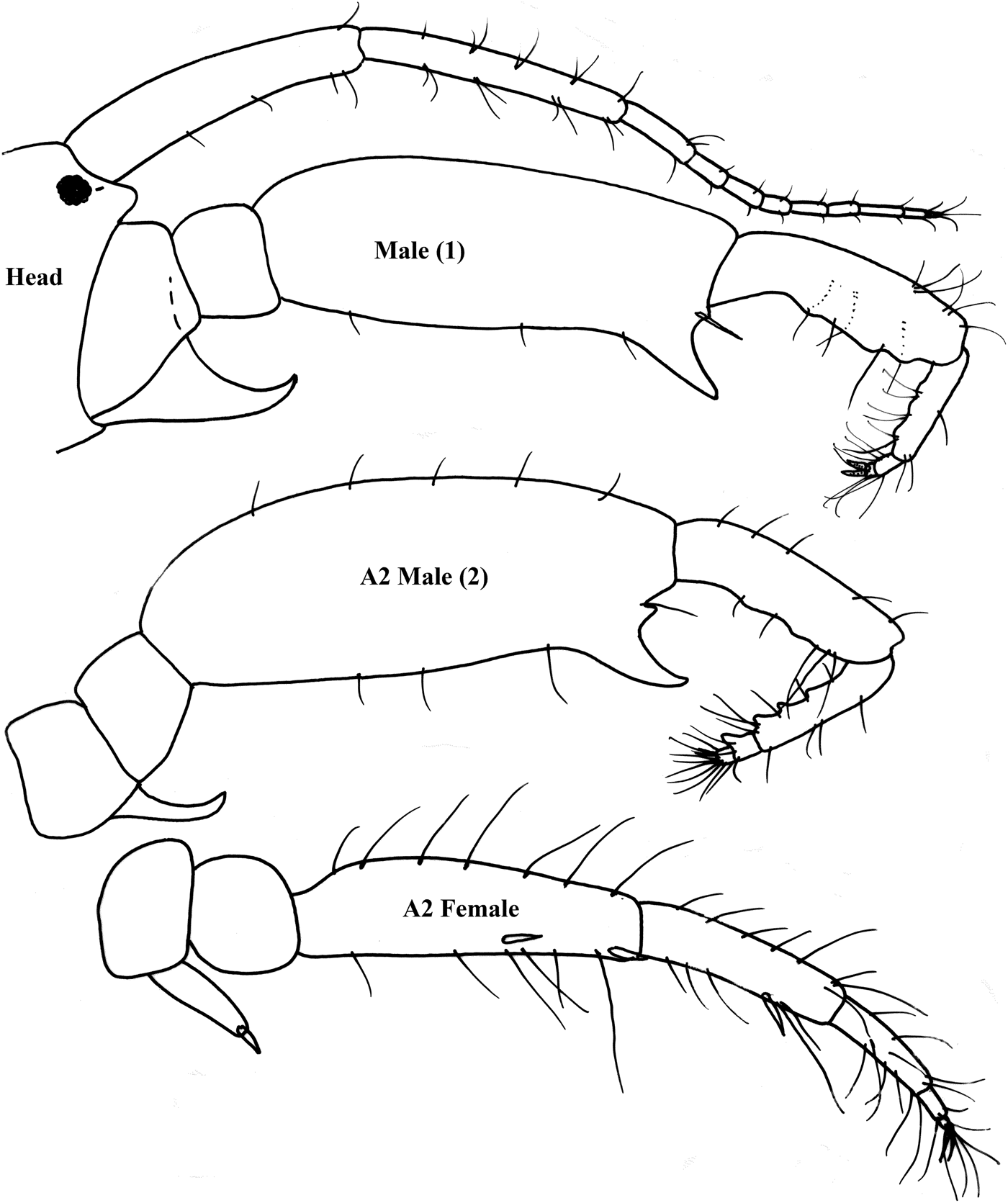
(Figures 1 & 2)
Medicorophium runcicorne Della Valle, male, Santa Cruz de Tenerife Harbour.

Medicorophium runcicorne Della Valle, male and female, Santa Cruz de Tenerife Harbour.

Corophium runcicorne Della Valle, Reference Della Valle1893, p. 13, 369, pl. 4, figure 7; pl 8, figures 1–16—Chevreux & Fage, Reference Chevreux and Fage1925, p. 365, figure 373—Crawford, Reference Crawford1937, p. 605—Gurjanova, Reference Gurjanova1951, p. 983, figure 684—Myers, Reference Myers and Ruffo1982, p. 197, figure 134—Medicorophium runcicorne Bousfield & Hoover, Reference Bousfield and Hoover1997, 82.
MATERIAL EXAMINED
6 males, 10 females, Santa Cruz de Tenerife harbour, UTM 380020x/3151713y, depth: 35 m, seabed (NHMUK 2013. 161–170.): silt/clay; 4 males, 2 females, Santa Cruz de Tenerife harbour, UTM 378005x/3148879y, depth: 16 m, seabed: silt/clay.
REMARKS
Material of Medicorophium runcicorne Della Valle (Reference Della Valle1893) from the Canary Islands differs from Mediterranean material in being smaller (<3 mm as opposed to 4 mm). It is also more slender, the male antenna 2 article 4 being three times as long as broad (2 × as long as broad in Mediterranean material) and article 5 is four times as long as broad (about 2 × as long as broad in Mediterranean material). The spine on the posterodistal margin of the male antenna 2 article 4 is broader based (subtriangular) and more deflected than in Mediterranean material. In the female, antenna 2, article 4 has only two robust setae on the ventral margin, whereas in Mediterranean material there are five.
In addition, the outer ramus of uropod 2 is longer than the inner ramus in Canary Islands material but is subequal with it in Mediterranean material. Despite these differences the Canary Islands material agrees with Mediterranean material of Medicorophium runcicorne too closely to consider it specifically distinct.
HABITAT
Canary Islands material was found on silt/clay seabeds in depths of 16–35 m. It was associated with the mollusc Abra alba, the amphipods Pariambus typicus and Apocorophium acutum, the isopod Anthura gracilis and the polychaete Aponuphis bilineata. In the Canary Islands, corophiini have been commonly recorded in harbours where sediments are dominated by silt and clay (Riera et al., Reference Riera, Monterroso and Nuñez2012).
Mediterranean material was found on mud and mobile substrates and among Peyssonnelia and Caulerpa.
KEY TO THE SPECIES OF MEDICOROPHIUM
-
1. Rostrum well developed, spine-like………M. aculeatum Chevreux, Reference Chevreux1908, male
-
– Rostrum small, triangular………2
-
-
2. Uropod 3 peduncle broader distally………M. rotundirostre Stephensen, Reference Stephensen1915
-
– Uropod 3 peduncle parallel sided………3
-
-
3. Antenna 2 article 4 lacking spines or robust setae………M. minimum Schiecke, Reference Schiecke1979, male
-
– Antenna 2 article 4 with spine(s) and/or robust setae………4
-
-
4. Antenna 2 lacking robust setae, but with distoventral spine(s)………M. runcicorne Della Valle, Reference Della Valle1893, male
-
– Antenna 2 with robust setae, with or without distoventral spine………5
-
-
5. Antenna 2 article 4 with robust setae and a small. blunt, distoventral spine………M. annulatum Chevreux, Reference Chevreux1908, male
-
– Antenna 2 article 4 with robust setae but no distoventral spine………6
-
-
6. Antenna 2 article 4 with proximal robust setae recurved………M. minimum Schiecke, Reference Schiecke1979, female
-
– Antenna 2 article 4 proximal robust setae straight or forward curved………7
-
-
7. Antenna 1 article 1 with robust setae or short fine setae along inner margin………8
-
– Antenna 1 article 1 with long slender setae along inner margin………9
-
-
8. Antenna 2 article 4 with uniformly short evenly spaced robust setae along inner margin………M. annulatum Chevreux, Reference Chevreux1908, female
-
– Antenna 2 article 2 with variable length, irregularly spaced robust setae along inner margin………M. aculeatum Chevreux, Reference Chevreux1908, female
-
-
9. Antenna 1 with proximal recurved robust setae………M. runcicorne Della Valle, Reference Della Valle1893, female
-
– Antenna 1 lacking proximal robust setae………M. longisetosum Myers, da la Ossa Carretero & Dauvin, 2010
-
ACKNOWLEDGEMENTS
We thank Eva Ramos (CIMA SL) for separating the Medicorophium specimens and for providing accompanying fauna data from sampling sites.