Introduction
Background
Mass-casualty (MASCAL) events are defined as incidents in which the number of casualties overwhelm the medical resources available; MASCALs create unique situations in which prehospital providers must provide care for multiple casualties simultaneously. There is a relative paucity of data specific to health care delivery during MASCAL events, in general, and almost no information on MASCALs occurring on the battlefield. Most information concerning responses to MASCAL incidents stem from After Actions Reports (AARs) from the civilian sector and analyses of data contained within the National Emergency Medical Services Information System (Salt Lake City, Utah USA) repository. In 1996, Butler and Hagmann demonstrated the inadequacies of applying the civilian model of prehospital care to the military setting since care in hostile situations demands a different skill-set.Reference Butler, Hagmann and Butler 1 During the recent conflicts in Iraq and Afghanistan, battlefield providers encountered increasing numbers of patients sustaining wounds from large caliber ammunitions and improvised explosive devices. Tactical Combat Casualty Care (TCCC) guidelines adapted accordingly to address the associated etiologies of prehospital mortality frequently encountered on the battlefield: hemorrhage, lack of adequate resuscitation, and hypothermia.Reference Blackbourne, Baer and Eastridge 2 However, the application of these guidelines is not based on the MASCAL situation. The current guidelines are based on an adequate provider-to-patient ratio and do not take into account situations where the battlefield medical providers are overwhelmed with the number of simultaneous casualties.
Goal of this Project
Little data exist on United States (US) military MASCAL experiences in the Afghanistan combat theater. This report describes the experiences of MASCAL interventions provided in the prehospital setting. This information will help improve the ability to plan and prepare for future battlefield MASCAL events.
Methods
Subjects and Setting
Subjects were casualties in Afghanistan during Operation Enduring Freedom (2001-2014). Prehospital data were obtained from the Prehospital Trauma Registry (PHTR), which is a module of the Department of Defense (DoD; Virginia USA) Trauma Registry (DoDTR); both of these databases are compiled and maintained by the Joint Trauma System (JTS) at the US Army Institute of Surgical Research (USAISR; Fort Sam Houston, Texas USA). The JTS personnel then linked subjects from the PHTR to the DoDTR to obtain fixed-facility treatment and outcome data when available. As only de-identified data were provided to the research team, the study was determined by the USAISR regulatory office to not require IRB review.
The JTS recently started collecting data regarding MASCAL status when a patient was brought into a combat support hospital (CSH) starting in 2014. This variable was to identify and include MASCAL patients into this descriptive study. Patients not designated as MASCAL but who sustained injuries in the same incident as other patients who did have designations as MASCAL patients also were included. The DoDTR data on prehospital intervention efficacy from the fixed-facility was combined with information within AARs in determining whether hemorrhage control was successful or not.
Prehospital Trauma Registry (PHTR) Description
The JTS PHTR is a data collection and analytic system designed to provide near-real-time feedback to commanders. The primary purpose of this system is to improve casualty visibility, augment command decision-making processes, and direct procurement of medical assets. Additionally, this system seeks to improve morbidity and mortality through performance improvement in the areas of primary prevention (tactics, techniques, and procedures), secondary prevention (personal protective equipment), and tertiary prevention (casualty response system and TCCC). Central Command and their Joint Theater Trauma System capture all documented prehospital trauma care provided on the ground by all services in the Afghanistan Theater: TCCC cards, DD 1380 forms, and TCCC AARs provide the registry data.
Department of Defense Trauma Registry (DoDTR) Description
The DoDTR, formerly known as the Joint Theater Trauma Registry, is the data repository for DoD trauma-related injuries. The DoDTR includes documentation regarding demographics, injury-producing incidents, diagnoses, treatments, and outcomes of injuries sustained by US/non-US military and US/non-US civilian personnel in wartime and peacetime from the point of injury to final disposition.
Data Analysis
Data from the DoDTR and PHTR were consolidated into an Excel database (version 14; Microsoft Corporation; Redmond, Washington USA). Descriptive statistics were utilized.
Results
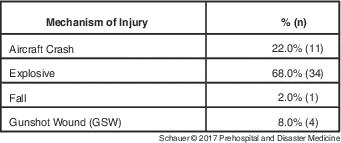
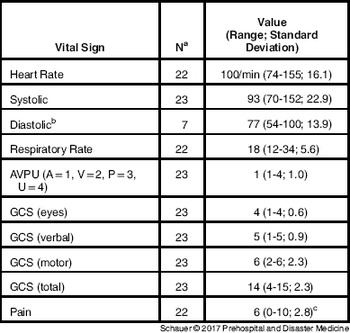
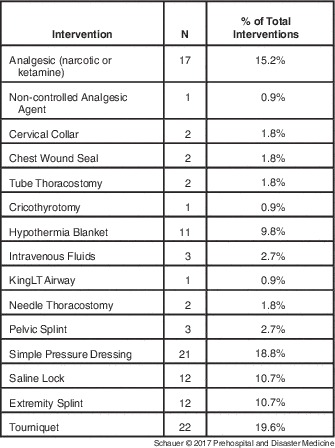
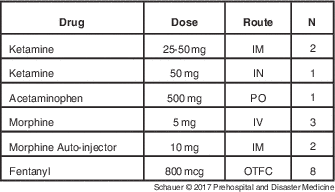
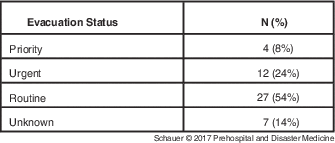
Ten MASCAL events were identified involving a total of 50 subjects. All the subjects were service members (local and Coalition), were male, and were part of conventional forces. For two of these events, documentation indicated only one severely injured patient in each event. Ten of the 50 subjects were US Marines, two were host nation service members, and the remainder (38) were US Army Soldiers. The majority (74%; n=37) of those injured were battle injuries. The majority were mounted-injuries (in or on a vehicle, 67.6%; n=34), the remaining were dismounted-related (directly on the ground) injuries. Discharge data were available for 36 of the 50 subjects, with 35 of these (97%) discharged alive. Injury severity scores were available for 36 subjects (mean 12.2; median 9; range 1-45). Explosives were the most common cause of injuries (Table 1). Table 2 describes the wide-range of vitals documented. Tourniquet placement and simple pressure dressings were the most common interventions noted in the prehospital phase (Table 3). Oral transmucosal fentanyl citrate (OTFC) was the most common parenteral analgesic drug administered (Table 4). Most were evacuated as “routine” to the CSH (Table 5). Evacuation platform was ground CASEVAC (Casualty Evacuation, non-traditional, non-medical platform) for three patients versus AIREVAC (Air Evacuation) for the remainder of patients.
Mechanism of Injury

Prehospital Vital Signs, When Available

Note: N denotes the number of subjects that had that vital sign documented.
Abbreviations: AVPU, alert, pain, verbal, unresponsive; GCS, Glasgow Coma Scale; TCCC, Tactical Combat Casualty Care.
a One subject had two sets of vital signs available, another had 3 sets (all sets were included).
b The majority of the blood pressures were estimated using the palpation method per TCCC guidelines, thus the systolic pressures were estimated and the diastolic pressures were not available.
c None of the patients had repeat pain scores available.
Documented Interventions Performed Prehospital

Documented Analgesic Drugs Administered during the MASCAL Events

Abbreviations: IM, intramuscular; IN, intranasal; IV, intravenous; MASCAL, mass casualty; OTFC, oral transmucosal fentanyl citrate; PO, per os.
Evacuation Status of Service Members Prehospital

Discussion
In this data set, the most common interventions performed prehospital were hemorrhage control via tourniquet placement (19.6%) and pressure dressing (18.8%). After hemorrhage control, the most common procedure performed was controlled-substance pain medication administration (15.2%).
In the recent civilian-based study on MASCAL events by El Sayed et al, the most common medications administered were oxygen and intravenous (IV) fluids; this is compared to the military-combat setting in the present study wherein the most common intervention was hemorrhage control. The current dataset had smaller proportion of patients receiving IV fluid than the civilian data by El Sayed et al (3.7% versus 6.9%).Reference El Sayed, Tamim and Mann 3 Another study by El Sayed et al found that the most common prehospital interventions performed were spine immobilization (21.8%) and IV access (14.1%).Reference El Sayed, Tamim and Mann 4 In contrast, this military MASCAL dataset finds the most common interventions were related to hemorrhage control, such as tourniquet placement (19.6%) and pressure dressing (18.8%). Regarding the procedures most commonly reported by El Sayed et al, the current dataset finds a much lower proportion of patients undergoing IV access (10.8%) and zero patients had documented spinal immobilization. This finding is likely related to the updated TCCC guidelines, the teaching of the (M) Massive bleeding, (A) Airway, (R) Respirations, (C) Circulation, and (H) Head (MARCH) acronym and the differences in mechanisms of injury (MOI) in the military setting compared to the civilian sector. All military medics are taught to perform life-saving interventions focused on MARCH, in that order. The MARCH method places less emphasis on IV access for resuscitation and immobilization, which likely explains this difference. Explosives accounted for the majority of the injuries, followed by aircraft incidents, which contrasts with the MOI noted in the civilian setting where motor vehicles trauma accounted for the majority.Reference Schenk, Wijetunge and Mann 5 Additionally, the tactical and hostile nature of the events battlefield care limit the ability to perform spinal immobilization.Reference Butler, Hagmann and Butler 1 Battlefield methods of pain control also recommend the use of ketamine or OTFC, both of which remain less common in the civilian setting. Hypothermia blankets were placed frequently, which is likely due to the varying extraction times and environments not seen in the civilian-sector. Previous papers have sought to explain the uniqueness of the military MASCAL compared to the civilian-sector.Reference Repine, Lisagor and Cohen 6 - Reference Beekley 9 However, data specific to the military MASCAL are limited. This descriptive study using the only currently available prehospital data from the battlefield may start to fill that void.
Limitations
This is a small sample-sized data set which limits wide-applicability now. The retrospective nature of this study limits cause-and-effect determinations. Data from this study are based on documented actions, which has the usual limitations in addition to those limitations related to combat casual care. This study is limited to the military combat-setting and thus may not be applicable to the civilian-setting.
Future efforts should be directed at obtaining a larger, more robust data set to help guide the development battlefield practice guidelines and for mission planning. These limited data, however, may help mission planning and development of prehospital practice guidelines pending larger, high-quality validation studies.
Conclusion
In this case series, the most common prehospital interventions were tourniquet and pressure dressing hemorrhage control, along with pain medication administration. Larger data sets are needed in order to guide development of MASCAL in-theater clinical practice guidelines.
Acknowledgements
The authors would like to thank the Joint Trauma System Data Analysis Branch, Joint Trauma System, US Army Institute for Surgical Research for their efforts with data acquisition.