In the late spring of 1887, a personal and didactic narrative appeared in the Land and Labor Library, one of the New York-based periodicals dedicated to Henry George's single tax. The teller of the tale, John Jones, drew upon his family's experience to illustrate the inequity of landlordism and the way that working people paid and suffered for their own productivity. In it, Jones recalled that every time the lower Manhattan neighborhood in which he grew up developed further, the landlord was not far behind, anxious to benefit from the labor of others by raising the rent. While the story was meant to illustrate George's arguments about the unearned increment of rent value that landlords extorted from their tenants, the depiction of each successive dwelling in which the family moved provided a sense of what single taxers had lost and were attempting to reclaim. Jones recalled that his family in the 1840s had lived in a “nice, roomy, twenty-five foot front house, two stories and a half high, with a long garden in the rear, which I and my sisters used to play.” But increasing development and higher rents had forced Jones and his family to consistently move farther away and into progressively more cramped quarters. In 1887, Jones told his reader that their most recent lodging, an uptown flat for which he originally had paid twenty-five dollars a month, was no longer viable due to a series of rent increases that had forced him to consider taking a cottage “on the outskirts of a village over in Jersey.” He related that he and his wife “put up a fervent prayer to God each night that the development might be slow.” The results were that he at the age of forty-five was “bowed and broken,” his wife “pale and faded before her time,” and his children were “at work.” While illustrating the worsening of conditions faced by a single family, the piece also provided a sentimental vision of nature and domesticity. Jones concluded by noting that he often looks “back to that dear old house in Prince street, with its shady tree where the swing hung in the summer days, and I and my sister played together.” Instead of playing in the street, as would become their custom, the Jones children had once played in what the author remembered as a “noble playground.”Footnote 2
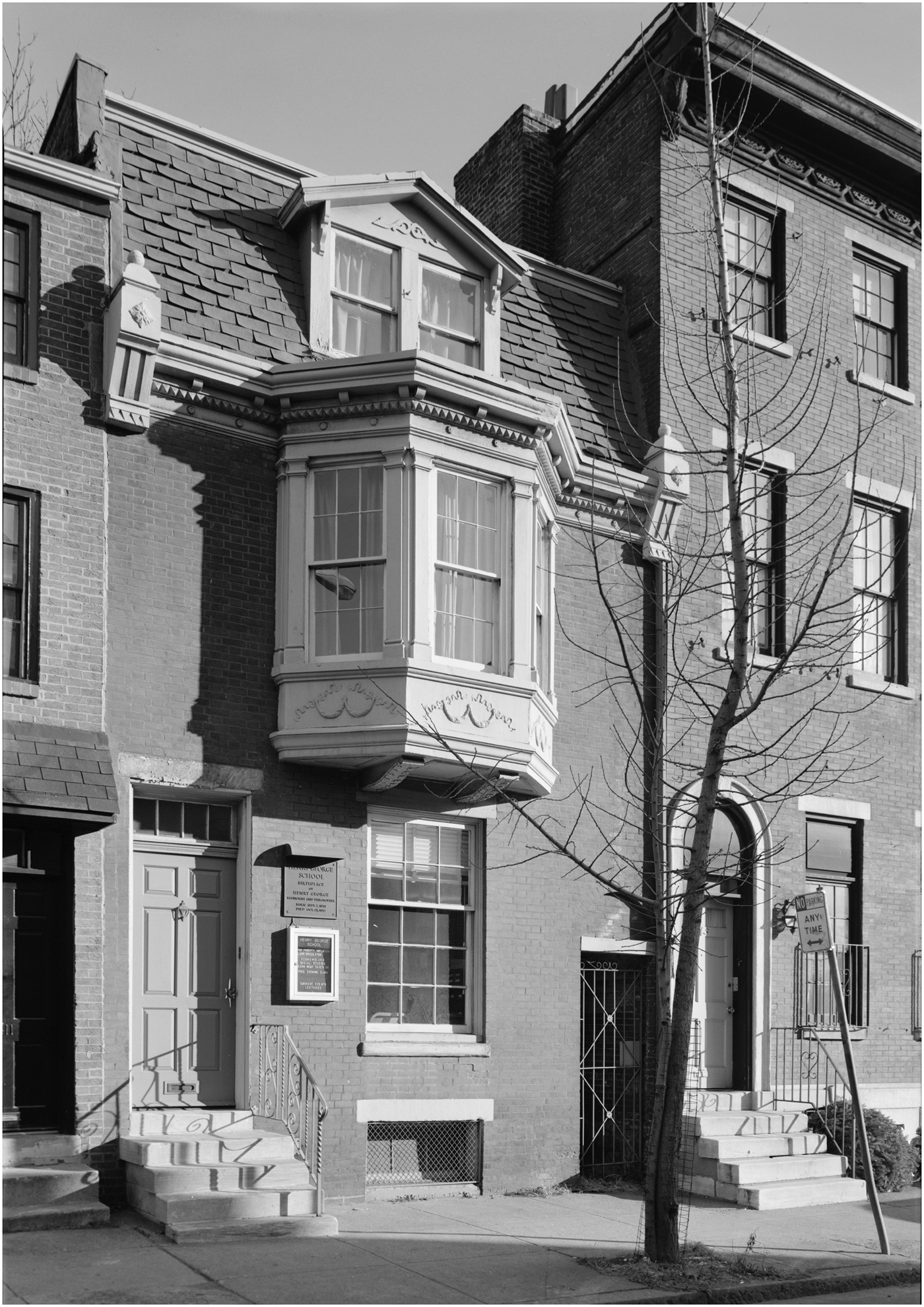
John Jones's story, with which this essay begins, hearkened back to an earlier day of urban housing for prosperous artisanal families, like this Philadelphia house in which Henry George was born and raised. Courtesy Prints and Photographs, Library of Congress, HABS PA, 51-PHILA, 310-1.

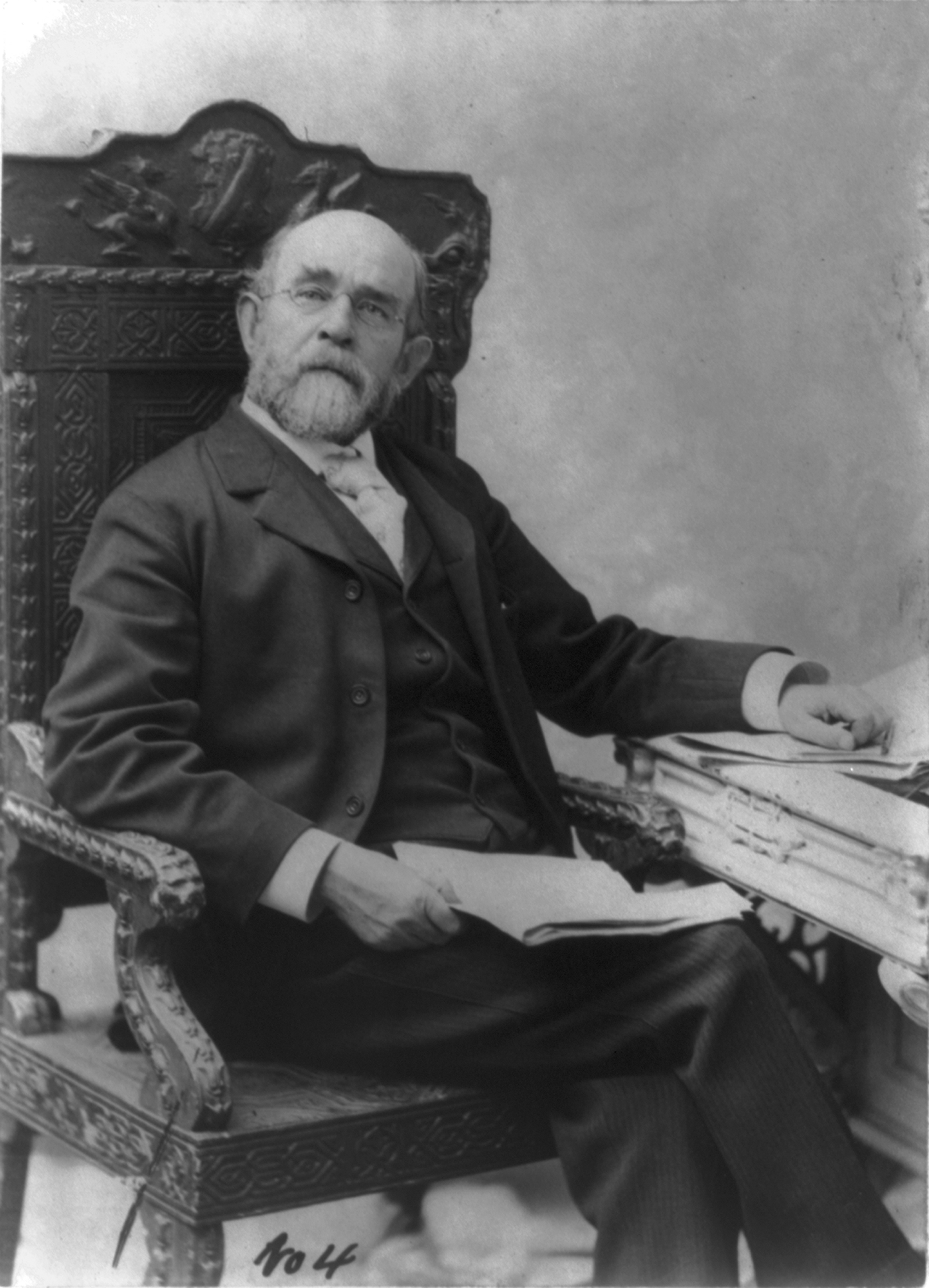
Henry George posing at his desk in the 1890s. Courtesy Prints and Photographs, Library of Congress, LC-USZ62-79139.
The story, by placing the site of child's play under a “shady tree,” suggests a world that was lost by the development of industrial capitalism and urbanization. It also reflects the importance that George placed on renewing working people's relationship with nature as a part of his effort to restructure the urban metropolis in new ways. While earlier nineteenth-century, land-reform movements had sought to place workers in a productive relationship with the earth, the George movement's aims were much more urban and sentimental.Footnote 3 Fueled by understandings of gender and the family that were first articulated by the antebellum northern middle class, the movement demanded that the metropolis be reshaped so that men, women, and especially children would once again enjoy the connection with nature within the family and, in so doing, improve their standards of living.Footnote 4 Aiming to end land monopoly and the extraction of rent from working-class families, the George movement imagined at once a more productive capitalism, one that would no longer be restrained by what it considered the extortionate demands of landlords, and a more spread-out urban environment characterized by single-family, working-class housing. In this way, George anticipated not only the garden cities of Ebenezer Howard, but also aspects of the domestic suburban future of the mid-twentieth century.Footnote 5 Attention to George's understanding of nature reveals the degree to which his vision of a more just world was grounded in domesticity as much as it was in nineteenth-century producerist radicalism.
Historians have long been aware of efforts by the better sort to turn to nature as a means of soothing discontent and anxiety that attended the rise of the Gilded Age metropolis. Some prominent men, such as Theodore Roosevelt and George Bird Grinnell, sought to preserve wildlife and habitat so that others like them might venture into the countryside and wilderness to appreciate birds and animals and to restore vitality and strength to what they considered an overly feminized manhood. Exertion through strenuous activity in the wild would help reclaim what the city and society had weakened. Many such men were motivated by the writings of nature advocates such as John Muir and John Burroughs to aid in the conservation of habitat and grand scenery. By preserving nature, they sought to remove it from labor and artifice. In the construction of such “wilderness,” they sought to create a site in which elite leisure could be played out by hunters and anglers untrammeled by the subsistence or market activities of lower-class locals.Footnote 6 Other prominent men and women identified nature as a means of civilizing the city. Park supporters such as Frederick Law Olmsted and Calvert Vaux saw naturalistic parks as providing an uplifting engagement with nature. They stressed the need to preserve the nature in city parks, while excluding any form of competition or machinery that would reflect the values of the economic sphere.Footnote 7 In all these ways, nature came to be seen as a positive force, counterpoised against yet ultimately compatible with the elements of the urban, competitive environment.
Some individuals blended the belief in the cultural value of a preserved nature with the need for better management of its resources. George Perkins Marsh and Theodore Roosevelt were not only hunting enthusiasts who had become enamored with the need to protect habitat and thereby preserve nature; they also were concerned that free and open access to natural resources would leave the future bereft of them. Conservation in the path cleared by Gifford Pinchot of the Progressive Era Forest Service stressed the need for government to step in and regulate the usage of important natural resources.Footnote 8 While preservationists sought to protect an idealized form of “wild” nature, conservationists aimed at sustained use for productive purposes. Whether the aim was the preservation of a pristine nature, often inspired by elite sport, or the conservation of natural resources, those aiming to change the human relationship with nature tended to come from the nation's most prominent families; moreover, they understood the way that common people used nature as a problem that needed to be contained.Footnote 9
In a history of conservation, George's critique of land monopoly and its effects on the capitalist marketplace fits neither tendency. From that vantage point, George's denial that there were natural law limits to human productivity seems the embodiment of the problems that conservationists such as Marsh had identified. Yet George did not merely perceive nature as an instrument of human productivity. This is clearly evident in his personal writings, which, unlike his arguments in political economy, are sprinkled with references to natural beauty and experiences with nature. This appreciation for nature helped George infuse his radical critique of private land ownership with the need to renew working people's relationship with nature. Unlike the early leaders in nature preservation, who in the United States tended to come from wealthy families, George sought not to use nature as an antidote, separate from the city and its processes, but to integrate it into urban family life.
George's embrace of nature amid human forms and his belief in the benevolent influence of trees and grass were evident in his personal life and political activism, and in both cases it was informed by his embrace of domestic ideology. For George and at least some of his followers, the female-dominated home was a source of morality and benevolent child raising, and the inability of working people to establish such a source of virtue was a sign of a depraved social order. At the same time, the quality of home life was associated with low levels of population density, which would permit children to play under the shade of trees instead of in the streets. These ideas had been expressed by middle-class reformers. What makes their expression by George interesting is his insistence that the realization of this vision required an assault on landed property. George's program for improving living standards and reconnecting working-class families with nature was grounded in producerist radicalism.Footnote 10
The importance that he placed on marriage undoubtedly reinforced these cultural assumptions, as evidenced by the constant correspondence that he engaged in with his wife, Annie George, whenever he was away from the family home. “Marriage is the natural estate,” George wrote her, explaining, “I only have to get away from you to feel that.”Footnote 11 A year earlier, on the occasion of their twenty-third anniversary, George assessed their marriage, asserting, “We have been closer to each other than to any one else in the world, and I think we esteem each other more and love each other better than when we first began to love.”Footnote 12 Always the devoted letter writer, George's expressions of love formed a consistent theme in their correspondence. More to the point, in those letters, as well as in correspondence to other female family members, George articulated a sense of natural beauty that was able to incorporate human economic activity. And he applied that sensibility to the plight of the urban poor. That so many working people lacked the material conditions for domestic comfort was a feature of his campaign for mayor of New York City in 1886 and in his organizing efforts thereafter. His speeches were replete with condemnations of unhealthy tenement conditions and child mortality. And his emphasis on the single-family residence and suburbanization was sometimes cast in nostalgic reflection of the loss of a more village-like city, despite his embrace of modern productivity. But that did not imply a rejection of industrialization or of the city. As the George movement spoke of people as fathers, mothers, and children, the family came to embody the source of virtue in society. That modern society failed to allow for the development of moral family life seriously indicted it. For George, private land ownership perverted the normal relations of family members; true reform depended upon a renewed relationship with nature.
Henry George and the City
George's most important work was Progress and Poverty, written in San Francisco during the late 1870s. Though its remedy for the ills of capitalism is unique among American radicals, the work's fundamental assumptions were grounded in the traditions of working-class producerism, an inchoate set of ideas that, like much of classical political economy, assumed that those who created goods should enjoy the fruit of their labor. Producerism provided a powerful moral critique of a capitalism in which growing numbers of workers were immersed in poverty.Footnote 13 In George's producerist tome, the starting point was the primacy of labor over capital in the creation of wealth. In his effort to explain the relationship between wages, capital, and rent, George carefully distinguished between land and capital, asserting, “Nothing that is freely supplied by nature can be properly classed as capital.”Footnote 14 Readers understood that he meant land, but his analysis could be extended to water, air, and other natural resources; in fact, anything that had been created by the divine—all of nature—as something to which all human beings shared equal access. George pointed out, “The equal right of all men to the use of land is as clear as their equal right to breathe the air—it is a right proclaimed by the fact of their existence. For we cannot suppose that some men have a right to be in this world and others no right.”Footnote 15 Not only was capital not grounded in nature, it was the creation of labor. Rejecting the notion that there was a limited wage fund within capital out of which workers were to be paid, George insisted, “wages are drawn, not from capital, but from the produce of labor.”Footnote 16 George narrowed the understanding of capital further by denying that stocks and bonds were capital, declaring, “Nothing can be capital that is not wealth” and that such wealth must “consist of actual, tangible things,” which had been created by labor.Footnote 17 But there was another point: by asserting that labor created all wealth and that capital was a creation of labor, George argued that “wages cannot be diminished by the increase of laborers.”Footnote 18
No small point, the assertion was the basis for much of what followed. Much of Progress and Poverty was a refutation of Thomas Malthus, on whom subsequent bourgeois political economists, particularly David Ricardo, had relied to explain working-class poverty. For George, Malthusian theory was particularly troubling, for it associated human nature with misery, ascribing impoverishment to the proclivity of workers to have too many children. Malthus had argued that while population increased exponentially, human production could only increase arithmetically and that overpopulation constantly threatened the masses with hunger and deprivation. As production expanded to feed the growing numbers, farmers took up marginal land that would not be as productive as that already under cultivation. Ricardo elaborated upon Malthus by asserting that the move to marginal land explained the source of rent. For Ricardo, rent was the payment for increasing productivity beyond what such marginal land could produce; though he recognized that this represented a charge upon labor that limited the upward path of wages, Ricardo only emphasized the way in which rent burdened tenant farmers and consumers of agricultural produce, having little to say about urban rent and the relationship between capitalists and workers.Footnote 19
Such thinking gnawed at George, as it challenged his view of a divinely created, harmonious universe that operated for the benefit of humanity. George argued that selfishness, not birthrates, explained some of the greatest misfortunes that had befallen the poor in the nineteenth century, blaming “the steady, grinding weight of English domination” for famine and misery in Ireland as well as India. While many saw in such misery a demonstration of the validity of the Malthusian formulation, George thought those explanations morally suspect, arguing it is “impiety far worse than atheism to charge upon natural laws misery so caused.” Bourgeois economists had mistaken social evils for “natural laws.”Footnote 20
George's faith in a harmonious and divine creation made it inconceivable that human beings could overwhelm the earth. Fifteen years after George Perkins Marsh had written about humanity's ecological destructiveness, George argued the earth could sustain “billions of people.” The problem was not the “niggardliness of nature,” but rather the “injustice of society” that was responsible for the “want and misery that current theory attributes to overpopulation.”Footnote 21 George denied that humanity was trapped within arithmetic limits of productivity; instead, he saw in human labor, acting upon divinely created natural resources, the source of constant creation and improvement. For George, productivity had the potential to be a constantly benevolent force.Footnote 22
That force would be most highly developed in the city. As cities were the result of constant improvement—the necessary result of human labor—George posed them as the source of human happiness. In his comparison of the city to the country, the latter fares poorly. George asked his reader to imagine the pioneering settler, taking advantage of the national homestead law, to demonstrate how those who live merely upon the earth's bounty do so very poorly. George's description speaks volumes. The settler travels across “an unbounded savannah stretching off in unbroken sameness of grass and flower, tree and rill,” until “the traveler tires of the monotony.” Choosing a piece of land is difficult, for “every acre seems as good as every other acre,” and “he is perplexed by the embarrassment of richness.” Here the soil is fertile, there is plenty of game to hunt, and the streams are filled with trout. George declared, “Nature is at her very best. He [the settler] has what, were he in a populous district, would make him rich, but he is very poor.” The settler must be “a jack of all trades and master of none,” and as long as present conditions continue, this will the lot of the next generation as well, for there can be no teacher in such an isolated homestead. Even the food supply suffers, for “though he has cattle, he cannot often have fresh meat, for to get a beefsteak he must kill a bullock.” It is only when other settlers arrive and establish farms that labor develops an “effectiveness which, in the solitary state, it could not approach.”Footnote 23
But that is not where George's developmental schema ended. As Frederick Jackson Turner would argue in subsequent years, George believed the settler paved the way for townspeople and the rise of cities. A growing population provided greater usefulness to the land, and the result was an accumulation of labor and capital. In the developing city—“a St. Louis, a Chicago, or a San Francisco”—production was carried on in highly mechanized conditions with advanced facilities. Under such circumstances, “the division of labor becomes extremely minute, wonderfully multiplying efficiency”; the land is more productively used than it could be under modes of rural production. George painted a picture not of a collection of homesteads but of the vastly productive city:
Instead of one man with a span of horses scratching over acres, you may count in places thousands of workers to the acre, working tier on tier, on floors raised one above the other, five, six, seven and eight stories from the ground, while underneath the surface of the earth engines are throbbing with pulsations that exert the force of thousands of horses… . The productive powers which density of population has attached to this land are equivalent to the multiplication of its original fertility by the hundredfold and the thousandfold.
It was not only the realm of production where the city trumped the countryside; it was in the breadth of civilized life that George found the city an idealized form that could not be replicated in rural areas:
Here intellectual activity is gathered into a focus, and here springs that stimulus which is born of the collision of mind with mind. Here are the great libraries, the storehouses and granaries of knowledge, the learned professors, the famous specialists. Here are museums and art galleries, collections of philosophical apparatus, and all things rare, and valuable, and best of their kind. Here come great actors, and orators, and singers, from all over the world. Here, in short, is a center of human life, in all its varied manifestations.Footnote 24
Yet, urban society as it existed was hardly ideal. Greater misery could be found in the city than in the countryside, as workers were paid scant wages while being forced to pay extortionate rents. To explain this, George emphasized that manufacturers also paid rent, a matter that forced them to pay their workers less than their productivity would normally warrant. As a result, the city—even more than the countryside—was impoverished due to the monopolization of land. Speculators in particular impeded the development of natural law by holding on to vacant lots, waiting for them to rise in value so that a fortune might be made. George argued, “If the land of superior quality as to location were always fully used before land of inferior quality were resorted to, no vacant lots would be left as a city extended, nor would we find miserable shanties in the midst of costly buildings.”Footnote 25 Under natural conditions, homes for working people would be healthier and less crowded, and rents for manufacturing establishments would extract less money from the product of labor.
Private ownership and speculation of land transformed the city into a depraved image of divine intent. Landlords illegitimately received the product of labor through rental income, though they engaged in no productive labor. Properly conceived, George insisted, rent was a tax, and in the cities where productivity was the greatest, it was a very steep tax indeed. “The wide spreading social evils which everywhere oppress men,” George reasoned, “spring from a great primary wrong—the appropriation, as the exclusive property of some men, of the land on which and from which all men must live.” Private land ownership violated the tenets of worker producerism, and the results were dire. Rent taxed the labor of producers, while land held out of production accrued in value as the city developed around it, landlords benefiting from the work of others as they waited to sell and benefit from their “unearned increment.” From this “fundamental injustice,” George argued, “flow all the injustices which distort and endanger modern development, which condemn the producer of wealth to poverty and pamper the non-producer in luxury, which rear the tenement house with the palace, plant the brothel behind the church, and compel us to build prisons as we open new schools.”Footnote 26
George's remedy for the evils of industrial society came to be known as the “single tax,” which would, if enacted, tax all land at its full rental value excluding improvements, whether it was in use or not. The government's take from the tax would render all other taxation unnecessary. Unlike other taxes, George argued, those “on the value of land” do not hinder productivity; instead “they tend to increase production, by destroying speculative rent” and by encouraging those who held land to use it productively. It would be irrational to hold on to land that was taxed at its full rental value if it were not being productively and profitably used. More employment would result, but so would a better metropolis as cheaper land close in and on the periphery of the city would be available for working-class housing. As George liked to put it, “The dog in the manger, who, in this country especially, so wastes productive power, would be choked off.”Footnote 27
The urban bias of the movement was perhaps best displayed when one of George's most important allies, the Catholic priest Edward McGlynn, delivered a speech to George's Anti-Poverty Society that was unmistakable in its city centeredness. Addressing his audience, which included a “large sprinkling of the fair sex,” McGlynn asserted that though “God made the country … and man made the town … it could with equal truthfulness be said that God made the town.” McGlynn pointed out that associations of morality and virtue with the rural countryside were overdrawn and that the very usage of English demonstrated the opposite. For instance, he told his audience of New Yorkers, “words that mean rudeness, coarseness and want of culture were nearly all borrowed from the word country, while the words that had to do with civilization were derived from the word city.”Footnote 28 It is not exactly the “idiocy of rural life,” but McGlynn's text illustrates the urban bias of the movement.
This is not to say that George could not imagine nature as the opposite of civilization, as a refuge from striving, the pressure of which he felt much of the time. This was especially true in the years before he picked up patronage jobs from the Democratic Party in California in the 1860s that ultimately helped finance his writing. George's family frequently experienced poverty, and at least on one occasion he said that he had contemplated crime as a means of feeding his family. George expressed the desire to escape these pressures in a long letter to his sister Jennie in the summer of 1862:
Sometimes I feel sick of the fierce struggle of our high civilised life, and think I would like to get away from cities and business, with their jostlings and strainings and cares altogether, and find some place on one of the hillsides, which look so dim and blue in the distance where I could gather those I love, and live content with what nature and our own resources would furnish; but, alas, money, money, is wanted even for that. It is our fate—we must struggle, and so here's for the strife!Footnote 29
Though George could express the notion that civilization and nature were polar opposites, and some have seen in it a strong sense of pastoralism that would influence his development of the single tax, we should be careful to make distinctions.Footnote 30 In contrast to George Henry Evans, leader of the National Reform Association, who retreated from the city during the hard times of the late 1830s for a New Jersey farm, Henry George would remain tied to the city, not only in thought, but in deed. Only for a short period, on returning from a tour of the British Isles, would he spend considerable time outside of the metropolis. In that case he spent a few months while his daughter convalesced in a farmhouse three miles from the Jamaica railway station on Long Island, about a thirty-minute rail ride from New York City. George considered the spot “a magnificent place to rest and sleep,” and he claimed to “have done more solid sleeping since I have been down here than I think I did before in my life.”Footnote 31 A rural landscape could restore one to health; in this case, the expectations were physical and literal.
More important is that the George family left after three months for Brooklyn.Footnote 32 Though George often expressed a sense that the countryside could be restorative, he time and time again chose the city in which to live his life. As a young man, he maintained contacts with the Curry family, neighbors of the George family in Philadelphia who had traveled to the Oregon Territory when a relative was appointed governor. Though he continued the correspondence while he was in San Francisco, he put off his own journey to Oregon, while describing for Rebecca Curry the California city as “a dashing place” that was “rather faster than Philadelphia.”Footnote 33 More than two decades later, after leaving San Francisco, George wrote a friend there that all the members of his family “like New York very much.” He explained in terms similar to the description that he had provided Rebecca Curry twenty-five years before: “When a man gets a way for a little while San Francisco does not seem near as big a place as it does from Montgomery Street.”Footnote 34 Though urban life sometimes overwhelmed him, George was no common rural nostalgic. He embraced the hurly burly of the big city, both in his personal life and in his political economy.
Natural Beauty, the Middle Landscape, and the Family Circle
Yet it would be misleading to suggest that George saw nothing more in nature than its productive potential and its occasional restorative powers. His appreciation for natural beauty and spectacular scenery was evident at a young age. At sixteen, he signed on as a “foremast boy” on a vessel, The Hindoo, bound for Australia and India. His position gave him ample opportunities to observe nature, and the time spent high above the water provided George with a close-up vision of the power of the natural world. Among his journal entries appear occasional realizations of the beauty around him. For instance, he jotted down in his diary that a school of dolphins made “a most beautiful appearance in the water, changing to brilliant colours as they swam from place to place.” From a letter that George wrote to his parents, his son and first biographer concludes that the passage through the Straits of Magellan offered him “perhaps the most magnificent and impressive [scenery] he ever beheld.” Young Henry described water that was “clear and green with depth even up to the banks, which in places were sheer walls of rock running up perhaps three thousand feet and mantled at their summits with dazzling snow.” In another letter to his parents, his description of St. Thomas—one he believed would “form a picture which I knew you would enjoy”—portrayed “noble mountains rising from the water, covered with perpetual vegetation of the tropics and varied in colour by the shadows of the clouds which seem to climb their sides,” as a background for the “little town with its square red-roofed, Dutch houses and white forts, surrounded by the palm and cocoanut trees which line the bay.”Footnote 35 George expected his parents to enjoy and appreciate these characterizations of a beautiful nature.
George's appreciation for natural beauty was expressed through the filter of his role as a member of an artisanal and middle-class family.Footnote 36 Historians have recognized that women played the role of maintaining links to the natural world in the middle-class family, so that George would include such matters in letters to his mother, Catherine, and later to his wife, Ann, should not be surprising.Footnote 37 Moreover, that he should express a preference for natural scenery amid human settlement suggests that for George, nature was not an antithesis of the household or civilization, nor did one need to remove oneself from society to appreciate it. For instance, when the teenage Henry visited his uncle in what he termed “the beautifull [sic] Valley of Wyoming,” he wrote a brief letter to his mother that stressed the natural setting. From Prospect Rock, to which he hiked two and a half miles, the youth described looking down on one side where his gaze fell on “the river winding through it [the valley] looking like a silver ribbon,” and on the other “the dark green of the woods being sett [sic] off by the golden fields of wheat,” while in the center “lay the town with several villages scattered up and down the valley.”Footnote 38
George appreciated the settled rural countryside with which he was familiar, and with that standard as his guide, he found the landscape in California often wanting. George got to know wide portions of the state, traveling frequently through Central California in part to attend political conventions, but also as part of his duties in a patronage position that he was awarded as a loyal Democrat. From there he wrote his sister Carrie that while “there is some magnificent scenery and some beautiful country … the people have not been here long enough to make a country like that of the East.”Footnote 39 Yet there were promising settled landscapes. One of them was San Jose, which he told his mother “was a perfect garden.” George was particularly struck with the way the “little Episcopal church” there brought together human artifice, natural beauty, and spiritual simplicity. George, who had spent Easter there with his wife, described for his mother the church as “surrounded by evergreen trees, with ivy creeping through the boards and growing inside and the wealth of beautiful flowers with which it was decked all seemed so much like what church should be.”Footnote 40 In May 1876, after attending a Democratic convention in Marysville, George headed for the community of Grass Valley, where he stopped to check gas meters. He wrote Annie that the ride was “beautiful” and that “the piney air felt very pleasant, and the roar of a foaming stream rushing down the hill side was very refreshing.” He noted, “I am charmed with Grass Valley,” but the charm was the blend of natural beauty and productive potential that held some allure to George, who completed the thought by adding, “I would love to live here and have a nice vineyard and gold mine.”Footnote 41
As George wrote down his impressions of the natural environment, another migrant to California, John Muir, was also exploring the state, expressing in a public forum his appreciation for the wilderness of the Sierra Nevada. Muir's writings would be embraced by the urban bourgeoisie, which came to see wilderness through his eyes, as a place of therapeutic and spiritual renewal for those who lived in cacophonous and dirty industrial cities.Footnote 42 It should be noted that George's appreciation never approached the distinctions between wilderness and city that it would for many prominent bourgeois men at the end of the nineteenth century and into the twentieth. Such men often imagined wilderness as unshaped by human beings and for that reason capable of restoring the physical and spiritual health of the overly civilized. When George wrote his sister about nature and scenery in California, he told her that the people there had not had time “to make” a country like easterners had. For George, nature was integrated into human productive and cultural relationships, and it was fashioned by human beings. And while George could express appreciation for the grandeur of nature, he found it in its most appealing form on the outskirts of cities or amid the small town, not in natural settings that tested human beings. This is one of the contexts in which George expresses ideas that seem romantic and nostalgic, a pining for the rustic simplicity of the preindustrial village rather than the bustle of the metropolis. However, while George appreciated rural beauty and scenic splendor and could find himself restored after a night of camping, his orientation remained urban.
Throughout his life, leisure and nature were intertwined in the George household. George's trips to the countryside were usually family affairs, as was the case when a friend of his visited his family in the East and described a series of outings, including boating by his mother and siblings, and an open-wagon ride to Mount Rogers taken by a group of eighteen men and women. Nature was often a focal point of family gatherings.Footnote 43 As an adult, George continued to spend leisure amid nature. From San Francisco, he wrote labor journalist John Swinton about a camping trip that he and Annie took with another couple. Such trips were well within the reach of the young editor, leaving as they did “late Saturday afternoon” and traveling “over the bay and across the hills to the sea beach” where they camped.Footnote 44 George and Annie took their children to the country to fish or stayed closer to home and took them boating.Footnote 45 After moving to New York, George followed up a speaking engagement at a Knights of Labor picnic in Baltimore with an overnight at Budd Lake in Northern New Jersey, where his family joined his apostle Louis Post and his wife, who had been camping. The evening seemed to restore George, who wrote his San Francisco friend Edward Taylor that he “had more of a dead rest than I have had for years.”Footnote 46 George continued to exert himself in gentle ways into his fifties, when he frequently went on bicycle excursions in New York City with Annie, his children, or with colleagues such as Post.Footnote 47
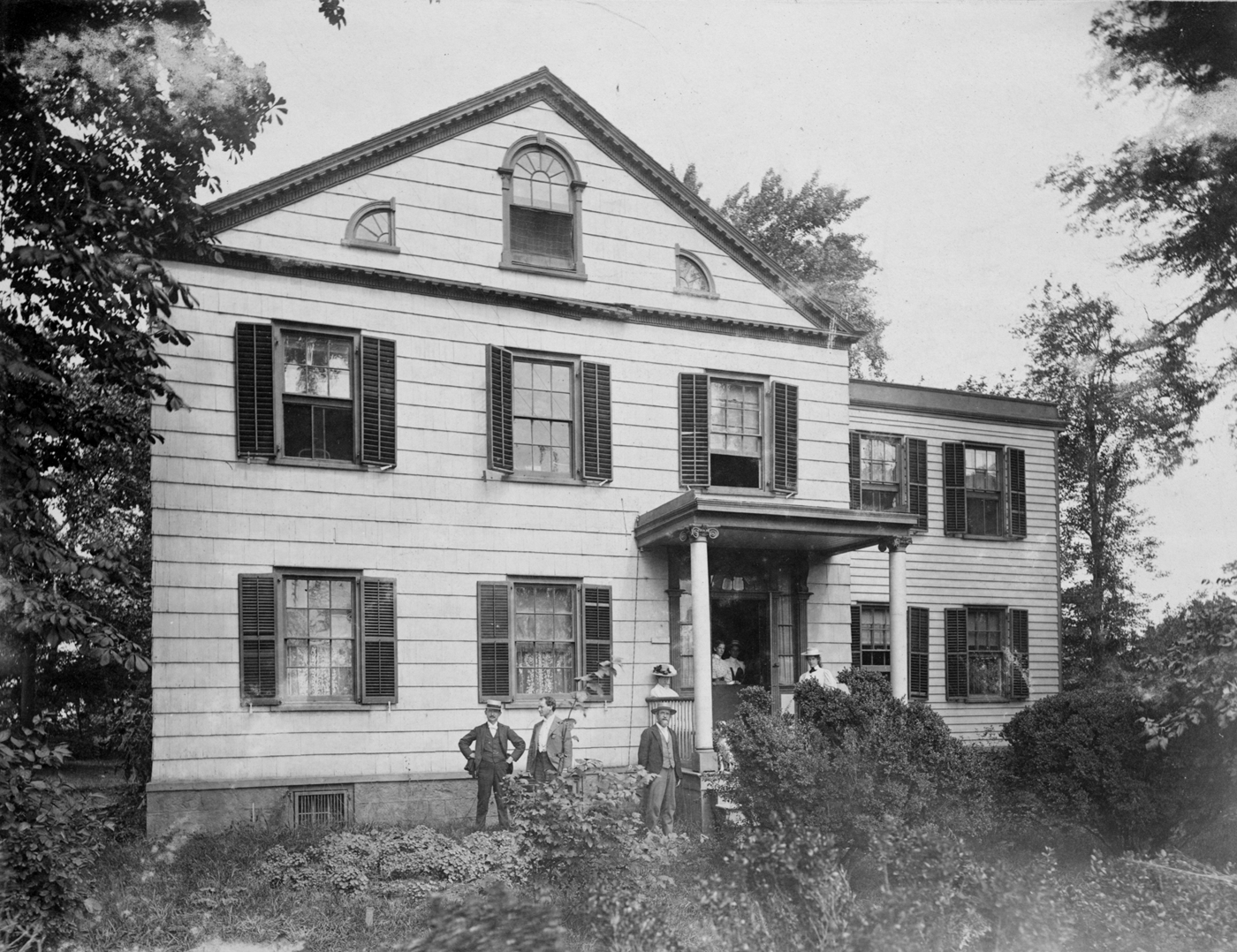
In the 1890s, the George family achieved the suburban ideal, blending domesticity and nature in this Fort Hamilton house on the suburban edge of Brooklyn, overlooking the mouth of the Hudson River. Henry stands by the steps, in front of his daughter Jennie. His other daughter is on the porch to the right. Henry George Jr. is on the far left. Reprinted by permission, Science, Industry & Business Library, the New York Public Library, Astor, Lenox, and Tilden Foundations.
Many of his followers in New York City similarly sought opportunities to spend leisure time outside of the city in some kind of engagement with a pastoral nature. Soon after his trade union-supported run for the mayor's office of New York City, George and the single-tax movement lost much of its working-class following, and the remaining middle-class membership took steps in 1888 to incorporate leisure into their politics. Members of the Manhattan single-tax club discussed the prospects of a “camping out” party during the summer, with one member suggesting the purchase of land in the country that would serve as a weekend retreat for members. Post, the long-time George lieutenant who would after his mentor's death become the leading single-tax advocate in the Progressive Era, described the purchased site in the Standard, George's weekly newspaper published in New York City. Post waxed enthusiastic about the land, which lay near Monticello in the Catskills: a trout stream “passes through a thickly wooded place at a point where the water plunges over the rocks, and makes a picture the romantic beauty of which art could not rival, while a few yards back from the stream is a ten acre grove of tall pine trees.” The site also contained a level field “well adapted for ball games,” and there was additional level land “in which tennis grounds might be laid out.” Selling the land to the readership, Post declared, “for boating, swimming, fishing, hunting, berrying, gardening, farming, and even for just living, the tract I have inadequately described is the best we saw, and I doubt if there is one anywhere with better natural advantages.” Post imagined that members might build dwellings, rent free of course, near the lake and “have their families there throughout the spring and summer months, going back and forth themselves every week at less expense in all than they would incur by living here.” In addition, Post proposed that some members might choose to relocate there and take advantage of the “excellent opportunities for cultivating superior garden products and fruits, and for raising poultry and eggs.”Footnote 48 For these middle-class single taxers, communion with nature meant organization and building, and it would be enjoyed within the confines of the nuclear family.
The Suburban Solution to the Crisis of the City
George's emphasis on land monopoly appeared in a political culture that had previously seen artisans and workers support homestead legislation that would enable working people to seek independence in the West, and so his ideas were received in a context that often stressed rural land as a solution to urban poverty. In 1887, Frank Colgate, a supporter of Henry George's effort to abolish private property in land, posed a problem that undoubtedly befuddled many then and since pondering the impact of the single tax. Writing to the Standard, Colgate asked how the single tax would benefit workers when it was clear that unemployed workers brought to rural locales by charitable organizations rapidly wearied of the country life, pointing out that they quickly “return to the city to renew the old struggle.” Certainly, if the George movement was primarily a back-to-the-land effort, grounded in Jeffersonian arcadianism and following in the footsteps of George Henry Evans and the National Reformers of the antebellum era, it was a pertinent query. But George, as coeditor of the Standard, responded in a way that helps clarify our understanding of the single-tax movement's place in the annals of American reform. He denied that city workers would “become farmers.” What they would gain is higher wages and, like an urban Daniel Boone, he emphasized that workers would gain “elbow room,” turning a frontier metaphor to the metropolis. It was critical that it was within the urban complex that this would be experienced. George explained: “The erection of a city house or the working of a mine opens avenues of employment—makes elbow room for labor—and tends to improve the condition of all workers, as well as would the shifting of city laborers to distant farms.”Footnote 49
George had the opportunity to develop these themes in his political efforts in New York City. Responding affirmatively to a request from Samuel Gompers and the New York Central Labor Union, George engaged in a spirited mayoral campaign in the fall of 1886, in which he came in second, ahead of Republican Theodore Roosevelt.Footnote 50 During the campaign and in its aftermath during the following year, George did not address issues that historians ordinarily associate with nature and the environment. Nonetheless, his focus on working-class housing and his remedy for overcrowding and misery led him to stress the need for a reconstructed urban domestic environment characterized by single-family housing in which mothers would preside over the home and be present for the raising of children. Whatever nostalgia that was evident, as Frank Colgate would learn a few months later, was not directed toward a potential return to the countryside, but rather toward a reconfiguration of urban society, one that would provide working people with an urban life that would be more comfortable and more in touch with the natural world.
During campaign rallies, George regularly linked land monopoly to the unhealthy and crowded conditions in which so many working people lived, and he punctuated the point by focusing on the high child mortality rates suffered by those who lived in the most crowded conditions. Two weeks before the election, he told a large crowd at Chickering Hall, “We are packed together in this city of New York closer than anywhere in the world—packed together so closely that the rate of mortality is greater than any other civilized country.”Footnote 51 But it was the fact that children died at high rates that confirmed that something terrible was amiss. George rarely failed to develop this theme throughout the campaign. At one of a series of nominating events, he asserted, “Poverty is worse than cholera,” and told his audience to “see where it is that children die like flies—it is in the poorer quarters.” During his acceptance speech at Cooper Union, George declared that children in working-class districts “die almost as soon as they enter the world. In the district known as the Mulberry Bend, there is an annual death rate of 65 in the 1,000, and in the tenement district the large percentage of the children die before they are five years of age.” As he concluded, he termed the high child mortality rate “a veritable slaughter of the innocents.” George vowed to do what he could to remedy conditions “that condemned little children to live such a life as you know them to lead in the squalid districts.”Footnote 52
It was more than urban child mortality rates; George and his fellow single-tax advocates focused on the way that overcrowding and poverty violated the tenets of domesticity, particularly focusing on the impact on women and children. In his nomination speech he vowed to do his best to remedy the conditions “that condemned little children to lead such a life as you know them to lead in the squalid districts,” and he spoke of “the social wrong that forces girls upon the streets and our boys into the grogshops and the penitentiaries.”Footnote 53 At another meeting, he asserted after reciting the high death rates in the poorest neighborhoods, “the little infant born to-night in the poorest room of the most squalid tenement in this city comes into life with a warrant equal to that of the child of the Astors, of the babe of the Stuyvesants.” Land monopoly and speculation provided the reason “why young girls are crowded together running sewing machines, 260 on one floor.”Footnote 54 In the spring of 1887, George's ally, Catholic priest Edward McGlynn, addressed similar themes at the Cooper Union. After distinguishing between labor and “excessive labor,” McGlynn focused on both labor and living conditions:
It is the unwholesome, unhealthful, unhygienic surroundings of labor that we complain of. It is the condemning to labor of little men and little women whose muscles are not yet properly hardened for labor. It is the confining in the workshop of little children who should be at play. It is the condemning to irksome and ill-requited toil in unwholesome rooms of mothers who should have no other care but that of their little ones. It is the condemning to toil of women who should be venerated with a peculiar deference because of the unjust, the harsh, the horrid burdens that are placed upon the laborer that we complain, and not because of labor itself.Footnote 55
Other George supporters focused on the way that private land ownership led to the destruction of the domestic environment. Responding to the news that a block of vacant land uptown had been sold by the Astors for $325,000, T. L. McCready asserted that the Astor's sole contribution to society was misery. Instead of presiding over comfortable homes, “mothers’ hearts have been rent for their little ones stewed to death in tenement houses for want of the fresh air that overblows these vacant lots.” Poverty had let “strong men” unable to support their families, and “houseless girls have sought in dens of sin the shelter that they might have found on that idle, unused land.” The Astors and others had forced “men who wanted homes for wives and little ones” into the tenements.Footnote 56
Single taxers juxtaposed moral and physical malignancies caused by overcrowding against an urban vision in which, as George himself put it, “every American citizen ought to have a separate house.”Footnote 57 William Croasdale, coeditor of the Standard, associated a better and more comfortable life with the cultural embrace of the family. In a long article exploring overcrowded conditions on the Lower East Side of New York City, the editor claimed average density reached 225,280 persons per square mile, which they announced was “a density of population unparalleled elsewhere in the world.” But the key point was the crowded conditions of this sort corrupted family life. The editor waxed sentimental about the family: “The center of human life, the unit of human society, is the family; and the life of the family is most powerfully influenced by the home—the sweetest, the tenderest, the most inspiring word, it has sometimes been said, in the whole range of the English language.” The problem, the Standard declared, was that most New Yorkers “have nothing worthy of the name.” Calculating that two-thirds of the “inhabitants of Manhattan island live to-day on floors occupied by two families or more,” the editors concluded that for the vast majority of workers “even the veriest semblance of a true home is utterly impossible.”Footnote 58
Croasdale insisted that such conditions were unnecessary despite New York's large population. The editor wrote that such crowding “is so utterly unnatural, so absolutely inconsistent with all the needs of healthy human life” that efforts to reform working-class behavior by imposing prohibition or ameliorative efforts to impose “sanitary inspection” could only be “utterly inadequate.” In the overcrowded metropolis, children “do not find room enough on the earth's surface to play.” The result is that “what is vile and what is demoralizing they see in plenty, but the sweetness, the vastness, the mysteriousness of nature, her suggestions of things beyond expression, they know nothing.” Even model tenements were inadequate to the task. The problem was to get people more space “on the earth's surface,” and there was “space enough to give each family a separate home.” Instead of legislative housing reform, the Standard called for the abolition of the tenement.Footnote 59
For George and his followers, these conditions that frustrated the development of a healthy and comfortable domestic environment were avoidable, even in the nation's largest metropolis. George and Croasdale, both during the mayoral campaign and subsequently in the pages of the Standard, argued that the crowdedness of New York did not result from the city's massive population but from private land ownership and speculation. When landlords complained that vacant buildings in Harlem demonstrated that the problem was too much housing, not too little, the Standard was quick to respond. The editor pointed out that Harlem had recently been a “pretty suburban village where men who would submit to the inconvenience of a long ride night and morning, found pleasant, comfortable homes, within the limits of an ordinary American citizen's means.” The building of the elevated railroad had been welcomed, and many “spoke hopefully of the good time coming when every New Yorker should have a home of his own, with a private vine and fig tree blooming in the back yard.” However, private landlords in Harlem demanded too much rent, while the holders of increasingly valuable real estate held on to make greater profits in the future, thereby stifling rapid development and the expansion of the suburban dream. The remedy was simple: “Tax Harlem land values out of sight, and within a year there wouldn't be a vacant lot or house to be found there.”Footnote 60
When a correspondent to the Standard from Oak Park, Illinois, asked how “the dwellers in the tenement houses of our ‘great’ cities” would be enabled to build homes for themselves in those cities, seeing that they would have to pay the tax, the answer anticipated some elements of the mid-twentieth-century suburbanization of working people. The editors suggested that such folk would be unable to live on land worth $350 a year but would rather “live on free land and enjoy their share of the $350 which someone else paid to the community for the valuable land.” They provided the example of the “compositor [who] found a vacant lot in the suburbs of the city in which he wished to live.” For such a lot, “there would be no tax.” They pointed out that if the city grew out until the point where there were others who desired his lot, the compositor would have to pay the rental value of the land as a tax. Due to the dynamics of urban growth, the editor suggested, “A time might come when the tax would be more than he would be willing to pay.” Were that the case, “he would sell his real estate to some one who could and would utilize the special advantage of the lot.”Footnote 61
Life on the margin of the metropolis was not, however, to be an isolated life. The George movement envisaged the development of cheap, public transportation that would allow working families to gain access to such suburban homes. The editor of the Leader, discussing life on Long Island, described George's “ideal society” as one “where the railroads are either free, or operated at cost, and where the social value on land is alone to bear the taxation required.” Dense land in the center of the city would bear the burden of taxation. To pay their taxes, owner/users would have to put the land to productive purposes, thereby increasing employment and diminishing poverty, while at the same time funding the ability of cities to open up working-class housing on the urban periphery.Footnote 62
The crucial reform, then, was the restructuring of the metropolis. George and his trade-union followers argued that the single tax would promote working-class suburbanization, thereby transforming a process that heretofore had excluded working people. The single tax would set in motion the migration of urban families to small lots of land, while generating revenue for improved transportation that would allow suburban residents to get to work.Footnote 63 A month after George accepted his nomination, a meeting of delegates from the trade organizations adopted a platform that declared that funds raised by the single tax would not only promote “the health, comfort, education and recreation of its people,” but would also provide the “means of transit commensurate with the needs of a great metropolis.”Footnote 64 In late October, William McCabe of the Typographical Union, who previously had been an officer of the Georgist “Free Soil Society,” and Samuel Gompers of the Cigar Makers’ International proclaimed that land monopoly in New York City forced thousands of workers to “work 100 days for a landlord, while the common methods of transportation could carry them conveniently to free suburban home sites if the city would justly resume its right to its thoroughfares and possess itself of the land near by now held by speculators.” The union officials charged that poverty was rooted in the efforts of “avaricious men [who] have possessed themselves by unrepublican laws of the free gifts of nature and a monopoly of the means of transportation, which should be the property of the commonwealth.”Footnote 65
Edward McGlynn brought these themes together in an especially concise manner. McGlynn had been converted to the single tax in the early ’80s, a transformation that would lead to his excommunication by the Catholic Church in 1887. A true believer, McGlynn regularly repeated George's logic that a benevolent God could not be the author of natural laws that led to human misery. The single tax, McGlynn asserted, would “sweep away the wretched rookeries that, under the name of tenement houses, are a sin and a shame,” and it would lead to the development of a new city, in which “the best class of houses will be built.” With the adoption of the George program, McGlynn concluded:
It would no longer sound Quixotic to talk of building free rapid transit railroads on solid foundations, on which trains could travel at the rate of thirty miles an hour for twenty, thirty or forty miles into the suburbs, to give homes to all the people, from which they could come and go every day, and in which they could enjoy some of nature's life, by which they could get sun and the air, green fields and flowers.Footnote 66
Mass transit, paid for by the single tax, would allow for a viable metropolis in which working people lived in single-family dwellings. On that, George, McGlynn, and the trade-union leadership could agree.
Conclusion
The story provided by James Jones, with which this essay began, reminds us that the vision that George articulated was consistent with both prior and future urban experience. If there was a nostalgic bent behind the single-tax movement, it was one embraced by many other Americans, most notably those of the urban middle classes. Advocates of the middle-class suburban home had long proposed that contact with nature would allow families to raise children in an environment conductive to an orderly, female-dominated domestic life. Like Catharine Beecher had done so decades before, George envisaged the single-family detached home, where children had a place to play aside from pavement, as the kind of place where tender familial sympathies could be developed. A city that developed horizontally more than vertically would overcome the problems of crowding that afflicted so many working people of the Gilded Age city.Footnote 67
Moreover, such a city would make domesticity and nature broadly accessible. Whether the new suburban home provided the biblical imagery of each man and his family with “a private vine and fig tree blooming in the back yard,” the nostalgic vision of John Jones's “shady tree” aside the home on Prince Street, or McGlynn's “green fields and flowers,” the single-tax movement imagined a softer urban existence through connection with nature. This is a relationship that George maintained his entire life, sensing the beauty of nature as something that was often best expressed intertwined with human productivity. Those experiences found their way into his 1883 discussion of Social Problems, where he despaired that the “vast populations of these great cities are utterly divorced from the influences of nature… . All the sweet and joyous influences of nature are shut out from them.”Footnote 68 Rather than emphasize the preservation of wildlife habitat far away from the city, George and his followers rethought the way in which human beings might live productive, but humane and comfortable lives in closer connection to some elements of the natural world. Despite his producerism and his emphasis on socializing land values, there are elements in George's thinking that anticipate mid-twentieth-century consumer society.
And they were consistent with the direction that Samuel Gompers was leading the labor movement. As recent historians have observed, Gompers in his emphasis on “more” helped orient the American Federation of Labor toward an understanding that modern economies produced a surplus that would render many produceristic notions of virtue and manliness obsolete.Footnote 69 Though his political economy was grounded in the labor theory of value and radical producerism, George's urban vision looked forward to the twentieth-century metropolis and the political economy of more. Certainly the clerks who came to see him in the midst of the campaign heard something more forward looking than a mere call for Victorian sentimentality, though there was plenty of that, for example: “I believe that the institution of the Sabbath is one of the greatest benefits the human race ever had. I believe in the strict enforcement of the law that prevents servile labor being carried out on the seventh day. If we played more and worked less we could do better work. In the true civilization work would be a pleasure.”Footnote 70 The George movement's focus on developing a closer relationship with nature was one of the paths by which working people experienced the rise of consumer culture.Footnote 71
This aspect of George's vision heavily influenced Progressive Era urban affairs experts such as Frederic Howe, who encountered the radical political economist first as a student at Johns Hopkins under Richard Ely and then as an assistant to single taxer and Cleveland mayor, Tom Johnson. An advocate of social justice and a more beautiful urban environment, Howe perceived in the single tax and George's analysis the means by which the urban environment could be restructured. Howe, who termed ground rent “one of the principal causes of poverty,” defined the objective of urban reform as creation of an environment that would “become a better, more wholesome and happier place of living.” Howe, who believed that American cities failed “to provide for happiness and recreation,” supposed the single tax could establish a city that would “provide places for play, opportunities for music, entertainment, and education…. Provision for happiness should be as obligatory on a city as provision for police protection.”Footnote 72 Despite his producerist grounding, George's embrace of the city and his determination to understand how it could be turned to greater human happiness instead of the abject misery that he found in the tenement districts of New York paved the way for responses that were more reflective of the possibilities of consumer culture. That consumer society would produce the automobile, which would end up transforming approaches to urban growth in ways that would be less dependent on sociability, should not blind us to the optimism that George's new urban vision held for working people in New York City.
This focus on nature and domesticity helps to explain the degree to which trade-union leaders such as William McCabe and Samuel Gompers could work with George despite the reformer's lack of interest in trade unions. George's understanding of political economy focused on the way that private land ownership caused poverty, minimizing the importance of conflicts between worker and employer, which hardly comported with that of the developing trade-union movement. Even George's contemporaries in the Knights of Labor, which was dedicated to the organization of all workers and which was known for their commitment to equal pay for women, condemned capitalists for destroying the moral basis of family life; their objective was to gain a “family” or “living wage” that would allow for their wives to remain in the home raising children. Certainly that was true for the trade unions connected to the nascent American Federation of Labor.Footnote 73
Nor was the movement's emphasis on the home and suburbanization irrelevant to workers elsewhere. Working people in American industrial cities often succeeded in acquiring the basis for domesticity and security that home ownership provided. In at least some cases outside of New York City, organized labor incorporated the drive for homeownership into its political program. In Boston, the George movement made suburbanization the core of its platform. After the collapse of the coalition between organized labor and George followers in 1886, Boston single taxers advocated for cheap municipal transit. In Chicago, where access to single-family dwellings had served as one of bases for an early cross-class, populist movement in the wake of the fire of 1871, the labor movement of the 1880s supported the building of working-class suburban housing. The organ for the Trades and Labor Assembly sounded George-like notes when it charged, “Prominent capitalists buy up every desirable piece of property in the market with the sole object of forcing the price still higher by raising the rents to create this fictitious valuation.”Footnote 74 Both in terms of working-class aspirations and the hold that domesticity had on the male leaders of the labor movement, George's emphasis on the single-family dwelling and the morality of the female-dominated home perhaps explains best the enthusiasm that trade unionists such as Samuel Gompers briefly displayed in support of George and the single tax in 1886. And that was grounded in a renewed relationship with the natural world, one in which children would have a place to play.