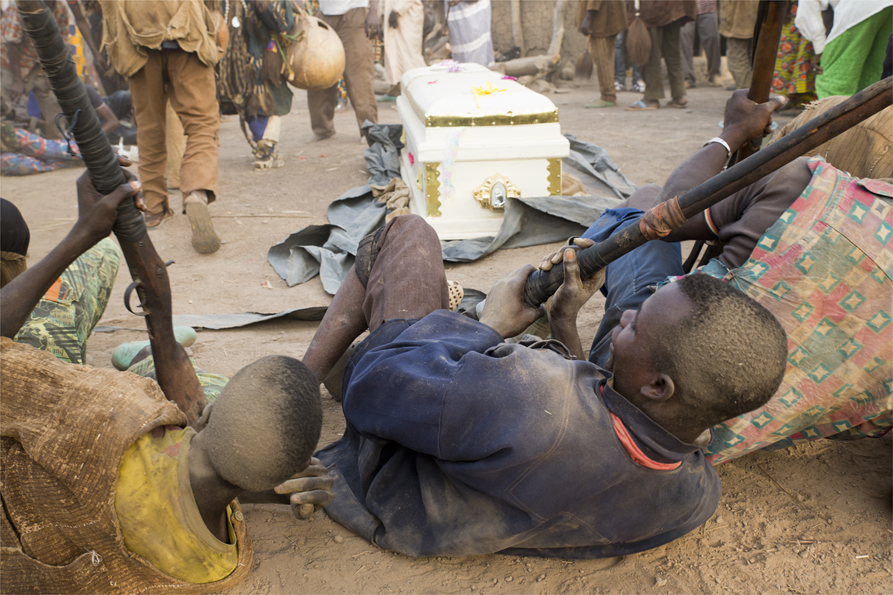
2016, a funeral in the savannah. The hunters’ performance was stunning. Dust began to cover everything. The men proceeded slowly in a circle to surround the coffin, moving in a way that was halfway between walking and dancing. The closer they came, the more they bent their knees, finally creeping through the dirt on the ground. Their feet, their cloth, their hair, their faces—everything turned into a sallow brown. More and more, the hunters merged with the earth and the dirt. Only their guns were still up in the air above their bodies (Figure 1). The singer who accompanied the men jumped onto the coffin and praised the deceased hunter, waiving his flywhisk through the sticky air. The hunters’ performance drew a huge crowd, but nobody dared to come close to them. Men and women watched attentively, but they did not mingle with the hunters as they had done with the relatives of the deceased. Later that evening, one hunter scattered smoldering charcoal over the ground in the middle of the courtyard. The visitors drew back while two other hunters walked across the glow. It was neither inevitable nor an accident. The two stopped in front of the coals as if they were paralyzed, looking at the ground in front of their feet. Then, they braced themselves and deliberately set their feet on the coals, one after the other, walking across the glow. They walked neither slowly, nor in a hurry—just as if they were heading toward the other side of the courtyard. “That doesn’t lie!” mumbled a mid-aged spectator in local French.Footnote 1
Dozo hunters performing at a burial of an elder. Odia, Côte d’Ivoire, February 6, 2016.

Hunters have enjoyed an ambiguous reputation since the early 1990s, when they began to fill the void that the police and the gendarmerie left when they withdrew from the countryside and many towns of the savannah (Bassett Reference Bassett2003, Reference Bassett2004; Hellweg Reference Hellweg2011; Koné Reference Koné2013). On the one side, hunters were known for their bravery, their knowledge of the wilderness, and above all for their war skills; on the other, they were suspected of cooperating with criminals and challenging the state’s monopoly of force. Depending on the speakers’ perspectives, hunters were either praised as “the only true protecting power” of the people or they were denigrated as “fakers” who pretended to have supernatural powers that did not exist (e.g., Kambou Reference Kambou2016; AFP 2014). Disbelief as well as appraisals characterized the public discourse that emerged around them.
But this performance was a proof in itself: it showed what the hunters were capable of and made their power an object of sensory experience. The self-injuries had been intentional acts—so much so that the bystanders began to watch carefully whether all hunters would walk across the charcoal. Not everybody did, and unsurprisingly, that became an issue among the visitors who had witnessed the act. Apparently, there were different levels of secret knowledge that the hunters were supposed to possess. Many spectators interpreted the brutality of the self-inflicted injuries—which they could hardly see—as the definite confirmation that another, concealed reality existed beyond the ordinary that they were all familiar with. As performers, the hunters exposed their audience to their bodily harms and simultaneously invited them to negate the empathy of physical pain that such acts would usually cause. Performance in that context meant that the hunters very literally embodied strength, knowledge, and bravery, while at the same time making their accountability visible.
This forum on the power of performance and the performance of power emerged from a set of critical conversations centered on the importance of hunting fraternities in the contemporary West African savannah. Widely known as dozo and dozoya, meaning “hunters” and “what hunters do,” they belong to the most successful institutions of the Manding world and the area where Manding serves as a market language.Footnote 2 Their role in violent conflicts, in particular the rebellion and civil wars in Côte d’Ivoire, Sierra Leone, Liberia, and to a lesser extent in Mali has made them famous. Many recent publications thus address their role as political and military actors, situating their formation as a corporate group in the contemporary context of dwindling statehood in West Africa’s conflict region.Footnote 3 Their upturn—which was to some extent a revival after a long period of gradual decline—was related to the weakness of state governance and the areas of limited statehood that it caused. As power associations, the hunters increasingly adopted and adapted elements of state governance, in particular in the field of security provision. They often complemented state authority and eventually replaced it (Hellweg Reference Hellweg2011; Heitz-Tokpa in this forum).
Many dozos view themselves as heirs of the old medieval kingdom of Mali, building on an uninterrupted “tradition” of many centuries (Cissé Reference Cissé1964, Reference Cissé1994). Dozos resisted the colonial conquest, but at the same time, they served as guides to French officers to lead them through the wilderness of the country, which was yet unknown to the French (see Gallieni Reference Gallieni1885; Frey Reference Frey1890:28, fig.14). As tradition is often a claim to “a suitable historic past” (Hobsbawm Reference Hobsbawm, Hobsbawm and Ranger1983:1), the dozos’ statements about historic continuities frequently articulate political interests to legitimize the execution of power in local arenas today. Indeed, dozos always demonstrated extraordinary cultural, societal, and political creativity, cross-cutting ethnic and religious identities. There is not one way of the dozos—there are many ways that inform their performance. In areas of acephalous social order, they developed segmentary types of organization, and where Islam was a marginal religion, they built on local religious practices that would be considered “pagan” by Muslims. Hunter associations brought such apparently divergent elements together, creating a coherent oneness that is rightly called dozoya (Hellweg in this forum). Dozo performances display this oneness. And that is how they are perceived by their audience—not as an amalgam of unrelated elements, but rather as a convincing creation in itself (Ferrarini in this forum).
Neither in history nor today were the dozos the only players. Their power also depends on whether their performance—in all its dimensions—is perceived as superior to that of others, including the state and its agencies, as well as other established non-state self-defense groups (Heitz-Tokpa, Hagberg in this forum). Their performances are articulations in a highly competitive field where other power associations are also active—not just the state and its institutions. Competing associations may fulfill similar functions, at a cultural, societal, and military level. New associations may challenge older ones, and they may make use of similar or slightly different performative practices, directly challenging longstanding claims to power (Hagberg in this forum). Still others may focus on specific fields, for instance social integration and the prosecution of deviant behavior. Whatever their purpose is, their performance in all its dimensions has to be convincing: They need to show what services they do and can provide. One dimension of this function is how they perform in practice, for instance when they surveil a neighborhood or a public gathering. The other is how to make that performance visibly convincing. The act of showing, of displaying the association’s performance thus has an aesthetic dimension. Parades in front of public offices, in particular prefectures, police, and gendarmerie stations, are often intended and perceived as an impressive show of force (Heitz-Tokpa in this forum).Footnote 4 Self-inflicted injuries are also a means with which to demonstrate the superior powers of those who do not show any sign of pain when they walk across the hot coals.
Power associations actively seek to enhance their performance and to make it more compelling by often moving beyond the familiarity of their social and cultural milieus. Any little element can make a difference as, for instance, the shirts that display all sorts of references to the wilderness and its hidden powers for those who adhere to local religious belief or to the divine truth of the Qur’an for those who are Muslims. It depends on the spectators’ perspectives whether one or the other dimension surfaces. They will watch the performance in a way that meets their background and expectations. The very same object can have more than one meaning, depending on how it is seen. To distinguish between “true” and “false” does not make sense, as the performers actively seek and combine elements that only Western outsiders would sort along lines of religious purity (Hellweg in this forum). For most actors, the power of the performance is central—not its background in a local or a universal religion.
Having two shirts—an undecorated one for the hunt and another for festivities and public displays—illustrates this aesthetic dimension (Ferrarini in this forum). The latter may display many small packages that can contain verses of the Qur’an written on tiny snippets of paper, but they may also contain the remnants of sacrifices over a local shrine that has nothing to do with Islam. The power of performance will depend on how the audience perceives the shirt. Even the development of a bureaucratic structure, which is, on the one hand, rightly interpreted as a form of statehood under another tutelage, has an aesthetic dimension. An office with a writing desk, a telephone, and perhaps a portrait of the president at the wall can be used as a stage for the performance of power. It is an inherent element of contemporary dozoya, and the koglweogos of Burkina Faso also have created such stages. It would be wrong to belittle such a presentation as merely mimicking the state and its institutions.
Power association is a generic term, and it may seem inappropriate to cover so many different practices and types of associations using the same term. However, the historic and current interactions between these associations have led to a sort of family likeness. Ethnic boundaries were often—though not always—of secondary importance. Today, the korobilão masquerade is widely seen as “Senufo,” but neither its name nor the practice of public witch hunting is a very good fit with Senufo culture. A closer look at the cult’s history shows that various Senari speaking groups borrowed the term in the 1920s from their south-western neighbors who spoke Manding.Footnote 5 Literally translated, korobilão means “put down the bone,” referring to the main task of the association that sustained the masquerade and hunted witches who had killed villagers.
Village societies, often called “secret societies,” are power associations in areas of segmentary social order. Very much like the dozo today, they once defended settlements, for instance against Samory Touré, the last founder of a Manding empire in the late nineteenth century (Person 1968–Reference Person1975). In the savannah areas in northern Côte d’Ivoire, south-eastern Mali, and south-western Burkina Faso, such societies were known as poro. Of these three countries, poro currently only persists as an institution in northern Côte d’Ivoire, and by the turn of the century, it had disappeared in many towns of that area as well.Footnote 6 The reasons have to be sought in the internal organization of the poro society, which differs significantly from that of the dozo. Poro builds on the largely segmental social order of the Senufo: Men are initiated into poro as members of age grades, while initiation into hunter associations is individual and not compulsory. The disintegration of segmentary social orders by cash crop economies and rural-urban migration thus affected poro much more deeply than dozo associations.
However, both associations build on initiation as a precondition of membership; rites play a central role for their internal integration (Förster in this forum). In northern Côte d’Ivoire, both associations have masquerades of the same type: horizontal helmet masks. Though they are clearly distinct institutions, their functions do overlap. They both protect social order, but they do so in different ways. Poro neither engages in military activities nor in witch-hunting. It rather makes its members feel that they belong to one social body. When the Ivorian state disintegrated more and more in the first decade of the twenty-first century, poro slowly began to fill the gap, re-surfacing in some areas after a long period of decline. A number of towns are currently seeking to re-establish the poro lodges in the abandoned woods where the seat of poro was once located. Other villages that never had such lodges are approaching poro associations elsewhere and ask them for help (Förster in this forum). This development parallels to some extent that of the dozo: The increasing emergence of areas of limited statehood has an enormous impact on power associations in the region—not only in Côte d’Ivoire, also in neighboring countries. The two associations addressed that challenge in different ways, but they both did so.
The wider public views dozos, as well as members of poro (see Little Reference Little1965, Reference Little1966, and Keefer Reference Keefer2018 for Sierra Leone), as honest men who share a strong will to serve the community, who are courageous and unbendable—and not least as men who are not corrupt. Corruption is the evil of their time, many say, and the police is the most corrupt body of the administration. Policemen are “legalized thieves,” and politicians are liars and crooks, they often add. In this discursive formation, initiated members of such power associations usually serve as a counter-image. Translated in terms of Greek philosophy, they have a rigid ethos. Their attitude toward the common good is unquestionable, and they show it every day and every night, the people say. Hence the central question of this Forum: What does it mean “to show” such an inner attitude, such an ethos of honesty and bravery? Does ἦθος (ethos, “character, disposition, attitude, convention”) translate into πάθος (pathos, “passion, fervor”, also “suffering”)? Can the people actually “see” the men’s ethos? And on what is this ethos based?
Working with the dichotomy of ethos and pathos has heuristic and analytical advantages. Many ordinary people, in particular in big multicultural cities such as Korhogo or Bobo-Dioulasso, do not know much about the hidden scripts that inform the dozos’ performances. Many assume that such scripts must exist, but since it is to some extent secret knowledge, they, ordinary urbanites, would not try to learn more about it. Nonetheless, the dozos’ performances have an impact—and not only on those who have some knowledge of their association’s secrets. In that sense, the performances of power associations could be understood as a mise-en-scène of a script contained in their oral or, where it exists, written archive (Connerton Reference Connerton1989; Assmann Reference Assmann2007; Latour Reference Latour2012). Such an approach implicitly presumes that the members of the associations are able to display their costumes, their masks, the acts that their performances are composed of as bridges between their audience and the concepts of their religious, cultural, or more broadly historical archive(s). Their performances would be both material and semiotic (Law & Fyfe Reference Law and Fyfe1988).
Such interpretations generate important insights. But they implicitly reproduce the Western model of ethos and pathos, of inner attitudes and outer presentation. From a sociological perspective, they draw a line between a core of knowledge in a privileged sphere—language, cognition, and perhaps text—and its display to someone, eventually an audience. Such interpretations work as long as the basic assumption is not violated, namely, that the audience acknowledges the existence of that privileged sphere. If it does not, the model has little explanatory value, as it would be unable to explain the power of performance by addressing the dialect relationship of performance and power.
In a multicultural context where this basic assumption can no longer be taken for granted, the dichotomy of ethos and pathos calls for another, a more appropriate perspective on performance as such. It should not be conceived as a staging or an acting out of something else but as a pure act of others. West African power associations bring situations into being where the gestures of their members can unfold as such—not as signs or symbols for something else. Neither hunters nor the initiates of other associations perform as actors in the theatrical sense of the term; rather, they perform both as character and as its presentation. They thus undercut the distinction of ethos and pathos, and—which is even more important in a political context of violence and insecurity—of means and ends. By showing what they do, they “trans-act” their intentions towards the social at large. They are what they are through their performance, and they engage in this intersection of life and art, of act and power, in an attempt to overcome the limits of mere knowledge and display (Agamben Reference Agamben2000; Fischer-Lichte Reference Fischer-Lichte2008).
However, in a multicultural social space where different ethnic, national, and religious identities overlap, two or more audiences will co-exist. Besides those who experience the actors’ performance as pure gestures, there will still be others who recognize the existence of concealed knowledge that informs the hunters’ performance as ethos and its display as pathos. Performances have different layers that the audience perceives in different ways. They are pure gesture and pathic display at the very same moment. To understand their double life is the real challenge and the underlying theme of the contributions to this forum.