

On 5 November 2009, the United Nations (UN) General Assembly overwhelmingly endorsed a UN report that found Israel and Hamas violated international law and committed war crimes during the Israeli military operations in Gaza in December 2008 and January 2009. The UN fact-finding mission, headed by South African Justice Richard Goldstone, charged both Israel and Hamas with war crimes and urged both parties to investigate. During the 3-week long Israeli incursion into the Gaza strip, at least 1300 Palestinians and 13 Israelis were killed. At the UN, the resolution endorsing the Goldstone report passed with 114 votes in favor, 18 against. In a statement in the General Assembly, deputy US ambassador to the UN Alejandro Wolff explains the US vote against the resolution in the following terms: ‘We believe that the Goldstone report is deeply flawed, including […] its failure to deal adequately with the asymmetrical nature of the Gaza conflict’.Footnote 1 By asymmetry, the ambassador referred neither to the imbalance in numbers killed nor to the lopsided vote at the UN but to Hamas's ‘decision to base itself and its operations in heavily civilian-populated urban areas’. Wolff's comments echoed an earlier statement by Michael Posner, US Assistant Secretary of State for Democracy, Human Rights and Labor. Speaking on 29 September, in the 12th Session of the UN Human Rights Council, Posner criticized the Goldstone report for failing to take account of the conflict's asymmetry. Posner explained that ‘The conflict in Gaza is emblematic of a new kind of conflict in our world, where some of those engaged in combat use civilian spaces – schools, hospitals and religious institutions – to store weapons and as staging grounds for rocket attacks and armed combat’.Footnote 2
By referring to the Gaza war as a ‘new kind of conflict’, the US officials draw on a by now familiar discourse on new and asymmetric warfare that has become the prevalent paradigm for talking about war over the past 20 years. According to many researchers and commentators, we are in an era of ‘new’ wars, or what have also been called ‘low-intensity conflicts’ (Kitson Reference Kitson1971), ‘fourth-generation warfare (4GW)’ (Lind et al. Reference Lind, Nightengale, Schmitt, Sutton and Wilson1989; Lind Reference Lind2004), ‘small wars’ (U.S. Marine Corps 1940; Merom Reference Merom2003), ‘network-centric warfare’ (Cebrowski and Garstka Reference Cebrowski and Garstka1998; see also Arquilla Reference Arquilla2007), ‘nonconventional’, ‘hybrid’ (Mattis and Hoffman Reference Mattis and Hoffman2005), and ‘asymmetric’ wars (Mack Reference Mack1975; Paul Reference Paul1994; Arreguín-Toft Reference Arreguín-Toft2001).Footnote 3 While these terms have different (and to some extent contradictory) valences, together they form a discursive constellation, a vocabulary for theorizing contemporary war, which I call the ‘asymmetric war discourse’. Even though this term cannot capture the internal differentiation and heterogeneity of this discursive field, I use it to highlight two categories – novelty and asymmetry (and asymmetry as novelty) – that I take to be critical for the political effects it generates. Among the wars that have been called ‘asymmetric’ are the civil wars and insurgencies in Afghanistan and Iraq, the former Yugoslavia, Palestine, Angola, Somalia, Congo, and Sierra Leone; usually included are also the low-intensity wars in Colombia, Indonesia, and in Kashmir, and the terminology is sometimes also meant to incorporate the campaigns of internationally networked terrorist groups such as al-Qaeda, as well as the United States’ Global War on Terror (GWOT).
In this essay, I would like to offer some critical observations and hypotheses concerning the asymmetric war discourse. My questions and approach are interpretive: they are concerned less with the denotative meaning than with the political and cultural significance of this discourse in the contemporary conjuncture. I will argue that the currency of the debates about asymmetric wars lies in its normative dimension: the idiom of asymmetry is not just a neutral descriptive military jargon; rather, it tends to moralize and depoliticize contemporary conflict constellations. In part 1 of the paper, I will map the asymmetric war discourse before turning, in part 2, to this discourse's normative valence, what I call the asymmetric moral economy. I use this term to designate a peculiar feature of the asymmetric war discourse, the tendency to portray powerful states as weak and vulnerable victims of dangerous non-state actors. By emphasizing states’ vulnerabilities to certain kinds of tactics and enemies, this discourse allows states to selectively rationalize brutal tactics against non-state actors; to justify collective punishments of entire populations; and to defend maneuvers that cause high casualties among civilians. The idea of asymmetry functions as a source of legitimacy because it frames the confrontation between states and their ‘asymmetric’ enemies in moral terms and transposes that confrontation onto a neo-colonial template of civilized vs. uncivilized forms of warfare. The claim that asymmetric wars represent new and unprecedented dangers have generated demands to revise the international laws of armed conflict, especially the Geneva Conventions. In part 3, I discuss these demands, as well as the broader consequences of the asymmetric war discourse for the international normative and legal order. While it is unlikely that the calls for official modifications of the Geneva Conventions will be successful, I conclude that the principle of distinction between combatants and civilians is being undermined in less formal and more complicated ways: through imaginative redefinitions of legal terms and creative legal interpretation. These strategies allow officials to publicly defend the integrity of domestic and international legal conventions while pursuing policies that directly contravene their very principles.
The discourse of asymmetry
What I call the asymmetric war discourse is a constellation of partially overlapping debates among scholars of international relations and military theory, military strategists and planners, international lawyers, human rights activists, government officials, commentators, and pundits. Formed through the convergence of academic, military, and political debates, this discourse blurs the conventional boundaries between official state pronouncements, policy debates, and scholarly research. In the United States, these boundaries are further obscured by the critical hinge role played by the military's own research institutions and each service branch's specialized journals, which together produce a tremendous output of material that straddles the lines between research and policy papers.
In the United States, the asymmetric war discourse frequently refers to the GWOT and to US counterinsurgency wars in Iraq and Afghanistan. While these conflicts have significantly shaped the debate about asymmetric war, the idea that contemporary warfare is new and unprecedented predates 11 September 2001. We are, to be sure, not the first generation that imagines its wars to be novel. But in its present iteration, the term ‘new wars’ was introduced in the late 1990s in response to inter-ethnic warfare in the former Yugoslavia. Coined by Kaldor (Reference Kaldor2001), it encapsulates the idea that late 20th and early 21st century conflicts are fundamentally novel because they are no longer fought by states.Footnote 4 Among military historians and strategists, this thesis had already gained some traction following the end of the Cold War, when military theorists such as van Creveld (Reference van Creveld1991) declared the end of conventional warfare and its replacement by civil wars and low-intensity conflicts.
In the context of the protracted wars of the 1990s – think of Sierra Leone and Congo, among others – the debates between scholars were largely about the causes and dynamics of so-called ‘civil’ wars: whereas the literature on civil wars, revolutions, and insurgencies from the 1960s to 1970s tended to emphasize national, anticolonial, and revolutionary motivations for war (Galula Reference Galula1964; Johnson Reference Johnson1966; Wolf Reference Wolf1969; Leites and Wolf Reference Leites and Wolf1970; Kitson Reference Kitson1971; Tilly Reference Tilly1978; Gurr Reference Gurr1988), the debate in the 1990s highlighted two different aspects: the resurgence of ethnic and tribal identities, as in Yugoslavia or Rwanda (Lake and Rothchild Reference Lake and Rothchild1996), and the role of greed and profit-motives in places such as Angola and Sierra Leone (Berdal and Malone Reference Berdal and Malone2000). Resurgent identities and an increasing commercialization of war were seen as the two principal explanatory axes of wars that were marked by weak or failing states (Kaplan Reference Kaplan1994). In the wake of 11 September 2001, these controversies were by and large overshadowed by terrorism and counterterrorism, and following 2001, the novelty of contemporary warfare was primarily ascribed to the strategies of global terrorist networks and the problems of anti-terrorist campaigns.Footnote 5 The debates were no longer framed in terms of ‘greed’ vs. ‘grievance’ or in terms of essentialist vs. constructivist understandings of identity but rather in terms of military strategies: the new key term across military, policy, and academic circles was asymmetry. The diction of ‘asymmetric’ and anti-terrorist warfare was quickly harnessed by some states to reframe their ongoing wars against anticolonial, nationalist, irredentist, and secessionist movements and also served as a template to reinterpret past wars, such as Vietnam. Because the concept of asymmetry is sufficiently broad and pliable, it can encompass a whole variety of conflict constellations. Thus, in 2004, the Pentagon responded to the emerging guerrilla war in Iraq by forming an ‘Asymmetric Warfare Group’ (Crawley Reference Crawley2005). Around the same time, military journals started calling for a unified doctrine for asymmetric warfare (Ancker and Burke Reference Ancker and Burke2003). In 2007, Defense Secretary Gates (Reference Gates2008, 6) acknowledged that the Pentagon needs to change its priorities ‘to be better able to deal with the prevalence of what is called “asymmetric warfare” ’; and in 2008, Taylor & Francis published the first issue of a new journal, titled Dynamics of Asymmetric Conflict.
The term ‘asymmetric war’ is not without its critics (see e.g. Mazarr Reference Mazarr2008). Yet over the past years, asymmetry has become the umbrella term for a diverse assortment of conflict constellations, from civil wars, occupations, counterinsurgencies, counterterrorist campaigns, to information and cyber warfare, drone and robotic strategies, to the conjured threats of dirty nukes, microbial pathogens, and so on. The idiom of ‘asymmetric war’ has become the language of contemporary conflict – not just any language but the vernacular of military experts and commentators, especially in the United States.Footnote 6 The idea that contemporary warfare is both asymmetric and new – new because it is asymmetric – functions as a ‘frame’ for contemporary conflict: a schema through which contemporary warfare is represented, made intelligible, analyzed, and executed. Such frames have become so entangled with military conduct that, as Butler (Reference Butler2009, 29) writes, ‘there is no way to separate, under present historical conditions, the material reality of war from those representational regimes through which it operates and which rationalize its own operation’.
But what exactly does ‘asymmetry’ mean, and in what sense is it new? While the term is frequently used to describe conflict constellations, in which civilians are intentionally and indiscriminately targeted, many scholars and military analysts have criticized this usage as both too broad and too narrow. It is too broad because it includes strategies such as the Allied carpet bombing and firebombing of German and Japanese cities in World War II, a conflict that analysts typically regard as the paradigm of ‘symmetry’, because it was fought primarily between regular state armies. And it is too narrow, because it excludes other unconventional strategies, such as information warfare or forms of political terrorism that target property rather than civilian lives. In the search for a more precise and yet parsimonious definition, some have characterized asymmetry in terms of disparities of access to military technologies (Kalyvas and Balcells Reference Kalyvas and Balcells2010), while others have argued that it involves more than merely an unequal distribution of military resources and capacities (Thornton Reference Thornton2007, 4). According to the 2009 edition of the US Army's Counterinsurgency Manual (FM 3-24.2), an asymmetric war is ‘a conflict in which a weaker opponent uses unorthodox or surprise tactics to attack weak points of a stronger opponent’. But what exactly is meant by ‘unorthodox’ tactics? As examples of unorthodox tactics, the manual lists terrorism, guerilla warfare, criminal activity, subversion, and propaganda. None of these tactics are new, nor are they exclusively used by ‘weaker opponents’. In fact, they have all been part of the United States’ playbook of Cold War interventions in Latin America, Africa, and Asia (e.g. see Mamdani Reference Mamdani2004). Moreover, conceptually, the definition of asymmetry in terms of ‘unorthodox and surprise tactics’ is wanting. Would not the French cavalry assembled at the battle of Crécy in 1346 have considered the longbows used by the English archers an ‘unorthodox or surprise tactic’?Footnote 7 In the wake of al-Qaeda's deployment of commercial airliners as missiles on 11 September 2001, others have argued that the hallmark of asymmetry is the ability to turn ‘the adversary's advantage against them’, by converting the adversary's technological superiority into a liability (Bellamy Reference Bellamy2002, 152). But the idea of using the adversary's advantage against them is nothing new – it is a principle of all strategy, from Sun Tzu through Machiavelli to Napoleon. After all, the Athenian victory in the Second Persian War in 480 BC was based on getting the epic Persian fleet into the narrow Straits of Salamis, where the vast number of ships became a decisive drawback. In other words, if asymmetric war is defined in terms of disparities in either military technologies or in tactics, then this would suggest that all warfare is to some extent asymmetric.Footnote 8 It is therefore unclear what exactly the concept of ‘asymmetry’ adds to the nomenclature of war and whether there is much by way of specificity to it. And yet, while many authors acknowledge that asymmetry is as old as warfare itself, most continue to treat the concept as though it designated a historically unprecedented constellation (Bellamy Reference Bellamy2002, 152).
The pervasiveness of the vocabulary of asymmetry despite its peculiar incoherence and vagueness suggests that the significance of this discourse may lie not in the particular taxonomies of conflict it generates but elsewhere. Granted, ‘asymmetric war’ is by no means the only incoherent or vague concept used by social scientists, military strategists, and commentators. The mere fact that a concept is underspecified does not necessarily imply further conclusions. Nevertheless, I would like to suggest that in the case of the asymmetric war discourse, conceptual vagueness is not accidental but constitutive of the very objects of knowledge indexed by this terminology. At bottom, the terms ‘new’, ‘irregular’, and ‘asymmetric’ mark little more than the fact that these conflicts typically involve a confrontation between states and non-state actors. But if that is all there is to asymmetry, what explains the success of this peculiarly incoherent idiom? If the asymmetric war discourse is a ‘frame’ or ‘representational regime’ of war, and if Butler (Reference Butler2009, 29) is right that such regimes rationalize war, then we must ask how this rationalization operates. How does the asymmetric war discourse generate a rationality for contemporary warfare?
From the vantage point of rationalizing war, the amorphous nature of the term ‘asymmetric war’ may not be a liability but an asset. To the extent to which the language of asymmetry is increasingly vague, it serves as a convenient all-purpose theme through which a motley variety of contemporary conflicts can be glossed. The nebulous quality of the concept allows a set of diverse conflicts to be grouped under a single heading. To be sure, there is nothing inherent in the term ‘asymmetric war’ that predestines it for that role. Any of the other various labels that have been proposed for contemporary conflicts could have fulfilled this synthetic function. And yet, the word ‘asymmetry’ captures something important about how major global or regional powers – such as the United States, Russia, or Israel – respond to the (real or imagined) threats of non-state actors. The term ‘asymmetry’ suggests instability: a pair of scales that are off balance, a disequilibrium to be recalibrated, an imbalance that calls for a counterweight. In short, the label ‘asymmetric war’ evokes a pathology. It functions as a diagnosis that already insinuates a pertinent treatment: if the conflict constellation is asymmetric, it can be re-symmetrized (Münkler Reference Münkler2006). Of course the only way to re-symmetrize a conflict is for states to respond in kind, that is, to imitate the asymmetric strategies of non-state actors. Thus, states and security apparatuses involved in these conflicts (especially the ones that define what Gregory (Reference Gregory2004) calls the ‘colonial present’) derive immediate political benefits from rebranding them as ‘asymmetric’. If conflicts are fought against ‘asymmetric’ enemies, states can claim latitude in the nature and scope of their response. This idiom allows states to selectively rationalize brutal tactics against non-state actors; to justify collective punishments of entire populations; and to defend operations that cause high degrees of ‘collateral damage’. The US opposition to the Goldstone Report, for instance, would be much harder to explain if the 2008–2009 Gaza War were portrayed as an anti-guerrilla war or as a counterinsurgency. In this context, the claim to asymmetry and novelty functions as a political shield against states’ legal responsibilities under international law, a point to which I will return in more detail below.
The asymmetric moral economy
The menacing quality ascribed to asymmetric wars derives from the perceived impossibility to retaliate in kind against non-state actors. The typical way this scenario is narrated is that rebels or insurgents can effectively target state armies with improvised explosive devices and terrorists wreak havoc on civilian populations, all the while (especially democratic) states are seen as unable to reciprocate, either because of legal or moral restraint (Merom Reference Merom2003) or simply because such reprisals would be ineffective in (militarily or politically) weakening their opponents (Sechser Reference Sechser2010). As a result, states are no longer able to control and contain military violence. Thus, Münkler (Reference Münkler2005) explains the excess violence of contemporary conflicts as a direct result of the loss of state control. The privatization and commercialization of violence; the increasing presence of local warlords and war entrepreneurs who traffic in arms, narcotics, blood diamonds, organs, and sex workers; and the role of child soldiers are all understood as results of the disintegration of the state's monopoly on warfare. Münkler and others derive the entire phenomenology of contemporary conflict from the postulates of asymmetry and irregularity: where the state used to guarantee the distinctions between war and peace, between friend and enemy, between combatants and civilian, between the violence of war and the violence of crime, and between war and commerce, contemporary conflicts blur all these boundaries (Kaldor Reference Kaldor2001, 20; Münkler Reference Münkler2005, 38–41). Labeling the tactics used by non-state actors ‘asymmetric’ thus insinuates that they are directed not just against a particular state but constitute threats to the international system's institutional and normative order. That order is based on the principle that the use of force is the prerogative of states and that violence by non-state actors is by definition illegitimate and has a corrosive effect on the ability of states to maintain their ostensible monopolies of legitimate violence. Implicit in the language of asymmetry is thus the distinction between legitimate and illegitimate violence.
What makes the language of asymmetry so effective is that it allows states to present themselves as vulnerable to strategic constellations that they ostensibly cannot win and moralize that difference. States, in other words, have learnt how to turn certain vulnerabilities into advantages by broadcasting themselves as victims. Thus, the US military described the alleged suicides of three detainees at Guantánamo Bay as ‘an act of asymmetric warfare waged against us’,Footnote 9 while Israeli pundits continue to worry about how Israel is facing a massive asymmetric ‘information war, unprecedented in scale and scope’.Footnote 10 The discourse of asymmetry allows states like the United States or Israel to present themselves not just as victims of malicious tactics, but as targets of a corrosive kind of power that has the potential to destroy the global political order. The asymmetric enemy, by contrast, can be depicted as a universal threat to peace and security. Here, the image of states as ‘afflicted powers’ is part and parcel of a representational strategy that generates legitimacy for state violence by inverting the actual power relations that structure contemporary conflicts (Retort Reference Retort2005). The asymmetric sleight of hand is that the actors rendered most vulnerable to asymmetric warfare are the most powerful states, those with the largest militaries and most sophisticated technologies and weapons systems. No wonder, then, that in the context of changing purposes of military force in the post-cold war international order (Finnemore Reference Finnemore2003), asymmetry has become the preferred framework for explaining and rationalizing the use of military force.
The vocabulary of asymmetry conveys a very peculiar moral economy. As General Wesley Clark (Reference Clark2000) puts it in a different context, yet in terms that capture why the logic of asymmetry is so useful for Israeli public relations: ‘For Israel, every casualty, even those among Palestinians, is a loss. […] For the Palestinians, every casualty, even their own, can be a strategic gain’. Clark's logic of asymmetry locks the Israeli–Palestinian conflict in a strategic zero-sum game: if casualties are always detrimental to Israel and at least sometimes advantageous to Palestinians, then the Palestinian side clearly has the upper hand, since escalation is always the easier tactic. What is odd about this account of asymmetry is that it is quite obviously inaccurate: of course Israel also uses casualties (both Jewish and Palestinian) to its strategic advantage, catering to both domestic and international audiences. Israel broadcasts dead Palestinian bodies as deterrent and retribution while publicizing dead Jewish bodies for domestic support and international patronage for punitive military strikes, increased blockades and surveillance, and for advancing the project of colonizing Palestinian land. This is not to say that there are no differences between the strategies employed by the sides in this conflict; yet the language of asymmetry obscures these differences rather than making them apparent.
One of the most perceptive definitions of asymmetry comes from Barnett (Reference Barnett2003, 15), professor emeritus at the US Naval War College and retired Navy captain, who characterizes a true asymmetric conflict as one that involves an adversary that will do things ‘that you either cannot or will not’. The concept of asymmetry, in other words, entails a claim about difference, about difference between self and other, ‘us’ and ‘them’, and about the limits to which ‘we’ can go without becoming like ‘them’. The difference marked by asymmetry is radical and existential: it indicates the ‘absence of a common basis of comparison’ (Meigs Reference Meigs2003, 4). To borrow Shapiro's (Reference Shapiro1996, 457) terminology, the concept of asymmetry pertains not only to the ‘strategic’ face of war, but also to its ‘ontological’ face, that is, to the concern with the being and identity of the entities that make up the field of war. The idea that an asymmetric enemy will do things ‘that you either cannot or will not’ implies that asymmetry has to do with limits and with norms: the norms that differentiate between admissible and inadmissible modes of warfare, between legitimate and illegitimate violence, and between civilization and savagery.
The nomenclature of war never merely consists of neutral descriptors (Helms Reference Helms2003, 23). As the example of General Clark's comment shows, the assertion that one side in a conflict avails itself of asymmetric strategies is not just a military analysis. The charge that an opponent uses asymmetric warfare is typically leveled by the stronger side, and just as in Clark's case, frequently involves an explicit or implicit moral evaluation. In the case of Israel–Palestine, it plays on the frequent accusation (here repeated by Clark) that Jews value life more dearly than Palestinians. In the Yugoslav wars, Bosnian Serbs charged Bosnian Muslims with bombing their own population to gain world sympathy and to discredit the Bosnian–Serb army.Footnote 11 In both cases, the implication is that the enemy is not just fighting with ‘unorthodox’ tactics but that these tactics are fundamentally uncivilized.
The distinction between ‘symmetric’ and ‘asymmetric’ enemies parallels the distinction between ‘war’ and ‘terrorism’, which as Asad (Reference Asad2007, 16, 22, 32) has argued, is central to the constitution of the liberal state. States need to be able to distinguish between forms of violence that can (under certain conditions) be legal and legitimate and forms of violence that are never legitimate. In symmetric wars, Asad explains, the moral problem involves avoiding excess violence, that is, violence that is not strictly necessary to achieve one's war aims. Asymmetric wars, by contrast, are seen as violent and excessive in their essence. To mark a conflict as asymmetric is thus to insist that the adversary fails to adhere to the norms of war, especially to the principle of discrimination or distinction between combatants and civilians. Because the asymmetric enemy does not discriminate between combatants and civilians, it is not a lawful enemy (justus hostis) both in terms of international law and just war theory. To the extent that the laws of war are regarded as the crucible of civilization, enemies who flout them are thereby marked as barbarians or savages. This civilizational logic thus becomes a way for states to justify forms of violence otherwise considered unlawful or illegitimate.
The argument that wars against enemies who do not conform to standards of civilization do not fall under the aegis of international law has a long colonial heritage. In a 1927 article in the American Journal of International Law titled ‘How to Fight Savage Tribes’, Colby (Reference Colby1927, 279), a US Army Captain, wrote: when ‘savage or semi-savage peoples […] effect ruses, surprises, or massacres’ against ‘regular’ (i.e. Western) troops, the uncivilized enemy must not be allowed to benefit from the international law of armed conflict. Colby concludes that war against savage adversaries who do not respect the laws of war must be ‘more brutal’ and involve ‘harsh methods’ and ‘rigorous measures’ (1927, 283, 285). Analogous to contemporary commentators, Colby justifies extraordinary military measures against asymmetric enemies by invoking their failure to adhere to universal standards of civilized warfare. The difference is that whereas Colby sees this non-adherence to the laws of armed conflict as resulting from the adversaries being ‘savage’, in today's discursive landscape the causality is inverted: it is because they do not comply with the norms of warfare that the asymmetric enemy deserves the label ‘savage’. The discourse of asymmetry thus forms a site where debates about military strategy, interventionist foreign policy, and a racialized colonial discourse intersect to construct a taxonomy of symmetric/asymmetric enemies superimposed on a schema of civilization vs. savagery.
Asad (who cites Colby) places the parallels between colonial warfare and contemporary wars against terrorists in the context of today's high-tech wars that increase the distance between NATO soldiers and their enemies to the point that the latter can be killed with impunity while casualties among US soldiers (or its allies) can be minimized. The effect of this increasing distance is an image of war no longer concerned with the risk of dying but primarily with the task of killing (Asad Reference Asad2007, 35; see also Shaw Reference Shaw2005). While in military discourse, the minimization of casualties is frequently seen as a strategic response to the pressures of public opinion in a ‘post-heroic’ society (Luttwak Reference Luttwak1995; Luttwak Reference Luttwak1996; Münkler Reference Münkler2006), Asad points out that there is ‘a long-standing tradition of fighting against militarily and ethnically inferior peoples in which it is proper that the latter die in much larger numbers’ (2007, 35). For Asad, Western military interventions continue this long-standing colonial tradition by rendering certain kinds of lives and human subjects disposable.
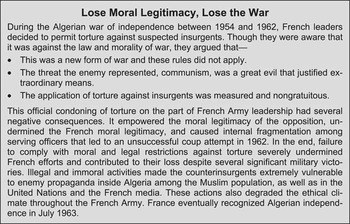
The colonial history of warfare does indeed form the soft underbelly of contemporary military discourse. On the political level, the continuities and parallels that tie Western military intervention to brutal colonial and anti-insurgency wars of the 19th and 20th centuries are frequently overlooked. Yet on the operational level, in the military's field manuals and documents, those very same conflicts are often adduced as examples for predecessors of contemporary conflicts. Thus, the 2006 US Army and Marine Counterinsurgency Field Manual (FM 3-24) cites the Algerian war as an example for what not to do in a counterinsurgency campaign (Figure 1).
Vignette from Counterinsurgency Field Manual (FM 3-24, 7-9).

It would be worthwhile, at some point, to perform a close reading of US military manuals, especially FM 3-24, not just for its content but to examine its formal aspects and rhetorical structure, for instance the way that gray-shaded boxes function as decontextualized didactic illustrations.Footnote 12 The gray-shaded vignette instructs that the French lost the war because they permitted torture. The use of torture made them vulnerable to enemy propaganda, such as Fanon's (Reference Fanon1994, 24) famous statement that the European nation that practices torture undermines its own claim to represent civilization in the face of barbarism. The US military's official opposition to torture as illegal, unethical, and ineffective is well-established; however, this vignette signifies a lot more than merely an injunction not to torture. By invoking the Algerian war as an example, the Counterinsurgency Manual implicitly recognizes the lineage that ties the insurgencies in Iraq and Afghanistan to the anti-colonial uprisings of the 1960s and 1970s. It is telling that the manual explains the loss of French legitimacy in moral rather than political terms. By this, I mean that the manual reduces the failure of the French counterinsurgency campaign to a neglect of moral codes, to a malfunctioning moral calculus that is entirely removed from the specific historical and political context. Readers are led to believe that the French lost the war not because their position as a colonial power was illegitimate and unsustainable. What compromised the French war effort, according to the COIN manual, was not colonialism as a racialized system of subjugation, not the denial of Algerian self-determination, not the absurdity of the French belief in their imperial mission civilisatrice, not the failure of various political projects to establish a vision of France larger than the hexagon, nor the inability of the Fourth Republic to devise an effective policy of decolonization (see e.g. Lustick Reference Lustick1993, 81–119). Rather, the field manual suggests, France lost the war because of a malfunction of military conduct. The take-home message is encapsulated in the title: ‘Lose Moral Legitimacy, Lose the War’. Legitimacy here is explicitly depoliticized: it is qualified as a moral rather than a political problem.Footnote 13
By turning the Algerian war into a historical specimen of an asymmetric constellation, the manual decontextualizes and depoliticizes the confrontation between the French army and the Algerian FLN. Readers – US military leaders and planners – are asked to identify with the French colonizers and to learn from their mistakes. (That the vignette identifies the ‘threat’ originating from the insurgents as ‘communism’ rather than nationalism, anti-colonialism, or self-determination is part of the effort to recode the Algerian war in terms of a moral hierarchy recognizable to American audiences.) The manual thus acknowledges the colonial genealogy of US counterinsurgency but neutralizes this genealogy at the same time, reducing it to a repository of strategic and tactical illustrations within a cosmic struggle against evil (communism or terrorism – take your pick).Footnote 14 The language of asymmetry serves to refashion the Algerian War of Independence into an abstract confrontation between regular and irregular forces, between a state and a non-state actor. Through the kaleidoscope of asymmetry, the principal distinction between these forces is not the colonial relation of domination but the implicit distinction between legitimate and illegitimate (or civilized and uncivilized) forms of violence. The lesson to be learnt is that a successful counterinsurgency must remain within the bounds of civilized warfare and must not allow itself to become like its enemies.
That the Algerian War of Independence serves as a reminder against torture shows the US military's concern to uphold the legal and moral codes that distinguish it from its asymmetric enemies even as these codes are being subverted in various different ways. To the extent that torture is the official benchmark for the distinction between civilized and barbarian warfare (or in contemporary terms, between states and their asymmetric enemies), the terms that structure this civilizational hierarchy are replicated in contemporary discourse. The prohibition on torture amounts to an injunction to safeguard the civilizational difference between ‘us’ and ‘them’, to avoid becoming ‘like them’ and thus lose the claim to moral and cultural superiority. Insofar as the official US manual for how to fight a counterinsurgency indexes the Franco–Algerian war in terms that evoke a civilizational difference between the United States and its asymmetric enemies (aka the insurgents), it is a reminder that the asymmetric war discourse does not abandon the hierarchies between civilized and uncivilized forms of warfare that emerged in the colonial era but reorganizes them. If the colonial wars of the past marked the racially coded space where European limitations on warfare did not apply, today's ‘asymmetric wars’ represent cultural zones of danger, where civilizational differences are liable to be flattened and undone.
Implications for the international legal and normative order
The assertion of novelty and the emphasis on asymmetry underwrite claims that contemporary conflicts require a new legal and normative order (Jackson Reference Jackson2007). If wars in the past were symmetrical and they are no longer, then the obvious conclusion, we are told, is that the international law of war and international humanitarian law (IHL) as encoded in the Hague and Geneva conventions are no longer relevant. Or, in more technical legal language: IHL lacks a clear definition of ‘armed conflict’; and the challenge of asymmetric wars is that they fall neither under the conventional notions of international (inter-state) nor internal armed conflict.Footnote 15 Moreover, since the non-state entities in these wars typically do not fulfill the criteria set out by the Geneva Conventions,Footnote 16 do not recognize IHL, or indeed strategically violate the laws of war in the pursuit of military advantage (Arreguín-Toft Reference Arreguín-Toft2001, 101–102), some have argued that the lack of reciprocity implies that the provisions of IHL do not apply (hence the designation by the United States, of presumed al-Qaeda fighters as ‘unlawful combatants’).Footnote 17 Along these lines, a growing number of politicians, strategists, and researchers – and not only neoconservatives – have argued that the legal rules of war need to be modified. While the current international legal regime is under pressure from two opposing directions – from demands to expand the international legal, judicial, and enforcement mechanisms and reinforce the legal responsibility of military actors, and from demands to contract the domain of the law by lowering the legal curbs on state violence – it is primarily the latter who frame their calls in terms of the language of ‘new’ and ‘asymmetric’ wars.Footnote 18
Pressure to make the international legal regime more responsive to the structure of contemporary conflict comes from academics and officials who argue that the requirements imposed by existing law on states are too burdensome and fail to address vital national security concerns. Aside from arguments concerning the applicability of certain laws of war (as in the case of the United States’ refusal to recognize the applicability of the 3rd Geneva Convention to Guantánamo detainees), there have been calls to renegotiate and rewrite the actual stipulations of the laws of war, especially the principle of distinction – the requirement to distinguish between civilians and combatants – embodied in the 4th Geneva Convention. Harvard Law Professor Alan Dershowitz, for instance, has argued that asymmetric warfare ‘requires a reassessment of the rules of war’.Footnote 19 Dershowitz made his comment, in response to criticisms of Israel for violating the principle of proportionality in its war against Lebanon in 2006, echoing a claim by then Israeli defense minister Amir Peretz that Lebanese civilians in whose homes rockets were being hidden are ‘involved’ in the war.Footnote 20 Of course if you are ‘involved’, you are no longer a non-combatant and you potentially become a military target. Sympathetic American commentators and international lawyers rushed to cover Israel's back, arguing that heavy civilian casualties are not Israel's fault but the direct result of asymmetric warfare waged by groups such as Hezbollah who operate from within civilian areas.Footnote 21 Dershowitz argued that the distinction between combatants and civilians is no longer binary today. Instead, ‘there is a continuum of “civilianality”: Near the most civilian end of this continuum are the pure innocents – babies, hostages and others completely uninvolved; at the more combatant end are civilians who willingly harbor terrorists, provide material resources and serve as human shields; in the middle are those who support the terrorists politically, or spiritually’.Footnote 22 The objective of such efforts is moralization and depoliticization of a formerly political category. At stake is the replacement of the category of civilian, which, as a regulative ideal, is nondiscriminatory with respect to an individual's political views by a scale of accountability that ranges from guilty to innocent. The substitution of ‘civilian’ by ‘innocent’ marks a return to the nomenclature of the early modern period, used by authors such as the 17th century legal theorist Hugo Grotius. While IHL has never left the idea of innocence behind, the category of civilian on which the Geneva Conventions are based marked a deliberate effort to separate the duties and obligations owed to individuals in war from their political involvement. To be granted the protections due to a civilian, one need not be morally or politically innocent. The explicit return, then, to the nomenclature of innocence is – despite its hallowed history – an attempt to abrogate the non-discriminatory aspirations of IHL, even if these latter were never realized.
The neologism ‘civilianality’ transforms the combatant/civilian binary – considered by the International Committee of the Red Cross as the hinge of IHL (Melzer Reference Melzer2009) – into a continuum. When you are no longer considered a full civilian but say a three-fifth civilian because you show political or spiritual support for insurgents or fighters whom others consider ‘terrorists’, then you are no longer entitled to the same kind of protection international law accords to ‘full’ civilians. According to this three-fifth compromise, you are now considered a semi-legitimate target or perhaps a partial collateral damage. By calling this a three-fifth compromise, I am referring of course to the apportionment compromise reached by the Philadelphia Convention of 1787, according to which a slave counted as three-fifths of a free person for the purposes of tax distribution and apportionment of representatives. I am not suggesting that the civilianality continuum proposed by Dershowitz and the apportionment compromise are the same. The allusion is meant to contextualize the proposal to think of civilians in terms of a ratio or continuum in the history of practices that assign the status of a person or a citizen a numerical value and proceed to calculate and distribute civil, political, and human rights in terms of this quantification.
Dershowitz's position is an extreme one, but it illustrates a trend. While no government has as of yet abrogated the principle of distinction, the debates are under way. Following Finnemore and Sikkink (Reference Finnemore and Sikkink1998, 895–897), Dershowitz can be understood as a ‘norm entrepreneur’ who calls attention to an issue, frames and dramatizes it, and attempts to shape the contours of the debate. In 2007, the Institutes for Counter-Terrorism of Syracuse University and of Herzliya held a joint conference on ‘New Battlefield, Old Laws’ to discuss ways of ‘fine-tuning’ international law in the context of challenges of 21st century warfare.Footnote 23 The debates were focused on modifying the Geneva Conventions and on redefining the categories of protected persons. But what is this rigid definition of ‘civilian’ in the Geneva Conventions that is considered so out of date? If we turn to the 1949 4th Convention Relative to the Protection of Civilian Persons in Time of War, what stands out immediately is that the Convention lacks a clear definition of what a ‘civilian’ is. And while the first Protocol Additional contains an entire article on terminology, which defines terms such as ‘wounded’, ‘sick’, ‘shipwrecked’, ‘religious personnel’, and ‘medical vehicles’, the term ‘civilian’ is only defined ex negativo, in terms of its opposition to ‘military’ and ‘combatant’. One might have expected more attention to this category, given the timing of the Convention in the immediate post-war era, especially in view of the extensive involvement of the civilian population in World War II, both in the war effort on all sides and as targets for aerial bombing. As Kinsella (2005b) has argued, this underdetermination of one of the key conceptual pillars of the international laws of war is not a coincidence. Rather, it is a result of the political struggles at the time and of the fact that the Convention's task was not simply to encode a previously existing combatant/civilian dichotomy but ‘to produce the difference between the two’ (Kinsella Reference Kinsella2005b, 264). Already at the time, there were renowned legal scholars who scoffed at the idea of distinguishing combatants from civilians, indicating that the distinction has been unstable and controversial from the very start. The claim, then, that the Geneva Conventions set too high a standard is by no means new. Yet the depiction of asymmetry as a novel constellation in today's conflicts provides a rationale for claims that the civilian/combatant dichotomy had its value in past wars but is no longer adequate for contemporary conflict constellations.
The idea of a continuum of ‘civilianality’ suggests a more precise and fine-tuned calculation of civilian status. Instead of the crude binary between combatant and civilian, it introduces a flexible and versatile scale, according to which civilian status can be tallied. The extent to which one counts as a civilian thus becomes subject to an intricate computation; civilian status becomes an object of specialized knowledge and expertise.Footnote 24 It requires not only the determination whether someone is a direct participant in war but a detailed socio- and psychographic analysis that diagnoses and classifies an individual's political views and proclivities and detects the extent to which someone ‘supports’ a particular act of asymmetric warfare. The logistical impossibility to actually conduct such an evaluation for every civilian killed suggests that the rationality of such a spectrum is elsewhere. Leaving aside the possibility that these proposals may in fact be aimed at making the determination of civilian status entirely impracticable, thus vacating the protections international law accords to civilians, there is another possible interpretation. If the spectrum of ‘civilianality’ would be used to compute civilian status, the object of such a computation would likely not be an individual but entire populations.
Whereas the question of whether an individual supports a particular armed group – politically or spiritually, to use Dershowitz's words – is difficult to resolve, at the aggregate level of a population it becomes a statistical problem. What percentage of the South Lebanese population voted for Hezbollah in the most recent Lebanese elections? How many votes did Hamas receive in Gaza? How many Afghans in Helmand Province acknowledge that they endorse the Taliban? These are just some of the questions one could ask to determine what kind of support a particular armed group has among a given population. In this aggregate model, the quality of being a civilian shifts from the status of an individual to a population because it is on the level of the population that the question of civilianality can be effectively determined as a statistical regularity. Mechanisms of optical and electronic surveillance, censuses, surveys, opinion polls, media analysis, and probability calculations in addition to covert intelligence operations are some of the possible techniques to compute the statistical distribution of civilianality among a given population and to determine whether the statistical mean and standard deviation are within the limits of acceptability.
Whereas, according to the Geneva Conventions, an individual is presumed a civilian unless he or she takes direct part in hostilities, the schema of a civilian spectrum appears to reverse the burden of proof. If an armed group manages to hide weapons in a residential neighborhood, one can presume that such a group received support from at least some of the residents. At this point, the question is what form the economy of support takes, what the statistical values are, and how the armed group circulates among the population. Under such conditions, it may be incumbent on residents to demonstrate their opposition to such practices in order to be awarded civilian status. Civilian status can no longer be presumed; it becomes a prize that is granted and conferred upon an individual or a group as a reward for good behavior. And like all rewards, it can be revoked at any point, which suggests that civilianality has the potential of being deployed as a carrot-and-stick mechanism with which one can manage and train ‘ungovernable’ populations.Footnote 25
As of yet, the demands to rewrite the 4th Geneva Conventions have not been translated into a formal process of revising existing treaty law. Indeed, Kinsella points to a disparity in compliance between the 3rd and 4th Geneva Convention: even as the Bush administration rejected the applicability of Geneva III to the Guantánamo detainees, it underscored the principle of distinction ‘as central to [the United States’] military operations’ (Kinsella Reference Kinsella2005a, 168). Nevertheless, even though one of the cornerstones of General Petraeus's counterinsurgency doctrine is minimizing civilian casualties, the default position by the United States is that those who are killed in its operations are enemy combatants unless someone proves the opposite. The determination of civilian status takes place post facto (or post mortem), and the fact that the Pentagon officially refuses to keep a civilian body count or to even estimate the numbers of civilian casualties indicates that the US government does not consider itself to be responsible for determining who, among its victims, is a civilian.Footnote 26 While the Israeli military, in contrast, does have a count of those killed who are ‘uninvolved’ in hostilities (shunning the term ‘civilian’), it typically includes only women and children under the age of 16 years. According to this accounting practice (recently replicated by a UN agencyFootnote 27), men and boys over the age of 16 years are by default considered ‘involved’ unless proven otherwise.Footnote 28 Even if officially, both Israel and the United States insist on their continuous compliance with the 4th Geneva Convention, de facto, the presumption of civilian status has thus already been seriously compromised.
It may well be that in the long run, the asymmetric war discourse will not lead to a large-scale revision of the international laws of armed conflict and that attempts to renegotiate major international conventions in light of the GWOT will eventually dissipate. If, as I have been arguing, the distinction between symmetric and asymmetric warfare (and thus between legitimate and illegitimate violence) is not incidental but constitutive for the institutional norms that govern the international order, redrafting these norms would fundamentally alter this order and undermine the legitimacy of states as its guarantors. That there is no radical overhaul on the horizon of the formal principles of the international laws of war is also suggested by the UN's vote on the Goldstone report. Ultimately, objections by the United States and others that the asymmetrical nature of the conflict was insufficiently accounted for in the report failed to sway a majority of states, and the report was overwhelmingly endorsed by the UN General Assembly. The vote was primarily a symbolic affirmation of the Geneva Conventions: it asked UN Secretary General Ban Ki-moon to refer the Goldstone report to the Security Council and to report back to the GA about the implementation of the 4th Geneva Convention in the Occupied Palestinian Territories.
The continuing public endorsement of the laws of armed conflict by, for example, the United States and Israeli military suggests that militarized security apparatuses find it more expedient to preserve the Geneva Conventions in principle while maintaining the flexibility to selectively disregard them. The rationale for this flexibility is provided not least by the asymmetric war discourse, which supplies a framework to systematically puncture loopholes into the laws of armed conflict yet remain committed to them. Thus, in the shadow of the public avowals of deference to legal standards, a new normative order may already be in the process of congealing (Winter Reference Winter2008). While many international norms are institutionalized in the form of explicit rules and organizations, the transformation of norms does not necessarily follow a formal institutional protocol. Two examples illustrate this point: (1) In the United States, over the past 10 years the most egregious departures from the domestic and international legal and normative order took place not through explicit defiance or renegotiation of statutes and conventions but through imaginative redefinitions of legal terms and creative legal interpretation. The attempt to legalize torture did not involve Justice Department officials coming forward with proposals to modify the various international declarations and conventions of which the United States is a signatory. Rather, the Justice Department worked to redefine the concept of torture and to increase the bar for what would count as torture. (2) In Israel, over the same time period, military lawyers have successfully managed to reclassify military operations in the occupied Palestinian Territories from the law enforcement model – as required by the international law of occupation – to one of armed conflict. Whereas the ‘law enforcement’ model requires soldiers to minimize the use of force, the ‘armed conflict’ model provides the military with more latitude in its resort to lethal force. George Bisharat has argued that the Israeli push to redefine these operations began sometime after the start of the Second Intifada, and that today it has been widely accepted by most observers, including major international human rights NGOs such as Amnesty International.Footnote 29
These two examples suggest that the public debates about how to adjust international law to a purportedly new reality may ultimately be only one part of the transformation of the normative order and that this transformation may, to a large extent, take place through a rewriting of the terms according to which certain kinds of violations are recognized. This strategy allows officials to publicly defend the integrity of domestic and international legal conventions while pursuing policies that undermine the very principles affirmed by these conventions and which rely on the political cover provided by the asymmetric war discourse. Weizman (Reference Weizman2009) has offered an insightful analysis of the way in which Israel is deliberately attempting to rewrite international law. He cites an exposé published in the Israeli daily Ha'aretz, which portrays the increasing role of the Israeli military's international law division (ILD) not only in authorizing attacks against civilians, but also in shaping new military tactics that are considered compliant with international law.Footnote 30 According to the exposé's authors, the ILD's lawyers first prodded military planners to develop the technique known as ‘knocking on the roof’, in which the Israeli military fires a non-explosive missile on the roof of a house to warn its inhabitants that the building will be destroyed. The roof-knocking operations are one of the ways by which the Israeli military minimizes civilian casualties by ‘informing’ residents that their house is under attack.Footnote 31 However, in addition, the ILD's legal experts say that the roof-knocking procedure functions as a legal indemnification: anyone who remains in the building after being warned can be regarded as a combatant. The point of the technique, then, is not only to protect lives but also to strategically probe the maximum flexibility of the law in order to redefine legitimate forms of killing. The article quotes the ILD unit's former commander's conclusion that these practices are effecting a transformation of international law. ‘If you do something for long enough, the world will accept it’. Israel's decision to use ‘targeted assassinations’ openly during the Second Intifada (earlier the tactic was used but not publicly acknowledged) is a case in point. Following initial international condemnation, the policy is now the norm and is used among others by the United States in its drone wars in Afghanistan and Pakistan. Rather than renegotiate the 4th Geneva Convention, the more obvious strategy, then, is to erode its legal protections from within.
Conclusion
The asymmetric war discourse offers an umbrella for a diverse assortment of contemporary conflict constellations and a framework for interpreting and reinterpreting past and present conflicts. Yet the language of asymmetry is not just a conveniently vague gloss to package a variety of conflicts, it also introduces a normative schema that moralizes and depoliticizes the difference between states and non-state actors and between regular and irregular forces. The discourse of asymmetry allows states to moralize their vulnerability to certain kinds of tactics; to selectively rationalize brutal tactics against non-state actors; to justify collective punishments of entire populations; and to defend maneuvers that cause high casualties among civilians. This normative schema operates at least partly through a civilizational template that maps the categories of civilized/uncivilized onto regular/irregular and state/non-state. In order to understand the effectiveness of the language of asymmetry, one must look, therefore, not just at the technological and strategic aspects of war, but at the way in which the moral and civilizational categories insinuated by this terminology (including their colonial heritage) generate a stock of legitimacy for certain military operations. The misrecognition of this colonial heritage can be glimpsed in the treatment afforded to colonial wars in contemporary military discourse. By decontextualizing and depoliticizing colonial and anti-colonial struggles, the political stakes of such wars (self-determination, freedom, popular sovereignty, autonomy) are tacitly removed from the criteria of legitimate warfare. Instead, the benchmark for ‘civilized’ and ‘legitimate’ war is whether or not the parties abide by legal or customary restrictions on combat tactics.
Yet paradoxically, at the same time as certain kinds of legal and moral restrictions are reified into markers of civilization, these very limitations are subverted and eroded by powerful states that fight asymmetric adversaries. While attempts to rewrite and renegotiate the Geneva Convention are unlikely to succeed, the transformation of the category of civilian is already happening on the ground. Whereas, according to the Geneva Conventions, an individual is presumed a civilian unless they take direct part in hostilities, contemporary military discourse and strategies tend to reverse the burden of proof and make civilian status contingent on a variety of other factors. The category of civilian thus shifts from a political to a moral or administrative register and affected populations potentially become subject to a series of new forms of biopolitical control, management, and surveillance. Thus, even as the principle of discrimination between combatant and non-combatant is frequently cited as the crucible of legitimate and civilized war, its application is simultaneously undermined by some of the very same discourses. Perhaps this is ultimately what makes this discursive constellation so effective: on the one hand, it generates legitimacy for the selective employment of brutal military strategies that undermine the protections international law accords to civilians, and, on the other, it turns these very same protections into a pious yardstick for what constitutes civilized war.
Acknowledgements
An earlier version of this essay was presented at Wesleyan's Center for the Humanities. For their comments on various drafts, I would like to thank Sonali Chakravarti, Joshua Chambers-Letson, Bud Duvall, Joe Fitzpatrick, Saida Hodzic, Osamah Khalil, Hagar Kotef, Ron Krebs, Katherine Lemons, Katrin Meyer, Jill Morawski, Dara Strolovitch, and International Theory's editors and anonymous reviewers.