Introduction
The 2009 general election caused an epoch-making change of government, with the landslide victory for the Democratic Party of Japan (DPJ) terminating the long-lived dominance of the conservative Liberal Democratic Party (LDP). For the first time in history, Japanese voters gave a clear mandate to an alternative administration. The DPJ, led by Yukio Hatoyama, won 308 seats as opposed to the 119 seats won by Taro Aso's LDP. This practically reversed the previous results of the 2005 general election, which had granted Koizumi's LDP an overwhelming majority, with 296 seats compared to the DPJ's 113. The macro analysis of voting behaviour adds a puzzling excitement to these contrasting results: it is the same type of young, highly educated, urban unorganized voters who brought a massive victory to the LDP in 2005, but somehow swung to vote for the DPJ in 2009 (Tanaka, Reference Tanaka, Tanaka, Kohno, Hino and Iida2009). This begs the question as to what motivated these voters to trigger this shift in power. We will attempt to find a key to this puzzle in the leaders’ messages.
So far, mainstream scholarly endeavour in election studies has been directed towards public opinion research, with rigorous and longitudinal macro and micro analysis of electorates’ voting behaviour and their perceptions towards political parties and their policies (e.g., Hirano, Reference Hirano2007: Miyake, Reference Miyake1998). This paper aims to look at elections from the top-down angle through discourse analysis of party leaders’ messages, which have received relatively little academic attention. Our discussion commences with an attempt to demonstrate why politicians’ speeches have been undervalued in Japan and why their language has come to matter in today's Japanese politics, justifying the fundamental approach of this study.
We conduct discourse analysis of three prime ministers–Koizumi, Aso, and Hatoyama–in defining their identity and their relationship with citizens. In our view, their discourse reveals much more than individual traits by serving as a clear indicator of the emergence of a new type of political communication style based on the party–citizen relationship as business–consumer. Traditionally, Japanese politics has been characterized as clientelist and paternalist, where producer-based interest groups are protected through deal-based policies by the ruling party (Scheiner, Reference Scheiner2006). In response to the rise of consumer-conscious unorganized voters, however, today's leaders seem to run the government increasingly like commercial businesses. What will happen once politicians start to describe the government as commercial service providers, and seek to please their citizens by promising to deliver high levels of service and products, such as the economy and social welfare? Although this political entrepreneurialism has been observed in western leaders, such as Ronald Reagan, Margaret Thatcher, and Tony Blair (e.g., Lees-Marshment, Reference Lees-Marshment2004; Lilleker et al., Reference Lilleker, Jackson and Scullion2006), it so far seemed to have little to do with Japanese leaders, who were comfortably practicing the time-honoured social norm of ‘fugen jikkou’ (Action speaks louder than words: be a man of action, not of words) and ‘chinmoku wa kin’ (Silence is gold).
Methodological issues
A few studies have taken a discourse analysis approach to examining the speeches of Japanese politicians, whereas content analysis and computer-assisted text analysis are more commonly used in the fields of political science (Reinem, Reference Reinem2005, Reference Reinem2007; Suzuki, Reference Suzuki2009; Suzuki and Kageura, Reference Suzuki and Kageura2011). Although all three methods stemmed from interest in texts, the latter two are predominantly quantitative, analyzing a large volume of digital data in terms of predetermined categories by using Japanese linguistic analysis software. Whereas these computer-based methods have the considerable advantages of being replicable and objective, and allowing a certain amount of longitudinal studies with relative ease, one of their potential shortfalls is their difficulty in representing latent, rather than manifest, content (Krippendorff, Reference Krippendorff2012; Popping, Reference Popping2000). This is the area where discourse analysis, which involves a qualitative fine-gained analysis of talk and texts by a researcher, enjoys its advantage and strength. Whereas content analysts tend to limit their investigation to the surface contents of communication, discourse analysts extend their attention to the discursive dimension of how meaning and beliefs are communicated among participants, and further consider how the social context, such as ideologies and power relations, interacts with the discourse.
Our discourse analysis approach emphasizes the relationship between discourse and reality by defining discourse as ‘an interrelated set of texts, and the practices of their production, dissemination, and reception, that brings an object into being’ (Phillips and Hardy, Reference Phillips and Hardy2002: 3, my emphasis). Language is considered not only as a reflection of reality but also as constitutive and constructive of our visions of the social and political reality. The linguistic turn has opened our eyes to analyzing discourse to interpret how relationships and organizations are socially constructed primarily in language and how this affects the socio-political identity and power structure among the participating actors (Fairclough, Reference Fairclough1992, Reference Fairclough2000).Footnote 1 While this labour-intensive discourse analysis provides an indispensable tool to understand the social world through the close examination of how language is used, this method, as is true of many qualitative methods, is vulnerable to the influence of the researcher's standards of values and subjectivity (Schegloff, Reference Schegloff1997: 183). As exemplified by several researchers (De Beaugrande, Reference De Beaugrande1997; Fairclough, Reference Fairclough2000), our discourse-based research attempts to increase transparency and replicability of the study by supplementing the basic quantitative analysis of word frequency to identify keywords, and the co-occurrence of collocations between the keywords and other words.
Why language matters in Japanese politics
The key to democracy is justifiability and accountability: those in power must justify and account for their actions to the public, who have the right to remove them should they wish. The Japanese Constitution defines the Diet as ‘the highest organ of state power’ (Article 41), and the elected members of both Houses as the ‘representative of all the people’ (Article 43). Considering the apparent importance of the Diet members’ discursive power in persuading the people, it seems odd that Japanese politicians in general were known for their tendency to resort to indirect, ambiguous or ‘empty’ rhetoric in their public speeches.
As the dominant party from 1955 onwards, the LDP marginalized the role of public deliberations that would serve as the best opportunity for the opposition to demonstrate their alternative views or proposals to the electorate. The most relevant example of such a legacy is the minimized role of public speeches in the Diet.Footnote 2 The LDP granted some face-saving concessions to the opposition in the backroom, in order to pass many important bills (Iio, Reference Iio2007). Certainly, there have been times when the opposition refused the deals offered and used delaying tactics to invalidate the bills (Mochizuki, Reference Mochizuki1982). Other than these cases, however, the Diet was often merely a place for roll-call voting, where the ‘logic of numbers’ ruled. Indeed, the legislators’ Diet deliberations were often drafted by bureaucrats who actually played a central role in policy-making decisions, allowing some Diet members to play a merely theatrical role (Nonaka, Reference Nonaka2008).
Within this context, a discourse approach to open-door politics may only reveal the politicians’ use of backward-looking strategies in the form of adopting an indirect, obscure, and uncommitted style for the purpose of maintaining a distance from the public and avoiding responsibility (Azuma, Reference Azuma, Landtsheer and Feldman2000; Maynard, Reference Maynard1994). Political leaders have often been criticized for their lack of clarity or commitment in speeches. For instance, the rhetorical style of Noboru Takeshita (prime minister from 1987 to 1989) was dubbed by the media as gengo meiryo imi fumei (‘clear-in-language, unknown-in-meaning’), that of Toshiki Kaifu (prime minister from 1989 to 1990) as biji reiku, tateita ni mizu (‘flowery language, flowing eloquence’), and that of Kiichi Miyazawa (prime minister from 1991 to 1993) as norari kurari no noori-gata (‘able bureaucrat's non-committed rhetoric’) (Ishii, Reference Ishii1993).
Reflecting the dual structural mechanisms of a theatrical Diet and backroom politics, the legislators’ speeches were described in terms of the dichotomy of the inner-group speech (we-code or honne) and the outer-group speech (they-code or tatemae). According to Feldman (Reference Feldman2004), the informal and friendly inner-group style was, on the one hand, observed in speeches to supporters in their constituencies (koenkai), the faction or party colleagues, as well as a small number of reporters in the Press Club. Public deliberation, on the other hand, generally employed outer-group speech as in ‘Too often Diet members speak in a kind of code that defies lexicographical definition; they speak in general terms, avoid being concrete, and shy away from taking clear-cut positions on hot issues; they equivocate in both national Diet deliberations and during news media interviews; and they use professional jargon that makes it difficult to understand the real meaning of their verbal communications’ (Feldman, Reference Feldman2004: vii).
From our perspective, it is the rise of consumer-conscious unorganized voters that functioned as one of the main engines in increasing the weight of the public discourse in Japan. The unwilling victims of the LDP's traditional producer-oriented politics were the public as consumers, who faced exceedingly high prices and limited choice in the marketplace. Consumers also had to pay high taxes and receive low interest rates on their savings (Rosenbluth and Thies, Reference Rosenbluth and Thies2010). However, the rapid process of urbanization and the expansion of the tertiary sector resulted in a fall in the number of rural agrarians, the erosion of close-knit communities, as well as the decline of labour unions. From the end of the 1960s till the early 1970s, the spread of anti-establishment attitudes, such as the student movement, coincided with a surge of unorganized voters and partisan independents who were identified as consumers rather than producers (Tanaka, Reference Tanaka2012). The basic principle of the unorganized voter is well expressed by Lilleker (Reference Lilleker2006: 67) as a rational choice of voting, in that ‘we vote not for a party due to ideological attachments but on the basis of a judgment of which party will be best for “me” the voter and “my” personal circumstances’. As their voting behaviour is becoming less predictable, with an increase in electorate volatility, politicians are placed under increasing pressure to account for their actions and persuade the citizens articulately to support them.
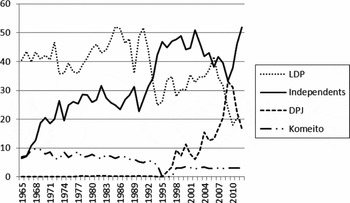
The longitudinal public opinion research by Weisberg and Tanaka (Reference Weisberg and Tanaka2001) shows another surge of unorganized voters in the 1990s, as the party system shifted from the 1955 system (the LDP on the right as opposed to the half-as-large Japan Socialist Party (JSP) on the left) to a coalition government by the rival LDP and JSP parties in 1994 (see Figure 1). Despite the weakening of its organizational base, the LDP managed to prolong its power until 2009. This was mainly due to falling voter turnout, from 73.31% in 1990 to 59.86% in 2003, which sustained the proportion of the LDP's votes as the highest. Furthermore, the LDP was helped by the vote-collecting power of its ally, the New Komeito Party (NKP), which is supported by one of the most popular Buddhist groups. Since then, however, the turnout has been increasing by approximately 10% per year, that is, as many as 10.8 million additional voters, between 2003 and 2009 (Tanaka, Reference Tanaka, Tanaka, Kohno, Hino and Iida2009). In a nutshell, at the time of 2005 general election, the Koizumi-led LDP was already in dire need of mobilizing the unorganized voters, in addition to the traditional organized voters, to win the election. In the election in 2009, unorganized voters were again the key players. This time, though, the better player turned out to be the opposition DPJ, which, lacking an organizational support machine, had inevitably been in the position of relying on volatile independent votes. The 2009 election demonstrated that if turnout is high and a single opposition party attracts the majority of unorganized votes, the loyal supporters for the LDP and the NKP no longer suffice. The hypothesis to be tested in this paper is therefore that both Koizumi and Hatoyama used consumer-oriented discourse to appeal to unorganized voters.
Overtime changes in partisanship: 1965–2010

Several institutional changes have concurrently occurred to further consolidate the role of leaders’ rhetorical power. Under the old electoral system (the single non-transferable vote system, combined with the multimember districts system), each voter had one vote in a district with three to five seats. The LDP had to nominate two or more candidates in the same district in order to win a majority of seats in the House of Representatives (HR). As candidates were forced to indulge in fierce intra-party competition for the same types of voters, they had incentives to keep away from competing on policy grounds and to consolidate a personal network of loyalty-based support. They were also forced to seek substantial support from the faction leader and its network. The new electoral system (single-member districts and proportional representation seats) of the HR has promoted party voting since 1994. Under this system, only one candidate is elected per district, and hence the voters have come to distinguish candidates by their party name. Consequently, intra-party competition was eliminated, weakening the power of the factions, and, instead, party endorsement has become essential for candidates’ (re)election. Since re-election is vital for all politicians, the party leader, who reserves the right to provide party endorsement, has become much more powerful than in the past (Krauss and Pekkanen, Reference Krauss and Pekkanen2004). As the party moved away from personalistic and fragmented intra-party power structures to a more strategic and centralized system, the image and rhetorical power of the party leader have become more salient, as ‘the face of the election’.
In addition, leaders’ debates between the prime minister and opposition leaders were established in 1999, which inevitably increased the importance of their discursive power. Furthermore, in response to a call for stronger leadership, PM Ryutaro Hashimoto established the Cabinet Office (Naikakufu) in 2001, boosting the power of the prime minister. Television also increasingly became a major source of information that the electorate could trust in order to decide how to vote. The mass media, which is primarily run on the commercial principle of achieving high audience figures, are the new pipeline between the party and unorganized voters (Krauss and Nyblade, Reference Krauss and Nyblade2005). The advance of media-oriented politics has led political parties and governments to be ‘personalized’ (Inoguchi, Reference Inoguchi, Blondel, Thiébault, Czernicka, Inoguchi, Pathmanand and Venturino2009), or to be identified with their respective leaders. All of these changes called for a strong leader who can be connected to the public through discourse and who can persuade them to accept the kind of social changes that Japan must undergo in order to survive and develop in the new global order.
Research (1): The 2005 general election – Koizumi's discursive reform
Background
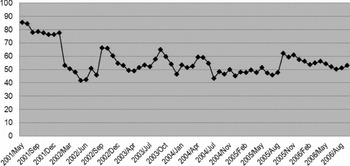
For many voters and scholars (e.g., Kabashima and Steel, Reference Kabashima and Steel2007; Otake, Reference Otake2003; Reinem, Reference Reinem2005; Uchiyama, Reference Uchiyama2007), the appointment of Prime Minister Jun’ichiro Koizumi (2001–2006) marked a new, empowered premiership that enjoyed unprecedented popular support, as seen in Figure 2. As Koizumi came from Yokosuka, an urban area facing Tokyo Bay, he was relatively free from the constraints posed by pork-barrel politics mainly rooted in rural constituencies. Koizumi, who was not even the head of the largest faction, seized the leadership of the LDP because of the popularity he had gained from the members of the prefectural chapters, rather than conventional interfactional deals. Since he lacked intraparty backing, he had in effect to constantly rally support from the public, especially unorganized voters.Footnote 3
Koizumi cabinet's approval rating

Since the economic recessions of the 1990s, the LDP has been caught in an acute dilemma about how Japan should confront the pressure of a global free market (Vogel, Reference Vogel2006). Whereas a series of structural reforms has been conducted in order to adjust to a free-market economy, the government, at other times, favoured their old familiar way, such as massive Keynesian-based spending on public works projects. Keynesianism, in effect, well matched the LDP's electoral concern to satisfy the construction lobby and rural constituencies. By taking advantage of his boosted premiership, however, Koizumi exercised assertive leadership in undertaking a number of economic reforms to promote laissez-faire privatization and liberalization that appealed to urban, middle-class consumer-conscious voters. Rural organized voters also supported Koizumi for their conventional partisanship, until they realized the negative consequences of such policies on their own lives.
We highlight Koizumi's immensely successful, but insufficiently explored, ‘discursive reform’ – to change the way the leader uses language to control the public's perceptions, and invite support. While the situation called for strong leadership to adjust Japan's central mechanisms so that they would function better in the global era, we hypothesize that it was Koizumi who cultivated his ‘discourse of enterprise’ as a strategic tool for gaining public support in order to push Japan towards a free-market economy. This study examines whether his enterprise discourse opened the door to a new era of political entrepreneurialism or neoliberal governmentality (Foucault, Reference Foucault, Braidotti, Burchell, Gordon and Miller1991), which ‘adopts the self-regulating free market as the model for proper government’ (Steger and Roy, Reference Steger and Roy2010: 12).
Kabashima and Steel note that ‘Koizumi's reform package was nothing new. But the way he presented his policies in dramatic sound bites through the media was new’ (Reference Reinem2007: 109). Although we agree that images and sound bites are effective, these alone are insufficient to transmit substantial messages. We extend this argument by claiming that it was not only his media-savvy performance but also the strategic handling of the discourse that mobilized the massive popular support for his reforms. Prior to the 2005 election, the LDP set up a party PR team with professional consultants, whose tasks included monitoring newspaper articles and TV programmes, producing political advertising, and supervising the content of the candidates’ speeches, as well as how they dressed and spoke (Seko, Reference Seko2006). Direct channels to the public were also established–two short daily briefings, monthly radio programmes, and hugely successful e-newsletters, as well as biweekly town meetings. His right-hand secretary, Isao Iijima, also opened up the press conference to unconventional tabloid newspapers and soft news magazines, and he became a master of the daytime ‘wide show’ (daytime soft news) (Kabashima and Steel, Reference Kabashima and Steel2007).
Koizumi's rhetorical style was entrepreneurial in nature. His ‘one-phrase politics’, the frequent use of effective sound bites and slogans to transmit his core message, such as ‘Structural reform with no sacred cows’, could be considered as nothing more than effective advertising for political policy products (Barry, Reference Barry, Landtsheer and Feldman1998). Koizumi also attempted to colour the party and cabinet with his own brand, by using labels such as ‘Koizumi reform’, ‘Koizumi politics’, or ‘Koizumi's LDP’ (Takase, Reference Takase2005). His rhetorical style appeared analogous to the talk of salespeople: he employed simple, short sentences, appeared to speak naturally and spontaneously rather than tactically, and made use of emotional rapport-talk rather than logical report-talk, which had the effect of reducing the psychological distance between him and his audience (Azuma, Reference Azuma2006). Under political entrepreneurialism in the West, the government was reported to have ‘sought to import consumer values into the government–citizen relationship’ (Needham, Reference Needham2003: 7), which, we argue, seems to have been under way under Koizumi's leadership in Japan.
Research hypotheses and questions
• Koizumi controlled his discourse to promote his consumer-oriented politics.
• Koizumi controlled his discourse to appeal to unorganized voters (consumers and tax-payers).
We will operationalize the hypotheses by addressing the following questions. How did Koizumi represent his political self and his relationships with the citizens? Did Koizumi's discourse empower certain groups at the expense of others?
Methods and data
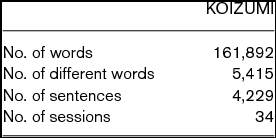
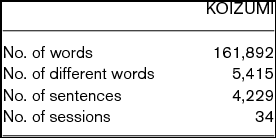
A corpus of texts was collected from Koizumi's speeches at plenary sessions to HR representatives as well as the leaders’ debates under the auspices of the joint committee on the fundamental national policies of the Upper and Lower Houses of the Diet from 19 January 2004 to 2 August 2005 (the Diet 159 to 162) between the 43rd (9 November 2003) and 44th (11 September 2005) HR general elections.Footnote 4 The period was selected to examine Koizumi's discourse prior to his landslide victory in the 2005 election. Table 1 shows the total numbers of words, different words, sentences, and Diet sessions. A quantitative corpus-data analysis was conducted using KH Coder, the free software developed by Koichi Higuchi for content analysis or computer-based text analysis, in order to examine word frequency and collocations.Footnote 5 Based on the results, a qualitative analysis was conducted.
Koizumi's corpus
Diet addresses were used for our analysis because these represent the official process of his professional endeavour as a politician in response to a number of pressing issues that the government had to deal with. He justified and accounted for his visions and policy proposals to members of the opposition parties and voters through Diet addresses. These therefore offer the most appropriate material for analysis among other more casual speeches. Plenary sessions are the final decision-making process dealing with comprehensive issues, which have to be attended by more than one-third of all legislators. Leader's debates also provide opportunities for the prime minister to ask questions to the leaders of the opposition parties on an equal footing. Plenary sessions and the leaders’ debates are usually broadcasted by the NHK through radio and television, and also available on the Internet. Even if a few voters listen or watch the live broadcast of the Diet, the TV news and newspapers usually summarize and quote key arguments, making their addresses, at least partially, readily accessible.
Results and discussion
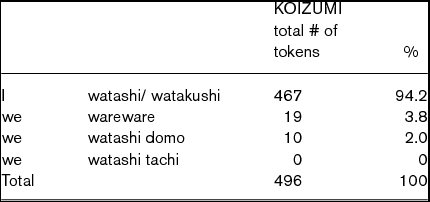
(1) Political self The pronoun is often a key indicator in revealing political identification (Cheng, Reference Cheng2006; Johansson, Reference Johansson2008). Table 2 shows Koizumi's frequent use of the first-person pronoun I, representing a distinct shift in style in order to construct a more personalized image. This sharply contrasts with the traditional norms of Japanese politicians: the preference for authoritative, ambiguous, subject-less syntax to avoid overtly presenting a political identity (Azuma, Reference Azuma, Landtsheer and Feldman2000; Feldman, Reference Feldman2004; Maynard, Reference Maynard1994). This is in line with Azuma (Reference Azuma, Landtsheer and Feldman2000)'s observation concerning the emergence of a more Western-like rhetoric among politicians since the 1990s, in order to demonstrate their sincerity and involvement. Interestingly, Koizumi rarely resorted to the collective identities that other politicians preferred. His solitary identity, however, echoed his reputation as a ‘political individualist’ and ‘his unashamed willingness to stand out from the crowd’ (George Mulgan, Reference George Mulgan2002: 48).
Frequency of the use of the first person pronoun
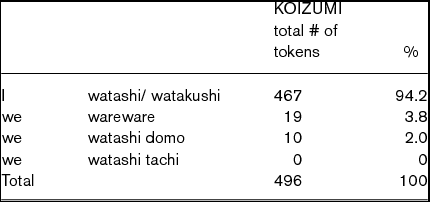
The collective identities of the leaders could be expressed ‘exclusively’ to refer to the government or ‘inclusively’ to refer to the Japanese people as a whole (Fairclough, Reference Fairclough2000). Although it is understandable that Koizumi avoided being grouped with his unpopular party, it appears odd that he did not speak on behalf of the nation. However, this individualism pinpoints a new neoliberal direction that Koizumi was proposing for Japan: an ideology to encompass more autonomous, responsible individuals. This sharply contrasts with the long-valued homogeneity and collectivism that the LDP fostered as mainstream values in Japanese society. Crucially, this individual identity matched the new social values of emerging independent voters in the urban areas, who were the primary target of Koizumi's messages.
Koizumi has also frequently compared himself to a heroic reformer who fought against prejudiced traditionalists. The most famous instance of this occurred during the press conference that was held to announce the snap election in 2005, at which he compared himself to Galileo Galilei. In example (1), Koizumi introduced the words of Mencius as his motto, which he had quoted several times in previous speeches. The repeated confession of an inner struggle indicated his desire to reinforce his identity as a fighting hero. By disclosing his emotions and suffering, he also exposed his human side in order to gain sympathy from the audience. Fairclough (Reference Fairclough2000) argues that a leader often experiences tension due to being the public authority as well as a private individual. Linguistically, Tony Blair used code-switching strategies, i.e., switching between formal and informal language, in order to move between these two identities. Whereas Azuma (Reference Azuma2007) observes a similar code-switching in Koizumi's speech, his self-categorization as a fighting hero can also be seen as the manifestation of such private/public tension. Koizumi continued this speech with an anecdote about Prime Minister Osachi Hamaguchi (1929–31), another fighting reformer, who strove to rescue Japan from economic disaster and military expansionism. Since one of the leader's missions is to present a role model to which the public aspires, he indirectly encouraged the public to behave as courageous reformers in their own context and overcome their difficulties.
1. Since I took office as prime minister, after days and nights of tension and heavy pressure, I have devoted all myself to the duties of the prime minister. Whenever I faced difficulties, I have striven for the realization of the reforms with the words of Mencius locked in my heart: When Heaven is about to confer a great office on any man, it first disciplines his mind with suffering and his bones and sinews with toil.
(21 January, 2005, my emphasis)Footnote 6
At the same time, since these anecdotes involved a clear moral positioning about who is good and who is bad, the populist stance encouraged the audience to see the world as a simple good-vs.-evil dichotomy (Otake, Reference Otake2003). This ‘populist’ framingFootnote 7 became more apparent when he labelled the intraparty rebels as resistance forces (teikou seiryoku) prior to the 2005 election. When he said, ‘I want to ask whether the citizens approve or disapprove of postal privatization’, this was by no means an invitation to make a fair assessment of the proposed policy, but a call for the public's moral judgment.
Overall, Koizumi's political standing was distinct from that of the traditional LDP politicians’ elitist or paternalistic attitude towards their loyal, organized supporters in rural areas. As long as the legislators insured ‘pork’ pipelines from the central government, there was little incentive for them to deliver any discourse to the general public outside their local network. Koizumi, being an urban politician and therefore unaccustomed to such pork-barrel strategies, was bound to establish a new type of relationship with voters, by means of using his rhetorical power as a tool to persuade them to support his policies. This stronger support meant more power, which he needed in order to advance his reform agenda in the government. Within such a context, the citizens are empowered as consumers who have the right to voice their wants and needs. This market-based environment also has a looping effect: the more citizens are treated as consumers, the more they come to identify themselves with the behaviour of consumption. Koizumi exemplified a consumer-oriented approach, which struck a chord with unorganized voters in urban areas, thereby maximizing his chance of winning the election.
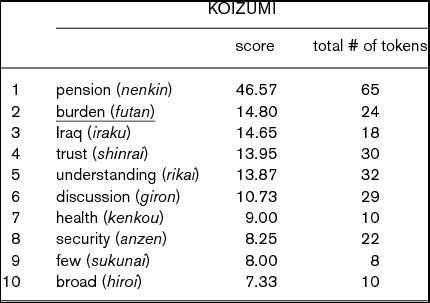
(2) Citizens Let us now consider how Koizumi represented the nation or citizens (kokumin) Footnote 8 (see Table 3). First, unsurprisingly, he frequently made pleas to the public to trust and understand his policies, as well as called for a discussion about policy issues, which was regarded as a cliché by many political observers. However, his repeated use of the phrase the nation's burden, as in example (2), appears odd. Koizumi emphasized the importance of minimizing the nation's burden and bills for the future as a major aim of the privatization of the public highway corporation. By focusing on the tax issue, Koizumi reinforced the tax-payers’/consumers’ business-like, cost–benefit, analytical mentality that they have to pay for the public services they receive. The reduction of the nation's burden became a regular pretext to persuade the public to approve of a wide range of neoliberal issues, such as reductions in social welfare and pensions, in the process of moving to smaller government. Since unorganized voters often identify themselves as tax-payers and consumers, this would also match Koizumi's electoral strategy. What he excluded from the discourse was the fact that a small burden also equals a fall in the services that citizens receive. This would affect rural areas, aged people, and small businesses particularly badly – the very individuals and entities that used to be the greatest beneficiaries as well as supporters of the LDP's large government under patron–client politics.
Words that collocate with the term ‘the nation’
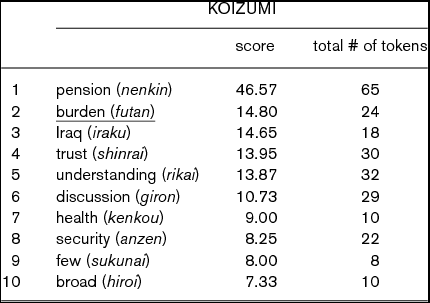
Note: ‘Total # of tokens’ indicates how many times a lexical item appears together with the target item (the nation). ‘Score’ incorporates an element of distance as well as frequency: how closely a word collocates with the target item.
2. An epoch-making and bold plan for the reform was made in order to build the necessary roads more effectively at smaller cost, minimizing the burden on the nation and bills for the future.
(19 January 2004)
Koizumi also repeatedly depicted a bright future that could be realized by an autonomous individual's efforts, as in Example (3). Although his optimistic words of encouragement have been taken positively (Takase, Reference Takase2005: 5), this celebration of individual empowerment is a common technique used by neoliberalists. Their interests usually lie in transferring public or corporate risk to individuals (Fairclough, Reference Fairclough2000), as we can confirm from his use of the expression: based on the spirit to help and discipline themselves. The veiled message here is that the citizens should make their own efforts to pursue individual success and happiness, suggesting that the time has come to end the old era when the citizens were protected by the state under the collective aim of catching up with the West. Since the secure but rigid lifetime employment system did not offer a second chance once an individual failed, the phrase they can challenge over again focused on the positive aspect of a more flexible labour market. Obviously, it would be over-optimistic to presume that all individuals can continue taking on challenges until they succeed. However, this type of emancipating discourse often sounds appealing to urban, highly educated white-collar workers. They had for a long time been restricted and frustrated by the LDP's distributive policies, through which taxes from their hard-earned salaries were transferred to less productive but politically strong groups in rural constituencies.
3. What is the most important thing in principle is the realization of a bright society with confidence and pride, where the efforts of an individual citizen, enterprise and region, as a main actor, are rewarded, and they can challenge over again based on the spirit to help and discipline themselves.
(6 April 2005)
While admitting that our qualitative analysis is limited in terms of its generalizability, the data support both of our hypotheses. Koizumi appealed to unorganized voters by focusing on the benefits of tax-payers and consumers – long-standing victims under producer-oriented politics. Koizumi also promoted his laissez-faire ideology though adopting enterprise discourse. According to Abercrombie and Keat (Reference Abercrombie and Keat1990), the free-market discourse encourages individuals to acquire and demonstrate ‘enterprising’ qualities, such as personal responsibility, independence, and self-discipline. Individuals are promoted to internalize and nominalize these qualities, fostering moral values to break away from the protection of the large state. Koizumi's discourse is rich with these examples of valuing autonomous and enterprising individuals, directing the public's perception to embrace the order of political entrepreneurialism. In other words, Koizumi's discursive reform was not only a reflection of institutional and social change, but also constituted and constructed a new vision of collective reality, redefining the state–citizen relationship from the patron–client model as something that we may call ‘the business–consumer model’.
Research (2): The 2009 general election
Aso's patron–client model vs. Hatoyama's business–consumer model
Background
This section examines how the LDP leader, Taro Aso, and the leader of the Democratic Party of Japan (DPJ), Yukio Hatoyama, used their respective discursive devices to appeal to voters prior to the 2009 general election. The outcome was a landslide victory for the DPJ, which brought about an epoch-making change of government. For the first time in its democratic history, Japanese voters gave a clear mandate to an alternative administration. The study also portrays the aftermath of Koizumi's free-market rhetoric and policies. Although the economy gradually improved under Koizumi, it was hit by the worldwide economic crisis of 2008, which symbolized the end of global free-market capitalism. Social crises such as the widening gap between rich and poor, as well as the deserted rural areas, further demanded a new direction.
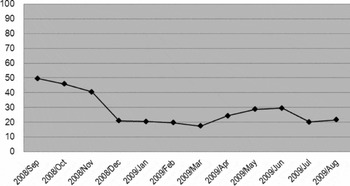
Prime Minister Taro Aso (2008–09) was originally elected as the party leader in the expectation that his popularity among young people would help the LDP to win the coming election. The cabinet approval rate, however, had plunged by the end of 2008 (see Figure 3), partly because of his luxurious lifestyle, slippery comments, and repeated misreading of Chinese characters in the Diet. In the face of the global recession, he swiftly passed a bill in October to provide supplementary income payment (teigaku kyuufukin) to all citizens for the purpose of stimulating domestic spending. The cabinet approval rating, however, did not respond even to such cash-distributing policies.
Aso cabinet's approval rating

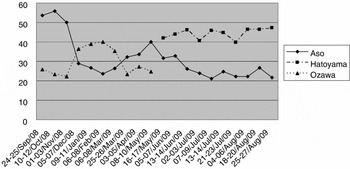
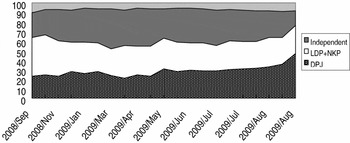
On the other hand, the DPJ, which was heavily defeated by Koizumi in 2005, came back with a manifesto full of social welfare programmes, many fresh-looking female candidates, and severe critiques of the LDP's long-lasting mismanagement. In May, the party leader, Ichiro Ozawa, was forced to resign because of a corruption scandal. Hatoyama, who received support from Ozawa's group, was elected as the next leader, and succeeded in maintaining popularity until the election (see Figure 4). Furthermore, as Figure 5 indicates, the Hatoyama-led DPJ gradually absorbed some of the independent voters into its support groups. The macro analysis of voting behaviour by Tanaka (Reference Tanaka, Tanaka, Kohno, Hino and Iida2009) reveals that young, highly educated, unorganized voters, who brought a massive victory to Koizumi's LDP in 2005, swung to vote for the DPJ in 2009. This begs the question as to what motivated these voters to trigger this drastic shift in power. We hypothesize that Hatoyama used more business–consumer rhetoric to appeal to unorganized voters than Aso.
The results of the opinion poll: ‘Who is more suitable as the prime minister?’

Ratios of independent voters, LDP/NKP supporters, and DPJ supporters

Research hypotheses and questions
• Hatoyama controlled his discourse to promote his consumer-oriented politics.
• Hatoyama used the discourse to appeal to unorganized voters (consumers and tax-payers) more than Aso.
We will operationalize the hypotheses by addressing the following questions. How did Aso and Hatoyama represent their political selves and their relationships with the citizens? Did their discourse empower certain groups at the expense of others?
Methods and data
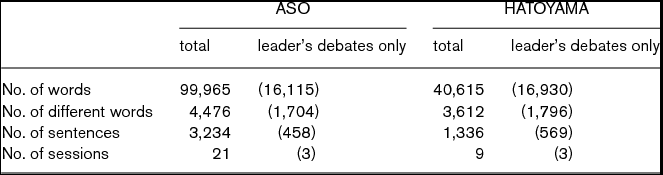
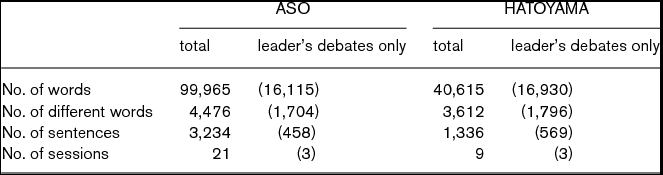
We produced two corpora of spoken texts, consisting of speeches made by Aso and Hatoyama, respectively, at plenary sessions of the HR, coupled with the Aso-Hatoyama leaders’ debates, from 29 September 2008 to 12 August 2009 (Diets 170 to 171). Taro Aso became the prime minister on 24 September, 2008, so this period was chosen to examine their discourse from then until the 45th HR general election (30 August 2009). Table 4 shows the total numbers of words, different words, sentences, and Diet sessions. The author conducted a quantitative corpus-data analysis using the software KH Coder, followed by a qualitative analysis, in a similar approach to that taken in Research (1).
Aso and Hatoyama's corpora
Results and discussion
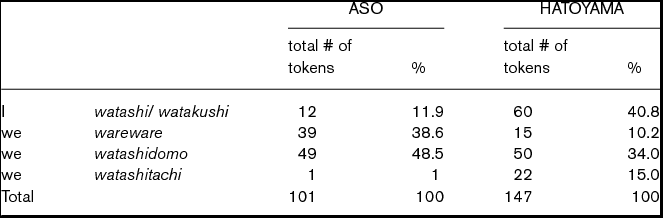
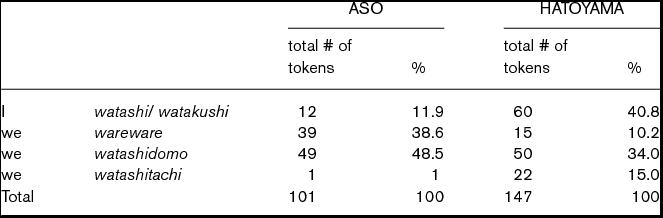
(1) Political self One striking difference in the use of the first person pronouns lies in the incumbent Aso's preference for the plural form, we, as opposed to the singular form, I (88.1%, see Table 4), compared with Hatoyama (59.2%). In example (4), Aso emphasized the exclusive use of we, clarifying the position that he is talking for the party in order to represent the government. Not only did he use we to categorize the party and himself as an in-group, but also assumed that Hatoyama was a representative of the opposition party and of Hatoyama himself. Hatoyama, on the other hand, adopted a different strategy, defining the in-group by articulating the idea that he represented the nation, despite being no more than the leader of the main opposition party, as in (5). Although Hatoyama, too, made substantial use of the inclusive we to refer both to the party and himself, he scattered rhetorical messages throughout the debates that suggested he was speaking on behalf of the nation.
4. Taro Aso: Since this is called a debate, we will also insist, we will also ask or give opinions. Once we have also listened to the opinions of Mr Hatoyama as the party leader, or the opinions of the DPJ, then we can call this a debate.
(27 May 2009)
5. Yukio Hatoyama: . . . I, as a representative of the nation, would like to ask questions about the matters which the nation feels most dissatisfied with or is most concerned about, and then exchange opinions, in order to make this opportunity meaningful.
(27 May 2009)
Example (6) further illustrates how Hatoyama challenged the incumbent by creating a binary image through the use of rhetoric, focusing particularly on contrast: the future of Japan should be centred upon the nation, or the tax-payers, as opposed to the current situation, in which the Aso administration was led by bureaucrats, or tax-eaters. By defining the LDP and bureaucrats as common enemies or outsiders, Hatoyama was attempting to strengthen the sense of unity inside the group.
As evidenced in example (7), Aso attacked Hatoyama's policies using the rhetoric of serial listing, naming three cases of being without, and using you to address the nation. In his speech, however, the nation never plays the role of an active political actor. The nation represents passive observers who are shown responsible policies by the government. Within such a framework, a sense of involvement cannot easily be developed.
6. Yukio Hatoyama: The current Aso administration, the coalition government of the LDP and the NKP, is a bureaucrat-led government, isn't it? We, on the contrary, would like to establish a government based on the opinions of the nation, citizens and ordinary people. To put it more frankly, instead of a world led by tax-eaters only, we stand on the side of tax-payers and listen to them.
(27 May 2009)
7. Taro Aso: What I am showing you is responsible policies supported by past performance. A party without industrial policies cannot lead to economic recovery. Dole-out policies without a source of revenue are equally irresponsible. A party without consistent security policies cannot protect Japan.
(12 August 2009)
Aso constructed his political identity as a paternalistic, responsible, and experienced figure. He took his mission to protect people and Japan, as in (8) and (9). He reminded the nation of its arduous recovery from World War II, to which the LDP had contributed tremendously. Aso's rhetoric here categorized the nation and himself into one group, and defined the relationship between the party/himself and the nation as in the traditional patron–client model. Aso's message, that the LDP, as a responsible protector, has been taking care of the citizens, and promises to continue to do so, is reminiscent of clientelism and patronage, the distinguishing features of the long-established LDP's governance. Although this rhetoric may have appealed to the LDP's traditional supporters, it was unlikely to be welcomed by cynical unorganized voters.
Hatoyama, on the other hand, attempted to create a new, pragmatic, and market-oriented self on an equal footing, as in (10), (11), and (12). The messages contained lexical items related to business, such as contract and service. The imagery that Hatoyama was creating suggested that, if you vote for us, we will listen to you and devote ourselves to providing you with good service, the content of which is guaranteed by a written public contract, i.e., the party's manifesto. In his world, the representation of the nation is that of active political consumers who have the right to tell the government what they want. Considering that it was mainly the unorganized mass in the urban areas that each leader had to persuade during the public discourse, Hatoyama's business–consumer approach perhaps matched better their social lifestyle and expectations than Aso's patron–client version.
8. Taro Aso: In August, sixty-four years ago, the whole area was turned into a burnt field, including my house. The present rich and safe Japan was built by your fathers, mothers, grandfathers, and grandmothers. I believe Japan possesses fundamental power. The LDP and I will protect Japan. Protect your and the nation’s lives. Protect Japan’s freedom.
(12 August 2009)
9. Taro Aso: The major difference (from the DPJ) is our ability to be responsible. . .
(12 August 2009)
10. Yukio Hatoyama: What matters is how the government can provide services for the nation. . .
(27 May 2009)
11. Yukio Hatoyama: A manifesto is a public promise, contract with the nation. We, in that sense, of course, feel that (we) have to take responsibility if (we) cannot keep it. I think that the contract with the nation weighs as heavily as that.
(12 August 2009)
12. Yukio Hatoyama: We are willing to listen to the nation’s sonorous voice yearning avidly for change, and devote all our power to establishing a new Japan.
(12 August 2009)
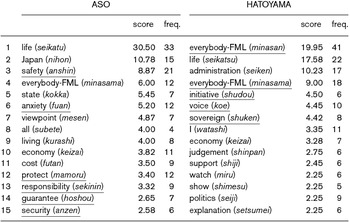
(2) Citizens Next, we examined how the two leaders used the term ‘the nation’. Hatoyama's relative frequency of referring to ‘the nation’ out of the total number of words was 0.640%, which was much greater than Aso's 0.199%. As Table 6 shows, in Aso's case, the term was often used in relation to anxiety and safety (protect, responsibility, guarantee, security). This over-wordingFootnote 9 suggests that Aso was intensely preoccupied with the task of ‘protecting’ an anxious nation's life. When Hatoyama addressed the nation, on the other hand, he used honorific terms (e.g., kokumin no minasama), emphasizing that he showed respect to everyone. Hatoyama's frequent use of honorific expressions toward the nation was a novel feature of public discourse (Inada, Reference Inada2009), in line with a salesperson's talk, based on more equal and respectful power relations between a politician and the public. This empowerment was further emphasized through the association of the nation with terms such as initiative, voice, and sovereignty.
Frequency of the use of the first person pronoun in the leaders’ debates
Words that collocate with the term ‘the nation’

The LDP was also aware of the need to care for the growing number of consumer-conscious individuals. Aso, for instance, took over a bill to establish a Consumer Affairs Agency (CAA) from the former Prime Minister, Yasuo Fukuda. The number of consumer consultations increased from 415,000 in 1998 to 929,000 in ten years (Asahi, 18 May 2010), and there was an urgent need to promote consumer protection. The LDP proposed that the CAA should function as the hub to assign a corresponding Ministry to investigate and take action against accident cases in their own sector. This was considered problematic by the victims and the opposition, since the bureaucracy had long promoted the development of industry, and therefore may have a conflict of interest when it came to consumers. What was really required was an outside supervisory mechanism.
As shown in example (13), Aso abandoned Koizumi's entrepreneurial spirit in order to return to the familiar bureaucratic method of management, with consumers as the new clients. Ironically, since his government simply reversed the way of thinking, rather than being innovative, the core of the system remained the same bureaucratic way of handling consumers, prioritizing the preservation of bureaucratic power over consumer protection. Eventually, after lengthy negotiations with the opposition, the bill for the CAA was passed in May 2009. The bill included the establishment of the CAA, coupled with that of a private monitoring agency for the CAA, the Consumer Commission, both under the direct supervision of the Prime Minister's Office.
13. Taro Aso: The administrative organization used to have a system for fostering entrepreneurs, and there were trained public servants to foster this purpose. (We will) reverse the way of thinking, and establish a Consumer Affairs Agency to be on the side of consumers and the people.
(29 September 2008)
When a certain group of people are repeatedly represented, it indicates the speaker's intention to demonstrate special concerns about them or issues related to them. In Hatoyama's case, he repeatedly drew vivid descriptions of particular groups, some of which were anecdotal. All of the stories highlighted the younger generation, as in examples (14) and (15), or their parents. Apart from these two examples, he included the story of a pregnant woman who died after being refused by 19 hospitals, as well as that of young people in their twenties and thirties whose cause of death was suicide. The school in (14) is an odd case to represent his ideal community, supported by the spirit of interdependence, which contrasts sharply with Koizumi's imagery of the competitive marketplace. All other cases involved the victimization of people socially excluded by the LDP's policies, such as the abolition of lone-parent benefit or the continuous reduction of the number of doctors in service. The portrayal of these figures must have been effective because a victimhood message can use morality as a base from which to attack an opponent. This was also a way to connect psychologically to the younger generation, the parental generation, females, and the weaker parts of society, as well as to those who sympathize with the social value of helping others. Here, we can observe the DPJ's attempt to appeal to those who were long excluded from the LDP's policies:
14. Yukio Hatoyama: There is the example of Mitaka Daiyon Elementary School. In addition to the teachers, there are 200 volunteers registered. One class has a teacher coupled with three to four volunteer teachers. For instance, many have difficulty in understanding fractions. Through private tuition, however, no one is left behind. The children are happy, and the volunteers are happy to give happiness to the children.
(27 May 2009)
15. Yukio Hatoyama: A little girl had just entered an elementary school. Her mother is a lone mother receiving single-parent benefit. Twenty thousand yen was cut. So she cannot go to high school any more. This story brought me to tears. She cannot go to high school although she wants to study.
(12 June 2009)
In sum, in response to mounting criticism against Koizumi's entrepreneurial discourse, Aso adopted the reverse course to the bureaucratic patron–client model, involving massive spending to stimulate the economy. Aso reminded the public of the collective and harmonious values that Japan had once fostered under the patronage of the LDP and bureaucracy. This discourse was appealing to loyal organized voters, but failed to strike a chord with unorganized voters, who had cultivated more independent and egalitarian social values, as well as global perspectives over the previous few decades. This finding is in line with Tanaka (Reference Tanaka, Tanaka, Kohno, Hino and Iida2009)'s argument that Koizumi understood the pressing need to appeal to unorganized voters, but the LDP leaders who followed (Abe in the first term, Fukuda and Aso) were hardly aware of the changing structures of the Japanese electorate. They therefore did not fully grasp why Koizumi enjoyed such high long-term popularity. Hatoyama, on the other hand, lacked organized backing, and therefore carefully concocted the discourse to appeal to not only to consumers and tax-payers but also to all those who had been left out during the LDP's long reign. By talking about care, love, and attention to young people, mothers, and the weak, he represented himself as someone who could bring social morality and justice to the dog-eat-dog, free-market world.
Despite the initial excitement and anticipation surrounding the DPJ government, however, Hatoyama's reign lasted a mere eight months. His failure was caused by several factors: a financial scandal, the influence of the previous leader, Ichiro Ozawa, and a broken promise to remove part of the US military base from the small southern island of Okinawa. In the eyes of the voters, who anticipated a clear break from the LDP's patron–client politics, the financial scandal quickly suggested that Hatoyama might be another money-eager politician. Ozawa's aggressive actions in recruiting the LDP's former support groups under the patron–client model contradicted Hatoyama's consumer-oriented and social welfare discourse. The public felt cheated that Hatoyama, their elected agent, was simply a favourable ‘face’ for the election, whereas the actual body still belonged to the previous leader, whom they had once rejected. Eventually, Hatoyama's reckless promise to transfer a part of the US army base from one of the most deprived regions in Japan proved impossible to keep, which pointed to a lack of competence in his role as prime minister. Since language now forms a major link between the state and the public, a discourse of betrayal immediately leads to a loss of trust, invalidating the leadership qualities of the one responsible for the betrayal.
Conclusion: The rise of the political consumer
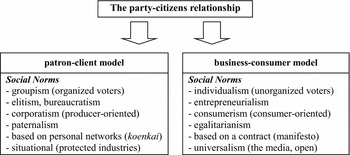
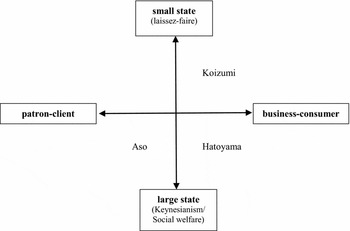
Changing perspectives means essentially changing the discourse. In order to radically reform the incumbent structure and system, first, there is a need to break away from the socially accepted norms and values that underpin the system. Since social values are largely the product of discourse, it is important to understand how the leaders discursively construct the new vision of reality to justify the way in which they govern. Figure 6 is a schematic presentation of the social norms constructed by the patron–client and business–consumer models in our study. While admitting that their discourse would not always fit within such clear boundaries, this is meant to serve as a general guide. Figure 7 is a biaxial political spectrum of the party–citizen relationship and economic policies. The critical point is that, at moments of crisis, the would-be ruling party has to identify itself as an attractive alternative against the incumbent, contrasting its ideologies and values with the status quo. We can here observe the trajectories of such calculations and endeavours. Koizumi, who positioned himself as internal opposition to the LDP, suggested the opposing values marked by the empowerment of individuals through entrepreneurial discourse. Four years later, in response to criticism against the legacy of the Koizumi reforms, Aso suggested a reversal of course to the patron–client model. Hatoyama resorted to the discourse of the social welfare state.
The dual model of patron–client model and business–consumer model

A political spectrum of the party–citizen relationship and economic policies

We may speculate that the social norms and values of the business–consumer model might have played a role in attracting a large number of unorganized voters to Koizumi in 2005 and in turn to Hatoyama in 2009. In other words, the majority of Japanese citizens now seek a government that exhibits a willingness to listen to them on a more equal footing. What this thesis also highlights is that the radical political changes, such as Koizumi's structural reforms and the new DPJ's governance, have not only brought about institutional and policy changes, but, more subtly and profoundly, changes in social norms and values that may eventually influence the way people think and behave. Since the political discourse can affect the colour of the lens through which citizens perceive the world, language does indeed come to the forefront with regard to political acts, especially in the world of the political consumer.
Finally, however, it must be emphasized that discourse reveals only half the story. Whereas mediated discourse plays a role in providing a channel to the unaffiliated masses in urban areas, the organized support groups have never lost their own interests, and the parties and candidates always need to secure votes from them. Behind Koizumi, who passionately articulated the values of independence and self-responsibility, the old guard of the LDP kept fighting in order to protect its own support groups. The DPJ also failed to implement Hatoyama's consumer-oriented and social welfare discourse, coupled with Ozawa Ichiro's aggressive actions in recruiting former LDP support groups. In order to maximize their chance of winning an election, strategic parties would now have to fight on two distinct battlefields: clientelism and consumerism.
Postscript
The HR election in 2012 and the House of Councillors (HC) election in 2013 saw another big swing from the DPJ to the LDP, resulting in the massive victory of the LDP led by PM Shinzo Abe. Abe served a brief term of 2006–2007 as prime minister but suffered from falling approval ratings and lost badly in the HC election in 2007. In his second term, what went right in his handling of clients and consumers? Whereas the LDP secured votes from organized clientelistic supporters by touting massive public works projects before and after the election, how did he approach unorganized voters through his discourse? Although a full analysis is beyond the scope of this study, this article ends with a preliminary comparative analysis of Abe's first general policy speech in the first term (9 September 2006) and in the second term (28 January 2013). These two speeches are in many respects highly contrastive. The differences suggest that Abe had learned the importance of establishing discursive pipelines to the unaffiliated mass.
His speech in 2006 consists of more than 8,301 words, exhibiting a long, lifeless list of general policies representing the issues and interests of each Ministry with equal weight. He made extensive use of English loanwords, some of which, such as ‘Asian gateway’ and ‘country identity’, were rarely used in Japanese, and therefore incomprehensible to many voters. Such elitist nuances were scattered throughout the speech. Whereas the speech included the anecdotes of two aspiring members of the elite in the past (an education reformer, Shoin Yoshida, and a cofounder of Sony Corporation, Akio Morita), he told no single story about an ordinary citizen. Abe identified himself as ‘the first prime minister born after the war’, and set his nationalistic but abstract agenda with the buzzword phrase ‘Beautiful Japan’. He manifested his long-term ambition for the revision of the ‘post-war regime’ and the constitution.
In contrast, the speech in 2013 was about half the length of the speech made in 2006. It focused on a few critical issues, using expressions such as ‘The greatest issue and indeed the most urgent issue for Japan is the revival of the economy’. At the same time, he refrained from taking the risk of exploring dividing, yet critical issues such as nuclear power plants, social welfare, and the revision of the constitution, which would surely fail to satisfy a part of the audience, but in essence require nationwide discussions. There was an anecdote of a little girl who received a ‘letter to the future’ from her mother, who died in the Great East Japan Earthquake. As she asked Abe to build a primary school, he was moved by her forward-looking attitude. Here, Abe depicted himself as a careful listener to the small voice of a victim, and as someone who takes concrete measures responding to such a voice. He also exhibited a more egalitarian or humble attitude than in 2006. For instance, he identified himself as ‘someone who has suffered a major political setback’ and vowed to ‘take to heart reflections and lessons from the past’. There were few fuzzy katakana words. He several times used the dialogic and inviting rhetoric of ‘let us’, which did not appear in 2006, as in ‘Let us share a readiness to break through the crises’, persuading the legislators and the public that it was they who had to take action to make a better future. These contrasting features alone exhibit Abe's changing awareness toward public speech: his speech shifted from the patron–client to the business–consumer orientation in an attempt to appeal to emerging consumers who seek for more than what they are used to hearing.
About the author
Emi Sauzier-Uchida is a professor in the School of Political Science and Economics at Waseda University, where she teaches sociolinguistics and political discourse analysis. She holds a Ph.D. in Applied Linguistics (Essex University, 2001) and took a further degree with distinction in Modern Japanese Studies at the University of Oxford. An early version of Research (2) appeared in Japanese as ‘A linguistic perspective on Japanese politics: An analysis of the Aso – Hatoyama debates in the 2009 general election’ in the Waseda Journal of Political Science and Economics (384): 36–41, 2012.