Introduction
Sumrall and Waters (Reference Sumrall and Waters2012) and Kammer et al. (Reference Kammer, Sumrall, Zamora, Ausich and Deline2013) transformed our understanding of the oral, or adoral, region of pelmatozoan echinoderms (crinoids, blastozoans, and edrioasteroids) using the Universal Elemental Homology (UEH) system. Previously, each class had a largely independent morphological nomenclature for this portion of its anatomy; whereas now, there is a common lexicon that allows for comparison of homologous features among pentaradial echinoderms. The oral region of a pelmatozoan corresponds largely to the ambulacra (axial region of the extraxial-axial theory, EAT, of Mooi and David, Reference Mooi and David1998, Reference Mooi and David2008). Oral region characters are functionally integrated for food capture and transportation of food to the mouth, thus this region is presumed to have had more evolutionarily conserved characters than those of the remaining, extraxial skeleton, as demonstrated by the similarities across several classes (Kammer et al., Reference Kammer, Sumrall, Zamora, Ausich and Deline2013).
Sumrall (Reference Sumrall2010) and Sumrall and Waters (Reference Sumrall and Waters2012) developed UEH terminology and demonstrated that this scheme could be used to identify homologous traits among blastozoans. Kammer et al. (Reference Kammer, Sumrall, Zamora, Ausich and Deline2013) extended the UEH scheme by demonstrating that crinoids and edrioasteroid-grade echinoderms shared these blastozoan homologies. Further, they defined six peristomial border systems (arrangements of plates around the peristome [mouth]) that are fundamentally different arrangements of the ambulacral skeletal elements.
As outlined in Kammer et al. (Reference Kammer, Sumrall, Zamora, Ausich and Deline2013) and below, application of the UEH scheme necessitates some changes to traditional terminology applied to crinoids (Ubaghs, Reference Ubaghs1978a; Ausich et al., Reference Ausich, Brett, Hess and Simms1999). Important among these is the redefinition of the tegmen and oral plates of the oral region. The plesiomorphic condition for the oral surface of a crinoid is for the mouth and ambulacra to be open on the surface. Alternatively, the mouth and/or the ambulacra may be covered by plating so that the mouth is not exposed, a structure to which the term tegmen is now restricted (Kammer et al., Reference Kammer, Sumrall, Zamora, Ausich and Deline2013). A tegmen is recognized, herein, as a constructional grade among pelmatozoans. In this study, the iterative appearances and constructions of crinoid and blastozoan tegmens from oral surfaces are discussed, as are the atavistic evolution of oral surfaces from tegmens.
Terminology
The use of names for echinoderm groups follows Kammer et al. (Reference Kammer, Sumrall, Zamora, Ausich and Deline2013), i.e., crinoids as used by Moore and Teichert (Reference Moore and Teichert1978) and blastozoans follow Sprinkle (Reference Sprinkle1973) with the inclusion of paracrinoids and coronoids. Pelmatozoa Leuckart (Reference Leuckart1848) are Crinoidea plus Blastozoa.
In living crinoids, the adoral surface, or perisomic skeleton, has been termed the tegmen (Breimer, Reference Breimer1978, p. T19). It may be a leathery oral membrane with calcareous spicules or a more rigid skeleton with calcareous plates or scales termed orals, ambulacrals, adambulacrals, interradials, or simply tegmen plates (Breimer, Reference Breimer1978, T19–T20). The mouth may be open or covered by moveable plates (Clark, Reference Clark1921). In both living and fossil crinoids, the tegmen has been defined as “Adoral part of theca above origin of free arms or occupying space between them; may be calcified or not; may bear anal vent, pyramid, sac, or tube.” (Moore, Reference Moore1978a, p. T242.) Note that this latter definition does not mention the location of the mouth. To recognize homologous morphological traits and to draw comparisons to blastozoans and edrioasteroid-grade echinoderms, Kammer et al. (Reference Kammer, Sumrall, Zamora, Ausich and Deline2013) proposed the following terminology for the diverse array of plates and configurations of tegmens sensu Moore (Reference Moore1978a).
The oral region is the general term referring to the adoral surface of a pelmatozoan and is basically equivalent to the tegmen of crinoids sensu Moore (Reference Moore1978a). The oral region may be plated or non-plated. An oral surface is the condition where the mouth (peristome) is exposed with (presumably) moveable cover plates over the mouth and ambulacra. As discussed above, the term tegmen is now restricted to a plated surface with the mouth and all or part of the oral region ambulacra subtegmenal.
The oral region may be composed of exclusively axial skeleton plates or be a combination of both axial and interambulacral (extraxial) plates (Sumrall, Reference Sumrall2010; Sumrall and Waters, Reference Sumrall and Waters2012; Kammer et al., Reference Kammer, Sumrall, Zamora, Ausich and Deline2013). Axial skeleton plates of the oral surface are the oral plates, primary peristomial cover plates, shared cover plates, and ambulacral cover plates (Kammer et al., Reference Kammer, Sumrall, Zamora, Ausich and Deline2013, fig. 1). Both the oral plates and primary peristomial cover plates are interradial in position. The oral plates are always fixed, whereas the primary peristomial cover plates may be either moveable or fixed, depending on the type of oral region.
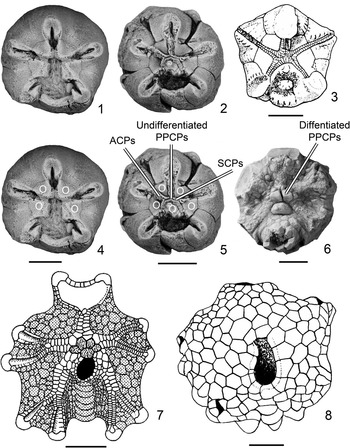
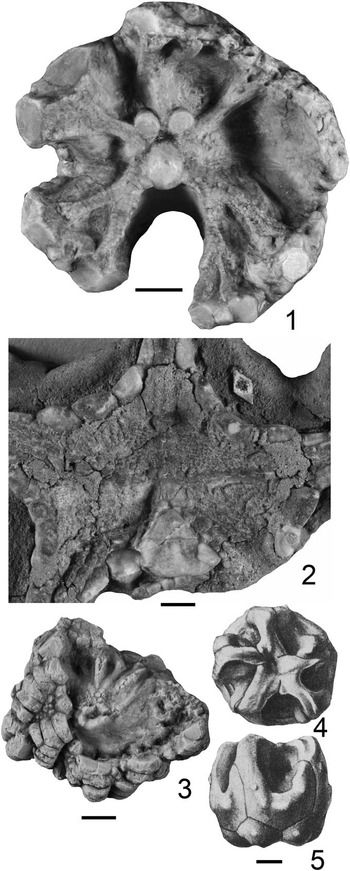
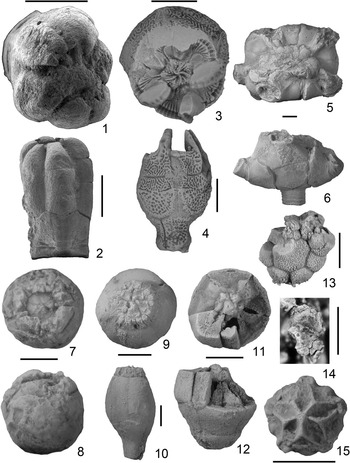
On an oral surface, oral plates (O) are interradial in position and form the peristomial border, a rigidly sutured circlet surrounding the mouth (Fig. 1.1–1.5); and the primary peristomial cover plates (PPCPs) are interradial in position are moveable plates that cover the peristome (Fig. 1.2, 1.3, 1.5, 1.6). Traditionally, the PPCPs (as used here) were typically termed orals in crinoids (Ubaghs, Reference Ubaghs1978a) (see Sumrall and Waters, Reference Sumrall and Waters2012, for names previously used among various blastozoans). On an oral surface, the peristome may be covered exclusively by PPCPs or by PPCPs and smaller shared cover plates (SCPs). The latter condition occurs in relatively few crinoids (e.g., Hybocrinus nitidus Sinclair, Reference Sinclair1945, Fig. 1.5; Hybocrinus conicus Billings, Reference Billings1857, Fig. 2.1; and Palaeocrinus hudsoni Sinclair, Reference Sinclair1945, Fig. 3.1), but this is common among blastozoans (e.g., Glyptocystitida or Diploporida; see Kammer et al., Reference Kammer, Sumrall, Zamora, Ausich and Deline2013, fig. 2) and other echinoderms. SCPs are present where the ambulacra have a 2-1-2 arrangement, and the SCPs cover the short length of the shared B-C and shared D-C ambulacra (Fig. 1.2, 1.3, 1.5). Ambulacral cover plates (ACPs) are positioned above unshared ambulacra that extend from the peristome, and the ambulacra (if present) are also open on a crinoid with an oral surface.
Basic types of oral regions present on crinoids. (1, 4) Hybocrinus nitidus, a PBS-A3 oral surface with four oral plates (O2-O5) preserved; primary peristomial cover plates, shared cover plates, ambulacral cover plates, and posterior oral plates disarticulated from specimen; note oral circlet would form a rigid frame around the mouth with all oral plates present (OU 9177); (2, 5) Hybocrinus nitidus PBS-A3 with most oral surface plating present; oral plates (O), anal opening (A), hydropore/gonopore (H); undifferentiated primary peristomial cover plates (PPCPs) are the same size as the shared cover plates (SCPs) and the ambulacral cover plates (ACPs) (OU 9179); (3) Hybocystites eldonensis PBS-A3 oral surface, note the PPCPs are undifferentiated, the presence of moveable SCPs, and more distal ACPs are also moveable; two arms are recumbent and three are erect (from Sprinkle and Moore, Reference Sprinkle and Moore1978, fig. 365.1g); (6) Cyathocrinites harrodi PBS-A4 oral surface, note the large, differentiated PPCPs that are moveable, the absence of SCPs, and relatively small ACPs (USNM S5832); (7) Dimerocrinites inornatus with a rigid tegmen and differentiated, fixed PPCPs and fixed ACPs (from Ubaghs, Reference Ubaghs1978a, fig. 151.1); (8) Stiptocrinus nodosus with a rigid tegmen composed of numerous undifferentiated plates (from Ubaghs, Reference Ubaghs1978b, fig. 257.1c). All scale bars represent 5 mm.

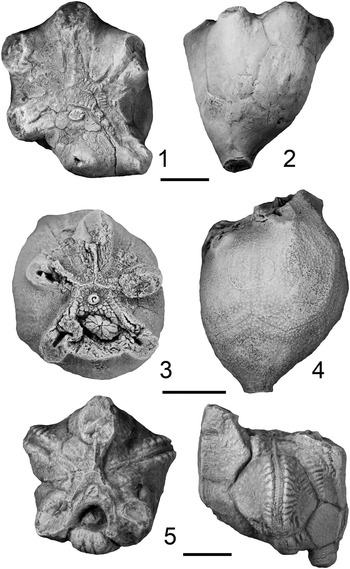
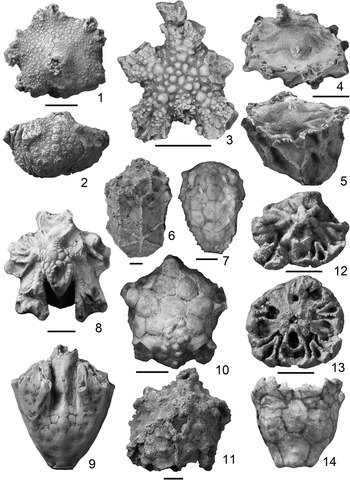
Oral surfaces of hybocrinid crinoids; all with PBS-A3 oral surfaces. (1, 2) Hybocrinus conicus with primary peristomial cover plates undifferentiated, moveable shared cover plates present, and more distal ambulacral cover plates also moveable; anal sac in marginal position; (1) oral view; (2) lateral view (Ordovician; USNM S2054); (3, 4) Hybocrinus nitidus with primary peristomial cover plates undifferentiated, moveable shared cover plates, and more distal ambulacral cover plates moveable; anal sac more abaxial in position; (3) oral view; (4) lateral view (compare to Fig. 1.1–1.4 where portions of the oral surface are missing) (Ordovician; OU 9174); (5) Hybocystites eldonensis with primary peristomial cover plates undifferentiated, moveable shared cover plates, and more distal ambulacral cover plates moveable; (left) oral view; (right) lateral view (compare to Fig. 1.5) (Ordovician; USNM S2048). All scale bars represent 5 mm.

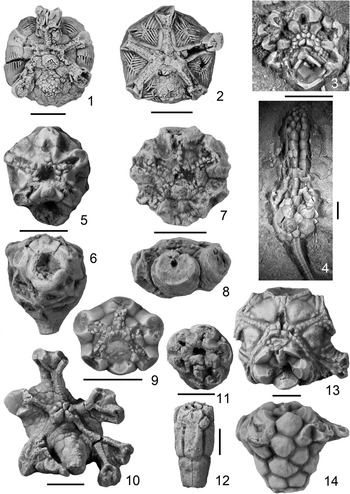
Ordovician to Mississippian cyathocrine oral surfaces. (1) Oral view of Palaeocrinus hudsoni PBS-A3 oral surface (Ordovician; OU 9150); (2) Carabocrinus treadwelli PBS-A3 oral surface (Ordovician; OU 9127); (3, 4) Illemocrinus amphiatus PBS-A4 oral surface with differentiated primary peristomial cover plates; (3) oral view of specimen lacking its anal sac, note doubling of primary peristomial cover plates; (4) lateral view with anal sac (Ordovician; ROM 45102); (5, 6) Porocrinus elegans PBS-A3 oral surface; (5) oral view; (6) lateral view (Ordovician; USNM 42196b); (7, 8) Gissocrinus incurvatus PBS-A3? oral surface; (7) oral view; (8) lateral view; central oral surface plates largely disarticulated (Silurian; NRM-Ec 9273); (9) Nuxocrinus crassus PBS-A3 oral surface with undifferentiated primary peristomial cover plates, note O1 modified to a madreporite (Devonian; USNM 305473); (10) Cyathocrinites harrodi PBS-A4 oral surface with differentiated primary peristomial cover plates, an expanded and bifurcating ambulacra, and an anal sac, note doubling of primary peristomial cover plates (Mississippian; USNM S2485); (11, 12) Bactrocrinites fusiformis oral surface with all moveable plates missing, note oral plates form a rigid rim around the mouth; (11) oral view; (12) lateral view (Devonian; USNM S5796); (13, 14) Euspirocrinus spiralis PBS-A3 oral surface, note doubling of primary peristomial cover plates; (13) oral view; (14) lateral view (Silurian; NRM-Ec 8966). All scale bars represent 5 mm.

In addition to the axial skeleton plates, one to several plates of the extra-axial skeleton may be incorporated into the oral region. These plates may be a continuation of the interradial plating of a calyx, continuation of the intrabrachial plating of a calyx, or oral region interambulacral plates may lack clear association with any calyx plating. As mentioned, the PPCPs, SCPs, and ACPs are moveable on a pelmatozoan with an oral surface.
Of the six peristomial border systems (PBS) types in edrioasteroids, blastozoans, and crinoids (Kammer et al., Reference Kammer, Sumrall, Zamora, Ausich and Deline2013, table 2), only two occur on oral surfaces of crinoids: PBS-A3 and PBS-A4. Important for this discussion, a PBS-A3 oral surface has oral plates in an interradial position, the peristomial border is composed exclusively of oral plates, the mouth (peristome) is elongate from the shared BC and DE ambulacra, SCPs are in the adaxial BC and DE shared ambulacra, and PPCPs are undifferentiated from ACPs. Diploporans, eocrinoids, paracrinoids, and crinoids are known with this oral surface type. Among crinoids, examples of the PBS-A3 are Hybocrinus nitidus (Hybocrinidae, Ordovician, Fig. 1.2, 1.5), and Hybocystites eldonensis (Parks, Reference Parks1908) (Hybocrinidae; Ordovician; Fig. 1.3). PBS-A4 is a slightly modified peristomial border system characterized by enlarged PPCPs that meet in the center over a circular peristome with no shared ambulacra and, hence, no shared cover plates. The smaller ACPs are present on the ambulacra extending away from the peristome. The PBS-A4 occurs in coronoids and crinoids (Kammer et al., Reference Kammer, Sumrall, Zamora, Ausich and Deline2013), with Cyathocrinites harrodi Wachsmuth and Springer, Reference Wachsmuth and Springer1880 (Cyathocrinitidae, Mississippian) an example among crinoids (Fig. 1.6).
The tegmen is a derived structure that covers the mouth. In most crinoids it appears to be an exaptation (Gould and Vbra, Reference Gould and Vrba1982) in which oral surface plates changed function from being moveable plates to fixed elements of the tegmen. Effectively, they were “lifted” above the plane of the mouth and, typically, tightly sutured into a tegmen, forming a roof over the mouth and all or part of the entire oral region. Homologous plates between oral surfaces and tegmens are recognized by their position, number, geometry, and size. This is very clear on taxa such as Dimerocrinites inornatus (Hall, Reference Hall1863) (Dimerocrinitidae, Silurian, Fig. 1.7). This form has a tegmen with five large fixed plates centrally positioned (fixed PPCPs); radially positioned, biserially arranged fixed ACPs leading to peripheral moveable ACPs connected with the ACPs on the arms; and fixed interambulacral plates. On a tegmen with much reduced oral region plating, the decision about plate homologies may be more equivocal. Further many camerate crinoids have completely undifferentiated plating (e.g., Stiptocrinus nodosus Springer, 1926a; Periechocrinidae, Silurian, Fig. 1.8) where homologies with the original surface plates are uncertain.
The determination of whether an oral region is an oral surface or a tegmen may be equivocal, especially in forms with much reduced plating. For this determination, it is important to note that oral plates are always fixed and surround the opening for the peristome. In contrast, PPCPs may be either fixed or moveable, and always lack an opening in their center. If moveable, the five plates in the central oral region must be PPCPs, the mouth is exposed, and the oral region is an oral surface. Alternatively, five, central, differentiated PPCPs may be fixed, which, in part, defines a tegmen. PPCPs commonly retain an asymmetry reminiscent of a 2-1-2 symmetry; however, in most cases with fixed PPCPs, it is unknown whether this symmetry reflects the symmetry of the underlying ambulacra. Whether differentiated or undifferentiated, fixed PPCPs may be positioned approximately at the level of the radial facets or elevated above fixed brachials. In a tegmen, sufficiently large openings exist from the arms to under the tegmen plates so that the food contents of the ambulacra were passed to a subtegmenal mouth. In all cases, a tegmen exists if the mouth is not exposed at the surface but, rather, is positioned below a solid or flexible plated surface, composed of few to many plates. This applies to the clear examples of camerate crinoids with a solidly plated theca, as well as cladid crinoids with a minimally-plated tegmen. ACPs on tegmens are typically fixed, but some or all may be moveable (Fig. 1.7)
In this contribution, we document the morphological disparity among oral surfaces and tegmens among crinoids and examine the constructional pathways by which this disparity originated. In addition, the tegmen of the hemicosmitoid Caryocrinites is discussed.
Specimens were examined from numerous institutions and publications for this study. Illustrated specimens are from the following museums: BSM, Buffalo Science Museum, Buffalo, New York; FMNH UC, Field Museum of Natural History, Chicago; GIK, Institute of Geology and Mineralogy, University of Cologne, Germany; GSC, Geological Survey of Canada; MNI, Muschelkalkmuseum Hagdorn, Ingelfingen; NHMUK, Natural History Museum, London, United Kingdom; NRM-Ec, Naturhistoriska Riksmuseet, Stockholm, Sweden; OU, Sam Noble Oklahoma Museum of Natural History, University of Oklahoma; OSU, Orton Geological Museum, Ohio State University; PMU, Paleontological Museum Uppsala, Uppsala University, Sweden; ROM, Royal Ontario Museum, Toronto, Canada; SUI, Department of Geology, University of Iowa; THDKA, Naturalis Biodiversity Center, Leiden, The Netherlands; TUG, University of Tartu, Tartu, Estonia; UMMP, University of Michigan Museum of Paleontology; USNM, U.S. Natural History Museum, Smithsonian Institution, Washington, D.C.; UT, University of Texas, Austin; YPM, Peabody Museum, Yale University.
Crinoid phylogeny
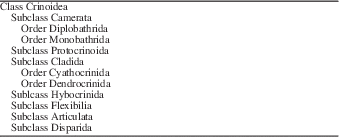
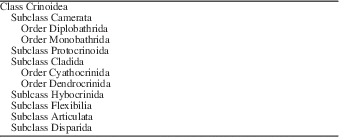
Table 1 lists the traditionally recognized major groups of crinoids as modified from Moore and Teichert (Reference Moore and Teichert1978). At this time, various aspects of the phylogeny of crinoids are under investigation. However, regardless of the character suites, underlying assumptions, and methods used, protocrinids, camerates, cladids, disparids, flexibles, and hybocrinids are recognized as distinct clades (e.g., Ausich, Reference Ausich1998a, 1998b; Guensburg and Sprinkle, 2003; Guensburg, Reference Guensburg2012; Ausich et al., Reference Ausich, Wilson and Vinn2015a). Similarly, the monobathrid camerates are considered a monophyletic clade (Cole and Ausich, Reference Cole and Ausich2015). However, the phylogenetic relationships among cladids and the clades derived from cladids (disparids, flexibles, and articulates) are unresolved (e.g., Simms and Sevastopulo, Reference Simms and Sevastopulo1993; Wright and Ausich, Reference Wright and Ausich2015). Further, the evolutionary relationships of families in major clades and genera in families requires detailed phylogenetic analyses, some of which are in progress.
Crinoid classification used in this manuscript.
Crinoid oral surfaces and tegmens
Oral region morphology has had a very limited role in crinoid systematics. If known, the oral surface or the tegmen typically was described; but as discussed in Kammer et al. (Reference Kammer, Sumrall, Zamora, Ausich and Deline2013) and above, oral surface preservation is commonly poor in crinoid clades, as compared to tegmens. Accordingly, this study conveys present knowledge of pelmatozoans for which oral surfaces and tegmens are known. The discussion below summarizes known oral region disparity within clades.
As noted above, oral surfaces in crinoids exist in three basic configurations, based on the configuration of the ambulacra (Kammer et al., Reference Kammer, Sumrall, Zamora, Ausich and Deline2013). These include the PBS-A3 configuration, the PBS-A4 configuration, and in some crinoids the oral surface is reduced to only five, moveable PPCPs (e.g., Pisocrinus de Koninck, Reference Koninck1858).
The primary objective of the present paper is to document the two general types of oral regions (oral surfaces and tegmens) and to examine their distribution through time and within a general phylogeny of different major groups of crinoids, plus in a hemicosmitoid rhombiferan. As outlined below, both tegmens and oral surfaces occur in most of the well-defined crinoid clades (Table 1); therefore, one may infer that tegmens and oral surfaces were iteratively evolved throughout crinoid evolutionary history. The exact character changes that yielded a particular oral surface or tegmen were presumably different in different lineages. However, morphogenetically, oral surfaces and tegmens were constructed of the same basic components: orals, PPCPs, SCPs, ACPs, interradial plating, and intrabrachial plating. Each of these plate types could have changed by size and an increase or decrease in the number of each plate type. Further, PPCPs, SCPs, and ACPs were either moveable or sutured plates. Plates could be tessellate and rigidly sutured, embedded within an integument, or plates could be entirely lost, resulting in an entirely soft tissue oral region.
The richest morphological disparity in crinoid oral regions was among tegmens. Generally, a tegmen is an exaptation of oral surface plating. It could be formed by rigidly suturing differentiated oral surface plates into a roof only over the mouth. Alternatively, differentiated oral surface plates could be vaulted above the plane where an oral surface would lie. Tegmen plating could remain differentiated so as to reflect homologies with an oral surface, or plates could be undifferentiated with no obvious homologies shared with oral surface plates. A tegmen surface may be expanded to include an innumerable number of small plates or be reduced to five plates. Among cladids, a tegmen could be formed by the expansion of the base of an anal sac to cover the entire adoral surface of a crinoid. Alternatively, a flexible array of newly derived plates or spicules could form a tegmen, or a tegmen could presumably be completely composed of soft tissue, as suggested by many cladids with no oral region plates (Kammer and Ausich, Reference Kammer and Ausich2007). Tegmens could also become specialized with development of partitions to separate adjacent arms or spines.
As noted above, the record of oral regions among crinoids is general poorly known, except for camerates, hybocrinids, and cyathocrine cladids. Thus, it is not possible at this time to document examples of morphological change through ancestor-descendant evolutionary transitions. However, we can understand the basic constructional pathways that formed oral surfaces and tegmens. Without a phylogenetic context, it is not possible to know how many times certain tegmen and oral surface morphologies evolved, but it is clear that they evolved iteratively in many clades.
Hybocrinids
Hybocrinid oral surfaces
All hybocrinids have oral surfaces that are generally well preserved by comparison with other crinoid clades, and all oral surfaces known in hybocrinoids are classified as PBS-A3 (Kammer et al., Reference Kammer, Sumrall, Zamora, Ausich and Deline2013). The hybocrinid oral surface has oral plates visible; undifferentiated, moveable PPCPs; SCPs; and moveable ACPs. Examples include Hybocrinus conicus (Hybocrinidae, Ordovician, Fig. 2.1, 2.2); Hybocrinus nitidus (Hybocrinidae, Ordovician, Figs. 1.1, 1.2, 1.4, 1.5, 2.3, 2.4); and Hybocystites eldonensis (Hybocystitidae, Ordovician, Figs. 1.3, 2.5, 2.6). Hybocystites eldonensis is unique in having recumbent ambulacra in the B and E rays and free arms in the A, C, and D rays (Fig. 2.5, 2.6). Not only is this PBS-A3 oral surface considered homologous with oral surfaces of various blastozoans (Kammer et al., Reference Kammer, Sumrall, Zamora, Ausich and Deline2013), but also the recumbent ambulacra growing over the surface of calyx plates is similar to recumbent ambulacra crossing thecal plates present in glyptocystitid rhombiferans, such as Callocystites or Spaerocystites (Kesling, Reference Kesling1967). If these recumbent ambulacra are homologous, rather than analogous, in origin they may be an atavistic feature from blastozoans, providing additional evidence for a shared ancestry with blastozoans. However, there are not enough data at this time to make such a determination.
Cyathocrinine cladids
Cyathocrine cladid oral regions
The majority of oral regions known among cyathocrine cladids, including the oldest preserved (Sandbian), are oral surfaces. Carabocrinus treadwelli Sinclair, Reference Sinclair1945 (Fig. 3.2), Palaeocrinus hudsoni (Fig. 3.1), Porocrinus elegans Kesling and Paul, Reference Kesling and Paul1968 (Fig. 3.5, 3.6) have plesiomorphic PBS-A3 oral surfaces (Kammer et al., Reference Kammer, Sumrall, Zamora, Ausich and Deline2013). However, Illemocrinus amphiatus Eckert, Reference Eckert1987 (Katian, Fig. 3.3, 3.4) has a modified PBS-A3 oral surface with a doubling of the PPCPs. There are paired PPCPs at each of the five orals, rather than one. The PPCPs and ACPs are differentiated and moveable. In addition, Illemocrinus amphiatus has a high anal sac that is positioned marginally on the oral surface.
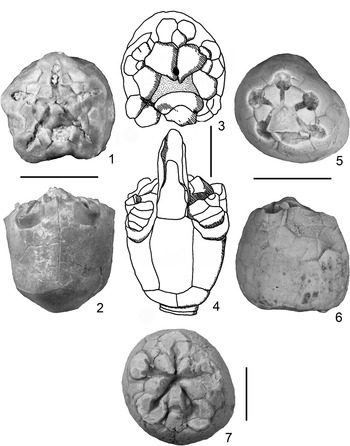
The majority of post-Ordovician cyathocrines with known oral regions have an oral surface. A few examples include the following: Euspirocrinus spiralis Angelin, Reference Angelin1878 (Euspirocrinidae, Silurian, Fig. 3.13, 3.14), which has PPCPs doubled; Gissocrinus incurvatus (Angelin, Reference Angelin1878) (Cyathocrinitidae, Silurian, Fig. 3.7, 3.8); Bactrocrinites fusiformis (Roemer, 1844) (Thalamocrinidae, Devonian, Fig. 3.11, 3.12); Nuxocrinus crassus (Whiteheaves, Reference Whiteaves1887) (Thalamocrinidae, Devonian, Fig. 3.9); Cyathocrinites harrodi (Cyathocrinidae, Mississippian, Figs. 1.6, 3.10), which also has PPCPs doubled; and Mississippian-Permian codiacrinaceans. These forms have either the PBS-A3 or PBS-A4 oral surface, depending on whether the peristome is elliptical or circular, respectively, and whether any SCPs are present or absent, respectively. The Oral 1 plate may be modified into a madreporite as in N. crassus (Fig. 3.9) and Cyathocrinites iowensis (Owen and Shumard, Reference Owen and Shumard1850) (Kammer and Ausich, Reference Kammer and Ausich1996, fig. 7.22). The Permian forms Monobrachiocrinus ficiformis granulatus Wanner, Reference Wanner1920 (Fig. 4.1, 4.2) and Embryocrinus hanieli Wanner, Reference Wanner1916 (Fig. 4.3, 4.4) are PBS-A4 and have oral surfaces reduced to five PPCPs. In Embryocrinus hanieli the zig-zag sutures between adjacent PPCPs suggest that these plates were locked rather than moveable, but the lack of any radial openings for arms indicates the PPCPs must have opened.
Permian cyathocrine PBS-A4 oral surfaces composed of only five primary peristomial cover plates. (1, 2) Monobrachiocrinus ficiformis granulatus; (1) oral view; (2) lateral view (Permian; THDKA 11962); (3, 4) Embryocrinus hanieli; (3) oral view; (4) lateral view; (Permian; UMMP 58254). All scale bars represent 5 mm.

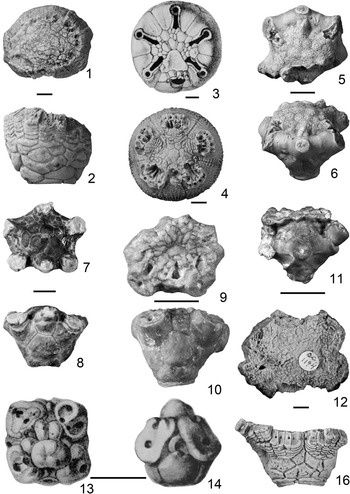
Oral surfaces are the norm for cyathocrine cladids, but several cyathocrines evolved a tegmen. Two lineages of Silurian cyathocrines with tegmens are the Crotalocrinitidae and Cyathocrinitidae. Among the Crotalocrinitidae, Crotalocrinites rugosus Miller, Reference Miller1821 (Fig. 5.4) has five PPCPs, numerous ACPs, and interambulacral plates. The regular arrangement of these plates is considered homologous with those on cladid oral surfaces. In contrast, Enallocrinus scriptus (Hisinger, Reference Hisinger1828) (Fig. 5.12, 5.16) and Syndetocrinus dartae Kirk, Reference Kirk1933 (Fig. 5.1, 5.2) have tegmens composed of undifferentiated plating. Two Silurian Cyathocrinitidae with tegmens are Conicocyathocrinites Frest, Reference Frest1977 and Levicyathocrinites Frest, Reference Frest1977. Conicocyathocrinites ramosus (Angelin, Reference Angelin1878) has five large fixed PPCPs and smaller irregular plating elsewhere on the tegmen (Fig. 5.7, 5.8), and Levicyathocrinites monilifer (Angelin, Reference Angelin1878) has at least one enlarged PPCP with irregular plating forming the remainder of the tegmen (Fig. 5.9, 5.10).
Silurian and Devonian cyathocrine tegmens. (1, 2) Syndetocrinus dartae tegmen composed of multiple undifferentiated plates; (1) oral view; (2) lateral view (Silurian; YPM 13650); (3) Sphaerocrinus geometricus oral view of tegmen with differentiated plating that retains a PBS-A4 configuration (the largest plate is O1 with the five primary peristomial cover plates all in contact directly above it) (Devonian; from Lane and Moore, Reference Lane and Moore1978, fig. 378.1f); (4) Crotalocrinites rugosus oral view of tegmen with differentiated plating (Silurian; NRM-Ec 9700); (5, 6) Vasocrinus turbinatus tegmen with large undifferentiated plates and an anal sac; (5) oral view; (6) lateral view (Devonian; USNM 2334); (7, 8) Conicocyathocrinites ramosus tegmen composed of a few large plates, plated anal sac absent; (7) oral view; (8) lateral view (Silurian; NRM-Ec 9132); (9, 10) Levicyathocrinites monilifer tegmen composed of numerous plates; (9) oral view; (10) lateral view (Silurian; NRM-Ec 9173); (11) Vasocrinus sp. with the anal sac expanded over the entire oral region to form a tegmen; oral view (Devonian; BSM E12872); (12, 16) Enallocrinus scriptus; (12) oral view of tegmen with undifferentiated plating; (16) lateral view of calyx (Silurian; PMU 26506); (13, 14) Nanocrinus paradoxus with tegmen composed principally of five primary peristomial cover plates, note the posterior primary peristomial cover plate is enlarged significantly; (13) oral view; (14) lateral view (Devonian; from Lane and Moore, Reference Lane and Moore1978, fig. 376). All scale bars represent 5 mm.

After the Silurian, cyathocrine tegmens are only known from the Codiacrinidae, Euspirocrinidae, Gasterocomidae, and Sphaerocrinidae. Sphaerocrinus geometricus (Goldfuss, 1831) (Sphaerocrinidae, Devonian, Fig. 5.3) has a tegmen composed of differentiated PPCPs and ACPs with adaxial ACPs fixed and abaxial ACPs moveable. Gasterocomids are Devonian and include Nanocrinus paradoxus Müller, Reference Müller1856 (Fig. 5.13, 5.14) that has five plates that form a solid tegmen. In addition to having a tegmen, this crinoid is unusual by having tetragonal symmetry and the periproct on the side of the aboral cup. Two potential interpretations of this tegmen are (1) the five plates are homologous with the five PPCPs, or (2) the largest plate is homologous with Oral 1 and the other plates are PPCPs, with one PPCP eliminated along with one ray.
Vasocrinus Lyon, Reference Lyon1857 is a Devonian Euspirocrinidae, and several species had tegmens. Vasocrinus turbinatus Kirk, Reference Kirk1929 (Fig. 5.5, 5.6) has a tegmen with differentiated, fixed peristomial cover plates, with or without well-defined ACPs, interambulacral plates, and a marginal anal sac. In contrast, a specimen identified as Vasocrinus sp. has the base of the anal sac expanded to cover the entire adoral surface of the cup (Fig. 5.11). Thus, the anal sac base covers the mouth and forms a tegmen.
Cyathocrine cladid morphological pathways
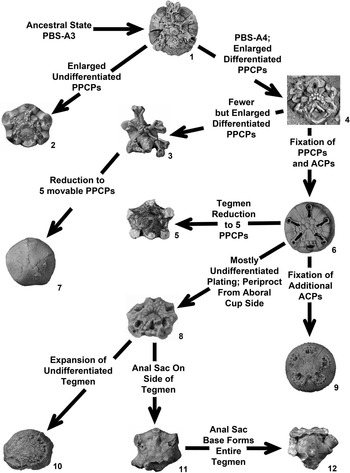
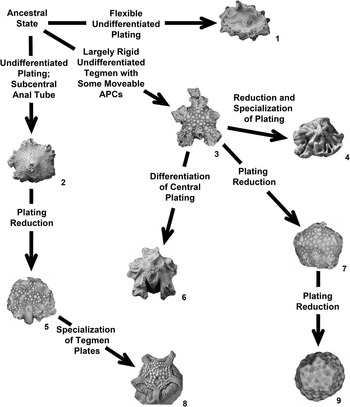
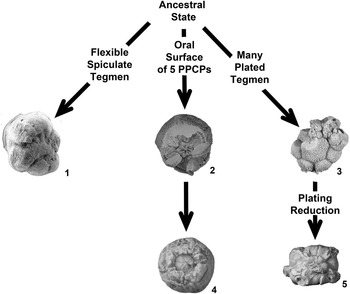
The oral region ancestral state is presumed to have been a PBS-A3 oral surface as preserved in Palaeocrinus hudsoni (Figs. 3.1, 6.1), and the PBS-A3 configuration of oral surfaces persisted in some lineages (Fig. 6.2) with undifferentiated PPCPs and SCPs. In some lineages, as early as the Sandbian, some cyathocrines developed PBS-A4 oral surfaces (Illemocrinus, Fig. 6.4), in this case a doubling of the PPCPs occurred. Evolution of PBS-A4 oral surfaces (Fig. 6.3, 6.4) may have occurred multiple times among cyathocrines, but limitations imposed by generally poor preservation of oral surfaces prevents documentation of iterative changes. Illustrated here is Cyathocrinus harrodi (Fig. 6.3), which has six large PPCPs. Cyathocrines like Embryocrinus hanieli (Fig. 6.7) reduced the oral surface plating to only five, moveable PPCPs.
Inferred cyathocrine cladid constructional pathways reflecting an unknown combination of phylogenetic and iterative evolution (thumbnails not to scale; compare with Figs. 3–5). (1) Palaeocrinus hudsoni; (2) Nuxocrinus crassus; (3) Cyathocrinites harrodi; (4) Illemocrinus amphiatus; (5) Conicocyathocrinites ramosus; (6) Sphaerocrinus geometricus; (7) Embryocrinus hanieli; (8) Levicyathocrinites monilifer; (9) Crotalocrinites rugosus; (10) Syndetocrinus dartae; (11) Vasocrinus turbinatus; (12) Vasocrinus sp. ACPs=ambulacral cover plates; PPCPs=primary peristomial cover plates.

Sphaerocrinus geometricus (Fig. 6.6) has a tegmen with identifiable fixed PPCPs, ACPs, and moveable ACPs. These plates are basically in the same plane as homologous plates in an oral surface. The plate configuration in Sphaerocrinus geometricus suggests that plates of a crinoid with a PBS-A4 oral surface were sutured more-or-less in place, exapting moveable plates covering the mouth and ambulacra into fixed plates permanently covering these regions. From this tegmen configuration, (1) the tegmen could be expanded with additional plates (Fig. 6.9), (2) the addition of plates and loss of clear homology among plates could occur (Fig. 6.8), or (3) the reduction of plates that retain a homology signature could occur (Fig. 6.5). From a tegmen lacking plate differentiation, a larger tegmen with undifferentiated plates could develop (Fig. 6.10) or a tegmen with an anal sac could form (Fig. 6.11). From a cyathocrine with a distinct tegmen and anal sac, a form evolved with the base of the anal sac expanded across the entire oral portion of the aboral cup, thus forming a tegmen (Fig. 6.12).
Dendrocrine cladids and flexibles
Dendrocrine cladid oral regions and constructional pathways
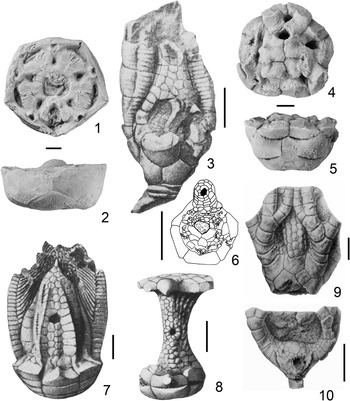
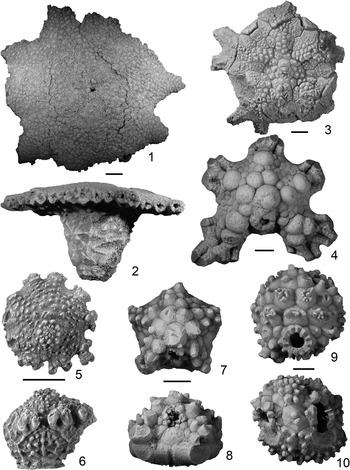
In general, the oral regions of dendrocrine cladids are very poorly known, and we regard the oldest preserved oral regions on a dendrocrine to likely be a PBS-A4 oral surface because of the circular peristome. Examples include various Devonian cupressocrinitids, such as Halocrinites schlotheimii schlotheimii Steininger, Reference Steininger1831 with five orals (Fig. 7.1, 7.2), and the Pennsylanian crinoid Stellarocrinus sp. (Stellarocrinidae, Fig. 7.6). In addition, Stellarocrinus sp. evolved an erect plated anal sac (Fig. 7.6).
Dendrocrine oral surfaces and tegmens. (1, 2) Halocrinites schlotheimi schlotheimi oral surface with moveable plates missing; (1) oral view; (2) lateral view (Devonian; GIK-1939); (3) lateral view of Rhopalocrinus gracilis tegmen formed by the proximal anal sac (Devonian; from Moore and Lane, Reference Moore and Lane1978a, fig. 430.1b); (4, 5) Delocrinus? malaianus with flat tegmen composed of a few large plates, anal sac absent; (4) oral view; (5) lateral view (Permian, THDKA 12062); (6) oral view of Stellarocrinus sp. PBS-A4 oral surface with a plated anal sac (Pennsylvanian; from Strimple, Reference Strimple1973, fig. 20); (7) lateral view of Zeacrinites wortheni tegmen formed by proximal anal sac (Mississippian; from Springer, Reference Springer1926b, pl. 23, fig. 2a); (8) lateral view of Tholocrinus spinosus tegmen formed by proximal anal sac (Mississippian; from Springer, Reference Springer1926b, pl. 26, fig. 10); (9, 10) Botryocrinus ramosissimus tegmen with a plated anal sac; (9) oral view; (10) lateral view (Silurian; from Moore and Lane, Reference Moore and Lane1978b, figs. 398,1g, 398.1h). All scale bars represent 5 mm.

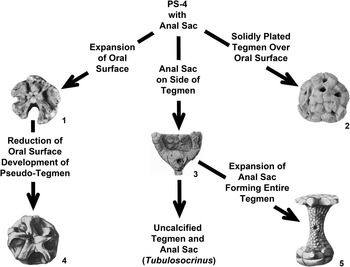
Tegmens are relatively rare in dendrocrines and were formed by either evolving a typical rigid plated structure or by expanding the base of the anal sac to cover all or most of the adoral surface. From an oral surface, dendrocrines evolved tegmens in one of three ways. (1) Delocrinus? malaianus Wanner, Reference Wanner1916 (Catacrinidae, Permian; Figs. 7.4, 7.5, 8.2) formed a flat-topped, rigidly-plated tegmen that presumably lacked an erect, plated anal sac. (2) Parallel to cyathocrines, a tegmen was formed covering the oral region and a plated sac was also present, such as in Botryocrinus ramosissimus Angelin, Reference Angelin1878 (Botryocrinidae, Silurian, Figs. 7.9, 7.10, 8.3). (3) Furthermore, tegmens composed exclusively of an expanded proximal anal sac (Figs. 7.8, 8.5) were formed. Examples include Rhopalocrinus gracilis (Schultze, Reference Schultze1866) (Cupressocrinitidae, Devonian, Fig. 7.3), Tholocrinus spinosus (Wood, Reference Wood1909) (Zeacrinitidae, Mississippian, Fig. 7.8), and Zeacrinites wortheni (Hall, Reference Hall1858) (Zeacrinitidae, Mississippian, Fig. 7.7). Due to poor preservation, few examples are known where it is clear that the anal sac was also a tegmen, but this tegmen type probably evolved many times and was most likely relatively common.
Inferred dendrocrine cladid and flexible crinoid constructional pathways reflecting an unknown combination of phylogenetic and iterative evolution (thumbnails not to scale; compare with Figs. 7, 9). (1) Taxocrinus intermedius; (2) Delocrinus? malaianus; (3) Botryocrinus ramosissimus; (4) Proapsidocrinus permicus; (5) Tholocrinus spinosus.

Additionally, all of the plating could be lost, resulting in a soft-tissue oral region, as suggested by the numerous dendrocrine genera with non-preservation of the oral region (Moore and Teichert, Reference Moore and Teichert1978) and by Tubulusocrinus doliolus (Wright, Reference Wright1936) (Scytalocrinidae, Mississippian, Kammer and Ausich, Reference Kammer and Ausich2007) with an uncalcified anal sac, but it is uncertain whether the oral surface was an uncalcified oral surface or a tegmen because the arms are tightly closed.
Flexible oral surfaces and morphological pathways
The oral regions of flexibles are also very poorly known, but those known formed by greatly expanding the oral surface (Fig. 9.1). Examples include Homalocrinus liljevalli Springer, Reference Springer1906, (Homalocrinidae, Silurian); Onychocrinus ulrichi Miller and Gurley, Reference Miller and Gurley1890 (Onychocrinidae, Synerocrinidae; and Taxocrinus intermedius Wachsmuth and Springer, Reference Wachsmuth and Springer1888 (Taxocrinidae, Mississippian), which all have a PBS-A4 oral surface. In T. intermedius (Figs. 8.1, 9.1), all five oral plates are exposed on the surface, PPCPs are absent, the ambulacra that branch on the oral surface have moveable ACPs, and the interambulacral regions were either uncalcified or had a spiculate integument. In O. ulrichi (Fig. 9.2) only Oral 1 is exposed, PPCPs are differentiated, the ambulacra did not branch on the oral surface, and interambulacral regions have numerous plates. Only the under surface of the oral region is known in Homalocrinus liljevalli (Fig. 9.3), with the five orals tightly sutured around the mouth. Based on calyx size, many flexibles must have also had smaller oral surfaces.
Flexible crinoid oral surfaces. (1) Oral surface of Taxocrinus intermedius oral surface (Mississippian; USNM S1821); (2) oral view of Onychocrinus ulrichi PBS-A4 oral surface (Mississippian; USNM S1877); (3) view of the underside of the oral surface of Homalocrinus lijevalli. (Silurian; NRM-Ec 12984); (4, 5) Proapsidocrinus permicus pseudotegmen; (4) oral view; (5) lateral view (Permian; from Moore, Reference Moore1978b, fig. 529.1a, 529.1c). All scale bars represent 5 mm.

No true tegmens are preserved among flexibles; however, one “pseudo-tegmen” is known. In Proapsidocrinus permicus Wanner, Reference Wanner1924 (Prophyllocrinidae, Permian, Figs. 8.4, 9.4, 9.5), the left shoulder of all five radial plates extend distally and adaxially to form a solid structure covering the mouth and adaxial regions of the ambulacra. Constructionally, this functions as a tegmen; however, it was formed exclusively by elements of the aboral cup rather than oral surface plates. Because it is formed in a fundamentally different manner than a tegmen, it is referred to here as a pseudo-tegmen.
Diplobathrid camerates
Diplobathrid camerate tegmens
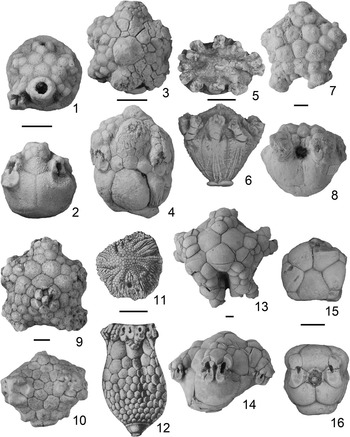
All known oral regions on diplobathrid camerates are tegmens, with the oldest preserved tegmens Ordovician (Sandbian). Most of these examples belong to the Rhodocrinitidae, and differing morphologies existed, even within a genus. Paradiabolocrinus stellatus Kolata, Reference Kolata1982 (Rhodocrinitidae, Ordovician, Fig. 10.1, 10.2) and Diabolocrinus arbucklensis Kolata, Reference Kolata1982 (Rhodocrinitidae, Ordovician, Fig. 10.3) are examples of Sandbian diplobathrids with tegmens. Both tegmens are composed of numerous undifferentiated plates. The anal tube is subcentral in P. stellatus. In D. arbucklensis, the anal tube is marginal and abaxial ACPs are well-defined and moveable.
Ordovician and Silurian diplobathrid camerate tegmens. (1, 2) Paradiobolocrinus stellatus tegmen composed of numerous undifferentiated plates; (1) oral view; (2) lateral view (Ordovician, OU 8860); (3) oral view of Diabolocrinus arbucklensis tegmen composed of undifferentiated plates in the center and fixed and moveable ambulacral cover plates (Ordovician; OU 8887); (4, 5) Gaurocrinus nealli tegmen with numerous very small plates, interpreted as being a flexible tegmen; (4) oral view; (5) oblique lateral view (Ordovician, NHMUK E14942); (6, 11) Lampterocrinus tennesseensis tegmen composed of more, smaller plates that the congeneric L. fatigatus; (6) lateral view; (11) oral view (Silurian; FMNH UC11942a); (7, 10) Lampterocrinus fatigatus tegmen composed of a few large plates; (7) lateral view; (10) oral view (Silurian; OU 4607); (8, 9) Dimerocrinites inornatus tegmen with differentiated plates including moveable abaxial ambulacral cover plates; (8) oral view; (9) lateral view (Silurian, FMNH UC 6395a); (12, 13, 14) oral views of Gazacrinus inornatus; (12) tegmen with primary peristomial cover plates, elongate fixed ambulacral cover plates (Silurian; USNM S137a); (13) oral view of oral region with tegmen removed; five orals forming a solid circle around the mouth; (14) lateral view of calyx (Silurian; USNM S137b). All scale bars represent 5 mm.

Gaurocrinus nealli (Hall, Reference Hall1866) (Reteocrinidae, Katian) has a tegmen with innumerable, small, undifferentiated plates and a marginal anal openning (Fig. 10.4, 10.5). The ambulcaral regions are raised above the interambulacral and intraambulacral regions; and it is probable that despite tessellate plating the tegmen was flexible.
Several Silurian diplobathrids have preserved tegmens. These include forms from the Rhodocrinitidae, Anthemocrinidae, Dimerocrinitidae, Gazacrinidae, and Lampterocrinidae. Again, the type of tegmens varies. Illustrated here is Dimerocrinites inornatus (Figs. 1.7, 10.8, 10.9), which has distinctive tegmen plates with five fixed PPCPs, fixed and probably moveable ACPs, and many interambulacral plates. Gazacrinus inornatus Miller, Reference Miller1892 (Gazacrinidae, Fig. 10.12–10.14) is a particularly instructive taxon, because it has five PPCPs differentiated on the tegmen and had fixed/moveable ACPs on the tegmen surface. However, in one specimen (Fig. 10.13) the tegmen is not preserved, and five large oral plates form a frame around the circular mouth in a position that would be directly beneath the PPCPs if the tegmen had been intact (Fig. 10.12), indicating it has the PBS-A4 arrangement. Note that in this example the PPCPs have an asymmetry reminiscent of 2-1-2 symmetry, but the underlying ambulacra have a PBS-A4 construction. Lampterocrinus Roemer, Reference Roemer1860 has relatively few tegmen plates compared to Ordovician and other Silurian diplobathrids. Lampterocrinus tennesseensis Roemer, Reference Roemer1860 (Lampterocrinidae, Fig. 10.6, 10.11) has a moderate number of smaller plates, but Lampterocrinus fatigus Strimple, Reference Strimple1963 (Fig. 10.7, 10.10) has even fewer plates in the tegmen. This tegmen is composed of only five much enlarged PPCPs; one or two interambulacral plates in each interray; and perhaps a single, radially positioned, fixed ACP in each ray.
Tegmens of Devonian and Mississippian diplobathrids are only known from the Rhodocrinitidae. Rhipidocrinus crenatus crenatus (Goldfuss, 1831) (Devonian) has a large, multiplated tegmen with undifferentiated plating (Fig. 11.8, 11.9). Gilbertsocrinus Phillips, Reference Phillips1836 has a highly modified tegmen with large tubular appendages. However, different species have differing degrees of tegmen plate specialization. The Devonian Gilbertsocrinus ohioensis Stewart, Reference Stewart1940 (Fig. 11.1, 11.2) has numerous undifferentiated tegmen plates, and Gilbertsocrinus tuberosus (Lyon and Casseday, Reference Lyon and Casseday1859) has a much larger tegmen, larger tubular appendages, and a more nuanced plating pattern (Mississippian, Fig. 11.7). Rhodocrinites cavanaughi (Laudon, Reference Laudon1933) (Mississippian; Fig. 11.5, 11.6) has poorly differentiated, fixed ACPs, and interambulacral plates, but the PPCPs are not clearly differentiated. In contrast, Rhodocrinites douglassi (Miller and Gurley, Reference Miller and Gurley1897) (Mississippian, Fig. 11.3, 11.4) has only a few, not clearly identifiable plates that comprise the tegmen.
Devonian to Mississippian diplobathrid camerate tegmens. (1, 2) Gilbertsocrinus ohioensis tegmen composed of numerous undifferentiated plates; (1) oral view; (2) lateral view (Devonian; SUI 56021); (3, 4) Rhodocrinites douglassi tegmen reduced to a few plates; (3) oral view; (4) lateral view (Mississippian; SUI 2057); (5, 6) Rhodocrinites cavanaughi tegmen with fixed ambulacral cover plates differentiated; (5) oral view; (6) lateral view (Mississippian; SUI 2059); (7) oral view of Gilbertsocrinus tuberosus tegmen with bifurcating, interradially positioned tegmen appendages. (Mississippian; USNM S1); (8, 9) Rhipidocrinus crenatus crenatus tegmen composed of numerous undifferentiated plates; (8) oral view; (9) lateral view (Devonian, GIK-1938). All scale bars represent 5 mm.

Diplobathrid camerate morphological pathways
Three basic tegmen types existed among Ordovician diplobathrid camerates, including those (1) with a flexible tegmen composed of numerous, very small, tessellate, and undifferentiated plates (Fig. 12.1); (2) with a rigid tegmen with numerous undifferentiated plates (Fig. 12.2); and (3) with a rigid tegmen with some differentiated plating including fixed ACPs axially and moveable ACPs abaxially (Fig. 12.3).
Inferred diplobathrid camerate tegmen constructional pathways reflecting an unknown combination of phylogenetic and iterative evolution (thumbnails not to scale; compare with Figs. 10 and 11). (1) Gaurocrinus nealli; (2) Paradiabolocrinus stellatus; (3) Diabolocrinus arbucklensis; (4) Gazacrinus inornatus; (5) Gilbertsocrinus ohioensis; (6) Dimerocrinites inornatus; (7) Rhodocrinites cavanaughi; (8) Gilbertsocrinus tuberosus; (9) Rhodocrinites douglassi. ACPs=ambulacral cover plates.

From forms with numerous undifferentiated plates, the plate number could be reduced (Fig. 12.4); and further, specialized plating could develop. Gilbertsocrinus and Rhodocrinites Miller, Reference Miller1821 are examples within a single family where both constructional trends existed. In Gilbertsocrinus, tegmens became more complex with interradially positioned tegmen extensions (Fig. 12.8); in contrast, plate reduction occurred in Rhodocrinites (Fig. 12.7. 12.9). Some forms evolved at least some differentiated plating, such as Fig. 12.3, and differentiation of plating could also become more pronounced (Fig. 12.6) in some diplobathrids.
Monobathrid camerates
Monobathrid camerate oral regions
The stereotypical monobathrid has a tegmen, although a few middle and late Paleozoic monobathrids have oral surfaces with moveable PPCPs. Similar to the diplobathrids, the oldest preserved oral region on a monobathrid is a tegmen, i.e., Glyptocrinus decadactylus Hall, Reference Hall1847 (Glyptocrinidae, Ordovician, Fig. 13.1) from Katian strata. In this crinoid, fixed ACPs are present with the remainder of the tegmen composed of innumerable, small, undifferentiated plates. The topography on the tegmen surface is variable, with interradial and intrabrachial portions of the tegmen depressed relative to the ambulacral positions. As in Gaurocrinus nealli, it is possible that this tegmen was flexible.
Ordovician to Silurian monobathrid camerate tegmens. (1) Oblique oral view of (three of the five rays) the presumably flexible tegmen of Glyptocrinus decadactylus with fixed ambulacral cover plates (Ordovician; from Ubaghs, Reference Ubaghs1978b); (2–4) Silurian Periechocrinus costatus tegmens. Note different shapes interpreted as the result of the tegmen being flexible; (2) oblique oral view with narrow anal tube, NHMUK E4071; (3) oral view with subconical anal tube. (NHMUK E54140); (4) lateral view of crown, NHMUK E1322 (crown); (5, 6) Methabocrinus laevigatus tegmen composed of a few large plates; (5) oral view; (6) oral view (Silurian; TUG 1395-40); (7, 8) Patelliocrinus punctuosus tegmen with large primary peristomial cover plates and a few other fixed plates; (7) oral view; (8) lateral view (Silurian; NRM-Ec 11579); (9, 10) Fibrocrinus phragmos with primary peristomial cover plates fixed and moveable ambulacral cover plates, and numerous interambulacral plates; (9) oral view; (10) lateral view (Silurian; GSC 126768); (11) Allocrinus irroratus tegmen with a large primary peristomial cover plates and a few other large plates centrally, and all ambulacral cover plates moveable (Silurian; OU 4655). All scale bars represent 5 mm.

Preserved examples of Silurian monobathrids with tegmens are known from the Carpocrinidae, Marsupiocrinidae, Patelliocrinidae, Periechocrinidae, and Stelidiocrinidae). Silurian monobathrid tegmens are also highly variable. Periechocrinus costatus (Austin and Austin, Reference Austin and Austin1843) (Periechocrinidae, Silurian, Fig. 13.2–13.4) has a tegmen composed of numerous, small, undifferentiated plates. Different specimens of P. costatus appear to have had somewhat different tegmen morphologies, which could also be the result of a flexible tegmen, despite tessellate plating.
Fibrocrinus phragmos Ausich and Copper, Reference Ausich and Copper2010 (Carpocrinidae, Silurian, Fig. 13.9, 13.10) has strikingly differentiated PPCPs and ACPs and interambulacral plates. Both fixed ACPs centrally and moveable abaxial ACPs are present. Similar to some diplobathrid counterparts, the tegmens of Methabocrinus laevigatus (Ausich et al., Reference Ausich, Wilson and Vinn2015b) (Carpocrinidae, Fig. 13.5, 13.6) and Patelliocrinus punctuosus Angelin, Reference Angelin1878 (Patelliocrinidae, Fig. 13.7, 13.8) are reduced in the number of plates. M. laevigatus has five, large PPCPs, five fixed ACPs, and a few interambulacral plates. The tegmen of Patelliocrinus punctuosus has fewer than ten total plates. Allocrinus irroratus Strimple, Reference Strimple1963 (Patelliocrinidae, Silurian, Fig. 13.11) has an unusual camerate tegmen. The tegmen has five, large, fixed PPCPs adjacent to three large plates supporting the anal tube, and elongate interambulacral plates supporting the arm trunks. Moveable ACPs extend from the PPCPs to the free arms.
Tegmens are commonly preserved on Devonian and Mississippian monobathrids, including the striking contrast between the very large tegmen with innumerable small plates of Strotocrinus glyptus (Hall, Reference Hall1860) (Actinocrinitidae, Mississippian) (Fig. 14.1, 14.2) and the small, few-plated tegmens of some Platycrinitidae (Devonian to Permian) with basically five PPCPs (Fig. 15.15, 15.16). Tegmens are best known on Devonian Dolatocrinidae, Hexacrinitidae, and Periechocrinidae and on Mississippian Actinocrinitidae, Batocrinidae, Dichocrinidae, and Platycrinitidae. Again, there is considerable variability among taxa. Some have larger tegmens and numerous differentiated tegmen plates (e.g., Gennaeocrinus carinatus [Wood, Reference Wood1901], Periechocrinidae, Devonian, Fig. 14.5, 14.6 and Amphoracrocrinus amphora [Wachsmuth and Springer, Reference Wachsmuth and Springer1897], Acrocrinidae, Mississippian, Fig. 15.11, 15.12). Although less common, large tegmens may also have differentiated PPCPs, ACPs, and interambulacral plates, including Agaricocrinus americanus Roemer, Reference Roemer1854 (Coelocrinidae, Mississippian, Fig. 14.4).
Silurian to Mississippian monobathrid camerate tegmens. (1, 2) Very large tegmen of Strotocrinus glyptus composed of innumerable small plates; (1) oral view; (2) lateral view (Mississippian; ROM 6225); (3) oral view of Marsupiocrinus (Amarsupiocrinus) stellatus stellatus tegmen composed of differentiated plates (Devonian; USNM S1296); (4) oral view of Agaricocrinus americanus tegmen composed of greatly enlarged primary peristomial cover plates and fixed ambulacral cover plates, but interambulacral plates are small (Mississippian; USNM S1064); (5, 6) Gennaeocrinus carinatus tegmen with undifferentiated plates, note the small plates covering anal opening; (5) oral view; (6) lateral view (Devonian, SUI 18152); (7, 8) Laticrinus oweni tegmen with differentiated primary peristomial cover plates, fixed ambulacral cover plates, and a few interambulacral plates; (7) oral view; (8) lateral view (Mississippian; USNM S1341); (9, 10) Collicrinus shumardi with very few plates, but differentiated primary peristomial cover plates; (9) oral view; (10) lateral view (Mississippian; USNM S1368). All scale bars represent 5 mm.

Mississippian to Permian monobathrid camerate tegmens. (1, 2) Platycrinites s.s. burlingtonensis tegmen reduced to fixed primary peristomial cover plates and five fixed ambulacral cover plates and a few interambulacral plates; (1) oral view; (2) lateral view (Mississippian; USNM S1337); (3, 4) Talarocrinus inflatus tegmen with very large posterior primary peristomial cover plate and other differentiated plates; (3) oral view; (4) lateral view (Mississippian; USNM S5898); (5, 6) Dichocrinus douglassi with undifferentiated plates forming a tegmen; (5) oral view; (6) lateral view (Mississippian; SUI 2073); (7, 8) Pleurocrinus goldfussi tegmen composed of primary peristomial cover plates and a few other plates; (7) oral view; (8) lateral view (Permian; THDKA 11841); (9, 10) Thinocrinus brevispina tegmen with primary peristomial cover plates, fixed ambulacral cover plates, and interambulacral plates; (9) oral view; (10) lateral view (Permian; THDKA 11815); (11, 12) tegmen of Amphoracrocrinus amphora with only fixed ambulacral plates differentiated; (11) oral view; (12) lateral view (Mississippian; from Ubaghs, Reference Ubaghs1978b, fig. 283.2a, 283.2b); (13, 14) Pleurocrinus depressus with fixed ambulacral cover plates, but homology of other plates unclear; (13) oral view; (14) lateral view (Permian; THDKA 11837); (15, 16) very reduced tegmen of Neoplatycrinus dilatatus with five fixed primary peristomial cover plates and five fixed ambulacral cover plates; (15) oral view; (16) lateral view (Permian; SUI 134856). All scale bars represent 5 mm.

Medium- to few-plated tegmens with differentiated plating occur among Devonian and Mississippian monobathrids, including Laticrinus oweni Ausich and Kammer, Reference Ausich and Kammer2009 (Platycrinitidae, Mississippian, Fig. 14.7, 14.8); Collicrinus shumardi shumardi Ausich and Kammer, Reference Ausich and Kammer2009 (Platycrinitidae, Mississippian; Fig. 14.9. 14.10); Platycrinites s.s. burlingtonensis (Owen and Shumard, Reference Owen and Shumard1850) (Platycrinitidae, Mississippian, Fig. 15.1, 15.2); and Talarocrinus inflatus (Ulrich, Reference Ulrich1917) (Dichocrinidae, Mississippian, Fig. 15.3, 15.4). In these crinoids homologies to oral surface plates are clear. In contrast, crinoids such as Dichocrinus douglassi (Miller and Gurley, Reference Miller and Gurley1896) (Dichocrinidae, Mississippian, Fig. 15.5, 15.6) have undifferentiated plating.
Pennsylvanian and Permian monobathrid camerate tegmens are rare relative to those of the Devonian and Mississippian. However, a reasonable disparity of tegmen morphologies persisted. The relatively large Permian crinoid Thinocrinus brevispina (Wanner, Reference Wanner1924) (Actinocrinitidae, Permian, Fig. 15.9, 15.10) has five differentitated PPCPs, fixed ACPs, and interambulacral plates. Most of the Permian monobathrid crinoids from Timor have a reduced number of plates in the tegmen, from Pleurocrinus depressus Wanner, Reference Wanner1916 (Platycrinitidae, Permian, Fig. 15.13, 15.14) with greatly enlarged fixed PPCPs; to Pleurocrinus goldfussi Wanner, Reference Wanner1916 (Platycrinitidae, Permian, Fig. 15.7, 15.8) with five PPCPs and one or a few fixed ACPs; and to Neoplatycrinites dilatatus Wanner, Reference Wanner1916 (Platycrinitidae, Permian, Fig. 15.15, 15.16) with a tegmen composed of five large PPCPs and one to a few fixed ACPs.
Despite the overwhelming occurrence of robust tegmens among monobathrids, a few small Devonian hapalocrinids and Mississippian dichocrinids and Pennsylvanian acrocrinids have oral surfaces with moveable PPCPs and ACPs. These include Amblacrinus rosaceus Roemer, 1844 (Hapalocrinidae, Devonian, Fig. 16.7); Camptocrinus alabamensis Strimple and Moore, Reference Strimple and Moore1973 (Dichocrinidae, Mississippian, Fig. 16.3, 16.4); Cyttarocrinus jewetti (Goldring, Reference Goldring1923) (Hapalocrinidae, Devonian, Fig. 16.1, 16.2); and Globacrocrinus glomus (Goldring, Reference Goldring1923) (Acrocrinidae, Pennsylvanian, Fig. 16.5, 16.6). Globacrocrinus presumably has five moveable PPCPs and moveable ACPs. Plating on Amblacrinus and Cyttarocrinus jewetti are more difficult to interpret, but the large rhomic-shaped plates that narrow to a point adorally may be exposed oral plates and PPCPs, and ACPs were moveable plates. It is possible that these plates were fixed (thus this is a tegmen), but because they are commonly not preserved in place, it is more likely that the PPCPs were moveable. Camptocrinus alabamensis has a reduced and highly modified oral region, with four or five moveable PPCPs, probably five ACPs that may be fixed, and a highly modified circular dichroism PPCP with the second circular dichroism interray plate forming distinctive anal tube (Fig. 16.4).
Devonian to Pennsylvanian monobathrid oral surfaces. (1, 2) Cyttarocrinus jewetti oral surface moveable ambulacral cover plates, presumably the large interradial plates are orals and the primary peristomial cover plates are missing; (1) oral view; (2) lateral view (Devonian; BSM E21032); (3, 4) Camptocrinus alabamensis oral surface with highly modified PPCPs; (3) oral view; (4) lateral view (Mississippian; from Strimple and Moore, Reference Strimple and Moore1973, fig. 23.4, 23.8); (5, 6) Globacrocrinus glomus oral surface presumably the large interradial plates are orals and the primary peristomial cover plates and ambulacral cover plates are missing; (5) oral view; (6) lateral view (Pennsylvanian; SUI 32936); (7) oral view of Amblacrinus rosaceus presumably the large interradial plates are orals and the primary peristomial cover plates and ambulacral cover plates are missing (Devonian; UMMP 56510). All scale bars represent 5 mm.

Monobathrid camerate morphological pathways
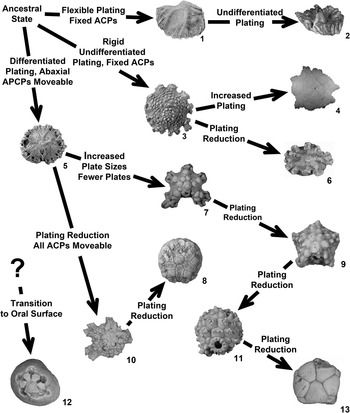
From the oldest preserved tegmen on a monobathrid camerate, Glyptocrinus decadactylus (Figs. 13.1, 17.1), presumably, three tegmen types arose: (1) a flexible tegmen with undifferentiated plating, as in Periechocrinus costatus (Figs. 13.2–13.4, 17.2); (2) a rigid tegmen with undifferentiated plating (Fig. 17.3) (e.g., Gennaeocrinus carinatus, Fig. 14.5, 14.6); and (3) a rigid tegmen with differentiated plating (e.g. Fibrocrinus phragmos, Figs. 13.9, 13.10, 17.5; Marsupiocrinus (Amarsupiocrinus) stellatus stellatus, Fig. 14.3). From the second type, tegmens could become larger, as in Strotocrinus glyptus (Figs. 14.1, 14.2, 17.4) or smaller, as in Dichocrinus douglassi (Figs. 15.5. 15.6, 17.6). From forms with differentiated plating (Fig. 17.5), plating could be reduced while still maintaining moveable ambulacra. An example is Allocrinus irroratus (Fig. 17.10) with a few fixed plates centrally (presumably PPCPs and a few interambulacral plates) and all of the ACPs were moveable. Tegmens also evolved that were composed of ten or fewer plates (Methabocrinus laevigatus, Figs. 13.5, 13.6, 17.8) and were presumably derived from a form like Figure 17.6 by the loss of visible ambulacra.
Inferred monobathrid camerate tegmen constructional pathways reflecting an unknown combination of phylogenetic and iterative evolution (thumbnails not to scale; compare with Figs. 13–15). (1) Glyptocrinus decadactylus; (2) Periechocrinus costatus; (3) Gaennaeocrinus carinatus; (4) Strotocrinus glyptus; (5) Fibrocrinus phragmos; (6) Dichocrinus douglassi; (7) Agaricocrinus americanus; (8) Methabocrinus laevigatus; (9) Laticrinus oweni; (10) Allocrinus irroratus; (11) Collicrinus shumardi; (12) Globacrocrinus glomus; (13) Neoplatycrinus dilatatus. ACPs = ambulacral cover plates, APCPs, ambulacral peristomial cover plates.

Differentiation of plating could become more extreme with very nodose PPCPs and ACPs, as in Agaricocrinus americanus (Figs. 14.4, 17.7). From this tegmen form, plating could be progressively reduced (Fig. 17.9, 17.11, 17.13) to produce a tegmen composed of ten plates (five large PPCPs and five small ACPs), such as in various Platycrinitidae.
This is only a very broad scenario for monobathrids. It is very likely that differentiated plating was lost and gained iteratively in numerous monobathrid lineages. Although relatively rare, tegmen plates also became highly modified. For example, tegmen plates may be modified to provide niches into which arms may be placed when closed. This includes crinoids in the ellipsoid calyx design of Ausich (Reference Ausich1988) and includes Eucalyptocrinites Goldfuss, 1831 (Ubaghs, Reference Ubaghs1978b, fig. 299) from the Silurian and Devonian (note this type of tegmen modification also occurred in disparids (Haplocrinites mespiliformis Goldfuss, 1831; Hapalocrinitidea, Devonian; Moore and Strimple, Reference Moore and Strimple1978, fig. 341.2a) and cyathocrines (Teganocrinus sulcatus Wanner, Reference Wanner1916 (Codiacrinidae, Permian, Lane and Moore, Reference Lane and Moore1978, fig. 385.10a)). Many camerate crinoids have tegmen and/or anal tube plates modified into spines. These vary from short nearly nodose plates, to the long, spinose ACPs of Dorycrinus gouldi Roemer, Reference Roemer1854 (Coelocrinidae, Mississippian, Ubaghs, Reference Ubaghs1978b, fig. 277.3c), to the spinose or blade-like “wing plates” of Pterotocrinus Lyon and Casseday, Reference Lyon and Casseday1859 that extend from tegmen plates (e.g., P. bifurcatus Wachsmuth and Springer, Reference Wachsmuth and Springer1897) (Dichocrinidae, Mississippian, Ubaghs, Reference Ubaghs1978b, fig. 281.7a–281.7c).
Tegmens dominated among monobathrids; however, some monobathrids had oral surfaces, including Amblacrinus rosaceus, Camptocrinus alabamensis, Cyttarocrinus jewetti, and Globacrocrinus glomus (Fig. 16). In all cases, these crinoids were relatively small, and the oral surfaces may have been the result of paedomorphosis within a lineage that reverted to an open mouth and ambulcacra. Alternatively, it is also possible that through the Paleozoic monobathrid lineages with an oral surface persisted, and we only have these few examples preserved (Fig. 17.12).
Disparids
Disparid oral regions
The temporal pattern among disparids is similar to that of monobathrid camerates. Although relatively few unequivocal oral regions are known among disparids, of the four examples of oral regions known on Ordovician disparids three are tegmens, each with very different architecture. Doliocrinus pustulatus Warn, Reference Warn1982 (Cincinnaticrinidae, Fig. 18.13, 18.14) has a small, multiplated tegmen with undifferentiated plating. Anomalocrinus incurvus (Meek and Worthen, Reference Meek and Worthen1865) (Anomalocrinidae, Fig. 18.5, 18.6) has a large tegmen with larger, irregular undifferentiated plating that may have formed a flexible integument. Cincinnaticrinus varibrachialis Warn and Strimple, Reference Warn and Strimple1977 (Cincinnaticrinidae, Fig. 18.1, 18.2) presumably had a leathery, spiculate tegmen. Acolocrinus crinerensis Sprinkle, Reference Sprinkle1982 (Acolocrinidae, Fig. 18.3, 18.4) has an oral surface composed exclusively of five, large PPCPs with a spiraled asymmetry.
Disparid crinoid tegmens and oral surfaces. (1, 2) Cincinnaticrinus varibrachialus tegmen composed of a presumably flexible network of spicules; (1) oral view; (2) lateral view with proximal arms nearly enclosing tegmen. (Ordovician; YPM 517519; scale bars represent 2 mm); (3, 4) Acolocrinus crinerensis tegmen composed of five primary peristomial cover plates with a spiral twist; (3) oral view; (4) lateral view, (Ordovician; OU 9050; scale bars represent 5 mm); (5, 6) tegmen of Anomalocrinus incurvus with irregular large central plates and fixed ambulacral cover plates; (5) oral view; (6) lateral view (Ordovician; YPM 517517a; scale bar represents 5 mm); (7, 8) oral surface of Pisocrinus (Pisocrinus) gemmiformis composed of five moveable primary peristomial cover plates; (7) oral view; (8) lateral view (Silurian; USNM S1958b; scale bar represents 2 mm); (9, 10) Zophocrinus howardi oral surface with five moveable primary peristomial cover plates and additional small plates; (9) oral view; (10) lateral view (Silurian; USNM S5910; scale bars represent 2 mm); (11, 12) oral surface of Synbathocrinus dentatus composed of five moveable primary peristomial cover plates; (11) oral view; (12) lateral view with anal plate and proximal brachials in a few rays (Mississippian; USNM S2019; scale bar represents 5 mm); (13, 14) Doliocrinus pustulatus tegmen composed of irregular plating; (13) side view; (14) oral view (Ordovician; UT 1391TX3; scale bar represents 5 mm); (15) oral view of Haplocrinites stellaris (Devonian; USNM 185820; scale bar represents 5 mm).

In contrast, the relatively few post-Ordovician disparids with oral regions known are interpreted to have had moveable PPCPs, making them oral surfaces rather than tegmens. Specimens of these taxa may be quite abundant, but preserved oral regions are exceedingly rare. Hence, we conclude that these plates were moveable, making them oral surfaces. This includes two Silurian and three Devonian crinoids. The two Silurian disparids are Pisocrinus and Zophocrinus Miller, Reference Miller1891with much reduced oral surfaces. Pisocrinus (P.) gemmiformis Miller, Reference Miller1879 (Pisocrinidae, Fig. 18.7, 18.8) has an oral surface reduced to five, moveable PPCPs. Zophocrinus howardi Miller, Reference Miller1891 (Zophocrinidae, Fig. 18.9, 18.10) is highly unusual by lacking normal arms, and the plating of the oral surface has five PPCPs and a few other plates that are probably associated with rays. Most Devonian through Permian disparids with known oral regions are reduced to five or fewer plates and belong to the Haplocrinitidae, Allagecrinidae, Synbathocrinidae, and the Paradoxocrinidae (e.g., Haplocrinites stellaris (Roemer, 1844), Haplocrinitidae, Devonian, Fig. 18.15) and Synbathocrinus dentatus Owen and Shumard, Reference Owen and Shumard1852; Synbathocrinidae, Mississippian, Fig. 18.11, 18.12). The Pennsylvanian disparid, Belskayacrinus turaevoensis Arendt, Reference Arendt1997 has more plating on the oral surface, but a reduced number of PPCPs (disparid incertae sedis, Pennsylvanian). The moveable PPCPs are reduced to three, and it has moveable ACPs and numerous interambulacral plates.
Disparid morphological pathways
The two oldest (Sandbian) disparids with a preserved oral region are Acolocrinus crinerensis (Figs. 18.3, 18.4, 19.2) with an oral surface composed of five oral plates and Doliocrinus pustulosus (Figs. 18.13, 18.14, 19.3) that has a tegmen. Both of the other Ordovician disparids with preserved oral regions also have tegmens: Cincinnaticrinus varibrachialus (Figs. 18.1, 18.2, 19.1) and Anomalocrinus incurvatus (Figs. 18.5, 18.6, 19.5). Later disparids (e.g., Pisocrinus, Fig. 19.4) had an oral surface composed of five moveable PPCPs. It is possible that these PPCPs were modified from five fixed PPCPs depicted in (Fig. 19.2) or that the condition present in Pisocrinus was present but unknown among the earliest disparids. We suspect the latter. This five plated condition was also present among numerous microcrinoids. It is possible that the five-plated oral surface construction of Pisocrinus evolved into an expanded oral surfaces, such as Belanskycrinus turaevoensis (Arendt, Reference Arendt1997).
Inferred disparid tegmen constructional pathways reflecting an unknown combination of phylogenetic and iterative evolution (thumbnails not to scale; compare with Fig. 18). (1) Cincinnaticrinus varibrachialus; (2) Acolocrinus crinerensis; (3) Doliocrinus pustulatus; (4) Pisocrinus (Pisocrinus) gemmiformis; (5) Anomalocrinus incurvus. PPCPs=primary peristomial cover plates.

Protocrinoids and aethocrinids
The oral regions of Aethocrinus moorei Ubaghs, Reference Ubaghs1969 and Titanocrinus sumralli Guensburg and Sprinkle, Reference Guensburg and Sprinkle2003 have been reconstructed similarly, with presumably flexible, tessellated plating, on a tall, conical tegmen with a distal opening. In both reconstructions (Ubaghs, Reference Ubaghs1969, fig. 1; Guensburg and Sprinkle, Reference Guensburg and Sprinkle2003, Reference Guensburg and Sprinkle2010, fig. 2), the entire oral surface is encased by this tegmen, and the mouth is interpreted to have been subtegmenal. Whereas these are plausible interpretations, it is also possible that one or both of these crinoids had an oral surface rather than a tegmen. The oral regions of both Aethocrinus Ubaghs, Reference Ubaghs1969 and Titanocrinus Guensburg and Sprinkle, Reference Guensburg and Sprinkle2003 are relatively poorly preserved, with oral region plating compressed between rays in laterally compressed specimens. Oral region plating on Aethocrinus is articulated to the proximal portions of the C-ray arm but not to the proximal brachials on other rays (compare Ubaghs, Reference Ubaghs1969, pl. 1, fig. 1b to pl. 1, fig. 1a). In the reconstruction of this crinoid, this plating is interpreted to indicate an off-centered tegmen, but clear evidence of a subtegmenal mouth is lacking.
Similarly, only a portion of the anal structure of Titanocrinus is preserved in the posterior interray (Guensburg and Sprinkle, Reference Guensburg and Sprinkle2003, text-fig. 5, pl. 2, fig. 3). Additional details needed to delimit the position of the mouth and structure of the remainder of the oral region are wanting. Again, the published reconstructions of the Aethocrinus and Titanocrinus oral regions are plausible; however, additional specimens with this important portion of the crinoids preserved are required to verify the oral region morphologies of these two important Early Ordovician crinoids.
Articulates
Articulate oral regions
In Hess and Messing (Reference Hess and Messing2011, p. 23), part of the definition for the post-Paleozoic Articulata is “Mouth exposed on the tegmen surface... .” Thus, the Articulata have an oral surface. Many oral surface morphologies are present in living crinoids with varying degrees of well-defined plating. A study of living crinoid tegmens is warranted to determine whether oral surface moprhologies are confined within clades or interatively evolved similar to tegmen and oral surface morphological grades among fossil crinoids. In addition, some oral surfaces on living crinoids are composed entirely of soft tissue.
Although extremely rare, oral surfaces are preserved on Uintacrinus Grinnell, Reference Grinnell1876 (Cretaceous). Uintacrinus is a relatively large articulate crinoid, and its oral surface was a soft-tissue structure with plates embedded in the soft tissue (Springer, 1901; Meyer and Milson, Reference Meyer and Milson2001, fig. 5D). It has a large anal sac that displaces the ambulacra from a strict pentameral symmetry.
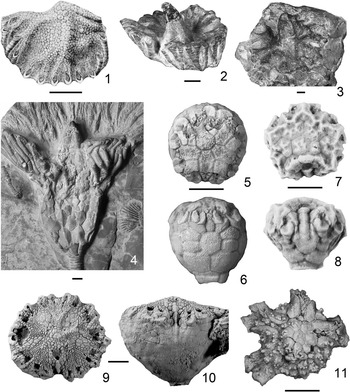
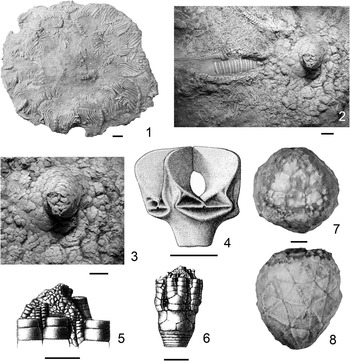
Tegmens are known in two fossil articulates. Traumatocrinus hsui Mu, Reference Mu1949 (Traumatocrinidae, Triassic, Fig. 20.1–20.3) had a tegmen that is composed of innumerable undifferentiated plates and lacks ambulacra along the tegmen surface. Traumatocrinus hsui is a one of a few crinoid clades that assumed a pseudoplanktonic lifestyle attached to floating logs (Hagdorn, et al., Reference Hagdorn, Wang and Wang2007; Hagdorn and Wang, Reference Hagdorn and Wang2015). The life position of this crinoid was with the crown hanging downward.
Articulate crinoid and hemicosmitoid tegmens. (1–3) Traumatocrinus hsui tegmens, photographs courtesy of Hans Hagdorn: (1) entire view of oral surface, from Hess and Messing, Reference Hess and Messing2011, fig. 18b, MHI 1882/3; (2) irregular, large plating of a tegmenMHI 1881/2; (3) enlargement of MHI 1881/2; (4) lateral view of Psalidocrinus armatus pseudotegmen (Jurassic; from Hess and Messing, Reference Hess and Messing2011, fig. 90.2c); (5, 6) Apiocrinites roissyanus elevated tegmen to secundibrachial level composed of small plates; (5) side view of partial calyx; (6) enlargement (Jurassic; from Hess and Messing, Reference Hess and Messing2011, fig. 81.2f, 81.2g); (7, 8) tegmen of Caryocrinites missouriensis with large fixed plates; (7) oral view; (8) lateral view (Silurian; OSU 54440). All scale bars represent 5 mm.

Additionally, Apiocrinites roissyanus d’Orbigny, Reference Orbigny1841 (Apiocrinitidae, Jurassic, Fig. 20.5, 20.6) has a relatively high tegmen that incorporates primibrachials and, perhaps, a few secundibrachials. The mouth was subtegmenal. Plating on the Apiocrinites roissyanus tegmen is innumerable, undifferentiated small plates.
The articulate Psalidocrinus armatus von Zittel, Reference von Zittel1870 (Psalidocrinidae, Jurassic to Cretaceous, Fig. 20.4) is another example of a pseudo-tegmen. Unlike its Paleozoic counterpart, Psalidocrinus armatus forms a pseudo-tegmen with both shoulders of the radial plates. The shoulders project symmetrically both distally and adaxially. These distal projections are sutured together, cover the mouth, and form a niche into which the arms retract when closed.
Blastozoan tegmens
Caryocrinites Say, Reference Say1825 is an unusual hemicosmitoid rhombiferan because it has exothecal ambulacra (“arms”) (Sprinkle, Reference Sprinkle1975). The oral region in Caryocrinites missouriensis Rowley, Reference Rowley1900, (Hemicosmitidae, Silurian, Fig. 20.7, 20.8) is a pavement of fewer than ten solidly sutured plates forming a tegmen (Sumrall and Waters, Reference Sumrall and Waters2012, p. 965). It is possible that the five to seven of the largest plates could be modified PPCP; however, homology of plates is unclear. Ambulacra enter the theca at the juncture of the tegmen and cup.
The paracrinoid Bistomiacystis (Sumrall and Deline, Reference Sumrall and Deline2009) and the diploporitan Tristomiacystis (Sumrall and Waters, Reference Sumrall and Waters2012) covered the mouth by suturing orals 1, 3, 4, and 6 together, eliminating the surface traces of the ambulacra typically present between these orals. This is a minimal kind of tegmen formed by the expansion of the orals and the resulting loss of ambulacra and their cover plates. This is in contrast to covering the oral region with fixed PPCP and ACP.
Discussion
Although typically not a well-preserved portion of fossil specimens in most crinoid clades, the oral region is a vital aspect of crinoid anatomy. The mouth is located in the oral region, and it is either exposed when alive (an oral surface) or covered by plating (a tegmen). The morphology of this focal position on early crinoids was derived from blastozoans (Kammer et al., Reference Kammer, Sumrall, Zamora, Ausich and Deline2013). This region of the crinoid was morphologically very pliable through evolution, with many iterative constructions are inferred both within and between major clades. The basic oral surface morphology inherited from blastozoans was maintained in some lineages; exapted in numerous ways into a tegmen; and in some cases, lineages with tegmens “reverted” to an atavistic oral surface. In addition to a true tegmen formed by oral region plating, a few crinoids (e.g., Figs. 9.4, 9.5, 20.4) covered their mouths with the extensions of aboral cup plating, thus forming a pseudo-tegmen.
At this time, oral surfaces and tegmens can only be understood as the two basic grades of crinoid morphology. When detailed phylogenies are constructed for clades and if oral region morphology is known for most clade members, it will be possible to understand specific morphological trajectories that were required to evolve a tegmen from an oral surface or an oral surface from a tegmen. From the survey of tegmen types presented here, we anticipate that tegmens were evolved through numerous sets of evolutionary transformations. Further, once a tegmen was present, its morphology remained relatively plastic as evidenced by contrasting tegmen morphologies in different species of the same genus (e.g., Gilbertsocrinus, Fig. 11.1, 11.2, 11.7; Lampterocrinus, Fig. 10.6, 10.7, 10.10, 10.11; Pleurocrinus, Fig. 15.7, 15.8, 15.15, 15.16; and Rhodocrinites, Fig. 11.3–11.6).
Evolutionary/ecological pressures
Rather than having the ambulacra exposed to the ambient environmental conditions, a pelmatozoan with a tegmen had the mouth, and at least the adaxial ambulacra, concealed beneath the tegmen. The repeated evolution of tegmens in multiple lineages suggests a clear selective advantage for crinoids with a tegmen. Such a proposal cannot be rigorously tested; however, as suggested by Meyer and Ausich (Reference Meyer and Ausich1983), Signor and Brett (Reference Signor and Brett1984), and others, it is possible that a tegmen would have provided some means of protection from predators, parasites, scavengers, and various disease causing agents. Multiple groups of organisms (bacteria to chordates) are pathogens on living echinoderms (Jangoux, Reference Jangoux1987a–Reference Jangoux1987d). One category of pathogens attacks the upper digestive tract, and a tegmen could have helped to limit access of at least larger organisms. With a tegmen, smaller predators feeding on tube feet, or parasites and scavengers feeding on food particles in the ambulacra or mouth would have been denied access if these oral features were covered. However, a large tegmen also provided an ideal surface for the attachment of platyceratid gastropods (see Baumiller, Reference Baumiller1990; Baumiller and Gahn, Reference Baumiller and Gahn2002; Gahn et al., Reference Gahn, Fabian and Baumiller2003; and Gahn and Baumiller, 2005).
Despite an apparently strong selective pressure for tegmens, virtually all post-Paleozoic crinoids have only oral surfaces. Thus, this is an apparent contradiction both in general and because of the well documented increase in predation pressure in the oceans during the Mesozoic marine revolution (e.g., Vermeij, 1977; Baumiller et al., Reference Baumiller, Salamon, Gorzelak, Mooi, Messing and Gahn2010). However, perhaps predation pressure became so high that more radical changes were favored over armoring the oral region with plates. For example, adaptations among living crinoids that presumably aid in predator avoidance include migration of stalked crinoids to waters greater than 100 m (Meyer and Macurda, Reference Meyer and Macurda1977); cryptic, semi-cryptic, and nocturnal behaviors of many shallow-water comatulid crinoids (e.g., Magnus, Reference Magnus1963; Meyer and Ausich, Reference Meyer and Ausich1983; and Meyer, Reference Meyer1985); and chemical deterrents within crinoid tissues (e.g. Rideout et al., Reference Rideout, Smith and Sutherland1979; Bakus, Reference Bakus1981; Meyer, Reference Meyer1985; but see McClintock et al., Reference McClintock, Baker, Baumiller and Messing1999).
Of the six Paleozoic pelmatozoan clades with true tegmens, three clades (diplobathrid camerates, monobathrid camerates, disparids) had tegmens when they first appeared during the Ordovician. The clades that evolved a tegmen secondarily did so during the earlier phases of the mid-Paleozoic Marine revolution, during which predation was inferred to have had a significant impact on crinoids (Meyer and Ausich, Reference Meyer and Ausich1983; Signor and Brett, Reference Signor and Brett1984, Sallan et al., Reference Sallan, Kammer, Ausich and Cook2011; and references therein). Of these three additional clades, cyathocrine cladids and hemicosmitids initially evolved tegmens during the Silurian, and dendrocrine cladids evolved a tegmen for the first time during the Devonian soon after this clade emerged. No representatives of the Flexibilia evolved a true tegmen, but a flexible pseudo-tegmen appeared during the Permian. The iterative evolution of the tegmen suggests strong selective pressures to protect the area around the mouth. The common occurrence of tegmens is in crinoids, versus blastozoans, which may help explain crinoid dominance among pelmatozoans after the early Paleozoic.
Another interesting correlation is that all stalked echinoderms with a tegmen have arms (exothecal ambulacra). Arms are typically used as a defining characteristic for the Crinoidea, which stand in contract to blastozoans that have brachioles and lack exothecal ambulacra (Sprinkle, Reference Sprinkle1973). Blastozoans with arms are relatively rare (e.g., Sprinkle, Reference Sprinkle1975; Sprinkle and Collins, Reference Sprinkle and Collins2006; Zamora and Smith, 2011), and taxa such as Eumorphocystis Branson and Peck, Reference Branson and Peck1940 have both arms and an oral surface (Sprinkle et al., Reference Sprinkle, Parsley, Zhao and Peng2011; Sumrall and Waters, Reference Sumrall and Waters2012). However, the one blastozoan with a tegmen, Caryocrinites, has arms. Blastozoans may have been less likely to evolve tegmens, because the potential loss of exposed ambulacra would directly affect food-gathering capabilities. The presence of “arms” on Caryocrinites may have eliminated that constraint.
Conclusions
The oral surface with the mouth exposed to the environment was a plesiomorphic condition that was evolutionarily conservative allowing recognition of homologous characters among pelmatozoans. In contrast, a plated covering making the mouth subtegmenal (a tegmen) was a derived, constructional feature that evolved many times among crinoids and in a few blastozoans. In addition to being iteratively evolved, once present, tegmen morphology was typically modified further in number and arrangement of plates, size, adding or subtracting plates that can be homologized to oral surface plates, etc. The one constant aspect of a tegmen is that if the number of plates is greatly reduced, the plating commonly reverted to the basic plates of the crinoid oral surface—PPCPs, ACPs, and/or interambulacrals. It is probable that the independent development of tegmens in all major crinoid lineages was a response to prevent easy access for predators, scavengers, parasites, and diseases into the mouth and proximal ambulacra of these Paleozoic pelmatozoans. The post-Paleozoic Articulata mostly lacked tegmens, probably as the result of different adaptations, such as predator avoidance or chemical deterrents, to protect the oral region.
Acknowledgments
We thank C.D. Sumrall and B. Deline for discussions of various ideas leading to this manuscript. Also, we thank the following (in alphabetical order) for assistance with curated specimens: T. Adrain, University of Iowa; J. Bohatý, Wiesbaden, Germany; R. Burkhalter, S. Noble Oklahoma Museum of Natural History University of Oklahoma; S.K. Donovan, Naturalis Biodiversity Center, Leiden; J. Dougherty, Geological Survey of Canada, Ottawa; J.O.R. Ebbestad, Paleontological Museum, Uppsala Sweden; T. Ewin, Natural History Museum, London; C. Franzén, Naturhistoriska Riksmuseet, Stockholm; D. Gnidovec, Orton Geological Museum, The Ohio State University; H. Hagdorn, Muschelkalkmuseum Hagdorn, Ingelfingen; K. Hollis, U.S. National Museum of Natural History; B. Hunda Cincinnati Museum Center; K. Leacock, Buffalo Museum of Science; F-J. Lindemann, Natural History Museum, University of Oslo; P. Mayer, Field Museum of Natural History; D. Miller, Museum of Paleontology, University of Michigan; A. Molineux, University of Texas, Austin; S. Rozhnov and G.V. Mirantsev, Borissiak Paleontological Institute, Moscow; H. Uwe, Solingen, Germany; O. Vinn, University of Tartu, Tartu, Estonia; J. Waddington, Royal Ontario Museum. Several images are used with permission of the University of Kansas Paleontological Institute, we thank H. Hagdorn for images of Traumatocrinus, and SEM images were acquired at the Subsurface Energy Materials Characterization and Analysis Laboratory (SEMCAL), School of Earth Sciences, The Ohio State University. D.L. Meyer, C.D. Sumrall, and S. Zamora improved an earlier version of this manuscript. This research was supported by the National Science Foundation project “Assembling the Echinoderm Tree of Life” (DEB 1036416 [to W.I.A.] and DEB 1036356 [to T.W.K.]).