The idea of domestic service as a realm suitable for jokes and laughter has had a long cultural heritage. Carolyn Steedman and Jane Thaddeus have written of eighteenth-century domestic servant jokes and “Mollspeak,” the pretentious and colloquial language put into the mouths of servants that made them so funny to their employers.Footnote 1 Jokes and laughter at the expense of employers and servants were equally prominent and persistent in late nineteenth- and twentieth-century British society. Victorians had for the most part regarded their jokes about servants as harmless or even as a healthy way of ensuring that servants knew their place. But, from around the turn of the century, reformers habitually talked of the comedy value of servants as a major problem, indicative of the lack of respect and dignity afforded the profession. The widely debated “servant problem” was often recast as a “humor problem,” a damaging tendency to laugh at all involved with domestic service. A 1919 government inquiry into domestic service described how the press represented servants as “comic or flippant characters … held up to ridicule,” while the domestic difficulties of employers were also commonly portrayed as “ignoble and laughable.”Footnote 2 Investigating the humor problem captures the deep sociocultural significance of domestic service in Britain and reveals the significance of laughter and comedy in delineating class and gender identities.
The topic of comic servants in the twentieth century was situated in an unstable social, economic, and cultural context. The “servant problem” had become a source of deep social anxiety among British elites, based on the widespread perception that this central institution of middle- and upper-class homes was no longer sustainable in its current form. Domestic service was the single-largest employer of women across the first half of the twentieth century, still employing around 20 percent of all working women in 1931.Footnote 3 Yet it was persistently described as incompatible with novel features of “modernity”—with new ideals of how to raise children; with the aspirations of working-class women whose employment opportunities had been transformed by the manufacturing, sales, and junior clerical jobs that had become more widely available to them; and more abstractly, with new ideals of democracy and equality.Footnote 4 Many households complained of not being able to afford, attract, or retain servants, as mistresses proved unwilling to grant the higher wages and shorter hours needed to compete with other types of employment. This prompted intense reform efforts among politicians and middle- or upper-class activist women during the long, drawn-out period of perceived transition from a “servant-keeping” to a “servantless” society. Between 1914 and 1945, there were four high-profile public inquiries on the future of domestic service, as well as myriad discussion papers and speculation in newspapers and periodicals.Footnote 5 Nonetheless, younger women largely chose to avoid the social confinement of private residential domestic service, and the institution declined from the 1920s. Domestic workers became predominantly older, casually employed “chars” and “cleaning ladies.”
Nonetheless, live-in domestic service declined slowly and unevenly. Servant keeping may have seemed unsustainable at the turn of the twentieth century, but “the comfortably off”—those whom Rowntree had termed “the servant keeping class”—were expanding throughout the Edwardian and interwar years, through the new opportunities for managers, administrators, and professionals.Footnote 6 Larger numbers came to identify as middle class through the growth of professional and clerical employment and sought the domestic help that might stabilize their social identity. Small but significant numbers of professional women were also seeking careers and insisting on domestic help to enable this. Servant keeping was incorporated into households of smaller means, typically employing a single-handed maid or live-out “daily” in suburban homes. As Judy Giles has argued, this created a new landscape of unmediated yet asymmetric relationships between mistresses and servants, marked by “small wars of attrition and manipulation” and moments of intimacy within the inherently oppressive relations of domestic service.Footnote 7
This period of flux and uncertainty around the scripts and norms of servant keeping prompted numerous opportunities for humor. Laughter at domestic service was evident among readers of cartoons and the popular press, audiences at cinemas and music halls, and radio listeners. A typical Evening Standard “investigation” into service in 1939 set the tone. It opened: “When I read about the servant question, I just laff and laff and laff.”Footnote 8 Examining such sources allows for an expansion of the range of any historical inquiry into domestic service and class relations, since the texts and performances that carried domestic service humor frequently had a far wider circulation than the “serious” treatment of the servant problem in the public inquiries, pamphlets, and articles on which historians have largely drawn.Footnote 9 Laughter was also evident in the myriad interactions that took place in kitchens and drawing rooms that were related and recalled at middle-class dinners, “below stairs,” and in working-class homes. Domestic service humor can thus be understood to span two intersecting realms—the cultural representations of domestic work and the everyday interactions in homes that employed servants or chars. Laughter at domestic service was both a response looked for by comic productions and an unpredictable, unstable element of the individual encounters of domestic service. This article will explore attempts, both successful and unsuccessful, to make domestic service laughable, dividing the laughter found at all levels of British cultural life from that found within homes, while acknowledging the interdependence of these realms. These are brought together with a concluding exploration of shared jokes and failed jokes of the second half of the twentieth century and with an assessment of the changes over time that can be traced in relation to domestic service humor.
I. Historicizing “Domestic Service Humor”: Historiographical Approaches
Looking at the jokes told about domestic service provides an alternative means of understanding the servant problem. Accounts of the pivotal role of domestic service within British society have predominantly offered social or economic explanations, exploring the wages, the hours, associated migration, and urbanization patterns.Footnote 10 Leonore Davidoff's work has been particularly influential and productive, outlining both the material and symbolic elements of the encounters of class and gender integral to servant keeping.Footnote 11 Another avenue of research has centered on the collection of oral histories of domestic service, producing accounts that aim to reflect the servant's point of view, though they are sometimes overly influenced by a tendency to find victims.Footnote 12 More recently, the historiography has focused upon literary and visual-cultural representations of servants, reflected in the work of Alison Light, Judy Giles, and Swapna Banerjee. Historians such as Jane Hamlett have also paid attention to the spatial enactment of power and authority within British homes, alongside wider relationships between gender, domestic service, and the boundaries of public and private.Footnote 13
This work has implications for broader understandings of the female labor market in Britain. Anne Summers has argued that domestic service provided a central paradigm that uniquely shaped women's professional and philanthropic identities and that it was “extrapolated to every sector of the public domain occupied by women.”Footnote 14 More recently, the work of Carolyn Steedman has placed domestic service more prominently in histories of class since the eighteenth century, and it has prompted Selina Todd to offer a revised account of class in the twentieth century.Footnote 15
Additionally, the historiography of emotions has generated new perspectives on servant keeping. Michael Roper's recent account of the emotional experiences of World War I has stressed the significance of domestic service as an influential “emotional template” for social relations between officers and their men.Footnote 16 Servants were part of the emotional economy of servant-keeping households, and part of the product of their work was emotional. Most influentially, Alison Light's work has pointed to the history of emotions as a new and rich historiographical framework for looking at domestic service, an approach that has helped focus my own interest in humor.Footnote 17 Light refers to the work of “emotional housekeeping” conducted by mistresses and servants, and she notes that “caste and class distinctions were the lingua franca of insult and comedy.”Footnote 18
This article builds on these insights and argues that laughter acted as a vehicle for managing and negotiating emotional and social investments in the precarious institution of service. Opportunities to laugh were important means of gaining authority, of resisting indignities, and of cementing or even abandoning the social scripts that governed interactions between employers and servants. Attention to laughter opens up the emotional range of accounts of domestic service, moving beyond the usual evocation of growing social discomfort—anxiety, irritation, and misunderstanding—for all parties involved in service. I argue that the laughter associated with domestic service also reveals moments of intimacy, found in occasional shared laughter between servants and employers. Humor and laughter were deployed in forming the individual subjectivities of mistresses and servants, and they provided a means by which individuals might resist or align themselves with broader social identities. Attention to humor and laughter enriches accounts of domestic service with an additional cultural and emotional dimension, and more abstractly, demonstrates the centrality of laughter in establishing, maintaining, and subverting social boundaries.
Despite the rich potential of recent work in the history of emotions, laughter has not been easy to incorporate, though Vic Gatrell's work suggests its historical potential.Footnote 19 The history of emotions literature, however, has tended to foreground certain emotional states—anger, fear, love—and to neglect laughter, which is seen as a less “primitive” or basic emotional state. Apparently rooted in culture rather than the relationships of kin and psychosexual development, laughter seems a transient, epiphenomenal state. There has been little attention to the laughter that accompanied domestic service—as if, lacking seriousness, the jokes about servants and employers did not have weight. Or perhaps it simply has not been evident that some texts were comic, since the jokes are often no longer funny to a modern reader. Why, for example, did the children of a late Victorian servant-keeping household in which a servant had been caught stealing money record that “we were all astonished at Mother's cleverness” when she posed the joke: “Why is a thief like a dirty carpet? Because the sooner it is taken up and beaten, the better.”Footnote 20 Yet, as Robert Darnton's work suggests, it can be the unfunny jokes of the past that are the most revealing.Footnote 21
The study of humor and laughter is located at the point of intersection between social, political, emotional, and cultural history, and it poses some questions for historical methodology. The history of humor as a cultural genre intersects with that of laughter as an emotional experience. Like many emotions, laughter is a subjective and even uncontainable physical human response, but it is also culturally codified. Indeed, emotions have been argued to act as a bridge between individual subjectivity and social being.Footnote 22 Laughter operates as a site of the exercise of power in providing a means of naming, belittling, imitating, and making ridiculous. It also, on occasion, promotes social inclusion, informality, and friendship. As Gatrell has recently proposed, “Studying laughter can take us to the heart of a generation's shifting attitudes, sensibilities and anxieties.”Footnote 23
Humorous acts and texts, funny or unfunny to later interpreters, differ from other historical sources. Jokes have a performative dimension and rely on gestures, pantomime, timbre, and rhythm. Historical work on humor is hampered by the difficulty of recovering this performative dimension from a historical distance. The passage of time, the translation in some cases from oral to written form, or the ambiguity of the visual form when read in a different context all make humor hard to pin down. Humor is often timely and not easily carried outside its historical context.Footnote 24 What was intended as satirical may now be read as neutral, as social realism, or as grotesque.
Reading the ambiguous and unstable medium of humor also requires a close attention to reception, not least to the possibility of very different receptions by different audiences or individuals. What one finds funny is highly context dependent, and this makes it hard for a historian to judge the success of comic performances and texts. Comic discourse is richly unstable and sometimes escapes the intentions of the author or performer. Finally, it is important to be sensitive to the conditions of production of humor; much nineteenth- and twentieth-century humor was created in commercial contexts, and it needs to be read as the product of a “humor industry” rather than as a direct vox populi or expression of mentalities. The production of, for example, nineteenth-century music hall songs as a commercial medium was in some senses “just entertainment”—songs were intended to amuse and not to provoke. The material context of their production therefore can limit the meanings that can be read into them.Footnote 25
The historiography of humor is dominated by two competing interpretations of the significance of humor, which will be summarized here very briefly. First, there is a literature (primarily located in sociology and anthropology) on the subversive power of humor, typified by political humor as the “underground culture of dissent.”Footnote 26 Mary Douglas, drawing on Henri Bergson and Sigmund Freud, offered a classic reading of jokes as essentially subversive, “levelling of hierarchy, [a] triumph of intimacy over formality, of unofficial values over official ones.”Footnote 27 Such dissident humor can operate symbolically, can be overtly political, or can be simply socially irreverent. In this guise, humor tends to be seen, following James Scott, as a “weapon of the weak.”Footnote 28 It is also identified with the grotesque inversions and license of carnival, as explored by Mikhail Bakhtin.Footnote 29
The apparent “dissidence” and subversive power of jokes, however, can be ambiguous to interpret; they can also shade into a second interpretation of the role of humor—to act as a kind of social vent that dissipates unrest. Umberto Eco has argued that carnival is an “authorized transgression” and thus reinforces established forms of identity. Anthropologist Susan Seizer notes that jokes paradoxically “often serve to reinscribe the very conventions they blatantly taunt.”Footnote 30 Humor can depict abuse or exploitation as reassuringly funny, or can, through humiliation of outsider groups, create emotional affinities and satisfactions within social groups. Humor formed an important ingredient of what Gareth Stedman Jones labeled the “culture of consolation” of late Victorian working-class leisure. It can serve as a substitute for political action, releasing social tensions and making the status quo seem more sustainable.Footnote 31
Peter Bailey has extended the historiography beyond these two options with his influential account of Victorian music hall comedy as based on “knowingness,” a “culture of competence” that was both subversive and complicit. The commercial genesis of the late Victorian and Edwardian music hall and its attempts to appeal to a broad audience limited the potential for subversive or challenging content. Yet Bailey has argued that there was a level on which music hall humor worked to “destabilise the various official knowledges that sought to order common life through their languages of improvement and respectability and the intensifying grid of regulative social disciplines that marked the period.” This made for a “counterdiscourse” potential, but one that “was limited to the infraction rather than the negation of the dominant power relationships”Footnote 32 In other words, Victorian and Edwardian music hall humor, alongside other contemporaneous sites of popular humor such as postcards, comics, and cinema, might mock and satirize official, elite, or establishment concerns, but it rarely challenged or changed the terms of the status quo in any profound sense. Andy Medhurst similarly argues that popular comedy represents a temporary “invitation to belong,” built on the “survival laughter” prompted by recognition of the grimness of daily life. He refuses to identify this with any ideological bent, concluding that popular humor “is primarily a politics of defense not attack, of refusal not uprising, of embracing your own, of consolidation against condescension.”Footnote 33
In domestic service humor, laughter was frequently excited by the familiar comic strategy of subverted expectation: the disruption of what appears to be proper to a particular social situation. For Ronald Pearson, Victorian Britain was saturated by laughter prompted by incongruity, and the uppity servant with aspirations to a middle-class lifestyle or accent was a powerful comic cue. As the most prominent representatives of the working classes to the middle and upper classes, servants were the ideal candidates for the kind of humor that relied upon social transgression and juxtaposition. In the nineteenth century, Fraser's Magazine had conducted a campaign against the pretensions of male flunkeys, chiefly footmen, with the character of Charles Yellowplush invented by William Thackeray, who also created Jeames for Punch. The illustrator John Leech of Punch continually drew attention to the snobberies of servants in two series, Flunkeiana and Servantgalism. As Pearson's analysis suggests, the language of servants in such work was a persistent cause of laughter, centering on their attempts to imitate middle-class speech and accent. Other cartoons based their humor not on the snobbery of servants but on their desire for a social life, for contact with other workers, or for social activities such as reading or music. Such “foibles” of servants were a stock topic for illustrated and comic magazines throughout the nineteenth century, as well as for collections of jokes, or jestbooks. Servants’ undainty and odorous bodies, their dirty faces, the unseemly physical positions their work required (e.g., scrubbing front-door steps), their names, and their misapprehension of middle-class social norms, all were long-established components of humor.Footnote 34 Jokes at the expense of servants can be read as a form of disciplining mockery—to perceive someone as ridiculous challenged their freedoms, habits, and lifestyle. The Edwardian humorist Max Beerbohm cheerfully recalled the incongruous servant character in Punch of the 1860s as maintaining appropriate social distinctions: “Absurd that Jemima Jane should imitate the bonnets of her mistress and secretly aspire to play the piano! ‘Punch’ and his artists, as you will find in his old volumes, were very merry about her, and no doubt his readers believed that his exquisite ridicule would kill, or his sound good sense cure, the malady in her soul.”Footnote 35
For mid-Victorians, laughing at domestic servants had been part of the solution to the servant problem. It was a useful means of establishing social distance and “place,” and nineteenth-century print culture returned again and again to the social faux pas of the pretentious, provincial, or foolish servant. Leonore Davidoff has commented on the use of “a form of humour which reinforces social difference” in Victorian servant-keeping families, though she argues that “fear can be sensed behind the stories which belittle the servant's grasp of middle class language and customs.”Footnote 36 Employers were aware that servant keeping made them vulnerable to being seen as figures of fun. Incongruity was a device that could be reversed, and employers were also laughed at for their vulgarity and pompous aspirations: “Many jokes revolved round the embarrassment of the previously servantless trying to cope with cook, housemaid, or coal-boy.”Footnote 37 Such jokes circulated not only in print media and music halls but also in the kitchens and attics of servant-keeping households, as servants themselves used laughter and humor to form what James Scott has termed “a ‘hidden transcript’ … spoken behind the back of the dominant.”Footnote 38
Jokes and sketches about servants could also be seen as a defensive reaction by nondomestic workers, a tendency to mock those workers who had a lower status or worse conditions than themselves—a consolation of sorts.Footnote 39 A static social hierarchy was often represented in Victorian popular culture, and servants occupied the lowest rungs of this hierarchy. They thus made an ideal means of satisfying what Christie Davies proposes as a transcultural “deep-seated need that people have to tell jokes about a group of stupid outsiders.”Footnote 40 Both nondomestic workers and insecure servant keepers of the lower middle classes might use domestic service humor to shore up and distinguish their own social position.
All of this leaves uninvestigated, however, the process by which domestic servants, rather than the workers of other despised occupations, came to be the “outsider group.” Nor does it tell us when domestic service no longer fulfilled this function and why. Domestic service humor does not easily fit into any simple category of the “function” of humor, and this indicates the limited usefulness of looking for an overarching, transcultural, or transhistorical explanation for how humor operates.Footnote 41 While there do seem to be repeated features in jokes about service (such as the idea of role incongruity), what is held to be incongruous must inevitably be historically and culturally specific. The fine-grained exploration of why it was domestic servants who so often functioned for eighteenth- to twentieth-century audiences as “stupid outsiders” cannot be solved by sociological, literary, or psychological generalizations. I turn now to a historical narrative of domestic service humor in late nineteenth- and twentieth-century Britain to shed more light on when, why, and for whom domestic service was funny.
II. Cultural Sites of British Domestic Service Humor
Domestic service humor had long prompted laughter at the vulgar, the gross, and the lewd. However, the nature of humor in Britain was shifting in ways that made domestic service humor more visible and more problematic for late Victorians. Alfred L’Estrange, a cleric and commentator on British life, highlighted this in A History of English Humour in 1878: “Hitherto the poor and uneducated had been regarded with a certain amount of contempt; their language and stupidity had formed fertile subjects for the coarse ridicule of the humorist.” L’Estrange suspected that this was fading and that “broader views were gaining ground.”Footnote 42 There is, however, plenty of countervailing evidence, particularly in the genres of humor aimed at the educated, servant-keeping classes; George Orwell still noted in 1937: “Look at any number of Punch during the past thirty years. You will find it everywhere taken for granted that a working-class person, as such, is a figure of fun.”Footnote 43 Nonetheless, according to L’Estrange, by the closing decades of the nineteenth century it was vulgarity, rather than poverty and low station, that was now the target of humor and satire. This was best represented by “those slightly below [middle-class people].” The style of comic writing of those dubbed the “new humorists” in the 1890s, such as Jerome K. Jerome, the Grossmiths, and H. G. Wells, created a new genre of humor, focused upon the “little man”; the suburban clerk epitomized the pretensions of the socially aspirant. L’Estrange however specified “the artifice and cunning of the waiter of the Hotel in Yarmouth” as a typical example of the comically vulgar.Footnote 44 It was both the lower-middle-class employers of servants such as Charles Pooter and the servants themselves who epitomized the incongruous and vulgar pretensions to gentility that for L’Estrange remained a legitimate object of humor, while other working-class targets had become exempt.
Servants thus emerged as distinct from the remainder of the working classes and as a persistently suitable group for jokes. When the American journalist Elizabeth Banks caused a sensation by her two-week employment impersonating a housemaid in London in the early 1890s, she intended her write-up in the Weekly Sun to be read as funny. Banks recalled in her autobiography that “whatever was sad, whatever was tragic, and, to a certain extent, whatever was serious, I determined to leave out of my ‘In Cap and Apron’ series. I knew there were plenty to write fiction, plenty to write tragedy, so I chose what afterwards proved to be the better and more popular part of trying to write brightly and entertainingly of my brief experience as a servant.”Footnote 45
Banks had correctly assessed the market in recognizing that many were willing to be entertained by a narrative of domestic service, and she became an overnight celebrity through her incongruous portrayal of a housemaid by a young, middle-class woman still possessed of her own long-serving personal servant. Banks reported that servants, employers, and reformers wrote to her copiously after the series had been published—all were consumers of her “bright” articles in a mass newspaper. Although domestic service humor took different forms within “popular” and “educated” cultural performances, there were overlapping audiences for each of these genres, and firm distinction cannot always be made between humor aimed at working-class or middle-class audiences.
Not everyone, however, found the series amusing. After the publication of “In Cap and Apron,” Banks was called to account for her “serious” aims in going into service at a meeting of a late Victorian reformist women's club. Her reply, that gaining entertaining copy had been her motive, caused outrage among her audience: “I shall never forget the shocked expression on that woman's face, nor fail to remember her exclamation of surprise and disgust, as she replied: ‘Copy!’ You mean to confess you had no philanthropic aim?”Footnote 46 The reaction exemplifies the new sense of unease at the entertainment to be derived from domestic service. The humor problem was widely identified as diminishing the supply of servants. The domestic reformer Ellen Darwin wrote in 1902:
The class of jokes which depends entirely on the inherent ridiculousness of the demands of servants for air, exercise and society, indicate the current state of mind of the subject. I call them jokes; because they appear in the pages on comic journals, so I suppose they are intended to raise a smile. But to those who don’t smile, they appear as curious and significant instances of class stupidity—of that want of imagination in employers, who have done all they can to isolate servants as a class, and to lower the type of person who enters domestic service.Footnote 47
The twentieth-century concerns over who was laughing were intensified by the new ability of servants to consume humor in sources such as the Weekly Sun. Where Victorian servants had sometimes been socially and culturally isolated, those of the twentieth century could read newspapers and novels, and they were more likely also to access realms of culture and leisure such as the music hall, the radio, and the cinema. This aroused extensive controversy over the “problem” of servants’ consumption of culture and leisure.Footnote 48 While the reading habits of servants had long been seen as problematic (distracting them from their work and inflating their romantic ambitions), it was the specific content of what they read and what they saw at the cinema and the music hall that became troubling. Servants could now access the cultural representations of domestic service, which could lead to disaffection, or worse, to service appearing comic in their own eyes. A contributor to The Spectator wrote in 1914 of the shift in the direction of domestic service laughter, from employer to servant: “Thackeray dealt a blow at domestic service from which it has never quite recovered. He made it ridiculous. … The literature of his day reflected his point of view. Servants did not like reading novels—they were 31s 6d each—neither did they belong to lending libraries. The derisive smiles of their employers were hardly understood by them. … Meanwhile, education has made rapid progress. A class which never read before is reading now. … The result is that the class from which servants are drawn is beginning to laugh at domestic service.”Footnote 49
Even in this sometimes isolating job, domestic servants were not insulated from the cultural depictions of service as comic, and all parties were aware of the symbolic importance of laughter in maintaining or subverting social boundaries. Who was thought to be laughing varied—sometimes it was the working classes in general, sometimes servants themselves, sometimes the employing classes. But in all cases, the comedy was beginning to be thought to be inappropriate and damaging.
Nonetheless, comic plays, essays, and serials, such as J. M. Barrie's 1902 The Admirable Crichton, Jerome K. Jerome's 1909 Fanny and the Servant Problem, Max Beerbohm's 1918 Servants, or the interwar Diary of a Provincial Lady by E. M. Delafield, used domestic service as a key vehicle for humor and as a means of making semi-serious comments on recent social trends.Footnote 50 Some standard comic tropes emerged, such as the self-important or snobbish servant; the savvy or work-shy servant; the deadpan, witty manservant; and the frivolous or fashion-loving maid. Overall though, it is hard to say exactly what is meant to be funny about many such sources. The humor is very implicit; to some degree, servants were simply funny in essence, much as bicycles had been in the 1890s, without needing to engage in much overtly comic activity.Footnote 51
Domestic service was also simply a vehicle for the domestic concerns that dominated both the comic/illustrated papers aimed at educated readers and the popular media of the music hall and halfpenny comic. One songwriter wrote in 1894 of the “pathos, homely humour—something to do with the wife and mother-in-law and so on” of the “catchy” songs he produced.Footnote 52 Servants were easy to add to this list—they added a romantic or sexual element to a plot, they conveyed sartorial anxieties and oddities, and domestic service was a feature of everyday life in which large sectors of the population were invested. Servants were a convenient vehicle for slapstick and for introducing sexual horseplay into plots, without necessarily emerging as characters in their own right. This was particularly evident in early cinema productions where female servants are kissed or seduced by their masters.Footnote 53 Other standard tropes in early cinema were the stupid servant (Mary Jane's Mishap; or, Don’t Fool with The Paraffin, directed by G. A. Smith [1903]) or just as commonly, the servant who turns the tables and humiliates or exploits the employer (Accidents Will Happen, directed by Walter R. Booth [1907]; Milkmaid, directed by Alf Collins [1905]). This was a persistent feature of servants in all forms of popular culture—though they inhabited degraded circumstances, they were rarely just derided characters; more often they were wily and cunning.
While there is a great deal of evidence that employers found their servants funny, it was not the laughter of employers that inspired early twentieth-century commentaries on the “problem” of domestic service humor. Instead, it was the laughter of the working classes or servants, elicited within more popular cultural productions, that seemed most problematic and threatening. Dramatic reviews, such as the “comic absurdity” of The Silly Servant, which played at the Hulme Hippodrome in August 1906, were feared likely to convince working-class audiences that domestic service was an undignified profession.Footnote 54 But where stupid servants were mocked, it was also the employer who emerged as comic. Adroitly picking up on anxieties over the reading skills of servants, a 1912 Edgar Bateman song, “Our Martha Jane Can’t Read,” mocked the employers’ preference for an illiterate “treasure” and their concern over the reading habits of servants:
Music hall songs mocked the pretensions of those who employed servants but were themselves barely middle class. Many songs had semi-serious content, drawing attention to the hard life and low pay of domestic servants, and these seemed sympathetic to the servant's perspective.Footnote 55 Some portrayed the smart servant who managed to confuse employers and so evade work, which resonated with a longstanding British popular comic tradition of sending up those in authority.Footnote 56
Interpreting the implications, ironies, and tacit meanings of music hall and popular performances requires “knowingness,” often hard to reconstruct at a historical distance, particularly when descriptive terms may have historically specific meanings. In reviews of music hall acts, for example, female servants (almost always portraying those at the bottom of the hierarchy of service, the maid-of-all-work, or “slavey”) were persistently described as “quaint.” An actress playing at the Dover Theatre Royal in 1906 was described as “the quaintest of quaint little slaveys”; a music hall maid-of-all-work in 1924 was declared “the essence of quaint comicality.”Footnote 57 Most reviews gave little detail on what this meant, though a write-up of a play at the Hackney Empire in 1906 gives a fuller picture of a quaint comic role: “Jemima is a London slavey, in service of a widow… [There is] a good deal of funny comedy business, in which Jemima takes a prominent part. … Miss Louie Freear quite revels in the part of Jemima, the lovelorn ‘domestic,’ and her embodiment of the quaint looking little slavey is marked throughout by a genuine humour which delights the audience. Her by-play is excellent. Everyone laughs when Jemima washes the seats of the chairs with a flannel cloth dipped in water and then, proceeds to dry them by a highly original method.”Footnote 58
Clearly there was an element of slapstick in this performance. But quaintness had quite different connotations from its contemporary meanings—to be quaint for Edwardians was to show a combination of ingenuity, wiliness, and affectation.Footnote 59 This last value was perhaps the most insulting to servants, since it was often believed to be a comic “affectation” on their part to seek some very natural human goals—to have a love life, a social life, or any pursuits outside of their work. The tennis- or piano-playing servant was a very common comic figure in cartoons aimed at educated readers, though similar snipes against pretentiousness also surfaced in popular humor. There was certainly no clear divide to be found between “elite” and “popular” humor, which often depicted the same comic figures—though mostly to quite different effect. The “lovelorn Jemima” was a more typical figure within the music halls, where the desire among servants to have a love life was, I suspect, regarded with irony rather than being straightforwardly incongruous or comic. Most of the working-class members of the audience would have been aware that to marry was the only way to get out of a profession that was not kind to older single women.
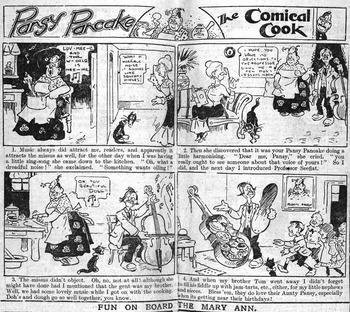
—“Pansy Pancake,” Comic Cuts, 22 February 1913, 4–5. © British Library Board (LON NT141 NPL).

Edwardian and interwar comic papers reveal an amalgamation of these comic tropes; the servants they portray are gross and ineffective, but by chance or design, they always end up in the whip hand over the master or mistress. Perhaps lampooning in their turn employers’ jokes about musical servants, comic papers repeatedly portrayed musically active servants who used this to “get one over” their employers. Pansy Pancake, the long-running “comic cook” character in the halfpenny paper Comic Cuts was portrayed in 1913 using her awful singing voice to irritate her mistress into getting her a singing teacher, by whom she then smuggled food out of the kitchen for her family (fig. 1).
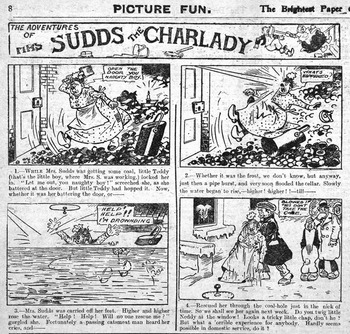
Another character from 1913, Mrs. Sudds the Charlady, featured in another cheap comic, Picture Fun. This character was much less wily (or quaint) than Pansy Pancake, and almost every week she was physically abused by her employers. Her strip is hard to interpret; it reads as an unfunny joke to a modern reader, in relying simply on the slapstick value of physical mishap. But a note of irony does creep in. The commentary to one strip ends with a typical humorous attempt to imitate the missing aspirate that servants were associated with: “But what a 'orrible experience for anybody. Hardly seems possible in domestic service, do it?” (fig. 2).
—“Mrs. Sudds the Charlady,” Picture Fun, 11 February 1913, 8. © British Library Board (LON NT181 NPL).

While this strip still mocks the language of servants, there is a sense that the audience being addressed is one that knows that ill treatment is not only possible in domestic service but common. It addresses a “knowing’” audience, who were well aware of the hypocrisy of the very common claims made by employers and public officials that service was the highest honor and privilege. As Nicholas Wolf notes, “popular culture does not straightforwardly assimilate the goals and tactics of elite culture.”Footnote 60 In relation to servants, the laughter elicited within British popular culture was equivocal and ironic. Despite the grossness and affectation of its comic servants, popular culture seemed relatively supportive of the dignity and aspirations of servants, and its satire was aimed more at employers.
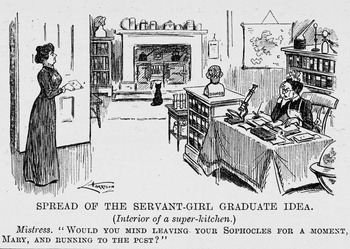
During and after World War I, a tendency emerged to find humor in the reversal of social esteem and circumstances that seemed to favor the domestic servant over the employer in interwar Britain. Punch, for example, depicted a “servant-girl
—“Spread of the Servant-Girl Graduate Idea,” Punch, 14 January 1914, 36. By permission of the Syndics of the Cambridge University Library.

graduate” studying in plush academic surroundings while a mistress requested: “Would you mind leaving your Sophocles for a moment, Mary, and running to the post?” (fig. 3). Punch readers were offered some incongruous announcements in 1919, motivated by the fear that the war had created more independent-minded young women who would refuse to serve: “A Servant Girls’ Trade Union has been formed. So far there is no suggestion of interfering with the mistresses’ evening out,” and “We understand that a West-End lady has just been appointed mistress to a young parlourmaid.”Footnote 61
The popularity of P. G. Wodehouse's Jeeves novels from the 1920s was partly based on the social reversal of the incompetent employer and the masterly valet. But the extent of the reversal was always limited. Despite the apparent reversal of Punch's “Servant-Girl Graduate” with a strong labor market position and aspirations to educated status, she is depicted as pretentious and shrewish, and her aspirations seem laughable and spinsterish. The ageing profile of twentieth-century domestic service perhaps contributed to the comic value of the unmarried female servant, as servant humor tended toward spinster humor.Footnote 62
Nonetheless, as the social divide between employers and servants decreased after World War I, there was a narrowing of the characteristics of servants that could be laughed at. The cartoons of George Belcher, published in Punch and The Tatler in the 1920s and 1930s, dwelled heavily on servants and particularly on the comic figure of the char. In a 1933 collection titled Potted Char, Belcher continued to ridicule the “mollspeak” of domestic workers (“Shall I serve the rabbit up in the camisole, mum?”), but his employers and servants had come to look physically similar—both tended to be large, aproned women, depicted in shared domestic spaces, rather than in domains that could be identified as belonging to “upstairs” or “downstairs.”Footnote 63
Social reversals and blurring of distinctions prompted not only laughter, of course, but also intense anger. In the early 1920s, there was outrage among middle-class public opinion over the possibility that working-class women might be drawing unemployment doles rather than going into available domestic service jobs. The Daily Mail ran a scaremongering campaign, “Scandals of the Dole,” in 1923, which prompted an inquiry by the Ministry of Labour into the supply of domestic servants.Footnote 64 The authors of the resulting report attempted to defuse Daily Mail readers’ outrage by blaming humor rather than the dole for keeping women out of service. Indeed, the humor problem had an extraordinarily high profile in the domestic service reform literature of this period. The 1923 report claimed that “the constant caricaturing of maidservants as dirty, harassed, impertinent and somewhat grotesque creatures, and the use of contemptuous terms such as ‘skivvy’ and ‘slavey,’ are significant.” Although it was mainly the educated classes who had the power to shape the representations of the media, the authors denied that this issue could be laid at the door of employers themselves. Rather, it was claimed that it was the working-class “friends and relatives” of servants who found their occupation ridiculous and thus damaged the profession.Footnote 65
Curiously though, of the servants who were quoted in the 1923 report on this issue, only one blamed the “snobbery of our own class” for the problem of servants being laughed at. Others named the daily papers, the stage portrayals of servants, and, most importantly, the attitude of employers. Clearly, employers were still making servants feel inferior through their ridicule and lack of respect. The only suggestion that the report's authors could make was to appeal to “the Press, the dramatist, and the humorist” to realize that their “cheap jokes at the expense of the ‘general’” were actually inflicting genuine pain.Footnote 66 They were unwilling to acknowledge that the laughter of employers might be to blame.
The educated classes, at whom books such as Monica Dickens's 1939 One Pair of Hands were aimed, were reluctant to stop laughing. Dickens's experiences as a servant were read by critics as portraying “unforced enjoyment in the spectacle of life below stairs,” despite the reform intentions of the author.Footnote 67 Alison Light records the laughter among 1930s Bloomsbury literati at their casual domestic workers and chars, alongside their deep practical dependency.Footnote 68 In 1939, the Evening Standard published a comic story about a servant sitting down in an armchair to listen to her employers’ music making; another employer wrote to the paper with a “funny” story of how her maid had asked for time off to see her children and to play tennis.Footnote 69 The jokes rested on the familiar incongruity of transgressing one's place without being aware of it, though the humor of the situation is barely evident to a twenty-first-century reader. The association of female servants and “dirty jokes” also persisted; the British Broadcasting Corporation had produced a list of subjects on which jokes were banned, which included chambermaids, alongside jokes about lavatories, effeminacy in men, and ladies’ underwear.Footnote 70 The 1944 report to the Ministry of Labour, attempting to rationalize and perpetuate domestic service within plans for the postwar reconstruction of Britain, concluded that little had changed in the humor problem since 1923, despite the challenges to domestic service that wartime full employment offered. The authors, Violet Markham and Florence Hancock, gave a detailed account of the problem as they saw it:
Ugly adjectives such as menial and servile were increasingly in use, and the domestic worker found herself often subject to contempt and ridicule from acquaintances who taunted her with being “a mere servant.” … In our opinion the music hall and the popular song have no little responsibility to bear in this matter. Infinite damage has been done to the status of the domestic worker by jests at her expense on the stage and in the Press. An intelligent and competent maid going to the theatre with friends is often humiliated by seeing her own skilled trade held up to ridicule. Work in which she takes a pride is “guyed” by some minor character who almost invariably is represented as a drunken, dishonest and incompetent. The house may be relied on to rock with laughter at any turn which caricatures a servant girl in a shapeless dress, with her cap askew and a smut on her nose. Illustrations in comic papers often elaborate the same theme. … Improved status cannot be achieved if the domestic worker is made to feel there is something ludicrous, if not contemptible, about her trade.Footnote 71
To what extent did domestic service humor become culturally marginal or in “poor taste” as servant keeping declined after World War II? The portrayal of servants in “popular” media remained in a burlesque mode into the 1940s, with characters such as Mrs. Tickle and Mrs. Mopp, the charwomen in the wartime radio comedy, It's That Man Again.Footnote 72 Comic papers such as Blighty and Razzle continued to portray domestic service as a site for laughter, though the char came to predominate over the maid. Domestic service humor was still viable in Britain of the 1960s and 1970s, decades more usually imagined as a time in which servants and the seriocomic anxieties they induced had disappeared. Reformers such as Mrs. Wales, president of the Institute of Home Help Organisers, were still concerned about the impact of comic domestic workers in the 1960s. Mrs. Wales assertively and somewhat defensively insisted on the difference between a home help and the comic charlady Mrs. Mopp.Footnote 73 And when Fay Weldon was asked to write a script for an early episode of Upstairs, Downstairs, she described the series as “quite a joke of an idea. Kind of frilly knickers on the stairs and oo-ers all over the place!”Footnote 74
By the later twentieth century, much laughter at servants had transferred to the new domestic workers—au pairs, cleaners, and home helps.Footnote 75 The extensive social and economic transformation of postwar Britain had been marked by some underlying continuities in the cultural realm of what was funny—the comic does not map closely onto direct social experience but often has its own autonomous trajectory. However, the laughter directed at cleaners and chars was milder, denoting fewer social anxieties. These workers, as Nicky Gregson and Michelle Lowe have argued, were more autonomous than the domestic workers of the early to mid-twentieth century, and they had less potential as sites of social incongruity. They still sometimes sustained relationships of emotional debt and complex intimacy with their employers, but they often worked with a much higher degree of control over their working conditions.Footnote 76 There was therefore less need to establish social boundaries through laughter. The comic productions that did emerge, such as Pam Brown's 1984 cartoon collection Mutterings of a Char, were wry rather than biting, and they were published alongside her comic accounts of life with teenagers and domestically hapless men.Footnote 77
III. Domestic Service Humor in the Home
Laughter at domestic service was not only elicited through reading illustrated papers or at the theater. Throughout the twentieth century, employers and servants both could experience their relationships in the domestic setting as funny on a daily basis. The laughter in the home was responsive to, or even scripted by, the available cultural representations. But it was also on occasion a realm of resistance and reinterpretation, and it was not determined by the cultural repertoire of jokes associated with service. This is a more problematic realm for historical investigation—fewer textual accounts survive to describe it. Such humor “in the home” is captured in some memoirs, journalism, autobiographies, and oral histories; it consisted of both employers and servants mocking each other's pretensions and idiosyncrasies. Capturing something of the laughter within servant-keeping homes provides a counterpoint to the continuities and shifts of the cultural history discussed in the preceding section. It reminds us of the diverse and unpredictable reception and uses of the forms of comedy staged within culture.
While it is hard to recover the conversation of middle- and upper-class “at homes” and tea parties, many commented on the dominance of the servant problem in polite society talk. It is likely that much of such talk consisted of complaints disguised as humorous anecdotes that served to release the frustration of employers and to share strategies for coping—that which Carolyn Steedman and Tim Meldrum have characterized as “a routine and ritualized moaning about their household servants.”Footnote 78 An inquiry sponsored by the British Weekly in 1889 recorded the anecdotes of a group of mistresses who had been asked to talk about their servant troubles; almost all used humor as their mode of addressing the problem.Footnote 79
The basis for the humorous value of servants varied—they were judged to be odd, pretentious, innocent, or wily; employer laughter was motivated by a range of emotions, from condescension, to ignorance of working-class lifestyles, to a desire to tease and bait. A revealing comic story was told to the social historian Paul Thompson by a Mrs. Hargrave in the early 1970s about her affluent Edwardian childhood in a middle-class London household that employed three servants. The humor of her anecdote rested on the long-standing comic trope of servants seeking cultural expression: her mother, the mistress, heard “the strains of a violin [coming] downstairs. She said ‘Where on earth is that coming from?’— waiting for afternoon tea you see. Goes upstairs, there's one of them— it's an easel up in the bedroom with music on it and there she was playing away and the other one sitting back in her chair with her feet on an ottoman cushion. Oh, they went faster than they came in.”Footnote 80 Laughter at servants with musical or artistic ambitions was not limited to the press and theater but was incorporated into family histories and personal biographies. This story was clearly narrated in a formula that suggested that it had been told on numerous occasions, the sort of anecdote one might “dine out” on in well-to-do circles.
Employers laughed at their servants to ease the social discomfort and ambiguities of the relationship and to create or perpetuate social distance. Laughter at servants might also serve to create intimacy within servant-keeping families and thus to close up other forms of social distance. For example, in an interview with the author, Graham Cross, a child of a servant-keeping household in Eastbourne, recalled moments of closeness to his mother through their shared laughter at the servants in the interwar years.Footnote 81 “Denise,” the name of the daughter of the long-serving housemaid, for example, was a family joke because it suggested pretensions to middle-class status. The boundaries of whom one might laugh with or at were strictly policed in this household: Cross's sharing of a mild joke at a family member's expense with his mother's housemaid was forbidden in strong terms. Laughter both established and transgressed social hierarchies and intimacies.
Although there are few sources showing how servants felt about the issue, it is clear that some servants resented their status as objects of humor. An Edwardian servant Kathlyn Oliver was enraged in 1911 by the cultural depictions of servants: “In literature and on the stage it is common to depict the domestic servant as non compos mentis, indeed as scarcely human.”Footnote 82 The report on domestic service to the Minister of Labour in 1923 gives us a valuable set of opinions from female servants on the humor problem. The report dwelled at length on this issue; indeed, it was only in relation to jokes that any direct speech of servants was given. When asked whether the ridicule servants suffered was so problematic, one “ex-maid” responded with dignity: “Not only servants but parsons, etc., are held up to ridicule by the stage. Why should servants object more than the others? For the very good reason that parsons, having an assured standing as the first gentleman in the district, could well afford to ignore it. Servants cannot.”Footnote 83 Servants continued to feel excluded from shaping public representations of themselves and vulnerable to the effects of laughter, despite their increased access to education and achievement of citizenship rights in the interwar decades. They pleaded for social and cultural dignity; when asked to describe a good mistress, one cook-general responded: “Her hand is Not continually on the bell-punch. Her sense of humour is kindly.”Footnote 84 Interwar servants still complained of their cultural isolation and the clichéd representations they encountered in British culture. Jean Rennie, recalling her time in service during the 1930s, noted: “It was always a source of annoyance to us, cooks and housekeepers, when we read in books, or heard in plays, anybody calling their cook ‘Cook’, or alluding to her as ‘cook.’ Even the so-called ‘best’ authors did it, when we knew that no lady ever called us anything but ‘Mrs…’ with our surname. However, since no one would ever print any objection we raised—and I wrote many a letter to the press—we dismissed it as showing how very much authors did not know about the people they were trying to portray.”Footnote 85 Her letters to the press suggest a newly articulate voice for servants, who might make cultural interventions, though their reception may have been disdainful or stifling.
Servants not only sought to parry the laughter of their employers with attempts to cultivate dignity and a public voice but also also deployed their own laughter, to the infuriation of their employers. One servant, caught laughing at the ugliness of her employer's relations during family prayers around 1907, recalled being “hauled up on the carpet.”Footnote 86 Middle-class employers clearly found such laughter an invasion of their privacy and subversive of their authority. It punctured attempts to establish serious or sacred spaces or rituals, such as family prayers, and prompted strenuous efforts to police it throughout the first half of the twentieth century. Nonetheless, servants continued to purvey what one Trades Union Congress publication in the 1930s called a “bitter humour.” Kitchen maid Margaret Powell was well aware of the comic and degraded status of being a “skivvy.” Powell and many of her contemporaries pretended to boyfriends that they had other occupations. But she also resisted the stresses of her social status with mockery and impersonations of her own, staged in kitchens and attic rooms in the 1920s and 1930s: “Even if you’ve got a mistress who's disagreeable, if the other servants are young and lively you can extract some humour from the place even if it's only making a combined attack on her upstairs. We used to give them a sort of kitchen psycho-analysis.”Footnote 87 The upper-middle-class Monica Dickens wrote of her discomfort at the constant jokes and satires of employers made by servants while she worked as a servant in the late 1930s, and employers also found it troubling. One house parlor maid wrote in 1939 of her mistress's response to their laughter: “When she catches us passing a joke she shouts at us instantly and gives us an unnecessary job to do to keep us apart.”Footnote 88
Servants especially found the pretensions of suburban and lower-middle-class employers amusing. The affluence and changing economic structure of the late nineteenth and early twentieth centuries had extended servant keeping to the “insecure bourgeoisie” of lower-level white-collar employment. Rose Gibbs encountered such employers in her first job in Edwardian London, when she was thirteen years old: “The first place was with a young couple who were only recently married and wanted to ‘be big’ and able to say ‘We’ve got a servant.’ It wasn’t really that they could afford a proper servant, only me as a new ‘maid of all work.’ They had a flat, two storeys over a shop in Fulham Road.”Footnote 89 These kinds of employers were deeply sensitive to questions of social status and felt themselves to be walking “a social tight-rope” that left them vulnerable to ridicule.Footnote 90 There was considerable resentment and mockery of attempts to keep servants and chars within lower-middle-class or suburban households, regarded by the upper-middle classes and many working-class observers as a snobbish affectation. Comic depictions of suburban lower-middle-class employers of servants foregrounded their anxious domesticity, a central component of which was their inability to manage their servants. Charles Pooter, satirized in Punch and in the comic novel Diary of a Nobody, suffered from the indignity of too familiar servants. One caller reported to him: “Your maid opened the door, and asked me to excuse her showing me in, as she was wringing out some socks.” Satirists also drew attention to the uneasy relationship to jokes and physical expression of laughter at this social level. Pooter confided to his diary: “I don’t often make jokes,” though the comedy of the diary rests on his assiduous recording of all the occasions on which he did. When he offered a clumsy quip to a friend, his laughter and that of his wife was inappropriately excessive: “I could not help roaring at this, and Carrie said her sides quite ached with laughter. I never was so immensely tickled by anything I have ever said before. I actually woke up twice during the night, and laughed till the bed shook.”Footnote 91 Suburban servant keepers were laughable, both for their pretensions and for their vulgar, convulsing laughter. Comically, they shared these traits with their servants.
Like the embarrassingly excessive laughter of the Pooters, it was not only what servants’ laughed at but how they laughed that was troubling and subversive; how one laughed was a distinctive marker of class. The bodily expression of servants’ laughter was felt by critical employers to be physically overwhelming and yet coyly expressed. Victorian magazines had commented on the “sniggering slavey” who would “grin in a gurgling manner at the most commonplace remarks” or “conceal her giggles in a shame-faced manner behind her hand, or the coal shovel or any other domestic implement, without regard to its dirtyness.”Footnote 92 Hinting at the fascination bordering on disgust employers might feel for the laughter of servants, Ursula Holden recalled the physical presence of her nursery maid and nanny of the early 1920s: “Didi was red faced and cheerful. I remember her and Nanny laughing so hard at some joke that Nanny's teeth fell into the basin in the bathroom. Those red gums and the clatter they made frightened me.”Footnote 93 Servants laughed in unacceptable, troubling ways, drawing attention to their mouths and bodies and transgressing norms of genteel physicality.
As servant keeping spread down the social scale in the early twentieth century, indicators of status such as names, educational level, dress, food, hobbies, and ambitions became less resonant of a comic social gulf between employer and employee. This, however, may have motivated harsher forms of humor, attempting to shore up dissolving social boundaries, as interwar servants such as Margaret Powell came to be able to claim, without humor, of one of her mistresses: “The trouble with me and Mrs. Hardacre was that I knew she was my inferior: … I was better educated, I read more and understood more, and as a result of my time in service I had better taste and better manners. She was a dried up, embittered, ignorant thing.”Footnote 94 Lower-middle-class families complained of having to curtail their behavior and speech in front of their servants for fear of looking ridiculous.Footnote 95 They suspected (rightly) that their servants were often laughing at them. Many servants noted the discomfort of serving such employers and felt anxiety intermingled with laughter over their social proximity to their employers. Celia Fremlin, a socialist writer who investigated domestic service in the late 1930s by taking jobs as a servant or cleaner, described in comic terms her interview with a “lower-middle-class housewife” looking for a general servant. The mistress, on answering the door, apparently suffered intense uncertainty: “Was I a visitor still, so that she should show me in? Or was I already a servant, so that she should go in first herself ? A few seconds’ agony on both our parts, and then she solved the problem by going in first herself, making an agonized but sufficiently indeterminate noise in her throat, which could have been interpreted as ‘excuse me’ if I wished, and not if I didn’t.”Footnote 96
Fremlin's description of this encounter as comic attempts to convey the new sense of egalitarianism and self-worth of young women in the 1930s resulting from greater access to education, leisure opportunities, and civic rights, alongside the influence of feminism, and their relatively strong labor market position.Footnote 97 While young women workers continued to be paid less and to have significant curtailments on their freedom relative to their male peers, even those employed as domestic servants were aware that they had alternatives and might negotiate better conditions.
While employers were forced to acknowledge the labor market power of servants in the more prosperous later 1930s, they continued to find servants openly ridiculous. Monica Dickens commented on the constant exposure of servants to employers’ idea of what was humorous:
It is a curious game that people like to play sometimes, drawing out the maid (baiting the butler in some houses), in order to get amusement out of the screechingly funny idea that she may have some sort of a human life of her own. … Once you get used to the idea of being suddenly hauled out from the oblivion of servitude into the spotlight of attention, and expected to provide entertainment until they just as suddenly tire of you, and intimate that you have said your piece, it's quite an easy game to play. You have to humour them by saying amusing and slightly outrageous things so that they can retail them to their friends, or “dine out” on quotations from your conversation.Footnote 98
It is hard to know how much laughter continued to define the relationships of domestic service in later decades, but an anecdote from the mid-1960s suggests that it was still in play. The novelist Ivy Compton-Burnett and her private secretary laughed together at the pretentious language of Mary, a housekeeper. As the secretary explained, “Old servants, having heard the talk of their superiors for most of their lives—and this was true of Mary—set an example to those beneath them by talking ‘above their station,’ lifting their vocabulary too high, the result being a kind of burlesque of ‘refined’ speech.”Footnote 99 Twenty years later, the employment of domestic workers had risen dramatically. In a direct revisiting of earlier concerns, the 1988 Good Nanny Guide advised employers not to humiliate their nannies by requiring comic performances from them at dinner parties, and it reminded nannies that comic impersonations of their employers were likely to land them in trouble.Footnote 100 The power of laughter to belittle and discipline was undiminished in this late twentieth-century phase of renewed reliance on paid domestic workers.
IV. Shared Jokes
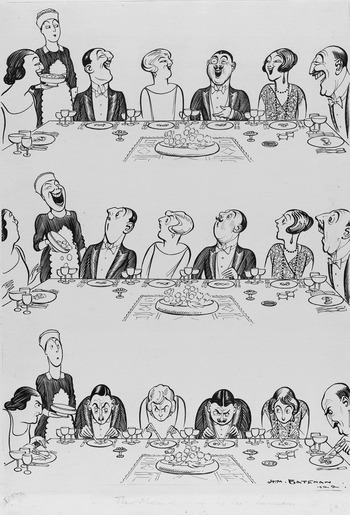
The growing cultural and economic confidence of younger domestic servants did not easily lend itself to emotional intimacy with employers. Shared laughter had been occasionally part of the texture of domestic service but was impermissible in most cultural scripts and was mostly recorded in the less strictly policed interactions between children and servants.Footnote 101 The impossibility of a shared joke between adult employers and servants had been satirized by H. M. Bateman in Punch in 1922 (fig. 4).
The servant's laughter in Bateman's cartoon was depicted as physically overwhelming; her mouth wide open, she lets drop the dish she holds. In contrast, the dinner party guests retain their genteel posture while laughing at the same joke. Nonetheless, both servants and employers were pictured as diminished and disempowered by their inability to laugh together. Bateman's cartoon makes clear that the things that one might find funny, and the physical style in which one laughed, were still part of the repertoire of cultural, emotional, and physical scripts that made up divides of social class in the Britain of the 1920s. The shared joke was potentially subversive of these norms and hierarchies of laughter, and moments of shared laughter indicate the changing relationship between servant and employer in the Britain of the 1930s.
Mrs. Sturgeon's description of her work as a housemaid in the 1930s dwelled on laughter as symbolic of changing social relationships. Having recounted her experiences of intense exploitation in service in Suffolk, she contrasted this with working in London for Charles Laughton, a Bloomsbury actor. At the center of the contrast was a tale of the cook, Nellie Boxall, being able to share a joke with Bertrand Russell, a houseguest; both laughed at the bald head of another guest at the house. The genuine shared laughter in the Laughton household was remarkable and noteworthy for Mrs. Sturgeon, as representing the new possibility of dignity and respect in domestic service. Service was not a static institution, and this anecdote reminds us that it could be constructed along more egalitarian lines in interwar Britain, particularly through the new sense of shared cultural horizons. As Mrs. Sturgeon noted, servants might be newly addressed “as if you could read and write.”Footnote 102 Nonetheless, the slapstick content of the bald head joke still suggests a confined emotional and cultural range for such encounters. Monica Dickens also found humor a significant marker of social relations, but she did not see the shared joke as indicative of change. She concluded gloomily in 1939: “Nice people like the Vaughans laugh with you, others laugh at you; but it comes to the same thing in the end.”Footnote 103
During and after World War II, it seems that the willingness of Bohemian London to laugh with rather than at their servants spread beyond their relatively unusual households. Mrs. Mathias, a married daily servant to a Jewish family in Belsize Park, London, between 1939 and the 1960s, recalled that her employers, Mr. and Mrs. Meres, “used to do the cooking. I used to prepare … the stuff and they used to … we all used … three be in the kitchen. We had a lovely time there. And … it's a long kitchen, with a table … and a … table there and the sink here. And Mrs. Meres used to be down there, the stove was down there, and … he used to say … ‘we’re boompsy-daisying again darling.’ 'Cos he used to bump … bump
—H. M. Bateman, “The Maid Who Was But Human,” Punch, 13 December 1922. By permission of the Fitzwilliam Museum, Cambridge.

into me and we used to have a laugh. That was the happy days there.”Footnote 104 It is possible that Jewish servant-keeping households were untypical in having less investment in the rigid boundaries of social class; nonetheless, such interactions were still in a clowning mode. More sophisticated forms of humor were less acceptable within the servant-keeping relationship. Mrs. Groszmann, an educated Jewish refugee working for a British couple in the Home Counties, found that her love of wordplay and puns was lost on her mistress, who was unable or unwilling to follow the jokes. Mrs. Groszmann's laughter had been a gesture toward a potential friendship, but it came to serve another function, perceived by her daughter as a weapon in an ongoing battle for dignity and status between mistress and housekeeper.Footnote 105 Laughter continued to be subtly or overtly defined by social class, and few moments of shared laughter emerge from the historical sources describing domestic service.
V. Conclusions
How should historians read and contextualize the phenomenon of domestic service humor? Laughter and humor signal the interplay of the domestic and cultural realms—servant keeping was a private employment relationship, but its relationships were mediated by cultural scripts and expectations, which predominantly worked in a comic mode that has been neglected by historians of domestic service. Its interpretation challenges us to reconstruct a degree of “knowingness,” though this is always a partial endeavor. Laughter may be elicited by cues and performances that have little contemporary resonance, as the discussion of the “quaint” servant reminds us, and some of its allusions and looked-for responses are likely to remain opaque to us.
Where we can recover their meanings, the frequently “unfunny jokes” of domestic service reveal the complex textures of domestic service relationships, as sites of negotiation of power. In particular, examining laughter reveals the persistent intolerance of employers for their servants’ social and cultural aspirations, their strategies for asserting authority, and the ambiguous intimacies and emotional dependencies of the relationship with the “distant companions” they employed in their homes.Footnote 106 Acute anxieties can be discerned about whether servants themselves were laughing at their work and their employers and about whether the whole institution of service was sustainable in the face of such laughter. Indeed, it was not simply the alternative jobs available to working-class women that made domestic service residual by the 1950s but also the harsh laughter and bitter humor of both servants and employers, which was corrosive of ideas of intimacy, homeliness, and the dignity of housework and which began to make the “servantless home” more and more attractive.
Understanding the humor problem is also central to understanding attempts made to reform domestic service, because it was the perceived problem of domestic service humor that shaped the solutions offered to the servant problem by twentieth-century reformers. Rather than better wages and conditions, reformers sought more symbolic and cultural resources for servants—a uniform that conveyed trained status, badges for long service, and calls for an end to music hall jokes. These solutions, of course, were not only relatively cheap but were also often strongly resisted by servants, who regarded uniforms as yet another area of intrusion by employers. While many servants complained of hours, social isolation, and rates of pay, reformers returned compulsively to the status of the profession.
There certainly was a subversive element to laughter about domestic service, because of the emotionally charged nature of the servant-keeping relationship and also because of the disproportionately large amounts of cultural and political resources devoted to anxieties around service. The many public and private inquiries and press discussions about the servant problem created opportunities for a script that satirized these concerns, for a chance to mock the earnest and intrusive reformers who sought to ensure their own continuing lifestyle reliance on domestic service. The weight such reformers gave to the humor problem suggests that finding servants, service, and employers of servants ridiculous was a powerful weapon of resistance to the indignities of service. It may have been the persistent portrayal of servants in popular culture as smarter than their employers and “on the fiddle” that really rankled. Nonetheless, the extent to which servant jokes challenged the status quo was limited, and servants themselves did not often deploy them. It is notable that, when the Evening Standard invited its readers to submit funny anecdotes about service in the late 1930s, the jokes that were published were almost entirely recounted by employers, while servants whose voices were included gave detailed, humorless statements about why they disliked domestic service. The comic voice was not easily adaptable to their perspective, and “the quaint slavey” was not an identity they could easily manipulate. Domestic service humor was not straightforwardly a “weapon of the weak.” The depictions of domestic service in the comic papers, music hall reviews, and Punch cartoons offered few resources for servants to reinterpret their experiences. It is clear that humor offered as much consolation as subversion—consoling to employers who could laugh at the servants who caused them so much trouble and consoling for other workers who could see their own factory job or unemployment as better than this low-status trade.
Overall, the laughter prompted by domestic service cannot effectively be read as either entirely consoling or entirely subversive, but instead, it offers a richer set of insights than these two historiographical poles allow. A historical reading of laughter requires going beyond the identification of power and resistance, and talk of the dominant and the weak, to chart the essential ambiguity of laughter. It promoted and connoted authority, mockery, and social distance, but it might simultaneously be an ingredient of intimacy and friendship in servant-keeping households.
The sources explored here also demonstrate that laughter is not simply a cultural response but is also somatically expressed. Its norms of physical expression are as significant as the content of what was laughed at, and in this role it forms a part of the performances of class and gender in British homes. Laughter in this somatic sense can be equated tentatively to the influence of smell, which George Orwell identified in The Road to Wigan Pier as functioning at a deep level at which class is enacted in bodily, sensory terms.Footnote 107 The somatic expression of laughter tends to be neglected in historical and cultural studies of the comic but suggests the ways in which social distinctions may be “written on the body.”
It may have been the changes in the media in twentieth-century Britain that in the end made service jokes redundant or transmuted them into the gentler humor of Mrs. Mopp or Upstairs, Downstairs. From Edwardian times, music halls attempted to reach a socially mixed audience, a process that ended with the more bland and commercial “variety show” of the interwar and postwar years. Cinema, and to some degree radio, were not aimed specifically at working-class audiences, but they became mass entertainment, relatively untethered to particular class cultures.Footnote 108 And print media were also transformed in the interwar decades: general women's magazines, such as Good Housekeeping, were founded, supplanting the prewar divide into a dual magazine market specializing, on the one hand, in sensational fiction aimed at working-class women and, on the other hand, in domestic material aimed at middle- and upper-class women running homes with servants.Footnote 109 As Judy Giles has pointed out, from around the 1930s, women's magazines came to assume that their audiences were middle- or lower-middle-class and did not employ servants. Editors built their interwar reading public around the image of the housewife, and this attempt to amalgamate audiences disrupted the “knowing economy” of domestic service humor.Footnote 110 The addressee of “domestic service humor” was becoming ambiguous and fluid in this context of the blurring of genres and audiences. In 1939, Housewife magazine ran a story titled “My Maid and Me.” “If you have a maid,” the byline promised, “you’ll enjoy this article, if you haven’t, you’ll enjoy it still more.”Footnote 111 It is clear that those who might employ servants, the servantless, and even servants themselves might all be anticipated as amused readers of such a text.
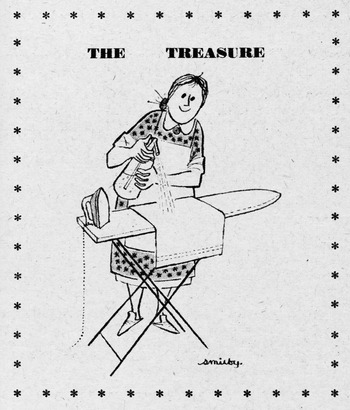
More generally, servants no longer undertook a key bridging function between social groups or audiences, and thus their power to convey humor through juxtaposition and incongruence slowly faded. This was a change, however, that developed in an uneven fashion; comic discourse has the power to interweave older meanings and symbolisms with newer ones, and it has a certain degree of autonomy from its immediate circumstances. British culture may have reorganized itself around less divisive domestic figures such as the housewife, but Housewife magazine remained wedded to the comic servant in the 1950s. Although the magazine's practical advice on running a home assumed the absence of servants, a long-running comic feature, titled “The Treasure,” still used many of the same jokes as prewar print culture. Depicting an overweight, overall- and slipper-clad older domestic worker, the jokes revolved around her determination to subvert the normal or efficient uses of household objects or laughed at her sexual interest in men (fig. 5).
A moment of resistance to the invitation to laugh at “The Treasure” by a Housewife reader in 1957 suggests, however, that the knowingness needed to find her an amusing character was no longer reliably felt by readers. Mrs. D. K. Tolley wrote to the editors from Cirencester: “While I saw the funny side of ‘The Treasure’ smilingly ‘sprinkling’ her ironing board with a soda water siphon in the November
—“The Treasure,” Housewife, November 1956, 185. By permission of the Syndics of the Cambridge University Library.

issue, well, if it's full of scrupulously clean water, why not?”Footnote 112 Housewives, like domestic workers, might also prefer to take shortcuts and use objects “against the grain,” and no role incongruity could be established in this unsuccessful joke.
Finally, laughter suggests a revised periodization for the servant problem, with jokes about service persisting well into the later twentieth century. Domestic service humor operated through genres and tropes that were still found funny in postwar Britain despite their uncoupling from mass social experience, though Mrs. Tolley made clear that the “knowingness” of the audience had become unreliable. Domestic service jokes proved a persistent vehicle for anxieties around the encounters between social classes, the establishment of domestic authority, and the willingness of young women to undertake domestic labor. They remind us that the serio-comic “servant question” was not resolved at the apparent watershed of World War II but continued to function within a society that turned decisively back to the employment of domestic workers in private households in the 1980s. Much had changed in the late twentieth-century labor market, and commentators have emphatically denied that pre-1939 domestic service can provide the paradigm for understanding the resurgence of paid domestic labor toward the end of the century.Footnote 113 Nonetheless, the enduring nature of the comic cultural cues surrounding paid domestic labor suggests that the two periods cannot be seen in isolation and should be situated within a single cultural imaginary.