Implications
The selection of more efficient animals (i.e. those who consume less feed for a given growth rate) can affect their ability to face challenges such as a degradation of the sanitary conditions. Under these conditions, animals are forced to use part of the nutrients for the inflammatory response instead of for growth. It appears that the most efficient animals can also activate quickly the inflammatory response, resulting in a more important, but also a transient reorientation of nutrients. The way metabolism is affected by the immune response may be anticipated through modification of diet composition to limit the impact on growth.
Introduction
Residual feed intake (RFI) in growing animals is defined as the difference between the actual feed intake and the predicted feed intake required for maintenance and growth. The RFI is indicative for the efficiency of utilizing dietary nutrients, assuming that the increased feed efficiency associated with a reduced RFI induces a decrease in feed intake without an effect on BW gain and BW composition (Gilbert et al., Reference Gilbert, Bidanel, Gruand, Caritez, Billon, Guillouet, Lagant, Noblet and Sellier2007). It has been demonstrated that the difference in maintenance energy requirements explains only half of the difference in energy intake between genetic lines of growing pigs divergently selected for RFI (Barea et al., Reference Barea, Dubois, Gilbert, Sellier, van Milgen and Noblet2010). Consequently, the energy efficiency of metabolic pathways other than those involved in maintenance energy metabolism may also differ between these two lines. Several hypotheses have been proposed to explain the difference in utilizing dietary nutrients among animals differing in RFI, such as differences in physical activity, thermoregulation, and protein anabolism and catabolism associated with growth (Herd and Arthur, Reference Herd and Arthur2009). The difference in RFI may also induce differences in the ability of animals to partition nutrients between growth and other functions such as the immune response. Chronic exposure to inflammatory challenges will force pigs to use dietary nutrients for immune response, which will therefore not be available for growth (Klasing and Barnes, Reference Klasing and Barnes1988; Le Floc’h et al., Reference Le Floc’h, Melchior and Seve2008; Klasing and Iseri, Reference Klasing and Iseri2013). Additionally, it can be hypothesized that highly efficient animals are more sensitive to inflammation and diseases (Rauw et al., Reference Rauw, Kanis, Noordhuizen-Stassen and Grommers1998), which could counteract the benefits obtained through a reduced feed intake. The objectives of this study were to determine to what extent the genetic selection for low (RFI−) or high (RFI+) RFI (Gilbert et al., Reference Gilbert, Bidanel, Gruand, Caritez, Billon, Guillouet, Lagant, Noblet and Sellier2007) resulted in differences in the metabolic response of piglets to a chronic inflammation.
Material and methods
The experiment was conducted according to the current French law on animal experimentation and ethics and under the direction of N. Le Floc’h, J. Noblet and J. van Milgen (authorization number by the French Ministry of Agriculture and Fisheries: 7719, 04739 and 7704, respectively).
Experimental design, animals, housing and feeding
The experiment was designed to study the difference in energy and nutrient utilization between RFI− and RFI+ castrated male piglets submitted to an experimental challenge inducing chronic inflammation. Piglets were from the seventh generation of divergent selection of two purebred French Large White lines between 35 and 95 kg BW at INRA (Gilbert et al., Reference Gilbert, Bidanel, Gruand, Caritez, Billon, Guillouet, Lagant, Noblet and Sellier2007). Heat production (HP) and nutrient utilization before and after the induction of a chronic lung inflammation with macroscopic granulous pulmonary lesions through the administration of complete Freund’s adjuvant (CFA; Sigma Aldrich, Saint-Quentin Fallavier, France) which was a mineral oil that contained killed Mycobacterium tuberculosis cells (1 mg/ml; Edwards and Slauson, Reference Edwards and Slauson1983; Melchior et al., Reference Melchior, Seve and Le Floc’h2004) were measured. Eight pairs of littermates from four batches (two piglets of each line in each batch) were housed from weaning (at ~4 weeks of age) in individual metabolism cages. The piglets were equipped at 6 or 8 weeks of age, under general anesthesia, with a catheter in the external jugular vein through a collateral vein. Seven to 14 days after surgery, the animal, in its cage (60×120 cm), was placed in a 1.7 m3 open-circuit respiration chamber (Vermorel et al., Reference Vermorel, Bouvier, Bonnet and Fauconneau1973) during a 1-week period composed of two successive periods of 3 days separated by 1 day for the intravenous injection of CFA. The cage was mounted on force sensors producing an electrical signal proportional to the physical activity of the piglet. As only one chamber was available for the study, measurements for each batch were conducted over four successive periods of 1 week each with alternating measurements of piglets from each line. The two pairs of piglets within batch were of similar age and measurements of the first piglet started at ~7 weeks of age. The ambient temperature was maintained constant in the chamber but decreased over the course of experiment (26°C for the first piglet, 25°C for the second piglet and 24°C for the third and fourth piglet of each batch). The hygrometry was kept constant (70%) and a 14-h lighting time span (from 0800 to 2200 h) was used.
Animals were offered a commercial weaner diet until ~6 weeks of age followed by a commercial starter diet based on corn (25.0%), barley (24.1%), wheat (23.2%) and soybean meal (22.6%) providing 20.9%, 2.9% and 48.9% of dry matter (DM) as CP, crude fat and starch, respectively; the gross energy content was 18.35 MJ/kg DM. The starter diet was supplemented with 0.3% of titanium dioxide as indigestible marker to determine fecal digestibility. In the chamber, the diet was offered as five approximately equal parts at 0900, 1200, 1500, 1800 and 2100 h and feeding level was equivalent for piglets from both lines and corresponded to ~125 g DM/kg BW0.60 per day, based on the BW of the piglet measured at the beginning of each period. This feeding level was equivalent to 80% of the voluntary feed intake of RFI− piglets. On the 3rd day of each period, the 0900 h meal was supplemented with 0.4% U-13C glucose (Cambridge Isotope Laboratories; 99% U-13C6) to determine the oxidation rate of dietary glucose. The piglet was offered the non-labelled starter diet for the other meals of the day. Piglets had free access to water. The day of CFA injection, the piglet was offered ~20% of its daily feed allowance, which were fed before starting measurements of the second period.
On the morning of the day of injection, piglets were removed from the respiration chamber and 3 ml of CFA (in 10 ml of physiological sterile saline solution) was injected slowly through the catheter (Melchior et al., Reference Melchior, Seve and Le Floc’h2004). During the afternoon and after visual appraisal of its state of recovery, the piglet reentered the respiration chamber. No measurements were made until the morning of the day after the injection.
Measurements
The animals were weighed at 0830 h three times at the entrance in the respiration chamber on the 1st day, before the CFA injection on the 4th day, and at the end of the measurements in the respiration chamber (i.e. on the morning of the day after the 7th day in the chamber). The daily feed allowance was weighed and the non-labelled diet was sampled daily and cumulated over the two periods for each piglet for DM determination. Samples were then pooled over the whole experiment for chemical analyses. Feed refusals and spillages (if any) were collected at the end of each period of measurements and were oven-dried to determine the refused DM. Daily feed intake was recorded continuously using a weight sensor placed under the trough. Feces were collected and pooled over the 3 days of the first period (before CFA injection) and over the 4 other days (the day of injection plus the 3 days after CFA injection); they were weighed at the end of each period and sampled for DM determination and for chemical analyses after freeze-drying and grinding through a 1 mm grid. The urine was collected daily in a bucket that contained 120 ml of a sulfuric acid solution (1.8 mol/l) to prevent microbial fermentation. Urine was cumulated during the 3 days of each period, stored at +4°C and sampled for chemical analyses. Ammonia losses (evaporated N) were recovered in condensed water and outgoing air of the chamber and they were cumulated over the two periods.
The O2 concentration in outgoing air of the respiration chamber was measured with a paramagnetic differential analyzer (Oxymat 16; Siemens AG, Karlsruhe, Germany), whereas the CO2 concentration was measured with an infrared analyzer (Unor 600; Maihak AG, Hamburg, Germany). Gas extraction rate of the air of the chamber was measured with a mass gas meter (Teledyne Brown Engineering, Hampton, VA, USA). Gas concentrations, signals of the force sensors, weight of the trough, gas flow rate, temperature and relative humidity in the respiration chamber were measured 60 times per second, averaged over 10-s intervals, and recorded for further calculations (van Milgen et al., Reference van Milgen and Noblet1997). When piglets received the U-13C-glucose test meal to measure 13CO2 production on the 3rd day of each period, the outgoing air was sampled after the CO2 analyzer using 10-ml Vacutainer evacuated tubes, which were filled during 2 min at 10-min intervals from 0830 to 1500 h, at 20-min intervals from 1500 to 2100 h, and at 30-min intervals from 2100 to 0830 h on the following morning.
Laboratory analyses
Weekly samples of the starter diet (1 per piglet) were analyzed for DM. The pooled sample of starter diet and the individual fecal samples collected at each period were analyzed for DM, ash, N (Dumas method), and gross energy contents according to standard procedures (AOAC, 1990). They were also analyzed for titanium content by a photometric procedure (Njaa, Reference Njaa1961). The pooled sample of the starter diet was also analyzed for ether extract and starch contents according to standard procedures (AOAC, 1990). Samples of urine were analyzed for N content on fresh material. Gross energy content in the urine was obtained after freeze-drying ~30 ml of urine in polyethylene bags. The ammonia content of condensed water and extracted air was determined using an enzymatic method (Enzytec fluid; Thermo Scientific, Vantaa, Finland). The 13C enrichment of outgoing air was measured with an automatic sampler (VG µgas; Fissons Instruments, Manchester, UK) interfaced with an isotope ratio mass spectrometer (Isoprime; GV Instruments, Manchester, UK). The sample gas is measured relative to a CO2 reference gas of a known isotope ratio, compared to international references.
Calculations
The daily DM intake was calculated for each period. The apparent fecal digestibility coefficients for DM, ash, N and energy were calculated using titanium dioxide as indigestible marker. Nitrogen retention (RN) was calculated as the difference between ingested N and N lost in feces and urine and N evaporated in the chamber. Digestible energy (DE) and metabolizable energy (ME) intakes were calculated according to standard methods excluding CH4 production. Total HP was calculated from respiratory gas exchanges and urinary N (including evaporated N) according to the Brouwer (Reference Brouwer1965) equation. The first day in the respiration chamber was considered as an adaptation day and it was not included in the calculations. Energy retention was calculated as the difference between ME intake and HP. Energy retained as protein (REp) was calculated from N balance, assuming an energy content of deposited protein (RN×6.25) of 23.6 kJ/g of deposited protein. Energy retained as fat (REf) was calculated as the difference between energy retention and energy retained as protein. Fat deposition was calculated from REf assuming an energy content of 39.7 kJ/g deposited fat. The daily respiratory quotient was calculated as the ratio between CO2 production and O2 consumption. Simultaneous measurements of O2 and CO2 concentrations in the respiration chamber, signals of the force sensors, meal information (i.e. time of intake and ingested quantity) and physical characteristics of the gas in the chamber were used to calculate the components of HP according to the modeling approach of van Milgen et al. (Reference van Milgen and Noblet1997). Parameters of the differential equations for gas concentrations in the respiration chamber involved in the model were estimated using the R software (Labussière et al., Reference Labussière, Dubois, van Milgen and Noblet2013). The HP due to physical activity (AHP), HP due to feed intake (short-term thermic effect of feeding, TEFs) and HP due to resting metabolism (RHP) were calculated from respective volumes of O2 consumption and CO2 production according to the Brouwer equation (Brouwer, Reference Brouwer1965), excluding urinary N losses and CH4 production.
Measurements of gas exchanges in the respiration chamber were also used to calculate nutrient oxidation and lipogenesis according to the method developed by Chwalibog and Thorbek (Reference Chwalibog and Thorbek2000). The energy-equivalent (EE) of digested protein and fat were calculated from digested protein (measured) and fat (estimated from the feedstuffs composition as 50% of intake, Sauvant et al., Reference Sauvant, Perez and Tran2002). The EE-digested carbohydrates were calculated as the difference between DE intake and EE-digested protein and fat. The EE-digested protein was partitioned between EE-protein retention (calculated from RN), EE-protein oxidation (calculated from urinary N), energy excreted in urine (calculated from 90% of urinary N, Chwalibog and Thorbek, Reference Chwalibog and Thorbek2000) and contribution of EE-protein to the EE-carbohydrate pool. The EE-carbohydrate pool (sum of digested EE-carbohydrate and contribution of EE-protein to EE-carbohydrate) was partitioned between EE-carbohydrate oxidation, energy excreted in urine (calculated as total urinary energy excretion and energy excreted in urine due to EE-protein) and lipogenesis. The estimation of EE-carbohydrate oxidation from respiratory exchanges is biased in growing pigs because of lipogenesis from carbohydrates. Therefore, EE-carbohydrate oxidation rate was assumed to equal the 13C recovery from U-13C-glucose as 13CO2. The difference between HP and oxidized EE-protein and EE-carbohydrate was assumed to equal EE-fat oxidation. The EE-fat retention was calculated as EE-digested fat plus lipogenesis minus EE-fat oxidation. All energy traits were expressed relative to metabolic BW calculated as BW0.60 (Noblet et al., Reference Noblet, Karege, Dubois and van Milgen1999).
The U-13C-glucose recovery as 13CO2 was calculated as the ratio between expired 13C (as 13CO2) and ingested 13C (as U-13C glucose) during 24 h. The expired 13C was calculated with subset integrals from instantaneous gas extraction rate, CO2 concentration and 13C/12C isotopic ratio in the outgoing air. Additionally, the modeling approach of van Milgen et al. (Reference van Milgen and Noblet1997) was modified to determine the kinetics of expired 13CO2 due to physical activity, feed intake and resting metabolism. In the original model, carbon in CO2 production due to RHP, TEF and AHP originated from the diet or from body reserves. It was assumed that 13C from labeled glucose contributed to a common pool of carbon (12C plus 13C) available for metabolic processes involved in TEF. This was modeled by adding to the original two-compartment model (van Milgen et al., Reference van Milgen and Noblet1997) a third compartment for modeling the mixing between C isotopes. Identical fractional outflow rates for each compartment were used to calculate the time required to recover 50% of 13C as expired 13CO2.
Statistics
The measurements were performed on each piglet at two periods, before and after the CFA injection. Therefore, apparent digestibility coefficients, components of N and energy balance, glucose oxidation rate, time required to recover 50% of 13C as expired 13CO2 and components of EE-carbohydrate and EE-fat balance were tested for the effects of period (P), genetic line (L) and their interaction (P×L). The effects of batch (B) and the interactions B×P, B×L and B×P×L were also included in the model, but they are not discussed in detail. Respiratory quotient, which was measured daily, was analyzed for the effects of day, genetic line and their interactions with or without the effect of batch. The statistical models were tested in a MIXED procedure with piglet as a repeated main effect between periods with a ‘compound symmetry’ covariance structure (SAS, 2004). The data on utilization of ME were adjusted by covariance analysis for similar ME intake between periods and genetic lines. Three piglets were removed from the dataset (2 RFI+ and 1 RFI−), because of euthanasia due to pulmonary edema, underfeeding or malfunctioning of the respiration chamber. The statistical analyses were then performed on 13 animals (six and seven from RFI+ and RFI− line, respectively), measured before and after the CFA injection.
Results
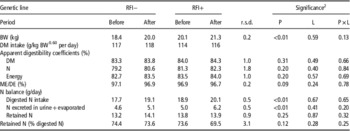
The mean BW did not differ between genetic lines and increased between the two periods (P<0.01; Table 1). The DM intake averaged 116 g/kg BW0.60 per day. The digestibility coefficients for DM, N and energy did not differ between genetic lines and periods, and averaged 83.8%, 80.8%, and 83.4%, respectively. The ME/DE ratio tended to be lower after than before the CFA injection (P=0.09, Table 1), but did not differ between RFI− and RFI+ piglets. According to the variation in daily DM intake between periods, digested N intake was higher after the CFA injection than before (P<0.01, Table 1). Nitrogen excreted in urine increased from 4.8 to 5.6 g/day after CFA injection (P<0.01) but was not affected by the genetic line. The RN was not affected by genetic line and CFA injection and averaged 13.7 g/day (73% of digested N intake).
Effect of period of measurement (before or after the complete Freund’s adjuvant (CFA) injection) on feed intake, apparent digestibility coefficients, utilization of the digestible energy and N balance in piglets selected for a low or a high residual feed intake (n=13)Footnote 1

DE=digestible energy; DM=dry matter; ME=metabolizable energy; RFI−=low residual feed intake; RFI+=high residual feed intake.
1 The experiment was conducted with six and seven piglets from RFI+ and RFI− lines, respectively, that were fed restrictively (1.72 MJ ME/kg BW0.60 per day) and housed individually during 3 days before and 3 days after injection of CFA in a respiration chamber.
2 Values were tested for the effects of period of measurements (P), genetic line (L), their interaction (P×L), batch of piglets (B) and their interactions (B×P, B×L, B×P×L); results are least-square means and P-values of the effects.
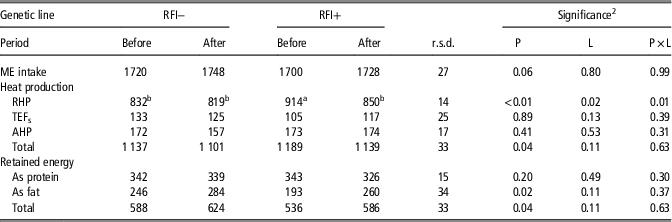
According to the experimental design (pigs received the same amount of feed), the ME intake did not differ between genetic lines and tended to be higher after than before CFA injection (P=0.06; Table 2). Total HP was lower after than before CFA injection (P=0.04), because of RHP variation in RFI+ piglets (P=0.01) whereas TEFs and AHP were not significantly different between periods. Additionally, RHP was the highest for RFI+ piglets before CFA injection (P=0.01) and total HP tended to be higher for RFI+ than for RFI− piglets (P=0.11). Energy retention was higher after than before CFA injection (P=0.04) because of the higher REf. Additionally, RFI+ piglets tended to have lower REf than RFI− piglets, that resulted in a tendency for a lower RE in RFI+ piglets (P=0.11). The REp was neither affected by period nor by genetic line, and averaged 338 kJ/kg BW0.60 per day.
Effect of period of measurement (before or after the complete Freund’s adjuvant (CFA) injection) on the energy balance (kJ/kg BW0.60 per day) in piglets selected for a low or a high residual feed intake (n=13)Footnote 1

ME=metabolizable energy; RHP=resting heat production; TEFs=short-term component of thermic effect of feeding; AHP=activity-related heat production; RFI−=low residual feed intake; RFI+=high residual feed intake.
abLS-means with different superscript letters within the same row differ (P<0.05).
1 The experiment was conducted with six and seven piglets from RFI+ and RFI− lines, respectively, that were fed restrictively (1.72 MJ ME/kg BW0.60 per day) and housed individually during 3 days before and 3 days after injection of CFA in a respiration chamber.
2 Values were tested for the effects of period of measurements (P), genetic line (L), their interaction (P×L), batch of piglets (B) and their interactions (B×P, B×L, B×P×L) and they were adjusted by covariance analysis for similar ME intake (1 725 MJ/kg BW0.60 per day); results are least-square means and P values of the effects.
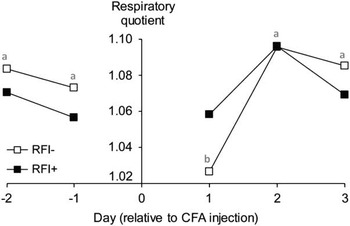
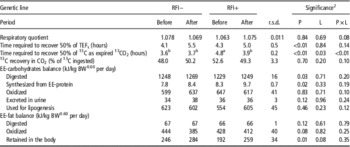
In RFI− piglets, the average respiratory quotient tended to be lower after CFA injection whereas it was greater in RFI+ piglets (P=0.08; Table 3). The tendency for the interaction is caused by a low respiratory quotient in RFI− piglets on the 1st day following injection (Figure 1). The time required to recover 50% of TEFs was lower before than after the CFA injection and was not affected by the genetic line. The time required to recover 50% of 13C as expired 13CO2 did not vary between periods in RFI− piglets (3.7 h on average) whereas it decreased from 4.8 to 3.9 h in RFI+ piglets (P<0.01). Total 13C recovery from U-13C-glucose as 13CO2 slightly increased after CFA injection in RFI− piglets whereas it decreased in RFI+ piglets (P=0.10). The EE-digested carbohydrate (kJ/kg BW0.60 per day) was higher after than before CFA injection (P=0.03), whereas EE-digested fat did not differ between genetic lines and periods of measurements. The EE-carbohydrates synthesized from EE-protein increased after CFA injection in both genetic lines (P=0.02). The oxidation of EE-carbohydrates (kJ/kg BW0.60 per day) tended to increase after CFA injection in RFI− piglets whereas the opposite occurred for RFI+ piglets (P=0.10). The EE-carbohydrates used for lipogenesis did not significantly differ between genetic lines and periods. Oxidation of EE-fat tended to be higher before than after the CFA injection (P=0.08). Finally, the EE-fat retained in the body tended to be higher in RFI− than in RFI+ piglets (P=0.08) and increased after CFA injection in all piglets (P=0.01).
Effects of complete Freund’s adjuvant (CFA) injection on the respiratory quotient (CO2/O2) in piglets selected for a low or a high residual feed intake (RFI− and RFI+, respectively; n=13). The experiment was conducted with six and seven piglets from RFI+ and RFI− lines, respectively, that were fed restrictively (1.72 MJ ME/kg BW0.60 per day) and housed individually during 3 days before and 3 days after injection of CFA in a respiration chamber. Within RFI−, LS-means with different subscripts differ (P<0.05). No significant difference between RFI+ points.

Effect of period of measurement (before or after the complete Freund’s adjuvant (CFA) injection) on nutrient utilization in piglets selected for a low or a high residual feed intake (n=13)Footnote 1

TEFs=short-term component of thermic effect of feeding; EE=energy-equivalent; RFI−=low residual feed intake; RFI+=high residual feed intake.
abLS-means with different superscript letters within the same row differ (P<0.05).
1 The experiment was conducted with six and seven piglets from RFI+ and RFI− lines, respectively, that were fed restrictively (1.72 MJ ME/kg BW0.60 per day) and housed individually during 3 days before and 3 days after injection of CFA in a respiration chamber.
2 Values were tested for the effects of period of measurements (P), genetic line (L), their interaction (P×L), batch of piglets (B) and their interactions (B×S, B×L, B×P×L); results are least-square means.
Discussion
This study was part of a larger project conducted at INRA for the evaluation of RFI as a genetic trait for improving the sustainability of pig production (Gilbert et al., Reference Gilbert, Bidanel, Gruand, Caritez, Billon, Guillouet, Lagant, Noblet and Sellier2007). For this purpose, two lines of growing pigs were selected for a lower or a higher RFI, resulting in differences during the fattening period in voluntary feed intake with only small differences in BW gain and BW composition (Sellier et al., Reference Sellier, Billon, Riquet, Lagant, Calderon, Guillouet, Bidanel, Noblet and Gilbert2010; Gilbert and Dekkers, Reference Gilbert and Dekkers2013). The RFI of a growing animal is indicative for the efficiency of utilizing dietary nutrients and energy (Koch et al., Reference Koch, Swiger, Chambers and Gregory1963). In the present study, piglets received equal and fixed amounts of feed, which were 30% below the voluntary feed intake capacity of both lines (Table 1). This resulted in similar supplies of digestible protein and energy, because digestibility coefficients were not affected by genetic selection, as confirmed by other observations in these genetic lines of pigs (Barea et al., Reference Barea, Dubois, Gilbert, Sellier, van Milgen and Noblet2010; Renaudeau et al., Reference Renaudeau, Frances, Dubois, Gilbert and Noblet2013; Montagne et al., Reference Montagne, Loisel, Le Naou, Gondret, Gilbert and Le Gall2014). The proportion of digested N that was excreted in urine was similar in both lines and the value measured in our experiment was in accordance with previous results in older pigs of the same lines receiving a similar diet (72%, Barea et al., Reference Barea, Dubois, Gilbert, Sellier, van Milgen and Noblet2010). The way that genetic selection for RFI affects protein utilization is unclear (Le Naou et al., Reference Le Naou, Le Floc’h, Louveau, Gilbert and Gondret2012; Cruzen et al., Reference Cruzen, Harris, Hollinger, Punt, Grubbs, Selsby, Dekkers, Gabler, Lonergan and Huff-Lonergan2013) but our results indicate that, at least when animals were fed the same restricted level, genetic selection for RFI did not affect protein utilization. Considering that protein catabolism and protein synthesis rate do not differ in the muscle of RFI+ piglets compared with RFI− piglets when fed ad libitum (Le Naou et al., Reference Le Naou, Le Floc’h, Louveau, Gilbert and Gondret2012), differences in feed efficiency between both lines may be related to differences in their feed intake and energy metabolism, that is the way the animal manages its energy balance and homeostasis. Because equivalent amounts of N were excreted in the urine, the ratio between ME and DE was also similar in both lines of pigs. The decrease in utilization of ME between RFI− and RFI+ piglets as retained energy was related to differences in their energy expenditure (Table 2).
Effects of selection for RFI on utilization of ME
The higher energy expenditure in RFI+ piglets (Table 2) indicated that the efficiency of ME utilization was higher for RFI− than for RFI+ piglets when fed restrictively, and this agrees with results of other studies comparing a low RFI line to a control line (Boddicker et al., Reference Boddicker, Gabler, Spurlock, Nettleton and Dekkers2011a and Reference Boddicker, Gabler, Spurlock, Nettleton and Dekkers2011b). Additionally, our study indicated that genetic selection, based on performance during the fattening period (from 35 kg onward; Gilbert et al., Reference Gilbert, Bidanel, Gruand, Caritez, Billon, Guillouet, Lagant, Noblet and Sellier2007) also affected metabolism during earlier stages of growth. Previous measurements with animals from the same genetic lines show that variation in HP in ad libitum fed animals is related to variation in physical activity and basal metabolic rate, whereas TEF is not affected by genetic selection (Barea et al., Reference Barea, Dubois, Gilbert, Sellier, van Milgen and Noblet2010; Renaudeau et al., Reference Renaudeau, Frances, Dubois, Gilbert and Noblet2013). In our experiment, the HP due to physical activity did not differ between the two lines, even though the size of the cage in which the animals were housed allowed for more movement than in the previous studies conducted in the same laboratory. In contrast to these studies, feed intake in our study was similar for the two lines, thus feed restriction was more pronounced for RFI+ than for RFI− piglets (feed intake equaled respectively 64% and 74% of voluntary feed intake based on the results of Le Naou et al., Reference Le Naou, Le Floc’h, Louveau, Gilbert and Gondret2012). The comparison between the three trials suggests that differences in activity related HP (and RFI) between both lines are mainly caused by differences in physical activity associated to eating behavior (de Haer et al., Reference de Haer, Luiting and Aarts1993; Herd and Arthur, Reference Herd and Arthur2009; Sadler et al., Reference Sadler, Johnson, Lonergan, Nettleton and Dekkers2011). This also agrees with behavioral observations, which indicate that differences in feed intake induce differences in the time spent eating and eating-related activities (Rauw et al., Reference Rauw, Soler, Tibau, Reixach and Raya2006; Young et al., Reference Young, Cai and Dekkers2011). In our study, the variation in total HP between the two lines was associated with variation in resting energy expenditure (RHP), which was also observed in ad libitum fed pigs from the same project (Renaudeau et al., Reference Renaudeau, Frances, Dubois, Gilbert and Noblet2013). According to the modeling approach for partitioning HP, the RHP is the sum of HP relative to the basal metabolic rate and the long term and constant component of thermic effect of feeding (van Milgen and Noblet, Reference van Milgen, Noblet, Dubois and Bernier2000). It has been shown that decreasing RFI in pigs is associated with a lower basal metabolic rate (Barea et al., Reference Barea, Dubois, Gilbert, Sellier, van Milgen and Noblet2010; Boddicker et al., Reference Boddicker, Gabler, Spurlock, Nettleton and Dekkers2011a), which is consistent with the variation in RHP. Moreover, the response of HP agrees with the 13C recovery from 13C-glucose as 13CO2. Our values suggest that more dietary carbohydrates tended to be oxidized for ATP production (based on the 13C recovery in CO2) rather than stored as body fat in RFI+ animals, which indicated that a greater proportion of carbohydrates may be used for lipogenesis in RFI− piglets. Accordingly, REf was lower in RFI+ than in RFI− piglets (Tables 2 and 3). Even though this was not taken into account in our calculations, the higher storage of glucose as muscle glycogen in RFI− pigs (Faure et al., Reference Faure, Lefaucheur, Bonhomme, Ecolan, Meteau, Coustard, Kouba, Gilbert and Lebret2013) may also explain part of the differences in dietary glucose utilization between lines. The REf calculated in our experiment is probably in the upper range of the ‘true’ REf of piglets from these two genetic lines. In our study, we also observed a faster utilization of dietary glucose in RFI− than in RFI+ piglets after feeding (measured as the time to recover 50% of 13C expired as 13CO2, Table 3), which suggests that restoring postprandial blood glycemia or lactatemia may occur faster in RFI− piglets because of increased tissue synthesis, in relation to higher IGF-1 levels (Bunter et al., Reference Bunter, Cai, Johnston and Dekkers2010; Montagne et al., Reference Montagne, Loisel, Le Naou, Gondret, Gilbert and Le Gall2014).
Effects of CFA on metabolism of piglets selected for RFI
Measurements in this study were conducted during the transient remission phase of inflammation after CFA injection (Edwards and Slauson, Reference Edwards and Slauson1983; Melchior et al., Reference Melchior, Seve and Le Floc’h2004). The response of the animals could be similar to that occurring in sub-clinical inflammation under farm conditions. It was not possible to measure the animal’s responses on the day of injection, because piglets had to be removed from the respiration chamber during the injection and they re-entered in the respiration chamber after visual recovery (i.e. during the afternoon). Additionally, feed allowance was deeply restricted on the day of injection to limit vomiting (only 20% of their daily allowance was offered and consumed) and this may have moderated the occurrence of anorexia. On the days after, CFA injection did not affect DM intake according to previous observations (Melchior et al., Reference Melchior, Seve and Le Floc’h2004). Additionally, digestibility of the main dietary nutrients remained constant after CFA injection, which agrees with the hypothesis that pulmonary inflammation does not affect the ability of the gastrointestinal tract to digest and absorb nutrients (Sandberg et al., Reference Sandberg, Emmans and Kyriazakis2007). Contrary to Rakhshandeh et al. (Reference Rakhshandeh, Htoo and de Lange2010), the gross efficiency of nitrogen utilization was not affected by the CFA injection. It was not possible to identify the metabolic partitioning of retained nitrogen from the nitrogen balance which was measured in our experiment. Nevertheless, CFA injection has been shown to stimulate the production of acute phase proteins (Melchior et al., Reference Melchior, Seve and Le Floc’h2004) and increase the catabolism of some amino acids (Le Floc’h et al., Reference Le Floc’h, Melchior and Seve2008). As suggested previously (Klasing and Barnes, Reference Klasing and Barnes1988), muscle protein accretion is probably reduced in animals after CFA injection, despite the constant amount of nitrogen retained in the body (Table 1). In agreement with previous observations (Moon et al., Reference Moon, Han, Gentry, Parmentier and Schrama1999), the effect of CFA injection on energy expenditure was low in our experiment but the response to CFA challenge on mean resting energy expenditure (RHP) was more pronounced for RFI+ piglets than for RFI− piglets (Table 2). Additionally, fat oxidation tended to decrease after CFA injection and the decrease was numerically higher for RFI− than for RFI+ piglets (Table 3). However, the respiratory quotient was modified to a great extent on the 1st day following CFA injection in RFI− piglets, but they recovered their pre-inflammatory level on the 2nd day following CFA injection, indicating that the metabolic consequences of the CFA challenge were overcome from 2 days after the challenge onwards (Figure 1). Accordingly, the dynamics of dietary glucose oxidation did not differ and the extent of glucose oxidation slightly increased before and 3 days after the CFA injection in RFI− piglets, whereas dietary glucose oxidation was lower 3 days after than before the CFA injection in RFI+ piglets (measured as 13C from 13C-glucose recovery in CO2). These results indicated that the most efficient piglets (RFI−) were able to change transiently their metabolism to the CFA challenge by increasing their catabolic activities during 1 day, and to quickly resume nutrient utilization for growth afterward. Conversely, the less efficient piglets did not exhibit a marked re-orientation of utilization of nutrients shortly after the CFA challenge, but expressed a difference in their metabolism during a more prolonged period. The decreased 13C recovery in CO2 and the increased respiratory quotient in RFI+ piglets suggest that glucose oxidation was reduced but the utilization of non-oxidized glucose in unclear because only U-13C glucose was used in our study. It may be also hypothesized that feed restriction, which was more pronounced in RFI+ piglets (64% v. 74% of voluntary feed intake for RFI− piglets), may have modified immune responsiveness but information in the literature on this topic is unclear. A moderate feed restriction is susceptible to increase immune responsiveness and limit negative consequences of infection (Klasing and Iseri, Reference Klasing and Iseri2013; Le Floc’h et al., Reference Le Floc’h, Deblanc, Cariolet, Gautier-Bauchardon, Merlot and Simon2014) but other results in minks divergently selected for RFI suggest that the degree of feed restriction correlates with the intensity of immune suppression (Damgaard et al., Reference Damgaard, Dalgaard, Larsen, Hedemann and Hansen2012) but the animals were submitted to a severe feed restriction. Moreover, pigs divergently selected for RFI may also differ in the patterns of inflammation induced by CFA. Nevertheless, no indicators were used in this study to determine to what extent inflammation occurred after CFA injection and to what extent it was resorbed.
In conclusion, piglets from lines divergently selected during the fattening period for a low or a high RFI also exhibited differences in energy utilization during the early stages of growth. The latter is characterized by a lower resting energy expenditure and a tendency for a higher energy storage as fat in RFI− piglets when compared to RFI+. Conversely, postprandial glucose oxidation lasted longer in RFI+ than in RFI−piglets. In case of a CFA challenge, total energy expenditure decreased in both lines whereas feed intake was not affected from the day following inflammation induction onwards. Nevertheless, respiratory quotient was markedly lower in RFI− piglets on the day following CFA injection whereas it tended to increase in RFI+ piglets. These data suggest that nutrient partitioning in the most efficient piglets seemed to be managed according to an ‘all or nothing’ strategy, whereas the less efficient animals exhibited a prolonged alteration of their metabolism.
Acknowledgments
The study was funded by the French National Research Agency (Agence Nationale de la Recherche, ANR, ANR-08-GENM038 PIG_FEED Project). The authors thank Yvon Billon for line selection and animal care, Alain Chauvin, Régis Janvier, Francis Le Gouevec and Vincent Piedvache for animal care and Yolande Jaguelin and Anne Pasquier for laboratory analyses.