Implications
The increasing trend in global population and increased meat and dairy consumption implies a greater demand for livestock feed. Triticale is a suitable grain for cultivation in water-stressed areas. However, currently there is limited information to suggest how calf performance and health may be affected by the inclusion of triticale in the diet. It was concluded that 16% triticale in the starter diet did not negatively affect the performance and intake of calves.
Introduction
Corn grain is a common source of starch in calf starter formulation (Khan et al., 2007); however, corn yield is restricted in regions where water supply is inadequate (Oveysi et al., Reference Oh, Kim, Kim, Choi, Kang, Nam, Kim, Song, Kim and Park2010). Moreover, its price has been rapidly increasing, mainly because of its tremendous use in grain-based biofuels industry in recent years (Agricultural Statistics, Reference Smith, Du Plessis and Griessel2011), signifying the need for other potential substitutes in the diet formulations.
Triticale, the first manmade cereal developed by crossing wheat (Triticum spp.) with rye (Secale spp.; Smith et al., Reference Shimada, Cline and Rogler1994) has the potential to replace corn grain as a source of energy and protein with a well-balanced profile of essential amino acids (Radcliffe et al., Reference Oveysi, Mirhadi, Madani, Nourmohamadi, Zarghami and Madani1983). Relative to other cereal grains, triticale is resistant to drought conditions and diseases, is favorable for low-input farming because of its low demand of pesticides application and can be cultivated on more marginal lands. These have contributed to its cultivation on ~3.7 million ha in more than 30 countries, yielding more than 12 million metric tons annually (Mergoum and Macpherson, Reference McDonald, Edwards, Greenhalgh and Morgan2004; Du Pisani, Reference Castells, Bach, Araujo, Montoro and Terré2009).
Ergot contamination as well as low palatability and metabolizable energy are the main restricting factors that affect the use of triticale in non-ruminant nutrition (Shimada et al., Reference Sharma, Ingalls, McKirdy and Sanford1974). Published literature on effects of feeding triticale grain to ruminants is inconclusive, which is largely related to the use of different triticale varieties (Goonewardene et al., Reference Du Pisani1994). Previous studies showed that the grain had poor palatability, high ruminal fermentability (McCloy et al., Reference Mantle1971) and increased the frequency of liver abscess (Reddy et al., Reference Radcliffe, Egan and Driscoll1975) when fed at high dietary inclusion rates to steers. Smith et al. (Reference Shimada, Cline and Rogler1994), however, reported that the newer varieties of triticale had better palatability. Authors also reported that an appropriate combination of corn and triticale grain improved feed conversion ratio in the finishing diet of steers, as well as milk yield and components in dairy cows (Smith et al., Reference Shimada, Cline and Rogler1994).
Little information is currently available on the use of triticale grain in starter diet of dairy calves. Ingalls et al. (Reference Hristov, Etter, Ropp and Grandeen1970) investigated the effects of two dietary rates of triticale on feed intake and growth performance of dairy calves; both feed intake and weight gain were depressed, which was attributed to an increase in ergot contamination (Ingalls et al., Reference Hristov, Etter, Ropp and Grandeen1970). In another study, however, Wright et al. (Reference Wright, Otterby, Linn, Stern, Marx and Johnson1989) fed calves a corn-based starter diet that contained ~27% triticale and reported that various measures of calf health and performance, before and after weaning, were not negatively affected.
It is hypothesized that replacing corn grain partially with triticale would reduce the use of corn in calf starter formulation, without negatively impacting animal performance and health. In the present study, triticale c.v. Juanillo 92 (accession number: 2291; taxonomy: Poaceae triticale tscherm. spp. triticale 6x), which is considered a promising cultivar, substituted corn at 0%, 25% and 50% (triticale at 0%, 16% and 32% of ration dry matter (DM), respectively). The main objective was to investigate how the dietary inclusion rates of triticale affect feed intake, health and performance of Holstein calves.
Material and methods
Animals and experimental design
The experiment was carried out in the Foodeh Agriculture and Animal Husbandry, located in Northeast part of Isfahan, Iran. Animals were cared for according to the guidelines of the Iranian Council of Animal Care (Reference Ingalls, Devlin and McKirdy1995).
The animal phase of the study took place from November 2011 to February 2012, when the average temperature was 5.5°C and ranged from −8.8°C to 21°C. Immediately after birth, calves were separated from their dams, weighed, fed pooled colostrum at 10% of BW for the first 3 days after birth twice daily at 0900 and 1600 h and then moved to individual sawdust-bedded pens (1.4×3.5 m). In all, 30 4-day-old Holstein calves were blocked by gender (five male and five female in each group) and BW (44.3±2.2 kg; mean±SD), and within each block, randomly assigned to three dietary treatments. In all, 0%, 25% and 50% of dietary corn was replaced with ground triticale, resulting in meal starter diets with 0%, 16% and 32% ground triticale (DM basis), respectively (Table 1). All calves received 4 l/day milk containing 32.8 g/kg fat, 30.8 g/kg CP, 45.5 g/kg lactose and 11.59 g/kg total solids (based on bulk tank samples) in plastic bottles with soft rubber nipples at 0900 and 1600 h from day 4 to day 42. Calves remained in the study until day 70. The triticale grain used in this study was cultivated at the Foodeh farm. Calves had free access to starter and fresh water throughout the experiment.
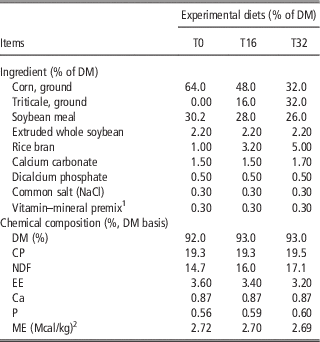
Ingredient and chemical composition of experimental diets

DM=dry matter; T0=control diet without triticale; T16=diet containing 16% triticale; T32=diet containing 32% triticale; EE=ether extract; ME=metabolizable energy.
1 Contained per 1 kg: 200 KIU of vitamin A, 50 KIU of vitamin D, 1500 IU of vitamin E, 10 mg of Se, 1.25 g of Cu, 1.25 g of Fe, 20.5 g of Mg, 3 g of S, 14 mg of Co, 2.20 g of Mn and 7.7 g of Zn.
2 As predicted by the Cornell Net Carbohydrate and Protein System.
Sampling and analysis
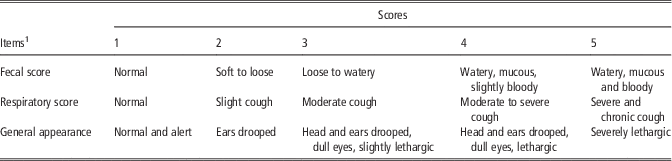
The starter feed refused was collected daily (at 0800 h) for each calf, and starter dry matter intake (DMI) was determined daily by calculating the offered and refused amounts of starter for each calf. BW was determined on day 4 and then weekly thereafter. Intakes, average daily gain (ADG), and feed efficiency were determined for the pre-weaning (days 1 to 42), post-weaning (days 43 to 70) and overall (days 1 to 70) periods, and data were statistically analyzed as such. Structural growth indices (body length, heart girth, wither height and hip height) were measured at initial (4-day old), weaning (day 43) and at the end of the experimental period (day 70), according to Khan et al. (2007). Health criteria of the calves including fecal, respiratory and general appearance were monitored daily and scored as described by Heinrichs et al. (Reference Goonewardene, Basarab and Zobell2003) as outlined in Table 2. Blood and ruminal samples were collected on days 35, 50 and 70. Jugular blood samples, collected before the morning feeding in evacuated tubes (10 ml) without anticoagulant, placed immediately on ice, and then centrifuged at 4500×g for 20 min at 4°C. The harvested serum was stored at −20°C for further analysis. Immediately after rumen fluid harvest (~3 h post-feeding using a stomach tube), ruminal pH was measured (HI 8314 membrane pH meter; Hanna Instruments, Villafranca, Italy) and then filtered through four layers of cheesecloth. A quantity of 15 ml of the strained ruminal fluid was immediately acidified with 3 ml of 25% (w/v) metaphosphoric acid and subsequently frozen at –20°C. Samples were later centrifuged twice at 4500×g for 30 min at 4°C.
Description of fecal, respiratory and general appearance scores (1 to 5) given to individual calves during the experiment

1 Health criteria of the calves were monitored daily as described by Heinrichs et al. (Reference Goonewardene, Basarab and Zobell2003).
Laboratory analyses
Before the analysis of chemical composition, feed and refusals were mixed thoroughly and ground using a hammer mill equipped with a 1-mm sieve. NDF was determined using thermo-stable α-amylase and sodium sulfite (Van Soest et al., Reference Van Soest, Robertson and Lewis1991). CP (N×6.25, method no. 984.13), ether extract (EE, method no. 954.02), DM (method no. 930.15) and ash (method no. 942.05) contents were determined according to the Association of Official Analytical Chemists (1990). The concentration of ergot in triticale grain was determined according to the procedure described by Mantle (Reference Laarman, Sugino and Oba1996). Briefly, following lipid extraction and methylation of fatty acids, methyl ricinoleate, as an index for ergot presence, was separated from other C16 and C18 fatty acids using thin-layer chromatography. In order to qualitatively and quantitatively investigate the fatty acids, the band cut out from the thin-layer chromatography plates was eluted with ether, evaporated and then analyzed by gas chromatography (Agilent 6890; Agilent Technologies Inc., Santa Clara, CA, USA).
Concentration of blood metabolites was determined using commercially available kits according to the manufacturer’s instructions (Pars Azmoon Company, Tehran, Iran); catalogue numbers: glucose (1-500-017) and urea nitrogen (1-400-029) according to the manufacturer’s instructions using an automated analyzer (Technicon RA-1000 Autoanalyzer; DRG Instruments GmbH, Marburg, Germany). Blood concentration of β-hydroxybutyrate (BHBA) was determined using a commercial kit (Randox Laboratories Ltd, London, UK) provided by Pars Azmoon Company. Ruminal NH3–N concentration in the supernatant was determined spectrophotometrically (Broderick and Kang, 1980).
Statistical analysis
Calves were blocked by gender and birth weight, and within each block, randomly assigned to treatments in a completely randomized block design, where starter intake, ADG and feed efficiency were analyzed using repeated measures over time using Proc Mixed of SAS (version 9.3; SAS Institute Inc., Cary, NC, USA) that accounted for calf as the random component of the model and diet, week and their interaction as fixed components. Gender (block) was not significant in any of the models tested and was later removed. Birth weight was considered as a covariate for starter intake, ADG and feed efficiency. An autoregressive type 1 covariance structure was chosen based on the Akaike and Bayesian information criteria. The skeletal measures at the start of study (4-day old) were considered as covariate for analysis of skeletal growth measures. Data are presented as least squares means and standard errors of the means. Means separation was performed using the Tukey’s test and a P⩽0.05 was considered as significant.
Results
Ingredients and chemical composition of calf starter diets, formulated to be isonitrogenous, are presented in Table 1. EE decreased slightly and NDF increased slightly as the inclusion rate of triticale increased.
All calves remained healthy with no signs of illness and thus none were removed from the experiment. The effect of gender and its interaction with diet was not statistically significant in any of the measurements, thus they were excluded from the model.
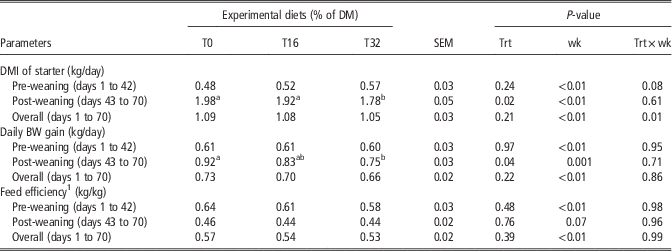
Starter intake increased with age; however, no significant dietary effect was detected from the beginning of the study (day 4) until weaning (day 43). Starter intake was decreased (P=0.02) for the post-weaning period (days 43 to day 70) in calves receiving corn-based diet containing 32% triticale (T32) compared with diet without triticale (T0) or diet containing 16% triticale (T16) (Table 3). Similar trends were observed for ADG; in pre-weaning and overall periods, treatment did not have a detectable effect on ADG. In post-weaning period, however, T32 had a depressed ADG (P=0.04), when compared with calves fed control (Table 3).
Least squares means for starter dry matter (DM) intake (DMI), daily BW gain and gain-to-feed ratio for calves fed different inclusion rates of dietary triticale

T0=control diet without triticale; T16=diet containing 16% triticale; T32=diet containing 32% triticale; trt, treatment effect; wk, week effect; trt×wk, treatment×week interaction.
a,bMeans with common superscript(s) within each row are not different (P>0.05).
1 Feed efficiency=kg of BW gain/kg of total DMI.
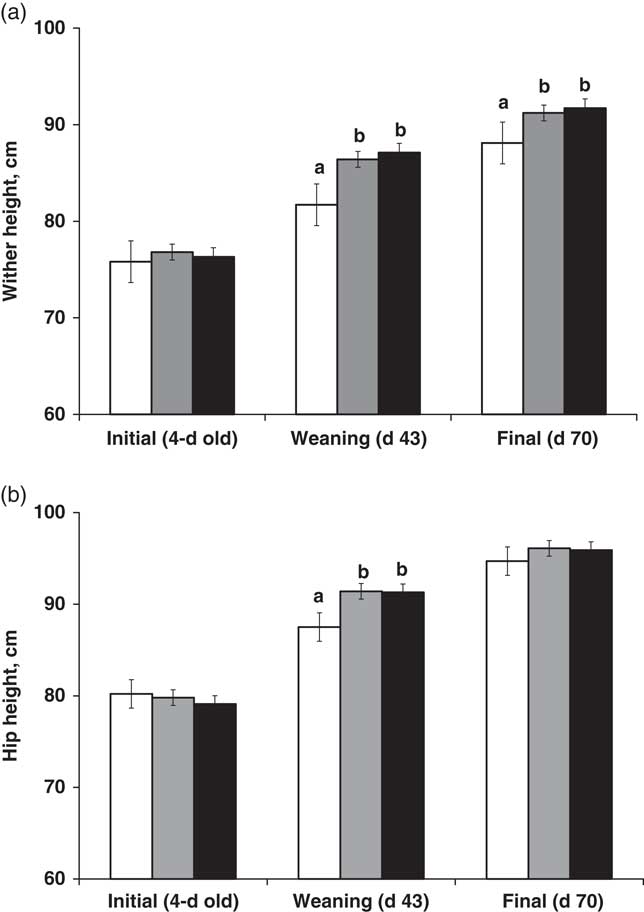
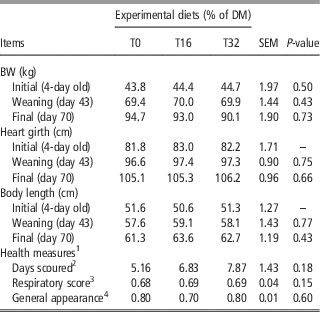
As presented in Figure 1, triticale-fed calves had greater height at wither than did T0 (control) calves on day 43 (86.8 v. 81.7±0.82 SEM; P<0.001) and day 70 (91.5 v. 88.1±0.96 SEM; P=0.05). However, only at weaning triticale-fed calves had greater hip height than control calves (87.5 v. 91.4±0.85 SEM; P=0.007). No significant difference by the treatments was detected for BW, heart girth and body length (P>0.05; Table 4).
Least squares means of withers (a) and hip (b) height (cm) for calves fed starter diets with different inclusion rates of triticale grain. T0=control diet without triticale (open bar); T16=diet containing 16% triticale (gray bar); T32=diet containing 32% triticale (closed bar). a,bMeans with different superscript(s) at each time point differ (P<0.05).

Least squares means for skeletal growth measurements, days scoured and health status of calves fed starter diet with different inclusion rate of dietary triticale

DM, dry matter; T0=control diet without triticale; T16=diet containing 16% triticale; T32=diet containing 32% triticale.
Means with common superscript(s) within each row are not different (P>0.05).
1 The detailed description of scores are presented in Table 2.
2 Days with fecal score ⩾3.
3 Days with respiratory score ⩾2.
4 Days with general appearance score ⩾2.
No dietary effect was detected in respiratory score, days scoured and general appearance score in the present study (P>0.05; Table 4).
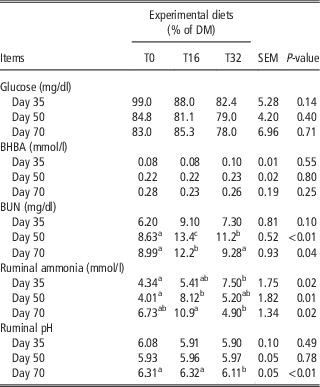
No treatment effect was detected for serum concentration of BHBA and glucose (P>0.05) at 35, 50 or 70 days of age (Table 5). On day 50, blood urea nitrogen (BUN) concentration was greatest for calves fed T16 diet followed by those fed T32 and T0 (13.4, 11.2 and 8.63±0.52 mg/dl, respectively; P<0.01). On day 70, calves fed T16 maintained a greater BUN concentration (Table 5).
Least squares means of serum concentration of glucose, β-hydroxybutyrate (BHBA), blood urea nitrogen (BUN), ruminal ammonia and pH for calves fed starter diet with different inclusion rates of dietary triticale

DM, dry matter; T0=control diet without triticale; T16=diet containing 16% triticale; T32=diet containing 32% triticale.
a,b,cMeans with common superscript(s) within each row are not different (P>0.05).
At 35 days of age, ruminal NH3–N concentration was greater (P=0.02) for calves fed T32 compared with T0, whereas on day 50, the concentration in T16 group was greater than those fed T0. On day 70, calves fed T16 had greater NH3–N concentration than those fed T32 (P=0.02). On day 35 or day 50, no detectable difference was found in ruminal pH among the treatments (Table 5). However, at day 70 of age, the pH for the calves fed T0 and T16 was higher (P<0.01) than for those fed T32 (6.31, 6.32 and 6.11±0.05, respectively).
Discussion
The results obtained for starter intake and ADG (Table 3) are in agreement with those reported by Ingalls et al. (Reference Hristov, Etter, Ropp and Grandeen1970). In contrast, McDonald et al. (Reference McCloy, Sherrod, Albin and Hansen2010) suggested that triticale can be used at greater inclusion rate in animal diet. Smith et al. (Reference Shimada, Cline and Rogler1994) reported greater DMI for steers fed diets containing a mix of triticale and corn when compared with steers fed diet containing triticale only. Laarman et al. (Reference Khan, Lee, Lee, Kim, Kim, Ki, Park, Ha and Choi2012) reported a greater rate of increase in starter DMI for diet containing triticale dried distillers grains (with solubles) as compared with control diet containing corn. This difference might be explained by the inclusion of alfalfa (3.1% starter DM) in starter diet in the study of Laarman et al. (Reference Khan, Lee, Lee, Kim, Kim, Ki, Park, Ha and Choi2012). Forage can stimulate starter DMI and act as a buffer when calves consume high starch levels from starter grains (Castells et al., Reference Broderick and Clayton2012; Montoro et al., Reference Mergoum and Macpherson2013; Hosseini et al., Reference Hosseini, Ghorbani, Rezamand and Khorvash2016).
In the present study, feeding triticale at 32% of ration DM (50% of cereal grain source) decreased post-weaning ADG. Triticale has high fermentability in the rumen (Reddy et al., Reference Radcliffe, Egan and Driscoll1975; Bird et al., 1999), which might have potentially reduced appetite and decrease DMI in dairy calves (Khan et al., 2007). Therefore, the decreased starter intake and ADG during post-weaning (day 43 to day 70) for calves fed T32 may collectively be attributed to possibly an increased starter fermentability. The fermentability of triticale, however, was not measured in the current experiment and warrants further investigation. Laarman et al. (Reference Khan, Lee, Lee, Kim, Kim, Ki, Park, Ha and Choi2012) reported no significant difference in ADG for calves fed a diet containing triticale dried distillers grains (with solubles) as compared with that for calves fed a control diet containing corn. The discrepancy between the two studies is likely related to the difference in the dietary inclusion rate: in the present study, triticale was included up to 32% of diet DM. However, triticale dried distillers grains was fed at 18.5% by Laarman et al. (2012), which is much closer to the T16 diet in the present study (i.e. 25% of corn replaced by triticale in the diet).
No treatment effect was detected for feed efficiency over the time periods tested (P>0.05; Table 3), which is supported by a previous report, indicating that feeding triticale to dairy calves may not have a negative impact on feed efficiency (Ingalls et al., Reference Hristov, Etter, Ropp and Grandeen1970). In fact, Smith et al. (Reference Shimada, Cline and Rogler1994) reported an improved feed efficiency when triticale+corn mix diets were fed to steers as compared with that for both corn alone and triticale alone diets.
Among cereals, triticale is very susceptible to ergot contamination, a factor capable of negatively influencing feed intake and performance of dairy calves when fed at high rate (Ingalls et al., Reference Hristov, Etter, Ropp and Grandeen1970). Schumann et al. (Reference Reddy, Chen and Rao2007) reported that calves consuming an ergot-contaminated feed, up to 5 g/kg, had a transient reduction in feed intake; however, health and performance of calves were not influenced. In another study, calves receiving starter diets contaminated with 0.024% and 0.032% ergot had thicker hair coats with dull appearance (Sharma et al., Reference Schumann, Dänicke, Meyer, Ueberschär and Breves1981). In the present study, ergot contamination was not detected and chromatogram showed no detectable peak, which points toward lack of ergot contamination, based on the lowest detection limit of the method used. This was indirectly supported by the observations that (1) respiratory and (2) general appearance scores of calves were not affected by dietary treatments (Table 4). In addition, the triticale grain used for the study was harvested at a farm where the weather was dry and hot, thus experiencing a much lower risk of ergot contamination.
The observation that calves fed triticale had greater height at wither and hip (Figure 1) tend to contrast with the results of a similar study by Laarman et al. (Reference Khan, Lee, Lee, Kim, Kim, Ki, Park, Ha and Choi2012), who reported no significant difference in wither height, hip height or heart girth for calves fed a starter diet containing triticale dried distillers grains (with solubles) as compared with calves fed a starter diet containing corn.
It appears that both BUN and ruminal NH3–N followed the same increasing trend for triticale-fed calves (Table 5). Studies have shown that there is a positive relationship between ruminal NH3–N and BUN concentration, and that BUN concentration is indirectly influenced by level and degradability of CP in the rumen and ruminal ammonia concentration (Broderick and Clayton, Reference Bird, Rowe, Choct, Stachiw, Tyler and Thompson1997; Hristov et al., Reference Hill and Utley2004). In parallel to increasing the degradability of CP in the rumen, ruminal NH3–N increases (Hristov et al., Reference Hill and Utley2004; Oh et al., Reference Montoro, Miller-Cushon, DeVries and Bach2008). In the present study, the differences in ruminal NH3–N among diets correlate well with differences in BUN concentration. Experimental diets were formulated however to be isonitrogenous, thus the variations in BUN and ruminal NH3–N concentrations among diets cannot be attributed to differences in the amount of dietary CP. In an in situ trial using growing beef cattle, it was reported (Hill and Utley, Reference Heinrichs, Jones, VanRoekel and Fowler1989) that ruminal degradation of feed N was greater for triticale than for barley and corn; total N in triticale disappeared faster than that in corn and barley (3.54, 1.13 and 1.48%/h, respectively). Therefore, the greater BUN concentration on day 50 and day 70 in T16 may have been related to consumption of more triticale with greater protein degradation in rumen, which probably was resulted from increased absorption of ruminal ammonia N across the rumen wall that was not incorporated into microbial protein. However, the protein degradability in the rumen of corn or triticale was not measured in the present study.
The numerical difference in ruminal pH among the diets (days 35 and 50) is consistent with Laarman et al. (Reference Khan, Lee, Lee, Kim, Kim, Ki, Park, Ha and Choi2012), who reported no significant difference in mean pH for calves fed a starter diet containing triticale dried distillers grains (with solubles) compared with calves fed a starter diet containing corn. However, calves fed a triticale-based diet showed a lower minimum pH compared with that for calves fed a starter diet containing corn.
In vitro fermentation of corn and triticale showed greater rumen fermentability for triticale compared with that for corn grain, which was reflected in a greater production of lactic acid and a higher drop in pH (Bird et al., 1999). Moreover, among cereal grains, triticale has a soft outer layer and its hardness index is substantially low (Van Barneveld, Reference Van Barneveld2002), which might mitigate chewing and thus saliva production as a strong buffer. This, in turn, may assist in ruminal pH drop for calves fed T32. In the present study, starter intake was negatively affected by feeding T32, which may have been related to their lower ruminal pH (6.11, Table 5), as Khan et al. (2007) hypothesized a pH-dependent feed intake depression in calves fed barley- or ray-based starters.
The performance of calves fed a diet containing triticale replacing corn at 25% rate (48% corn plus 16% triticale of ration DM) was comparable with that of a control diet (64% corn with no triticale) and resulted in few slight improvements in structural growth measures. The inclusion of triticale also slightly reduced soybean inclusion rate in the diet as well, which may help reduce the cost of diet at times. Under our experimental conditions, triticale grain, where available, can partly substitute corn grain in calf starter where corn is less abundant or its price is prohibitive, without negatively affecting calf performance or health. Results reported should be viewed cautiously however as the number of animals allocated to each treatment was small and calf-to-calf variation may have affected the results.
Acknowledgment
The authors gratefully acknowledge Foodeh dairy farm (Isfahan, Iran) for providing the research facility.