




The lack of funding for humanities research, and educational systems that focus on STEM (Science, Technology, Engineering, and Mathematics) disciplines, have often forced the humanities to take a backseat.Footnote 1 Archaeology offers a great opportunity to counteract this development and advocate for the humanities as a meaningful research field, using its nature as a discipline that consistently works at the intersection between humanities and natural sciences.Footnote 2
One example of an outreach initiative is the archaeology program developed in collaboration between the Danish NGO Videnskabsklubben (English: Science Club, henceforth VK) and archaeologists from the Centre for Urban Network Evolutions (henceforth UrbNet), Aarhus University. Since 2024, the after-school archaeology program has been running at selected Danish schools, introducing fourth and fifth graders (ages 10–12) to archaeology as a rich research discipline that produces knowledge about the human past.
In this article, I will introduce the archaeology program as a best-practice example of an archaeological outreach initiative, promoting a career path in humanities and allied natural sciences worth considering. I will also provide some practical advice to educators and archaeologists that hopefully dispels hesitation and concerns about implementing archaeological education into school settings.
The content of the program was developed by archaeologists from the Danish National Research Foundation’s Centre for Excellence UrbNet, a research center that operated between 2015 and 2025 carrying out archaeological research on past urbanism and urban networks, while VK secured the funding for the payment of the archaeologists during the development phase and the materials to practically implement the program at the schools.Footnote 3
At the core of the program stand a variety of hands-on activities that get the school children engaged in the methods archaeologists use in the field, in the laboratory, and in desk-based research. Before a case study (day four of the program) is giving a more details insight into the setup and activities, VK’s concept is introduced in more detail to contextualize the environment in which the archaeology program exists.
1. Videnskabsklubben’s model
1.1. Background
VK is designed to promote children’s interest in science by offering after-school programs.Footnote 4 The target group is pupils in grades 4–6 of the elementary school (folkeskole), with programs hosted by local upper secondary schools (gymnasier). Each program runs for seven weeks (always between the Danish fall and winter holidays), with weekly sessions in which groups of 12 children—referred to as “mini-researchers”—explore a specific research field and learn about the practices and questions that drive it. Participation is free of charge for all mini-researchers as the materials for the participating schools are provided centrally by VK, removing financial barriers both for host schools and families that want to sign their children up for a program.Footnote 5 Sign-up usually opens at the end of August on VK’s website and parents can freely decide what program to sign their children up to, as long as they are visiting the target grades.
The core values of VK are the creation of unique environments where curious children and young people can freely be themselves while exploring the world around them. Here, members experiment without pressure to perform or fear of making mistakes, making learning a joyful experience. VK emphasizes taking responsibility for others and sharing knowledge, passion, and experience, believing that giving creates greater returns. By making science and research meaningful to more people, participants find purpose in engaging with something bigger than themselves. Ultimately, knowledge serves as the foundation for everything they do, equipping the participants to navigate tomorrow’s society.Footnote 6
Since its foundation in 2017, VK has developed programs in a wide range of STEM disciplines, including biodiversity, material physics, microbiology, mathematics, primatology, and chemistry. In 2023, the development of the archaeology program started, leading to the launch of the archaeology program at 10 schools in the winter of 2024.Footnote 7 Due to generous funding, and based on the success of the archaeology club (see below), VK has started to extend the model further into the humanities, with programs in history (launch fall 2026), philosophy, languages, and architecture (currently in preparation).Footnote 8
A key feature of VK is its collaboration with Danish universities, and the researchers that actually carry out the research in the research disciplines that the mini-researchers get to explore. The programs are thus at the state-of-the-art in scientific knowledge and accurately reflect the methods used in the respective research fields. One of the main aims is to teach school children how scientist work and how scientific knowledge is produced, including important skills such as the forming of a hypothesis, the conduction of scientific experiments, and a critical assessment of the results. The programs are less meant to teach the mini-researchers the scientific content and more about the actual research process and why research—and the knowledge we draw from it—matters. In contrast to the school system, the focus in VK lays on prioritizing questions over answers, the development of a community of curious children, and the room to learn from mistakes instead of trying to avoid them.Footnote 9 However, while based on the work of researchers, the programs are not taught by the professional researchers themselves, but by students from the upper secondary schools that host the program.
1.2. Peer-to-peer learning
One of VK’s defining characteristics is its peer-to-peer learning model.Footnote 10 Older students from host schools serve as mentors who guide the mini-researchers through the programs.
Unlike traditional classroom settings, teachers are absent from the instructional role: mentors themselves run the sessions, pose the daily research questions, set up and lead through the experiments/activities, and facilitate discussion and reflection. VK supports the mentors’ work by providing a comprehensive program book, developed and written by the researchers, that combines pedagogical guidance with practical resources. Each day is outlines in detail. All daily sections are accompanied by a detailed list of required materials, which minimizes logistical challenges and helps the mentors to navigate each week’s materials and activities. It also contains carefully written preparation notes and activity instructions, ensuring that the experiments can be set up and carried out by all the participants. Finally, the book offers a reflective section that encourages mentors to connect the day’s guiding question, the experiments, and the overarching theme of the program, thereby providing a sense of coherence and closure. In this way, VK equips its mentors with the tools they need to conduct the programs independently while upholding a high standard of content delivery and didactic quality.
The guidance from the program book is accompanied by a mandatory annual training workshops for all mentors, where they receive instruction in both scientific content and didactics. During the workshop they spend half of the day with the researchers that developed the program and go over some of the activities and receive more background information on the program’s overall scope. The other half of the day is set aside for input from former mentors, practical exercises on, for example, ice breakers, and professionals talking on the handling of challenging situations that might occur.
The peer-to-peer model paired with the detailed program and preparatory workshop positions mentors as both instructors and role models. Their relative proximity in age (they are about 4–6 years older than the mini-researchers) makes them highly relatable to the younger participants, who may see in their mentors a possible future self. The approach has been shown to foster engagement and to lower barriers to participation, particularly for children who may feel less confident in traditional school settings.Footnote 11
The benefits are not one sided and the students volunteer for their roles as mentors, with different motivations, such as their plan to become a teacher in the future, because they want to create a community for curious children as they experienced this as children, did not have the opportunity to experience something similar in their own education, or because of their own enthusiasm for science.Footnote 12 Mentors report significant personal gains, including improved scientific communication skills, greater confidence in explaining complex concepts in accessible ways, and an enhanced understanding of the material itself through teaching. They also acquire pedagogical skills and experience the satisfaction of helping other children to find their place in a group of like-minded kids and develop excitement for the program’s content. In some cases, the mentors also have cited their work as mentors to be the reason why they now study to become a teacher.Footnote 13
1.3. Impact
Evaluation data based on questionnaires send to the parents before and after the programs take place suggest that VK has a measurable effect on children’s interest in science. The parents are asked to fill in the questionnaire together with their children. A large majority of participating children reported heightened curiosity and engagement with the subjects after attending a program. The evaluation methodology was expanded between 2024 and 2025 to capture feedback from both parents and children in a more nuanced manner. In 2024, only parents participated in the evaluation and the questions were focused on the parameters the children entered the programs with (e.g., whether their child knew what an hypothesis is and what it is used for), with 47 family respondents of 105 mini-researchers who attended the program. In 2025, the evaluation was broadened to include the children’s experience alongside parents, resulting in 68 total family respondents of 158 mini-researchers who attended. Among the children, 45 responded to a question about whether they were now more inclined to explore topics they previously knew nothing about. Among parents, 29 responded “highly so” and 13 responded “to some degree” to the question “Did you give your child courage to try more science-focused activities?”Footnote 14 The noncompetitive environment is central to this success: VK emphasizes collaboration, play, and exploration rather than assessment or grading. This creates a “safe space” for experimentation and failure, free from the pressures of formal schooling.
While most assessments to date have focused on the STEM programs, the initial launch of the archaeology program in 2024 is already yielding promising results. In fact, the archaeology program received the highest satisfaction ratings among all VK programs in their first year. The parents that participated in the evaluation rated the archaeology program an average of 4.7 of 5.Footnote 15 Future research will be needed to assess whether these programs foster similar long-term effects on interest in humanities disciplines as the STEM programs have done for science. To underline the positive impact that the program had, I would like to share a quote by a parent. During my visits to the schools in 2024, when I post the question whether their child enjoy the days, she replied: “He enjoys it a lot. As his mum I can just say, he is such a nerd. And here he finally found other nerds that share his interests.”
2. Designing the archaeology program
Covering the entirety of archaeology as a discipline within seven sessions is, of course, impossible. A careful selection of topics was therefore necessary. Because VK’s funding has formerly been tied to the promotion of STEM subjects, the archaeology program was designed with a strong natural science component, as reflected in the chosen case studies below that hopefully can inspire similar activities by archaeologists wanting to create archaeological outreach.
2.1. Overall structure
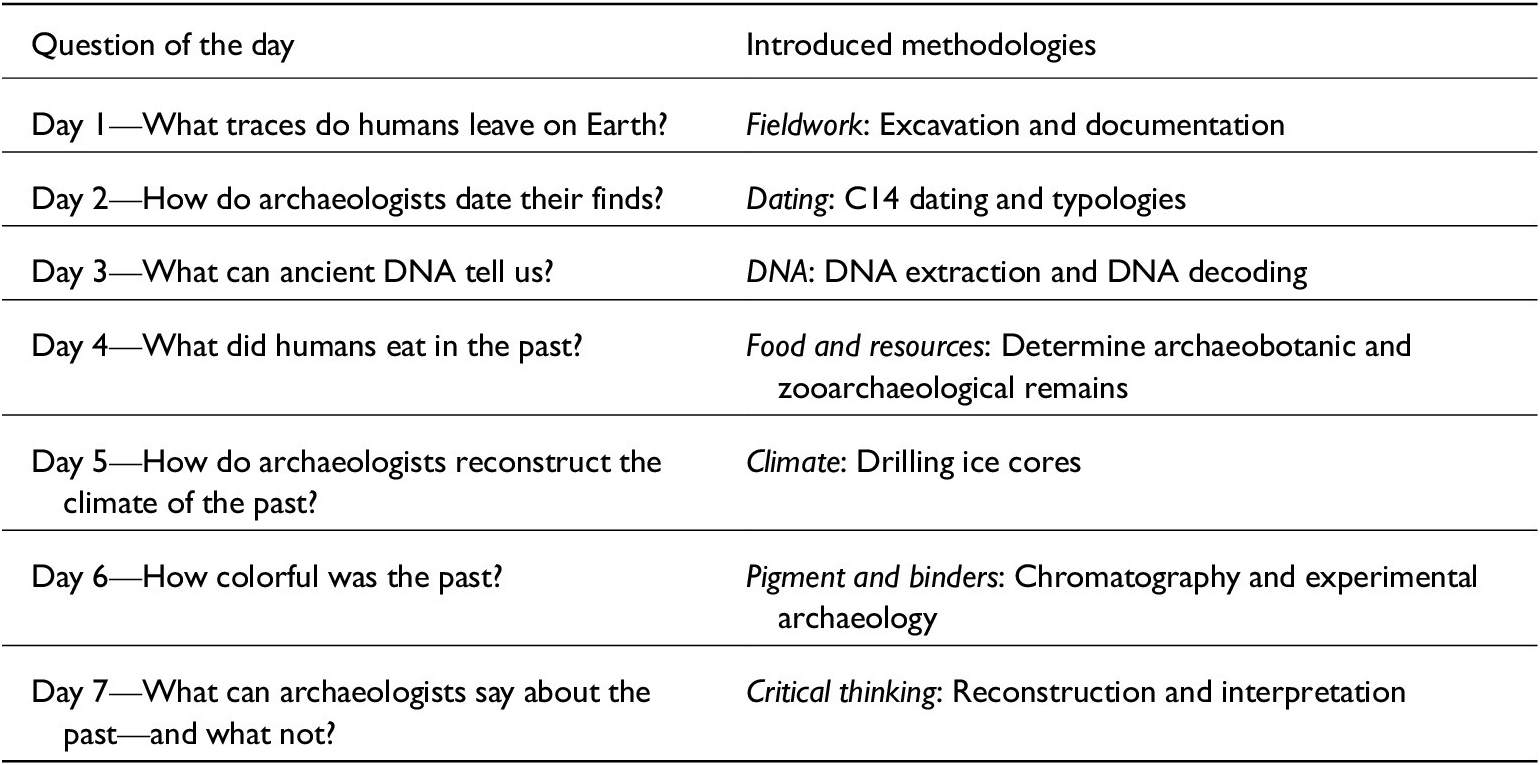
Each day of the program is framed around a “travel of the day,” in which the mini-researchers are introduced to a new region and archaeological case study (e.g., prehistoric China, Roman Britain, or Viking Age Denmark). This was chosen to reflect that archaeology is happening in the entire world and that there are factors that connect the human past across all parts of the world. A full overview of the chosen topics and the methodologies introduced is presented in Table 1.
Overview of the questions of the day and the main topics covered within

Table 1. Long description
The table consists of two columns titled Question of the day and Introduced methodologies.
* Day 1. Question: What traces do humans leave on Earth? Methodology: Fieldwork involving excavation and documentation.
* Day 2. Question: How do archaeologists date their finds? Methodology: Dating using C 14 dating and typologies.
* Day 3. Question: What can ancient D N A tell us? Methodology: D N A extraction and D N A decoding.
* Day 4. Question: What did humans eat in the past? Methodology: Food and resources involving the determination of archaeobotanic and zooarchaeological remains.
* Day 5. Question: How do archaeologists reconstruct the climate of the past? Methodology: Climate studies via drilling ice cores.
* Day 6. Question: How colorful was the past? Methodology: Pigment and binders analyzed through chromatography and experimental archaeology.
* Day 7. Question: What can archaeologists say about the past and what not? Methodology: Critical thinking regarding reconstruction and interpretation.
Source: The author.
At the beginning of each day, a short video (maximum three minutes long) was shown, in which archaeologist Kirstine Haase (Head of Research at Museum Odense, Denmark) explains the site, its context, and the specific question to be addressed during the day.Footnote 16 Around these case studies, archaeological methods were developed into two or three classroom-based activities per day. Each session concludes with a reflection round, during which the “question of the day” is revisited and the knowledge gained by the mini-researchers is consolidated—without there being a focus on the mini-researchers being tested, but with a focus on why the results matter (e.g., what can we learn from cave art about the people that created it). It also put an emphasis on creating a link to the mini-researchers life (e.g., asking them what they would draw on their cave wall, to get them to think about the expression of what matters to them or to the group they are part of).
To help the mentors with their work, all paper copies needed were compiled in a field diary that is given to each mini-researcher at the beginning of the program. Here they can find room to write down hypotheses, complete some of the activities, and make notes. As an example, on day 1, when they excavate finds from the Viking Age town of Ribe, in Denmark, they can use the diary to make a drawing of their “trench” and document the exact find spot of each object—just like archaeologists would do in the field.
2.2. Practical constraints
The development of the archaeology program had to account for four central constraints:
-
1. The groups only had access to standard classrooms, not laboratories or science facilities (e.g., no access to water at all times, which meant that we needed to supply them with beakers to get water into the room).
-
2. No teachers/adults are present, which required that all activities be safe and manageable for young participants and their student mentors (e.g., no fire).Footnote 17
-
3. Activities needed to be conducted indoors, given the likelihood of inclement weather and limited daylight in the late autumn/early winter months (e.g., no exploration of the school yard).
-
4. All materials had to fit into standardized transport boxes supplied by the logistics provider and adhere to preset weight maximums.
These parameters shaped the design of the program and influenced the choice of case studies and activities, which will be reflected on following the case study that describes one of the days in more detail.
2.3. Case study: What did humans eat in the past?
On the fourth day of the program, the central question posed to the mini-researchers was: What did humans eat in the past? The topic thus introduced them to archaeobotany and zooarchaeology, disciplines concerned with the study of plant and animal remains.
The case study situated the group in prehistoric China during the Longshan period (c. 3000–1900 BC). For the activities, research conducted in the region and period was the background of what plant and animal remains should be included in the activities.Footnote 18
Following the introductory video, the mini-researchers were asked to formulate a hypothesis: what kinds of foods might people have consumed at this site? They then tested their hypotheses through two main activities, while the third activity is meant to get them to reflect on human–environment relationships.
2.3.1. Activity 1: Coprolite analysis
Each child was given a mock coprolite (fossilized feces), prepared by the mentors using colored salt dough into which different kinds of seeds had been embedded.Footnote 19 The two groups received different seed assemblages, reflecting on the archaeological finds from a coastal and an inland site from the case study region: one with soybeans, wheat, and millet; the other with rice, wheat, and millet. Using tweezers and sticks, the mini-researchers extracted the remains, sorted them, and counted their finds. With the aid of a reference collection, they then identified the plant species represented in their samples. A reference collection, a commonly used tool in archaeology, is a collection of artifacts or modern comparanda materials that helps archaeologists to identify their finds. This exercise not only engaged them in a hands-on approximation of archaeobotanical analysis, but also introduced them to the concept of dietary reconstruction (Figure 1).
Mini-researcher extracting plant remains from a “coprolite” to reconstruct what plants were cultivated. Photo: Videnskabsklubben/Lars Svankjær.

2.3.2. Activity 2: Identifying animal remains
In groups of four, the mini-researchers were provided with a set of seven 3D-printed and spray-painted animal bones. Alongside these replicas, they received schematic drawings of different animals, which served as reference material. Working collaboratively, each group was tasked with determining which bone corresponded to which animal. To support this process, the participants were given access to light boards, originally designed for drawing. When the animal illustrations were placed on the light boards, the outline of a complete skeleton became visible, with a specific bone highlighted. This allowed the mini-researchers to directly compare the highlighted skeletal element with the 3D-printed specimens in their possession, thereby facilitating the identification process (Figure 2). The “x-rays” of the animals were made by placing an image of the animals’ skeleton behind a picture of the animals’ outline and laminating the two pieces of paper together.
Mini-researchers discussing what animal the bones belong to. Photo: Videnskabsklubben/Lars Svankjær.

To ensure that the 3D prints are precise replica, bones were borrowed from the zooarchaeological reference collection of Moesgaard Museum (Aarhus, Denmark) and 3D scanned with an AutoScan-DS-MIX blue light scanner by D. Parrott, at the time PhD student at UrbNet.Footnote 20 Another option would have been casts of the bones but experience within VK has shown that casts are prone to break rather easily and hence we decided on 3D prints for the bones, to ensure that the materials can be used for years to come.
2.3.3. Activity 3: Settlement reconstruction
Finally, the mini-researchers synthesized their observations by creating collages representing a reconstructed settlement. Using drawn images from their previous two activities with crops and rice fields and animals, the children cut out pictures from their field diaries to create collages. They were also encouraged to add other important elements such as water sources for drinking water and irrigation, forests, and animal enclosures. Because the two groups had worked with different sets of seeds, their collages revealed distinct subsistence strategies, prompting discussion about regional variation and environmental adaptation.
2.3.4. Ending the day: Reflection and consolidation
At the close of the session, mentors returned to the guiding question of the day. Together with the mini-researchers, they reviewed what had been learned about plant and animal remains and discussed why archaeologists study such material in the first place and what they ultimately can learn from them. This reflection emphasized both the empirical results of the activities and the broader significance of archaeobotany and zooarchaeology for understanding past human societies and human–environmental relationships.Footnote 21
2.4. Further considerations
To reflect and evaluate on all activities and individual choices made for the program is beyond the scope of this article, but to help navigate potential challenges that other creators of educational archaeology content are facing, a summary of selected things learnt from its development are presented next. This will hopefully be of use to others who want to design and implement archaeology outreach for children.
1. The lack of activities is not the problem. There are a range of activities that can be used for archaeological outreach and they can be adapted to suit the historical and methodological context. An example is the activity on the ingredients of paint used for cave wall paintings in the VK program, simulating what happens inside a mass spectrometer. A simple paper chromatography set-up (Figure 3) to visualize what happens inside a GC–MS instrument. The same activity could be used to explain the analysis of food remains from pottery, where the analysis also involves spectroscopy.
Paper chromatography experiment—used to explain what happens inside a GC–MS instrument. Photo: Videnskabsklubben/C. P. Hoffmann.

2. Analogies are key. An example of where this was very successful was in the explanation of typology in archaeology. In order to explain what typologies are, an activity was set up where the mini-researchers are presented with a variety of LEGO bricks. They are asked to sort them any way they see fit (e.g., after size, color, shape). Afterward they applied their developed criteria to a set of pottery finds, using the criteria from sorting LEGO. While the pottery is unfamiliar to them, they all have used LEGO before and easily came up with ways of sorting this familiar material. Using their sorting system on a set of unfamiliar material made the methodology of building typologies accessible to them.
3. You do not need the “real” things to get children engaged in archaeology. While real artifacts are without a doubt a great choice for educational content, this was not viable for the VK program. In my observations in the classroom, however, I observed that mini-researchers were equally excited about replica objects (e.g., 3D-printed bones or replica of coins) and archaeological contexts simulated with different materials. An example of the latter is an activity on ice cores. There are many activities to be found online where teachers create ice cores to demonstrate how climate change can be seen within them. This level of planning and preparation, which would require that the mentors freeze layers of waters over multiple days at the school or at home, was not suitable for the needs of the VK program. Instead, playdough was used in the VK program to simulate ice cores. The mentors stack different colored slices of playdough on top of each other and press it into a cup, simulating the layers of ice that form in permafrost environments. The mini-researchers then use a straw to drill their own core and learn about the layers inside the “ice” (Figures 4 and 5).
Stack of playdough before it is being pressed into a cup. Photo: the author.

“Ice” cores with layers indicating different temperatures. Photo: the author.

3. Archaeology and its power in a classroom
Thus far, VK has engaged thousands of children and young people in research-based learning communities, while also contributing to a broader societal debate on leisure, volunteering, and informal education.Footnote 22 In 2024, director Rikke Schmidt Kjærgaard actively participated in public discussions through op-eds in large Danish newspapers such as Altinget, Politiken, and Kristeligt Dagblad, addressing issues such as the role of schools, grade pressure, and the value of meaningful leisure communities. The importance of these debates is exemplified by the traction they received in the wider media; VK was mentioned in around 250 media outlets during the year 2024.Footnote 23 This arena of public debate and the clearly demonstrated importance of the debate are the context in which the VK archaeology were created and continue to exist in.
Bringing archaeology into the classroom through the VK model presents both challenge and opportunity. The program’s success depends not only on the innovative peer-to-peer structure but also on the substantial support provided by private foundations, which ensure that materials are available free of charge to all participants. This means that VK needs to inspire the support of both mentors with engaging topical programs and foundations that their work is valuable on a number of fronts. The archaeology program demonstrates that the VK framework can be extended beyond STEM, opening new possibilities for humanities education in informal, curiosity-driven settings. It also brings to the fore academic debates on what archaeology as a discipline is to the classroom. This article and the program it describes has demonstrated it is possible to bring archaeology into the classroom and have an impact on the standing of humanities in the real world, and perhaps most importantly in the classroom, where the next generation of both humanities and STEM students are being educated.
Acknowledgments
I thank everyone at Videnskabsklubben for the wonderful collaboration, especially Sarah Kirkegaard Verver, who did her very best to ensure that the program was everything we envisioned. Thanks to Rowan English for his feedback on an early draft and proofreading the final version. Thank you to the peer reviewer for their constructive and detailed feedback that helped shape the manuscript. All mistakes and shortcomings remain my own. I extend my thanks to the foundations that financially supported Videnskabsklubben in the development of the archaeology program: Novo Nordisk Fonden, Beckett-Fonden, and Dronning Margrethes and Prins Henriks Fond. The program development was carried out by archaeologists at the Centre for Urban Network Evolutions, directed by Prof. Rubina Raja and supported by the Danish National Research Foundation under grant DNRF119.
Author contribution
Conceptualization, Writing - original draft, Writing - review & editing: J.S.


 Open access

