Introduction
Scholarly and lay uses of musical categories can vary hugely. I found this out one day when I asked my students at New York University what kind of popular music they preferred, and received the near-unanimous answer of, ‘None’. As it turned out, they interpreted the term as a synonym for bland, major-label ‘pop’, in contrast to the hip-hop or rock they avidly consumed and which, I told them, scholars call ‘popular’. Such differences in classification only become compounded in translation. In Spanish, for instance, ‘popular’ and ‘traditional’ are near synonyms, both referring to music ‘of the people’. The former's meaning is thus nearly opposite to its English-language one, which enables non-oxymoronic phrases like ‘traditional popular music’. Meanwhile ‘folk’ usually has nationalist connotations. Another term, música típica, is often equated with ‘traditional music’, but usage suggests the translation is inadequate. While tradicional suggests a tie with the past, típico is more closely tied to place than time.
Opposing understandings of the term ‘popular’ in Spanish and English have had lasting effects. Popular music theorists have considered Latin America infrequently and unevenly, and many have applied the term ‘popular’ without regard for its emic meanings. Meanwhile, Spanish-language intellectual production on popular-traditional and mass-mediated musics is not often read by scholars from the north. Both Spanish- and English-speaking scholars also sometimes make the mistake of using etic genre labels in ways that either contradict or simply ignore emic usage, further muddying the situation. Insisting on the ubiquitous application of scholarly musical categories can even cause omission of those styles that do not seem to fit. Such styles fall between the cracks of our musical disciplines of musicology, popular music studies and ethnomusicology, which to some extent have been based around that tripartite division into art, popular and traditional musics.
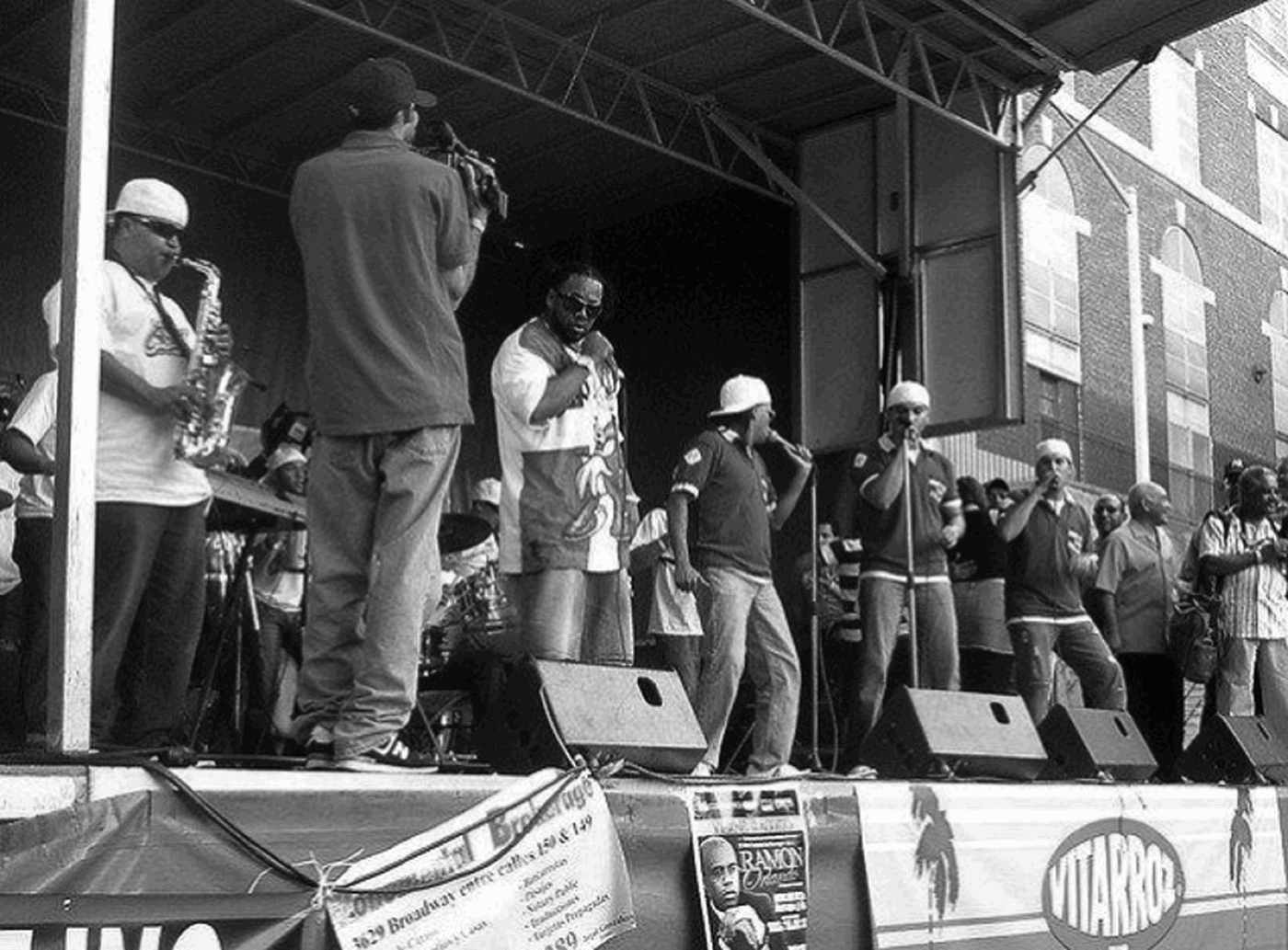
Now-defunct típico moderno group Aguakate performs at New York City's Dominican Day Parade. Photograph by Sydney Hutchinson.

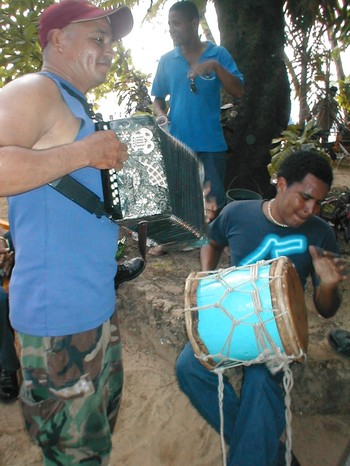
An informal merengue típico trio (perico ripiao) plays for tourists on the beach at Sosúa. Photograph by Sydney Hutchinson.

With this paper, I wish to point out some problems inherent in our current classification systems, how they are questioned by what are sometimes termed folk taxonomies, and how music studies can be broadened and enriched by the inclusion of these alternate views on its subject. I want to suggest that considering emic musical categories can help us not only to deepen our ethnographic detail but also better to theorise our subject matter, particularly considering recent transformations in the realm of popular music. I will do this by examining uses of the terms típico, folklórico and popular in various contexts, with a particular focus on Dominican merengue típico musical culture. I argue for a rehabilitation of the concept of típico, which some academics disdain for its association with nationalism and folklorismo, but which also carries positive connotations for many musicians. I suggest that típico, a term frequently used ‘in the field’ but seldom analysed, can be a particularly useful concept for researchers studying transnational ‘roots’ musics that do not easily fit into our usual categories. In doing so, I hope to contribute to a more unified and interdisciplinary field of music studies, one which will exploit the strengths and explore the weaknesses of the several disciplines of music research.
Classifications based on social factors and production
Western musical categories are a legacy of the Enlightenment obsession with collection and classification, but their employment may often be accompanied by problems such as hierarchisation, power imbalances and a distortion of knowledge (Birenbaum Quintero Reference Birenbaum Quintero2006). As a corrective, I first question the categories themselves to demonstrate that they neither denote a homogenous study object nor are used with much regularity. I then turn to alternative classifications originating outside the academy, and suggest that we include them in our scholarly musical discourse.
Folklórico, tradicional and popular are the terms most often used in Latin American scholarly discourse to designate oral traditional music, in opposition to música culta (‘cultured’ or ‘art music’). The three terms also generally denote secular genresFootnote 1 and local ones, as opposed to imported, mass-mediated musics. The exact definitions vary, particularly in reference to the ethnicities and classes included under each label. They can nevertheless be made to correspond, however confusingly, with two parts of the old tripartite classification of culture into elite, popular and folk, dating back at least to Johann Gottfried Herder, that have led to the production of our current disciplines of musicology, popular music studies and ethnomusicology. Latin American variations on this theme include Pedro Henríquez Ureña's classification into ‘cultured’, ‘vulgar’ and ‘popular’ (Rodríguez Demorizi Reference Rodríguez Demorizi1971).Footnote 2
‘Folklórico’ is closely tied to nationalism. In the late 19th and early 20th centuries, ‘national’ music and dance genres were selected around the Americas, often in conjunction with populist political projects. Folk genres were considered worthy symbols because they were believed to represent the country's ‘essence’, either due to their association with a particularly important region, ethnicity or racial mixture, or because of their ties to independence movements (see Chasteen Reference Chasteen2004; Hutchinson Reference Hutchinson, Nájera-Ramírez, Romero and Cantú2009a). In most cases, nationalised folk musics reflect a belief – still very much alive in Latin America – that national identity was best found among the peasantry, who represented an ideal form of community in contrast to industrialising urban societies (Mendoza Reference Mendoza2008, p. 4).
‘Folk music’ also has temporal and social connotations. Argentine folklorist Carlos Vega described folklore as ‘a stratification of history’, suggesting that folk music could provide a window into the past (Vega Reference Vega and Shelemay1990 [1965], pp. 144–5). Paradoxically, to study that past, folklorists must study living, rural people, although never ‘the countryside occupied by tribes, which are other “nations” or their remnants’ (p. 153). Here Vega echoes earlier views of peasant cultures as restricted to those of European origin.Footnote 3 Writing in the same year, Cuban scholar Fernando Ortiz instead found folk music to be the contemporary music of marginalised groups, and strongly disagreed with those folklorists who restricted their studies to the rural or lower classes: ‘Each one of us belongs in part, according to place and occasion, to the basic social stratum’ (Ortiz Reference Ortiz1965, p. x). For him, ‘folklore’ also included localised foreign musics. Later Cuban socialist scholars similarly located folk music among the urban working classes, and assigned folklore a special role in the socialist system, believing it to represent the people and their will (Martínez Furé Reference Martínez Furé and Manuel1991).Footnote 4
While ‘folk music’ is often considered antiquarian in nature, folk music canons, often political in themselves, generally arose fairly recently in interactions between intellectuals, institutions and musicians (Feldman Reference Feldman2006; Mendoza Reference Mendoza2008). Some styles termed ‘folklore’ are specifically new, as in Bolivia, where in the 1980s ‘folklore’ arose as a new combination of the traditional musics of the European-descent and indigenous populations (Céspedes Reference Céspedes1984, p. 217). Thus, in some cases, the label ‘folklore’ implies a legitimising move, either enabling a traditional style's social ascent or creating an entirely new style for mass consumption; in others, it can have negative connotations. For instance, Martínez Furé finds the term racist, classist and simply inappropriate in revolutionary Cuba, since it formerly divided the ‘high culture’ of upper-class white Cubans from the ‘low culture’ or ‘folklore’ of the lower-class, black Cubans (Hagedorn Reference Hagedorn2001, p. 195).
Tradicional often appears as a synonym for folklórico. Although it lacks the latter's political baggage, it too may have racial connotations, as when Vega and Aretz omit indigenous Argentines' music from their definitions of folklore, but include European ballroom dances played by Argentine creoles (Aretz Reference Aretz1952, p. 13). For them, indigenous people may have ‘traditional’ music, but ‘folklore’ is the province of whites. In addition, García Canclini (Reference García Canclini2001, p. 23) notes that conservatives use ‘traditions’ to overlook the conflicts and colonialism that formed modern nations. Other theorists see the tradition/modernity binary as itself depoliticising, since it is frequently accompanied by a social evolutionary scale where modernity is equated with the West (Frank, Webster and Said in Tomlinson 1999, p. 64). Tomlinson suggests this view be corrected by dismantling the binary and opening the possibility for the existence of multiple modernities (p. 65). However, it is unclear where this leaves the traditional – can we also conceive of multiple traditionalities?
Popular is perhaps the most frequently used of the three terms. Because it is derived from el pueblo (‘the people’), it can be applied to any music belonging to or consumed by a group, but is usually used for oral traditions. In practice, how the term is used may reveal more about politics than about the music in question: does the author celebrate this ‘authentic expression’ of the nation or community? Or does she see ‘popular’ as lower-class music, inferior to música culta?
This term carries additional problems, long recognised by scholars. Vega points out that ‘popular’ was usually related to lower social classes, so might be used derogatorily: ‘In the realm of music, it indicates mediocre ideas and techniques and, if the intention is pejorative, suggests media or elements of low quality.’ At the same time, he notes that the term may also simply denote ‘widespread music’, and in this sense ‘classical music’ can also be ‘popular’ (Vega Reference Vega1997 [1970]). Ortiz adds that the ‘folk’ sing the songs of higher social classes and make them their own; elite composers write songs for the folk; songs ‘from below’ can catch on among upper classes; ‘folk music’ may be played by respected professional musicians; and changes in status occur frequently (Ortiz Reference Ortiz1965, p. xii–xiii). Such contradictions and multiple meanings show the term to be of limited use academically. Various alternatives have been proposed, like Isabel Aretz's (1984, p. 9) ‘etnomúsica’,Footnote 5 and Carlos Vega's (1997 [1970]) ‘mesomúsica’, but they have not caught on.
Still today, Latin American theorists tend to use ‘popular’ to refer to communal, oral, traditional culture, as in García Canclini's Transforming Modernity. His updated version includes a class-struggle view, indicating that while the popular is always tinged with romanticism, it actually has more to do with marginalisation (García Canclini Reference García Canclini2001, p. 108). He therefore insists that it be studied not as an object, but as the product of the interrelation of ‘unequal appropriation of cultural capital, [the popular classes’] own reflections about their living conditions, and conflict-ridden interaction with hegemonic sectors' (García Canclini Reference García Canclini2001, p. viii). Elsewhere, he attempts to resolve the problem inherent in Vega's conception of ‘mesomusic’ – its limited view of modernity, which precludes any understanding of the interaction between ‘traditional’ and ‘popular’, rural and urban, the technological and the artisanal – by proposing that ‘hybrid culture’ replace ‘popular culture’. Capitalist modernisation does not always destroy traditional culture, as had previously been supposed, he says; instead, it transforms and resignifies it, producing a heterogeneous blend of new and old cultural, social and economic configurations (García Canclini Reference García Canclini and Lozano1993, p. 47).
This view of the popular has the advantage of recognising the constructedness of authenticity, thus obviating the need to search for it, but still leaves out how the term circulates in non-academic discourse – in other words, popular definitions of the popular. These uses can differ radically from academic ones, as Julio Mendívil demonstrates, noting that Peruvians use the term variously for nationalist, official or lower-class musics, ranging from huayno to chicha to rock (Mendívil Reference Mendívil2001, p. 10). And while García Canclini's ‘hybrid’ proposal does help bring into focus those musics that combine traditional and modern aspects in ways that resignify tradition, the term can imply racial and ethnic blending, when the blending of different economic systems and social configurations may be more important.
Place-based classifications
While folklórico, tradicional and popular categorise music by production, transmission or social factors, other categories define music by its relation to place: they differentiate between what is produced locally, and what is imported.
Criollo (‘Creole’) is one such term, though it also has racial connotations. In the colonial period, it usually was applied to people of European descent born in the Americas. Today, the term may be even more specific, as in Peru, where it refers principally to the ‘official’ or hegemonic culture of the coastal region, which competes with highland or Andean Peru in the national imaginary (Julio Mendívil, pers. commun.). In the Dominican Republic during the Trujillo dictatorship some scholars used it as a synonym for popular in such a way that it could tie local music to venerated Spanish traditions as they had been recreated in island popular culture (e.g. García Reference García1947).
In postcolonial times, particularly in the Caribbean, Creole has come to refer to what is both local and of mixed origins, and creolité is a source of pride in local languages and cultures. But while the term has grown in importance in the English- and French-speaking islands through the influence of thinkers like Eduoard Glissant and Stuart Hall, it is seldom used in the Spanish-speaking ones, perhaps because there criollo continues to be identified more with whiteness than with mixture. Elsewhere, música nacional is used in place of música criolla, and while obviously connoting nationalism, it may also be used simply to oppose a regional or local music with something more widespread, intended for consumption by an entire nation – and, often, its diaspora (e.g. Riedel Reference Riedel1986).
Típico is another place-based term, but the one least used in scholarly literature, although it sometimes appears tied to concepts like folk music (Monsanto Reference Monsanto1982, p. 60) or ‘our’ music (García Reference García1947, p. 8).Footnote 6 García Canclini is among the few who seriously examine the term, and he finds it is a depoliticising one imposed from above, one of the principal mechanisms for integrating traditional culture into capitalism. The separation of production from circulation and consumption, and individuals from community, results in ‘the reduction of the ethnic to the typical’ (García Canclini Reference García Canclini2001, p. viii). While this integration may ensure traditional culture will not disappear, it also serves to erase indigenous groups. For instance, he notes how Mexican tourist crafts are marked simply as ‘Mexican curios’, rather than as being made by Purhépecha people. This ‘tipicisation’ process homogenises crafts and their producers into a fictive regional or national unity, which ‘becomes disorienting and depoliticising when it leaves out the differences and contradictions that it includes in reality’ (García Canclini Reference García Canclini2001, p. 65). Musical parallels might be noted in world music marketing practices. In a related critique, Ricardo Pérez Monfort (Reference Pérez Monfort2005, p. 191) notes that the idea of what ‘típico’ is has often been constructed by those at the centre who consider themselves above it, rather by those in the regions actually supposed to produce it. The officialising or academicising of folklore then produced an idea of what típico ‘should be’, and that ‘should’ still permeates Mexican national and regional cultural expressions.
These critiques focus on the term's usage by marketeers or policy makers. But in fact, it is more often used by musicians. Roberta Singer explores the significance of típico styles to salsa musicians in New York City, noting:
Típico is perhaps the most semantically laden of all music-related concepts and terms in use by contemporary Latin musicians. Most often it refers to a range of Island-rooted styles of performance, each country having its own típico styles. The precise referent can only be known in the context of conversation. Puerto Rican típico can be the jíbaro cuarteto styles as well as the Afro-Puerto Rican styles either as performed in traditional ways or in the more urban conjunto format. Cuban típico includes the later charanga groups and the son septeto and sexteto styles. All típico styles, on some more or less removed levels, contributed to the development of contemporary salsa styles.
Some contemporary performers in New York City define típico as ‘source’ music: the non-commercial styles from which contemporary commercial styles are derived and reinterpreted. A performer in commercial Latin music may be complimented by other performers if the latter feel he is a ‘real típico player’. (Singer Reference Singer1982, p. 226)
Típico styles are thus tied to a real yet mythologised Caribbean island or homeland, although rural or urban, creolised, African- or European-derived forms might all be equally ‘típico’. Salsa musicians consider música típica a source but not, apparently, as something to be reproduced as is, or something that can be contemporary in itself. At the same time, a típico sound is desired because it lends authenticity to a performance, rooting it in a particular place and history.
In a related case, John Murphy centres his analysis of Cuban charanga groups in New York on típico as a style and a term referring to ways of playing that are perceived as being historical rather than contemporary. He finds típico style to be a kind of ‘residual culture’ because
It was formed in the past, and expresses a musical worldview that cannot be expressed in terms of hegemonic musical styles like rock or rap, but is effective for its audience in the present, especially the energised, transformed present of live musical performance. (Murphy Reference Murphy and Manuel1991, p. 132)
Residual is an inaccurate description, since it implies that such styles are in disappearing, whereas in cases like that of Dominican merengue típico, their popularity may in fact be growing. But this description demonstrates the importance of live performance in making típico genres relevant in the present, in the ‘reaffirmation of ethnic identity’ (Murphy Reference Murphy and Manuel1991, p. 132), and in maintaining an artistic vision of the past even after a rupture with it (p. 117).
As García Canclini suggests, típico has little to do with race or ethnicity, although it may have much to do with class. Manuel Peña tells us that in Mexico, for example, the canción típica (‘typical song’) was a 19th-century song ‘of a folk nature – with simple tunes and lyrics, anonymous in composition, and often of antiquarian origins’, preferred by the rural lower classes. The style was pitted against ‘romantic song’, associated with modern European importations and with the urban upper classes. In the 1920s, the canción típica grew into the now-familiar ranchera at the same time as disparities between Texas Mexican social classes grew more marked, and the ranchera became the preferred music of the masses (Peña Reference Peña1999, pp. 50–53).
These examples suggest that for musicians claiming to ‘play típico’, concepts of rootedness and historicity may be more important than others, like race; in this the term differs from others like criollo or even folklórico or tradicional. Yet típico styles can also serve as a means of reconnection with or promotion of an ethnic identity. However, the ethnicity in question is generally not a black, white or indigenous one, but a Latino one within the US (or, sometimes, European) context – and a Latino ethnicity subdivided into nationalities, which may themselves come to be used as ‘ethnic’ labels related to racial characteristics rather than to citizenship. While García Canclini writes of the movement from ethnic to typical, a transnational context may instead produce the reverse, as we will see in the case study below.
To sum up, most scholars who have written about the labels tradicional, folklórico or popular have confined themselves to the etic perspective – they are concerned principally with how such labels help or hinder research and analysis. The term típico, however, has been more often studied from the emic perspective, by looking at how musicians choose to apply the term. These facts suggest típico has been of greater importance to musicians and listeners, who see it positively, than to scholars. The classifications used by fans of típico styles show that means of dissemination and transmission may be less important for them than ideas about heritage, home or history, while ethnicity is likewise less of a factor than place in some such sonic communities.
Case study in music, place and category: merengue típico
The relationships between place, identity and music remain complicated, and the high mobility of people and music today makes it impossible to view the music–place relationship as a 1:1 correspondence. Yet the concept of place continues to be important for many listeners, particularly in transnational communities. The merengue típico scene in New York City and Santiago, Dominican Republic is just such a community, and for these musicians and fans, the terms folklórico, popular, tradicional and típico have specific meanings, which often contradict scholarly usage. These connotations reveal communally-held conceptions of place, history and identity.
On a sonic level, merengue típico can be defined by its rhythms, structure and instrumental ensemble. The group is led by the two-row diatonic button accordion, accompanied by the tambora drum and güira scraper. Típico groups play several rhythms, principally merengue or the more syncopated pambiche. Many ‘traditional’ merengues are bipartite, sometimes with an old-fashioned paseo introduction added. Today, a style termed típico moderno alters this form and adds new instruments and rhythms.Footnote 7
On a historical level, merengue típico may be defined in opposition to merengue de orquesta, or big band merengue. When dictator Rafael Trujillo came to power in 1930, he made merengue the national music, required all musicians to compose and play it and all partygoers to dance it. Yet in order to bring this formerly low-class music into elite ballrooms, a new format was needed – that of the big band, with its written arrangements and predominance of melody over rhythmic instruments. Accordion receded to a background role, when it was used at all; saxophones took over its melodic role, the piano filled in harmonically, and rhythms became simpler as harmonic complexity expanded.
Today, merengue típico and merengue de orquesta exist side by side, but cater to different audiences. Merengue típico developed in the northern Cibao region; it is now produced principally in Santiago, the Cibao's largest city. Merengue de orquesta is a national style and is so identified. The first is thought of as rural and traditional, the second as urban and modern. The first caters to rural-to-urban migrants, rural businessmen/landowners or proud transnational Cibaeños, and is mainly consumed live. The second is a popular music in the English-language scholarly sense: mass mediated, appealing to broad sectors of the lower, middle and sometimes even upper classes.
Yet the situation is more complicated than this simple binary would suggest. Merengue típico is often still a traditional music in the usual sense of that term: orally transmitted, reliant on face-to-face interaction, anonymously or communally composed. But it has also moved from the rural, agricultural Cibao to urban, transnational spaces in New York City and Santiago. Those who are lucky are able to travel frequently and easily: the best known musicians tend to spend a few months here, a few there, while the same fans and patrons can often be seen at típico restaurants in New York and at ranchos in Santiago from one week to the next.Footnote 8 Nonetheless, those who play and consume merengue típico continue to insist on its ties to the Cibao and particularly to rural places, a practice which helps them build urban communities and identities.
Because merengue típico appears to be a traditional music, a tie to the past among confusing, modernising changes, it can be easy to forget that both típico and orquesta as musical terms have a particular history and politics. Orquesta was created for political reasons: to satisfy Trujillo's desire for a national music and thus to nationalise what was a regional style, to popularise what was lower-class, to urbanise what was rural. Before the appearance of orquestas, there was no need for ‘típico’; there was only ‘merengue’.Footnote 9 In addition, típico was not generally used to describe accordion-based Cibaeño merengue until later: while further research is needed, it seems to have become common only with the advent of radio and television, on which the Trío Reynoso performed accordion merengues in a self-consciously rural style, often appearing barefoot and in straw hats. It seems that tipicisation was the same kind of legitimising move as folklorisation was in other times and places: what was formerly theirs – rural, backwards peasant music – was now ours – a symbol of Dominicanness. Under Trujillo, notoriously racist and anti-Haitian, tipicisation was equally important because it tied merengue to the Cibao, which was thought whiter than the south or east, partly due to the descendants of European settlers surviving in pockets in the mountains there.Footnote 10
Since at least the 1970s, musicians in accordion-based groups have insisted on calling their style típico, and I believe this insistence reflects a desire to better their social standing as they move into the cities. The term perico ripiao (‘ripped parrot’) had formerly been used to describe the ensemble, and is still used for the trio instrumentation. Perico ripiao is said to have been the name of a Santiago brothel at the turn of the last century where such groups played, and is thus inherently a lower-class label. Some therefore thought of this music as simply a cheaper and less-skilled version of orquesta merengue, rather than as ‘folklore’ or ‘traditional music’, something unique and valuable in its own right. Today, when young musicians playing modern, popular accordion music insist on being termed ‘típico’, they are highlighting their ties to tradition and claiming some of the respect a folkloric musician deserves.Footnote 11
But what does típico actually mean within this listening community today? To answer this question I must contrast it with ‘merengue tradicional’, ‘merengue popular’ and ‘merengue folklórico’, terms widely used among the general public, journalists, musicians and even radio announcers, although with varying frequency.
For merengue típico musicians, merengue folklórico is a self-consciously historical, reconstructed past merengue using only accordion, tambora and güira. It is usually performed to accompany folk dance groups or other staged performances of the rural. A request for ‘merengue folklórico’ also entails adherence to a particular repertoire of pre-1970s songs, often with a paseo tacked on for good measure. The dance style is also different. In a conversation with típico fan and avid dancer Papote de León and his wife Cary, they explained:
Cary: With música típica, the dancing couple normally does not let go of each other. But when you are dealing with a dance company [performing] música típica as Dominican folklore …
Papote: [They] separate.
Cary: There they let go, they do turns, they do jumps … they do many things that a Dominican típico dancer does not do.
Those who wish to increase Dominicans' respect for merengue típico as valued heritage may apply ‘folklórico’ to the genre as a whole, as does journalist and típico supporter Rafael Chaljub Mejía, but the two terms are clearly different for típico fans.
Although ‘folklórico’ is understood by musicians, they seldom use the term themselves. As noted, they call the trio ensemble not ‘folklórico’ but ‘perico ripiao’. They also differentiate older from more recent repertoire by calling the former ‘tradicional’ or ‘merengue de línea’Footnote 12 and the latter ‘merengues de fiesta’ (‘party merengues’). For instance, accordionist Chiqui Taveras recounted an incident in which he played at a party in the capital. After finding that none of the merengues de fiesta that reliably incite dancers in the Cibao produced any reaction, he switched to merengues tradicionales, and then the people got up to dance (Interview, 2006). His story demonstrates that traditionality also has a spatial component: since he was performing in the South, many of those present were likely unfamiliar with the current Cibaeño típico canon of merengues de fiesta, while in contrast many of the ‘traditional’ tunes had become nationally known.
Yet Chiqui's use of tradicional is just one of many: its meaning varies according to the speaker, and it is perhaps the most contradictory of all the categories. As we have seen, típico musicians may use it simply to refer to older merengues, and then its opposite is moderno. Others simply use tradicional as a synonym for rural merengue típico. Tradicional can also be a sub-style within either típico or orquesta merengue, although típico musicians vary between this term and the (for them) synonymous ‘merengue derecho’ (‘straight merengue’, a term also used for a particular tambora rhythm).Footnote 13 Bass player Che even placed merengue típico tradicional in a specific time period, stating, ‘Música típica has favoured [artists like] el Prodigio, Geovanny [Polanco] … because people are following the music who didn't go before to [hear] the merengue tradicional that we played in the 1980s’ (Interview). Thus merengue típico – while recognised as a general category for accordion-based merengue as a whole – may be used specifically to refer to the more recent manifestations of this music and to contrast them with older playing styles and rhythms, sometimes called ‘traditional’. Such a usage underscores the historical specificity of the term.
Strangely enough, among the general population in the Dominican Republic, the term ‘traditional’ generally refers not to merengue típico, as one might expect, but rather to the style performed by modern-day, mass-market orquestas – exactly that type of music scholars would be more likely to refer to as ‘popular’. For instance, reporter Susana Veras (Reference Veras2009) writes, ‘In the Cibao merengue tradicional is falling [in popularity] compared with típico, “street” [merengue] and bachata’, going on to define ‘traditional’ as a ‘popular rhythm’ synonymous with ‘conventional merengue’ and even ‘merengue clásico’. Another article complains that ‘merengue tradicional is not being played in the US’, only ‘merengues de calle’, and names as examples of ‘traditional’ musicians Juan Luis Guerra, Los Hermanos Rosario and Sergio Vargas – all mass-market, major label, high-selling artists dating to the 1980s or later (‘Merengue tradicional …’). Thus, it is no surprise to hear that, as one headline announces, ‘Traditional merengue is still stuck in the 1980s’ (Nyvlek Studios Reference Nyvlek2009). The association of ‘traditional’ with a particular – and very recent – moment, whether in típico or orquesta, positions the current time as a break with the past, a notion echoed in other discourses, such as those on Dominican carnival and cultural policy (Hutchinson Reference Hutchinson2009b).
Tradicional is even used as an opposite to folklórico – again contradicting the usual scholarly usage of these terms. For example, one online article explains that there are two types of merengue: ‘authentic merengue folklórico which is still found in the countryside, and ballroom merengue. The latter is the one which is most widely disseminated and which most people think of as folkloric’ (my emphasis). Later the authors add, ‘Merengue tradicional is the one which goes to the “Lo Nuestro” or Grammy prizes, it has been internationalised while street merengue is not recognised outside the country’ (El Arte 2008). As can be seen, this categorisation leaves no room for modern merengue típico, as it is neither rural, nor ballroom, nor recognised by Grammy. Meanwhile, merengue popular is either used as an umbrella category for contemporary merengue de orquesta in all its forms, and thus as an opposite to merengue típico, or else simply to describe the latest style, which today is ‘merengue de calle’ (‘street merengue’). While, as in English, ‘popular’ can refer to anything – past or present – that appeals to a mass audience, the fact that it is seldom if ever applied to merengue típico even when it does attain mass appeal is revealing.
So where does típico fit? Perhaps it simply doesn't. It has been left out of the national discourse on merengue almost entirely, and I believe this omission is partly due to the impossibility of fitting modern típico into the established scholarly categories (and, hence, disciplines). Looking only at recent histories of Dominican popular music, Cabral (Reference Cabral2009), Tejeda (Reference Tejeda2002), Batista Matos (Reference Batista Matos1999) and Del Castillo and García Arévalo (Reference Del Castillo and García Arévalo1989) all give passing mention to típico, but only up until the time of Trujillo.Footnote 14 Chaljub Mejía provides us with the only book dedicated to típico, primarily through musician biographies, but he too leaves the moderno style out, except to scold such musicians for neglecting their roots (Chaljub Mejía 2004, pp. 155–6). Perhaps most tellingly, Brito Ureña uses típico as synonym for rural or campesino, in contrast to urban, which for him is equivalent to orquesta. He states, ‘In merengue típico we generally find only güira, tambora, accordion, saxophone and marimba;’ and while urban merengue was listened to everywhere, ‘típico is popular in the backwoods, and not as much in town’ (Brito Ureña Reference Brito Ureña1997, p. 42). To make such statements at a time when nearly every típico group included bass and congas, none performed with marimba, and most lived and worked in Santiago clearly indicates the presence of a cultural blind spot. This blind spot is related to a similar exclusion of some of the biggest supporters of merengue típico today: return migrants, discussed below.
Let us turn, then, to in-group uses of the term. As noted, one of típico's defining features is its relation to place. Much like ‘folk music’ in English, música típica is that which belongs to a particular, generally rural, location. Merengue típico is therefore intimately connected to the rural Cibao. Today it is produced almost exclusively in the urban centres of Santiago and New York, having left its rural environment during the massive urbanisation and migration of the 1960s–1970s. Yet the rural as a concept, and a cibaeño sense of place, is no less important to típico musicians today than it was in the past.
Nearly all musicians and fans I talked to used típico in opposition to orquesta, the two forming opposite poles in the world of merengue. Musicians' usage thus clashes with the tradicional-clásico-folklórico designations preferred outside the típico community. Unlike orquesta, ‘música típica has to do with the ear’ (Taveras, Interview) and ‘interaction with the audience’ (Mejía, Interview). Many musicians stated that merengue típico must be learned in the family, if in fact it is ‘learned’ at all. These ties to place and community show that típico differs from orquesta on social as well as musical levels.
Autóctono (‘autochthonous’) is sometimes used synonymously with típico, particularly by announcers, but típico is a much more emotional and meaningful word. Thus, some tradition-minded fans of the genre insist that if a group plays rhythms other than those considered canonical (merengue, pambiche, guinchao and a few more) they lose the right to use the powerful term ‘merengue típico’ and must give their music another name. The maco rhythm is the one that has received the most acrimonious criticism on this account, possibly due to its having passed into merengue típico from orquesta, rather than the other way around.
Listeners and musicians react emotionally to the various changes made in típico because it is so closely tied to place and place-based identities. Merengue típico connotes a region that has suffered dramatic changes since the 1960s through emigration, urbanisation, dam construction, economic restructuring and the disappearance of the subsistence agriculture that used to characterise life there. Since the 1970s, cities have been mentioned in song lyrics, reflecting the migrations of many típico listeners, but the prime referent of the music, in lyrics, videos and discourse about the music, remains the campo or countryside. Papote de León explains, ‘Música típica is an authentic country music of the Dominican Republic, and those of us who feel this pride of being campesino [a country person], we carry it inside ourselves’ (Interview). Merengue in the Dominican Republic is thus split in two along the rural–urban, or típico–orquesta, divide. This divide is also between region and nation.
The appearance of an urban, transnational style called merengue típico moderno since approximately 1987 thus appears as a paradox, one so perplexing that, as seen, most domestic writers on merengue simply ignore the style altogether. It symbolically negotiates between traditional and modern, rural and urban. For instance, it continues to rely on the patronage of wealthy businessmen and on live performances that allow the musicians to interact one-on-one with fans, especially through the sending of saludos or formulaic greetings, even as musicians attempt to insert themselves into the international music marketplace through radio and recordings. Much of the music's economic support now comes from transnational migrants or return migrants (retornados), a group frequently shunned for their lack of cultural capital and segregated into certain city spaces and institutions, much like the music they consume. Because típico production has been so centralised, southern or eastern Dominicans have until recently had relatively little contact with the style, ensuring that it remains strongly regional even as it becomes more transnational. Even musicians who travel between countries so often that it is difficult to determine their place of residence proudly affirm their roots in the rural Cibao. And some of the most important sites for the consumption of this music are the ranchos típicos, thatched roof, open-air buildings built to emulate the enramada structures once used to hold rural dances, but much larger and with the latest in sound and lighting technology. Significantly, most ranchos are located along the highways leading out of Santiago, in the rural–urban margins.
Típico musicians themselves focus on place-based sentiment in their lyrics and related discourse, but their music is developing in certain ways because of the socioeconomic spaces they inhabit, spaces of inequalities based on differing experiences with respect to global capitalism and entrenched class hierarchies. Place-naming practices, as in lyrics that take listeners on virtual journeys through the Cibao, are a way of putting down roots for those inhabiting disorienting spaces. When such songs are played in urban, transnational contexts, they serve to create outposts of Cibaeño geography abroad and bind together a divided community.
‘Típico’ thus appears no longer to refer to any of the things it once meant: it is neither rural, nor ‘traditional’; neither purely oral, nor confined to a particular place. Yet people continue to use the term as if it did. Today típico refers to those musical styles that people choose to represent the place to which they feel tied and a history they wish to maintain, but which also express their current conditions and form part of everyday life. Even though those lives may now be lived in cities – or even in a nomadic state – and under the constraints of global capitalism, the importance of place, especially the emotions it can induce and the human ties it can produce, remains. In this way, calling a music ‘típica’ does not preclude its participation in both oral traditional systems and the mass media, its engagement with both foreign and local styles, its varying uses by lower and upper classes, its being local and regional as well as national or transnational. When musicians choose to identify themselves as ‘típico’, they seem to assert that their commitment to a community takes precedence, but that they nevertheless have the right to sell their music and earn a living.
Both people and the music they play are changed through migration experiences. Returning to García Canclini's suggestion that under capitalism the ethnic is being ‘reduced’ to the typical, perhaps nationalist projects do employ such a device, yet I doubt that the same dynamics are at play in transnational popular culture. When unity must be created in a country containing diverse ethnic groups, the removal of ethnic labels and their replacement with regional ones may serve centralist purposes (see Hutchinson Reference Hutchinson, Nájera-Ramírez, Romero and Cantú2009a). But in transnational situations where multiculturalism has political value, the opposite may occur: what was once típico may be resignified under an ethnic label. Through this process, neither music nor ethnicity stays the same. A person who was black, white, mestizo, mulatto or Puerto Rican in the Caribbean may be assigned to a completely different category in the US or, more often, subsumed under the catchall ‘ethnicity’ of Latino. When this occurs, musics like merengue típico, charanga or música jíbara – called ‘típico’ in their countries of origin and there considered representative of only one part of society – can come to stand for Dominicans, Cubans or Puerto Ricans as a whole in the US when multicultural presentations are called for. Thus merengue típico can be used to represent not the Cibao but the Dominican Republic as a whole in Dominican Day Parades, or even as broader ‘Latino’ culture in Latino Heritage Month events. When típico listeners and musicians simultaneously continue to assert their rural Cibaeño roots, they are trying to create a face-to-face community within a larger transnational one. ‘Tipico’ is not necessarily reductive.
To summarise, Dominican musicians tend to categorise styles according to their relationship to place and collective memory. Típico, folklórico, tradicional and popular are all separate styles of merengue defined according to these parameters. For típico musicians, típico is a category that interacts with both popular and folklórico, occasionally sharing materials and practices, but belonging in neither. Even though folklorists, ethnomusicologists or popular music scholars might easily apply all these terms to merengue típico, they are not accurate descriptors: it is not a nationalist but a regionalist music, even in diaspora; it does not generally reach a wider ‘imagined community’ of audience members cutting across classesFootnote 15; it still relies on oral transmission and a traditional patronage system even as some típico musicians simultaneously participate in transnational networks and utilise internet, radio and video as promotional tools. Musicians choose the term ‘típico’ over others, and in so doing they push us to reconsider the relationship between transnational networks and locally situated traditional musics, between music and place, between our musical categories and the way we conduct research within or between disciplines.
Conclusions
Historically, nationalists and other groups have ascribed value to the popular or the traditional as being ‘true’, ‘authentic’ or ‘genuine’, as expressing something ‘essential’ about a people. Meanwhile, academics have deconstructed the folkloric and traditional, demonstrating how politicians and scholars have often themselves constructed the very authenticity they sought. This has not been the case with típico, a term that has been virtually ignored by scholars. Among musicians and fans, however, típico may have the higher value. Unlike many of the other labels commonly applied to their music, típico is the one these Dominican musicians themselves have chosen and continue to choose. Típico is a voluntary affiliation, and membership in this community of musicians and listeners requires constant reaffirmation – by playing old songs and thus acknowledging the music's history, by satisfying audience requests and thus acknowledging its social relations, by singing about the Cibao and thus acknowledging its geography.
Merengue típico moderno is frequently maligned both by in-group traditionalists and by outsiders who prefer other styles (like merengue tradicional, or rather, orquesta merengue). It is a style that falls into the cracks between usual categories. Típico moderno musicians highlight conflicts over city space, class structures and Dominican identities by seeking to play in higher status sites, by utilising foreign musical materials, by demonstrating a new relation to place in their songs. They also complicate Dominicans' understandings of place by disrupting the typical rural típico/urban orquesta binary. For musicians, the problem becomes how to play music that is relevant in contemporary lives while at the same time attaining or maintaining the status of ‘traditional’ or ‘folkloric’ music. For scholars, the challenge is in understanding how this or any music relates to place when its ‘home’ is now two distant cities, or indeed why place is still important at all for the producers and consumers of the music.
The fact that it is important is visible not only in típico but in many other transnational regional musics,Footnote 16 such as Mexican banda sinaloense, Colombian vallenato, or Punjabi bhangra. The artificiality of distinguishing between popular and traditional musics can be demonstrated by glancing at any of these styles. Perhaps it is just as artificial to distinguish between local and transnational musics, but the fact that listeners and musicians often still point to place as a means of distinguishing ‘our’ music from ‘theirs’ demands that we examine it further. One way to do this is by examining how musicians, fans, journalists and scholars categorise music and why they choose the categories they do. Such research may show that, as in this case, musicians are describing their style more precisely than scholars have so far done. Genres can create ‘blind spots, especially if a genre is defined around a single focal point’ (Holt Reference Holt and Stobart2008, p. 42). Methodologically, we might work around these blind spots by using not our categories but theirs, and examining how both describe or fail to describe their objects.
Our choice of classification systems must be made carefully in order to fit the values of the musical community in question. Choosing to apply external taxonomies from European academic traditions may help in making comparisons, but may also be disempowering for musicians, forcing them to make musical choices about whether to be ‘traditional’ musicians with the respect that may entail, or whether to be ‘commercial’ or ‘popular’ ones with access to additional markets but with less prestige (Nieves Oviedo Reference Nieves Oviedo2008, pp. 77–8). As Birenbaum Quintero writes,
In postcolonial societies, scholars from the Northern academy have some significant and rather regrettable advantages derived from our position, from funding possibilities to an often almost built-in legitimacy. We may end up being the sources cited further down the line to legitimise future versions of traditional music scholarship. As such, we have an important responsibility to discuss the formation of canons of authenticity and to inject into the discussion non-canonical forms and methods. (Birenbaum Quintero Reference Birenbaum Quintero2006)
Giving too much weight to our own academic classifications and disciplinary delimitations can also be detrimental to scholarship and the exchange of ideas. Confining oneself to English language understandings of the popular contributes to the maintenance of a model of popular music studies that has ‘evolved around an Anglo-American canon with a black/white dichotomy defined by whites’ (Holt Reference Holt and Stobart2008, p. 41), a popular music studies that excludes not only the Latin American and Asian but also the lower classes. Latin American music is generally absent from popular music studies not only because of ethnocentric bias, but also because of the incompatible ways in which ‘popular music’ is defined by Spanish and English speakers.
The value of típico lies, then, in the possibility it gives us to recenter our thinking: around place rather than production, in community rather than in national politics, in sentiment rather than in folklorismo. While such a refocusing is not desirable or necessary in every kind of ‘popular’ music, it is so in those transnational regional musics that prioritise the ‘traditional’ even as they adapt to medialisation, urbanisation and global capitalism. It allows us to focus on those musics that have lain outside the canons of either folk or popular music, impossible to legitimise as folklore, difficult to market as modern. And, increasingly, it is exactly these styles of music that are the most ‘popular’ today.
Acknowledgements
The author wishes to thank Maurice Mengel, Julio Mendívil and Jan Fairley for their comments on earlier versions of this article.