Introduction
Smoking during pregnancy increases a woman's risk of hypertension, premature rupture of membranes, placental abruption (Mund, Louwen, Klingelhoefer, & Gerber, Reference Mund, Louwen, Klingelhoefer and Gerber2013), and still birth (Marufu, Ahankari, Coleman, & Lewis, Reference Marufu, Ahankari, Coleman and Lewis2015). It may negatively impact foetal growth, brain and heart development, and is associated with a higher risk of obesity and asthma in childhood (Banderali et al., Reference Banderali2015).
Like other poor rural states, where smoking was higher than the national average and more likely to increase between 2000 and 2020, smoking before and during pregnancy is a health issue in Maine (located in Northeastern United States). Smoking rates before pregnancy in Maine for 2010 were 40% higher than the U.S. national average; in the last 3 months of pregnancy they were 70% higher (Tong et al., Reference Tong2013). Neither rate declined in Maine between 2000 and 2010 (Harris, Aboueissa, Baugh, Sarton, & Lichter, Reference Harris, Aboueissa, Baugh, Sarton and Lichter2014) even though Healthy People 2020 (2014) considers increasing tobacco abstinence during pregnancy an important objective.
A previous multi-state U.S. study found pre-pregnancy smoking rates 33% lower for African-Americans than for European-Americans, 88% higher for women with only a high school diploma than for women with more education, twice as high for women who received Medicaid than for women with private insurance, and 44% lower for women 25 – 34 years of age than for those 20 – 24 years of age. It also found that women who smoked before pregnancy were more likely to quit during pregnancy if they were better educated and less likely to quit if they received Medicaid (Tong et al., Reference Tong2013). An international meta-analysis found that women who smoke prior to pregnancy are more likely to quit during pregnancy if they are married, are having their first child, have better education, drank alcohol before pregnancy, and have a higher household income (Schneider, Huy, Schutz, & Diehl, Reference Schneider, Huy, Schutz and Diehl2010). However, regional variability may exist.
To compare factors predicting tobacco use before and during pregnancy in Maine to results from other areas and to look for evidence that care providers’ efforts to persuade pregnant smokers to quit are effective, we analysed 11 years of Maine data (2000 – 2010) from the Pregnancy Risk Assessment Monitoring System (PRAMS) project. Our results have clinical implications because they identify at-risk populations and determine if current prenatal smoking cessation efforts are effective.
Methods
The PRAMS dataset: We obtained data from the Maine PRAMS questionnaires for 2000 – 2010 from the Maine Centers for Disease Control and Prevention (2013). PRAMS is a national surveillance project conducted by the Centers for Disease Control and Prevention (CDC) and state health departments. It uses mailed questionnaires with telephone follow-up to collect self-reported health information from women who gave birth to a live infant in the previous 2 – 4 months and joins those responses to birth certificate data. Women with at-risk pregnancies are over sampled. In Maine, this includes women whose infants were low birth weight (<2,500 g) (CDC, 2016).
Variables analysed: To determine the factors correlated with smoking in the 3 months prior to pregnancy (analysed as a dichotomous variable, smoked vs. did not smoke), we extracted the following independent variables:
• maternal age as a continuous variable;
• BMI (calculated from self-reported weight and height) as a continuous variable;
• first live birth vs. previous live births as a dichotomous variable;
• number of people in the household as a discrete variable;
• married vs. not married as a dichotomous variable;
• education (≤ 12 years vs. > 12 years) as a dichotomous variable;
• household income (< $20,000/year vs. > $20,000/year) as a dichotomous variable;
• race (non-white vs. white) as a dichotomous variable;
• alcohol consumption in the 3 months prior to pregnancy as a dichotomous variable;
• rurality of residence (urban and suburban vs. small rural town and isolated rural location using rural-urban commuting area codes) as a dichotomous variable.
To determine the factors correlated with continued smoking in the last 3 months of pregnancy (analysed as a dichotomous variable, smoked vs. did not smoke), we included the variables above and also extracted the following self-reported independent variables:
• gestational age when the woman was sure she was pregnant (in weeks) as a discrete variable;
• gestational age when the woman had her first prenatal visit (in weeks) as a discrete variable;
• if the woman got prenatal care as early as she wanted as a dichotomous variable;
• if the woman recalled a provider discussion about the dangers of smoking any time during pregnancy as a dichotomous variable;
• gestational weight gain as a categorical variable (less than recommended, within recommended range, more than recommended range as defined by the Institute of Medicine based on pre-pregnancy obesity status (Institute of Medicine, 2009) using within recommended range as the reference category;
• alcohol consumption during the last 3 months of pregnancy as a dichotomous variable.
Smoking during pregnancy was defined as smoking during the last 3 months of pregnancy and smoking after pregnancy was defined as smoking during the 3 months after giving birth. The PRAMS questionnaire uses a 7-category system to measure the extent of smoking. We analysed smoking as a dichotomous variable to clarify interpretation of the result. We also analysed several of the independent variables as dichotomous variables either because the data was collected in that form (e.g., recall of a stop-smoking discussion with the provider), because this clarified interpretation of the results, or because variability in PRAMS questionnaires over time necessitated this approach. We analysed race as a dichotomous variable because the lack of racial diversity in Maine necessitated this approach. The full PRAMS questionnaires are available at: https://www.cdc.gov/prams/questionnaire.htm.
Statistical analysis: A multi-variable logistic regression analysis was performed using the survey procedures in the Statistical Analysis Software v9.3 (SAS Institute; Cary, NC) to adjust for the complex sampling strategy (oversampling of at-risk populations) of the PRAMS dataset. Adjusted odds ratios, 95% confidence intervals, and P values were calculated; significance was accepted at the P < 0.05 level. This protocol received a human subjects' research exemption from the University of Southern Maine Institutional Review Board.
Results
Of 12,600 responders to Maine PRAMS questionnaires during the study years, 12,409 (98.5%) recorded if they smoked during the 3 months prior to pregnancy with 8,439 (68%) answering no and 3,970 (32%) answering yes. Of the women who smoked prior to pregnancy, 3,938 (99%) recorded if they smoked during the last 3 months of pregnancy with 1,554 (39.5%) answering no and 2,384 (60.5%) answering yes. Detailed demographic analysis of this population has been published elsewhere (Harris et al., Reference Harris, Aboueissa, Baugh, Sarton and Lichter2014; Harris, Aboueissa, Baugh, & Sarton, Reference Harris, Aboueissa, Baugh and Sarton2015).
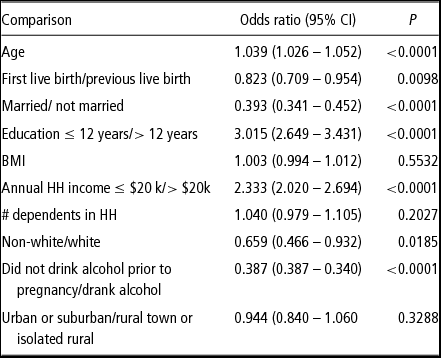
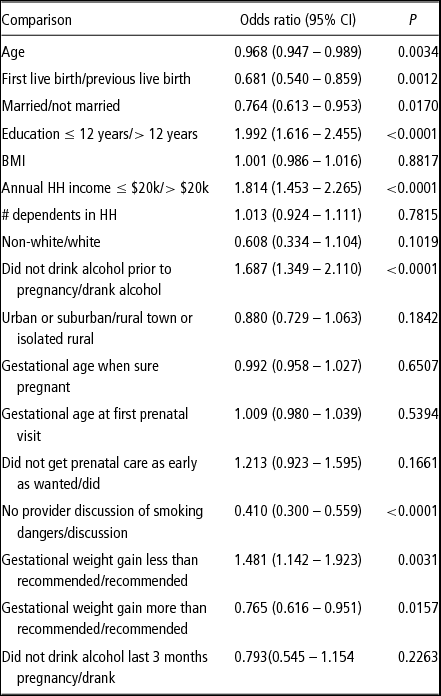
Women who were having their first child or were married were less likely to smoke prior to pregnancy (Table 1) and also less likely to continue smoking during pregnancy (Table 2). Less advantaged socio-economic status (less education and lower household income) correlated with both the higher risk of smoking prior to pregnancy (Table 1) and the higher risk of continued smoking during pregnancy (Table 2). Older women were more likely to smoke prior to pregnancy (Table 1) but less likely to continue smoking during pregnancy (Table 2). Women who did not drink alcohol prior to pregnancy had a lower risk of smoking before pregnancy (Table 1) but were more likely to continue smoking during pregnancy (Table 2). Having a race other than white decreased the risk of smoking prior to pregnancy (Table 1) but had no significant impact on the odds of quitting during pregnancy (Table 2). Having a gestational weight gain less than the recommended range correlated with continued smoking during pregnancy, while having a gestational weight gain above the recommended range correlated with not smoking during this period. Surprisingly, smokers who reported a discussion with their provider about the dangers of smoking were less likely to quit than were women who did not report such a discussion (Table 2).
Maternal predictors of smoking in 3 months prior to pregnancy (N = 12,409)

Multi-variable logistic regression analysis results for predictors on maternal smoking in the 3 months prior to pregnancy. Women were more likely to smoke prior to pregnancy if they were older, had a previous live birth, were not married, had no more than a high school education, lived in a household with an income ≤ $20,000/year, were white, and drank alcohol.
Maternal predictors of continued smoking in last 3 months of pregnancy (N = 3,938)

Multi-variable logistic regression analysis results for predictors on maternal smoking in the last 3 months of pregnancy. Of the women who smoked prior to pregnancy the risk of continuing to do so in the last 3 months of pregnancy was greater for women who were younger, had a previous live birth, was not married, had no more than a high school education, lived in a household with a yearly income ≤ $20,000, did not drink alcohol prior to pregnancy, recalled receiving a discussion from a provider about the dangers of smoking during pregnancy, had a gestational weight gain less than the recommended amount (compared to those who had a weight gain within the recommended range), or had a gestational weight gain within the recommended range (compared to those who gained weight more than the recommended range).
Discussion
Comparison of Maine results to previous studies: The socio-economic status and demographic variables we identify as risks for pre-pregnancy smoking and continued smoking during pregnancy (Tables 1 and 2) generally mirror those from national and international studies (Schneider et al., Reference Schneider, Huy, Schutz and Diehl2010; Tong et al., Reference Tong2013) and identify patients who require particular support to achieve tobacco abstinence. Previous findings show that many women who continue to smoke during pregnancy were tempted to smoke when they consumed alcohol before pregnancy (Panjari, Bell, Asbury, Bishop, & Rice, Reference Panjari, Bell, Asbury, Bishop and Rice1997). Thus, the positive correlation between pre-pregnancy alcohol use and tobacco cessation during pregnancy (Table 2) might suggest that situational smokers (women who predominantly smoked when they consumed alcohol prior to pregnancy) may stop smoking during pregnancy when they stop drinking and are no longer tempted to smoke. Our result that smoking risk prior to pregnancy increases with age (Table 1) runs counter to previous studies (Tong et al., Reference Tong2013). However previous studies analysed age as a categorical variable without considering other demographic factors, while we analysed age as a continuous variable in a multi-variable analysis. Younger mothers may also be unmarried, have less education, and have lower household incomes, all factors correlating with an increased pre-pregnancy smoking risk. The confounding effect of these variables may have produced the negative correlation between age and pre-pregnancy smoking risk in previous studies and demonstrates the importance of determining how patient characteristics interact in defining smoking risk, particularly given how difficult it is to achieve pre-pregnancy smoking cessation via preconception counselling (Williams, D'Angelo, Harrison, & Morrow, 2012).
Effectiveness of tobacco abstinence interventions during pregnancy: Our finding that pre-pregnancy smokers who did not recall a provider discussion of the dangers of smoking were more likely to quit smoking (Table 2) suggests that spontaneous abstainers (pre-pregnancy smokers who quit before their first prenatal visit) represent a significant number of smokers as previously reported (Quinn, Mullen, & Ereshoff, Reference Quinn, Mullen and Ereshoff1991). These women are counted as pre-pregnancy smokers who abstained during pregnancy in this study but would have presented for prenatal care as non-smokers, and thus may not have received in-depth discussion of the dangers of tobacco. This finding also highlights how many women who present at their first prenatal visit as smokers continue to smoke during pregnancy and demonstrates that the '5A's' approach to tobacco abstinence with pregnant smokers recommended by the American College of Nurse-Midwives (2014) and the American College of Obstetricians and Gynecologist (2011) and widely used in Maine may not be effective, probably because it is not always fully implemented as suggested in current tobacco use treatment guidelines (Fiore et al., Reference Fiore2008). An example of this gap in care is one survey of midwives and gynaecologists in Switzerland which found that most providers asked their pregnant patients about tobacco use, explained the dangers of smoking and advised quitting (first 2 of the 5A's), but did not assess their patients’ willingness to quit, assist their patients in planning to stop smoking or arrange stop-smoking support (A's 3 – 5) (Lemola, Meyer-Leu, Samochowiec, & Grob, Reference Lemola, Meyer-Leu, Samochowiec and Grob2013).
Some of the reasons practitioners cite for not fully implementing the '5A's' approach include lack of time (Price, Jordan, & Dake, Reference Price, Jordan and Dake2006) and the belief that smoking cessation interventions have a low effectiveness (Thyrian et al., Reference Thyrian, Hannover, Roske, Scherbarth, Hapke and John2006). Practitioners also thought that asking pregnant smokers about smoking on each visit could damage the provider – patient relationship (McLeod et al., Reference McLeod2003), a concern reinforced by the finding that some pregnant smokers perceive having practitioners ask about tobacco use at each visit as nagging (Ebert & Fahy, Reference Ebert and Fahy2007). This suggests the need for more practitioner education about the importance of smoking cessation for pregnant smokers and the tools to accomplish this goal.
This possible gap in care also suggests that settings outside the brief standard prenatal visit may be more effective at achieving smoking cessation. One such setting would be the CenteringPregnancy approach (DeCesare & Jackson, Reference DeCesare and Jackson2015), which brings groups of pregnant women, their supporters, and providers together after individual prenatal visits for education and discussion of pregnancy health issues. CenteringPregnancy has been shown to improve weight gain trajectories for pregnant women (Magriples et al. Reference Magriples2015). The use of CenteringPregnancy to encourage smoking cessation has not been extensively studied (Barger, Faucher, & Murp, Reference Barger, Faucher and Murp2015) but makes sense given the importance of peer support in successful tobacco abstinence among pregnant smokers (Ebert & Fahy, Reference Ebert and Fahy2007). Smoking and weight gain could be discussed together in a CenteringPregnancy meeting addressing the concern of some pregnant smokers that quitting will result in increased weight gain – a concern that may have some basis (Favaretto et al., Reference Favaretto2007) but does not justify continued smoking. A quality improvement project could test the effectiveness of this approach and provide a fruitful opportunity for future research.
Two clear limitations of this study are: (1) that it makes use of self-reported data which may not always be reliable, and (2) that it reports data from a single state which may not be generalizable. However, we have determined risks for smoking in the 3 months before and during the last 3 months of pregnancy in Maine, which may help practitioners identify patients requiring particular attention. We also found no evidence that efforts by providers to encourage tobacco abstinence are effective for women who present for prenatal care as smokers, suggesting the need for more effective tobacco abstinence approaches including those that extend beyond the standard prenatal visit.
Acknowledgements
We wish to acknowledge the Maine CDC for providing us with PRAMS data.
Financial Support
This research received no specific grant from any funding agency, commercial or not-for-profit sectors.
Conflict of Interest
None.
Ethical Standards
The authors assert that all procedures contributing to this work comply with the ethical standards of the relevant national and institutional committees on human experimentation and with the Helsinki Declaration of 1975, as revised in 2008. This protocol received a human subject research exemption from the University of Southern Maine Institutional Review Board.