1 Introduction
In this article, I consider the phenomenon of split intransitivity – the notion that there is a ‘split’ amongst different classes of intransitive verbs in relation to the behaviour of their arguments, with a focus on English.
The most widely accepted analysis of split intransitivity is the so-called Unaccusative Hypothesis, first developed by Perlmutter (Reference Perlmutter1978) in the framework of Relational Grammar. The Unaccusative Hypothesis was later re-expressed in terms of Government and Binding (GB) Theory by Burzio (Reference Burzio1986) and has received a great deal of attention in the literature in relation to a wide range of languages.
The core notion of the Unaccusative Hypothesis is that in all languages there are two classes of intransitive verb – ‘unaccusatives’ and ‘unergatives’ – which differ as regards the grammatical relation borne by their single argument, or in GB and minimalist terms the deep structure / first-merged position of that argument. The argument of unaccusatives is at some level like a (direct) object of a transitive verb; the argument of unergatives behaves more like an (active voice) transitive subject. All intransitives must be employed either as unaccusatives or unergatives; some verbs arguably alternate between the two (Rosen Reference Rosen, Perlmutter and Rosen1984: 66).
In standard minimalist terms, unergatives are said to have an external argument, first-merged in the specifier position of vP (as are the subjects, in the active voice, of transitive verbs). Unaccusatives have an internal argument which is merged as the complement to the lexical verb V (i.e. in the same position as transitive objects). This distinction between the two classes of verbs may be represented as follows:Footnote 2
(1) Unergatives:

(2) Unaccusatives:


It is widely held that the identification of an intransitive verb as either unergative or unaccusative may be determined via various language-specific ‘unaccusativity diagnostics’. On the basis of systematic consideration of these diagnostics in relation to English verbs, I will contend in this article that this two-way grouping of intransitive predicates into just two classes is too simplistic. Instead, I will show that the diagnostics pick out multiple different classes; I argue the behaviour of these can be captured in terms of the following hierarchy of multiple functional heads:Footnote 3
(3)

This structure is a more articulated version of the standard ‘vP’; I will discuss the denotation of each of the functional heads in the structure very shortly. Different verbs merge their arguments at different levels of the structure: for example, a [+control] predicate has an argument in Spec,ControlP, a [+initiation] predicate one in Spec,InitiationP, and so forth. A single argument may be merged in multiple positions within this domain. Split intransitivity behaviours arise as a result of sensitivity of different diagnostic constructions to different heads (or different feature values on those heads) – this will be discussed at length in the remainder of the article.
The representation of the structure of the lower part of the clause in this way can be seen as an extension of the cartographic programme (Rizzi Reference Rizzi and Haegeman1997; Cinque Reference Cinque1999 and many others) to the thematic domain, a point on which I elaborate in Baker (Reference Baker2017; see especially section 1.2).
I assume that each functional head in the hierarchy is always present in clausal constructions,Footnote 4 and that they each bear bivalent features corresponding to their categories: [±control] on Control, [±initiation] on Initiation, [±state] on State, [±change] on Change, and [±telic] on Telic. Each feature must bear either a positive or a negative value in any given construction. Where a head X bears the corresponding feature [+x] (e.g. [+control] on Control) an argument must be merged in its specifier (in clausal constructions – arguments may be absent in nominalised or participial constructions); where X bears [–x] no argument is merged. I also assume the verbal root V incorporates successively into each of these functional heads via head movement, resulting in a complex of heads bearing all these features, though for clarity of presentation I do not illustrate this movement in tree diagrams.
The multiple-head approach retains a central insight of the Unaccusative Hypothesis – that split intransitivity can be connected to syntactic argument structure – but through the inclusion of multiple argument positions is also able to account for the patterning of intransitive verbs into multiple classes. Accordingly, each of the heads in the proposed hierarchy is posited on the basis of the behaviour of different classes of verbs, to be discussed throughout this article. The composition of these classes seems to have a semantic basis: compare semantically-based approaches to unaccusativity such as that of Van Valin (Reference Van Valin1990), but note that on the present approach the relevant semantic properties are directly encoded in the functional structure. This semantic basis is reflected in the semantic labels given to the heads in question. Starting at the bottom of the tree, the Telic head describe whether or not the verb denotes a telic event – one semantic definition of telicity is that of an event which reaches a culmination point (Kratzer Reference Kratzer, Guéron and Lecarme2004), representable in simple formal terms as follows:
(4) [+telic]: [e & culminate(e)]
Change, State and Initiation can be defined in terms closely based on semantic classes identified by Rappaport Hovav & Levin (Reference Rappaport Hovav, Levin, Butt and Geuder1998; henceforth RH&L):
(5) [+change]: [BECOME [x ⟨STATE⟩]] or [BECOME [x ⟨PLACE⟩]]
[+state]: [x ⟨STATE⟩]
[+initiation]: [x ACT ⟨MANNER ⟩]Footnote 5
Initiation necessarily involves causation. RH&L represent this in terms of a CAUSE primitive, but we might conceive of causation as a fundamental component of all instances of ⟨MANNER⟩ – even sometimes the only component, as in the case of change of location verbs like go which are initiated by their argument and may be represented as follows:
(6) [+initiation, +change]: [x ACTCAUSE [BECOME [x ⟨PLACE⟩]]
Note that initiation is separate from volition or control – some verbs (e.g. cough) may describe events that are initiated but not controlled by the entities denoted by their subjects – and hence is a necessary but not a sufficient condition for ‘agentivity’. This is part of the motivation for a separate Control head, for which we can say x volitionally controls an event e if and only if: (i) x possesses a state of desire that e occurs, and (ii) e occurs (where desire(e) is an instance of ⟨STATE⟩):
(7) [+control]: [[x desire(e)] & e]
Causation is not itself represented on Control, as this aspect of meaning is contributed by the Initiation head.
This approach fits into a tradition of analysing argument structure in terms of syntactic structure (see Marantz Reference Marantz2013 for further discussion of this tradition, on which the discussion in this paragraph builds).Footnote 6 Following most other approaches at present, the properties determining this structure are mostly event-related (following a tradition beginning with Generative Semantics, represented by e.g. Postal Reference Postal1970). In particular, close parallels can be seen between the [+change] and [+initiation] features adopted here and Generative Semantics’ BECOME and CAUSE primitives. However, these are parallels only, and the features are by no means identical to the primitives. It will also be noted that these features are independently motivated on the basis of the syntactic behaviours discussed.
There are also parallels to the theory of thematic roles of the sort originating in Fillmore (Reference Fillmore, Bach and Harms1968): most clearly, the ‘Agent’ role corresponds to the interpretation of an argument merged in both Spec,ControlP and Spec,InitiationP. Following the ‘lexicalist’ tradition (originating in Chomsky Reference Chomsky, Jacobs and Rosenbaum1970), I identify several classes of intransitive verbs, but this is integrated with the ‘constructivist’ approach (of e.g. Hale & Keyser Reference Hale, Keyser, Hale and Keyser1993, Reference Hale and Keyser2002) so that these different classes are represented in terms of different syntactic structures, with semantic properties encoded on functional heads.
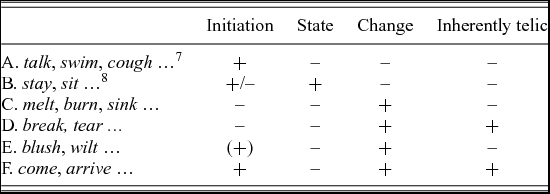
In this article, I will discuss the various split intransitivity diagnostics that have been proposed for English in the literature, the classes of verbs they pick out, the evidence this provides for the multiple-head approach over the traditional Unaccusative Hypothesis, and the ways in which these diagnostics may be analysed under my proposal. For reference, the principal classes of intransitives I identify are as shown in table 1.Footnote 9 After a brief overview of the methodology by which the data have been procured (section 2), this discussion and analysis will form the bulk of the article, considering, in turn: resultatives and the causative alternation (section 3), prenominal past participles (section 4), for hours (section 5), and what I term the ‘process’ diagnostics (section 6); in section 7, I discuss two proposed diagnostics (locative inversion and there-insertion) which I argue should not be related to argument structure. In section 8, I discuss some further arguments for preferring the proposed analysis over the traditional one, including arguments for assuming the features identified to be encoded in a hierarchically ordered series of functional heads.
Classes of intransitives

2 Methodology
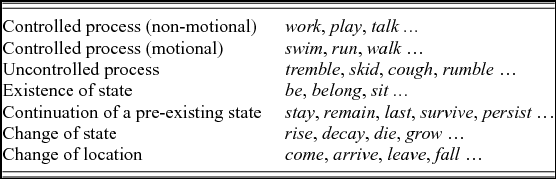
The classification of verb classes to follow, as summarised in table 1, is based primarily on the analysis of a core sample of around 35 verbs from a range of semantic classes, namely those discussed by Sorace (Reference Sorace2000) in relation to their crosslinguistic auxiliary selection behaviour (see table 2), plus some additional verbs which undergo the (anti)causative alternation like burn and tear. A few verbs discussed by Sorace which in English are either not strictly intransitive in the sense of having exactly one argument (e.g. please) or are phrasal in nature (e.g. be born, catch on) are not considered.
The Auxiliary Selection Hierarchy (Sorace Reference Sorace2000)

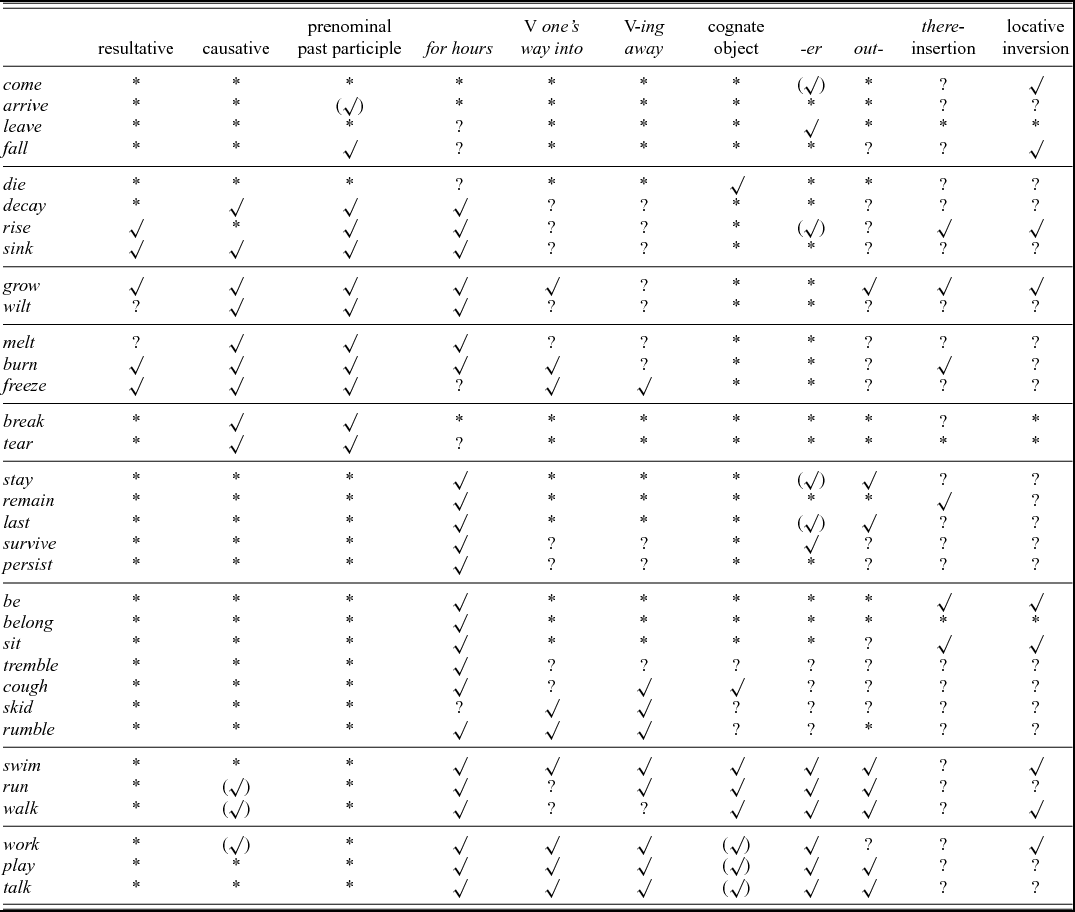
The results presented here are drawn primarily from online surveys, supplemented by my own judgements as a native speaker in a few cases. Six surveys were undertaken in all: as a full discussion of the design and results is beyond the scope of this article, the reader is referred to Baker (in preparation) where more details and in-depth statistical analysis will be provided. However, I give here an overview of the most important features. I focus on the first survey which provided most of the data; other surveys were of similar design though differing in slight details, and generally much shorter.
The surveys all employed the Qualtrics platform (www.qualtrics.com). Respondents were asked at the beginning of each survey if they were native speakers of English and non-native speakers were excluded from continuing to the main body of the survey.
Respondents were presented in each survey with a series of items designed to test the constructions under consideration, in an order randomised for each respondent. These included full sentences (e.g. Lucy outarrived Chris), shorter phrases (e.g. the arrived man) and single words (e.g. arriver). Respondents were asked to judge whether each item constituted a natural example of English (something they might say themselves, or expect to hear). By and large, the first survey tested each verb in the core sample with each construction, although some verb/construction pairs were omitted: 241 items were tested in all. Most of the constructions were presented in simple sentences with semantically appropriate arguments: a subject (most often Lucy) and, where relevant, also an object, e.g. Lucy was talking away, Lucy outtalked Chris, Lucy broke the window, The lake froze solid. Occasionally a longer context was provided for the full-sentence items to clarify the intended meaning (e.g. Lucy was swimming away, round and round the lake). Judgements were requested in terms of a three-way choice between ‘OK’, ‘Not OK’ and ‘Not sure’ responses. This survey drew the largest number of respondents, with around 110 useable responses per item.
The results as presented here represent an ‘average’ speaker drawn from a numerical idealisation of these results. Each judgement was valued as follows:
(8) OK: +1
Not OK: –1
Not sure: 0
An average response value was then calculated for each item. With a very small number of exceptions, an average less than –0.6 is idealised as an ungrammatical (‘*’) judgement, an average between –0.6 and +0.6 as an uncertain (‘?’) judgement and one above +0.6 as a grammatical judgement. Thus, an ungrammatical judgement as presented here corresponds to agreement among about 80 per cent of respondents that an item was ‘Not OK’ and a grammatical judgement to about 80 per cent agreement that an item was ‘OK’.Footnote 10
In general these idealised judgements correspond closely to my personal native-speaker judgements. Most sentences marked here as grammatical (on the basis of the surveys) are those I myself consider grammatical, most marked ungrammatical are ones I consider ungrammatical, and most marked as uncertain I myself do not have clear-cut judgements for. I believe this is good reason to be confident in the reliability of the results.
The subsequent sections contain overviews of the findings of the study; judgements for each diagnostic with each verb tested are presented in table 3.
Typical judgements for each diagnostic

Key: ✓ – grammatical; * – ungrammatical; ? – uncertain judgements; (✓) – grammatical in restricted contexts only.
3 Verbs denoting uninitiated changes: resultatives and the causative alternation
3.1 Data
A number of intransitive verbs in English may participate in the resultative construction, denoting a change with an end-state expressed through an adjective or preposition phrase. With transitives employing this construction, the affected argument is always the lower argument,Footnote 11 e.g.:
(9) Lucy hammered the metal flat.
This provides a basis for the argument that resultatives are a diagnostic of the presence of an internal argument and hence of unaccusativity (see Levin & Rappaport-Hovav Reference Levin and Rappaport-Hovav1995: ch. 2). The resultative construction occurs firstly with intransitives denoting a change of state:
(10)
(a) The lake froze solid.
(b) The window broke into pieces.
It also occurs with change of location verbs, provided they are not inherently telic (see section 5):
(11)
(a) The sun sank low.
(b) *Lucy came low.
Resultatives do not occur with verbs denoting states (e.g. stay, sit) or with what Sorace (Reference Sorace2000) terms ‘process’ verbs – best defined as those intransitives which describe neither a state, a change of state or an (inherent) change of location.Footnote 12
Close examination of the intransitive verbs which allow the resultative construction reveals them to comprise very almost the same class as those allowing the causative alternation, i.e. those verbs which have a transitive alternant where the higher argument is the external cause of the change:
(12)
(a) Lucy froze the ice cream.
(b) Chris broke the window.
(c) The storm sank the ship.
(13) *Chris talked/ran/coughed/survived/came Lucy. (intended meaning: ‘Chris made Lucy V’)
An analysis of the causative alternation as the addition or removal of an external argument (see Schäfer Reference Schäfer2009: sections 3.1, 3.2 for references to both sides of this debate) also makes it a candidate diagnostic for unaccusativity (Perlmutter Reference Perlmutter1978: 162).
The overall characterisation, then, is that intransitive verbs which allow these constructions are those denoting changes which are not inherently telic changes of location. This is essentially Levin & Rappaport Hovav's (Reference Levin and Rappaport-Hovav1995) characterisation of intransitives which allow resultatives. Ramchand's (Reference Ramchand2008) analysis of the causative alternation may also shed light on the matter. Ramchand characterises the verbs which allow the causative alternation as those which lack an expressed ‘initiator’: I represent such verbs as [+initiation]. I will take it as a fact of the English lexicon that intransitive change verbs do not take initiators (they are [–initiation]), with the exception of inherently telic changes of location which are [+initiation] by default and hence disallow the resultative and causative constructions. Thus, for example, melt, break, sink etc. are [–initiation] but come, arrive are ordinarily [+initiation]. Note however that the inherently telic change of location verbs may also have non-initiated readings:
(14) The letters arrived.
These verbs nevertheless never allow resultatives or causatives. Only intransitive verbs which never have [+initiation] interpretations allow these constructions, therefore.
One other exception to the general rule that verbs denoting changes of state allow this construction is die:
(15)
(a) *The man died lifeless.
(b) *Curiosity died the cat.
Note that the event described by die is not typically initiated by its subject. It is possible die is merely a lexical exception to the general rule (as a very frequent verb, it would be a prime candidate for lexically idiosyncratic behaviour). Another possibility is that kill acts as its (morphologically suppletive) alternant (cf. McCawley Reference McCawley and Darden1968, Dowty Reference Dowty1979: 44–51), although this does not explain the absence of any resultative form.
Another potential complication is posed by the non-agentive ‘internally caused’ verbs: grow, wilt, blossom, blush etc. (Levin & Rappaport-Hovav Reference Levin and Rappaport-Hovav1995: 90–8). These seem to vary, or produce uncertain judgements, as far as resultatives and the causative alternation are concerned (see McKoon & Macfarland Reference McKoon and Macfarland2000; Alexiadou et al. Reference Alexiadou, Anagnostopoulou, Schäfer and Frascarelli2006):
(16)
(a) The daffodils grew tall.
(b) Chris blushed scarlet.
(d) ?The tulips wilted brown.
(17)
(a) Lucy grew daffodils.
(b) *Lucy blushed Chris.
(c) The heat wilted the tulips.
Arguably these verbs have initiators, the ‘internal causers’. I suggest, however, that their grammaticalised status as [+initiation] is uncertain: as far as the syntax is concerned, they are sometimes conceived as having initiators and sometimes not: the degree to which one or the other is true depends on the verb in question. This is possible on account of the conceptual distance between the causation in these cases, which most often involves an inanimate, non-volitional argument, and prototypical initiation (neither animacy nor volition is necessary for initiation, but it is usual for these properties to co-occur). It does seem to me that if a verb like die or break (particularly in contexts like The branch broke by itself) lacks an initiator, then verbs like bloom or blush can (sometimes) be conceptualised of as lacking initiators also. This explains why they pattern with the other verbs which allow the resultative construction and the causative alternation, but only to an extent.
3.2 Formal analyses
Hoekstra (Reference Hoekstra1988) analyses the affected argument plus result phrase part of a resultative as a small clause.Footnote 13 I suggest small clauses in general can be conceptualised as StatePs or ChangePs containing an argument and a modifier, with State or Change interpreted as abstract verbal elements, respectively BE or BECOME. For example:
(18) (Lucy wants) him sober.

Resultatives also contain a ChangeP containing a modifier (the result phrase):
(19) The ice-cream is freezing solid.Footnote 14

A result state can only arise from a change, and hence the result phrase can naturally only refer to arguments which undergo a change and are merged in Spec,ChangeP. Additionally, recall that the result phrase cannot describe an argument which is an initiator. This may be because ChangeP is here interpreted as a small clause: thematically complete domains whose arguments do not need to receive thematic roles from outside the small clause. Plausibly such domains constitute phases, and once the phase is sent to LF to receive its thematic interpretation no new thematic roles can be assigned to the arguments contained within it. This means that the argument cannot move to Spec,InitiationP, and therefore cannot be interpreted as an initiator; intransitives which require an initiator are thus incompatible with the construction.
As for the causative alternation, whether is viewed as the addition of an argument to an intransitive base, or as the removal of an argument from a transitive, the argument that is present in the transitive but not the intransitive alternant is that which is merged in Spec,InitiationP. The alternation is thus ruled out with any intransitive verb that is already [+initiation], as Spec,InitiationP is already filled: e.g. a verb like talk does not have a causative alternant as it already takes an initiator argument and there is no position for an additional causer to be merged.
This analysis has various advantages over the traditional approach to argument structure of the Unaccusative Hypothesis. The notions of Initiation, State and Change, which are key to understanding which verbs do and do not allow resultatives and causatives, are on this approach encoded directly in the syntax. This contrasts with the traditional approach, which cannot map the arguments of verbs to their syntactic positions in such a systematic manner. Levin & Rappaport-Hovav (Reference Levin and Rappaport-Hovav1995: ch. 4) posit a number of ‘linking rules’ mapping the arguments of verbs into one of two positions (external vs direct internal arguments) on the basis of their semantics. These can be summarised as follows:
(20)
(a) immediate cause → external argument
(b) entity undergoing directed change → internal argument
(c) entity whose existence is asserted → internal argument
(d) other argument → internal argument
However, it is unclear why these rules should take the forms they do, how they might be constrained (i.e. which rules could not occur) or how they are acquired. While the approach presented here may not completely solve these problems at this stage, it does allow us to generalise the linking between semantics and syntax, to something like the following:
(21) Generalised Linking Rule: An argument of which the property [+a] is predicated is merged in the corresponding Spec,AP.
Hence, an argument which is an initiator (of which the property [+initiation] is predicated) is merged in Spec,InitiationP, an argument of which a state (the property [+state]) is predicated is merged in Spec,StateP, etc. This constrains the possible forms of the rules considerably, which may in turn ease the process of acquisition. In addition to the single generalised rule, the language learner must only acquire the features and heads involved (many of which seem conceptually basic and for which a good deal of evidence may exist in the input data) and the hierarchical order in which they occur.
The traditional approach, if it assumes (as is usual) that stative verbs are unaccusative, must also postulate that these are an exception to the general rule that the resultative and causative constructions occur with unaccusatives (see e.g. Levin & Rappaport-Hovav Reference Levin and Rappaport-Hovav1995: section 2.3.3) – an exception which does not necessarily appear particularly well motivated. On the present approach, [+state] and [+change] verbs form entirely separate classes: we can state that resultatives/causatives are only available with the latter, and do not need to postulate an exceptional class. Additionally, the association of State and Change with the abstract elements BE and BECOME allows for a neat formalisation of the parallels between small clauses and resultatives. Further, more general advantages of the multiple-head approach will be presented in subsequent sections.
The Generalised Linking Rule can be compared to Baker's (Reference Baker1988) Uniformity of Theta Assignment Hypothesis:
(22) Uniformity of Theta Assignment Hypothesis (UTAH): Identical thematic relationships between items are represented by identical structural relationships between those items at the level of D-structure.
Specifically, UTAH effects can be seen as a consequence of the Generalised Linking Rule, which states much the same thing in a more precise way. Note, however, that for UTAH to hold cross-linguistically we would need, in addition to the Generalised Linking Rule, to assume that the features in question and their hierarchical ordering are universal. I will not discuss this issue further here.
4 Change verbs and prenominal past participles
Prenominal past participles are another purported diagnostic of unaccusativity in English (Levin & Rappaport Reference Levin and Rappaport1986: 654). This construction has been considered diagnostic of unaccusativity on the grounds that it picks out a subset of intransitives, and the same construction with transitive verbs is used to describe nouns which would be the lower arguments of equivalent clausal constructions, for example the destroyed city (a city that has been destroyed, not a city that destroys). This is evidence, then, that the construction, like the resultative construction and causative alternation discussed above, should be analysed in terms of argument structure – an analysis which the present approach retains.
Amongst intransitives, prenominal past participles are restricted to verbs of change of state, including those which undergo the causative alternationFootnote 15, and verbs of (inherent) change of location:Footnote 16
(23)
(a) fallen leaves
(b) a decayed corpse
(c) the broken window
(d) *the remained/trembled/run/talked man
Amongst the verbs which allow the construction, however, there are further restrictions. For example, arrived can only occur prenominally with certain modifiers, e.g. the recently arrived recruits. Furthermore, some verbs of change (e.g. come, go, die) do not seem to allow the construction at all. Overall, however, the statement that this construction is permitted with only (a subset of) change of state verbs holds up very well.
A formal analysis of this behaviour can be formulated in terms of selectional restrictions under a Distributed Morphology-type framework in which the morphological processes which derive these constructions take place in the syntax according to the usual constraints on syntactic formations. Under such an approach, the past participle morphology (realised in various ways, often as -ed or -en – I shall denote it here by the latter) can be viewed as an Adj head, which incorporates the root and categorises it as an adjective.Footnote 17 That the prenominal past participle is restricted to (a subset of) [+change] verbs suggests -en selects a [+change] ChangeP with intransitives:
(24) the risen sun

The fact that this construction is not possible with all [+change] verbs may be related to the often idiosyncratic nature of derivational morphology.
The present proposal, which distinguishes [+state] and [+change] verbs in terms of the positions of their arguments, is thus able to capture the occurrence of prenominal past participles with the latter but not the former in terms of structural considerations alone. This distinguishes it favourably from the traditional approach to syntactic argument structure, which in addition to restricting prenominal past participles to ‘unaccusative’ verbs (i.e. those which take only an internal argument) must also provide some separate explanation for the non-occurrence of the construction with state verbs (which are also held to be unaccusative).
5 Inherently telic verbs
Split intransitivity has often been connected in various ways to telicity (for example by Zaenen Reference Zaenen1988 and Borer Reference Borer2005). Diagnostics of telicity and hence purportedly unaccusativity in English are adverbials like for hours, for seconds, for years etc., which supposedly only occur with atelic/‘unergative’ verbs (Schoorlemmer Reference Schoorlemmer2004: 227). Most verbs in English occur with phrases like for hours very freely:
(25) Lucy stayed/sat/coughed/swam/worked for hours.
Some verbs, however, allow for hours more restrictedly. These verbs belong to the change of location and change of state classes:
(26)
(a) *Lucy arrived/died for hours.
(b) *The window broke for hours.
I will describe such verbs as ‘inherently telic’. Note, however, that most of these do allow for hours in specific contexts; these contexts vary from verb to verb:
(27)
(a) Lucy came for hours. (= ‘Lucy came and stayed for hours’)
(b) The guests were arriving for hours.
Several change of state verbs do freely allow the construction:
(28)
(a) The corpse decayed for years.
(b) The butter melted for hours.
The overall generalisation I propose is that the inherently telic verbs comprise the change of location verbs and a subset of the (uninitiated) change of state verbs, but that the inherent telicity of these verbs can be overridden in certain contexts.Footnote 18
As to the formal analysis of this diagnostic, the incompatibility of adverbials like for hours with inherently [+telic] verbs (i.e. verbs which must occur with a [+telic] Telic head) can be seen to result from the adverbials bearing their own [–telic] features: a clause cannot contain both [+telic] and [–telic] values at the same time.
This approach allows us to maintain the popular idea that telicity relates to argument structure (see, for example, Tenny Reference Tenny1987 and Borer Reference Borer2005).Footnote 19 But at the same time, by identifying multiple argument positions, we can also maintain the idea that other split intransitivity diagnostics, unrelated to telicity, also relate directly to argument structure. This, then, is another advantage of this approach over the traditional Unaccusative Hypothesis.
6 Process verbs
6.1 Data
A number of tests pick out sets of verbs in English each corresponding more-or-less to Sorace's (Reference Sorace2000) ‘process’ class – which basically corresponds to most conceptions of the traditional ‘unergative’ class insofar as it is ever defined explicitly. Each of these tests does, however, pick out a slightly different group of verbs.
The diagnostics in question which I have been able to identify in the literature are: V one's way into (Marantz Reference Marantz, Stowell and Wehrli1992), V away (Keyser & Roeper Reference Keyser and Roeper1984), the cognate object construction (Massam Reference Massam1990), agentive suffix -er (Burzio Reference Burzio1981: 255–8), and prefix out- (Keyser & Roeper Reference Keyser and Roeper1984). These are all illustrated below with the verb swim, with which they can all occur:
(29)
(a) Lucy swam her way into the harbour.
(b) Lucy was happily swimming away, round and round the lake.
(c) Lucy swam a swim.
(d) swimmer
(e) Lucy outswam Chris.
None of these constructions, on the other hand, can occur with a verb like arrive:
(30)
(a) *Lucy arrived her way into the building.
(b) *Lucy was arriving away.
(c) *Lucy arrived an arrival.
(d) *arriver
(e) *Lucy outarrived Chris.
To reiterate, the overall generalisation is that these constructions are acceptable with process verbs and ruled out with other intransitives. There are a few nuances, however. Certain of the tests produce doubtful results with certain process verbs, particularly with the class Sorace (Reference Sorace2000) calls ‘uncontrolled processes’:
(31)
(a) ?Lucy trembled a tremble / skidded a skid.
(b) ?Lucy outtrembled/outcoughed Chris.
This difference in the strength of judgements between controlled and uncontrolled processes is evidence for the operation of the [±control] feature in English, and therefore for the Control head.
With other verbs the cognate object test is restricted to certain meanings, e.g. Lucy talked a talk can refer to a presentation to an audience, but not to acts of talking in general. Speakers’ intuitions about the cognate object diagnostic seem in general to be much weaker than those concerning the other diagnostics, though a distinction between process verbs and others (which are hardly ever accepted with cognate objects to any degree) is still apparent.
The diagnostics may also sporadically pick out various verbs that do not belong to the process class. This varies between diagnostics, and in some cases there does not seem to be much of a consistent semantic basis as to which verbs are identified, for example:
(32)
(a) The musical died a death.
(b) survivor, early-riser
Some groups of exceptions appear more systematic. In particular, the V one's way into construction is frequently accepted with non-inherently telic verbs which undergo the causative alternation (burn, melt etc.):
(33) The butter melted its way into the cake.
This same group of verbs tends to receive mixed or uncertain judgements with regards the out- construction (see Keyser & Roeper Reference Keyser and Roeper1984: section 4.4), as do several members of Sorace's ‘continuation of state’ class; however some verbs in these classes are widely accepted with this construction:
(34)
(a) Lucy outgrew her older brother.
(b) ?Lucy's butter outmelted Chris's butter.
(35)
(a) Lucy outstayed Chris.
(b) ?Lucy outpersisted Chris.
Change of state verbs seem to receive similarly mixed/uncertain judgements with regards V away (cf. Keyser & Roeper Reference Keyser and Roeper1984: section 4.3):
(36)
(a) ?Lucy was freezing away outside in the snow.
(b) ?The weeds were growing away in the garden.
To summarise, these tests all pick out verbs primarily of the process class, plus some other verbs with varying degrees of semantic systematicity. In featural terms, we can say that they identify primarily [–state, –change] verbs (with the out-prefixation and cognate objects additionally preferring but not absolutely requiring [+control] verbs).
6.2 Formal analyses
I will now consider analyses for each of these diagnostics in turn.
6.2.1 V one's way into and cognate objects
Both the V one's way into and cognate object constructions involve the addition of an argument to the clause (see also the discussion of out-prefixation in subsection 6.2.4). Like the other diagnostics discussed in this section, these constructions are restricted primarily to verbs which are ordinarily [–change, –state] (the cognate object construction is in addition dispreferred with [–control] verbs). Considering firstly the V one's way into construction, I suggest that the new argument one's way is merged in Spec,ChangeP – it undergoes the change of coming into existence as a result of the event described by the verb. The presence of this argument in Spec,ChangeP prevents the occurrence of the construction with verbs which would ordinarily merge an argument in this position (i.e. verbs which are ordinarily [+change]). It is also prevented with [+state] verbs, as the same verb cannot express both a change and a state.
(37) Lucy talked her way into the room.

V one's way into is accepted, to varying degrees, with some verbs denoting states and changes of state (e.g. persist, grow). I suggest that the semantics of these verbs is loose enough to permit or at least not entirely rule out the possibility of a reconceptualisation of the verbs as denoting (motional) processes, thus allowing them to occur with the construction.
Like V one's way into, the cognate object construction also involves the addition of a new argument (the ‘cognate object’), which can also be analysed as being merged in Spec,ChangeP (again, it undergoes a change of coming into existence due to the event), again rendering the construction incompatible with [+change] and [+state] verbs:
(38) Lucy talks the talk.

A further restriction on the cognate object construction is that it prefers the presence of [+control] ControlP.
6.2.2 V away
The V away construction does not introduce a new argument, but a similar analysis to that adopted for V one's way into and cognate objects is still possible. I suggest that the particle away induces a stative reading:
(39) Lucy is working away.Footnote 20

Evidence for this stative analysis of the construction comes from the fact that in a sentence like Lucy was freezing away outside in the snow, the subject Lucy need not be undergoing an actual change from an unfrozen to a frozen state; rather, the sentence describes an ongoing state. Likewise, a construction like Chris was working away may be interpreted as ‘Chris is in the ongoing state of working’. This analysis is supported by the behaviour of V away with the diagnostics of stativity (from Dowty Reference Dowty1979: 55–6), as it appears to be restricted in contexts where statives are restricted, such as the following:
(40)
(a) *Lucy forced Chris to play away.
(b) *Play away!
(c) *Lucy deliberately/carefully played away.
(d) *What Lucy did was play away.
V away is accepted at least to an extent with verbs denoting changes of state, e.g. ?The weeds were growing away in the garden. This suggests that some speakers allow such verbs to be reconceptualised as expressing states, although the inherent change-denoting nature of these verbs may present an obstacle. V away does not appear to occur with change of location verbs, presumably because it is not possible to reinterpret these in a stative sense. Its incompatibility with verbs which are [+state] regardless may be because additional marking of the stativity of such verbs is redundant, though note that a considerable minority of speakers do allow this construction with at least some verbs, e.g. they accept Lucy was surviving away.
6.2.3 Suffix -er
I now turn to agentive suffix -er. Note that this suffix also occurs with transitive verbs, and its behaviour in such contexts provides evidence for analysing it in terms of argument structure. Thus, when -er occurs with a transitive root, it denotes the higher argument of the transitive, not the lower: destroyer means ‘a person or thing who destroys’ not ‘a person or thing who is destroyed’. This suggests that we should retain the traditional intuition that intransitive verbs which allow -er merge their arguments in the same position(s) as transitive higher arguments – here, that both sorts of argument are first-merged in Spec,InitiationP (transitive higher arguments are prototypically initiators of the event described).
For -er, as with prenominal past participles above (section 4), I shall adopt an analysis in the style of Distributed Morphology (cf. Alexiadou Reference Alexiadou2001, particularly pp. 128–31). Intransitive -er selects primarily for [–state, –change] complements: this suggests it selects a StateP, on the head of which both [±state] and [±change] can be assumed to be marked,Footnote 21 provided it has the correct feature values. I shall assume -er is a nominal head which essentially occupies the same position as Initiation does in the clause:
(41) walker

The sporadic occurrence of -er with non-process verbs (e.g. survivor, early-riser) can be taken as lexical idiosyncrasies of the sort which are commonplace with derivational affixes.
6.2.4 Prefix out-
out-prefixation involves both a morphological process and the addition of an argument. The construction is curious from a thematic perspective in that both arguments appear to be initiators of the event described by the verbal root: thus, Lucy outran Chris entails both Lucy ran and Chris ran. This is surprising as we do not expect to find two arguments within a clause bearing the same thematic role.
Irube (Reference Irube1984: 114) suggests that prefix out- may be analysed as a sort of preposition (with the internal/lower argument in its complement) with the meaning X-er than, into which the verbal root incorporates. Drawing on this, I propose that out- is a head which selects a clausal complement, analogous to the selection of a clause in comparative contexts introduced by phrases like more than:
(42) Lucy outran Chris.

Lucy is merged in the specifiers of InitiationP and ControlP in the higher clause; Chris in those same positions in the lower clause: this enables them both to be interpreted as volitional initiators. out- incorporates into the higher V whereas the lower V is deleted: this is analogous to the deletion of the lower VP in sentences like Lucy eats sandwiches more than Chris eats sandwiches. out-prefixation is in general limited to [–state, –change] (and preferentially [+control]) verbs; this may be due to a restriction on the type of complements out- may c-select.
The acceptance (albeit usually marginal) of out- with verbs denoting states and changes of state (e.g. outlast, ?outmelt) may reflect the marginal possibility of the reconceptualisation of these verbs as processes which was also posited for V one's way into.
6.2.5 Advantages of this approach
This approach to argument structure has certain advantages over the traditional approach in regard to these diagnostics in particular. Firstly, it explicitly encodes in the syntax the [–state, –change] nature of the verbs which prototypically allow these constructions. It is not enough merely to state that external arguments are initiators (or ‘causes’, or ‘agents’) of the event described: this wrongly predicts, for example, that change of location verbs like come and arrive (which are typically agentive) would group with verbs like work and play in regard to the diagnostics. The [+change] status of the former set of verbs is important. The position of arguments, taking the featural properties of the predicate into account, can be encoded in the syntax on the present proposal without recourse to the more complex ‘linking rules’ some problems with which were addressed in section 3.2.
The present approach also captures the variation between this set of diagnostics in regard to [±control]: we can state that certain of the constructions prefer the presence of a [+control] head, whereas others are neutral as to the presence or absence of such a head. This is in contrast to the traditional approach which does not make an explicit syntactic distinction between controlled and uncontrolled events, and cannot relate the different behaviour of these diagnostics to argument structure alone.
7 Two non-diagnostics: locative inversion and there-insertion
Various authors have associated the locative inversion ((37)) and there-insertion ((38)) constructions with unaccusativity (see Levin & Rappaport-Hovav Reference Levin and Rappaport-Hovav1995: 19).
(43) Into the room arrived a man.
(44) There arrived a man.
However, this association has been disputed. Levin & Rappaport-Hovav (Reference Levin and Rappaport-Hovav1995: ch. 6) argue that locative inversion is related to discourse function, not argument structure, and speculate that the same may be true of there-insertion (p. 277); Ramchand (Reference Ramchand2008: 78, fn. 6) also assumes there-insertion is not an unaccusativity diagnostic.
Speakers seem to vary widely in regard to which verbs they accept these constructions with, at least when they are presented with examples out of context. The rate with which the diagnostics are accepted appears to bear little relation to the semantic class of the verb: unlike many of the other diagnostics (see section 8.2), they do not exhibit any correlation with Sorace's (Reference Sorace2000) Auxiliary Selection Hierarchy. Thus, speakers appear no less likely to accept these constructions with prototypical ‘unergatives’ than with prototypical ‘unaccusatives’: e.g. There worked a man is about as readily accepted as There arrived a man, and speakers are similarly doubtful about both ?In the room talked a man and ?In the room died a man. Therefore I shall follow Levin & Rappaport-Hovav (Reference Levin and Rappaport-Hovav1995) and Ramchand (Reference Ramchand2008) in assuming these are not truly argument structure diagnostics, and set them aside.
8 Further issues
8.1 Further advantages of the multiple-head analysis
In this subsection I shall present some further advantages of the analysis of split intransitivity presented in this article which I have not been able to address above.
One problem of the traditional binary analysis is that it does not account for variation within the ‘unaccusative’ class. Whereas the ‘process’ verbs – which seem to be the strongest candidates for the class of ‘unergatives’ – behave as a reasonably coherent set in regard to the diagnostics (though we can make some distinction in regards to [±control]), the remainder of intransitives exhibit a great deal of heterogeneity. The change verbs, the subsets of that class which are inherently telic and/or those which allow the resultative construction and undergo causative alternations, and the stative verbs all behave differently with regard to various of the purported diagnostics of unaccusativity presented in the literature.
A multiple-head analysis largely overcomes this problem. The behaviour of each of the different (sub)classes can be captured by relating the different diagnostics to the different heads, and multiple different argument positions (see section 5). Whilst some problems nevertheless remain in relation to the apparently idiosyncratic behaviour of certain verbs, the proposed analysis nevertheless provides a level of explanation which is lacking in the traditional Unaccusative Hypothesis.Footnote 22
Another issue for the traditional analysis is apparent overlap between the classes. In particular, the for hours diagnostic groups with the prototypical ‘unergatives’ a number of verbs which otherwise seem to test as ‘unaccusative’, creating a new problem of unwanted overlap between the classes identified: we do not expect verbs be both unaccusative and unergative, at least not without a corresponding shift in meaning – which does not obviously take place here. We could simply say that telicity does not relate to split intransitivity (at least not in English). However, as discussed in section 5, such a relation has frequently been posited both for English and other languages and there does seem to be some sort of connection between telicity and argument structure. The multiple-head analysis allows us to maintain the relation between telicity, split intransitivity and argument structure whilst overcoming the problem that telicity does not directly relate to the classes identified by the other diagnostics.
Another advantage of the multiple-head analysis is that it captures the fact that each diagnostic picks out a more-or-less semantically coherent set of verbs; the classes that arise, therefore, are similarly semantically coherent. The stipulation of separate ‘unaccusative’ or ‘unergative’ properties would seem redundant, then, when the observed behaviour can be adequately described without them.
The binary analysis, further, makes no clear predictions as to the exact membership of the classes. That this is a problem becomes particularly clear when it is considered that there are a number of verbs – the statives in particular, plus some others: go, come, leave, die – which fail both the ‘unergative’ diagnostics (or at least, pass them only sporadically) and the ‘unaccusative’ ones; i.e. they are not positively identified as belonging to one class or the other by any diagnostic.Footnote 23 How is the linguist to decide whether such verbs are to be classified as unergative or unaccusative? The language learner faces the same problem: to assume that the membership of the two classes is encoded directly in Universal Grammar would seem to run contrary to minimalist ideals. The lack of crosslinguistic uniformity in the putative classes (Rosen Reference Rosen, Perlmutter and Rosen1984 and much of the subsequent literature) would also suggest that the composition of the classes is something which would have to be learned.
Of course this problem does not simply disappear when a number of smaller classes are posited instead. But its significance is perhaps reduced. Under the binary classification the stative verbs must be placed, presumably quite arbitrarily, in one class or the other. When multiple classes are posited, however, stative verbs can simply be omitted from all the other classes – and thus placed, quite literally, in a class of their own.Footnote 24 Additionally, as the multiple class analysis has a more straightforward relation between the syntactic classes and semantics, the semantic property of stativity may be sufficient for such a class to be posited.
What about the other exceptional verbs (go, come, etc.)? As with all (actual or apparent) lexical idiosyncrasies, these pose a problem. One possible solution may simply be to postulate that these verbs, too, form their own class, one which lacks any of the features to which the diagnostics are sensitive. This is problematic, though, given that we have postulated [±change] as the feature governing most of the patterns under discussion, and these verbs would also seem to denote changes either of state or location. Perhaps the semantic evidence alone is enough for these verbs to be classified as [+change] verbs, and they fail to partake in the constructions otherwise available to verbs associated with this feature for separate reasons. It may be notable that the verbs in question all seem to be extremely frequent, and hence perhaps particularly liable to show exceptional behaviour.
In summary, there are a number of advantages of an analysis which identifies multiples classes and features over a traditional, binary one. Advantages are also apparent in comparison with another approach which identifies multiple argument positions in intransitives, that of Ramchand (Reference Ramchand2008). I will only summarise these advantages briefly here. Firstly, Ramchand's approach does not systematically distinguish changes from processes: for example, jump and arrive are not distinguished in spite of showing different behaviours:
(45)
(a) the recently arrived/*jumped recruits
(b) jumper/*arriver
(c) Lucy outjumped/*outarrived Chris
Ramchand also does not account for the [±control] distinction, which though marginal for English intransitives is more apparent elsewhere (see for example Oerhle Reference Oehrle1976 on the distinction between agents and causes in ditransitive constructions, and discussion throughout Baker Reference Baker2017). On Ramchand's system it is also necessary to analyse stative verbs as initiated, which seems questionable (see fn. 9). In all these respects, then, my approach is better able to account for the data.
Having presented here an argument for identifying a particular set of features, in the following subsection I shall discuss one further outstanding issue: the encoding of these features in a hierarchy of functional heads.
8.2 Hierarchical encoding of features
I have argued that multiple different classes of intransitives can be identified in English, and that these can be described in terms of features ([±control], ([±initiation] etc.) I have also argued that these features should be seen as encoded in a hierarchy of functional heads, each corresponding to a different feature: this hierarchy was presented in (3). However, two questions which naturally arise in relation to this are: firstly, why should one encode these features in terms of a hierarchy of heads at all, and secondly, why is this particular hierarchical ordering posited?Footnote 25 To answer both questions at once, it does seem that adopting a particular ordering captures certain empirical facts. There are various reasons for taking the order of heads given above. One of these concerns transitives: there is reason to believe that arguments associated with InitiationP are merged higher than those associated with ChangeP and/or TelicP – in active sentences, the former are typically subjects and the latter objects. A detailed discussion of transitives is beyond the scope of this article, but consider a sentence like Lucy eats cake, which on the present assumptions about functional structure lends itself to an analysis along the following lines:
(46) Lucy eats cake.

Lucy, the volitional initiator of the action, is merged in Spec,InitiationP and Spec,ControlP; cake, which undergoes a change as a result of the action, is merged in Spec,ChangeP. The assumption that Initiation c-commands Change also permits the analyses of causatives and resultatives in section 3.2 and of V one's way into and cognate objects in section 6.2.1. In telic sentences, such as Lucy ate the cake (in an hour), the direct object might additionally be merged in Spec,TelicP, given the link between telicity and direct objects argued for by many authors (e.g. Kratzer Reference Kratzer, Guéron and Lecarme2004; Borer Reference Borer2005).
We can also note that, amongst intransitives, [–state, –change] verbs seem only to be [+initiation] (see table 1), which is most easily captured by assuming Initiation to be higher than Change or State, with restrictions on the featural values of the heads it may c-select (i.e. [–initiation] Initiation cannot c-select [–state, –change] StateFootnote 26); compare the analysis of suffix -er in section 6.2.3 which rests on a similar assumption. Likewise, the restriction against [+control] Control occurring with [–initiation] Initiation can also be reduced to a selection relation if Control c-commands Initiation: namely, [+control] Control must c-select [+initiation] Initiation. Note also [+change] and [+state] do not co-occur – this may be taken to suggest that the Change and State heads occupy similar positions in the hierarchy.
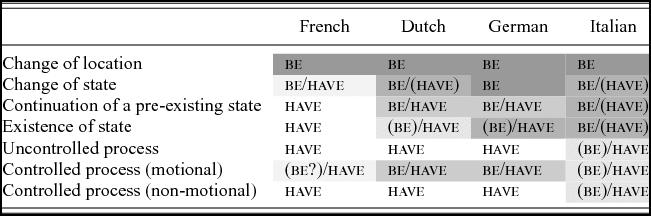
The order of heads is also intended to capture some of the key facts described by Sorace's (Reference Sorace2000) Auxiliary Selection Hierarchy (ASH), which was given in table 2. The ASH is formulated by Sorace on the basis of auxiliary selection patterns in Western European languages; table 4 summarises Sorace's (Reference Sorace2000) findings as to which classes of intransitive select be or have as the auxiliary in periphrastic perfect constructions. The ASH is also hypothesised to be applicable to split intransitivity patterns more generally (Sorace Reference Sorace2000: 887, Reference Sorace2004: 268). This hypothesis is that where a diagnostic identifies a split between two different sets of intransitives, one set will contain verbs further toward the top of the ASH and the other those further toward the bottom, although the ‘cut-off point’ may vary between languages and/or diagnostics.
Auxiliary selection in four Western European languages, after Sorace (Reference Sorace2000)

Note: Parentheses denote a more marginal option.
Many of the split intransitivity diagnostics proposed for English show reasonably good to excellent correlation with the ASH, as predicted. The for hours diagnostic (section 5) picks out all intransitives apart from those in the bottommost category, change of location, and a subset of those in the next-from-bottom category (change of state). Prenominal past participles (section 4) are only permitted with verbs in these bottom two categories. The ‘process’ verbs, a class of verbs in categories toward the top of the hierarchy, are identified by a number of diagnostics, as discussed in section 6. As also discussed, some of these diagnostics also received stronger judgements with controlled as opposed to uncontrolled processes (the latter are lower in the hierarchy). This is good support for the wider applicability of the ASH, adding to that already in the literature (in addition to Sorace Reference Sorace2000, see Sorace Reference Sorace2004 and Montrul Reference Montrul2005; Legendre Reference Legendre2007b presents some evidence from diachronic patterns).
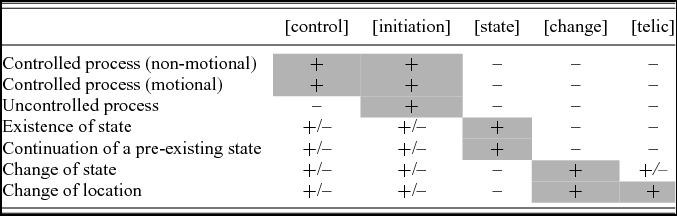
Thus it makes sense that a functional hierarchy intending to capture split intransitive patterns should reflect the ASH, and the order of heads has been selected in order to do this. The Telic head, at the bottom of the functional hierarchy, is inherently positively valued (i.e. is [+telic] not [–telic]) only with verbs at the very bottom of the ASH: change of location and some change of state verbs.Footnote 27 The next head up, Change, has a positive value ([+change]) with a slightly larger selection of verbs, namely the change of location and change of state classes in their entirety. The State head, which is above both Change and Telic, is positively valued ([+state]) with the next highest classes in the ASH, those containing continuation of state and existence of state verbs. The remainder of verbs, towards the top of the hierarchy, by default have negative values on all three of these heads; they are [–state, –change, –telic]. These remaining verbs are all [+initiation], but only a subset (which, again, are higher on the hierarchy) have a positive value ([+control]) on Control, the highest of the heads. These facts are summarised in table 5. (Compare Legendre Reference Legendre and Aranovich2007a, Reference Legendre2007b for another approach to the ASH in terms of an ordered hierarchy of formal features, but employing Optimality Theory rather than a functional structure.)
Summary of relations between the ASH and the features of the functional heads

These behaviours are one reason to prefer the structure presented here over an approach like that of Alexiadou, Anagnostopoulou & Schäfer (Reference Alexiadou, Anagnostopoulou, Schäfer and Frascarelli2015). Following Kratzer (Reference Kratzer, Rooryck and Zaring1996), the authors posit different varieties of Voice: incorporating these into the system adopted here, Voiceagent can be seen to occur with controlled processes, Voicecause with uncontrolled processes, and Voiceholder with states. However, because these heads all occupy the same position in the structure, the sorts of properties captured by the ASH are not derived so easily as in my approach.
9 Conclusion
The main contribution of this article has been twofold. It is has systematically considered the composition of the classes of verbs identified by various proposed split intransitivity diagnostics for English, and it has proposed a hierarchy of functional heads (given in (3)) to account for the behaviour of these diagnostics in relation to these classes. It has been argued on several grounds that this functional hierarchy accounts better for split intransitivity in English than the traditional Unaccusative Hypothesis, which divides intransitives into only two groups. The analysis retains, however, the central insight of many interpretations of the Unaccusative Hypothesis in relating split intransitivity to argument structure. It allows for a characterisation of split intransitivity that has a semantic basis directly reflected in syntax. It should not be seen, therefore, as a radical alternative to the Unaccusative Hypothesis, but rather a development of it.