A key step in developing an integrated management programme for invasive insect pests is to assess the potential for indigenous parasitoids and predators to cause mortality of the invader. In addition to identifying what natural enemy species have the capacity to attack the invasive pest, it is important to establish the relative efficiency of the different life stages, since predator ontogeny can affect prey preference and ability to successfully consume prey (Bakker and Sabelis Reference Bakker and Sabelis1989; Cisneros and Rosenheim Reference Cisneros and Rosenheim1997; Lucas et al. Reference Lucas, Coderre and Brodeur1998; Roger et al. Reference Roger, Coderre and Boivin2000).
Halyomorpha halys Stål (Hemiptera: Pentatomidae), the brown marmorated stink bug, is a new invasive pest in North America. This highly polyphagous species of Asian origin was first officially detected in Pennsylvania, United States of America, in 2003 (Hoebeke and Carter Reference Hoebeke and Carter2003), and has since spread to over 35 states (Leskey et al. Reference Leskey, Hamilton, Nielsen, Polk, Rodriguez-Saona and Bergh2012). In some invaded areas, H. halys has become a serious pest of tree fruit, and shows the potential to cause substantial losses in many other crops (reviewed in Leskey et al. Reference Leskey, Hamilton, Nielsen, Polk, Rodriguez-Saona and Bergh2012). The first established population of H. halys in Canada was detected in Hamilton, Ontario in 2012, and evidence suggests it has spread to several new locations in Ontario, including the Niagara region (Gariépy et al. Reference Gariépy, Fraser and Scott-Dupree2014a, Reference Gariépy, Haye, Fraser and Zhang2014b). In anticipation of this species becoming a potentially important pest in Canada, an integrated management strategy needs to be developed, which could include biological control by natural enemies already present in North America.
There is little published information regarding the ability of North American parasitoids or predators to attack H. halys. One of the most common parasitoids of stink bug eggs in North America, Telenomus podisi Ashmead (Hymenoptera: Scelionidae), readily attacks H. halys eggs, and kills ~25% of attacked hosts, but is unable to successfully develop in them (Abram et al. Reference Abram, Gariépy, Boivin and Brodeur2013). In terms of predators, there are anecdotal reports from the United States of America of several species attacking H. halys eggs in the field, including big-eyed bugs (Geocoris Fallén (Hemiptera: Geocoridae) species), spiders, ladybird beetles (Coleoptera: Coccinellidae), and earwigs (Dermaptera: Forficulidae) (Leskey et al. Reference Leskey, Hamilton, Nielsen, Polk, Rodriguez-Saona and Bergh2012; CABI 2014). Reports from the stink bug’s native range in Asia are few and mostly anecdotal in nature, including reports of Arma chinensis (Fallou) (Hemiptera: Pentatomidae) and several species of spiders (CABI 2014). There are currently no published evaluations of what predator species in North America are able to attack H. halys eggs, and no consideration of how predator life stage might affect their ability to attack the eggs. Because the chorion of stink bug eggs is very hard compared with alternative soft-bodied prey (e.g., aphids, eggs and larvae of other insect species), the range of life stages able to pierce or chew H. halys eggs to feed on the contents may be limited.
We tested the susceptibility of H. halys eggs to different life stages of three species of generalist predators common in Canadian agroecosystems: the green lacewing Chrysoperla carnea (Stephens) (Neuroptera: Chrysopidae), the twelve-spotted lady beetle Coleomegilla maculata De Geer (Coleoptera: Coccinellidae), and the spined soldier bug Podisus maculiventris (Say) (Hemiptera: Pentatomidae). These three predators have searching strategies that differ in regard to the degree of random versus localised searching, and the importance of factors such as prey movement and olfactory cues (e.g., Bond Reference Bond1980; Heimpel and Hough-Goldstein Reference Heimpel and Hough-Goldstein1994; Munyaneza and Obrycki Reference Munyaneza and Obrycki1998; Dickens Reference Dickens1999; Zhu et al. Reference Zhu, Cossé, Obrycki, Boo and Baker1999). Their modes of feeding also differ; C. maculata is a “chewing predator”, using mandibles to tear through host tissue, while C. carnea and P. maculiventris are “piercing-sucking” predators, using their mandibles or stylet, respectively, to pierce the surface of hosts and suck out the contents. In addition to testing these predators against H. halys eggs, we considered whether the eggs of H. halys are more resistant to predator attack than the eggs of P. maculiventris, which is considered a beneficial insect in Canadian agriculture (Cutler et al. Reference Cutler, Scott-Dupree, Tolman and Harris2006).
Adult H. halys were collected from a population in Hamilton (Ontario, Canada) in 2012 and reared continuously thereafter in ventilated cages (30 cm3) with raw pumpkin seeds, carrots, green beans, potted pea (Pisum sativum Linnaeus (Fabaceae)) plants, and water. Adult P. maculiventris were collected from several locations in the London and Ottawa (Ontario, Canada) regions in 2011 and 2012. Adults and nymphs of P. maculiventris were fed with live mealworm (Tenebrio molitor Linnaeus (Coleoptera: Tenebrionidae)) larvae and fresh green beans. Adults of the 12-spotted lady beetle C. maculata were originally field collected in St-Mathieu-de-Beloeil (Québec, Canada) in 2009 and reared on soybean aphid, Aphis glycines Matsumura (Hemiptera: Aphididae), pea aphid, Acyrthosiphon pisum Harris (Hemiptera: Aphididae), and ground bee pollen (Club Organic, Montréal, Québec, Canada). Chrysoperla carnea were purchased from Plant Prod Quebec and reared on soya bean aphid. All insects were maintained in muslin cages at 24±1 °C, 50±5% relative humidity and a 16:8 hour light:dark photoperiod.
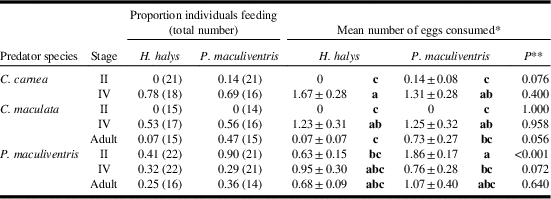
Eggs (0–24 hours old) of P. maculiventris or H. halys were removed from the sides of rearing cages and fixed with nontoxic white glue (LePage®, Mississauga, Ontario, Canada) on filter paper in a group of three eggs in a Petri dish (diameter: 10 cm, height: 2 cm). Halyomorpha halys eggs are typically laid in masses of ~28 (Nielsen et al. Reference Nielsen, Hamilton and Matadha2008), but smaller groups of eggs were used to test the relative ability of the predators to consume the eggs, rather than to directly quantify voracity. The predators tested in the experiments were C. maculata (larval instars II and IV, and adults), C. carnea (larval instars II and IV; adults do not feed on prey), and P. maculiventris (nymphal instars II and IV, and adults). Immature stages (nymphs/larvae, newly moulted) and adults (<7 days old) were starved for 24 hours (C. maculata and C. carnea) or 48 hours (P. maculiventris); these time periods were shown to induce high voracity for the prey used in rearing (i.e., aphids, mealworms) during preliminary tests. One predator was released into a Petri dish arena containing P. maculiventris or H. halys eggs and left for 24 hours. After this period, the number of eggs consumed (the chorion was pierced/opened or the egg was emptied of its contents) was recorded. To confirm that unattacked eggs (i.e., eggs in which the chorion appeared intact following exposure to predators) were not fatally damaged or partially consumed, they were reared in Petri dishes, and emergence of pentatomid nymphs was recorded. Any eggs from which no emergence was observed were then dissected to record whether a nymph had fully developed but did not emerge. Eggs unexposed to predators (positive control for nymph development) were set up in parallel and emergence and development of nymphs was recorded. All experiments and the rearing of the egg masses were conducted at 24±1 °C, 50±5% relative humidity and 16:8 hour light:dark photoperiod. Sample sizes for each predator tested are included in Table 1. For each stink bug species’ eggs, the proportion of predators feeding (consuming at least one egg) were compared with G-tests of independence. The mean number of eggs consumed by predators was calculated (including replicates in which no eggs were consumed) and a Kruskal–Wallis test was used to test for differences among treatments. For specific comparisons of mean ranks between treatments, we next conducted pairwise Wilcoxon tests with Bonferroni corrections to adjust for experiment-wise error rate (Sokal and Rohlf Reference Sokal and Rohlf1995). Proportions of developmental success in apparently unconsumed eggs (all replicates pooled) were compared to unexposed controls with 2×2 Fisher’s exact tests.
The proportion of predator individuals consuming at least one Halyomorpha halys or Podisus maculiventris egg, and the number of eggs consumed (mean±SE) by each predator.

Notes: Roman numerals represent larval/nymphal stage of each predator species.
* Within columns, different letters indicate that values are significantly different between different predators/stages for a given species of pentatomid egg.
** P<0.05 indicates a significant difference between the number of H. halys and P. maculiventris eggs consumed for a given predator/stage.
We found evidence for differential ability of predators to consume H. halys eggs both among species and within species among life stages. The proportion of individuals feeding differed significantly among predator treatments for H. halys (G-test of independence; G=47.96, df=7, P<0.001) and P. maculiventris (G=53.94, df=7, P<0.001) eggs (Table 1). Six out of the eight predator species-stage combinations tested consumed H. halys eggs at least once during our trials, while seven out of eight consumed P. maculiventris eggs in at least one replicate. The number of eggs consumed by predators also differed significantly among predator treatments for both H. halys (P<0.001) and P. maculiventris (P<0.001) eggs. Second-instar C. carnea and second-instar C. maculata rarely or never consumed any eggs of either stink bug species, while the most H. halys and P. maculiventris eggs were consumed by fourth-instar C. carnea and second-instar P. maculiventris, respectively (Table 1).
There were no significant differences in the number of H. halys and P. maculiventris eggs consumed, except for second-instar P. maculiventris nymphs, which consumed significantly more P. maculiventris eggs than H. halys eggs (Table 1). This difference was probably due to the fact that H. halys eggs (1.27±0.06 mm3; mean±SE, n=10) are almost four times more voluminous than P. maculiventris eggs (0.33±0.01 mm3; n=10), and thus more easily satiated the relatively small second-instar P. maculiventris nymphs.
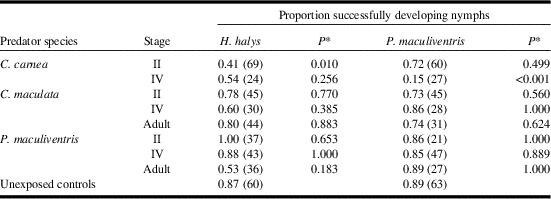
Relative consumption rates of stink bug eggs (Table 1) are probably not directly indicative of relative attack rates. For example, during the trials we often observed C. maculata adults repeatedly attacking both species of stink bug eggs, but in most cases appeared unable to pierce the egg chorion (especially for H. halys eggs), and the developmental success of unconsumed eggs was not significantly lower than that of unexposed controls (Table 2). Conversely, the rates of developmental success of apparently unattacked H. halys eggs exposed to second-instar C. carnea and P. maculiventris eggs exposed to fourth-instar C. carnea were significantly lower compared with unexposed controls (Table 2), suggesting that the predators may have pierced or otherwise damaged the eggs. Follow-up laboratory observations confirmed that C. carnea larvae frequently attacked H. halys and P. maculiventris eggs, and that such attack caused external damage to the eggs. The reason for the reduced developmental success of pentatomid nymphs exposed to C. carnea requires further investigation.
Developmental success of Halyomorpha halys and Podisus maculiventris eggs exposed to different life stages of three generalist predators, but apparently not consumed, compared with unexposed control eggs (number of replicates in parentheses).
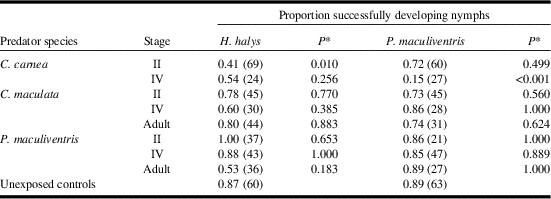
* P<0.05 indicates a significant difference between the developmental success of pentatomids between exposed eggs and unexposed controls for a given predator/stage.
This laboratory study represents the first screening of the ability of common generalist predators to attack the eggs of H. halys, and a step towards identifying candidates for inclusion in integrated control programmes. Most significantly, the results suggest that it may be prudent to consider the breadth of ontogeny across which potential predators are able to consume H. halys eggs. For example, P. maculiventris, which has the capacity to attack H. halys eggs across all feeding stages tested (stage II–IV nymphs and adults) could be more worthy of consideration than C. maculata, whose early-instars and adults have a limited ability to consume H. halys eggs.
None of the predators tested consistently consumed the H. halys eggs offered over the 24 hour testing period, although this is not necessarily indicative of low efficacy under natural conditions when predator or prey density could be high. Nonetheless, screening of different life stages of other predator species that may be more effective should continue to be conducted. Future studies should also consider the ability of predators to attack other life stages of H. halys and their relative preference for other prey species.
Acknowledgements
The authors would like to thank Gabrielle Crevier for her help in the laboratory, and two anonymous reviewers for their helpful comments on a previous version of the manuscript. This work was supported by a Natural Sciences and Engineering Council of Canada postgraduate scholarship to P.K.A. and the Canada Research Chair in Biological Control to J.B.