In late December of 1901, twenty-six-year-old Clemencia López abruptly left Hong Kong to travel over ten thousand miles to Boston, in the company of an American man. This was an unusual, even unprecedented, voyage for a young Filipina woman of her generation. The wealthy, well-educated López men had directed family business and politics. Clemencia served mainly as “the general correspondent and factotum,” assisting her mother and elder sister in managing domestic matters. She had no public role, nor did she overtly take sides as the United States turned from military ally to colonizer. Clemencia's previous journeys from Balayan to Manila and back and from the Philippines to Hong Kong traced family networks, and she undertook those journeys in the company of relatives, mindful of social propriety.
Both the particular demands of her family and the broader context of imperialist politics changed the domestic compass of López's life. Circumstances in 1901 called on her to act as an emissary for her family, to plead with the U.S. government against her brothers' unjust imprisonment. Having entered the mouth of the lion, she then proceeded to champion Filipino sovereignty through the American press—a bold act, considering that anti-imperialist activism by her own brother Sixto and others had already branded them as treasonous against the United States.
Scholars have recently come to recognize López as a contributor to American anti-imperialism. Historians cite Clemencia's most important speech, delivered in 1902 to a gathering of American suffragists, as a rare instance of articulate resistance by a colonized woman, a public statement by one who was doubly silenced by her sex and her race. The few scholars who press further have noted how the radical potential in López's powerful words of protest went unfulfilled.Footnote 2
Clemencia López's errand to America comprised more than one speech, however. Her brief public career is indicative of the transformation in Filipino ideas about gender that American colonization set into motion. War and occupation called forth a redoubled Filipino independence movement with ambivalent repercussions for women's domesticity. At the same time, the United States introduced different assumptions about women's place in society and encouraged Filipina women's entry into an Americanized public sphere. Clemencia tacked back and forth between these ideals of femininity, the domestic Maria Clara and the New Woman. While she rarely had the opportunity to address American audiences directly, she made herself above all a living exemplar of a civilized people, distinct from yet equal to the American colonizers and thus deserving of sovereignty.Footnote 3 Ideologies of gender, class, and ethnicity proved valuable in refuting the notion of Filipino savagery, not only verbally but also visually. Furthermore, López's advocacy was not simply a matter of her attempted protest within the metropole. Her experience exposed her to models and strategies for women's activism that she later put to use in the Philippines.
The López family had openly championed Philippine independence for many years before Clemencia embarked for America. Although Clemencia's father died a decade before the start of the revolution, his public stance against Spain was well known in his native province of Batangas.Footnote 4 Her eldest full brother Sixto ardently supported nationalist José Rizal. Sixto later served on Emilio Aguinaldo's revolutionary committee and became secretary to Felipe Agoncillo, Philippine ambassador to the United States, in 1898. Another brother, Cipriano, joined Aguinaldo's army. At first, the López family welcomed American allies in the struggle against Spanish rule. Then came the defeat of Spain and a peace treaty granting the United States possession of the Philippines. By the end of April 1901, Aguinaldo and most of his generals had surrendered to U.S. forces, but the United States cautiously put off declaring victory, and incidents of armed resistance persisted.Footnote 5 The hostilities led to the deaths of over 4,000 U.S. soldiers, up to 20,000 Filipino insurrectionists, and more than 200,000 Filipino civilians.
American domination divided the López family at this point. Clemencia's half-brother Mariano adopted a pro-annexation, pro-American position. Like other members of the Federalist party, Mariano believed that a gradualist approach to independence would be more effective than continued war against the United States. Sixto chose a different path, one of vocal confrontation against American imperialism. Sixto traveled to the continental United States as an unofficial delegate of the self-declared Philippine Republic. With the sponsorship of American anti-imperialists like Erving Winslow, William Lloyd Garrison Jr., and Fiske Warren, Sixto tried to ignite popular opinion. His forceful articles, pamphlets, and speeches persuaded some influential figures, like future Supreme Court justice Louis Brandeis, to oppose war and annexation. The Anti-Imperialist League (AIL) kept its distance from him, however, finding Sixto too controversial. After it became clear that the United States would prevail in the Philippines, Sixto began his way back home in the company of his close friend, Fiske Warren. He hoped to keep the goal of Philippine independence alive through negotiation. Instead, Warren and López found themselves barred from entering the Philippines under suspicion of treason. A new law passed by the U.S. Philippine Commission required those “reasonably believe[d] guilty of having aided, abetted, or incited insurrection in these Islands against the authority and sovereignty of the United States herein … or of coming to these Islands for that purpose,” to swear an oath of allegiance to the United States before re-entry.Footnote 6 Warren and López refused to take the oath. They sought refuge in Hong Kong, where the Filipino Central Committee, the de facto revolutionary government of the Philippines, resided in exile.
Although Clemencia's personal opinions from this time are unknown, her closeness to Sixto suggests at least tolerance of, and probably sympathy with, his political position. By visiting him in Hong Kong, she helped to maintain Sixto's connection to the rest of the family. The Filipino Central Committee was all-male, but for that very reason Clemencia's movements would have excited few suspicions of political involvement. Masculinity was central to Filipino nationalism; José Rizal and other influential writers and propagandists envisioned women as objects of desire, bearers of tradition, and symbolic mothers for the newly imagined Filipino nation, not as citizens or political equals.Footnote 7
On December 13, 1901, American officials arrested three of Clemencia's brothers and seized the family's property. The family interpreted this as a move against Sixto, who remained in Hong Kong. Perhaps unsurprisingly, the authorities accused Cipriano López, a former insurgent, of harboring concealed weapons. Although Lorenzo and Manuel had been quietly dedicated to the family business in farming, ranching, and shipping, they found themselves imprisoned as well, without charge. Four other men who worked as superintendents of the López lands were arrested and tortured; one (Isabelo Capacia) drowned while in custody.Footnote 8
The López family had probably anticipated the possibility of such action. Sixto's criticism of American policies attracted much attention. The Division of Insular Affairs discussed Sixto at length in its report to the secretary of war, although it strenuously denied that any retaliation or threat against Sixto motivated the arrests. The report depicted Batangas province as dangerous “insurrectionary territory,” “an intolerable situation” from a military standpoint, comparable to “Indian outbreaks in the United States.”Footnote 9 Weapons, such as those that Cipriano López was accused of hiding, posed an immediate risk to American forces there.Footnote 10
Complicating matters further, the ilustrado (elite) class of Filipinos was divided in its loyalties, and deep rivalries marked local politics. Mariano López, the pro-American federalist, was not imprisoned like his half-brothers. His position on policy gave him some protection. Nevertheless, Mariano found his own allegiance to the United States publicly questioned by another Filipino politician who had lost re-election to one of Mariano's allies. “I find myself powerless and unable to remedy matters,” confessed Mariano as he contemplated his financial ruin.Footnote 11 Even if Sixto returned to the Philippines, took the loyalty oath, and gave himself over to authorities as Mariano proposed, there was no guarantee that the government would free his brothers in exchange. In any case, Sixto was unwilling to try such a means. “To make any sacrifices in return for their release would be simply reviving the old system of bribery which held sway under Spanish rule, and would practically amount to yielding to blackmail,” Sixto replied.Footnote 12
In the end, neither the conciliatory Mariano nor the controversial Sixto had effective means to protest their brothers' detention under U.S. rule. Filipino citizenship and basic civil rights were far from guaranteed. In an abrupt departure from previous practice, the U.S. Supreme Court sanctioned the view that territories that were acquired in 1898 were “unincorporated,” meaning that the U.S. Constitution did not automatically extend to them. The very inclusion of the Philippines as part of the United States, even as a colony, was controversial. By the racial thinking of the time, peoples of the Pacific and Caribbean were so foreign as to be unassimilable. American descriptions of “brown” Filipino people most often cross-referenced familiar, domestic racial types of African Americans and Native Americans.Footnote 13 By this logic, Filipinos were unfit for self-government—perhaps genetically so. The concern spanned both popular and scientific discourse. In the Insular Cases, the Supreme Court explicitly determined the legal status of indigenous inhabitants of Puerto Rico, the Philippines, and other new possessions to be U.S. subjects and not citizens.Footnote 14
When their brothers could not resolve the family's crisis, the López sisters surged forward. Such an active role for women transgressed the patriarchal customs that Spanish rule had nurtured in the Philippines.Footnote 15 The demands of anticolonial struggle and war and the constraints that the United States kept on Filipino men's public authority pulled Filipina women out of an ideal of domestic passivity. Clemencia López later commented on this curious change when she noted that “men in the Philippine Islands [lack the] freedom to declare their opinions and feelings, because of the sedition laws there; but we women, taking advantage of the gallantry of the Americans, and because the [sedition] law was not passed for our sex, are more free to speak our minds frankly and take part in discussion.”Footnote 16
The sisters took action in various ways. The eldest, Andrea, attempted to secure the family home in Balayan by her physical presence and witness. Though ordered to evacuate, American officials granted her use of part of the house “because there were so many things in it that belong only to women.”Footnote 17 Soldiers took up residence in the house around her. “God grant that [she] may keep well and not be insulted,” wrote Juliana, well aware of rapes and other atrocities that American soldiers had committed during the war.Footnote 18 Younger sisters Clemencia and Mariquita consulted with Sixto in Hong Kong.Footnote 19 Within two weeks of her brothers' arrests, the young, unmarried Clemencia headed for the United States to plead their case. She was escorted by anti-imperialist advocate Fiske Warren.Footnote 20
Despite the scarcity of other options, it was a bold and difficult decision to send Clemencia to lobby for her brothers' release. At the very least, it flouted the social codes of her class. Neither she nor Sixto sought her mother and eldest brother's permission. Indeed, the plan had never been openly discussed within the family. Clemencia was a young, unmarried woman traveling with no relative or other appropriate chaperone. Her companion, Fiske Warren, was an intimate friend of Sixto. Warren's anti-imperialist inclinations were cemented after he met Sixto in London in 1899. He sponsored Sixto's advocacy in the United States beginning that same year and spoke and wrote avidly on Filipino independence. In 1901, he founded the Philippine Information Society with Charles Francis Adams Jr. and Elizabeth Glendower Evans.Footnote 21 However, political credentials aside, as an older, married man, Fiske Warren did not make for a respectable escort. From Manila, Juliana warned of how “many who call themselves our friends do not approve, but prophesy that all sorts of horrible things will happen to our family when it is known that Clemen has gone to look after our affairs.”Footnote 22 Family resistance abated in the face of a fait accompli. Sixto reassured them that “Clemen can do much toward getting liberty for our brothers.”Footnote 23
Clemencia's journey departed from the nationalists' defiance and political dissent toward an alternative strategy of pilgrimage and petition. Her lack of citizenship did not notably disadvantage her in her mission. Petitions had long before become a special political strategy of women activists in the United States,Footnote 24 but perceptions of Clemencia's racial inferiority threatened her ability to gain sympathy. As long as she was perceived as a “savage” dark woman, she would be unable to claim the moral authority accorded white American women.Footnote 25 She would need to be seen as a paragon of respectable, feminine purity to play effectively the deserving damsel in distress. Socioeconomic class gave her a decided advantage. Her voyage itself reinforced the impression of a privileged, cultured background. Curiously, Clemencia did not travel the most direct route, from Asia to California, but rather through Europe. Partly she followed the paths of Filipino expatriates and the networks of her own family; she visited her youngest sibling José (Pepe), who was studying engineering in England.Footnote 26 She also attended to her reputation by intersecting with Fiske Warren's wife and children, probably in Paris.Footnote 27 This ensured that Clemencia did not arrive in the United States alone with Fiske Warren but with a more appropriate escort: his charming family. In addition, the net effect of the route emulated the Grand Tour, granting Clemencia the personal experience of European culture, such as any young American woman of her class might expect.
Whatever her itinerary, the Warrens' resources and reputation made Clemencia's dignified introduction to American society possible. Their sympathy might have reflected recognition of their similarities to the López family. Both families had gained wealth through business, both emphasized education, and both were politically engaged. For the Warrens, the Lópezes may have represented a morality tale of how the abuse of power could imperil a prosperous family like themselves. Many in the Warren family supported Clemencia's mission. Fiske's brother, Samuel Dennis Warren II, connected Clemencia to Louis Brandeis for legal advice. Sam's wife, Mabel Bayard Warren, accompanied Clemencia to Washington, D.C. Sam Warren, like Fiske, belonged to the Massachusetts Reform Club, along with other founders of the AIL in Boston.
López's connection to the Warrens and their social circle brought her into the orbit of American radicals and mugwumps while also exposing her to women who involved themselves in politics and reform. Mabel Bayard Warren may have been preoccupied with her household and children, but as the daughter of Thomas F. Bayard Sr., the Delaware senator and secretary of state, she was well versed in American political culture. Clemencia resided with Fiske's philanthropist sister, Cornelia Lyman Warren, who worked with the settlement movement in Boston's South End.Footnote 28 She met progressive college graduates her own age, like Helen Calista Wilson, a Radcliffe alumna and an energetic anti-imperialist. Wilson's fluency in Spanish proved essential to López's ability to communicate with American audiences. Through her intimate connection to these activists, López began to observe a different type of womanhood than she had known in the Philippines.
Clemencia's immediate concern was her brothers' liberation. She succeeded in attracting attention to this cause, not only because of the Warrens and their anti-imperial networks, but because of a concurrent congressional investigation of American military actions in the Philippines. The Senate's Committee on the Philippines held hearings beginning in January 1902, coinciding with Clemencia's journey. These hearings responded to press reports of war crimes by the U.S. army. Anti-imperialists hoped that exposure would precipitate action, as it had when journalists publicized Spanish brutality against Cuban insurgents in 1898. This time, it was not Spain but the United States forcing rural folk into crowded camps where they could be watched more closely. Starvation and disease then further weakened the population. General James Franklin Bell established this policy of “reconcentration” within López's home province of Batangas in late 1901.
Much of the congressional testimony in 1902 focused not on reconcentration itself but on the murder of civilians by U.S. soldiers and on the torture of prisoners. Veteran officers justified the practice of the “water cure” as a “mild form of torture” that was suitable for uncivilized Filipinos.Footnote 29 Throughout the several months of hearings, the anti-imperialist minority on the committee pressed to call international journalists and Filipino witnesses such as Emilio Aguinaldo, Apolinario Mabini, and Sixto López. The hearings presented Clemencia with a possible platform to plead for her brothers' freedom and to urge the United States to reexamine its broader policies. The Filipino point of view was essential to the appearance of an unbiased investigation. At the same time, Clemencia's gender might prove advantageous. Although it was known that Filpina women had been active in the insurgency,Footnote 30 Americans more readily saw women as vulnerable and apolitical, with a keener moral sense than men. Because Filipina women were not vying for citizenship, their perspective as mere witnesses to war could seem less threatening than Filipino men's.
Despite her auspicious timing, by May it was clear that both parts of López's “twofold mission”Footnote 31 had failed in an immediate sense. Although there was speculation that the committee would summon her, López never testified in person.Footnote 32 Compared to the atrocities about which the committee was collecting information, her personal experience was less than shocking. Still, the real impediment was the committee's pro-imperialist majority, under the leadership of Senator Henry Cabot Lodge. In fact, no Filipinos at all were admitted to the hearings, and the committee refused to endorse a fact-finding mission to the archipelago. Clemencia met briefly with the president, but her voice entered the official record only indirectly, when Senator Charles Allen Culberson of Texas submitted her petition and supporting materials as official exhibits.Footnote 33 Similarly, it was only through Culberson and Mabel Bayard Warren that Clemencia garnered any response from Theodore Roosevelt. The president replied to her petition via his secretary, George Cortelyou. Cortelyou informed Mabel Warren (not Clemencia herself) that Roosevelt “does not think anything can properly be done. He will see Sec[retary of War, Elihu] Root on his return from Cuba, but there appears to be a consensus of opinion that no injustice was done” in the case of the López brothers.Footnote 34
At this point, Clemencia's “ordeal” seemed to be over. Neither chivalry nor the civilities of polite society applied to a colonial subject. Her class status and family background did not even merit the same courtesies that her American hosts could expect. Sam Warren advised his sister Cornelia concerning her Filipina houseguest: “You must not burden yourself with her much longer. She should, I think, either return home or go … elsewhere for study. She can do no more for her brothers.”Footnote 35 Indeed, military circumstances accomplished what Clemencia's efforts could not. Some weeks later, as the U.S. army gained control over the guerillas in Batangas province, Cipriano, Lorenzo, and Manual were quietly freed. With the country pacified, they no longer seemed dangerous enough to keep in prison.
Clemencia's errand was broader than gaining her brothers' release, however. She turned to public venues to plead the cause of Filipino nationalism. With the press, she took on the roles of spokesperson for her people and exemplar of her culture. Her physical appearance and demeanor were as central to this mission as her words. López captivated the attention of American audiences by presenting herself as racially and culturally different from them. By emphasizing her distinctiveness, López individually recapitulated Filipino nationalism while rejecting Americanization. At the same time, winning respect demanded that López carefully position herself—and all Filipinos, by extension—as the equal of her American audiences. From the U.S. perspective, racialized representations of Filipinos as savages had rationalized both the war and the persistence of American rule. Political cartoons, whether critiquing or supporting imperialism, represented the Philippines as versions of Africans, Native Americans, or sometimes Chinese—all tagged as dark-skinned and savage.Footnote 36 Only proof of an extant Filipino civilization would persuade Americans that they need not take on the “white man's burden” of cultural uplift in the archipelago.Footnote 37 Sixto, for example, challenged the colonial government's reports that multiple, diverse tribes comprised the Philippines, but the impression persisted.Footnote 38
Gender played a crucial part in representations of Clemencia. By this time, Sixto had followed his sister to Boston, but he carefully stayed in her shadow. The public perceived Sixto as a savage male, belonging to a “dark race” and associated with militant nationalism. Late nineteenth-century American popular culture categorized colonized men either as weak, defeated, and emasculated, an older view of racial inferiors, or as dangerous, violent, and prone toward rape, notions that in their U.S. domestic form justified the period's virulent anti-black racism. A more particular chain of associations linked Filipinos with Islam and thus polygamy, which in turn seemed little more than a sexual license granted to primitive men. One of the many rationalizations of the burdens of empire was that Filipino men needed to be tamed and controlled; some feminists argued that colonization was necessary to protect Filipina women from all kinds of abuse by their men.Footnote 39 By 1902, Sixto had encountered enough of these attitudes to surmise that his sister would make a less threatening representative, being neither sexual predator nor prospective citizen within the metropole.
By late May, when it had become clear the Congressional Committee on the Philippines would not allow her to testify in person, Clemencia's petition was released to the press along with her photographic portrait.Footnote 40 This garnered the first of dozens of articles about her, published in newspapers across the nation. López was never in complete control of her pictorial representation; for example, newspapers minimized the visual spectacle of her foreign dress by cropping photographs of her. Even so, she projected a convincing image of herself as a gracious, cultured young beauty—an image in sharp contrast to most popular images of Filipinas and Filipinos.
Much in American press descriptions of Clemencia López mirrored the ideal middle-class woman of the nineteenth century, possessed of beauty and of talents in music and needlework. She appeared as a lady who “has been living quietly during the time she has been in Boston.”Footnote 41 One interview depicted her as “industrious and likewise domestic. Although her home is abundantly supplied with servants, the senorita weaves and embroiders many of the fabrics which she wears.”Footnote 42 Despite this conventionality, a hint of the New Woman gleamed in her “electric temperament [and] eyes [that] fill with vivacious fire while she talks to one,” in the view of one Boston Daily Globe writer. “She possesses courage, enthusiasm and high intelligence.” She struck interviewers as a future teacher, rather than a future mother, whatever her domestic attributes.Footnote 43 Clemencia agreeably expressed her eagerness to learn English better “in order that she may … employ it as freely as she does her native Spanish.”Footnote 44 By this time, plans were underway for López to study English at Wellesley College, where Cornelia Warren was a trustee.
While her manners, personality, and comportment bespoke a cosmopolitan young woman, Clemencia visually conveyed her foreign Filipino identity. Newspapers avidly reproduced a portrait photograph of “Senorita Clemencia Lopez” by a nationally known artist. Elmer Chickering had innovated the celebrity photograph, producing studio portraits of entertainers like Anna Held, as well as of Boston's social elite. Chickering was both a popular artist and a professional with impeccable class credentials. “His patronage is drawn from the best classes of citizens and from the leading families in the suburbs,” effused a contemporary.Footnote 45 Perhaps López and her hosts, the Warrens, commissioned Chickering with knowledge of the photographer's colonial subjects. It was not a job for John Singer Sargent, who painted Fiske's wife, Gretchen Osgood Warren, and daughter Rachel in 1903; Sargent drew his patrons from the white elite. Chickering, by contrast, depicted not only Boston Brahmins, but also Hawaiian Princess Ka'iulani (Victoria Cleghorn), who had made many public statements protesting annexation in 1893. Earlier still, Chickering had taken studio portraits of the Northern Paiute writer and lecturer Sarah Winnemucca Hopkins.Footnote 46 López presented him with a familiar challenge: a sitter whose racial difference must be marked but not at the loss of her femininity.
Photography contributed heavily to American perceptions of the Filipino as racially inferior. Among the most common images of the war were photographs of dehumanized Filipino corpses in trenches. Photographs of American war dead did not circulate in this way. Photography was also essential to ethnographical categorization, travel accounts, and colonial records.Footnote 47 Popular books, lavishly illustrated with photographs, displayed anonymous bare-breasted Filipinas and Hawaiian women as icons of their peoples, visual proof of their savagery.Footnote 48 Such images simultaneously legitimated colonial rule and commodified the United States' new subjects. Still, photography also had the potential to create a different view. Its technology and its increasing use in journalism gave it authority as realistic depiction. A photograph could convincingly present a properly dressed, beautiful Filipina as an exotic but sufficiently civilized variation of the American girl.Footnote 49 López's portrait might join the ranks of contemporary women that adorned newspapers' society pages.
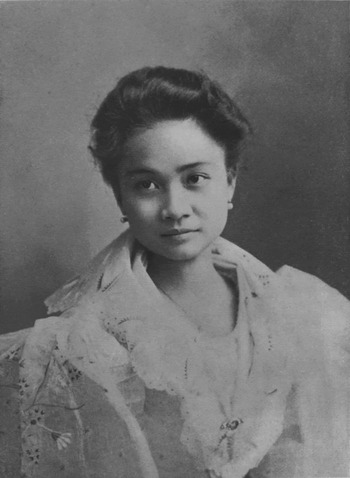
Several newspapers and a collection of family letters (pseudonymously edited by Fiske Warren) published this portrait of Clemencia López by photographer Elmer Chickering, c. 1902. Frontispiece of Canning Eyot, The Story of the Lopez Family: A Page from the History of the War in the Philippines (Boston, 1904). Courtesy of the López Foundation of Balayan, Batangas.

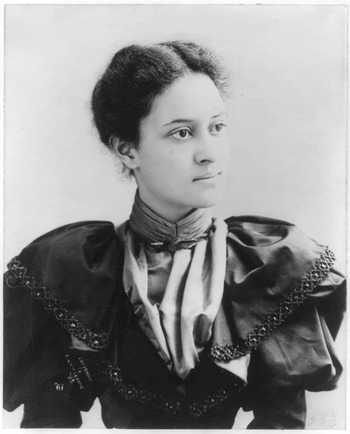
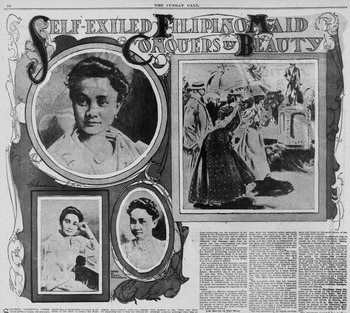
Chickering's portraits of Clemencia López more closely resemble the cabinet card he produced of Princess Ka'iulani of Hawaii in 1893 than his older publicity photograph of Sarah Winnemucca from 1883.Footnote 50 The focus of the image is on López's face, her soft, genial expression set off by simple but elegant jewelry. The arrangement of her hair shows off her high forehead. In the particular three-quarter view favored by the newspapers, López looks to the left with a steady earnestness. The shadows make her eyes appear larger and her gaze deeper. A different, more casual pose, reproduced in a San Francisco Call piece, has her leaning her head on her hand.
Portrait of Ka'iulani (Victoria Cleghorn), c. 1893, by photographer Elmer Chickering. Prints and Photographs Division, Library of Congress.

López posed for Chickering's photographs “in native costume” even though she probably wore American-style clothing day-to-day while in the United States.Footnote 51 This self-presentation coincided with her promotion of Filipino handicrafts, such as piña embroidery.Footnote 52 In fact, López seems to have worn Filipina dress more frequently as she extended her time in the country. Her family appreciated the importance of dress for Clemencia's mission; they sent a box of her clothing and even her jewels.Footnote 53 What López wore in her portraits and other public appearances was not an ethnic costume, but what she would wear at home. She has pearl earrings and a necklace with a medallion, likely with a saint's image or relic as was popular among Catholic Filipinas. Her dress was a relatively conventional “María Clara” ensemble of saya (a floor-length skirt), camisa (a diaphanous blouse), paneulo (stiff kerchief covering the low neckline of the camisa), and tapis (opaque overskirt). From observers' accounts, it seems López omitted the tapis, which could be identified with servants and mistaken for an apron. The “train” of her saya also suggested the increasingly popular, narrower skirt of the traje de mestiza, another version of the traditional barot saya (blouse and skirt).Footnote 54 Its style designated her as a Filipina while its sumptuous materials, silk and piña cloth, signaled her privileged class.Footnote 55
Dress thus functioned as an important marker of Clemencia's identity and political message.Footnote 56 She could profess admiration for American culture while showing she did not wish to adopt it. She sidestepped the contentiousness of politics by presenting the choice as a matter of personal taste. “She likes America and everything American except the manner of dress,” one newspaper reported. “This she cannot accustom herself to, and much prefers to wear the costumes which she brought with her.”Footnote 57 Visibly, yet in a way that avoided direct confrontation, López chose cultural separateness and sovereignty rather than assimilation. After all, she was not advocating inclusion in American democracy but rather independence for the Philippines.
“Self-Exiled Filipino Maid Conquers by Beauty,” San Francisco Call, November 2, 1902, 10.

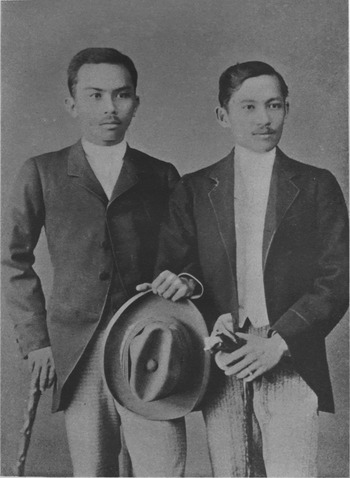
Dress offered a mode of protest unavailable to her brother Sixto and other Filipino men. Newspapers only infrequently illustrated articles about Sixto with his photograph. When he was depicted, Sixto too appeared in his attire of choice. Whereas Filipina women took the role of cultural guardians, expressing their nationalism by wearing “terno and pañuelo” instead of American fashions, the modern Filipino man sported an Americanized ensemble of suit, jacket, and trousers, known as an Americana. Like other twentieth-century independence and anti-colonial movements, Filipino nationalism styled women as the bearers of tradition and men as the representatives of modernity.Footnote 58 Thus Sixto chose the universalized uniform of sober, respectable, self-controlled manhood: the dark-colored business suit, or sack suit.Footnote 59 He could not make a persuasive case for his civilization without it.
Sixto López (holding the hat) and José Rizal (holding the gloves), Hong Kong, 1891. Canning Eyot, The Story of the Lopez Family: A Page from the History of the War in the Philippines (Boston, 1904), facing p. 32. Courtesy of the López Foundation of Balayan, Batangas.

The effectiveness of López's self-presentation as civilized is apparent from the fantastic, contradictory comparisons that observers employed to describe her. One writer described “Philippine fashion” as “quaint and charming,” “something after the style worn by Martha Washington,” while at the same time “fashioned in a general way after the modern kimono pattern.”Footnote 60 (“Kimono” sleeves and Japanese aesthetics more generally happened to be popular among Americans, especially in artistic circles, at the time.) Clemencia's physical features and skin color were also likened to “the Japanese type. She is small and slight, with an oval face, light brown skin, very dark brown eyes, and wavy black hair.” In other instances, the press described Clemencia as “brunette” in complexion, with “dark Spanish eyes.” These representations of Clemencia's race are striking given the harsh racist language regularly applied to Filipino insurgents.Footnote 61 No allusions to African-American or Native-American elements, for example, appear in newspaper accounts of López.
Despite substantial American racism against Asians in this period, López's association with Japan crowded out more charged intimations of Filipinos as “negroes” or “coolies.” Asian design and culture were hotly debated—pilloried as decadent and immoral on the one hand, but celebrated as healthful, simple, and flowing on the other.Footnote 62 Nevertheless, the Orientalist vogue meant that Americans might perceive a Filipina of “the Japanese type” as modern, delicate, and even beautiful.Footnote 63 López's dress achieved a note of sensuality without immodesty, for example by “voluminous sleeves [that] suggested rather than concealed her bare arms.”Footnote 64 A headline in the San Francisco Call even imagined her as an imperialist herself: “Self-Exiled Filipino Maid Conquers by Beauty.”Footnote 65 Thus Clemencia was able to trade upon her genteel appearance, manners, and education—her class in conjunction with her gender—to elide stark racialization.
Although her image and appearance played important parts in López's anti-imperialist mission, these did not constitute the whole of her efforts. Print culture proved more hospitable than the halls of Congress to her nationalist endeavor, but it did not enable her to speak as a subject. Apart from reproducing her written testimony to the congressional investigators, newspapers rarely quoted her own words directly. To the intimacy of journalistic interviews, within six months of her arrival, López added public speaking, as her brother Sixto had engaged in years before. This was riskier territory; public speaking by women was still relatively unconventional, even somewhat radical. Despite the dangers, Clemencia took the active part in presenting her case.
Her first public address, on May 29, 1902, marks the apex of her public campaign in the United States. As in the newspaper accounts, her sex proved a boon to her anti-imperialist message. She spoke to an audience of about 400 at the Park Street Church in Boston, gathered for the annual meeting of the New England Woman Suffrage Association (NEWSA).Footnote 66 The occasion reportedly attracted “many persons not generally seen at suffrage gatherings,” in addition to prominent activists.Footnote 67 López had not to this point shown any specific concern with women's rights or women's position, whether within Filipino society or under colonial domination, but the suffrage movement gave her a sympathetic audience. Suffragists had evinced an interest in colonized women since the war against Spain in 1898. Though other speakers had taken up the topic before, Clemencia offered them an unprecedented opportunity to hear an authentic, indigenous, female perspective on “Women in the Philippines.”
López's age also appealed to NEWSA. The suffrage movement, like the labor movement, cultivated young speakers, starting in the 1860s with Anna Dickinson.Footnote 68 Youth connoted purity and avoided the charge of man-hating spinsterhood that detractors used to taint suffragists as sexual transgressors. Moreover, the “society plan” of the National American Woman Suffrage Association (NAWSA) targeted college women as potential members. In her debut as a lecturer, López stood alongside other women her age as well as suffrage veterans. Her address followed that of Maud Wood Park who had likewise started public speaking at twenty-six and who was on the Massachusetts WSA executive board and a delegate to NEWSA. Alice Stone Blackwell, who presided over the NEWSA business meeting, was older but had begun working on the Woman's Journal with her parents in 1881, at the age of twenty-three.
Most importantly, López's speech coincided with a historical moment in which suffragists and anti-imperialists were considering a political alliance. With only about 9,000 members in the NAWSA in 1900 and some 30,000 in the Anti-Imperialist League (AIL), suffragists saw potential in the anti-imperialist movement as a political ally.Footnote 69 Meanwhile, the AIL's campaign against the colonization of the Philippines was at its height.Footnote 70 Though women comprised more than half the audience at the AIL's formation and provided crucial support in those early years, they had thus far remained in the background of the movement. The AIL had no women presidents or vice-presidents, despite the grassroots work women performed for the group. Plans to recruit women activists for the AIL had not yet ignited.Footnote 71
Some shared beliefs between the groups made such an alliance tenable. Both the anti-imperialist and suffrage movements criticized the United States as undemocratic in the rights it actually extended. However, suffragists concerned themselves primarily with the status of women in new territorial possessions, not with the principle of self-government.Footnote 72 Prominent suffragists in the United States (as in Great Britain) often saw imperialism as a tool for spreading civilization and gaining a higher status for colonized women. Suffrage leader Elizabeth Cady Stanton justified her support for colonizing the Philippines in such terms. After all, she mused, “What would this continent have been if left to the Indians?”Footnote 73 Members of the NAWSA styled themselves protectors of Filipinas, whom they saw as victims of both Filipino and American men. Most suffragists believed that brute male domination over women typified savage societies. This followed the contemporary thought that civilization elevated women's status—that women were drudges and concubines in primitive societies, with none of the moral authority or protection that civilized women enjoyed.
Suffragists used these ideas to promote sexual equality and democracy as the marks of advanced civilization. NAWSA explicitly referenced the concept in its appeal to Congress to grant the vote to women in Hawaii after annexation. Susan B. Anthony and the other officers wrote, “It is a truism that the progress of civilization in every country is measured by the approach of women toward the ideal of equal rights with men.”Footnote 74 Many suffragists consequently lobbied against Filipino self-government as it was then proposed, for it would grant suffrage to Filipino men only, while Filipino women (and themselves) remained disenfranchised. The argument recalled the controversy over black male suffrage that had fractured the movement in the wake of the Civil War. Nevertheless, this time no strong contingent within women's suffrage championed un-enfranchised men on principle, as the American Woman Suffrage Association had done for black men. Instead, they held up Anglo-Saxon culture as an ideal worth disseminating. In her speech, “Our Duty to the Women of Our New Possessions,” Anna Garlin Spencer articulated such a sense of cultural obligation. She argued that the error of imperialism lay in exporting Anglo-Saxon law without the accompanying Anglo-Saxon ideal of a nurturing family and home. This reinforced tyrannical patriarchy—but presumably a wholistic imperialism that imposed all American culture would be beneficial.Footnote 75 Maud Wood Park demonstrated a similar brand of cultural superiority when she read aloud verses from the ancient Anglo-Saxon epic, “Battle of Maldon,” to “inspire” those assembled immediately before López gave her first speech.
Some contemporary white suffragists categorically opposed imperialism. NAWSA members regularly critiqued imperialist policies at annual meetings, and several prominent feminists were vocal anti-imperialists. Jane Addams was among the speakers and signers at the famous Liberty Meeting in Chicago in 1899. Other anti-imperialist suffragists were active in the leadership of the NEWSA, the regional chapter of NAWSA that invited Clemencia to speak. Alice Stone Blackwell, for instance, was not only prominent in NEWSA but also editor of the suffrage newspaper, the Woman's Journal. Sometimes anti-imperialist suffragists suggested, as López did in her 1902 speech, an affinity between disenfranchised Filipinos and disenfranchised American women. A year and a half later, Mary Livermore declared at the New England AIL meeting, “I think I have got a good deal of the Filipino spirit in my veins which enables me to sympathize with the work you are doing for the Filipinos.”Footnote 76
López challenged both the notion of an inherently patriarchal savagery and the feminist noblesse oblige that demanded intervention. Despite the audience, her talk was not primarily occupied with rights for women. Nor did she position herself against Filipino men. Rather, she asserted her cultural equality to, and difference from, American civilization. Both her words and her person refuted the perception of Filipinos as “savages without education or morals,” her characterization of how Americans viewed her compatriots. As in her press interviews before and afterward, López emphasized her difference from the audience. The Woman's Journal noted approvingly the hint of luxurious exoticism in her satin skirt, gauzy blouse, and jewelry. The “neat knot” in which she wore “her straight black hair” no doubt augmented the impression of her as a “fairy”-like “Japanese girl.” In this case, López's alienation from her audience was also audible: she delivered her speech in Spanish, depending on Helen Wilson to translate for her.Footnote 77 The Woman Journal remarked, “As the tall, fair-haired American girl stood protectively beside the dark Filipino maiden, the two young women made a beautiful picture, typical of the friendly relation that may exist at some future time between the United States and those far-off islands.”Footnote 78 The contrast between López and Wilson modeled an ideal relationship, with only a suggestion of inequality in the protection that the American woman supposedly offered to her metaphorical sister.
Clemencia López began her address by separating the image of the Filipina from the Orientalist stereotype of Eastern women as the indolent, cloistered victims of their savage husbands. Instead, she offered the high position of women in the Philippines as evidence of her country's modernity and civilization. She insisted:
Mentally, socially, and in almost all the relations of life, our women are regarded as the equals of our men. … You will also be surprised to know that this equality of women in the Philippines is not a new thing. It was not introduced from Europe, but was innate, and the natural expression of the love and respect which a man ought to feel toward his mother, his wife and his daughters. … Long prior to the Spanish occupation, the people were already civilized, and this respect for and equality of women existed.Footnote 79
Such a vision of women's “natural” equality resonated in feminist thought. Despite her confidence in the superiority of Anglo-Saxon civilization and ideals, Anna Garlin Spencer conceded that among primitive peoples, women enjoyed a certain prestige, even matriarchy. A long tradition within the woman's rights movement heralded indigenous foremothers, like Iroquois women, for their political power and independence.Footnote 80
López's words not only refuted American suffragists' notions of cultural superiority, but encapsulated the nationalism of her countryman, José Rizal. After writing his electrifying novel Noli Me Tangere, Rizal had undertaken a new edition of the early seventeenth-century history of the Philippines, Sucesos de las Islas Filipinas, by Antonio de Morga, a Spanish colonial official. Rizal worked with the book as part of his research on pre-colonial Filipino history at the British Museum. He reprinted the volume with his own extensive scholarly annotations. This was partly to update and correct Morgas's biased view of Filipino culture, partly to make the authoritative work available in the Philippines, and partly to recover the sense that a Filipino civilization predated Spanish rule.Footnote 81
Whatever the level of equality that had once existed in her homeland, López recognized contemporary American women's “greater liberty” to take up professions and inhabit the public sphere. “I am the first Philippine woman to leave my home and travel so far alone,” she admitted.Footnote 82 Her well-travelled audience no doubt reacted with sympathy. However, López attributed such differences to “customs” rather than to a more progressive society in the United States. She explicitly challenged the authority of Americans to represent Filipinos. “I believe we are striving for much the same object—you for the right to take part in national life; we for the right to have a national life to take part in,” López stated. She vehemently rejected the American doctrine of “benevolent assimilation,” by which the United States tried to justify its imperialist policies as a project of civilizing savages. She resolutely demanded liberty and defined “patriotism” as Filipino nationalism. “This is a delicate subject, for to be patriotic to our country means that we must oppose the policy of yours. But patriotism is a quality which we all ought to be able to admire, even in an opponent … you ought to understand that we are only contending for the liberty of our country, just as you once fought for the same liberty for yours.” She suggested that American rule had not uplifted the Philippines but rather brought inequality, including between the sexes. American laws muzzled freedom of expression by Filipino men like her brother Sixto, while leaving Filipinas like herself relatively more liberty “to speak [their] minds frankly and take part in discussion.”Footnote 83
López did not call for American women to export their ideas and customs but rather to bring their political influence to bear on behalf of women and men in the Philippines. López knew that military resistance had failed to liberate her country. The Philippines could not achieve autonomy without American support for Filipino self-government, and winning such support was the purpose of her lecture. She pressed for an investigatory committee to visit the islands—to dispel ignorance through personal experience. She trusted that such intimate knowledge would inspire support for Filipino independence.Footnote 84 In this one instance, López implied a sisterhood between Filipinas and American women, as well as a trust in the democratic process. She asked American suffragists to continue her path. They should bear witness to the actual situation in the Philippines and raise public awareness.
The Woman's Journal published López's address (silently translated into English), making her speech to suffragists the best known moment in her life. López praised American women's place in civic life and their access to education but not as evidence of U.S. superiority. She saw these "greater liberties" instead as a means by which Filipinas and American women might protest colonial domination.Footnote 85 Clemencia adopted a revised ideal of Filipina womanhood for herself, beyond the domestic compass that tradition and nationalism had defined as her proper place. During the remainder of her sojourn in New England, López publicly addressed members of the New England AIL twice more.Footnote 86 She also took the opportunity to attend university, anticipating an experience still unavailable to Filipinas at home.Footnote 87 In studying abroad, she followed the example of her brothers, as well as Rizal and other illustrados. She hoped to improve her skills in English enough to address U.S. audiences in their native language.
Even more than travel or public speaking, education was a liberty with imperialist connotations. Education was a cornerstone of the U.S. plan for the benevolent assimilation of its new colonial subjects. Education provided the route to civilization, and civilization seemed a prerequisite of self-government. The U.S. federal government instituted public school systems and soon afterward universities in the Philippines and Puerto Rico. It also established “pensionado” programs for Puerto Rican, Cuban, and Filipino/a teachers to pursue advanced studies at U.S. universities. Wherever these courses were located, their intent was to Americanize students; they embodied a sort of intellectual imperialism that would reverberate through future generations.Footnote 88 Such programs built upon a history of acculturating Native Americans and African Americans at vocational boarding schools. Indeed, Puerto Rican and Cuban students began coming to Carlisle, Hampton, and Tuskegee in 1899 to be civilized and made useful alongside other children categorized as “colored.”Footnote 89
The institution that informally hosted Clemencia was unlike Carlisle, or Harvard for that matter. At Wellesley College, López was a unique commodity, with less pressure to assimilate. The college had a history of welcoming special students. This category included Japanese women selected by their government, like Mitsu Okada, who returned to teach English at the Tokyo High Normal School. “We are always glad to welcome Japanese students in our midst,” noted the college newspaper. López later wrote to express her appreciation for the chance to attend Wellesley.Footnote 90 Still, the existing records do not reflect whether the college community perceived Clemencia as racially akin to Okada or to Portia Washington, daughter of Booker T. Washington, a special student at Wellesley in 1901.Footnote 91 The yearbook suggests that López had to persuade Wellesley of her civilized nature and her desire for independence. Her fellow students thought jokingly of the Philippines as “banana land,” a tropical idyll where grinning “black and tan” natives welcomed their colonizers.Footnote 92
Her experience at Wellesley introduced López to a community of women activists, professionals, and scholars. Though she was not a regular matriculated student and thus did not earn a degree from Wellesley, she gained special permission to study with several faculty, including economist and historian Katharine Coman, one of the college's most inspiring professors.Footnote 93 Coman had earlier taught rhetoric and history but in 1900 joined the Economics Department, where she developed courses in political economy and economic theory. Caroline Hazard, president of the college since 1899, was a respected writer and talented financial steward. Wellesley professors demonstrated that women deserved and belonged in higher education. They connected intellectual achievement to political action and social consciousness. Coman, for instance, emphasized women's historical significance and achievement in the face of exclusion, and she intended her curriculum to prepare women for civic participation, including as voters. With Katharine Lee Bates, Emily Greene Balch, and other Wellesley faculty, Coman put her radical ideas into practice by establishing a settlement house, Denison House, in Boston. Several of the faculty with whom López came into contact espoused radical politics. Bates was an ardent anti-imperialist, Balch a peace activist (and later Nobel Prize recipient), and Ellen Hayes a suffragist and Socialist.
Such women were novel examples of public engagement for López. Even if “our ideal woman is not of the Carrie Nation type,” the college newspaper explained, Wellesley students looked to the faculty as models for themselves and as guides for feminist action.Footnote 94 One graduating class confidently declared that by learning of “the proven ability of these women [in the past,] we have the greater chance to prove our ability.”Footnote 95 Campus life and culture reinforced this idea. Outside of the classroom, López would have seen (if not participated in) the student government, along with debating clubs like the Agora Society. The students whom she befriended and “in whose company I have spent some of my happiest hours in this country” became professionals, employed in social work and publishing. Her acquaintances also became clubwomen active in organizations ranging from the American Association of University Women to trade unions.Footnote 96 Outside of Wellesley, López spent the most time with unmarried women—her host, Cornelia Warren, and her friend and translator, Helen Wilson—who had found meaningful work for the social good. Alternative examples to marriage and motherhood abounded for Clemencia, who had moved far beyond the family circle.
Upon her departure for the Philippines in fall 1903, about one hundred men and women gathered to bid Clemencia López a formal farewell. National anti-imperialist leaders Moorfield Storey, George Boutwell, and William Lloyd Garrison Jr. graced the guest list alongside suffragists and college students. As before, López's public remarks implicitly traced imperialism to ignorance, not to systemic racism or other inequities. She hoped to dispel that ignorance by humanizing the suffering and crisis in her country, as she emphatically referred to it. Suffragist Fanny Ames commended her for her success in that goal: “We were indignant at the wrongs [toward] the Filipinos before; but now our feeling is less impersonal; it goes deeper and is more intimate.”Footnote 97 Other speakers also explicitly praised López as graceful and cultured, a worthy exemplar of the Philippines. “Señorita López has not suffered by comparison and competition with the refined persons who have met her during her sojourn in America,” declared Boutwell. “We cannot believe that a people is savage or incapable of self-government which has produced such persons,” exclaimed suffragist Fanny Ames. Wellesley professor Katharine Coman noted more dispassionately, “We are indebted to Miss López for the demonstration she has given of the possibilities of [her] people,” possibilities that American imperialists had presumably underestimated.Footnote 98 López became valuable to the anti-imperialist cause largely because she willingly served as a positive symbol of Filipino civilization. She deployed her sex and class as distinct advantages, even while views of Filipinos as savages suffused popular culture.Footnote 99
López's success was admittedly circumscribed. After all, López achieved neither Filipino independence nor a sea-change in public opinion through her journey. Her gender posed limits as well as opportunities. Even if López had effectively come to represent her nation, as a woman, incapable of full citizenship, she could not unseat the impression of Filipino dependency. She could not single-handedly root out American's entrenched racial ideologies either. Hundreds of Filipinos populated the Philippine Reservation, an ethnographic display at the 1904 World's Fair in St. Louis, the year after her departure. Fair organizers selected photographs and human performers to embody a “spectrum” of Filipino tribes. Although a few “civilized and cultured” Filipinos were included, the spectacle of the savage majority caught the popular imagination.Footnote 100
López's journey nevertheless had significant effects, both within the Philippines and for the transnational anti-imperialist movement. Though she never again sought center stage, neither did López remain within the domestic compass of the traditional Filipina. She assisted the AIL in compiling and editing family letters about her brothers' ordeal. The AIL hoped that The Story of the Lopez Family would challenge views of Filipinos as “a distinctly inferior race” that therefore merited their unequal treatment by occupying forces.Footnote 101 More strikingly, she also joined other young Filipinas in claiming a public role for women. As López told her American suffragist audience in 1902, Filipina and American women had distinct ambitions and agendas: “You for the right to take part in national life; we for the right to have a national life to take part in.” Upon returning home, she dared to deviate from her nationalist stance: although Filipinos still lacked “a national life to take part in,” López began challenging women's position in Filipino society. Not content to address the issue privately and individually, she became a founder of the Asociación Feminista Filipina (AFF) in Manila in the summer of 1905.
Her trajectory mirrored that of many women in reform movements whose activism on behalf of others brought awareness of their own subordination. The AFF was committed to social service and reform, the first club in the Philippines to promote women's civic participation. Working through local committees across the archipelago, it spread the gospel of temperance, anti-prostitution, sanitation, and maternal health. It called for reforms in women's education, labor conditions, and prisons, similar to progressive women's groups at that time in the United States.Footnote 102 It emulated American reform organizations by organizing women as women to work for women's rights.
Perhaps her experiences with NEWSA and at Wellesley College encouraged López to regard herself in gendered terms and to reassess her bonds with other women. Alternatively, she and the other founders of the AFF may have adopted an American model of association strategically, accommodating American cultural assumptions while they remained under American rule. Whatever the impetus for López, American anti-imperialists also took part in the AFF's formation. Filipino-authored histories credit López's traveling companion, Fiske Warren, with the idea for the AFF. Clemencia's friend, Helen Calista Wilson, numbered among its founding members.Footnote 103
Just as importantly, López took advantage of her sex and her mobility to pass information about local conditions to the AIL and to Filipino expatriates during a period of censorship. For years after her sojourn in New England, she continued to serve as a vital point of connection between the Filipino independence movement and American anti-imperialists.Footnote 104 Even after her well-publicized, anti-imperialist speeches, López traveled in and out of the Philippines without having to swear allegiance to the United States. She was not asked to take the oath when she returned in 1903. After a trip in 1905 to Hong Kong and Macau, where Sixto and other Filipino nationalists still resided, federal authorities detained her, but she again evaded the oath without being deported. López did not escape notice by her docility while traveling; on the contrary, she confronted customs inspectors with “heated colloquy” when her luggage was separated from that of other passengers.Footnote 105 Yet her sex apparently absolved her from suspicion “of having aided, abetted, or incited insurrection.”
Clemencia's case shows how gender could complicate and even subvert the repressive politics of empire. Despite women's tenuous place in politics, both in the United States and in the Philippines, López was able to insist on, and work toward, Filipino independence as clearly and resolutely as any male nationalist. From the American perspective, her status as a woman kept her from being silenced as her brother Sixto had been. López realized this; her NEWSA speech referred to Filipina women's freedom to speak frankly when Filipino men could not legally do so. During her sojourn in America, she translated her initial mission, that of securing her brothers' freedom, into advocacy of Filipino independence. She drew upon her gender and her elite background to demonstrate that Filipinos needed no American tutelage to become civilized. As a woman, she could embody her culture, resisting assimilation to American culture and politics more effectively than Filipino men while still seeming admirable to the American public. Although she never wavered in her advocacy of Filipino autonomy and sovereignty, she saw advantageous aspects in American culture, especially new attitudes toward women. She recognized the value of higher education and the power of public advocacy. Filipinas did indeed gain access to universities under American rule, and they developed activist organizations under American influence. The challenge for López's generation at home was how to appropriate American forms without becoming assimilated, how to resist colonization even as the colonial experience transformed them, and how to gain recognition as a civilized, modern nation on their own terms.