1. INTRODUCTION: THE TRANSFORMATION OF THE CITY ELITES
This article scrutinises the process that brought about the end of the late medieval elite of Turin and its replacement in the late fifteenth century by a political society founded on a completely different basis. The social composition, economic power, and participation in political and religious institutions of the elites of late medieval Italian cities have always been among the major interests of historiography. Upheavals and periods of consolidation in the ruling classes have been repeatedly analysed and regarded as the outcome of the thirteenth-century phase of economic expansion and political inclusiveness, and of the following crisis that led to excluding the rest of the citizenry and new inhabitants.Footnote 1 While the fourteenth-century institutional stabilisations had previously been viewed as forerunners of the formation of early modern patrician oligarchies, social mobility and political upheavals have more recently been reconsidered, with a series of studies showing a significant level of permeability of the Italian elites even during the fourteenth and fifteenth centuries, notwithstanding local differences.Footnote 2
The shift in political ruling groups is part of a wider and multifaceted debate on the formation and transformation of city and town elites throughout Europe between the late Middle Ages and the early modern period. Scholars have considered the problem especially in connection to processes of state-building, examining the impact of the relationships between local elites and central authorities in various polities, the interconnection between urban and rural elites, the influence of financial and merchant elites, the growing importance of courtly society, and the role and transformation of the nobility.Footnote 3 Furthermore, this interest in social mobility highlighted the social turnover that characterised late medieval cities, and placed great emphasis on the notion of agency and the definition of channels of ascent.Footnote 4
The significance of such transformations of the ruling groups lies in two main issues. Firstly, the mechanisms of turnover, their chronology and causes can present similarities or differences depending on the economic framework, the political role of the city and the interference of the princely power. Secondly, the scale of political change can imply diverse consequences, impacting (or not) on the social fabric of the city and the features of its government. In this respect, scholars have frequently attempted comparisons between Italian and Flemish cities and towns in particular, thanks to similar patterns in their demographic and economic development – notably regarding the importance of artisanal and commercial activities.Footnote 5 Nevertheless, their political evolution seems less comparable. Some studies have insisted on the particular nature of the two types of urban communities rather than on their similarities, highlighting the various meanings of the word ‘city’, the unique persistence of the Italian city-states in contrast with the eventual pre-eminence of the princely state in the Flemish area, and a differing capability and need to control the hinterland and its resources.Footnote 6
In the light of these works Turin is a useful case study, since its transformation presents a degree of specificity not only in comparison to northern European cities, but also to other major Italian centres. Not only was Turin distinctive in its limited size and population, but its economy was still largely based on land in the period under consideration here. Despite the gradual growth of the city due to its increasing administrative importance, the process of state-building did not have a direct influence until the late sixteenth century, when Turin became the new capital of the Duchy of Savoy in 1563. Only at this date was a proper princely court established in the city, following the occasional visits of the dukes of Savoy – whose main court was still in Chambery – and the period of French domination (1536–1562).Footnote 7 Until then the impact of the princely power on the city was limited. In the two centuries taken into account by this study, the effects of the ducal intervention were mainly indirect, triggering the slow process that transformed the face of the city well before it was chosen as capital.
The fifteenth-century process of political shift took place after at least two centuries of stability. It marked the end of an entire political class, rather than a simple turnover of families within that class, dramatically changing not only the composition of the council, but also the way of interpreting political activity and the social fabric of the city. The medieval political elite was built on a core of lineages that all shared the same political horizons, including magnates, nobles of a lower level and Populares, social strata that will be examined in the next section. By contrast, the new ruling group mainly consisted of lawyers, merchants and financiers who had recently gained citizenship and often did not settle in the city for long, their political and professional ambitions being wider.
The aim of this article is to retrace the causes of such a deep change, ascribed by the existing studies to the intervention by the superior authority of the dukes of Savoy as they gradually turned the city into the main centre of their domain.Footnote 8 This substitution of elites certainly occurred within a process of state-building, but its factors were not limited to the transformation of the political framework that mostly occurred later. Other elements need therefore to be assessed, namely the differing economic and demographic behaviour of the kin-groups that constituted the elite, behaviour that strongly impacted on their social reproduction. This article thus scrutinises family and kinship strategies for social and political survival and success in order to take into account the inner dynamics of local society alongside the action of ducal authority. This perspective is meant to combine two important traditions in Italian and international historiography. On the one hand, family history, as far as demographic changes, inheritance patterns, economic behaviour and lineage relationships are concerned; on the other, the study of urban elites, embracing their political activity, their different spheres of pre-eminence and the dynamics of social mobility.Footnote 9 A great deal of work has been done on both medieval aristocratic families and the evolution of urban political society, but very few studies have attempted to link the two questions over a significant period of time.Footnote 10
Major exceptions are represented by the works highlighting the link between socio-political pre-eminence, family identity and the adoption of specific marriage and inheritance patterns.Footnote 11 In particular, studies of aristocracies have pointed out the political impact of marriage and succession strategies. Intended to reproduce lineages and maintain their wealth, the long-term effect of such practices was to weaken and eventually extinguish them, an outcome that facilitated the success of princely or royal authority.Footnote 12 More recently, John Padgett, assessing the Florentine elite in the long term, has shown the connection between political upheavals and marriage strategies.Footnote 13 Given the complex Florentine social stratification (based on different and rarely overlapping criteria of pre-eminence), regular intermarriage between these different strata resulted in a high degree of upward social mobility, making the Florentine elite an open group.
Political and economic pre-eminence instead went hand in hand and were at the core of the elite in Turin, where social structures were much simpler than in other cities. The effect of certain family choices was thus more detrimental in terms of political continuity. Taking into consideration this set of issues and the relationship between them allows a more thorough analysis of the connection between political change and social and economic transformations in the long term. In what follows I will give an account of the institutional organisation of Turin political society and the methodology underlying the reconstruction of lineages and their agency; a scrutiny of inheritance patterns and their evolution, and finally, a consideration of the social and political consequences of such succession practices. In all this, three social and familial groups are in play: the household as the co-resident relatives, the lineage as a line of descendants, and kinship as a complex association of different lineages (or branches) linked by a common surname and common ancestors, no matter how distant in time.
2. POLITICS AND PATRIMONY: THE ROOTS OF THE TURIN ELITE
In the late Middle Ages Turin was a small town with an average population of 4,000 people. Nonetheless, its geographical position and the fact that it was an episcopal see made it to some extent the pre-eminent city of the region.Footnote 14 However, it was not until the late fifteenth century that it became the real administrative heart of the area, due to two developments: the foundation of a new university, a Studium generale offering degrees in law, medicine and theology, and the establishment of the ducal council, a court of appeal separate from the main court in Chambery.Footnote 15
Until then the lower classes of the city's population were in continuous transformation in the same context of high geographical mobility as was typical of the societies of the ancien régime. By contrast, the core of the political ruling class represented the stable part of the citizenry, the group entrusted with the management of the town and its material and immaterial resources.Footnote 16 Mostly descendants of the aristocracy of the twelfth-century commune, these lineages lasted and maintained their political and economic pre-eminence until the mid-fifteenth century.
The Turin elite examined here was the group of kinships,Footnote 17 which controlled on a continuous basis the majority of economic resources (especially land) and political offices (the seats on the city council and all the related roles), obtaining at the same time the most important ecclesiastical positions (namely in the local monasteries, the cathedral chapter and the entourage of the bishop), and sometimes seigneurial offices in the service of the princes of Savoy-Achaea, and later the dukes of Savoy. In particular, the connections between wealth, its use, and participation in the council constituted the core of the definition and the functioning of this ruling class, and were further strengthened by frequent intermarriages within the elite.Footnote 18 Kinship and patrimony played a fundamental role in acquiring and keeping political pre-eminence, since occupying an elite position required great economic reliability in the first place, which could be assured either by belonging to an influential kinship or by helping to finance public debt.Footnote 19
Chronic fiscal emergencies, due to continuous financial demands by the princes, in practice reduced political activity to the financial management of the city, with the result that members of the council had to provide solutions and often assume the burden of ‘buying public debt’ through loans and the purchase of excise income.Footnote 20 Belonging to a prestigious and rich kinship and contributing to public finance thus became the main routes into the highest level of the elite and the principal means of consolidating political influence and assuring the participation of one's heirs. Until the mid-fifteenth century, when this political world started collapsing, no other routes to political pre-eminence existed, due partly to the lack of alternative power institutions such as guilds or factions and partly to the small size and economic structures of the city.Footnote 21
The study of the Turin elite in the fourteenth and fifteenth centuries thus entails a constant assessment of the relationship between the three complementary factors determining the functioning of this ruling group: political activity, kinship structures and patrimony.Footnote 22 For this reason, the analysis was carried out by combining the information gathered from two main series of records – city council and cadastral registers – in order to reconstruct in detail and link to each other these three factors, each of which has in turn been further scrutinised through a wider range of sources such as notarial deeds as well as the court and other administrative records of various ducal officers. The analysis of political participation is based on the city council proceedings, collected annually in 83 registers dating from 1325 to 1491.Footnote 23 They include the lists of councillors and city officers as well as the reports of the council meetings, allowing a thorough examination of the activities of local government and the people involved.Footnote 24 The council proceedings made it possible to trace the most prominent individuals in the city government by recording not only the lists of councillors, but also the offices they took up and their various financial interventions, the committees formed to discuss specific issues, and the duration of kinships’ political continuity.
The next step was to identify the wealthiest citizens (in particular the greatest landowners) over time by means of the cadastral sources,Footnote 25 an operation that showed a perfect overlap between them and the most prominent councillors. The Turin cadastre was an inventory of all types of property, owned or rented, of all inhabitants except for the clergy, to allow a fair allocation of tax burdens.Footnote 26 Each record refers to a household and reports the owner's name or a list of all the co-owners of the patrimony (co-owners being heirs, rather than all the members of the household), followed by a list and detailed description of property and its total value. Every cadastre includes four registers, one for each city district reporting the fiscal statements of taxpayers residing in that area. The total runs to 66 registers from 1349 to 1488. Taking into account 46 registers at average intervals of ten years, a complete investigation of the almost 9,000 taxpayers of Turin over a period of 150 years has been carried out. This analysis enabled me to identify the wealthiest taxpayers and match them with the political ruling group, verifying the coincidence of the kinships and changes over the period here examined. As we will shortly see, through these data it was also possible to assess lineage and kinship structures, the evolution of the patrimonies and the ways they were managed. This picture was completed with data collected from the notarial and administrative records that provided information regarding ecclesiastical careers, seigneurial offices and more generally spheres of activity within the city, showing how all the relevant positions and resources were controlled by a limited number of kinships forming the elite.
The elite included both noble and non-noble kinships. By the late Middle Ages, in Turin as in most other northern and central Italian cities, nobility was the result of having been seen and treated as a noble for a long time, both in favourable and unfavourable ways depending on the political complexion of the government at any particular time. Unlike in neighbouring France, there was no clear legal criterion to distinguish the noble from the non-noble. The Turin nobility thus was essentially a civic nobility, identified by long-standing political participation at the highest level and landed wealth.Footnote 27 Descendants of twelfth-century milites and bishops’ vassals, the most ancient and prestigious noble kinships (hospicia, similar to the magnates of other Italian communes) were defined by their extensive and ancient political presence.
The other constituents of the elite were the greater kinships of the Populus, an extremely heterogeneous social group identified by exclusion as all the non-nobles. The most prominent families of this group, mainly notaries and merchants, mixed with the members of the nobility in a wide ruling group and were often ennobled in the early fifteenth century thanks to their political success.Footnote 28 Only the nobility and the most important Populares formed the large and more stable group that actually controlled city life. By contrast, lesser members of the Populus did not play a role in local politics. Because these few individuals formally took up a seat on the council for short periods without obtaining any office, their merely occasional presence there was not sufficient for their full integration in the elite. Lacking a significant patrimony and being unable to form a lineage, these individuals did not satisfy other criteria of social pre-eminence and have therefore been excluded from the present study.
All the city officers were elected from among the councillors, whose number – initially fluctuating around 80 – was set to 60 in the 1360 Statutes. New members were co-opted by the councillors, without any real intervention by the prince, for life, their office becoming thereafter hereditary. Seats were divided equally among nobles and Populares, and allocated to the various kinships depending on their importance.Footnote 29 The first criterion was established in the local Statutes, whereas the second emerges from the organisation of the annual lists of councillors. They present individuals on the basis of surnames, in strictly hierarchical order, starting with the hospicia – who controlled a higher number of seats – followed by the greater Populares and finally the lesser members of the Populus. Kinships themselves were political groups, since they were entitled to a certain number of seats and free to assign them to different lineages over time. The council seats were thus potentially available to all members of the kinship and the group exerted influence over its constituents.Footnote 30 The study entailed therefore taking into account kinships as a whole rather than just the individuals present in the council in a specific moment.
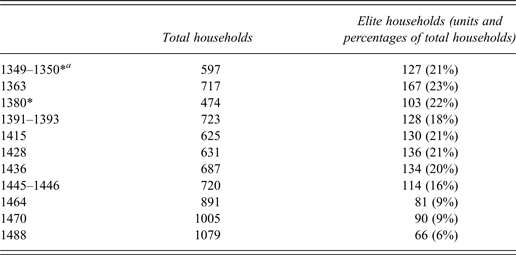
On the basis of these criteria and other elements emerging from the sources, 67 kinships were selected for this study, 25 of whom already belonged to the elite by the mid-thirteenth century at the latest, the remainder having joined it during the early fourteenth century. These kinships produced a number of households that varied over time depending on the longevity of lineages and their residential arrangements. Table 1 shows the number of households taken into account in relation to the total households listed in the sources and displays a clear reduction in the number of elite families in the second half of the fifteenth century.
Total households and elite households in Turin, 1349–1488

a * denotes one missing register.
Source: Archivio Storico della Città di Torino (hereafter ASCT), Collezione V, vol. 1022–101.
Despite a political conspiracy that caused a partial replacement of the elite in the 1340s,Footnote 31 the main group forming the elite basically remained unchanged. This apparently resembles the longevity rates of the higher social strata of several other European regions between the late medieval and early modern period.Footnote 32 Nevertheless, a more profound transformation took place in Turin during the mid-late fifteenth century, completely breaking this long-term continuity and leading to the disappearance of this dominant group. It is no exaggeration to say that an entire ruling class died out in this period, to be replaced by new families of a very different kind.
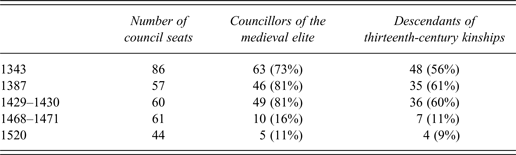
This fact is clear from an examination of the changing personnel of Turin's ruling council. In the second half of the fifteenth century, the number of council members belonging to Turin's traditional elite declined dramatically. Considering the composition of the council at average intervals of 43 years, Table 2 shows how these families occupied the majority of seats until 1430 (49 out of 60), whereas in the central decades of the fifteenth century they noticeably declined in number. As a result, the proportion between old members and newcomers was reversed. In 1468–1471 the lineages of the medieval elite held only ten seats (16 per cent of the total), the remaining ones having been taken over by new citizens and people who had previously been on the fringes of the political institutions. The number declined further still in the sixteenth century, which saw the final phases of this development as the last heirs of the original, medieval, kinships died.Footnote 33 The numbers tell an unambiguous story: until 1430 an average of 60 per cent of the councillors were heirs of lineages that had been established in the elite since at least the 1250s, and often from as far back as the twelfth century (Table 2, column 4). However, by 1468 this percentage had dropped to 11 per cent.Footnote 34
Number of council seats controlled by the medieval elite, 1343–1520

Sources: ASCT, Ordinati, vol. 1–99; Q. Sella ed., Codex Astensis qui de Malabayla communiter nuncupatur, III (Rome, 1880), 1091–2; F. Cognasso ed., Documenti inediti e sparsi sulla storia di Torino (Pinerolo, 1914), 252–5.
The present article offers an explanation of this plunge in the fortunes for Turin's old, medieval, ruling class by analysing the marriage and succession practices adopted by the families constituting that class, which proved to be the crucial factor in accelerating the extinction of this elite. The analysis of kinship structures and inheritance practices was carried out by means of the cadastral sources. The cadastral survey is based in the first place on the lists of owners and the information they provided regarding their family relationships: the existence of fixed surnames in the elite families – but increasingly also in the rest of the population – and the use of the patronymic made it possible to link people and reconstruct lineages.Footnote 35 Since the cadastral enrolment was based on residence and every household was fiscally responsible and independent, the fact that heirs were included in a single fiscal statement implied they were regarded as belonging to a single household, an assumption further supported by the existence of only one house in several fiscal statements or, in cases where more than one building was available, by the wording ‘where they live’ (Latin: in qua habitant) accompanying the description of their first house. There is no trace of substantial changes to tax-assessment policy, which might have induced taxpayers to declare a different living arrangement; furthermore, fiscal statements were periodically revised by the city officers.
The sequence of cadastral registers makes it possible to examine changes in the life cycle of the same family – since it sometimes shows phases of co-residence, followed by a division between heirs when they attained the necessary age or economic resources to separate – as well as the transformations that involved the lineage over time. Living arrangements were always linked to the management of wealth, so family structure was often the result of conscious agency and deliberate strategies for economic success, ultimately aimed at assuring the political continuity of the lineage. A key factor in the management of family wealth was its transmission, a fact that made it necessary to reconstruct inheritance systems on the basis of the cadastral surveys, the data from which were then cross-checked with the surviving wills in order to examine the most common patterns and their development in the long term.Footnote 36 In this respect the cadastral registers have the significant advantage of displaying the actual inheritance practices – rather than just the intentions of the testator – and the changes that occurred after the moment of succession. Here I will focus on the dynamic that proved to be the key factor in accelerating turnover among the families constituting the political elite in fifteenth-century Turin, namely the shift in inheritance patterns, which from a wider range of possible systems converged towards a prevalence of impartible inheritance.
3. STRATEGIES FOR ECONOMIC AND POLITICAL SUCCESS: TOWARDS IMPARTIBLE INHERITANCE
In late medieval Turin succession occurred at the father's death, his children remaining until then under his control even if adult and married. The only exception was emancipation. Through this Roman law institution a father voluntarily released his son from his authority, thereby making him legally independent and free to form an autonomous household. Emancipation being a particularly rare circumstance, most adult sons – and possibly their wives and children – had to keep living under the same roof as their parents.Footnote 37 In accordance with Roman law, the 1360 Statutes established equal division of the estate among all heirs, male and female, at the father's death and the priority of agnatic kin over strangers in case of death ab intestato of parents.Footnote 38 The daughters’ share was delivered through the dowry at the moment of marriage, so that nothing could later be claimed (abiding by the exclusio propter dotem common not only in Italian cities, but also in France).Footnote 39 Wills nevertheless show high flexibility in the distribution of family property – adjustments to the previous arrangements could be made, with extra portions of goods being given to women. Moreover, wills and cadastral registers provide evidence of daughters as universal heiresses in the absence of brothers, whereas in other Italian cities they might even then have been bypassed by their male agnatic relatives.Footnote 40 If on average the sources show a respect for the principle of equal division in the fourteenth century, the behaviour towards daughters could by contrast vary considerably depending on the choices made by individuals and kinships.
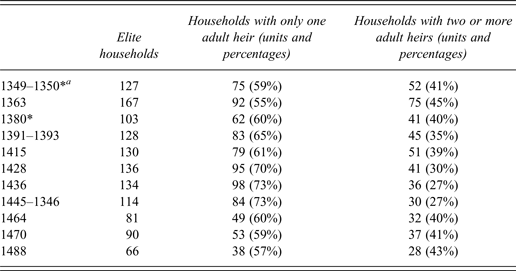
Families were inevitably confronted with a choice between various inheritance practices when more than one heir was alive. It is therefore important to emphasise that the sources display a fairly high number of cases in which only one son survived long enough to inherit the family patrimony (Table 3). The high number of only sons is firstly the result of the low rate of emancipations, which meant that a number of potential heirs died before their fathers. Secondly, there was a strong trend towards ecclesiastical careers (especially as canons of the cathedral chapter), which further reduced the availability of heirs. Cross-checking the reconstructed lineages with the data in the ecclesiastical records reveals the popularity of this strategy.
Proportion of households with one or multiple adult heirs among the elite families, 1349–1488

a * denotes one missing register.
Sources: ASCT, Collezione V, vol. 1022–101; Archivio Capitolare di Torino, Pergamene; Archivio Arcivescovile di Torino, sezione VI.
It is possible to exclude some insufficiencies in the sources here, since all heirs were listed in the cadastre as owners, even when the eldest had guardianship over his younger brothers. Moreover, the succession of the registers sometimes shows how an only son was actually the surviving heir of a group of siblings who had died in the course of time. This trend, already oriented towards a – more or less intentional – limitation of heirs, was further enhanced by inheritance practices due to a change between the fourteenth and fifteenth centuries. Subject to the formal, equal division of inheritance on the basis of the Statutes, the practical solutions emerging from the sources, adopted according to economic agency and the relationships within the family, can be gathered into three main types:
-
1. Partible inheritance and separate domiciles
-
2. Impartible inheritance and co-residence
-
3. Mixed forms
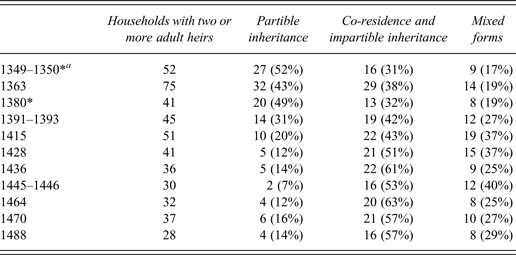
Taking into consideration only the elite households including two or more adult sons, households that were accordingly able to choose between the available practices, Table 4 shows the incidence of the alternative inheritance systems. Despite variations due to life cycle changes and mixed forms of divided domicile and undivided assets, it reveals a significant increase in practices of co-residence and impartible inheritance during the fifteenth century. As we shall see shortly, the fifteenth-century development of the city prompted at least half – with peaks of two thirds in 1430s and 1460s – of the elite households to secure their wealth from dispersal, increasingly orienting their inheritance practices towards the preservation of the patrimony, and with it political pre-eminence.
Incidence of the inheritance systems among the elite households with multiple heirs, 1349–1488

a * denotes one missing register.
Source: ASCT, Collezione V, vol. 1022–101.
Partible inheritance represents the direct application of the norm. At the father's death, the children proceeded to an immediate and complete division of family property, moving to separate houses, although often close to each other. This tactic was mainly aimed at reaching economic independence and the foundation of autonomous households, free from the constraints of sharing possessions and space. Chosen by more than 40 per cent of the elite families in the second half of the fourteenth century, partible inheritance was initially preferred by rich individuals, characterised by a high degree of diversification of economic and financial investments, rather than a concentration of family wealth in land. It was the case of the brothers Ardizzone and Giovannino Ainardi, members of a noble family and usurers, who separately managed their property, including houses, land, livestock, rents, shops as well as toll incomes and credits.Footnote 41 Not only did separation protect each brother from the risk of a possible financial failure of the other, it also enabled them to form independent households, so that in the following years they both had two children who survived until adulthood and were therefore able to continue the lineage.Footnote 42
However, it is important to point out that inheritance systems were never simply a matter of social class – both noble and non-noble families were equally willing to choose between different options. These decisions were the result of several factors, both economic and affective.Footnote 43 Partible inheritance, though, brought with it two major problems. Firstly, the division of property could turn into open conflict when one heir took advantage of his siblings to get a bigger share, an event revealed by the reports of disputes.Footnote 44 Secondly, division proved to be an inadequate system of property management in the long term, as it led to a gradual dispersal of goods, in particular land. This situation was made even more difficult by the serious economic crisis of the late fourteenth century, which encouraged citizens to preserve their wealth by reducing its fragmentation. Not only was the city struck by frequent plagues in the last decades of the century (the most serious in 1381, 1388 and 1399), but it was also severely damaged by the permanent state of war in the region during the 1390s and 1400s. The continuous conflicts between the counts of Savoy and princes of Savoy-Achaea on one side and the marquises of Monferrato and Saluzzo on the other, coupled with the incessant depredations by mercenaries, who ravaged part of the countryside, impeded regular trade and prompted several inhabitants to leave Turin.Footnote 45
Moreover, these circumstances raised the cost of political activity, which strengthened the link between wealth and political pre-eminence. Military expenses, divided among the communities of the Savoy territories, and defensive needs of the city exacerbated the financial situation, increasing the urban public debt to which elite members contributed directly or as guarantees for foreign creditors.Footnote 46 The need for an extended and cohesive patrimony became even more urgent in the mid-fifteenth century, when the city council had to cope with a new economic burden in order to keep the newly established Studium and ducal council in Turin, against competition from other centres in the region. After decades of transfers and returns, these two institutions were finally established in Turin in 1436. This ducal decision was the result of a series of financial efforts on the part of the Turin council to provide the necessary housing, services and personnel. The council finally agreed to pay 500 florins each year in exchange for the commitment to keep the university and the ducal council forever in Turin.Footnote 47 As politics involved sharing the costs of the city, elite families increasingly tried to protect their property from dispersal in order to preserve their political survival. These factors led to a decline in partible inheritance during the fifteenth century in favour of impartible inheritance and mixed forms, regarded as more suitable to the current economic and political context.
The second option, impartible inheritance, meant keeping all property in common (Latin: pro indiviso) and living under the same roof. Despite the fact that one heir was formally responsible for making the fiscal statement, it is possible to exclude the existence of primogeniture in such cases for two reasons. First, the appointed heir sometimes changed in subsequent registers. Secondly, impartible inheritance could be a merely temporary solution, leading in later years to division among surviving heirs. It was nevertheless a sort of forerunner of the primogeniture and fideicommissum systems that were to be adopted in the early modern period, since it implied – especially in the fifteenth century – that only one heir in each generation was going to get married.Footnote 48
Aimed in the first place at keeping family property together while increasing wealth or waiting for all heirs to come of age, impartible inheritance often became a stable arrangement intended to avoid the dispersal of possessions and the political decline that would have followed. Rather than being linked to and determined by membership in a particular social class, this system was the result of deliberate economic and political agency. In addition to the previously mentioned factors, the growing importance of impartible inheritance was related to greater investments in the land market in order to create larger and more productive estates. The fifteenth century was actually characterised by significant changes regarding landed property. On the one hand, the process of consolidation of land in more extensive blocs, which allowed the construction of new irrigation systems; on the other, a reorganisation of production, through an increase in cultivated land and a wider variety of crops.Footnote 49 Keeping landed property undivided thus became essential for bringing these transformations about.
However, great landed possessions played a role not only as economic investments, but were also a way for families to present themselves as cohesive and reliable economic units, and thus contributed to the political continuity of the lineage. Since the 1390s, as was the case in other southern European cities, the fiscal policies of Turin focused on immovable property, conceived as the type of possession capable of proving citizens’ economic trustworthiness publicly.Footnote 50 As a result, the majority of the elite increasingly turned their investments to land, including lineages that had joined the city's elite more recently – especially merchants – whose wealth had previously taken more diversified forms. Co-residence and impartible inheritance therefore contributed to a political as well as economic strategy.
Unsurprisingly, this system had a strong impact on family structures, being directly responsible for a reduction in marriages and thereby heirs. Managing undivided wealth and living together in extended households usually involved a single marriage in each generation, conceived as a way of limiting fragmentation of property in a context in which wealth was essential to preserve a political role. For instance, Antonietto Borgesio's heirs, four sons and a daughter, kept their father's inheritance undivided from 1400 to 1436: when Beatrice and Ludovico left the family house, the former through marriage, the latter for an ecclesiastical career, the three remaining brothers actually shared the house and patrimony.Footnote 51 Only one marriage, though, is recorded as producing an heir who reached adulthood, and who appears as the only member of this lineage left after the mid-fifteenth century.Footnote 52 Although this strategy was the most appropriate in order to prevent the dispersal of wealth and so to allow the owners to maintain their political role, it resulted in a serious demographic decline among these families.Footnote 53 As a disadvantage of co-residence and impartible inheritance, due to the lack of heirs part of the elite was constantly at risk of extinction and eventually died out, as we shall shortly see.
The third and last inheritance pattern was the only effective alternative, a solution to protect wealth and guarantee offspring at the same time. In this scenario heirs formed separate households – however they kept pro indiviso most of the property, especially the real estate. Mainly adopted in the fifteenth century (see Table 4), this tactic offered not only higher chances of success in the long term, but almost certainly a better quality of life as well, allowing a certain degree of independence and reducing conflicts arising from cohabitation.Footnote 54 The division could occur through moving to adjacent houses – a suitable option when more than two adult sons survived – or actually by splitting the family palace into two different buildings, a frequent practice which also shows the symbolic significance of this edifice, never alienated until the last heir died.Footnote 55
The prevalence of impartible inheritance is nevertheless clear in the fifteenth century. As the disadvantages of this system – namely the reduction of heirs – were certainly evident to these families, solutions to the risks of extinction and subsequent dispersal of goods outside the kinship were constantly sought, from legitimation of illegitimate sons to endogamous marriages within the kinship. Two main responses were developed in order to assure the presence of heirs on whom to bestow property and therefore a political role, without transferring wealth to other kinships: the institution of a ‘horizontal heir’, and the transfer of the surname through women. Both systems were aimed at providing an heir able not only to inherit and manage property, but also to enter politics by taking up his ancestors’ seat on the council. These expedients can be related to some extent to practices of adoption especially common in the early modern period and prompted by similar needs to provide ‘artificial’ heirs in the absence of natural ones.Footnote 56 Similarly to residence and succession schemes, they were potentially available both to noble and non-noble families, provided kin or daughters were present.
In the first case an individual without surviving sons would transfer his wealth and subsequently his council seat to an adult relative, no matter how distant, who shared the same surname, but who did not have the means and social connections to enter the council. Because admission to the political institutions depended to a great extent on wealth and membership in an important kinship, this transmission of property enabled a less well-off member to replace his relative, preventing thereby the loss of the seat to the kinship. At least eight out of the fifteen extended kinships (formed by distinct lineages) have been found to turn to this mechanism once and sometimes twice in the fourteenth and fifteenth centuries. In this way the group and its internal political balance were reshaped so that the same surname mentioned in the council conceals different subjects over time rather than signifying a direct vertical descent of one ancestor's offspring.
For instance, this system was repeatedly applied by the nobles da Gorzano. In the absence of heirs, a tendency to bequeath wealth to distant and recently urbanised kin is observed frequently, a practice conceived as a way of easing social integration in the local community and political ascent.Footnote 57 Strong economic and political cooperation was the distinctive feature of this closely-knit kinship. Their members, once established in the city, not only all resided in the same two blocks of houses, but habitually counted on relatives for loans, purchases and rents of houses or land.Footnote 58 Transferring wealth to a horizontal heir was therefore part of a wider political strategy aimed at collective success, as well as an application of the norm of patrilineal succession favouring agnatic over cognatic kinship.Footnote 59 Ludovico da Gorzano, who had moved from Susa to Turin in the 1390s, later benefited from the huge inheritance received from his distant kinsman Nicola, politically as well as economically the leading figure in the da Gorzano group, who died without heirs.Footnote 60 The inheritance also conveyed Nicola's political role, enabling Ludovico to hold relevant offices in the city government and so represent his kinship at the highest level.Footnote 61 Similarly, in 1498 the last member of the da Gorzano chose as heir in his will a distant kinsman who was living in the Susa Valley at the time. Not only did the latter inherit the da Gorzano's wealth, but he was also appointed as councillor, so that the kinship reproduced itself and was still politically influential in the sixteenth century.Footnote 62
Even though agnatic transmission of property frequently took place, this was not the only available option. Succession depended not only on law and patriarchal values, but was also the outcome of family and individual agency. A second system for reproducing kinship could thus be applied when the testator was – or was likely to be – the last surviving male in his kinship: wealth could be transferred through a daughter, whose son would acquire her surname instead of his father's. Sometimes the sources would juxtapose the two surnames, the woman's initially being a nickname for her husband and son, but eventually replacing the patrilineal one. In 1422 Margherita, daughter of the rich notary Antonio de Brozolo, married another notary, Giorgio de Triesto, subsequently called de Triesto alias de Brozolo.Footnote 63 Their child, Girardo, had a double surname as long as his father was alive. After that, not only did he inherit his mother's remarkable wealth, but his original surname disappeared from the sources, which continued to call him de Brozolo.Footnote 64 Since in the meantime Margherita's two brothers had died without heirs, her son was the only male descendant of the entire lineage. This change in the surname enabled the de Brozolo to reproduce their family, making them one of the very few still living in Turin and playing a relevant political role in the sixteenth century, during the French domination over Turin.Footnote 65
Although this system could be applied while the woman's male kin were still living, it was absolutely impossible in the presence of her husband's kin, who would have tried to reclaim both heir and possessions for the paternal line.Footnote 66 Albeit only applied in a limited number of cases, this strategy of social reproduction sheds some light on a less strict patriarchal system compared to other late medieval societies. In addition, it highlights the relevance of wealth as a marker of family identity and tool for political continuity. Providing a male successor through these alternative routes enabled the appointed heir to enter politics in a context in which patrimony and distinction of kinship played a crucial role in admission to the city council. Lastly, all these alternative inheritance choices show the significance of personal and family agency in the transmission of wealth and political pre-eminence.
4. THE CRISIS OF A POLITICAL WORLD
The remedies outlined, aimed at correcting the various knock-on effects of a shift in inheritance patterns, enabled the social reproduction of a few kinships, but could not stop the structural change that was taking place across the elite as a whole. This prevalence of impartible inheritance was a response to the risk of decline that threatened the elite families from the 1420s, when the gradual development of the city started. In the central decades of the fifteenth century the elite had to cope first with the rising costs of political participation, then with the increasing competition from new citizens attracted to Turin by the Studium and the chances of investment that urban growth brought with it. Elite families thus increasingly resorted to solutions to avoid wealth fragmentation, since in this context political success and social pre-eminence were closely related to the family patrimony.
This shift in inheritance patterns fits in with a general trend observed not only among Italian aristocracies, but also in other parts of Europe, mainly in the Mediterranean area. New systems of property devolution were developed at the end of the Middle Ages and beginning of the early modern period in close connection with the emergence of new institutional mechanisms of distributing power. Primogeniture, fideicommissum and various inheritance practices intended to exclude women and younger sons were widely adopted in order to protect wealth and preserve with it the family's social status.Footnote 67 Studies of late medieval and early modern elites of Sicily, Veneto, southern France and Spain have shown this attempt to preserve the unity of patrimony, essential to support titles and political positions.Footnote 68 The precise timing of this process varies according to specific political circumstances. All these studies nonetheless highlight that during critical periods strategies for social reproduction and political continuity returned to the same tool, an innovation in inheritance practices. In most cases this shift resulted in a vertical reorganisation of family relationships, leading to stronger patrilineal systems of property devolution – a phenomenon already observed by Martha Howell in the Low Countries – and new cultural representations of kinship.Footnote 69
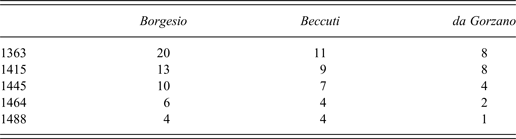
In Turin the increasing preference of families for impartible inheritance jeopardised instead their chances of social reproduction, leading to the disappearance of several lineages and subsequently of the medieval elite, as shown in Tables 1 and 2. The general adoption of this system and limitation of marriages caused a sharp rise in the extinction rate of elite families from the 1430s, with the disappearance of at least three kinships per decade and the gradual extinction of lineages of the wider noble kinships. This process can be further outlined by observing the evolution of the three largest noble kinships, whose number of households dramatically declined in the fifteenth century, more rapidly than in the late fourteenth. The numbers provided in Table 5 show that the Borgesio and da Gorzano, and less dramatically the Beccuti, suffered a heavier decrease from 1415 than in the previous 50 years. The key to this process lay in the inheritance system, which reduced marriages and heirs. In this respect, it is important to point out that among the 13 households of the Borgesio listed in 1415 six were extended, including two or three adult brothers, or uncles and nephews, whereas in the previous cadastres they were more frequently divided into separate households (in 1363 only two out of 20 households were extended). This led to a further reduction of heirs and families in the following decades.
Households of the largest noble kinships, 1363–1488

Source: ASCT, Collezione V, vol. 1022–101.
The transformation in inheritance patterns thus accelerated the social and political turnover of elite families in the late Middle Ages. Thanks to the institutional organisation of the council, the vacant seats of deceased branches were initially reallocated to kin, leading to the emergence of minor branches or the concentration of power in a few lineages that took over multiple seats. As shown in Table 2, eventually, the extinction of lineages created a political void, paving the way for a new ruling group whose entry into politics was enabled by now vacant seats in the council.Footnote 70 Even though this replacement was in a sense triggered by the role the city was starting to play on a regional scale in the fifteenth century, and especially by the creation of the university and the ducal council, the formation of a new political elite only became possible with the disappearance of the old one, which would have otherwise reproduced itself hereditarily. These two new institutions were undoubtedly at the core of the transformations of the city at the end of the Middle Ages, attracting new inhabitants and financial investment. It was nevertheless a long process, which should not be assumed to be the only reason for the sweeping social and political changes in the elite. The disappearance of the medieval elite had already occurred when Turin gained regional pre-eminence and, even later, official supremacy in the Duchy.
The end of this political class represented much more than a turnover of families in the council: it was the collapse of a political world based on the relationship between patrimony and political presence. The core of the medieval elite had shared a way of interpreting political activity as a family and community affair, which entailed sharing its privileges as well as its costs. This joint responsibility was connected to families’ integration into the political society that revolved around the council. The crisis of the elite thus went hand in hand with a change in the political role of the city council: at the end of the fifteenth century it was no longer the centre of the local political world, as the development of the city created new ways to pre-eminence and success.
It was mainly due to this that the late fifteenth- and early sixteenth-century councillors did not form a new consolidating elite: rather than being the focus, the council had become one of several available professional political careers, one moreover which influential citizens took up in conjunction with other offices. In particular, jurists were university professors and lawyers, sometimes in the service of the dukes of Savoy, and never actually took root in local society, while other wealthy individuals – merchants and entrepreneurs – invested their resources in more lucrative deals and offices, taking part in the council mainly at the end of their career.Footnote 71 These wider political and professional horizons brought with them a lower level of integration in urban society for high-ranking citizens, who rarely created new lineages and consequently failed to reproduce the connection between family, patrimony and political activity that was at the core of the functioning of the ‘old’ elite.
The crisis of this system implied that politics was no longer meant to be a matter of kinship, since kinships ceased to exist in the form of political groups. In this respect the sources mirror the political and institutional transformation of the council, whose members were from the 1470s not recorded following the traditional mechanism: the names of councillors were no longer listed according to kinship, but according to new criteria and titles defining social distinction, reflecting a new political organisation founded on a different basis. Literally at the top of the list were the jurists defined as spectabiles domini, followed by the nobles – now including a new range of families to replace the deceased ones – and by an intermediate group with the title of egregius. Lastly, a group devoid of any title, which represented the lower level of the council.
5. CONCLUSIONS
Notwithstanding the role played by economic and demographic constraints and the intervention of the Savoy dukes in local politics, individual and family choices emerged as an important factor in driving the changes in the elite. Turnover among the constituents of the elite was not only the result of external factors, but mostly the outcome of the agency of individuals seeking to keep their economic and political position intact as circumstances changed.
By taking into account kinship structures, residence patterns, channels of transmission of wealth, focuses of investment, family and kinship cooperation or conflict, it is possible to reconstruct the economic strategies of the elite aimed at maintaining political power in a phase of dramatic change for the city. The need to preserve the lineage's patrimony as a tool for political predominance resulted in a widespread adoption of impartible inheritance and limitation of marriages. Despite having been conceived as a way to prevent the disintegration of estates, impartible inheritance turned out to seriously weaken kinship structures and thereby accelerate the process of extinction of the medieval elite. These dynamics led first to a turnover within kinships, with the ascent of secondary lineages thanks to inheritance from their relatives and then to the inclusion of new citizens in the elite. Although new strategies – horizontal and female transmission – were adopted to correct the consequences of impartible inheritance, most of the elite families disappeared by the late fifteenth century and made room for a new political class.
In this perspective the case of Turin sheds some light on the process of transformation of urban elites in the context of the dynamics of state-building between the late medieval and the early modern period. The specificity of Turin lies in the fact that these dynamics mainly had indirect effects in the period assessed here, characterised by very limited interference by the superior authority. When an effective intervention of the dukes did take place, with the choice of Turin as the new capital city of the Duchy (1563), the medieval elite had long been dead and the political context had dramatically changed. The late fifteenth- and early sixteenth-century growth of the city and the new multiple spheres of agency at local and regional levels involved a completely new ruling group, whose political horizons were radically different from those which had formed over the previous centuries.
ACKNOWLEDGEMENTS
I am very grateful to Magnus Ryan and Massimo Vallerani for their assistance in preparing this article, and to Amy Erickson, the reviewers and journal editors for their constructive comments on the first draft of the manuscript.