The Sarum rite was renowned for its well-organised liturgy, beautiful music and extensive system of processions. What began as the local rite of Salisbury Cathedral had been adopted by most of the dioceses of southern England by the end of the Middle Ages. Its processions were carefully ordered and distinguished according to the rank of a feast and its place in the liturgical year, and they varied in their chant, order of persons and route.Footnote 1 Processions were most often accompanied by the chanting of a responsory adopted from Matins, but a group of such responsories for the Christmas octave is distinguished by the inclusion of particular prosae with melismas.
Melismas added to the responsories of the Divine Office have a long history, the earliest record being the witness of Amalarius of Metz in the ninth century. He describes three melismas added to the ninth responsory of Matins, In medio ecclesiae, for the feast of St John the Evangelist (27 December) and comments that a more recent usage was to sing the same melisma to the responsory at Christmas, Descendit de caelis.Footnote 2
The responsory Descendit de caelis with its three melismas was widely distributed over a long time span. It was also sung with added texts, which liturgical books of the time called prosae.Footnote 3 It appears to have been the model of a series of responsories with prosae, unusual at Salisbury Cathedral, sung for the three successive days after Christmas – the feasts of St Stephen, St John the Evangelist, and the Holy Innocents.Footnote 4 These responsories tell a tale of choir-solemnities celebrating each group of the choir: the deacons, priests and choirboys in turn.
Descendit de caelis in the Salisbury processionalsFootnote 5 retained the three melismas: to the melisma on each of the three elements of the responsory – responsory, verse and doxology – a separate prosa was added, as: Responsory Descendit, concluding with fabrice mundi – Prosa Felix Maria – Verse Tamquam sponsus – Prosa Familiam custodi – Doxology Gloria Patri – Prosa Te laudant – Repetendum fabrice mundi. There is something distinctive in the third prosa, Te laudant, however: its melody paraphrases the verse of the responsory, Tamquam sponsus, but it is broken into seven short lines sung by three clerics, and after each line the whole chorus sings the melody of the line as a melisma on the last vowel of its text, a melisma explicitly noted in the processionals.
The responsories for the following three days do not maintain the three distinct prosae, but go directly to the pattern of the last prosa of Descendit, with several short verses each followed by a melisma sung on the same melody. The actual melisma of Descendit in turn served as the model for the melodies of the prosae for both St Stephen and St John. Even St Stephen's text, Te mundi climata, hearkens back to Te laudant of Descendit (see Ex. 1).Footnote 6
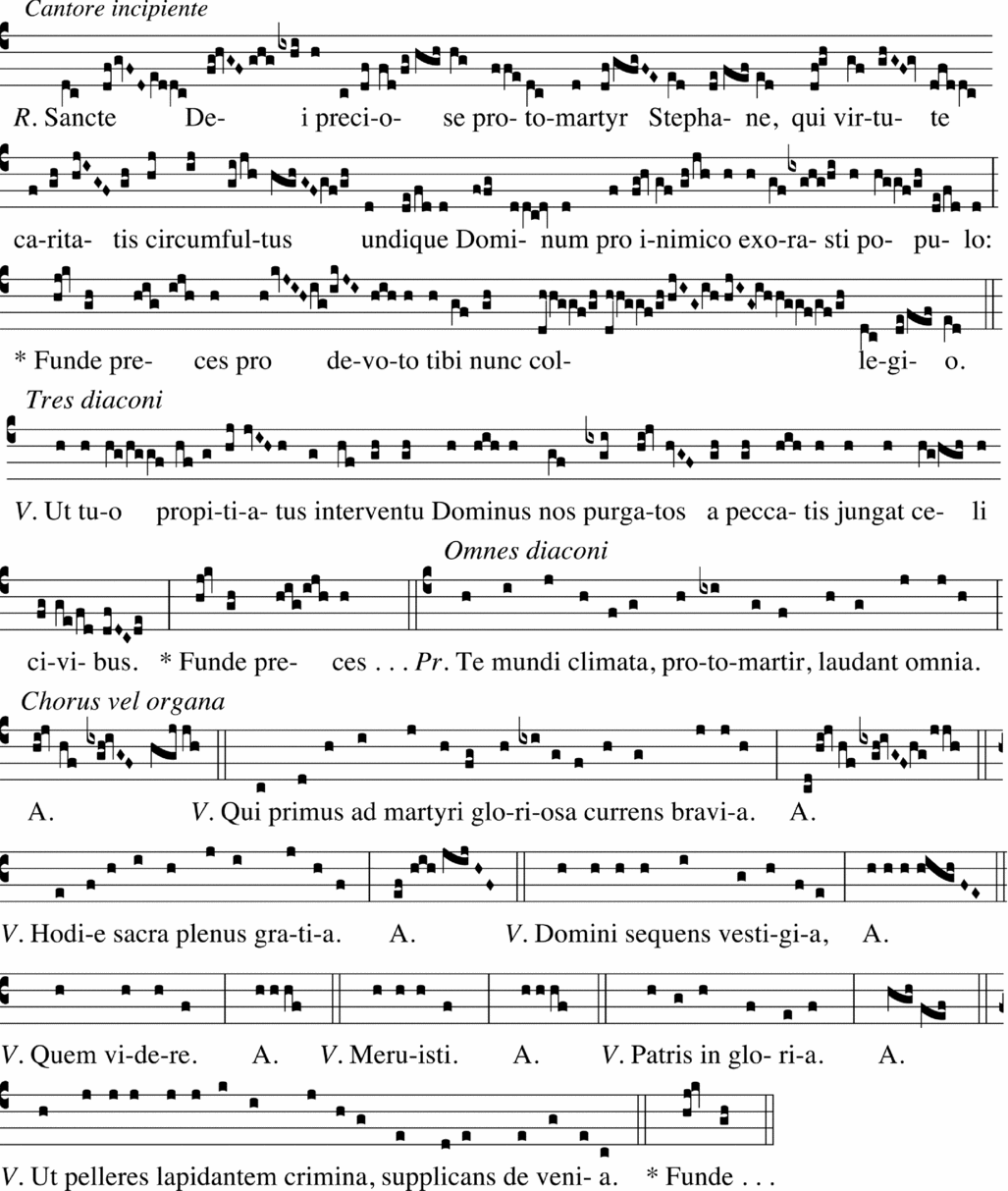
Sancti Dei pretiose (1502 Processionale, fols. 8v–9r).

The remarkable varieties of performance of responsory melismas were discussed by Thomas Kelly.Footnote 7 For Salisbury, however, the performance is clearly specified in the processionals, which details who should sing each element and provide notation for the melismatic repeat of the melody of the prosa by the chorus.
Descendit de caelis at Salisbury Cathedral was sung as the third responsory of Christmas Matins and also as the chant for the extended procession before the Mass of Christmas Day.Footnote 8 The breviary gives the text of the responsory and its verse, but states that the prosae were not sung at Matins but only at the procession before Mass. This rubric is interesting, since it prescribes in brief the difference between the responsory for Christmas and those for the succeeding days, stating explicitly that these latter performances were for the sake of the deacons, priests and choirboys:
This prosa, that is Felix Maria, and the two following ones [for Descendit], are not sung at Matins, but at the procession of this day, as given at that procession.
And note that there are other feasts where prosae are noted, for which there are altars in the church of Sarum: thus prosae are said at the procession at Vespers and not in its proper place at Matins, that is: in the week of Christmas, at St Andrew at second Vespers, at St Nicholas at first Vespers and at Matins with nine responsories; at the Finding of the Holy Cross at second Vespers. Never is the prosa said at Matins through the whole year, but [only] at Vespers and at the procession [before Mass], except for St Stephen, whose service is committed to the wishes of the deacons, and except for St John, whose service is committed to the wishes of the priests, and except for the Holy Innocents, whose service is committed to the wishes of the choirboys, and except for St Nicholas's day, when the prosa Sospitati is said at Matins.Footnote 9
Thus, there are three places where the responsory could be sung: at first Vespers of a feast of a saint to whom an altar in the church had been dedicated, at Matins, and then – when the feast occurred on a Sunday – at the procession before the Mass of that day. Characteristically, the same responsory for each day was sung in each of these places during the Christmas octave. But generally at first Vespers, it included the prosa but not the Gloria Patri; at Matins, it was with Gloria Patri without the prosa, and at the procession before Mass, it included both prosa and Gloria Patri. But since, except for the highest feasts, the procession before Mass occurred only when the feast fell on a Sunday, first Vespers was the focus of the extra festivities on these three days.Footnote 10
Only on the three days after Christmas could the prosae be sung in all three places, thus even outdoing their singing on Christmas Day, and this is just one indication of the exceptional character of what I shall call the ‘choir solemnities at Salisbury’, observances featuring in turn the three elements of the choir – deacons, priests and choirboys. These choir solemnities were celebrated at Vespers in the most festive way. That this is expressly a special observance is indicated by a rubric for the ninth responsory of Matins for St Stephen: ‘R. Sancte Dei pretiose, as above at the procession, and it is said with its prosa and with Gloria Patri by all deacons, namely in the Church of Sarum, according to the solemnity of the deacons’ [my emphasis].Footnote 11
The Vespers processions following Christmas were celebrated with greater festivity than any other Vespers procession. After second Vespers of Christmas Day, a procession went to the altar of St Stephen, as would be expected. But this was a more solemn procession than those of the other processions on the eve of a saint's day, distinguished by vestments, route of the procession, the carrying of candles and a chant with prosae assigned to one element of the choir: the deacons wore silken copes and carried lighted candles. They sang the responsory, Sancte Dei pretiose (see Ex. 1), intoned by a deacon; three deacons then sang its verse and the chorus sang the repetendum, funde preces. Then all the deacons sang the prosa: to each line the choir responded by singing its melody as a melisma or the organist played it.Footnote 12 The lines of the prosa became shorter and shorter, creating a crescendo of alternation between deacons and chorus. The last verse of the prosa led to another statement of the repetendum of the responsory.
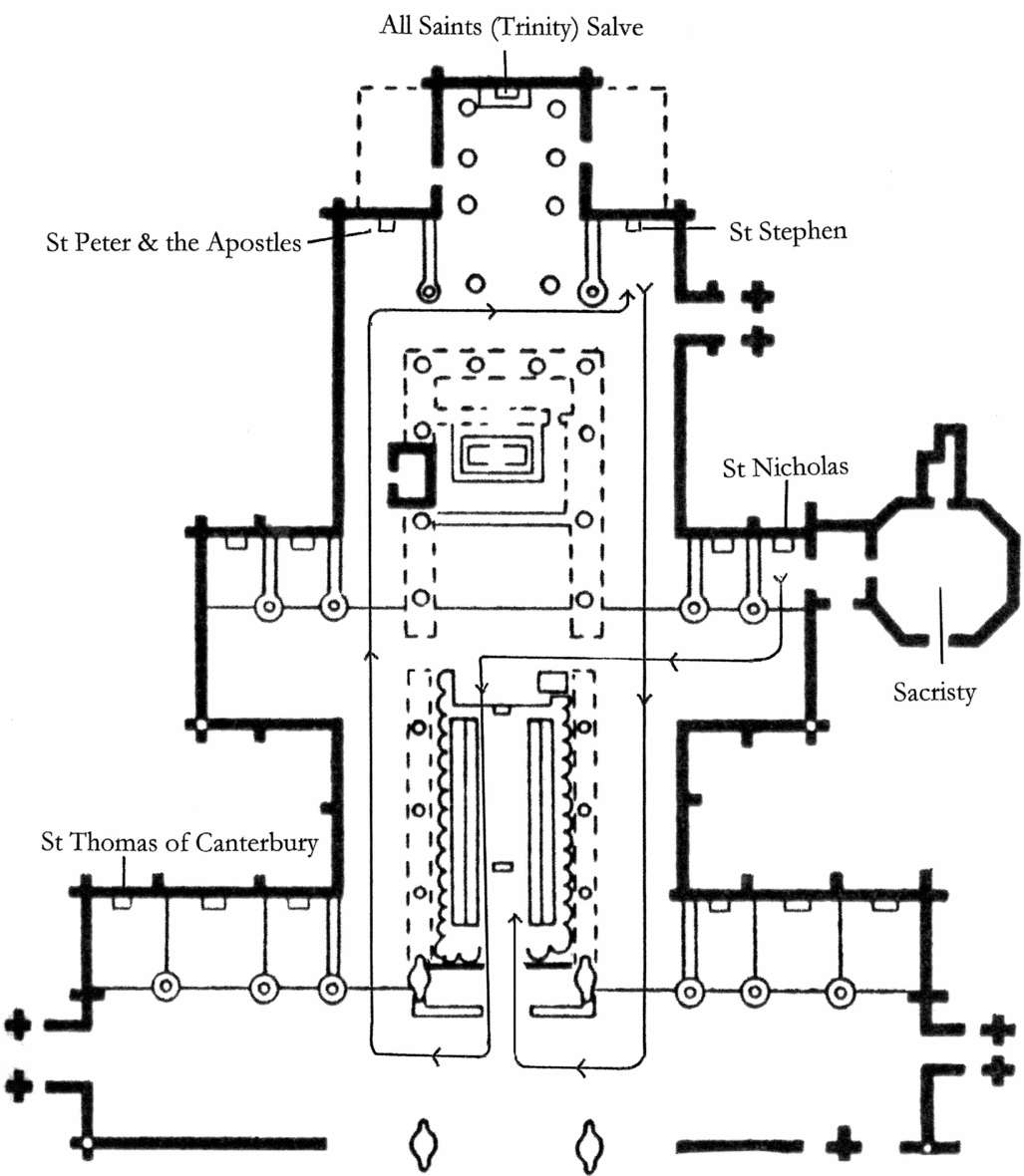
The procession began at the altar of St Nicholas, presumably because it was adjacent to the sacristy, from which the deacons would fetch their silken copes and lighted candlesFootnote 13 (see Fig. 1). It proceeded to the middle of the choir, exited through its west door and went around the outside of the choir to a station at the altar of St Stephen. During the singing of the prosa, the priest incensed the altar and the image of St Stephen and then intoned the versicle and collect. The procession then returned to the choir, entering its west door singing a chant to the Blessed Virgin, to whom the high altar was dedicated. As all processions, this return concluded with a versicle, response and collect.
Route of the procession on St Stephen's Day.
A similar procession was made the next day, the eve of the feast of St John the Evangelist after Second Vespers of St Stephen, this time featuring the priests, in silken copes carrying lighted candles. It went to the altar of St Peter, that is, of the Apostles;Footnote 14 there the priests sang the prosa and the choir or organist responded with the melody of the prosa as a melisma; the priest incensed the altar and image of St John, sang the versicle and collect, and the procession returned to a chant of the Blessed Virgin as on the previous day.
The procession after Vespers the next day included what little is found in England of the boy bishop ceremony. On the continent, a boy was elected bishop on St Nicholas's Day, 6 December, and officiated at some of the ceremonies, leading to the celebration of New Year's Day, called the ‘Feast of Fools’, when certain liturgical excesses took place. This event seems not to have been widely celebrated in England, though Salisbury documents mention a festum puerorum or festum folorum.Footnote 15 The procession took place after Second Vespers of St John on the eve of the Holy Innocents – commemorating the children martyred by King Herod – with the choirboys wearing copes and carrying lighted candles. It went to the easternmost altar, called Trinity and All Saints (Salve),Footnote 16 and there the responsory was intoned by the boy bishop, three choirboys sang the verse, the choir the repetendum and then all the boys sang the prosa, the choir or organist responding with the melisma. The boy bishop then incensed the altar and the image of the Trinity and sang the versicle and collect. A chant to the Blessed Virgin accompanied the re-entry into the choir, but the choirboys now took the choir stalls of the highest ranking members of the clergy. The boy bishop took his place in the stall of the bishop, and taking the crosier, gave the extended ceremonious blessing of a bishop, which is described in detail in the sixteenth-century processional.Footnote 17
The following evening, a similar procession went to the altar of St Thomas the martyr (Thomas Becket, Thomas of Canterbury); now no one changed vestments, wore silken copes or carried lighted candles. After the responsory, a prosa was sung by those who wished to do so, and all responded with the melisma.Footnote 18 On the feast of the Circumcision, which was the Christmas octave, if it occurred on a Sunday, the ninth responsory of Matins was sung in the procession before the Mass, and only here with prosae, melimas and Gloria Patri.
On these days, the responsory sung at the procession at Vespers was sung again with the Gloria Patri in the procession before the Mass, but, except for Christmas, this was done only when the feast fell on a Sunday. Thus, the entire Christmas octave was celebrated with prosae, but these were sung more often on the three days at Vespers featuring the deacons, priests and choirboys – days also with more precious vestments, lighted candles and more extensive processions.
Processions to an altar of a saint at Vespers took place once a year for each altar. The rubric is found at the first instance of such a procession, on St Andrew's day. After providing for the procession after first Vespers, a general rubric is given, which reads:
And there is a procession, after the commemorations, at first Vespers on every feast of a saint for whom there is an altar in the church, which is held once in the year, with responsories either proper or from the common, with versicle and oration of the saint.Footnote 19
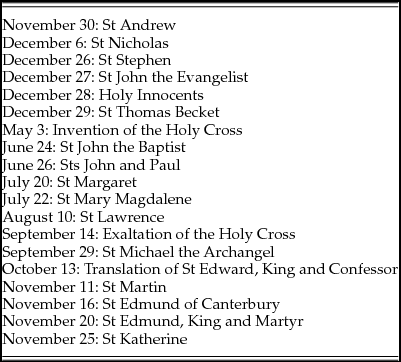
The altars at Salisbury were dedicated to a variety of saints, and the sixteenth-century processional provides for a procession to each. Vespers processions at Salisbury during the course of the year are listed in Table 1.
Vespers processions at Salisbury Cathedral in the sixteenth century.
Aside from the processions to the Cross at first Vespers of each Sunday after Pentecost, the feasts of the Invention and Exaltation of the Holy Cross, and the feast of Saints John and Paul, the rest of the processions on the list went to the altars in the church dedicated to saints for which the processional prescribes a first-Vespers procession. Two of these altars, however, have no processions: St Peter and All Saints. Why? Of the three processions after Christmas, the first was to the altar of St Stephen on his own feast day, but the other two, St John the Evangelist and the Holy Innocents, seem to have prevented processions to the altars of St Peter and All Saints on their proper days since there can only be one procession a year to each altar. How could this have happened?
What we can infer of the history of processions at Salisbury Cathedral suggests that the processions on the days after Christmas were established before the other Vespers processions on saints’ days. The procession of St Stephen is described in the earliest manuscript of the consuetudinary of Sarum edited by Walter Howard Frere, with origins at Old Sarum.Footnote 20 There are already silken copes and lighted candles, but no prosae, and it proceeds from the altar of St Nicholas through the choir and out the western door of the choir, then around the outside of the choir to the altar of St Stephen. This can all have come from Old Sarum, since St Stephen's altar is thought to have had a place there similar to its location in the new Salisbury Cathedral.Footnote 21
Sources, clearly from the new Salisbury Cathedral, include the processions for St John and Holy Innocents, so these must have been provided first at Salisbury upon the already existing example of St Stephen.Footnote 22 Only in much later processionals do we find the processions for the other Vespers of the year. The transfer of the cathedral from Old Sarum to Salisbury on the plain below entailed keeping the dedications of altars at Old Sarum, which included St Peter, All Saints and St Stephen.Footnote 23 For St John the Evangelist and the Holy Innocents, it would seem that for each the most likely altar at the east end had to suffice. For John it was the altar of St Peter, which eventually came to be called St Peter and All Apostles, perhaps for this reason; for the Holy Innocents, the generic All Saints was adequate. When the Vespers processions were developed for the whole year, it would have been natural to have omitted those altars already taken by the pre-existing and privileged processions of the Christmas week.
That all three altars were at the most eastern end of the church suggests that this group of three processions could have originated as soon as the choir portion of the cathedral was built, since it was finished first. The completion of the whole first Vespers series would have had to wait for the completion of the rest of the building.Footnote 24
It would seem that even in the very orderly Sarum liturgy, with its sensitive hierarchical ranking of feasts and ceremonies, the post-Christmas processions of First Vespers took precedence over other First Vespers processions and brought even greater festivity to Vespers of these three days than on Christmas Day. Though Christmas and Easter are clearly the most important feasts of the year, and although the ceremonies of Holy Week and the Easter octave were much more extensive and varied than those of Christmas itself, in this way, Christmas, the second most important feast of the year, received a particular liturgical emphasis through its octave. Because of the immediate succession of major feasts after Christmas, there was no possibility of a proper First Vespers for any of them; this must have been an incentive to provide the alternative of a festive procession. The Christmas procession and the Vespers processions with prosae and melismas and with greater ceremonial gave the Christmas octave substantial weight in comparison to Easter. These processions also lent recognition to the choir itself and its members, even the boy bishop, for their daily service throughout the year.
* * *
Michel Huglo was a generous patron of all scholars of chant and a sensitive connoisseur of its manuscripts. Processions were a particular interest for him, and he edited the RISM volume on processionals. He examined a fourteenth-century Dominican processional in my possession for this volume with extraordinary expertise and fascination.