Congenital cardiac disease is one of the most common of the birth defects, with approximately 2 to 3 per 1000 live births requiring early open-heart surgery in order to survive. Diagnostic and surgical advances in the field have resulted in a dramatic decline in rates of mortality over the past 10 to 20 years, with a greater focus now placed on long-term neurologic morbidity.Reference Hoffman and Kaplan1 Evidence from recent longitudinal studies suggest that such children are at elevated risk for neurologic and developmental sequels, including difficulties in gross and fine motor abilities such as coordination, manual dexterity and motor planning, impairments in volitional expressive language skills and oral-motor apraxia, deficits in working memory and problem-solving, poor selective attention and perceptual-motor abilities, and emotional and behavioural problems including anxiety and shyness.Reference Bellinger, Bernstein, Kirkwood, Rappaport and Newburger2–Reference Wray7 Preliminary evidence suggests that functional limitations in everyday tasks such as academic activities, self-care and socialization are also common.Reference Kirshbom, Flynn and Clancy8–10
Medical management is typically comprehensive and ongoing, and is aimed at diagnosing and managing defects and monitoring cardiovascular status. Most cardiac programmes, nonetheless, do not currently have a system in place intermittently to assess and monitor development across domains by experienced developmental specialists.Reference Lewin, Kendall and Sloper11 Rehabilitation services can play a critical role, both acutely and long-term, in recognizing and minimizing developmental delays, and optimizing functional independence using remediation and adaptive strategies.Reference Chen, Heinemann, Bode, Granger and Mallinson12–Reference Limperopoulos, Majnemer, Shevell, Rosenblatt, Rohlicek and Tchervenkov14 Occupational and physical therapists may be involved in the acute perioperative period as part of their consultative role, covering the intensive care units of paediatric hospitals. Interventions at this time would focus predominantly on the evaluation of neurologic integrity, including neuromotor performance and responsiveness to auditory and visual stimuli, early interventions to facilitate developmental acquisitions and enhance modulation of the behavioural state, and strategies to improve feeding efficiency and growth.Reference Limperopoulos and Majnemer15 If disability is moderate to severe, children may be referred for early therapeutic intervention by paediatricians or medical specialists.
School entry represents an important transition in the developmental trajectory, when existing developmental delays may pose new challenges. In particular, these deficits may impact on educational achievement, participation in recreational activities, and in peer relationships. Although children with congenitally malformed hearts represent a group at high risk for persisting developmental, functional, and academic difficulties at school age, it is unclear whether or not these children are receiving rehabilitation services and educational supports needed to enhance performance in the home, school, and community. The primary objective of our study was to describe the patterns of use of educational supports and rehabilitation services by children at early school age who had undergone open-heart surgery in infancy to repair a congenitally malformed heart. In addition, we examined possible developmental and clinical predictors associated with the receipt of these services.
Methods
Participants and procedures
Subjects were part of a prospective cohort study describing developmental outcomes of children with congenitally malformed hearts who required open-heart surgery early in life. They were evaluated for developmental progress preoperatively, postoperatively before discharge, 12 to 18 months after surgery, and at 5 years of age. These findings have been previously reported.Reference Majnemer, Limperopoulos, Shevell, Rosenblatt, Rohlicek and Tchervenkov5, 10, Reference Limperopoulos, Majnemer, Shevell, Rosenblatt, Rohlicek and Tchervenkov14, Reference Limperopoulos, Majnemer, Shevell, Rosenblatt, Rohlicek and Tchervenkov16–Reference Majnemer, Limperopoulos, Shevell, Rohlicek, Rosenblatt and Tchervenkov19 At each assessment, investigators did not initiate referrals to rehabilitation specialists, given the lack of clinical and historical context that would need to be considered in making these decisions. If parents asked for the results of the assessments, an overview of strengths and weaknesses were provided in a small subset. This may have prompted greater likelihood for parents to seek out resources and supports.
Subjects were included if they had a diagnosis of a congenital cardiac defect that required open-heart surgery, with cardiopulmonary bypass with or without deep hypothermic circulatory arrest, before 2 years of age. Infants were excluded if there were known risks for neurologic sequels attributed to factors other than direct complications of the cardiac malformation. This included prematurity or small for gestational age, clinical evidence of central nervous system malformation or perinatal asphyxia, or a known genetic syndrome associated with developmental disability, for example, Trisomy 21. In addition, children with hypoplastic left heart syndrome were also excluded, as they may be at enhanced risk for neurologic morbidity.
At school age, parents of children in this longitudinal study were contacted by telephone to determine if they were interested in participating in a brief telephone questionnaire on rehabilitation and educational services. A convenient time was then arranged to carry out the telephone questionnaire. The interview was administered by one of two individuals (E.L. or A.L.).
Questionnaire
The survey was developed in English, translated into French and field-tested on two sets of parents not involved in this study, to ensure that questions were clear. The survey followed a standardized multiple-choice format. Parents were first asked about the educational services received by their child, including the type of school (public, private, special needs), the type of educational supports and resources provided (none, tutoring, special educator or resource teacher, special education class, segregated school setting). If educational supports or resources were not provided to their child, parents were asked whether they felt their child would benefit from such services. Parents were then asked if their child was currently receiving services from an occupational therapist, physical therapist, speech language pathologist, psychologist or special educator. For those receiving any of these services, a number of questions were asked about the service delivery. Specifically, they were asked where their child was receiving services (hospital, rehabilitation centre, community health centre, school, private practice), who referred the child (family physician, paediatrician, medical specialist, school, self), the frequency of services (more than once/week, once/week, bimonthly, a few times per year), and payment for services (free access through government health insurance, private health insurance, paid by family). Parents were asked about their satisfaction, using a 5-point Likert scale ranging from not at all satisfied to very satisfied, with these services, when provided. Parents were also asked to determine what factors would improve their level of satisfaction with receipt of services. Finally, parents were asked about possible barriers (no referral made, unclear about which services would be appropriate, cost, location, waiting list) to receiving rehabilitation services. In addition, parents were asked about their perception of the abilities or difficulties of their child in each of the developmental domains (fine motor, gross motor, language, socialization/play, cognition, emotional/behavioural).
Potential predictor variables
As part of the analysis, we examined whether specific clinical factors or developmental delays were associated with greater likelihood of receipt of educational and rehabilitation services at school age. Developmental and functional performance at school entry (5 years of age) were available as part of this prospective study. This included scores from the following standardized tests: Wechsler Primary and Preschool Scale of Intelligence,20 Peabody Developmental Motor Scales,Reference Folio and Fewell21 Child Behavior Checklist,Reference Achenbach22 Peabody Picture Vocabulary Scale,Reference Dunn23 Vineland Adaptive Behavior ScaleReference Sparrow, Balla and Cicchetti24 and the Functional Independence Measure for Children.25 Furthermore, age at first open-heart surgery, deep hypothermic circulatory arrest time, cardiopulmonary bypass time, days in the intensive care unit, type of heart lesion (cyanotic, acyanotic), and type of surgery (corrective, palliative) were examined as possible predictor variables.
Analysis
Descriptive statistics were used to summarize the findings on the survey and to characterize the sample. T-tests and Chi-square analyses were used to compare differences in scores according to receipt of specific educational and rehabilitation services. These same analyses examined differences in services according to clinical factors.
Results
Group characteristics
We followed 98 children longitudinally to the age of 5 years, and 60 (61.2%) of them participated in the current study by completing the phone survey. Non-participants either refused (5), or the remainder could either not be located or did not respond to phone messages. Overall, there were no significant differences between participants and non-participants with respect to age at surgery, gender, type of lesion, type of surgery, time on bypass, deep hypothermic circulatory arrest time, days in intensive care, number of hospitalizations, neurologic examination perioperatively, presence of microcephaly, language at home, or maternal/paternal education levels. With respect to developmental progress, all scores acutely and long-term were not significantly different, with the exception of non-participants having lower motor scores in the acute perioperative period, but not at 12 to 18 months or 5 years, and scores for intelligence quotient being lower at 5 years. The mean age of children at the time of the telephone interview was 8.1 years, with standard deviation equal to 1.1, and range from 5.8 to 11.1 years. The sample consisted of 31 (51.7%) females and 29 (48.3%) males. The mean age at the time of surgery was 2.7 months, with standard deviation equal to 4.7, and ranging from 0.03 to 26.9 months. The most common malformations included transposition, tetralogy of Fallot, ventricular septal defect, and those with functionally univentricular hearts.
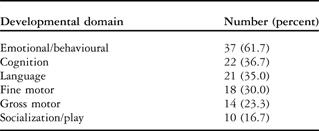
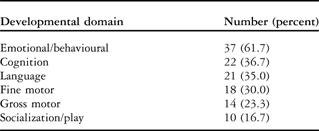
Most parents reported that their children were having difficulty in a variety of developmental areas, with emotional and behavioural difficulties being the most frequent developmental problem as perceived by the parents (Table 1). Only 15 out of 60 (25%) indicated that they had no developmental concerns, whereas over half (32 out of 60, 53.3%) noted two or more areas of concern.
Number of parents reporting that their child had difficulties in a particular developmental domain.
Educational and rehabilitation services
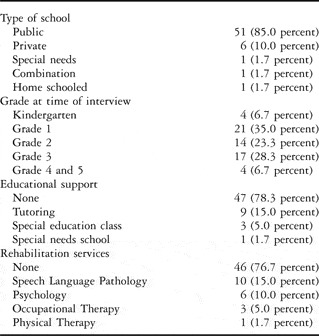
Participants most frequently attended public school, with 78% not receiving any additional educational support, and 77% not receiving rehabilitation services (Table 2). Educational support consisted primarily of tutoring after school hours. Of 47 parents who indicated that their child did not receive any educational supports at this time, 8 (17%) felt their child needed this type of support. A variety of concerns were identified by parents as areas needing educational support, to including general classroom work, handwriting, mathematics, behaviour and communication difficulties.
Educational supports and rehabilitation services.

Those that were receiving rehabilitation services reported on the referral source, frequency, location and payment of these services. For 3 receiving occupational therapy, referrals were from family physicians in 2 instances, and self referral in the other. Intervention took place weekly for 2, or bi-monthly for the other, either in their school for 2, or at a rehabilitation centre. Public coverage was available for these services for 2, but the other child was covered through private insurance. The one child who was receiving physical therapy was referred from their family physician, had intervention weekly, in a hospital, and was covered through public insurance. There were 10 children receiving treatment from a speech language pathologist. Referrals were from multiple sources, either from a family physician for 1, a paediatrician for 2, a medical specialist for 1, from school for 5, or from another source in the remaining instance. Interventions occurred weekly or more frequently for 8 children, while 2 were seen less frequently. Services were provided at school for 7, for 2 at a rehabilitation centre, and 1 in a private practice. Public coverage was available for 8, while one used private insurance, and one paid for services. Those seen by a psychologist were either self-referred, in 3 cases, or referred by their family physician or school, with one each. The frequency of intervention was variable, and was provided either at school in 3 cases, or in a community or private clinic, each for 1. Services were under public coverage for 4, and one paid for service. No parent indicated that they were dissatisfied with the rehabilitation service they were receiving for their child.
Barriers to receiving services
Of the 46 children not receiving any rehabilitation services, 9 (19.6%) of the parents indicated that their child should receive some service. The identified barriers to receiving services were cost of services for 5, lack of referral for 4, waiting time for 2, and geographic location for 1.
Need for services
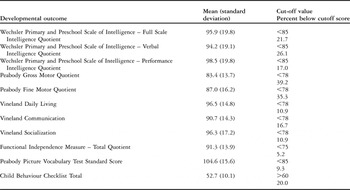
Results of developmental testing completed at 5 years of age, the age for entry to school, were used to determine the need for service. The number of subjects for each analysis varies according to the number of subjects who could be tested at 5-year follow-up, as not all children were tested on all tests. The mean scores for the group as a whole, as well as the percentage falling below the cut-off value, this being the statistical cut-off below which child experiences clinically meaningful difficulties in the domain, for each test are presented in Table 3.
Developmental scores at 5-year follow-up in those surveyed at early school age.

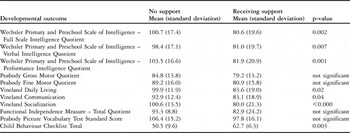
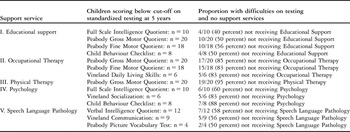
The developmental and clinical factors associated with receiving services were examined. There were significant differences in the mean scores on the Wechsler Primary and Preschool Scale of Intelligence, Vineland and Child Behavior Checklist between those receiving and not receiving educational support, such that children with educational resources had lower developmental and functional scores (Table 4). Scores on the developmental tests were also examined according to receipt of rehabilitation services. Peabody gross motor (p equal to 0.001) and fine motor (p equal to 0.035) scores were significantly lower for children receiving occupational therapy services compared to those not receiving services, though there were no differences between groups on Vineland daily living skills and Functional Independence Measure for Children scores. Vineland communication scores (p equal to 0.02) were significantly lower for children receiving speech therapy, though no differences were found for Peabody Picture Vocabulary Scale and Wechsler Primary and Preschool Scale of Intelligence verbal outcomes. When differences in scores were examined according to those who receive and do not receive psychology services, significant differences were found for the verbal (p equal to 0.02), performance (p equal to 0.04) and Wechsler Primary and Preschool Scale of Intelligence full scale Intelligence Quotients (p equal to 0.02). These findings suggest that those receiving services had difficulties in the expected developmental and functional domains. The majority of children who had delays on school entry were not receiving educational or rehabilitation services in the domains that might be helpful in optimizing functional performance. About half of children with difficulties in domains of importance to academic success were not receiving educational support whereas the majority of children with delays were not receiving the appropriate rehabilitation services for each of these domains. This is presented in Table 5.
Developmental scores associated with receipt of educational support.

Proportion of children with low performance on particular domains at school entry that did not receive relevant educational support or rehabilitation services at early school age.

Medical and surgical factors, including age at first open-heart surgery, deep hypothermic circulatory arrest time, cardiopulmonary bypass time, and days in the intensive care unit, type of heart lesion (cyanotic, acyanotic), and type of surgery (corrective, palliative) were not associated with receipt of educational support or rehabilitation services, except for a significantly longer time of deep hypothermic circulatory arrest time for those receiving occupational therapy compared to those not receiving these services (p equal to 0.03).
Discussion
Our survey of services provided to survivors of open-heart surgery who were now of early school age revealed that most were not receiving educational or rehabilitation support in spite of parental perceptions in the majority that their child exhibited developmental concerns. Only one-fifth (22%) were receiving educational support, which consisted primarily of supplemental tutoring. Similarly, nearly one-quarter (23%) were receiving rehabilitation services, which included predominantly speech language pathology, and to some extent, psychologic evaluation and support. In Quebec, these two services are more likely to be offered to a limited degree by regional school boards, whereas occupational therapy and physical therapy are rarely available in the school setting. Referral source for rehabilitation was inconsistent, suggesting that no single professional, either health or educational, viewed this as their primary responsibility. This would, however, require validation in future studies. When provided, rehabilitation treatment was frequent, and often offered in the school setting. Those receiving rehabilitation services had lower developmental scores in the expected domains compared to those not receiving services, validating the appropriateness of these resource needs. Many children with low performance in one or more developmental domains at school entry, nonetheless, were not receiving educational or rehabilitation supports. Clinical factors relating to surgical approach or type of heart lesion were not associated with receipt of services at school age, therefore no particular medical high risk subgroup appeared to be specifically targeted for ongoing resource support.
Few studies to date have reported on the rehabilitation and educational service supports being provided to children with congenitally malformed hearts at particular points in their development. For children with transposition participating in the Boston Circulatory Arrest randomized trial, parents reported that between 4 and 8 years of age, one-third were evaluated by a speech pathologist, one-sixth by an occupational therapist, one-tenth by a psychiatrist, and one-twentieth by a physical therapist.Reference Bellinger, Wypij and duPlessis26 To our knowledge, only one other study formally surveyed families of this high-risk population by questionnaire regarding school performance and educational supports provided.Reference Mahle, Clancy, Moss, Gerdes, Jobes and Wernovsky9 Respondents to the mailing included 115 parents of children with hypoplastic left heart syndrome that had successfully undergone palliation and were now of school age. Overall, from the parents’ perspective, they viewed the health of their child as good to excellent in four-fifths of instances, with slight limitations of activity for one-third, and no limitations in half. Furthermore, parents indicated that academic performance was average or above average for 84%, yet one-third were receiving some form of special education support, and one-fifth of those supported were held back in school. At this time, one-third were already diagnosed with a learning disability, although few had cerebral palsy or intellectual deficiency.Reference Mahle, Clancy, Moss, Gerdes, Jobes and Wernovsky9
There is convincing evidence that children with congenitally malformed hearts requiring open-heart surgery are at high risk for visual-motor and visual-spatial deficits, attention problems, and other developmental delays that are important precursors to academic success. It would be expected, therefore, that educational resources may be necessary in a substantial subset of these children in order to ensure academic success. Limited evidence to date suggests that, although some children are receiving these supplemental educational services, the need for such supports may not be systematically evaluated in this population at large.
There is growing recognition that families of children with chronic health conditions such as congenital cardiac disease may need greater help beyond medical management of the disease itself.Reference Kendall, Sloper, Lewin and Parsons27–Reference Spall29 Indeed, a recent survey of parents highlighted important gaps in knowledge regarding the cardiac disease, indicating that ongoing parental education is inadequate.Reference Cheuk, Wong, Choi, Chau and Cheung30 Furthermore, the stress due to greater demands imposed on families is cumulative and ongoing, and resilience and coping appear closely linked to the social support and adaptive strategies provided directly to parents. Potential resources to enhance parental well-being and adjustment not only include family members and friends, but also include community rehabilitation services that offer family-centreed care.Reference Tak and McCubbin31 A qualitative study that included semistructured interviews with parents of children with congenitally malformed hearts indicated that parents would like more support and communication from health providers, but parents are often intimidated to ask specific questions, notably with respect to special service needs for their child. They disclosed that they tended to overprotect and unnecessarily restrict the activities of their children, which may have a negative impact on their functioning. These authors concluded that a holistic approach that comprehensively addresses ongoing physical, educational and social-emotional well-being of the child and family was recommended.Reference Kendall, Sloper, Lewin and Parsons28
When interviewed directly, children and youths with congenitally malformed hearts also acknowledged the need for more support and understanding from teachers and peers, and improved communication with health professionals. In particular, encouragement was needed to participate more actively in activities. Support in the form of a resource person from the health centre who could provide information and referrals to services, if needed, would be helpful.Reference Kendall, Sloper, Lewin and Parsons27 In another qualitative study, adolescents with congenital malformed hearts experienced challenges with psychosocial adjustment, physical activity and social participation, suggesting that rehabilitation interventions at this stage would be helpful to enhance their competence and confidence in everyday life skills.Reference McMurray, Kendall and Parsons32, Reference Lunt, Briffa, Briffa and Ramsay33 For example, programmes for cardiac rehabilitation, as well as physical training in children and adolescents with congenitally malformed hearts, have been found to improve physical activity and uptake of oxygen, enhance self-esteem and emotional state, and also decrease internalizing behaviors such as withdrawal and somatic complaints.Reference Fredriksen, Kahrs and Blaasvaer34, Reference Rhodes, Curran and Camil35
Compelling evidence indicates that children with congenitally malformed hearts may have multiple developmental and learning difficulties.Reference Miatton, De Wolf, Francois, Thiery and Vingerhoets6, Reference Wray7 Health professionals in tertiary cardiac centres, therefore, need to be proactive in minimizing disability and promoting family adjustment and well-being.Reference Samango-Sprouse and Suddaby36 Family-centred approaches that address the needs and priorities of families of children with developmental disabilities have been found to facilitate parental satisfaction, adaptation, and adjustment, and enhance outcomes for their child.Reference King, Cathers, King and Rosenbaum37 An interdisciplinary team to include the cardiologist, nurse, social worker, dietitian and rehabilitation specialists would likely best meet the diverse needs of the child and family through infancy, childhood and adolescence. Delivery of health services should include ongoing parental education and support, targeted developmental assessments and interventions, as well as anticipatory guidance. Intermittent screening at key points in the development of the child is needed to ensure that developmental, psychosocial, and educational problems are identified early, and appropriate referrals are made to provide the resources needed to optimize outcome for the child and family.Reference Samango-Sprouse and Suddaby36, Reference Pye and Green38 Weinberg et al.,Reference Weinberg, Kern, Weiss and Ross39 carried out developmental screening of a group of young children with congenitally malformed hearts, and found that many who failed screening were not identified clinically as delayed, suggesting greater diligence is needed through systematic screening of all children within this population.
Strategies such as decentralization and regionalization of services have been supported by policymakers with the expectation that this will enhance the continuum of care from the hospital to the rehabilitation centres, and eventually to the home, school and other community-based settings. Services to children with special needs should therefore be coordinated, comprehensive and accessible. Recent studies on the quality of rehabilitation services for children with developmental disabilities indicated that these children often do not receive the interventions they need in their local communities.Reference Feldman, Champagen, Korner-Bitensky and Meshefedjian40, Reference Majnemer, Shevell, Rosenbaum and Abrahamowicz41
With respect to survivors of infant open-heart surgery, few centres as yet provide a systematic, coordinated follow-up programme with timely referrals to educational and rehabilitation specialists, when required. Acute developmental issues such as poor feeding, lethargy or irritability, and abnormal muscle tone that arise when the infant is medically unstable are more likely to be addressed, highlighting a reactive rather than proactive approach.Reference Lewin, Kendall and Sloper11 In a survey of 17 centres providing tertiary care in paediatric cardiology in the United Kingdom,Reference Lewin, Kendall and Sloper11 health professionals indicated that, although they felt that children with congenitally malformed hearts often needed rehabilitation services, rehabilitation programmes or services were not currently being offered in most cases. Furthermore, none of the centres surveyed systematically provided standardized evaluations to assess needs or to objectively measure outcomes. With the exception of cardiologists from 2 of the 17 centres, only the physical therapists and nurses at each of the centres responded to this survey, therefore these views only reflect that of the non-physician health professional staff.
There are a number of limitations to our descriptive study. The telephone questionnaire was not validated with another gold standard measure, but relied on knowledge of the parents, and honest appraisal of the resources being provided to their child at the time of the survey. Also, the assessment of developmental state took place 2 to 3 years prior to the administration of this questionnaire, and therefore only estimates those likely to have developmental difficulties. Furthermore, a subset of the cohort could not be located or reached, and although they were not different from those surveyed for most clinical and demographic characteristics, children of non-respondents had significantly lower intelligence quotients, and a trend towards somewhat lower scores on other domains. As a result, the descriptive findings of this survey may have underestimated the availability and use of educational supports and rehabilitation services provided to our cohort as a whole. Furthermore, generalizability of the findings is limited by the resources available in local community health and educational systems. Quebec provides uniform medicare coverage, however community-based services and supports are lacking and therefore hard to access.
In summary, it is necessary to provide intermittent and ongoing follow-up programmes that address developmental, psychosocial and educational concerns in concert with medical managementReference Wernovsky, Rome and Tabbutt42 of the chronic health condition. Cost-effective initiatives for health promotion, such as telephone screening using reliable measures of functioning across activity domains,Reference Limperopoulos, Majnemer, Steinbach and Shevell43 and effective use of a case coordinator as a primary resource person for families, can be considered. Novel service models are clearly needed to ensure that paediatric cardiac centres are promoting the health and well-being of the child and family once they are discharged following surgical repair.Reference Spall29 These findings may guide policymakers and health planners in the allocation of appropriate human resources directed at this growing population born with a highly complex, chronic health condition and now routinely surviving into adulthood.
Acknowledgements
This project was funded by the March of Dimes, United States of America, the Heart and Stroke Foundation, and the National Health Research and Development Program, Canada. We would like to acknowledge the tremendous efforts of our research coordinator, Lisa Steinbach, as well as our research assistants, Nicholas Hall and Nancy Marget. We would like to thank Rena Birnbaum, Amy Brownstein, Cynthia Perlman, Brenda Wilson, Kandace Krebs, Lisa Steinbach and Nancy Marget for carrying out the standardized assessments. We are especially grateful to the families for their ongoing participation in this study. Special thanks to Dr Harter and the late Dr Darwish for assistance in organizing data collection for children living in Alberta. This study was presented (poster) at the American Academy of Cerebral Palsy & Developmental Medicine, Orlando, September, 2005. If you would like an electronic copy of the questionnaire, please send your request to Annette.majnemer@mcgill.ca.