Introduction
Mahaim pathways are characterized by decremental atrioventricular node-like conduction properties and are involved in antidromic atrioventricular reciprocating tachycardia.Reference Gormel, Yasar and Yildirim1,Reference Katritsis, Wellens and Josephson2 No or minimal pre-excitation is usually observed on ECG; there is no retrograde conduction over the accessory pathway, and rapid atrial pacing elicits prolongation of the AH interval.Reference Gallagher, Smith and Kassell3 Tachycardia shows a left bundle branch block morphology, with left axis deviation on electrocardiogram as the antegrade limb is formed by the Mahaim fibre and the atrşoventricular node forms the retrograde limb of the circuit.Reference Tchou, Lehmann, Jazayeri and Akhtar4 Ablation of Mahaim fibres is always fraught with challenges. Mahaim fibres frequently originate from the anterolateral, lateral, and posterolateral regions of the tricuspid annulus. There may be rarely left-sided origin Mahaim accessory pathway,Reference Chen, Wang and Wang5 which are particularly difficult areas for catheter stabilization. The tendency of these fibres to easily disappear with contact further complicates mapping. The decision of whether to perform ablation from the atrial side or the ventricular side has been a frequent topic of debate.Reference Bohora and Tharakan6 In the case of Ebstein’s anomaly, the apical displacement of the tricuspid septal and posterior leaflets complicates the procedure even further.Reference Viray, Wiener, Batnyam, Rasquin, Pressman and Mainigi7 The use of long sheaths for catheter stabilization and cryoablation catheters can improve success rates, yet recurrences are still observed. We aim to share our ablation results performed without the use of long sheaths, utilizing contact force catheters through femoral and jugular vein access. This approach has shown promise, yet it challenges conventional methods by foregoing standard stabilizing techniques.
Material and methods
Patient population
Between January 2015 and January 2025, a total of 22 patients with Mahaim tachycardia were included in the study. Informed consent was obtained from all patients prior to the procedure, and the study was conducted with the approval of the local ethics committee, adhering to the standards of ethical research practices. Clinical and periprocedural data were collected from electronic medical records and the electrophysiology laboratory database. In 17 patients, a documented attack was observed, while in 5 patients, Mahaim tachycardia was induced during the procedure. All procedures were performed under deep sedation using the EnSite Precision mapping system by the same operator at a tertiary care centre. Of these patients, six had Ebstein’s anomaly, while the remaining patients exhibited no other cardiac pathology. Patients with Ebstein’s anomaly who had not undergone preoperative electrophysiological studies and developed Mahaim tachycardia in the postoperative period were excluded from the study. A contact force catheter was used for all ablations, optimizing the precision and effectiveness of the procedure. After the procedure, echocardiography was performed to assess for effusion and valve insufficiency.
Electrocardiographical and electrophysiological characteristics of Mahaim fibre
In patients with Mahaim fibers, the electrocardiogram may show normal findings or varying degrees of preexcitation with a left bundle block pattern, except during episodes of tachycardia. Programmed atrial pacing leading to obvious manifest pre-excitation following an increase in A–V interval, along with shortening of H–V interval at shorter pacing cycle lengths. Right bundle electrogram preceding His bundle activation during anterograde pre-excitation and supraventricular tachycardia. Mahaim tachycardia was initially attempted to be induced in basal conditions from the coronary sinus using programmed or burst stimulation. In case where tachycardia could not be elicited under basal conditions, isoproterenol was administered to provoke it.
Ablation procedures
The ablation procedure was performed under deep sedation and local anaesthesia to ensure patient comfort and minimize movement during the procedure. TactiCath contact force ablation catheter (Abbott, One St. Jude Medical Dr., St. Paul, MN ) (Figures 1 and 2) was employed for all patients to map and target the Mahaim fibre signals precisely. Initially, the femoral approach was used, and in cases where catheter stabilization could not be achieved or was unsuccessful, the jugular approach was utilized. Additionally, Agilis long sheat was used when necessary to provide catheter stabilization. The ablation procedure was performed during sinus rhythm or atrial pacing to ensure catheter stabilization and highlight pre-excitation, aiming to observe the disappearance of pre-excitation with ablation. Acceleration of the rhythm during ablation was also considered important for a successful ablation. Ablation was not performed during Mahaim tachycardia. No ablation was performed in any patient from the ventricular side or near the right bundle branch area. The setup was adjusted according to the patient’s age, typically using a power setting of 20–40 W and a temperature of 42°C. Adequate catheter contact was defined by a minimum of a 10% drop in impedance and at least 5 g of contact force, ensuring effective energy delivery and successful lesion formation. Isoproterenol was used for tachycardia induction before and after the procedure. The inability to induce Mahaim-compatible tachycardia after ablation and the absence of a pre-excitation pattern related to Mahaim during pacing were considered success criteria.
The technical specifications of the TactiCath catheter are shown.

The tissue structure and electrode characteristics of the TactiCath catheter are shown.

Results
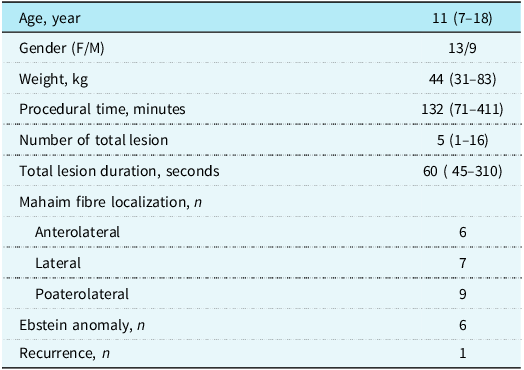
A total of 22 patients underwent catheter ablation for Mahaim pathways. The median age was 11 years (range: 7–18). The median weight was 44 kg (range: 31– 83). There were 13 males and 9 females. Locations of the Mahaim fibres were at the right anterolateral (n = 6), right lateral (n = 7), and right posterolateral (n = 9) tricuspid annulus. Table 1 Mapping was based on the finding of a specific Mahaim potential in all patients. Antidromic tachycardia was induced in all patients with the left bundle block. All patients underwent successful ablation with a TactiCath radiofrequency ablation catheter. Ablation procedures were performed under atrial pacing in four patients regarding catheter stabilization. We did not perform ablation on any patient during tachycardia. In 18 out of 22 patients, we observed Mahaim fibre acceleration associated with warming. No ablation was performed in the right bundle branch area or on the ventricular side in any of the patients. The median number of radiofrequency pulses used was 5 (1–16). Ablation was performed via the jugular approach in 11 patients and via the femoral region in another 11 patients. The acute success rate was 100% (22/22). Fluoroscopy was not used on any patient. The median procedure time was 132 minutes (range: 72– 411). No major complications were observed. Arrhythmia recurrence was noted in one patient. The recurrent patient who presented with a tachycardia attack one month later had Ebstein’s anomaly. An ablation procedure was successfully performed from the right lateral region.
Patient characteristics and procedural data

The values are presented as median (minimum, maximum).
Follow-up
After the procedure, all patients were hospitalized overnight after the procedure. The day after, they underwent ECG and echocardiographic evaluations. Follow-up was conducted through either inpatient or outpatient visits or through phone communication without a pre-scheduled follow-up period. Electrocardiographic data were recorded during each follow-up visit, which occurred at 1, 3, 6, 9, and 12 months in the first year and then every6 months thereafter. No major complications have been encountered with any of our patients during the follow-up. The median duration of follow-up was 60 (5–118) months. In a patient with Ebstein’s anomaly, tachycardia recurred one month later. Successful ablation was performed from the lateral region. None of the patients required antiarrhythmic drug therapy.
Statistical analysis
Statistical analysis was performed using SPSS 22.0 (IBM Corporation, Armonk, New York, USA). Quantitative data were expressed as mean ± standard deviation or median range (minimum–maximum) values. Categorical values were presented as n (number) and % (percentage).
Discussion
Mahaim fibres often exhibit a prolonged pathway with significant branching across a broad region of the ventricular muscle, complicating ablation at the site of ventricular insertion. The most effective technique to ablate these accessory pathways typically involves targeting the site of the M potential,8 with successful ablation leading to the elimination of Mahaim automatic tachycardia.Reference Sternick9 Radiofrequency ablation of Mahaim fibres has demonstrated high success rates overall. Challenges in catheter stabilization during Mahaim pathway ablation are frequently encountered due to bump formation from the contact between the pathways and the catheter. Additionally, altered tricuspid anatomy, such as in Ebstein’s anomaly, significantly increases the difficulty of Mahaim ablation. To overcome these challenges, a 3D mapping system, contact force catheters, and the use of the jugular approach when necessary are employed to ensure adequate tissue contact. During ablation, tissue contact was carefully maintained between 5 and 30 g using contact force catheters in our study. Catheter contact force is a critical factor influencing procedural success. By ensuring adequate tissue contact and utilizing long sheaths when required, we achieved a 98% ablation success rate in our series of patients. This approach not only optimized procedural efficiency but also contributed to long-term success by minimizing recurrence rates.
The most helpful criterion to localize the atrial insertion of the atriofascicular pathway is the presence of the Mahaim potential (M potential). The best circumstance to delineate the M potential is during atrial pacing or antidromic tachycardia. However, the M potential is not always easy to locate along the TV border due to its complex anatomy and dynamic behaviour present during RV contraction. One should realize that the M potential can be very sensitive to catheter manipulation and can be blocked by mechanical force. Sometimes (in certain reports, even up to 50% of the time), the M potential cannot be localized.8
The ablation catheter should be carefully manoeuvred along the annulus to prevent mechanical trauma and accidental loss of pre-excitation.Reference Sternick9 Locating the blocked area may not always be easy. It is essential to closely monitor the catheter movements. If this is not done, the location given based on where the bump is can be incorrect. Mahaim fibres predominantly originate from the anterior, anterolateral, lateral, and posterolateral regions, posing additional challenges for both mapping and ablation. Given the sensitivity of Mahaim accessory pathways to mechanical stimulation, frequent bumps may occur, particularly during prolonged mapping and ablation procedures. Even when a potential ablation site is identified, catheter contact and stability may be insufficient. Long sheaths can help enhance stability.Reference Kakarla, Abhilash and Namboodiri10 Whenever possible, ablation should be performed during atrial pacing, as it provides better catheter stability compared to ablating during Mahaïm antidromic tachycardia, where tachycardia termination may cause catheter displacement. Additionally, radiofrequency energy applied during atrial pacing enhances pre-excitation, facilitating the assessment of conduction block.
In cases where the accessory pathway is located in the anterior or anterolateral region, the femoral approach often proves ineffective for successful ablation, even with the use of long sheaths. When adequate tissue contact or clear assessment of Mahaim signals could not be achieved, or in cases of catheter stabilization issues, the jugular approach was preferred. This method enables improved catheter contact at challenging locations, significantly facilitating the ablation procedure. The use of contact force catheters further enhances tissue contact, contributing to procedural success. Ergul et al. have previously reported successful ablation using the jugular approach.Reference Ergül, Özgür and Şahin11 Similarly, in our study, successful ablation was achieved in 11 patients via the jugular route, with no recurrence observed during follow-up.
Cryoablation is used to maintain catheter stabilization.Reference Ergul, Akdeniz, Kiplapinar and Tuzcu12 This method is advantageous for its applicability in smaller children and the ability to perform ablation during tachycardia. Since the catheter adheres completely to the tissue, catheter migration does not occur. However, during the procedure, it is not possible to assess the degree of catheter-tissue contact fully. Additionally, some mobility of the catheter can occur during tissue adhesion. In a study involving nine paediatric patients, cryoablation was used in four cases, with three being successful, while radiofrequency catheter ablation combined with cryoablation was used in the remaining five cases, with four being successful.Reference Ozturk, Ergul, Tanidir, Akdeniz, Tola and Tuzcu13 This study employed limited fluoroscopy. The mean procedure duration was 249 ± 90 minutes, with no major complications. The long-term success rate for cryoablation was 78%. Knowing the degree of tissue contact and observing a decrease in impedance are significant parameters for effective ablation. During ablation procedures, we utilize power settings with a minimum of 20 W and a maximum of 35 W. For tissue contact, at least 5 g of contact force is deemed adequate, provided a 10% decrease in impedance is observed, which we consider sufficient for effective ablation. Thus, a minimum of 5 g of contact force is regarded as sufficient for optimal performance. In our study, we observed a higher success rate and shorter procedure duration.
Mapping the earliest local ventricular potential to target distal branches is a time-consuming process.Reference Gormel, Yasar and Yildirim14 While some branches can be ablated using this technique, complete elimination is generally unlikely. In some patients with atriofascicular pathways, ablation at the distal insertion site has been associated with a pro-arrhythmic response, facilitating the occurrence of antidromic tachycardia due to slow conduction induced by radiofrequency ablation.Reference Lokhandwala and Vyas15 Additionally, ablating the right bundle branch within the ventricle may prolong the tachycardia circuit, leading to more persistent tachycardia. Due to these potential complications, ablation is typically performed at the proximal (atrial) insertion of the pathway. However, in certain cases, successful mapping and ablation of the ventricular insertion site have been achieved, resulting in favourable clinical outcomes, as described in the case report by Valentino et al.Reference Ducceschi, Vitale, Sokola, Ottaviano, Sangiuolo and Gregorio16
Most of the studies conducted have been performed on adult patients and typically used catheters without contact force capabilities.Reference Ducceschi, Vitale, Sokola, Ottaviano, Sangiuolo and Gregorio16 Therefore, our study is significant in terms of utilizing both three-dimensional mapping and contact force catheters together. To the best of our knowledge, these results represent the largest series of cases conducted in this field with paediatric patients so far.
Study limitation
This retrospective cohort study was conducted at a single centre, and it is important to consider that the results may be influenced by the patient population, as we primarily serve as a tertiary referral centre.
Conclusion
In paediatric Mahaim tachycardia ablations, the use of a contact force catheter can be safe and successful. In addition to ın cases where adequate catheter contact cannot be achieved despite using a long sheath via the femoral approach, the use of the jugular route can significantly impact success.
Acknowledgements
None.
Financial support
This research received no specific grant from any funding agency, commercial, or not-for-profit sectors.
Competing interests
None.