INTRODUCTION
Individual rights are central to both American culture and American politics, profoundly affecting politics and law (Hartz Reference Hartz1955). Though there has been some debate about the nature of rights in the American Founding (see e.g., Diggins Reference Diggins1984; Hanson Reference Hanson1985 Shain Reference Shain1994; Smith Reference Smith1993; Zuckert Reference Zuckert1996), rights permeate American politics. The American rights culture has long been the domain of liberals, especially as the role of rights has increased in law and politics over the past century in what has been called the “rights revolution” (Pacelle Reference Pacelle1991). Liberal legal organizations developed sophisticated strategies to gain short and long-term victories (see e.g., Epp Reference Epp1998; Goldberg-Hiller Reference Goldberg-Hiller2004; McCann Reference McCann1994; Tushnet Reference Tushnet2005), and defeating conservatives with their rights-based arguments. The secular and religious liberal successes in individual rights were largely responsible for activating the “culture wars” in American politics (Hunter Reference Hunter1991). Even after losing ground in the culture and before the Supreme Court in the latter half of the 20th century, conservatives' initial push was not to rights-based argumentation but to arguments for limited government and law and order (Teles Reference Teles2008). Yet conservative elites, Christian Right conservatives in particular, have become leading advocates for the expansion of particular individual rights, signaling a paradoxical shift that has broad ripple effects.
With much success, Christian Right advocates have marshaled rights talk to achieve success in a variety of domains. Conservative rights talk has been used to counter other individual rights claims (e.g., marriage equality, abortion, and healthcare), as well as to counter common good policies favored by liberals (e.g., campaign contributions, the separation of church and state, and national health insurance). In the process, Christian Right activists are taking legal and political positions that would have been controversial, if not untenable, only a generation ago. Free speech law is a notable example. For much of the 20th century, minority political groups, radical, libertine activists, and so-called “smut peddlers” were the frequent participants in free speech cases, often defended by liberal mainstays such as the American Civil Liberties Union (ACLU). Conservatives, and particularly conservative evangelicals, were the supporters of the rule of law, order, and common morality. In the past two decades, this has changed for conservatives, with evangelical elites promoting an expansion of the individual rights approach to free speech, particularly in the areas of public protesting, campaign finance, and student speech.
Previous scholarship has identified this rights-oriented approach (see Brown Reference Brown2002; Djupe et al. Reference Djupe, Lewis, Jelen and Dahan2014; Hacker Reference Hacker2005; Southworth Reference Southworth2008; Teles Reference Teles2008). Steven Brown (Reference Brown2002), in particular, has identified the increasing Christian Right commitment free speech arguments in order to win legal cases about the role of religion in public life. Yet, there has been little attention to the mechanisms underlying the increasing evangelical commitment to free speech, especially free speech for disfavored groups, as well as the right's emphasis on rights-based arguments in public and legal discourse.
As such, I am animated by the question: how have evangelical leaders come to embrace an individual rights approach to free speech, after decades of supporting an ordered liberty approach. Related, does this shift correspond with the rank-and-file? I argue that one issue — abortion — has been the primary springboard for the evolution of evangelical free speech advocacy. Evangelical elites' emphasis on abortion politics has facilitated a transition away from a common morality, limited rights perspective and toward an individual rights approach. The emphasis on abortion has satisfied the base as it advances a higher priority. This advocacy shift and emphasis on rights has produced important alterations in the landscape of legal advocacy, and it is evidence of an evolving culture war.
DATA AND METHODOLOGY
I use a variety of data sources to investigate how abortion has affected evangelical free speech advocacy and how advocacy leaders used this issue to facilitate change. The data are both qualitative and quantitative. The qualitative components are used to identify elite learning, framing, and position taking. They include systematic analyses of evangelical position statements and resolutions, amicus curiae brief filings, and religious news archives. Primary emphasis is given to the Southern Baptist Convention (SBC), America's largest evangelical denomination, and its various advocacy arms.
The quantitative data are used to link advocacy decisions with rank-and-file opinions. The primary source is the General Social Survey (GSS) from 1972–2012, analyzing evangelical respondents and comparing them to the general-public.Footnote 1 I examine free speech views and analyze ordered logistic regression models. The two dependent variables are respondents' views on the legality of pornography and an additive free speech index made up of five questions asking respondents if they are accepting of different minority groups speaking in their community.Footnote 2 The index ranges from 0–5, with higher scores representing favoring more free speech. The primary independent variable is an additive pro-life index made up of seven questions asking respondents if they approve of abortion under certain circumstances.Footnote 3 The index ranges from 0–7, with higher scores representing stronger pro-life preferences. I also control for various political and demographic characteristics.Footnote 4 I support these analyses with data from the Cooperative Clergy Project (religious threat) and the American National Election Study (campaign finance).
EARLY EVANGELICAL FREE SPEECH ADVOCACY
In the middle of the 20th century, evangelical organizations were infrequently involved in major free speech debates. For example, prior to the 1988 conservative change in leadership of its advocacy organization, the SBC had little activity in free speech legal advocacy beyond the equal access cases that developed in the 1980s.Footnote 5 When the denomination engaged on free speech issues, it focused largely on non-judicial advocacy such as making public statements, supporting local activities, and encouraging legislation. On the whole, evangelicals emphasized a common morality, ordered liberty legal framework in the area of free speech. In what follows, I briefly trace these developments in three areas: obscenity, campaign finance, and radical protest.
Anti-obscenity advocacy is the primary free speech issue that evangelicals were engaged in for much of the 20th century, as most evangelicals have long been opposed to public distribution of pornography and have supported laws outlawing obscenity and profanity. At its 1953 annual convention, the SBC first went on record opposing obscenity in literature, which “serv[es] no good purpose at all,” and supporting legal restrictions on obscenity (Southern Baptist Convention 1953). The National Association of Evangelicals (NAE) joined the SBC in 1958, opposing all forms of alcohol advertisements and supporting the end of “indecent and obscene publications” (National Association of Evangelicals 1958a; National Association of Evangelicals 1958b).
Though evangelicals stood firm against obscenity and pornography, they were fighting a losing battle. Beginning in the late 1950s, the Supreme Court facilitated the easing of anti-obscenity laws in a string of decisions beginning with Roth v. United States (1957). Evangelicals were slow to recognize these important legal shifts, at first praising the decision in Roth for declaring that obscenity was outside the bounds of the First Amendment (Sommerkamp Reference Sommerkamp1957).
Evangelicals were also slow to develop a robust legal justification for their positions. In the more than a dozen SBC resolutions, the First Amendment is rarely referenced, and the NAE largely avoided crafting a legal defense against liberal rights. When evangelicals did develop constitutional arguments, they focused on ordered liberty and community morality. For example, in a 1970 Congressional testimony, SBC advocacy leader Harry Hollis argued that despite the fact that Baptists embrace liberty, he would support laws that would prevent adults from reading and viewing what they would like. Hollis said, “Constitutional controls are needed not to abridge freedom but to provide a stable moral climate in which freedom can be enjoyed” (Baptist Leader Asks Public Funds to Fight Pornography 1970). The default constitutional position was to assume that pornography and obscenity were outside the bounds of the First Amendment's protections, though it did not attempt to define these boundaries. A 1986 SBC resolution epitomizes this approach, declaring that “the Supreme Court of the United States has set forth clear and precise standards which allow for a determination of obscenity applying the local community standards” (Southern Baptist Convention 1986). This is in reference to the Court's perspective following Miller v. California (1973), though the SBC's confidence in the Court's “clear and precise standards” was and is not shared by most legal scholars who point to Justice Stewart's “I know it when I see it” obscenity standard.
Related to their common morality perspective, evangelicals, the SBC in particular, were largely deferential to the Supreme Court.Footnote 6 The SBC showed little outrage when the Court narrowed its definition of obscenity, allowing more sexually explicit content to become legal. In fact, the SBC clung to the Court's statements that obscenity was outside the bounds of free speech, while failing to understand that the definition of obscenity had changed in a way unfavorable to most Southern Baptists. This deference to the Supreme Court characterized the SBC's approach in other areas, including the court's controversial decisions on school prayer and abortion that many evangelicals strongly opposed. As evangelicals would become more focused on rights, they would no longer accede to the Court, an outlook learned following Roe v. Wade. Growing rights consciousness coincided with reduced deference.
While obscenity and pornography were the most prominent components of mid-century evangelical free speech advocacy, evangelicals also engaged in other prominent free speech issues, including issues of campaign finance reform and radical protest. While they only engaged in a smattering of advocacy, they consistently supported ordered liberty over individualism.
In the 1970s, the Watergate scandal set the stage for campaign reform. Twenty religious organizations, including the Baptist Joint Committee (BJC),Footnote 7 joined the Religious Committee for Integrity in Government, which supported the public financing of elections. After the Senate approved of public campaign financing, James E. Wood, executive director of the BJC, praised the Senate for “assuring integrity in government” and limiting the detrimental influence of corporations and the wealthy on elections. Wood made no mention of free speech concerns (Public Financing Passes Senate; House Outlook Dim 1974), and it is likely that most in the SBC supported reform.Footnote 8 Like anti-obscenity laws, campaign finance restrictions emphasized the need for ordered liberty and deference to the political process, though they arose from the liberal, not the conservative, perspective.
Similarly, evangelicals also supported a limited rights approach to radical protest. During the Vietnam War, several prominent anti-war protests included some type of desecration of the American flag, such as burning the flag or hanging it upside down. Congress sought to combat this type of expression and proposed several bills in 1967 to make it a criminal offense to desecrate the flag. Neither the NAE nor the SBC took official positions on flag burning or the legislation, though Baptist Press reported on the issue during the 1960s and 1970s. Throughout, prominent evangelicals spoke out in favor of limiting radical, flag-based protests. Even Baptist evangelist, Billy Graham, gave an impassioned speech defending the flag against protestors at a July fourth religious service on the National Mall (Hayworth Reference Hayworth1970). Though Baptist Press did not take a specific position, in tracking these cases it appeared to be catering to those who would oppose the protests. While the evidence here is scarce, evangelicals certainly were opponents of the radical protests in the 1960s and 1970s, preferring community rights over individual rights.
EVANGELICALS, ABORTION, AND ADVOCACY SHIFT
As with free speech, many evangelicals supported a limited rights approach to abortion for much of the 1970s — affirming a limited right for a woman to choose to terminate her pregnancy. In the years following Roe v. Wade (1973), several SBC leaders took clear positions favoring abortion rights, while the Convention supported a moderate and nuanced pro-choice approach (see Lewis Reference Lewis2014; Perry Reference Perry1996). Though the SBC's position allowed for an abortion right, it rejected a more absolute rights approach in favor of a limited rights approach that sought to balance common morality with individual rights.
While the SBC supported a mild pro-choice position on abortion in the 1970s, the NAE was more firmly opposed to abortion beginning with a 1971 resolution that opposed abortion on demand while allowing certain exceptions for rape, incest, and the mother's life (National Association of Evangelicals 1971). Following Roe v. Wade (1973), the NAE reasserted its position, while vehemently opposing the ruling, stating that they “deplore in the strongest possible terms the decision of the U.S. Supreme Court which has made it legal to terminate a pregnancy for no better reason than personal convenience or sociological considerations” (National Association of Evangelicals 1973).
In the late 1970s and early 1980s, however, there was a decisive shift in the SBC's view on abortion, bringing it more in line with the NAE. This is best seen in a 1980 resolution that unequivocally declared the SBC's opposition to “abortion on demand” and “the use of tax money or public, tax-supported medical facilities for selfish, non-therapeutic abortion,” along with its support for “a constitutional amendment prohibiting abortion except to save the life of the mother” (Southern Baptist Convention 1980). In every resolution on abortion since 1980, the SBC has taken a firm pro-life stance, and it has been one of the religious leaders of the pro-life movement
Initially, opposition to abortion brought together several streams of Christian Right advocacy, support for morality and family values, opposition to feminism and sexual liberation, and frustration with the supposed activism Supreme Court. Yet, by the end of the 1970s, evangelicals began to crystalize their anti-abortion message as supporting a “right to life.” Evangelical apologist Francis Schaeffer has been credited with bringing this Catholic, rights-based argument to evangelicalism (Williams Reference Williams2016). Within Christian Right politics, an emphasis on individual rights began to emerge. Opposition to abortion came to be framed in individualist, right-to-life terms. Similarly, the individual-based free exercise of religion sought to trump the ordered liberty protection against religious establishments.
The focus on rights took root in free speech, too. Evangelicals became more accustomed to the need for expanded speech rights, following proposed restrictions on religious broadcasting in 1974 and the success of Christian Right groups using an individual rights-based free speech argument to support religious liberty claims (see Brown Reference Brown2002). At the same time, Christian Right advocates, in line with Reagan politics, expressed ire toward the Supreme Court, backing away from the deference shown by the SBC leaders in previous periods.
EVANGELICALS AND CONTEMPORARY FREE SPEECH ADVOCACY
For the past two decades, evangelicals have been expanding their free speech advocacy, with the SBC doing so largely under the leadership of Richard Land who took over the denomination's advocacy in the late 1980s, leading the Christian Life Commission, now called the Ethics and Religious Liberty Commission. Abortion politics has played an important role in this process, as the pro-life issue seems to have provided both the need for supporting expanded speech rights and the mechanism to promote rank-and-file support of such advocacy. The increasing prevalence of the individualized right to life arguments within evangelical life has also transferred to a broader, more-individualized right to free speech. Yet, the relationship between abortion politics and liberal free speech arguments at the elite level does not bear itself out in surveys of the evangelical rank-and-file.
Radical Protest
Survey data of evangelicals present a puzzle in the evangelical approach to free speech, particularly in regard to radical protest. Though evangelicals are some of the leading advocates for strengthening free speech protections, the rank-and-file continue to trail the general-public. The survey data on this subject are limited, but the General Social Survey provides the best opportunity to evaluate the views of rank-and-file evangelicals. The GSS has consistently asked a battery of questions regarding whether or not controversial people should be able to speak in one's own community. I combined the responses to these items into a free speech scale ranging from 0–5, with higher scores representing more tolerance of speech.Footnote 9
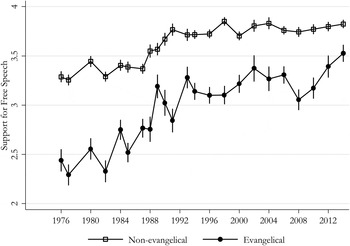
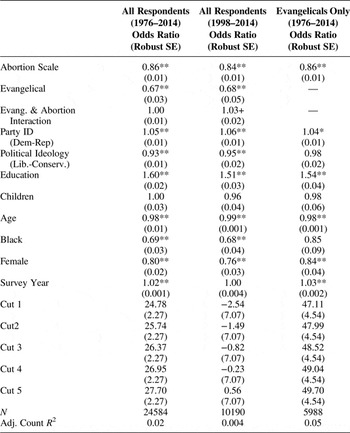
Figure 1 presents a comparison of evangelicals and non-evangelicals over time. The plotted lines represent the means, while the bars are one standard error above and below the mean. Non-evangelicals are consistently more tolerant of radical free speech than evangelicals. Both have increased in acceptance over time, however, with the general-public being more linear. While evangelicals lag the general-public, they are more accepting of expanded speech rights than 40 years ago, and their tolerance has increased at a greater rate. As Table 1 shows, this increasing support for free speech remains, even when controlling for religious and political variables.
Free Speech Scale, Evangelicals & All Others

Free speech scale — All and Evangelicals only

+ = p < 0.10; * = p < 0.05; ** = p < 0.01.
The multivariate models of the survey data across all the time periods provide more insight. Contrary to individual rights thesis, those with more pro-life views are likely to have decreased tolerance for free speech. The same is true for conservatives. Being an evangelical, less educated, female, African American, older, along with having children, also are related to favoring reduced levels of free speech. Stronger Republican identification, however, predicts more favorable free speech views. Taking into account all years from 1976–2014, the evangelical and abortion interaction fails to reach statistical significance. That said, there is some evidence that pro-life views help enhance free speech support among evangelicals in recent years, as the interaction is significant (p = 0.10) and positive from 1998–2014.
Looking only at evangelicals, those who are more pro-life, older, parents, and female are more likely to support for greater restrictions on speech. The pro-life variable in particular does not capture the elite effect of utilizing pro-life arguments to expand free speech. Yet, those who are more Republican are more likely to support broader free speech rights. This may suggest that elite arguments in favor of expanded levels of free speech may have more partisan origins than pro-life origins. A 1996 survey of Southern Baptist clergy supports this conclusion, as the clergy found Republicans more likely to be supportive of free speech than Democrats (50–13%).
Party affiliation (and time) also appears to condition the effect of abortion attitudes on support for free speech for evangelicals. From 1990–2014 in the GSS, an interaction effect between Republican party identification and pro-life attitudes predict enhanced free speech views among evangelicals (p = 0.03).Footnote 10 The results of the pre- and post-1990 models are in Online Appendix B.
In the big picture, while rank-and-file evangelicals still trail the general-public in their support for radical speech, evangelical elites have come to be strong supporters of protest, even radical protest. In addition, elites' pro-life positions seem to clearly and consistently enhance their commitment to free speech. This is in some contrast to the rank-and-file, whose abortion attitudes generally suppress their support for free speech, though there are signs that anti-abortion attitudes have had a positive effect on free speech since the 1990s, especially for Republican evangelicals. Nevertheless, the relationship abortion and free speech for evangelical elites deserves considerable attention.
In some cases, the elite relationship between abortion and free speech is direct. For example, the third amicus curiae brief the SBC filed under Land was a defense of Operation Rescue abortion protestors in Bray v. Alexandria Women's Clinic (1992) who had blocked access to an abortion clinic. The brief, in partnership with the National Right to Life Committee, marshaled free speech rights and a narrow view of 14th Amendment civil rights to support the protestors (Strode Reference Strode1991). Related, in 1994, the SBC and other evangelicals opposed the Congressional Freedom of Access to Clinic Entrances (FACE) legislation, which was signed into law in 1994. During the legislative process, the SBC's Christian Life Commission (CLC) sharply criticized FACE for its diminution of free speech, arguing that the Act was an attempt “to squash politically incorrect pro-life dissent” (Strode Reference Strode1993). In a resolution detailing its pro-life position and opposition to pro-choice policies, the SBC declared its opposition “to any legislation which would have the effect of denying First Amendment freedom of speech rights, especially as a means of responsible, non-violent protest at abortion clinics” (Southern Baptist Convention 1993).
The pattern continued in Madsen v. Women's Health Center (1994), when a broad array of evangelical and Catholic groups, including the Southern Baptist CLC, the Christian Legal Society, the National Association of Evangelicals, and the Catholic League for Religious and Civil Rights, filed an amicus brief objecting to abortion protest restrictions. These groups continued to oppose abortion-related free speech zones in Schenck v. Pro-Choice Network (1997) and Hill v. Colorado (2000). After the Court upheld the free speech zone in Hill, SBC leader Richard Land declared, “The majority of this court is so committed to the preservation of its supreme value, abortion, that it denies other explicitly guaranteed constitutional rights when they may conflict with the recently discovered right to abortion…. [I]n order to protect an undisturbed right to abortion they explicitly deny the guaranteed First Amendment right of freedom of speech…” (Strode Reference Strode2000).
Most recently, in 2014, the Supreme Court heard McCullen v. Coakley, another anti-abortion protest case, with the Supreme Court ruling unanimously that the buffer zone in Massachusetts was too restrictive on free speech. The Christian Legal Society wrote an amicus brief signed by many evangelical groups, including the Ethics and Religious Liberty Commission (ERLC), supporting the protestors and declaring Hill to be in “deep tension with longstanding First Amendment values.” The brief begins by quoting favorably the language from the liberal New York Times v. Sullivan (1964) case that protected the press from libel suits. It then opposes neutral time, place, and manner restrictions because they “deny access to places of symbolic significance [and] undermine the expression that depends upon connection to place.” It further argues that these restrictions can strip speech of its “emotive” content, echoing Cohen v. California (1972), possibly the individual rights apex of free speech jurisprudence. The brief closes with an argument for a broad protection of the individual right to free speech, citing Snyder v. Phelps's (2011) approval of “even hurtful speech, expression, and protest” (Christian Legal Society 2014). Under the banner of promoting the pro-life cause, evangelical leaders have embraced liberal free speech clause jurisprudence.
While anti-abortion protests provide the direct link between abortion and expanded free speech advocacy, evangelicals have also come to promote the expansion of non-abortion protest speech, citing potential pro-life concerns. A prominent example is Morse v. Frederick, a 2007 case where a high school student was suspended for holding a “bong hits for Jesus” banner at a school event to watch the passage of the Olympic torch. Though evangelical legal scholar Kenneth Starr represented the school district in the case, many evangelical organizations, including the Christian Legal Society, Alliance Defense Fund, Rutherford Institute, American Center for Law and Justice backed the student, even though he was vaguely supporting drug use and religious mockery. The Christian Legal Society argued that, while it “has no sympathy for Frederick's tasteless banner and his juvenile stunt,” this case could bestow “broad power on public school officials” and “they would almost certainly employ that power to suppress controversial religious expression, including the right to associate around shared convictions and moral standards” (Staff 2007). Such “controversial religious expression” is clearly a reference to abortion and same-sex marriage. Driving home this point, the American Center for Law and Justice declared, “While we strongly disagree with the student's message in this case, the fact is that unless student speech is protected, a message considered appropriate today could be deemed offensive tomorrow. We want to ensure that students who hold pro-life and pro-family positions will continue to be able to present those messages without censorship” (Staff 2007). For evangelical elites, the expression of their abortion convictions was at the forefront of their concern.
Similarly, evangelicals supported broad free speech protections in the Westboro Baptist Church protest case — Snyder v. Phelps (2011), in which a family was seeking damages after the Westboro Baptist Church had protested their son's military funeral using offensive language. Due to the toxic nature of the case, several typical religious advocates refrained from filing briefs, though Liberty Counsel and the Rutherford Institute filed briefs in support of Westboro. As has become a frequent occurrence in free speech cases, evangelical advocacy groups joined the ACLU in promoting individual free speech rights.
Though Liberty Counsel strongly opposed Westboro's actions, Staver said that the “bad facts of this case could have negatively affected the legitimate free speech rights of law-abiding Americans…. Free speech needs breathing room. I would rather tolerate a person's offensive speech than be silenced by the force of law” (Liberty Counsel Reference Counsel2011). In a press release, Liberty Counsel went on to warn that not extending Westboro free speech protections could produce future trouble for the pro-life cause. “This case could give a veto right to anyone who claims that speech of another is ‘offensive.’ Today the offensive speech of the Phelpses was on trial, but tomorrow it could be religious, pro-life or pro-family speech or any other speech for that matter” (Liberty Counsel Reference Counsel2011).
Evangelicals' increased commitment to individual rights to protest can also be seen in their evolution on the radical activity of flag burning. In the 1960s and 1970s, evangelicals were firm supporters of laws limiting the desecration of the American flag. Following the Supreme Court's seminal decision to strike anti-flag burning laws in Texas v. Johnson (1989), evangelical groups were largely silent. By the 2000s, evangelicals seemed to support the constitutionality of flag burning. In 2010, a Baptist Press columnist defended flag burning and the Texas v. Johnson decision, stating: “While I personally find burning a U.S. flag or a Bible in protest offensive, I accept both as part of comprehensive freedom of speech. The price we each must pay to enjoy our own freedom of speech is to endure being offended by someone else's” (Boggs Reference Boggs2010). This approach epitomizes a liberal, individual rights approach to free speech, and it is quite a change for an SBC elite.
Campaign Finance
In addition to supporting broad protest rights, for both abortion protests and disfavored groups, evangelical elites have recently engaged in broader pro-speech advocacy, often informed by recognition of their support for pro-life and pro-family advocacy. For example, while some evangelical elites championed campaign finance reform in the 1970s, evangelicals have been leading opponents of such legislation since 2001, arguing that it infringes on free speech.
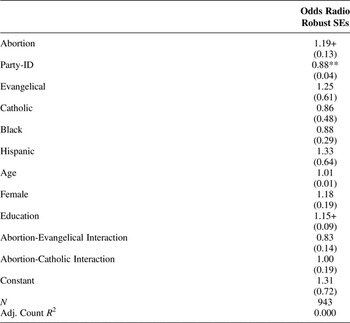
There is scant data in national surveys on campaign finance reform, but in 2000 the American National Election Study asked respondents if they preferred that we “protect the government from excessive influence by campaign contributors” or that we protect “the “freedom of individuals.” Over 75% of all respondents stated they preferred to protect against excessive campaign contributions. This dropped to 70% for evangelicals. Yet, if 70% of the rank-and-file supported campaign finances reform, how were activists able to oppose it? The multivariate models in Table 2 may provide some insight, as abortion is a significant predictor. Individuals who oppose abortion rights are more likely to oppose campaign finance reform. The interactions between evangelical and Catholic religious tradition and abortion attitudes are not statistically significant, however, and the biggest contributor campaign finance opinion is party identification.
Evangelicals and campaign finance reform — 2000 ANES

+ = p < 0.10; * = p < 0.05; ** = p < 0.01.
Though partisan politics are central, the data suggest evangelicals are prone to pro-life arguments against campaign finance restrictions, and evangelical elites have made these connections. In 2001, when Senators John McCain and Russell Feingold collaborated to pass the Bipartisan Campaign Reform Act, the SBC and other pro-life groups were critical of how the reforms would infringe on free speech. The National Right to Life Committee argued that the bill would prevent them from sponsoring advertisements opposing partial-birth abortion, and the Christian Coalition and others organizations joined them (Strode Reference Strode2001). The SBC passed a resolution at its annual convention in June 2001 “object[ing] vigorously to any attempts to abridge the free speech rights of any American citizen or group” and “reject[ing] any campaign finance legislation that hinders or abridges free speech.” In the resolution, the SBC also approvingly cited the Court's limitations on campaign finance reforms in Buckley v. Valeo (1976) (Southern Baptist Convention 2001). Land argued in 2002 that, because of the legislation's limits on free speech, the “price is too high” for this reform. In fact, he reasoned that it would increase the power of the media, while decreasing the role for religious advocacy (Strode Reference Strode2002). As such, Land supported constitutional challenges led by Jay Sekulow of the American Center for Law and Justice (Strode Reference Strode2002), though the ERLC did not participate in amicus activity. When the Supreme Court upheld the McCain-Feingold bill, Land was outraged, calling the decision “a disaster for Americans' First Amendment guarantee of freedom of speech.” He went on to define his free speech-based opposition to the outcome, arguing:
If we want true campaign finance reform, we should pass laws that require full and timely disclosure of all contributions from all sources that sponsor political speech. That way people are free to spend their money promoting their political views, which until now was guaranteed under the Constitution. Voters would know who is paying for what and supporting whom, and make their electoral decisions accordingly (Strode Reference Strode2003).
The SBC continued to oppose campaign finance reform that would inhibit advocacy, citing free speech grounds. In fact, when Elena Kagan was nominated to be a Supreme Court justice, one of Land's objections to her nomination was her free speech perspective presented in her oral argument in support of campaign finance regulations in Citizens United v. Federal Election Commission (2010) (Land Reference Land2010).
Most recently, several Christian Right groups supported the pro-life Susan B. Anthony (SBA) list in 2014, as it challenged an Ohio campaign law that prohibited advertisements that make false statements in Susan B. Anthony List v. Driehaus (2014). The Christian Legal Society, National Association of Evangelicals, and others filed a joint brief supporting SBA, while Alliance Defending Freedom filed independently. The liberal ACLU joined these religious groups in their support of SBA. For reasons unknown to the author, the ERLC did not participate in this campaign finance case that again pits pro-life advocacy against campaign finance regulations. The ERLC did offer public support for the Susan B. Anthony list, a common partner in pro-life causes (see Strode Reference Strode2014).
In a mere 30 years, evangelical activists have sharply changed their positions in support for political speech and in opposition to campaign finance reform. No longer is common morality central; instead an individual rights perspective prevails. Evangelicals' role in abortion politics, at least at the elite level, had much to do with this, as campaign finance reform has largely been opposed by pro-life organizations such as the Wisconsin Right to Life and the Susan B. Anthony List.
Obscenity — The Exception
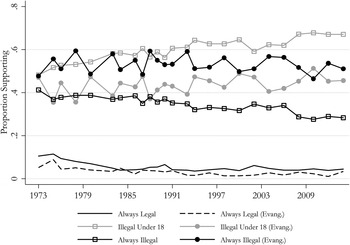
While evangelical elites have become broad supporters of expanded free speech rights, they continue to oppose obscenity and pornography, arguing that these categories are expression outside the bounds of First Amendment protection. The rank-and-file are also strongly opposed. Since 1973, the GSS has asked for people's views on the legality of pornography, with the options of it being always illegal, illegal for those under the age of 18, and always legal. Figure 2 shows a comparison of these responses over time for evangelicals and all other respondents. Non-evangelicals have become more accepting of pornography, with an increase (and now majority) in those holding that it should be legal for those over age 18. Evangelicals, on the other hand, have remained stable in their positions. Since 1973, there has been nearly an even split between those who say it should always be illegal and those who say that it should be illegal to those under age 18.
Proportional Views on the Legality of Pornography, Evangelicals & All Others

Multivariate models support this relationship. Pro-lifers, conservatives, and Republicans are likely to favor stricter pornography laws, as are parents and the less educated. Older respondents and females are more opposed to pornography legalization, while African Americans are more likely to support it. Analyzing only evangelicals, abortion attitudes and demographic factors (i.e., age, race, gender, children) the only statistically significant variables that predict one's view on pornography laws. Those who are more pro-life and older favor more restrictive laws, as do respondents from older surveys. According to the fixed effects (not shown), the liberalization has happened in the past 20 years, as most of the years prior to 1995 are significantly more restrictive than 2012 (see Online Appendix C for complete results).
Unlike radical protest and campaign finance, evangelical elites' positions on obscenity and pornography have not liberalized. In fact, under Land in 1993 the SBC filed its first legal brief in support of tough obscenity standards. In Alexander v. United States of America, the ERLC filed a brief with several religious groups, including the United Methodist Church, Episcopal Church, National Association of Evangelicals, and National Council of Churches, supporting the government's obscenity penalties. It also filed briefs urging the court to uphold the constitutionality of child pornography statutes in United States of America v. X-Citement Video (1994) and Ashcroft v. American Civil Liberties Union (2002). Further, evangelical groups attacked the National Endowment for the Arts (NEA) in the 1990s for funding what they determined to be obscene and profane art. Evangelical groups helped oust NEA chairman John Frohmayer in 1992 (Strode Reference Strode1992), and in NEA v. Finley (1998) Christian Right groups, including Liberty Counsel, the American Center for Law and Justice, the National Family Legal Foundation, and Morality in Media supported obscenity and profanity speech restrictions implemented by the NEA (Strode Reference Strode1998).
In recent years, the attention that these groups give to issues of obscenity has decreased, but their positions have remained strongly opposed. How does this fit with their rights-oriented shift in the areas of radical protest and campaign finance? Certainly part of evangelicals' opposition to campaign finance reform is their participation in Republican Party politics, but this is not the only basis. Party politics also does not fully explain the liberalizing radical protest advocacy. Instead, much of the difference is linked to abortion politics. In liberal obscenity law, there is no logical or practical connection to pro-life politics. The higher order policy position (abortion) is not affected by protecting the common morality of obscenity standards. In fact, some evangelical leaders argue that anti-obscenity laws reduce abortions. Elites decreased emphasis on obscenity cases, however, may suggest that they understand the tension in the scope of their free speech advocacy.
DISCUSSION AND CONCLUSION
Over the past 30 years, evangelicals have become increasingly involved in free speech advocacy, seeking expanded free speech rights and moving away from positions that focus on common morality. Moral restrictions have largely given way to the rights of the individual; the focus has shifted from the legislature to the courts. Evangelicals have been active in protecting the right to protest, especially at abortion clinics, and opposing campaign finance restrictions that limit political expression. Obscenity law is the one area where they have remained supportive of government restrictions, however. The evidence from legal and political arguments points to abortion politics as a primary cause of this advocacy shift, especially among elites. The shift in free speech activism did not just coincide with evangelicals' growing activity in pro-life politics; the shift was facilitated by pro-life views. Elites often cited abortion as the primary concern for supported expanded free speech rights, even for those with whom they disagreed.
While the data to measure rank-and-file views on free speech are limited, results from the General Social Survey suggest that congregants, though growing in support of free speech, are less supportive than elites. Further evidence from the GSS suggests that the role of abortion in increasing evangelical support for free speech has grown since the 1990s, especially for self-identified Republicans. In addition, evangelical organizations, like the SBC's Ethics and Religious Liberty Commission, receive high praise from their constituents for their advocacy. It seems that the membership is more accepting of controversial advocacy if it is framed as a protection, either direct or indirect, of evangelicals' policy priority — abortion. Advocacy leaders can diverge from their constituents if it advances the pro-life cause.
Survey experiments are needed to more directly test the effect of pro-life frames on free speech acceptance by the rank-and-file, but leaders has employed this framing strategy and the membership has responded approvingly. Regardless, abortion politics has come to dominate the political advocacy of evangelicals. Evangelical advocacy leaders appear to have used abortion politics to become successful issue entrepreneurs in the area of free speech law. Further investigation into how abortion politics may be impacting wide array of evangelical legal involvement would be an important contribution.
If abortion politics are driving evangelical legal engagement in areas such as free speech, there are implications for the politics of culture wars. Salient cultural issues may be able to legitimate expanded advocacy, providing unrealized opportunities for culture warriors. Moreover, the culture wars may be shifting, pitting rights claims against each other. This may bolster the conservative cause, as they seem to have adopted the language of rights that was used to defeat them in the last generation's culture wars (see Djupe et al. Reference Djupe, Lewis, Jelen and Dahan2014).
Evangelicals' foray into free speech politics may also be signaling a broader shift in America's cultural landscape. No longer are evangelicals the silent majority or the active cultural force. In fact, many see themselves as the persecuted minority, being trampled by the secular left. Minority groups are often the most protective of their political rights, because the majority threatens them. In taking an active role in free speech advocacy, evangelical elites are signaling a shift from Christian America to post-Christian America. Having the dominant cultural voice may no longer be an option. Instead, evangelicals are seeking to ensure that they have a voice in politics and culture. In fact, the new leader of the SBC's advocacy arm, Russell Moore, has made similar statements, admitting, “The new reality is an increasingly post-Christian America, an increasingly secularizing America” (CBS 2014). In this kind of America, evangelicals are learning the value of rights.
Supplementary materials and methods
To view supplementary material for this article, please visit http://dx.doi.org/10.1017/S1755048316000171.