


Introduction
College students have reported being exposed to a wide variety of traumatic events that meet diagnostic criterion A for post-traumatic stress disorder (PTSD) (Anders et al., Reference Anders, Frazier and Shallcross2012; Boyraz et al., Reference Boyraz, Granda, Baker, Tidwell and Waits2016). These include, but are not limited to: witnessing family violence, natural disaster, having lived or worked in a war zone, abuse by a romantic partner, motor vehicle accident, sexual assault as an adult, and childhood physical and sexual abuse (Anders et al., Reference Anders, Frazier and Shallcross2012). In their 2016 study, Boyraz et al. found that 52.2% of college students in their sample had experienced a traumatic event. Read et al. (Reference Read, Ouimette, White, Colder and Farrow2011) found that a higher number of students (66%) had experienced a traumatic event.
A study of community college students indicated that 25.1% of Veteran students and 12.6% of non-Veteran students were above the cut-off score on a PTSD screening instrument (Fortney et al., Reference Fortney, Curran, Hunt, Cheney, Lu, Valenstein and Eisenberg2015). Another study found that rates of PTSD were higher for community college students at 15%, than university students at 11%, as measured by the Post-traumatic Checklist (PCL; Anders et al., Reference Anders, Frazier and Shallcross2012). Similarly, in the college student sample studied by Boyraz et al. (Reference Boyraz, Granda, Baker, Tidwell and Waits2016), 12.4% had a positive screening for PTSD. Additionally, Anders et al. (Reference Anders, Frazier and Shallcross2012) found that college students who experienced traumatic events reported poorer physical and mental health and academic performance. Students with PTSD were also significantly more likely to drop out of school (Boyraz et al., Reference Boyraz, Granda, Baker, Tidwell and Waits2016).
These findings suggest that college students who experience traumatic events and meet diagnostic criteria for PTSD have poorer mental and physical health outcomes and are at risk of academic problems and drop-out. The aforementioned findings also suggest that providing treatment for PTSD to college students could be of great benefit.
University Counselling Centers (UCCs) were developed in the United States in the early 1900s to address issues that interfered with students’ academic success or ability to stay in school (Kraft, Reference Kraft2011). In the past two decades, the role of counselling center professionals has changed from providing support for developmental and identity concerns and problems in everyday living to treating students with psychopathology (Watson, Reference Watson2013). In recent years, UCCs have reported large increases in volume of students being seen, and in severity of presenting concerns (American Psychological Association: http://www.apa.org/advocacy/higher-education/mental-health/index.aspx). Psychotherapy in UCCs may be provided by mental health professionals with training and credentials in social work, psychology or counseling (Van Brunt, Reference Van Brunt2010). Additionally, some UCCs offer psychiatry and drug and alcohol counselling. Novotney (Reference Novotney2014) provided information from the Association for University and College Counselling Center Directors (AUCCCD) annual survey data that show a 32% increase in the number of centers who report having wait-lists. To address student needs, some UCCs refer students to off-campus providers for longer term treatment, and offer limited numbers of sessions for students in their centers (Van Brunt, Reference Van Brunt2010). The use of empirically supported treatments that are time limited can provide needed solutions for busy UCCs addressing increases in case-load, and for students with PTSD diagnoses.
Cognitive processing therapy (CPT) is an empirically supported, manualized treatment for PTSD that was developed in the late 1980s. CPT is a 12-session therapy that can be offered either in group or individual format. The treatment has been shown to effectively reduce PTSD symptoms related to a variety of trauma aetiologies such as child physical and sexual abuse, combat trauma and rape (Bass et al., Reference Bass, Annan, Murray, Kaysen and Griffiths2013; Chard, Reference Chard2005; Forbes et al., Reference Forbes, Lloyd, Nixon, Elliott, Varker and Perry2012; Maieritsch et al., Reference Maieritsch, Smith, Hessinger, Ahearn, Eickhoff and Zhao2016; Monson et al., Reference Monson, Schnurr, Resick, Friedman, Young-Xu and Stevens2006; Morland et al., Reference Morland, Mackintosh, Greene, Rosen, Chard, Resick and Frueh2014; Resick and Schnicke, Reference Resick and Schnicke1992; Resick et al., Reference Resick, Nishith, Weaver, Astin and Feuer2002, Reference Resick, Galovski, Uhlmansiek, Scher, Clum and Young-Xu2008, Reference Resick, Wachen, Mintz, Young-McCaughan, Roache, Borah and Peterson2015). The International Society of Traumatic Stress Studies, Institute of Medicine, and US Departments of Veterans Affairs and Defense have identified CPT as one of two treatments that have the most evidence to support their use for PTSD. Prolonged exposure (PE) and CPT were first formally implemented in the Veteran's Health Care Administration in 2007 (Cook et al., Reference Cook, Dinnen, Coyne, Thompson, Simiola, Ruzek and Schnurr2015).
The primary goal of treatment is to help the client recover by understanding and conceptualizing the traumatic event in an adaptive way while feeling their related, natural emotions (Resick et al., Reference Resick, Monson and Chard2014, 2017). The initial phase of treatment provides psychoeducation about PTSD and cognitive theory. During this stage, clients work with therapists to identify maladaptive thoughts related to the traumatic event, known as ‘stuck points’, that may elicit feelings of guilt or shame (e.g. ‘It was my fault that I was raped because I let him in my room’ or ‘I wouldn't have been raped if I wasn't drinking’). Early treatment may also focus on Just World Beliefs (JWBs). These beliefs stem from the faulty premise that life is fair, and we get what we deserve (e.g. good things happen to good people and bad things happen to bad people). For trauma survivors, the idea that we deserve the things that happen to us can lead to misattribution of responsibility for traumatic events from the perpetrator to the victim. Subsequently, treatment focuses on challenging maladaptive thoughts and ultimately generating alterative thoughts that are more balanced. This process assists clients in accepting the traumatic event as it happened, while encouraging clients to feel their natural feelings associated with the event. The final phase of treatment involves the client continuing to identify, evaluate and modify thoughts in five conceptual areas of traumatic experiences: safety, trust, power/control, esteem and intimacy.
Socratic questions are an essential element throughout this treatment, as clients are progressively encouraged to increase their independence from the clinician over time. Clinicians initially use Socratic dialogue to help the client consider evidence for or against their conclusions about the traumatic event, contemplate the source and meaning of their thoughts, and consider the possibility that there may be further information which is not currently included in their beliefs. Clients also learn to detect unhelpful patterns of thinking, such as jumping to conclusions or all-or-none thinking, which can prevent them from accurately viewing trauma-related events as they occurred. Subsequently, clients work to replace unhelpful, maladaptive beliefs with more adaptive thoughts and conclusions. Throughout treatment, clients practise the aforementioned skills between each session by completing worksheets that assist with their ability to create alternative beliefs independent from, or with minimal, clinician input.
CPT was originally devised with the inclusion of a trauma account. However, a dismantling study found that use of a trauma account was not a necessary element for PTSD recovery (Resick et al., Reference Resick, Galovski, Uhlmansiek, Scher, Clum and Young-Xu2008). Since the completion of the dismantling study, randomized control trials that utilized CPT without a trauma account have demonstrated strong support for this version of CPT (Resick et al., Reference Resick, Wachen, Mintz, Young-McCaughan, Roache, Borah and Peterson2015, Reference Resick, Monson and Chard2017). Current CPT treatment guidelines refer to the use of a trauma account within the therapy as CPT+A (Resick et al., Reference Resick, Monson and Chard2017). For this study, CPT without a trauma account was utilized.
CPT was sought as an option for one UCC looking for solutions to the high number of students presenting with symptoms of PTSD related to a variety of trauma aetiologies. Although CPT offered a time-limited, empirically supported option for staff, the treatment has not been widely implemented in UCCs. Wilkinson et al. (Reference Wilkinson, Infantolino and Wacha-Montes2017) surveyed UCC therapists and only 1.8% of therapists surveyed endorsed using CPT to treat college students diagnosed with PTSD. Slightly more (5.5%) endorsed use of PE.
This is the first known study that uses CPT in a university counselling setting. In the absence of past data, the primary aim of the current study was to examine the effectiveness of CPT when implemented in a UCC for treatment-seeking students. We hypothesized that students would show a statistically significant and clinically meaningful decline in PTSD symptoms across the course of CPT, which was provided by recently trained counselling center staff.
Method
Participants
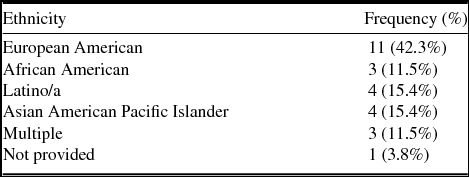
The sample consisted of n = 26 undergraduate and graduate students who sought treatment at the UCC of a large, public university and completed more than one session of CPT. Their ages ranged from 18 to 36 years; the mean age was 21.80 years. The sample predominantly identified their gender as female (n = 23). For ethnicity of sample, see Table 1.
Ethnicity of sample

Procedures
All students completed a standard intake assessment at the center, inclusive of a semi-structured symptom interview. All students in this sample endorsed experiencing a traumatic event that met Criterion A for PTSD. Criterion A events included: sexual assault (46.2%), childhood physical (3.8%) and sexual (19.2%) abuse, physical assault (3.8%), military combat trauma (3.8%), motor vehicle accident (3.8%), exposure to aversive details of a trauma (3.8%), and more than one category of trauma (15.4%). The PTSD Checklist for DSM-5 (PCL-5), described in the ‘Measures’ section below, was administered to all students at intake and was used in coordination with a clinical interview. The first PCL-5 observation was used in all analyses, whether it was from session 1 or the intake session. During treatment, each student was given measures at each session for both PTSD and depression. Scores from these measures were recorded in the students’ health records. After the first 12 months of CPT implementation, a retrospective chart review was completed for the 26 students who were seen for individual CPT and completed more than one session at the UCC by therapists who had recently completed training and were participating in ongoing consultation to become CPT providers. Institutional Review Board (IRB) approval from Rutgers University was given to perform a retrospective chart review to examine these data after the certification process was completed for all therapists.
Therapists
The eight therapists who completed the treatment for this sample had a wide range of experience: only one of the therapists had past training and experience using CPT, whereas the other seven were new to using this treatment. All eight therapists had recently completed a three-day workshop to learn CPT and were participating in weekly consultations to obtain certification while treating these students. At the time treatment was completed, therapists ranged in time since receiving their degree from zero (i.e. psychology pre-doctoral interns) to 15 years (i.e. licensed psychologists and social workers). More specifically, there were: four licensed psychologists, two pre-doctoral psychology interns, and two licensed clinical social workers. Most of the therapists had training and past experience in CBT and other evidence-based therapies, and identifiedy CBT as their theoretical orientation. One therapist in the study had an extensive background and identified as a family systems therapist; another had training as an acceptance and commitment therapy (ACT) provider.
Measures
PTSD symptom severity
The Post-traumatic Stress Disorder Checklist for DSM-5 (PCL-5; Weathers et al., Reference Weathers, Litz, Keane, Palmieri, Marx and Schnurr2013) was used to evaluate self-reported symptom severity at weekly sessions. This 20-item measure corresponds to the PTSD diagnostic criteria described in the Diagnostic and Statistical Manual for Mental Illness (DSM-5, 5th edition; American Psychiatric Association, 2013). Each symptom is rated in terms of severity from 0 (‘not at all’) to 4 (‘extremely’). Total scores on this measure range from 0 to 80. The PCL-5 has been demonstrated to have strong internal consistency (α = .94) and test–retest reliability (r = .82) (Blevins et al., Reference Blevins, Weathers, Davis, Witte and Domino2015).
Depression symptom severity
The Patient Health Questionnaire's 9-item depression subscale (PHQ-9; Kroenke et al., Reference Kroenke, Spitzer and Williams2001) was used to evaluate self-reported frequency of depression symptoms at weekly sessions. Symptoms are rated from 0 (‘not at all’) to 3 (‘nearly every day’). The PHQ-9 has been shown to have strong internal consistency (α = 0.89), and has been validated as a tool for diagnosing major depressive disorder (Kroenke et al., Reference Kroenke, Spitzer and Williams2001). Scores on this measure range from 0 to 27.
Data analytic approach
To investigate change in PTSD and depression symptom severity over the course of treatment, linear multilevel models were utilized with the intercept and slope specified as random effects. Symptom scores at each week were entered as the outcome variable and time was entered as the predictor variable. SPSS version 24 was utilized for analyses. All data from all participants were used, regardless of drop-out or missingness, consistent with the intent-to-treat principle. Reliable change (i.e. change in symptom scores that are not due to chance alone) was defined as a reduction in PCL total score of at least 5 points, and clinically significant change was defined as a reduction in PTSD symptom severity of at least 10 points (Weathers et al., Reference Weathers, Litz, Keane, Palmieri, Marx and Schnurr2013).
Results
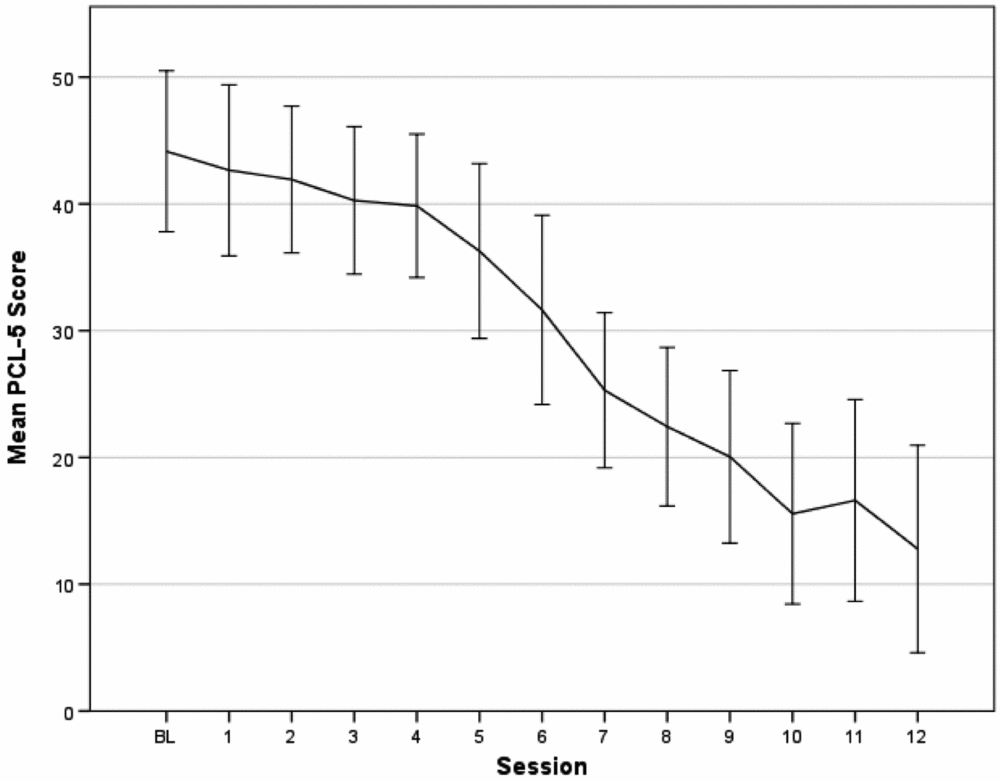
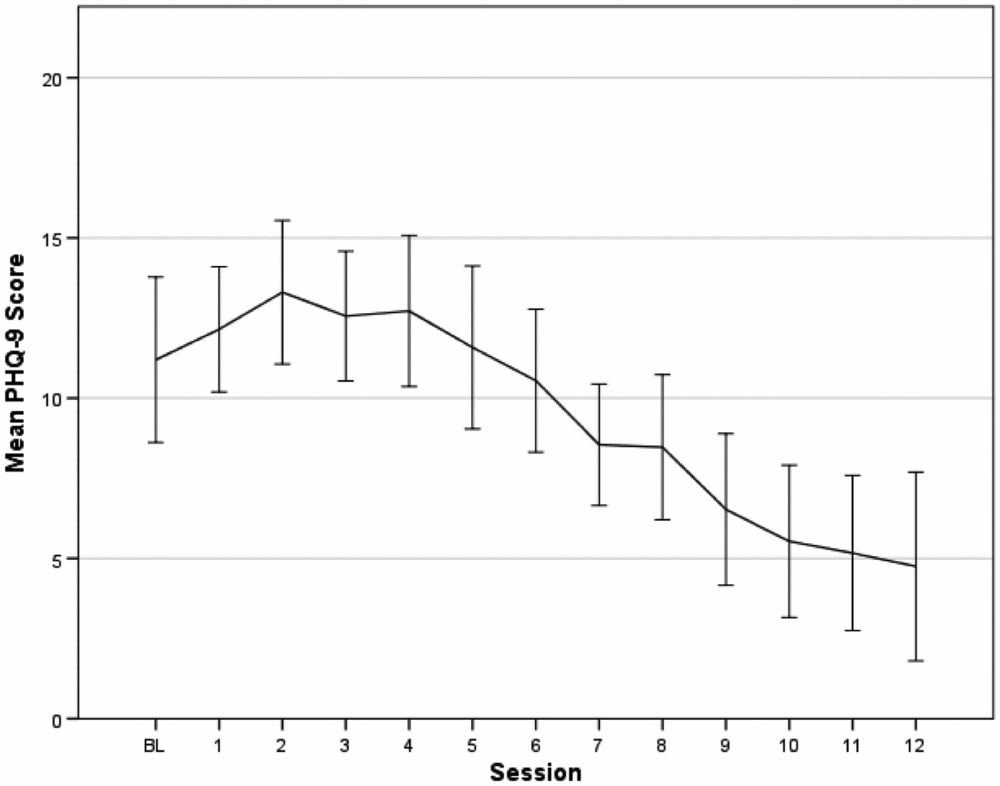
Approximately half (53.8%) of the 26 students completed all 12 sessions of CPT, four (15.4%) completed 10 sessions, and two (7.7%) completed nine sessions. Mean PCL-5 and PHQ-9 scores over time are displayed in Figs 1 and 2. Results of multilevel models indicated that PCL-5 scores and PHQ-9 scores significantly declined over time (PCL-5: b = –2.60, SE = 0.40, p < .001; PHQ-9: b = –0.44, SE = 0.15, p = .013). The main effect of time remained statistically significant in both models when adjusting for the number of years post-degree for therapists.
Mean Post-Traumatic Stress Disorder Checklist (PCL-5) total score over time among students receiving cognitive processing therapy for PTSD. BL, baseline.

Mean Patient Health Questionaire-9 (PHQ-9) total score over time among students receiving cognitive processing therapy for PTSD. BL, baseline.

In this sample, only 15.38% (n = 4) of students showed an overall reduction in PCL-5 scores from pre- to post-treatment that was smaller than 5 points. Another 15.38% (n = 4) students showed a reliable improvement from pre- to post-treatment, as indicated by their PCL-5 total score reduction of 5–9 points. Finally, 69.23% (n = 18) of students showed a clinically meaningful improvement from pre- to post-treatment, as indicated by a PCL-5 total score reduction of 10 or more points. Using the criteria suggested by Weathers et al. (Reference Weathers, Litz, Keane, Palmieri, Marx and Schnurr2013), 84.6% (n = 22) of students can be considered treatment responders. Additionally, 57.7% (n = 15) of students experienced a reduction of 50% or greater from first to last PCL-5. Effect size was calculated using mean PCL-5 pre- and post-scores d = 1.152. Effect size was also computed using mean PHQ-9 pre- and post-scores d = 0.479. Notably, three of the four students who had pre- to post-treatment changes of less than 5 points, resumed services at the center at a later date and were treated with CPT, and demonstrated additional improvement during the second course of treatment.
Discussion
In addition to replicating the previous finding that symptom remission in CPT frequently occurs prior to the full administration of the protocol, this study suggests that therapists’ years since obtaining their degree may not contribute to patient improvement. Results of this retrospective study additionally show promise for the dissemination of CPT in a UCC setting. All students in this sample had a criterion A event and symptoms of PTSD as indicated by a semi-structured clinical interview and PCL-5. Criterion A events included childhood sexual and physical abuse, sexual assault, and military combat trauma. Of particular interest, and supported by prior research (Galovski et al., Reference Galovski, Bain, Mott, Elwood and Houle2012), 75% of students who did not complete all 12 sessions can be considered to be treatment responders prior to completion of the full protocol. Given the often truncated or inconsistent time frames in which UCC counsellors have to work with patients, this finding provides further evidence that CPT can be effectively offered on undergraduate campuses. Although not included in the analyses, it is also noteworthy that three of the students who prematurely terminated returned at a later date to complete treatment. This could potentially offer assistance with treatment planning for a college population, given the frequent breaks in therapy continuity inherent to this setting. Insights about implementation of CPT with Active Duty Military Personnel, who may also have difficulty with treatment breaks and unpredictable schedules, were considered (Wachen et al., Reference Wachen, Dondanville, Pruiksma, Molino and Carson CS Blankenship2015). Counsellors may anticipate in their treatment plans the possibility not only of breaks in treatment, but also the ability to resume treatment without necessarily having to fully restart the protocol.
Years since obtaining their degree varied widely across therapists in this study, ranging from zero (unlicensed, pre-doctoral psychology internship trainees) to 15 years, and was found to have no significant impact on treatment outcomes. This offers promise for the continued dissemination of CPT; extensive time in the field may not be required in order for a provider to effectively offer this treatment. Treatment outcomes as measured by both the PCL-5 and PHQ-9 improved steadily over the course of treatment, dropping on average a total of 24.96 points and 4.00 points, respectively, by treatment completion. Utilizing prior-obtained measures of clinically significant change on the PCL for DSM-IV, these results suggest substantial gains beyond reliable change estimates. Years since obtaining degree and type of degree did not account for this improvement in symptom reduction. A more likely explanation for the consistent symptom remission seen across patients is fidelity to the protocol. Although fidelity was not formally measured in this study, therapist fidelity to the protocol was closely monitored by weekly consultation and supervision of cases.
Strengths of this study include the intent-to-treat analyses, use of a manualized empirically supported treatment with high frequency of observations, ongoing supervision and consultation to improve therapist fidelity throughout, and strong patient participation and completion rates. Furthermore, this study was conducted in a challenging clinical setting with broad inclusion criteria, and a wide range of therapist experience. Limitations of this study include the small sample size, and non-randomization to treatment. Additional limitations include lack of a control group, such as treatment as usual, to ensure that improvements were a result of receiving CPT. Another limitation is that this study did not include information about time since traumatic events occurred. For many of the students, traumatic events happened in childhood or combat, but others had more recent traumas such as sexual assault or motor vehicle accident as an adult. Natural recovery may have occurred for some of these clients. However, therapy for all students did not start until at least 1 month after the traumatic event. The two pre-doctoral interns in this study received supervision in addition to weekly consultation, which may have also contributed to successful client outcomes.
Future research at UCCs in particular is needed. A randomized, control trial of CPT in a university counselling setting would provide stronger evidence for use of CTP in this setting. Special focus more specifically on typical lengths of break in the protocol in an educational environment, and students’ abilities to resume treatment successfully upon returning to campus, would add to the current body of literature and help maximize treatment for this population. Progress in therapy prior to the break in sessions occurring, as well as symptom scores at the time of the break, may be possible indicators of ability to resume treatment where one left off, and of overall treatment outcome in such situations. Future research should also focus on more in-depth measurement of the factors influencing successful treatment outcome when faced with varying consistencies in treatment attendance.
Implications
This study shows promise for use of CPT in UCC settings. Results suggest that CPT can be utilized by therapists with wide-ranging experience. Findings of this retrospective study also indicate that students can benefit from CPT while incurring both planned and unplanned breaks of varying lengths. Review of the literature suggests that symptom remission prior to session 12 is not uncommon, and may be of particular interest to clinicians in this setting.
Main points
-
(1) Cognitive processing therapy (CPT) has strong potential for college students being treated in UCC settings.
-
(2) CPT can be implemented with novice therapists.
-
(3) Clients with PTSD diagnoses do not need to complete all 12 sessions of CPT to experience improvement in symptoms.
-
(4) Level of therapist experience was unrelated to clinical outcomes in this study.
Ethical statements
The authors assert that all procedures contributing to this work comply with the ethical standards of the relevant national and institutional committees on human experimentation and with the Helsinki Declaration of 1975, and its most recent revision. This study was granted IRB approval at Rutgers university, reference number: IRB #16-064M/.
Conflicts of interest
Charity Wilkinson, Meghan von Linden, Annmarie Wacha-Montes and Katherine O'Leary have no conflicts of interest with respect to this publication. Craig Bryan has received grants from the Department of Defense and Salary from Laredo Technical Services, Neuro Analytical Solutions.
Financial support
This research received no specific grant from any funding agency, commercial or not-for-profit sectors.
-
(1) To learn how cognitive processing therapy (CPT) can be successfully implemented in a University Counselling Center setting.
-
(2) To learn how novice therapists who complete CPT training and consultation can effectively deliver treatment for PTSD.
-
(3) To gain a better understanding of the impact of using CPT on symptoms of depression and PTSD in college students.



Comments
No Comments have been published for this article.