‘The avant-garde is in the audience.’Footnote 1
– Fred MotenThe avant-garde is in the audience? Is not Moten's assertion a paradox? After all, and as Jacques Rancière reminds us, a leading precept of ‘the’ avant-garde is ‘the topographical and military notion’ of the vanguard: an elite, technocratic cadre claiming an ‘ability to read and interpret the signs of history’ and ‘determine the direction of historical evolution’.Footnote 2 The avant-garde leads the audience from on high. Yet by the end of this article, I hope to show that the work of at least one artist forces us to rethink theories of avant-gardism in precisely the light Moten proposes: as a populist, popular force that joins-in and sublates itself with a proletariat that is always-already in the audience. And that process is sonic.
Not only is the ‘avant-garde in the audience’, but also its expression in/as a proletariat is sonic. It is an intriguing idea, which Moten explains by way of a prolonged meditation on the work of pan-African and Marxist theorist C. L. R. James. Specifically, Moten focuses on James's history of the San Domingo slave revolt, The Black Jacobins,Footnote 3 wherein James contrasts the revolutionary tactics of Toussaint L'Ouverture and Jean-Jacques Dessalines, the work's protagonist and the first ruler of independent Haiti, respectively. A proto-Marxist, Toussaint adhered to the tradition of the Enlightenment, what Moten labels the same ‘abstract-subjective-telic-white’ logic of the dialectic on which later European Marxisms (like Lenin's vanguard) would draw.Footnote 4 Toussaint dictated orders from afar. Dessalines, for his part, developed a ‘national-objective-present-black’ methodology of action, like James himself did much later; he sat on the cusp and in excess of ‘the historical trajectories of either Marx or Hegel’.Footnote 5 So, where Toussaint spoke the language of Bonaparte, and negotiated with colonial France directly – thus inserting himself into the dialectic – Dessalines reasserted the dialectic ‘from the outside’. He animated it. That is to say, ‘through production, through the ongoing production and consumption of performances’, Dessalines actualized action by embodying, being action.Footnote 6 No letters to France required.Footnote 7 Through what Moten deems a ‘truly radical aisthesis’, Dessalines democratized struggle, ‘proletarianized’ the slaves by giving the dialectic a ‘dialect’ excessive of it, in vernacular expressions like Vodun ritual, dance, and song, and in the physical act of leaping into the ditches with the slaves. It is the force of this movement – ‘jumping in the ditch, revolutionary tactic and dance’ – that Moten suggests constitutes the sonic and non-vanguardist foundations of the ‘black radical tradition’ generally: foundations which to him are really one and the same.Footnote 8 In James's depiction of Dessalines, one senses an ‘externalizing force … left behind in a sound, a loud hurrah enacting a certain interference of and with what is falsely described as common sense and reason, the material hyperrationality of the undercommons’.Footnote 9 This undercommons is the avant-garde, and the audience is in it.
While novel in his attention to Dessalines and sound, Moten is not the only scholar to assess the work of James in relation to the avant-garde. In his work on the African-American-led Black Arts Movement (BAM), Mike Sell, for instance, contends that The Black Jacobins ‘is enormously important to any discussion of the avant-garde and the BAM’.Footnote 10 He makes this claim for two reasons. First, like Moten, Sell flags James's reappraisal of Marxism, his rejection of ‘the development of vanguard political theory by the Left’. Second, he highlights how James's thought rests on an ambivalence – as did the BAM's well-known separatist programme involving literary expression, theatre, the visual arts, and much more.Footnote 11 Qua ‘black’ Marxism, James's ideas inhabit a shaky ‘inside/outside’ relation to Marxist history, praxis, and temporality, much like the BAM's ‘black’ avant-gardism did vis-à-vis Euro-American aesthetic, philosophical, and critical traditions.Footnote 12 James was to vanguardism as the BAM's stress on ‘black art for black people’ was to avant-gardism as classically conceived.
For as Sell reminds us, the canon of ‘the’ Euro-American avant-garde betrays a patently racist genealogy. Thus, by the turn of the 1970s (the BAM's heyday), it demanded revision, or at least de-centring. Glossing Italian futurism's ‘macho, militaristic white supremacist’ bent, Sell clarifies that Marinetti ‘wasn't just espousing modernization and machines in the abstract. His call for modernization of the Italian army and its supporting industries was echoed by his hatred for the antiracist, prolabor, democratic-humanist currents in Italy’.Footnote 13 If ‘the terms of the twentieth-century avant-garde tradition were substantially set by the futurists’ (hence Rancière's futuristic teleology), then it would only make sense that movements like the BAM wished to detach from that tradition's epistemologies, canons, and institutions – and to think the avant-garde anew.Footnote 14 For BAM-affiliate Larry Neal, such an (anti-)avant-garde would entail a ‘radical reordering of the Western cultural aesthetic’, ‘a separate symbolism, mythology, critique, and iconology’ beyond ‘white paradigms or models’. Plus, it would be ‘opposed to any concept of the artist that alienates him from his community’.Footnote 15 The avant-garde would be in the audience.
That prominent BAM scholar James Smethurst labels the Movement a ‘popular avant-garde’ seems only appropriate, then. Smethurst applies this moniker less to indicate a sublation of hierarchy, though, than to spotlight the BAM's revision of the avant-gardist trope of ‘the new’.Footnote 16 ‘Avant-garde’, he writes, ‘connotes a bold journey into the future that, as Ezra Pound polemicized, made things new … it suggests a vision of modernity which require[s] the wholesale abandonment or even destruction of existing culture.’Footnote 17 For Smethurst, BAM-figurehead Amiri Baraka represents an important alternative to this view. Underscoring the critic and poet's oft-cited tenet of ‘the changing same’, Smethurst explains how Baraka espoused an avant-gardism ‘that has roots in actually existing and close-to-home popular culture’ rather than the destruction of it. Baraka regarded ‘the semi-avant-garde of bebop’ and ‘the “free jazz” of such musicians as Ornette Coleman, John Coltrane, Cecil Taylor, and Sun Ra’ as mild changes in the same lineage that spawned African-American folk and popular culture.Footnote 18 ‘The new’ was not so new to this blues person, as the writer's own historically reflexive ‘jazz poems’ brought to a head.Footnote 19
Yet Baraka's Afrocentric outlook was far less democratic than Smethurst lets on. In fact, Baraka could be downright exclusionary – a vanguardist, even. Proffering free jazz as the cultural arm of black liberation, the poet distrusted black musics produced in the (white-owned) commercial sphere, and routinely voiced anxiety that the black masses of the late 1960s were rapaciously consuming rhythm and blues. For Baraka, Dionne Warwick was ‘emotionally expressive’ at best, whereas Coleman and company – like Baraka himself – were ‘self-conscious’. As Eric Porter summarizes this stance, Baraka trumpeted an avant-gardism that would be ‘consistent with the spiritual and communal needs, if not the tastes, of a black popular audience’.Footnote 20
But what do we make of those avant-gardists who found no contradiction between the ‘communal needs’ and tastes of a black popular audience? Indeed, how might we conceptualize the work of an artist who expressly aimed to extend avant-gardist tropes like (black)radical formal experimentation into the popular domain, precisely to enact a (black)radical politics? And, to zoom-out, how might the critical frames availed by Moten, Sell, Smethurst, and Porter require tweaking when applied to other black avant-gardes around the world, outside the United States (and beyond the cardinal status studies of black avant-gardism routinely grant the BAM)? Finally, what about those avant-gardes in which James was involved, as opposed to merely theoretically related? Drawing on archival research, this article pursues answers to such questions by sketching a historical portrait of an artist who not only reapplied James's philosophy, but also collaborated with the thinker directly: black British poet and recording artist Linton Kwesi Johnson.
Johnson is a giant in the history of black British poetry and music – ‘a kind of single Colossus’, in dramatist Burt Caesar's words.Footnote 21 In the 1970s, he innovated ‘dub poetry’, a written and spoken form that, while often accompanied by reggae, also integrates dub rhythms into verse.Footnote 22 Dub poetry was not solely literary or musical, however, but for Johnson tied to local grassroots and anti-racist struggle. It was also commercially popular. Signed to the Virgin and Island labels, Johnson was a leading reggae artist in his prime, releasing hit records such as Dread Beat and Blood (1978), Forces of Victory (1979), Bass Culture (1980), and Making History (1984). Seeking to document this convergence of interarts experimentation, activism, and mass-popular production, my study comprises four parts. Part one offers an introduction to Johnson's aesthetics by situating him in the lineage of what Moten, famously, has termed the ‘aesthetics of the black radical tradition’.Footnote 23 Centring on the poet's early career, and especially his connection to the Caribbean Artists Movement in London, I explore how an ‘excess’ of the kind Moten affiliates with Dessalines formed a core feature of Johnson's musico-poetics. Sections two and three concentrate on and theorize the ‘popular’ nature of Johnson's dub poems – specifically with regard to the poet's involvements with the Railton Road Community Centre in Brixton – whereafter I examine Johnson's political work with the Race Today Collective, a bastion for anti-racist organizing in 1970–80s Britain, where Johnson co-edited the Collective's journal, and led cultural initiatives and action campaigns. My combination of theoretical material and a finer-grained empirical lens in these sections should indicate that I wish for this article to expand on studies of black avant-gardism and avant-garde theory as well as cultural histories of Johnson and dub poetry in particular.Footnote 24 Adding to this latter body of literature, I use a host of primary materials to show how Johnson acted as a community-based documentarian in his songs. As I argue, Johnson behaved as a ‘collagist’ in avant-garde theorist Peter Bürger's sense, by ‘counter-historically’ documenting the activist efforts to which he also contributed via Race Today. Part four investigates Johnson's role in this institution's cultural initiatives specifically, and returns to the questions raised by Moten with respect to James – who also worked for Race Today. The 1978 Carnival events and a forum Johnson apparently co-facilitated, called ‘Black Creation’, receive special attention.
My study is far from comprehensive.Footnote 25 But by the end of it, I hope to have done enough legwork to demonstrate that the simultaneously anti-elitist and avant-gardist ethos identified by Moten is not as paradoxical as it may seem. Johnson exemplified this ethos, forging a ‘popular avant-gardism’ minus the baggage of Baraka's exclusions. And he rebuked Eurocentric avant-gardes much like the BAM did, but from the unique vantage of black Britain, histories of which this article likewise intends to contribute. To begin to consider, let us go to Johnson's early days in London.
From the Black Panthers to the Caribbean Artists Movement: dub poetry and the aesthetics of the black radical tradition
Johnson emigrated to London from Jamaica in 1963, whereupon he enrolled in Tulse Hill secondary school in the South London Borough of Lambeth. While there, he endured what critic Vivien Goldman, in a profile in Sounds magazine, dubbed an ‘archetypal immigrant childhood’, an experience of estrangement Johnson himself portrayed as follows: ‘I used to think literally the streets of London were paved with gold … so I was in for a rude awakening when we arrived and I saw all these grey buildings with smoke coming out of chimneys and so on.’Footnote 26 ‘Tulse Hill’, meanwhile, ‘was initially a very traumatic experience because that was my first confrontation with racism’ outside the Caribbean.Footnote 27 ‘I was naturally put into a very low stream [of students] because they assumed that if you came from the Colonies you aren't up to it … I was really, really surprised at the amount of prejudice from the staff’ (italics in original, et passim).Footnote 28 Britain's colonial past was obdurate. If by the 1980s, liberal multiculturalism would be its byproduct, then in the 1960s official discourse on race remained baldly discriminatory, premised in an ‘enemy within’ notion of national(istic) cohesion.Footnote 29 As Johnson puts it in his semi-autobiographical text, ‘Writing Reggae’:
The Britain that I grew up in during the 1960s and early 1970s bears little resemblance to the so-called Cool Britannia of multiculturalism, now apparently in crisis. Even a decade after the Notting Hill and Nottingham race riots of 1958–59 Britain was still a decidedly racially hostile place … There was not an institution of the state not riddled with racial prejudice, none more so than the police and the judiciary, who together ensured the criminalisation of a significant section of my generation of black youth. Members of the Flying Squad, it was said, were rewarded with a tie with an ace-of-spades logo on it after they had put a certain number of blacks behind bars. Black children were routinely sent to ‘ESN’ schools – schools for the educationally subnormal … The colour bar was alive and well.Footnote 30
Such a context ‘makes it very easy [for young blacks] to be politicised’, Goldman noted.Footnote 31 By his late teens, Johnson became politicized indeed.
‘I became involved in the Black Panther Movement [in 1970]’, he recalls, joining the organization's youth wing following a rousing presentation delivered at Tulse Hill by Panther figurehead, Althea Jones.Footnote 32 The link-up proved formative. At the Panthers, Johnson was encouraged to study the black literary canon, notably authors such as James, Frantz Fanon, and W. E. B. Du Bois, and to try his own hand at writing. On both of these fronts, Du Bois was a particular interest. ‘He talked about “The Colour Line”’, Johnson reflects. ‘The problem of the 20th century was the problem of the colour line. And after I read [him] I just wanted to read more and to write more and to express my own ideas and my own feelings and my experiences about growing up in England.’Footnote 33 Following yet additional studies at New Beacon Books – Johnson cites reading Aimé Césaire at John La Rose and Sarah White's now-legendary store as a pivotal influence – the poet co-founded a Panther-associated group called the Black Literary Society, in which to workshop poems vis-à-vis Du Bois's theories. The Society quickly dissolved; but it remains important historically – indeed, momentous. In conjunction, Johnson and fellow Panthers established arguably London's first Rasta drumming ensemble: Rasta Love.Footnote 34
It is here that one observes a clear link with Moten's ‘aesthetics of the black radical tradition’, and with the BAM specifically. As Johnson remembers, ‘in the Panthers I heard the Last Poets’, BAM-affiliates.Footnote 35 ‘We used to have the albums of the Last Poets which circulated amongst the membership and I was attracted to what they were doing, using the voice and percussion. I started to do that … The drummers [I performed with] were called Rasta Love.’Footnote 36 Unfortunately, like the Society's poems, Rasta Love's corpus has largely eluded historical documentation.Footnote 37 But there is one notable exception: a hybrid work of theatre, poetry, and music titled Voices of the Living and the Dead – a piece that brings Johnson's early aesthetics sharply into relief.
Written by Johnson and premiered by Rasta Love in 1973, the piece is nominally a play, featuring four ‘characters’, including personifications of the Dead, an Echo, and the Living, plus a narrator. Musically, it calls for drums, bass guitar, and flute.Footnote 38 Resembling Césaire in its fragmented verse and Fanon in ‘its emphasis on violent insurrection’,Footnote 39 the work lacks an obvious narrative; instead, it unfolds through a call-and-response structure, as Dead makes a statement, Echo ‘echoes’ it, and the Living draws comparisons between recent political events (among the ‘living’) and those of the past (the ‘dead’). Convening what critic Robert Stewart calls a ‘libation for the ancestors of black history and struggle’ generally, Voices at the same time alludes to black British locality specifically.Footnote 40 Have a read. While attending to the piece's dual temporality, consider also the way Johnson evokes the experiences glossed in ‘Writing Reggae’. Not for nothing did one critic think Voices ‘sensed accurately the events which tore at the guts of British society in the summer of 1981’ – the 1958–9 riots’ second showing.Footnote 41 If, in Johnson's words, the ‘wounds’ of history had turned into ‘scars’, then his not-so-subtle invocation of MP Enoch Powell's infamous ‘Rivers of Blood’ speech of 1968 suggests a new wound and catalyst for impending insurrection.Footnote 42
DEAD: There is a scar …
ECHO: A scar … a scar … a scar … a scar
DEAD: On the finest flower of history's
spring-time garden.
There is a wound
ECHO: A wound … a wound … a wound … a wound
DEAD: On the sacred breast of silence.
There is a trance
ECHO: A trance … a trance … a trance … a trance
DEAD: Transfixed in the eyes of madness …
ECHO: Mad-
ness
mad-
ness
[…]
LIVING: My heart fluttered and trembled
like a freshly headed fowl
as I ran gun in my hand
and a rainbow of sweat in my eyes.
Stand still you trembling hill,
my heart, I cried,
you galloping thing gone wild
be cool and controlled … be still
at this most sacred hour.
Then the banks of the river
of rage exploded …
Then blood began to flow.Footnote 43
How might one conceptualize Voices’s aesthetic demeanour? A textual excerpt can hardly do justice to the piece, which demands performance. But there is more at interpretive stake than simply losing out on the work's ‘presence’.Footnote 44 To this end, Voices’s intermedial status is instructive. While technically a piece of theatre, in 1974 Voices was published as Johnson's ‘first book of poems’.Footnote 45 Accordingly, whether to witness the work live, to read it privately, or to hear it recited would seem perfectly valid modes of aisthesis.Footnote 46 Yet there is still more to take into account. Because to read the text would also mean to view a set of drawings by artist Errol Lloyd, which the book's publisher intercalated throughout, suggesting an importantly graphic expressive dimension to the work. Throughout his career, Johnson would consistently integrate visual elements of this sort in his publications (to say nothing of album art or images in liner notes); alongside Voices, the 1981 collection, Inglan is a Bitch, likewise contains several illustrations, serving as a prime example of this convergence of media.Footnote 47 That Johnson dovetailed media in this manner should scarcely come as a surprise, though, given his debt to Du Bois, Fanon, Césaire, the Last Poets, and so on. After all, as Moten insists, ‘black performance’, historically, ‘has always been the ongoing improvisation of a kind of lyricism of the surplus’.Footnote 48 In Voices, such surplus entails medial undecidability. In Moten's terms, Johnson enjoins an ‘appositional encounter’, a ‘visual-spatial-tactile improvisation of [a] system’ of formats and generic contracts enacted in the ritual of performative and interpretive acts. Granted, it would be reductive to limit experimentation of this kind to African-diasporic cultures; ‘intermedia’ has remained a constant in the post-conceptual arts at large.Footnote 49 And yet, as Brent Hayes Edwards has recently argued, the history of black aesthetic technologies affords an exceptionally illuminating site for unpacking this drive. Variously textual, graphic, sonic, and phonic, Voices situates itself squarely in this history, exploiting the electricity produced by the friction of cross-cutting media, ‘testing and stretching and redefining the frontiers of articulacy’.Footnote 50 As in James's revision of Marxism, this anti-hierarchical, ‘radical nonexclusion’ of elements offers a field of possibility: a modality of interstice and excess wherein ‘(re)visions of Enlightenment formulations of universality and freedom’ have – again, historically – been empowered.Footnote 51
At any rate, if Voices reflects Johnson's reimagining of extant black radicalisms discovered at the Panthers and New Beacon, other involvements at this time manifest the poet's keen interest in interfacing this political-aesthetic with likewise extant avant-garde formations. Johnson's participation in the Caribbean Artists Movement (CAM), mentioned earlier, proved key to this interest. Active between 1966 and 1972, the CAM represented a Britain-based analogue to concomitant black arts initiatives across the globe, such as the BAM, yes, but also numerous other post-war movements in the wake of the 1920s New Negro Movement, Afrocubanismo in Cuba, Haiti's indigénist movement, and more.Footnote 52 By contrast with these groups, however, the CAM signalled the first institutionalized effort to concentrate on the whole of the Anglophone Caribbean and its diaspora, thus departing from a ‘black aesthetic’ per se (as in Baraka) in favour of a stress on creolization and what co-founder Kamau Brathwaite called ‘intercultural’ exchange.Footnote 53 Johnson caught only the tail-end of the CAM; ‘I am what the cooling embers of the movement spawned.’Footnote 54 Still, the Movement's impact on Johnson is difficult to overstate, and in particular that of Brathwaite, whose presence gave the young poet a crucial push for thinking critically about music-text relations: a fundament, that is, of what would become Johnson's hallmark, dub poetry.Footnote 55 Indexing what Moten would call ‘musicked speech’, Johnson remembers:
On reading Brathwaite, I could recognise imagery which came out of my background in the Caribbean. I could recognise something which I had never heard in poetry before, apart from the Afro-American poets who sort of worked in the Jazz-Blues tradition. I was hearing Caribbean rhythms in poetry. And I was seeing Caribbean poetry written in the spoken vernacular, or in ‘nation language’, as Brathwaite calls it … one could see that in the poetry one could hear steel pans, one could hear reggae.Footnote 56
Let us dwell on this statement momentarily. In it, Johnson flags two interrelated facets of Brathwaite's thought, which not only preoccupied debates within the CAM, but also pervaded Johnson's output from the 1970s onward: a concern for ‘musicked speech’, and its apparent corollary, ‘nation language’.Footnote 57 This latter term is especially problematic. As summarized in his celebrated History of the Voice, Brathwaite theorized the idea to refer to the submerged, allegedly transhistorical voice of the Afro-Caribbean people as registered in oral cultural traditions.Footnote 58 Such linguistic variations as patois or pidgin emerge not as derivations of English, or as ‘dialects’, Brathwaite argues, but as quasi-languages all their own. Nation language bespeaks the historical roots of oral culture as a history of routes, ‘the submerged area of dialect which is much more closely allied to the African aspect of experience in the Caribbean. It may be in English: but often it is in an English which is like a howl, or a shout or a machine-gun or the wind or a wave.’Footnote 59 Hence this concept's basis in ‘surplus’, a ‘horizon of articulacy’ – indeed, in music. For Brathwaite, nation languages both stem from and mimic Afro-Caribbean musics such as kaiso, calypso, and reggae; rife with whispers, assonance, and stuttering, they likewise stress performance. To wit, Brathwaite sees vernacular speech and vernacular music as two sides of the same coin, both of which are part of a ‘total expression’ that evades standard English, not least because colonial education structures absented nation languages altogether. This last point is paramount. If, according to Peter Hitchcock, History of the Voice reflects ‘an archaeology of voice, a history intoned more than inscribed’, then it likewise suggests a supplement to hegemonic literary models.Footnote 60 ‘The hurricane does not roar in pentameters’, as Louise Bennett, Claude McKay, Mighty Sparrow, and indeed dub poets such as Johnson – all of whom are analysed in History of the Voice – knew well.Footnote 61
In short, the simultaneously everyday idiom and literary technique Brathwaite named nation language aimed to furnish a decolonial consciousness: in Brathwaite's words, a ‘syllabic intelligence’ premised in aurality.Footnote 62 Pace Hitchcock, though, Brathwaite routinely inscribed this consciousness into text, as the poet's well-known Rights of Passage collection makes plain. Brathwaite employs short, alliterative, and onomatopoetic lines in the tome, as if to transcribe performances or recitations. In the poem ‘Wings of a Dove’, for instance, he replicates the trochee sound-structures of Rasta drumming, while in the process weaving a dense fabric of ‘intercultural’ musical allusions. ‘Titled after a traditional Pukkumina ritual song in Carlos Malcolm's ska recording, “Wings of a Dove”’, the text of the poem in turn references the ‘Dry Bones’ spiritual popularized by African-American composer and polymath James Weldon Johnson.Footnote 63 ‘Watch dem ship dem / come to town dem … / prasin’ the glory of the lord.’Footnote 64 Music is made both content and form.
In any event, and to reiterate, I belabour the matter of nation language because it formed a germinal point of departure for Johnson's poetry from his involvement in the CAM onward (and after Voices, which exempted nation language).Footnote 65 Johnson did not adopt Brathwaite's theory wholesale, however. Deviating from Brathwaite's interest in Afro-Caribbeanness generally, Johnson often used nation language as a means of rendering the localized diasporic experience of the British nation specifically – as he would later put it, ‘Dread Inna Inglan’ (see section ‘Dub poems as “avant-gardiste works of art”’).
A case in point of this emphasis on locality would be the 1973 ‘Five Nights of Bleeding’, Johnson's first published poem, and early attempt at putting his own spin on Brathwaitean and similar principles. Dedicated to Leroy Harris, a teenager who was stabbed at a South London party, the song chronicles ‘five nights’ of violence at London clubs. Adopting patois as its mode of address, the piece invokes a transnational quality while at the same time speaking the language of the poet's local fanbase.Footnote 66 And it does so in multiply sonic, ‘excessive’ ways. First, the piece recruits reggae rhythms as a syntactic basis; as critic Mervyn Morris observed in 1983, ‘we can distinctly hear reggae rhythms in or under [its] verse’.Footnote 67 Simultaneously, the piece is about the soundscape of 1970s London, referencing music venues such as Shepherd's youth club in Brixton, the Rainbow Theatre in Finsbury Park, and Soprano B sound system. Lastly – and most innovatively – Johnson potentiates the poem to contribute to the very music scene it describes. Published in 1973, ‘Five Nights’ was also recorded on the 1978 LP Dread Beat and Blood, a hit record that would have been spun regularly at Shepherd's (where Johnson also worked; see below), versioned at the Rainbow, dubbed-over by Soprano B, and so on. As you read the following excerpt, part of which is Brathwaite's transcription of Johnson's performance, I suggest that you also listen to the 1978 recording in order to get an impression of the poem's musical traits.
Did you hear it? BRIX/TON. Sys/tem. Mad/ness… war. Like reggae guitar strokes, iambic upbeats suffuse the poem's structure, cross-cutting media. Via the inscription and recitation of patois-based verse, Johnson transforms reggae music into reggae poetry formally, while evoking the music played at Shepherd's, the Rainbow, and Soprano B in terms of content. To be sure, Brathwaite had already amply investigated this nexus of form and content. That Johnson updated Brathwaite's techniques by recording ‘Five Nights’ on the popular medium of the LP, though, commands pause. A collection of pop songs, Dread Beat and Blood was a far cry from the ‘self-conscious’, ‘certifiably “out there” sounds of Cecil Taylor and Ornette Coleman’.Footnote 70 This is music you can sing along and dance to. Accessible musically, it could likewise be readily consumed, available for purchase at local record stores, and for a listen at sound systems.Footnote 71 No attendance at a CAM meeting required. You need not even attend a performance. You do not even have to read this dub poem! Johnson in a sense commodified the avant-garde, making CAM-inspired techniques ‘popular’ by at once documenting and relating the excesses of nation language to the concrete circumstances of black Britain as noted in ‘Writing Reggae’.Footnote 72 The avant-garde is in the audience, as an LP. The audience makes their own ‘appositional encounters’ in the act of listening. In part, such is Johnson's popular avant-gardism in action.
Johnson's popular avant-gardism and the ‘booshwah’ institution: the Railton Road Community Centre
But how do we know Johnson's recordings were actually in the audience? And how did Johnson sublate his position as artist in relation to that audience in the manner described by Moten in the introduction? To both queries, I would respond that we might productively glean the nature of Johnson's blossoming popular avant-gardism by turning back to Sounds – that is, a leading popular music journal of the day.
Or more precisely, consider the following statement by Sounds’s Eric Fuller regarding a 1979 biopic about the artist produced just after the release of Dread Beat and Blood. Directed by Franco Rosso (best-known for the 1980 Babylon), the film shared much of its impetus with the preoccupations of the present article, seeking to detail the community-inclined slant of Johnson's oeuvre. Widely hailed as a significant achievement, what excited critics most about the piece, also titled Dread Beat and Blood (more appositions!), were the first-hand glimpses it offered of the poet at work in the community spaces and action campaigns I describe more extensively momentarily. Wrote Fuller:
The poet appears in oral action in Railton Road Community Centre [while] reasoning with the unemployed and SUSpected in the Keskidee Centre … The recitation of his disco 45 ‘It Dread Inna Inglan’ to a crowd of Bradford Blacks demonstrating for the release of George Lindo, flanked by a brace of policemen, oozes barely restrained violence while clips of full scale war at the ’76 Notting Hill Carnival benefit from [sic] reasoned and sympathetic commentary.Footnote 73
That Johnson attracted the interest of such an eminent filmmaker as Rosso speaks volumes about the poet's emerging popularity. The biopic itself added to this. Although ‘I had already developed a cult following performing my poetry with the Rasta drummers’, Johnson recollects, ‘the film, I think, did a lot in making me known to the wider public.’Footnote 74 But likewise, Rosso's production testifies that Johnson was also himself part of the demographic to whom much of his intermedial praxis was targeted. As Brixtonite Akua Rugg remarked:
The strength of the film lies in the fact that, in society today, artists are usually seen as extraordinary people above and beyond the understanding of ordinary folk. ‘Dread Beat and Blood’ shows us how Linton puts his talents at the service of the black working class from which he comes, and that this background has been a source of strength to him.Footnote 75
For my purposes, it merits pausing to get a clearer sense of how Johnson put the ethos underlying Rugg's and Fuller's commentaries into practice. For their observations not only begin to evince what later I characterize as the poet's Jamesian cultural politics. Moreover, Johnson's work at the Railton Road Community Centre, specifically, enables us to re-evaluate a key tenet of most avant-garde theories from a decidedly popular avant-gardist perspective; namely, the joint matter of the ‘bourgeois institution’ and ‘anti-bourgeois’ art.
As such influential theorists as Peter Bürger, Marjorie Perloff, and Andreas Huyssen have observed, the ‘historical avant-gardes’ of Dada, Surrealism, Futurism, and Russian Constructivism wished routinely to develop an ‘anti-art’ sensibility: to deploy the products of their labour as a means of critiquing the very conditions of production and exhibition on which the art-world relied; through these ‘institutional critiques’, the remnants of nineteenth-century aestheticism including the principle of autonomy and disinterested judgement might fade, in favour of jettisoning institutions altogether in order to merge aesthetics with everyday life.Footnote 76 Famously, Bürger deemed these ambitions to have failed; by the time the initial shock of ‘the’ avant-garde waned, he holds, the art-world had absorbed and thus annulled all avant-gardes’ critiques of it, be they a urinal with ‘R. Mutt’ written on it (to demystify institutions’ ability to accord ready-mades with value), a manifesto (which endeavoured to interpellate an audience on behalf of a cause), or a ‘neo-avant-gardist’ multiple of the sort associated later with Warhol, Fluxus, and others.Footnote 77 As popular avant-gardist, Johnson did not fulminate against institutions such as the gallery or museum. Nor did he pose institutional critique or the convergence of art and life – the twin evergreens of many avant-garde studies – as expressed problematics.Footnote 78 But he did inhabit other kinds of institutions, both ambivalently and strategically. Notably, he exploited his budding celebrity as flagged by Rugg in market institutions in order to facilitate activist efforts at the grassroots institutions invoked by Fuller.
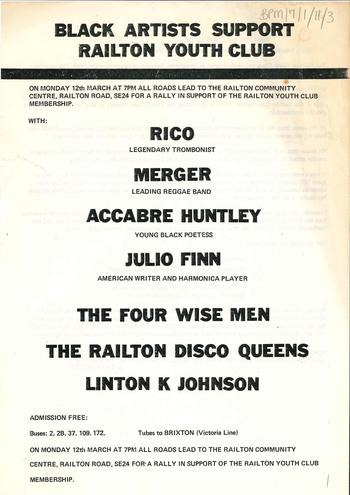
Johnson's position at the Railton Road Community Centre, also known as Shepherd's – the same Shepherd's from ‘Five Nights’ – throws this twofold institutional status into relief. Founded in 1964 by the Methodist Church, Shepherd's was a 100 per cent black youth club, and hosted events ranging from dances to sport leagues to sound systems (Soprano B periodically played there).Footnote 79 Johnson worked at the Centre, and dwelt frequently on his involvements there in press interviews; above all, he spoke of the Railton Youth Club Action Committee (RYCAC), a subgroup the poet helped form amid a shake-up in the Centre leadership in 1979. According to an October 1979 issue of Action Line, the Committee's newsletter, the Centre underwent the change involuntarily, when the Methodist Association of Youth Clubs and affiliate parties not only closed Shepherd's without notice, but also suspended a youth worker named Ivan Madray: ‘Righteously angered by this high-handed action, Railton youth club members responded immediately. Together with workers, [they] seized the club premises and staged a sit-in which lasted three long months.’Footnote 80 In addition to re-opening the club, sit-in participants issued three demands: to reinstate Madray; to ensure that other workers could stay at Railton; and to grant Centre membership bargaining power. In part to pressure the Methodist Association, Johnson – again, strategically – exploited his growing celebrity in order to stage a rally, which drew nearly five hundred attendees, and made for a star-studded show to boot: ‘The rally was supported by black artists like Rico, Merger, Accabre Huntley, the Four Wise Men, The Railton Disco Queens and Linton Johnson’, Action Line recounts (Figure 1).Footnote 81 Subsequently, and crucially, the poet utilized his access to the press in the hopes of garnering support for RYCAC struggles more publicly. Glossing the release of his 1980 record Bass Culture, Johnson put the matter succinctly: ‘People could say I'm using the youth club to publicise my record … when in fact I'm using my record to publicise the youth club.’Footnote 82
(Colour online) Flyer for a rally in support of the Railton Youth Club Action Committee. Accessed at GPI, the Railton Community Centre collection, GB 2904 BPM/7/1/11/3. Reproduced with permission from the George Padmore Institute.

Johnson made this statement in Sounds. This should be double-underlined. For Johnson's popular avant-gardism – the transposition of experiments at the CAM and with Rasta Love into the commercial mainstream and the grassroots domains – did not radically oppose the cultural industries. Rather, and to put a point on it, the poet engaged these structures tactically, precisely to elicit support for causes of the variety pursued by the RYCAC. Such an orientation towards popular culture digressed from the anti-bourgeois ‘anti-art’ of the historical avant-gardes, whose manifestos, for instance, certainly attempted but nonetheless struggled to reach a wide audience; similarly, events such as the RYCAC rally differed substantially from the attention-grabbing exhibitions of the Dadaists, say, which as David Hopkins reminds us attracted only small patches of bourgeois elites (hence the ‘failure’ of Dada's anti-bourgeois purview).Footnote 83 This is not to say that Johnson wholly evaded a ‘theory-death’ of this kind, however.Footnote 84 In fact, at Shepherd's, the poet persistently found himself butting against a ‘bourgeoisie’ of a different sort: in his words, London's ‘black petty booshwah’.
In Action Line, Johnson co-wrote:
Most of us are aware of the fact that since he got his job back, Ivan Madray has made it clear that he is not willing to tolerate any members organisation in the club which was independent of him, and [with the active connivance of the management committee and Methodist Church authorities] has set about trying to antagonise, frustrate, discredit and destroy [the] Action Committee [sic].Footnote 85
Madray no longer identified with the very campaign that led to his reinstatement, it seems, having indeed antagonized the RYCAC in several ways. As Johnson alleges, Madray attempted to thwart the poet from representing the RYCAC on the London Fyle radio programme; barred management sympathetic to the RYCAC from attending organizational meetings; and even trafficked in ‘high-handed’ actions of his own, firing three members of Railton's administrative team without notice.Footnote 86 Yet the most disheartening action entailed a measure ‘to officially exclude members over 21 years of age from the activities of the club’, thus reversing a tradition of maintaining ‘links between different generations of young blacks with differing sets of experiences’.Footnote 87 For Johnson, this ‘autocratic’ act symbolized a burgeoning trend towards careerism within the black community at large, somewhat in the vein Lester Spence has diagnosed.Footnote 88 Accordingly, Action Line declared, ‘Enough is Enough, the Madrays Must Go!’: ‘We will not allow people who live outside of our experience dictate to us … it is up to members to fight to preserve our rights and protect what is ours’.Footnote 89 Amplifying this sentiment, Johnson released the song ‘Di Black Petty Booshwah’, on Bass Culture, in an effort to clarify how Madray ‘lived outside’ the experiences of RYCAC members. As he told ZigZag – like Sounds, another major music journal – ‘I was basically talking about Ivan Madray.’ The song ‘is talking about a section of the black community who make a living out of the colonial situation that blacks find themselves in here in Britain. They don't believe in radical change, revolutionary change … They hustle a living off the State … They get all these big urban aid grants and all this Inner City partnership money’, selling their agendas with ‘black power rhetoric’ without trying genuinely to fulfil its tenets.Footnote 90 Set to ska rhythms, the following text captures this view concisely: ‘tru dem seh dem edicate dem a gwaan irate / tru dem seh dem edicate dem a seek tap rate / dem a seek posishan / aaf di backs af blacks / seek promoshan / aaf di backs af blacks / dem a black petty-booshwah / dem full a flaw.Footnote 91
To be sure, I do not wish to suggest that Johnson's work in the RYCAC or elsewhere somehow voids the value of classic theories of the avant-garde. Nor do I want to imply that the historical avant-gardes’ anti-elitist or even ‘popular’ ambitions were vacuous, gobbled by the very institutions they purported to counteract, as Bürger does. Instead, part of what I hope to highlight is how Johnson's activities permit those of us invested in avant-garde studies to broach the topic of institutionality more charitably. As popular institutions rooted in the marketplace, Sounds and ZigZag enabled the propagation for an ‘anti-bourgeois’ campaign at the grassroots level, which itself unfolded within a community institution that dealt with agonisms of its own. Institutions served not as foils, but as vehicles through which a popular avant-gardism was achieved, if ambivalently. This would not be so remarkable were it not for a certain preponderance in avant-garde studies to understand avant-gardism categorically as anti-institutional.Footnote 92 Johnson's avant-gardism was in the audience, by way of institutions – as was the CAM's before him (not to mention the BAM's). I elaborate on the grassroots character of such activities shortly, ultimately returning to James to do so. But as a means of getting there, I now explore ways Johnson's work also resonated with classic theories of avant-gardist practice (recall Sell's ‘inside/outside’ designation). Following Bürger, I show how dub poems can be interpreted as ‘avant-gardiste works of art’.
Dub poems as ‘avant-gardiste works of art’
A theoretical excursus
As Bürger has discussed, avant-gardist artworks customarily involve an ‘allegorical’ stance towards their historical situation, a tendency the critic rightly associates with standby techniques such as collage and (photo-)montage. Or more acutely, Bürger concentrates on what he calls allegory's ‘non-organic’ principle of construction, which for him entails a few key steps. First, ‘the allegorist pulls one element out of the totality of the life context’, whereupon this fragment – a news clipping, extant recording, etc. – is imbued with a meaning ‘which does not derive from the original context of fragments’.Footnote 93 By juxtaposing found bits like these, ‘cut’ from the real, the allegorist imparts them with a new significance and – importantly – a critical agenda; for this reason, Bürger treats ‘avant-gardiste works of art’ as at-root historically reflexive in nature.Footnote 94 In the Dadaists’ or Constructivists’ collages, for example, ‘the observer is confronted with the “facies hippocratica” (the deathmask) of history as a petrified primordial landscape’, a shock-inducing re-rendering that destabilizes dominant historical narratives.Footnote 95 While on one hand militating against the autonomy principle, Bürger reasons that non-organic art thus also parallels the historical-materialist method developed by Walter Benjamin. For neither such art nor Benjamin's method depict the past positivistically, ‘as it really was’. Rather, they explode ‘the original context’ in order to propagandize a new one. Allegory bespeaks a counter-history, and the allegorist a counter-historian, for whom like Benjamin's Angel ‘the world must be made anew to wrest tradition away from a conformism that is about to overpower it’.Footnote 96
Certainly, Bürger's views on allegory should not be taken as the only or authoritative ones.Footnote 97 Yet in the case of Johnson's dub poetry, I find his emphasis on counter-history productive, in that it resembles closely recent scholarship on dub, a practice based heavily on collage techniques. As Michael Veal observes, (de-)constructivist and meta-historical desires to ‘express in new formats regenerative powers’ utterly dominate dub aesthetics. But by contrast with Dada, Constructivism, and so on, Veal associates dub's fragmentary and non-linear qualities with diasporic experience. He writes, ‘Dub may be one of a number of diasporic musics on which a traumatic history and turbulent present has left its structural imprint, “converting the outrage of the years into a music” through an aesthetic of broken, discontinuous pleasures that may represent a synaptic adaptation to long-term historical trauma, but that also fit into a broader global pattern’ – that is, the lineage Bürger traces – ‘in which collage forms join the search for new realities to define the twentieth century.’Footnote 98 For Veal, the work of Lee ‘Scratch’ Perry, Scientist, King Tubby, and others both musically reflects and inserts itself into ‘broader context[s of] erasures, tears and disruptions in the seam of history’. From its thematizing of the Manley-Seaga years (Jamaica's ‘roots’ era) to the legacies of the Middle Passage, ‘dub is the sound of a society tearing itself apart’.Footnote 99
Building on Bürger and Veal, the present section argues that the localized aesthetic exhibited by dub poems such as ‘Five Nights’ and ‘Di Black Petty Booshwah’ allows us to expand our understanding of the meanings of both dub and collage methods. I propose that Johnson's dub poems operate as ‘avant-gardiste works of art’, and not just in the musical terms of Veal's sense of diasporic trauma. Additionally, their lyrical contents index counter-histories in Bürger's sense of propagating a ‘real’ in the face of hegemonic narratives (Veal's ‘new realities’). I highlight this latter facet of Johnson's oeuvre not to depict the poet as a ‘griot’, the vernacular chronicler of everyday micro-histories; he bore no direct connection to this tradition.Footnote 100 He did occupy the role of documentarian, though – as allegorist. As Fred D'Aguiar reminds us, by the early 1980s, Johnson had established himself as ‘the leading poet of protest in the black community’, producing ‘literary and political document[s]’ that both recorded events important to this community and themselves ‘form[ed] a part of the history surrounding [it]’.Footnote 101 The very title of Johnson's 1983 poem, ‘Making History’, which commemorated the 1981 riots from a black British perspective, suggests that the poet was well aware of this status. In turn, Johnson recorded such counter-historical accounts atop collage-heavy music tracks based in dub: as on the album of the same name.Footnote 102 Johnson was a twofold collagist, in both Bürger and Veal's senses. To explore further, let us take a look at his work at the Race Today Collective, an organization whose grassroots campaigns Johnson partook in and paid tribute to in his dub poems, in the manner of but also more extensively than his work at Shepherd's.
Johnson and the Race Today Collective: dub poems as ‘avant-gardiste’ counter-histories
The Race Today Collective (hereafter Race Today or Collective) was formed as an outgrowth of the Panthers, which in the wake of internecine debates in the early 1970s began to splinter partially at the behest of Party organizers Darcus Howe and Farrukh Dhondy.Footnote 103 Subsequently, Howe and Dhondy joined the editorial board of the magazine Race Today, which preceded Race Today as such, and was at the time operated out of the Institute of Race Relations.Footnote 104 Initially, the journal was dry and academic in tone, and focused on the colonial territories. But ‘we turned it into a radical black newspaper’, Howe recalls, striving to augment Race Today’s coverage to speak to the local black community. Campaigning proved another motivating factor in this transformation. As Howe puts it, ‘the intention was to be aggressively campaigning, and to “record and recognize” the emerging struggles in the black community’.Footnote 105 To this end, Race Today de-emphasized the militant and internationalist ‘tropes that had been integral to the first phase of Black Power’,Footnote 106 favouring instead to cover and campaign for things such as unionization drives and walk-outs, black studies in school curricula, and struggles against abusive policing.Footnote 107 If the Race Today journal and Race Today campaigns were reciprocally intertwined, so too was Johnson's relationship with these entities. By 1976, Johnson joined Race Today as poet-in-residence, and later became co-editor of the magazine. While there, he published poems, wrote criticism, and spearheaded cultural initiatives and campaigns. The dub poems he published in Race Today ‘allegorized’ the histories with which they shared page-space – histories that were themselves counter-historical inasmuch as they either escaped notice of or were cynically ignored by mainstream outlets.
A case in point of this meeting of counter-history, poetic allegory, and grassroots campaigning can be glimpsed in Race Today and Johnson's joint treatment of the events surrounding the arrest of black resident George Lindo, in Bradford. This is the same George Lindo to whom Sounds gestured in its coverage of the Rosso biopic. On 5 August 1977, Lindo, a textile worker, was arrested on the charge of robbing a betting shop. He confessed to the crime.Footnote 108 But, as documented extensively by Race Today, Bradford's black community widely viewed the confession as a ‘frame-up’. Vindicating this suspicion, the police were eventually proven to have extracted Lindo's statement on spurious grounds. Of the three officers involved, one was ‘discovered to have forged evidence in the Yorkshire Ripper inquiry’ from earlier that year, thus discrediting himself, while another was shown to have forced a confession from a rape suspect named Geoffrey Elliot, who later was exonerated once a different man voluntarily came forward to the police with an admission. ‘On the strength of the Elliot case’, Race Today reported, ‘and the fact that the Home Office was forced by the Elliot scandal to order an enquiry, [Lindo] made an immediate application for bail pending his appeal. His case was that the information about [the officer's] corruption was not available at the time of his trial.’Footnote 109 ‘Repeated requests by solicitors for the legal papers on the Elliot case and for the report [were] repeatedly denied’, however. And here is where Race Today stepped-in.
Access was ultimately granted by the Court of Appeals. But it is difficult to imagine this outcome minus the efforts of the George Lindo Action Committee (GLAC), a campaign Race Today co-organized to raise awareness about police corruption and to pressure the courts. As Race Today recounts, the GLAC generated an onslaught of ‘propaganda plac[ing] the issue of George's innocence before the nation’, creating a media spectacle impossible for the public to overlook.Footnote 110 Alongside Howe, who served as the Committee's chair, Johnson led the charge of these endeavours, and supplemented the ‘propaganda’ initiative by speaking at (similarly spectacular) demonstrations in Bradford (which Race Today also chronicled), hence both Rosso's and Fuller's interest in these matters. At the demonstrations, the GLAC issued five demands: for Lindo's immediate release; that the conviction be quashed; that the officers be fired; for police to ‘stop framing blacks’; and that in the future black defendants be afforded the right to stipulate a multiracial jury.Footnote 111 The demands were partially satisfied. One of the officers was dismissed, while on 8 March 1979, Lindo was finally set free. Afterward, a disturbing revelation was made public indicating that the Manchester Constabulary had known six months prior to the release that the officers had fabricated Lindo's statements.
As his participation in the GLAC clearly attests, Johnson was far more than a poet or musician exclusively. Echoing Rugg's commentary from earlier, Race Today accordingly christened him a ‘dub organiser, the writer of Railton Road’ whose artistic direction was dictated ‘by the experience and destiny of the people [he] write[s] about and play[s] for’.Footnote 112 Indeed, just as Race Today, like Shepherd's, addressed itself to the local community, Johnson's dub poems adopted a decidedly community-oriented ethos – yet in ways that, in contrast with the locality of ‘Five Nights’, Voices, or even the ‘Di Black Petty Booshwah’ could serve a decidedly allegorical purpose.
Consider Johnson's poem about the GLAC. Titled ‘It Dread Inna Inglan’, and released on a 12-inch of the same name, the piece provides a portrait of Lindo, the imprisoned. Adopting a moralistic and partisan tone, the piece is far from positivistic, objectively ‘true’ to the Lindo case. Rather, and like GLAC propaganda, the poem seeks to spark aggravation towards the West Yorkshire police. Just as Race Today advocated for Lindo by offering alternatives to mainstream reportage, ‘It Dread Inna Inglan’ evinced a comparably Benjaminian outlook poetically. As Michael Steinberg writes, ‘when Benjamin looked at the past, he looked at its underside’. So too did Johnson, whose reflexive practice entailed a ‘moral homage … [which] has nothing to do with a positivistic claim of objectivity’.Footnote 113 Race Today published counter-histories and Johnson composed ‘counter-memories’, about the histories he contributed to and was a part of.Footnote 114 In ‘It Dread Inna Inglan’, Johnson used a chant shouted at the Bradford rallies as a structural basis for doing so, part of which went, ‘George Lindo / him is a working man / George Lindo / him is a family man / George Lindo / him nevah do no wrang / George Lindo / di innocent one … dem bettah free him now!’Footnote 115
That Race Today and Johnson crafted counter-historical and counter-memorial accounts is clear. But what else qualifies Johnson's poetry as ‘avant-gardiste works of art’ in Bürger's sense? Johnson's poetry dabbled in ‘musicked speech’ and intermedial surplus – summarily (black radical) avant-gardist tropes, as discussed above. But to stop our analysis at this Baraka- or Brathwaite-style aesthetic would be to miss a distinctly Bürgerian element that comes through Johnson's recording of such experimentation atop collage-based dub, a praxis Veal portrays roughly as ‘vernacular modernist’ in hue.Footnote 116
The recording of ‘It Dread Inna Inglan’ is instructive, to this extent – in two ways. First, Johnson (who also produced the track) enlists the chant's call-and-response structure to establish a formal musical structure. Second – and crucially – he incorporates recorded fragments from an actual GLAC rally, ‘cut’ from the real. The song starts with a soundbite of the rally, wherein the crowd shouts ‘George Lindo’, and Johnson replies ‘him is a working man’, ‘him is a family man’, and so on. Soon enough, the poet re-hashes the GLAC sound-world by employing the rhythms of the chant as a skeleton for creating the rhythms of the music. Take a listen. If you do, you will notice that throughout the piece Johnson recapitulates the fragment of the chant in order to make obvious the music's basis in it; he yanked the chant ‘from the totality of the life context’, a context that incidentally the poet thought possessed a musical element. As he told Sounds, the GLAC rally ‘had a kind of Calypso, bacchanal feel to it. If you'd have seen [us] you wouldn't have believed we were a picket you [would] have thought it was a Mas – a Carnival.’Footnote 117 Muffled cries of ‘Lindo! Lindo!’ in turn suffuse the song's first interlude, while in the coda Johnson subjects this and the earlier fragment to dub techniques such as echo, reverb, and delay, summoning a surrealistic re-rendering of GLAC events to distribute en masse.Footnote 118
Musically and poetically, ‘It Dread Inna Inglan’ exemplifies Johnson's dub poetry aesthetic. Like ‘Five Nights’ and ‘Di Black Petty Booshwah’, it chronicles recent events, but in this case also parallels reports published in Race Today. It is a brand of dub that departs somewhat from the self-conscious internationalism that Veal argues typifies dub writ large, though. Sure, Johnson was a diasporic subject, and a Jamesian-Marxist one at that (see the following section); one might therefore easily infer a pan-Africanist impulse in the poet's catalogue (not to mention in Race Today's pagesFootnote 119). But nowhere in Johnson's poems do we find ‘diasporic tropes of exile and nostalgia’ for a mythical African homeland like we do in much other dub.Footnote 120 To wit, Johnson rejected such tropes. In his well-known ‘Reality Poem’, for instance, Johnson spurned Rasta ‘mythalagy’ surrounding the movement's enthusiasm for Garveyite repatriation and Haile Selassie.Footnote 121 Insofar as Rasta predominates dub, Johnson represents an outlier in dub history, then. One might go so far to label the poet's Britain-focused music a kind of ‘nation dub’ that ran alongside his localized reinterpretation of nation language.Footnote 122
While ‘It Dread Inna Inglan’ epitomizes this local variant of dub-based collage, it was by no means the only such allegory in Johnson's oeuvre. Nor was it alone in thematizing Race Today's activities. For another example, simply flip the It Dread Inna Inglan 12-inch to its B-side.
Titled ‘Man Free (for Darcus Howe)’, the song concerns the arrest of Race Today's Howe and the consequent campaign Johnson participated in to free him from jail. As recounted in a series of Race Today articles, the arrest occurred following an altercation involving Howe and three white barristers at the Notting Hill underground. The squabble was instigated by a barrister named Patrick Conlon, who shouted racist slurs at Howe while the activist was buying a ticket. Although seemingly unprompted, Howe, in Race Today, suggests that the attack was in fact triggered by proxy – by the aforementioned Enoch Powell, who had delivered a speech the day before. As numerous historians have acknowledged, Powell's ‘warning of the black menace’ had by the mid-1970s fortified itself as a mainstream discourse; his ‘authoritarian populism’ was ubiquitous.Footnote 123 As such, and to quote Howe, it therefore should not come as a surprise that ‘every national newspaper carried large, bold headlines [from the speech]’, nor should the prospect that ‘Conlon would be [Powell's] standard bearer at Notting Hill Underground’.Footnote 124 A station inspector quickly diffused the fight, at which point another barrister joined in to chastise Howe for causing it. Incensed by the accusation, Howe retorted ‘piss off’, thus spurring a final quarrel that landed him and Conlon in the Notting Hill police station. Charges against the barristers were ultimately dismissed, while Howe was sentenced to three months in Pentonville prison on the charge of actual bodily harm, despite a claim of ‘self-defence’.
As with Race Today's treatment of the Lindo ‘frame-up’, the magazine's coverage of the incident in the underground suggests a duly counter-historical stance. Grounded in partisan testimony rather than ‘fact’, it brushes against official versions of what happened in the tube, that is, what would have been published in the very papers that uncritically magnified Powell's ‘great moving right shows’.Footnote 125 And just as Race Today formed a campaign in response to Lindo's incarceration, the Collective formed the Darcus Howe Action Committee (DHAC) in reaction to Howe's. Johnson stood at the helm of this undertaking, helping to organize demonstrations and an international propaganda initiative. As a Race Today article titled ‘We Freed Darcus’ indicates, the DHAC mobilized support from individuals and organizations ranging from Trinidad to the USA to Britain, and initiated a letter-writing campaign, circulated petitions, and picketed Pentonville nightly.Footnote 126 Collectively, such efforts aimed to combat the judge's decision, which many perceived as plainly racist in tone. As Robin Bunce and Paul Field note, ‘flyers produced by the Race Today Collective record that Judge Clover's summing up ascribed Howe the role of “black aggressor against white little Mr. Conlon”’.Footnote 127 Despite this, the campaign proved a resounding victory. ‘Within a week, the British State, through its judicial arm, set Darcus free. They were not willing, at [that] time, to confront an international movement.’Footnote 128 In part, Johnson himself attributed this success to the perseverance of the domestic groups that supported the DHAC, including the Black Parents’ Movement, the Black Students’ Movement, and the Carnival Development Committee, each of whom made an appearance in the text of ‘Man Free’.Footnote 129
Granted, to say that ‘Man Free’ applies the same collage techniques as ‘It Dread Inna Inglan’ would be incorrect. The track's musical backbone omits any ‘cuts’ from the Bürgerian real. Still, the concept of collage remains fruitful when interpreting the song, I contend – especially when we zoom-out to register its position in relation to the musical ‘albums’ on which it was recorded. What springs to mind when you hear the word ‘album’? A collection of photographs? A stamp collection? An index? An LP? In any of these cases, ‘album’ denotes a compilation oriented around a theme, discrete bits unique to a time and place brought together to articulate something larger than the bits alone: like a collage. Johnson situated ‘Man Free’ precisely in this fashion. For not only was it released on the B-side of ‘It Dread Inna Inglan’, but it also appeared on the Dread Beat and Blood LP (so did ‘It Dread Inna Inglan’). Taken together, the discrete stories told by the album's songs bring about a collage-like structure on a macro-level: according to the same non-organic principle of individual tracks such as ‘It Dread Inna Inglan’. The format of the album structurally lends itself to being treated as an ‘avant-gardiste work of art’ – a mass-distributed, popular avant-gardist one. The rest of this article examines how the poet transferred this avant-gardist sensibility to yet additional artistic endeavours in order to articulate an expressly Jamesian cultural politics.
The Jamesian politics of Race Today: from the 1978 Carnival to the Black Creation initiative
In its published version, Johnson gave ‘Man Free’ the subtitle, ‘reggae poem’, an appellation that might initially raise an eyebrow – recalling the ‘bacchanal’ sound-world of ‘It Dread Inna Inglan’, the piece is in fact based in calypso. The song's groove ‘is informed by Calypso beats and rhythms’, Johnson has said, while ‘between the lines “Darcus Outta Jail” and “Race Today Cannot Fail” is the beat of a steel band’.Footnote 130 But beyond the fact that reggae and calypso styles have enjoyed a history of mutual exchange, Johnson's decision to draw such a propinquity between these musics in a poem about Howe particularly would only make sense. After all, and as Abner Cohen reminds us, Howe ‘had been steeped in the steelband movement since his early childhood in Trinidad, where he was a member of a well-known band called Renegades, of East Dry River, Port of Spain’. Writes Cohen: ‘Steelband music was in his blood.’Footnote 131
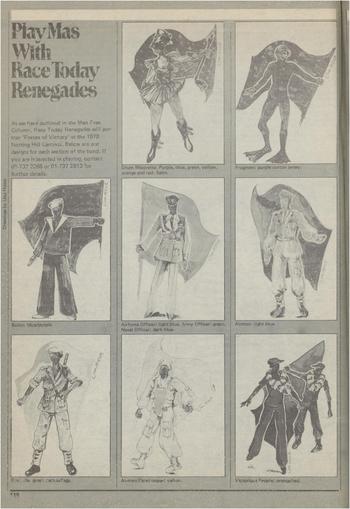
Johnson's sophomore album, Forces of Victory, effectively prolongs the calypso association, as the LP's title track makes plain. The song is about a mas band called the Race Today Renegades, so named for the Port of Spain Renegades, which Race Today organized for the 1978 Notting Hill Carnival. As Ashley Dawson has neatly summarized, each year at Carnival, mas bands develop a band ‘theme’, according to which costumes are made, music performed, and even short plays written.Footnote 132 In 1978, the Renegades chose ‘Forces of Victory’ as their theme, a selection that proved serendipitous indeed. That year, the group won the ‘Band of the Year’ prize from the Carnival Development Committee, the same group Johnson nodded to in ‘Man Free’ (and for which Howe was by this time serving as the first democratically elected chair). The ‘victory’ theme was less about competing for the award, however, than the band's performances. As Howe explains, the Renegades sought to recreate ‘the spectacle of a modern army, victorious in battle’.Footnote 133 Emulating decolonial guerrilla movements of decades past, the Renegades elaborated a vanguardist aesthetics – notwithstanding Race Today's opposition to vanguardist politics, as I discuss shortly – which Johnson evoked in ‘Forces of Victory’ by declaiming ‘wi dressed in red / an wi feelin dread / we dressed in green / an wi feelin mean’, among other descriptors.Footnote 134
That Johnson and the Renegades aestheticized decolonial struggle is obvious. Yet the combined work of the Renegades, Johnson, and Howe enacted ‘victory’ on much broader symbolic and cultural registers, as well. The very existence of the 1978 Carnival brings this to a head. As Dawson reminds us, since Carnival's beginnings in Britain in the early 1960s, the event was plagued by an ‘igniting conflict between the black community and the state’, due to recurrent threats levelled by government officials and police to uproot the annual affair from the Notting Hill streets.Footnote 135 The occasional pick-pocket and street fight were too much for the Met to handle, apparently, spurring ‘heavy manners’ in 1976 and 1977, and open hostility in the processions’ interim. Charged with policing the 1976 Carnival, the Met's Police Commander Patterson, for instance, ‘openly identified with and promoted the aims of a petition being organized by a small section of the local white community to have the Notting Hill Carnival relocated to White City Stadium or Battersea Park’.Footnote 136 By 1978, then, Carnival had consolidated itself as a hotly contested facet of Britain's public sphere; as a Race Today pamphlet put it, ‘Carnival has now established itself as the most important, annual mass event, in the life of black Britain … It has inevitably become not only a cultural festival, but an arena for the demonstration of the political forces that take this cultural opportunity to gather and make themselves felt.’Footnote 137 So, again, Carnival's survival through the 1970s marks its very existence as a counter-hegemonic ‘victory’ for London's Caribbean communities. Forces of Victory – as album, song, and mas theme – both counter-memorially contributed to and was a part of this demographic. As if to amplify this community-aligned cultural politics, Race Today recruited its readership to participate in the 1978 processions as ‘Renegades’, via several articles Howe published about Carnival aesthetics and history (Figure 2).Footnote 138
(Colour online) 1978 Notting Hill Carnival information, published in the July/August issue of Race Today. The image features the many costumes and ‘characters’ that possible participants can play. © Una Howe, reproduced with permission.

While perhaps the most spectacular example of Race Today's cultural-political tilt, the Renegades were not, however, an isolated instance of it. Indeed, since its founding, Race Today specialized not just in action campaigns, but also more subdued cultural initiatives as cornerstones in achieving Howe's joint goal of documenting and facilitating ‘emerging struggles’. Accordingly, under the direction of the aforementioned Rugg, Race Today’s erstwhile literary critic, the periodical added sections such as ‘Poet's Corner’ and ‘Creation for Liberation’, regular columns covering topics in music, film, theatre, and literature.Footnote 139 Outside the journal, meanwhile, the Collective assisted with London's annual Open Exhibitions, which showcased the work of black visual artists.Footnote 140 What's more, Howe, Johnson, Dhondy, and so on co-sponsored the International Book Fair of Radical Black and Third World Books, a likewise annual event which staged musical performances, readings, lectures, screenings, and more (Figure 3).Footnote 141 Such a culturalist focus was nothing new, of course; as we've seen, the Panthers similarly prized grassroots cultural production and education. But what distinguished Race Today's efforts were their intensity, prodigiousness, and – by contrast with some Black Power groups – their prioritizing of art's position in the everyday rather than revolutionary politics or rhetoric. Race Today committed itself to what Bunce and Field deem Howe's ‘essential insight’: ‘that political movements and cultural movements emerge hand in hand’.Footnote 142
(Colour online) Flyer for The International Book Fair of Radical Black and Third World Books, 1985. Johnson (pictured) is a featured performer at this year's set of events. Accessed at GPI, The International Bookfairs collection, GB 2904 BFC/04/02/03/02. Reproduced with permission from the George Padmore Institute.

In his dub poetry, Johnson aimed analogously to bring this dual emergence into fruition. In the Fanonist undertones of Voices, the local preoccupations of ‘Five Nights’, the exasperation conveyed by ‘Di Black Petty Booshwah’, and in the counter-memorial pieces on It Dread Inna Inglan, a cultural politics of this kind can be readily inferred. Yet it is in the poet's work as co-editor of and contributor to Race Today that his investment in community-based cultural engagement comes across most vividly. And so too is what I see to be Johnson's signal revision of avant-garde theory, as broached earlier through Moten, Sell, and Smethurst: his foregrounding of community arts engagement as part and parcel of an avant-gardist programme. Such a revision complemented the poet's comparable reimagining of the matter of the institution underscored previously with respect to Shepherd's. To investigate further, let us take a look at an arts initiative Johnson apparently co-facilitated, called Black Creation, a predecessor of Creation for Liberation.
‘Creation for Liberation tried to follow in the footsteps of CAM’, Johnson has said. ‘But we hadn't been able to really come up to anything like that. I mean, after all, CAM had within it some very powerful and seminal figures.’Footnote 143 Neither Creation for Liberation nor Black Creation truly wanted powerful figures, though. Instead, they strove to generate community- and even amateur-friendly involvement – like the Renegades, in a populist vein. Black Creation's mission statement, which Johnson seems to have co-written, throws this inclusive ethos into relief. ‘In the last few years’, it states, ‘black culture has become a political issue in Britain. Our festivals are surrounded by police, the books which reflect fractions of our lives are attacked, the music we make is subject to the coercion and pressure of media, market[s] and the interests which control both.’ Race Today's Marxist slant peppers this statement just as much as its aversion to multiculturalism. ‘At another level, Britain attempts to encapsulate this culture, parcel it in a pill to be swallowed by legislated generations of “multi-culturals.” In that thicket of opposition, the struggle for “culture” is a struggle for authenticity.’ This last point is crucial as far as avant-garde theory is concerned. Because ‘[ours] is not the kind of authenticity sought by the avant-garde of Europe’, the authors write, ‘who lived as artists and created for a future they could have no hand in bringing about.’ Against such futuristic ambitions, Black Creation features such as ‘the short stories of [Brixtonite] Jennifer Johnson present the kind of authenticity that sustains the lives of young blacks in Britain. With only that amount of self-consciousness required to speak into a microphone or put pen to paper, [contributors] represent an artistic movement which grows out of the day to day life of a community that retains and rejoices in its distinctness.’ Importantly, ‘success gets a second place’ in this milieu:
That in itself is a break from the recent past when the Caribbean boasted only of its Naipauls and India of its Satyajit Ray, glittering prize-winners who put themselves on international maps of distinction. The dub organiser, the writer of Railton Road, the poet of our nights of bleeding, have their artistic direction dictated by the experience and destiny of the people they write about and play for. It makes for the rootsiness and responsibility that the writing and criticism in these pages exhibit.Footnote 144
How might we conceptualize Black Creation's avant-gardism? At first, the question might seem perverse: Black Creation expressly disavowed ‘the avant-garde of Europe’, and it differed from the CAM, whose ‘powerful and seminal figures’ implied an elite structure – a vanguard. And yet, the vision sketched by Black Creation betrays classic avant-gardist traits, much like the BAM, which as Sell notes similarly opposed itself to Eurocentric models. The BAM was never wholly ‘of the avant-garde’.Footnote 145 And neither was Black Creation. But insofar as we can detach the critical category of avant-gardism from the socio-historical category of the avant-garde, and insofar as we can appreciate avant-gardism as a ‘plural’ concept encompassing manifold radical practices, then the cultural vision animating Black Creation is suggestive.Footnote 146 Black Creation exceeds the example Johnson had already set in performative, ‘appositional’ works such as Voices or ‘Five Nights’. And it goes beyond the paradigm of the ‘avant-gardiste work of art’ displayed by pieces such as ‘It Dread Inna Inglan’ or ‘Man Free’. It even differs from the RYCAC, which after all was not an arts-based undertaking. To turn a phrase from Ana Alonso-Minutti, the initiative indexes what we might call a ‘community-oriented avant-garde’: focused on arts and culture while premising itself in ‘roots and responsibility’.Footnote 147
To get a more concrete sense of this community-oriented avant-gardism, consider the following contributions to Black Creation, each of which appeared in the forum's first set of publications.Footnote 148 On the literary front, Jennifer Johnson offers two short stories, called ‘Ballad For You’ and ‘Park Bench Blues’; like Linton Johnson's poems, both are composed in an orthographic patois. Rugg for her part gives a searing review of the film Black Joy starring Norman Beaton, Paul Newman, and Barbara Streisand, asserting that the film's ‘prurient interest’ in ‘sex, drugs, and violence’ supplies a false image and indeed ‘encapsulates the culture’ of daily life in Brixton as an expurgated commodity. Meanwhile, Michael and Keith La Rose review a 45 that Johnson released under the name Poet and the Roots (his moniker for a time in the late 1970s), while Johnson himself reviews Max Romeo's Reconstruction and Third World's 96 Degrees in the Shade. Finally, Lorine Burt and Claudius Hilliman profile Peoples War, a sound system which took its name to indicate the specificity of ‘Britain where black youth are fighting the state’: an analogue, the interviewee suggests, to ‘peoples wars’ in Angola, Mozambique, and the West Indies. This last example makes Black Creation's links with the Renegades obvious, and not just in the terms of a decolonial aesthetics.Footnote 149 As Alonso-Minutti might put it, Black Creation, ‘while locally rooted’, offered an alternative space ‘for the configuration of a community of performers that contests issues of race [and class]’. The result is a ‘community-oriented experimental platform’ reaching ‘levels of inclusion and group solidarity rarely seen in experimental scenes’.Footnote 150
In avant-garde scenes as well. Indeed, and as I will contend in the final part of this article, Black Creation's grassroots and community platform offers a real chance for theorists of the avant-garde to position their subject of study anew. To dissect further, I want to return to the issues I began to sketch in the introduction, and specifically the (anti-)philosophy of James, as presented by Moten.
Why spotlight James? Well, not only did Race Today count James as a member, but also the group's politics and theory were directly shaped by Jamesian strategy. As Bunce and Field observe, ‘James's relationship with Race Today dated back to the earliest days of Howe's involvement with the magazine.’Footnote 151 Howe was James's nephew, in fact, and in 1981 James relocated to London from the USA in part to reinforce this family tie, moving in to a flat situated above Race Today's offices. While there, Race Today granted the 80-year-old a regular column (called ‘Cricket Notes’), and routinely published his writing and lectures.Footnote 152 That Race Today later was absorbed into the C. L. R. James Institute alone speaks volumes, as James's philosophy figured centrally in the Collective's self-understanding, notably in its neo-Marxian emphasis on bottom-up, directly democratic organization. Echoing the Black Creation statement, Johnson describes this ethos succinctly: ‘we followed Jamesian ideas, based on the principle that every cook can and should govern. We were a small organisation that was having a big impact – that small meant big.’Footnote 153
Note Johnson's stress on smallness, egalitarianism: again, community-oriented locality. For it is on this front that we can locate a first, key way that Race Today's application of James's thought forces us to rethink avant-gardism: specifically, the group's departure from vanguardism. The Black Jacobins is instructive in this regard. As already discussed, James's history posed a critique of Toussaint, who in San Domingo adhered to a proto-vanguardist notion of struggle. In leading from afar, Toussaint largely ‘ignored [the] black labourers’. But to ‘bewilder the masses’, James maintained, ‘is to strike the deadliest of all blows at revolution’.Footnote 154 Elsewhere, the sage derided Maurice Bishop's New Jewel Movement in Grenada for the same reason, as it lacked a mass-populist, grassroots base of the kind Johnson depicts. It was precisely this concern for directly democratic organizing that led to James's chief revision of Marxist theory following the disappointment of the Soviet Union. By employing a rigid selection process, forming an elite technocracy, and stifling ground-up participation, ‘the vanguardist party structure of the New Jewel Movement, based upon the doctrinaire model that Joseph Stalin had constructed’, exhibited an authoritarian tendency inimical to an authentic socialism comprising ordinary people. Toussaint, Bishop, and Stalin all failed to realize James's essential, if paradoxical insight: they failed to become popular vanguards. Put in the context of 1970s Britain, the words of John La Rose (another colleague of James's) are germane. Groups such as Race Today and La Rose's New Beacon practised ‘leadership but not vanguardism’.Footnote 155
Already we see a counterpoint to the futurists, say, who both the BAM and Black Creation spurned, and even the CAM's ‘powerful’ figures. Yet there is a second aspect of James's thought, implicit above, that allows us to appraise Race Today and Johnson's ventures as a pivot from even those populist avant-gardes such as the BAM. Earlier, I noted how Baraka argued for the eminence of experimental musics such as free jazz inasmuch as they would be ‘consistent with the spiritual and communal needs, if not the tastes, of a black popular audience’.Footnote 156 Thus, the ‘self-conscious’ musics of Coleman and Coltrane could be theoretically justified, while the commercial releases of Warwick could not. Contrastingly, James was deeply sympathetic to pop culture; so too was Johnson, who, after all, released reggae records – pop music – through major labels such as Virgin and Island, and his own LKJ Records later on.Footnote 157 Bearing these sympathies in mind, I want to argue that James's theories regarding the vernacular arts particularly – the everyday practices of ‘the people’/populi – beckon us to re-evaluate the matter of taste within the history of both Eurocentric and black avant-gardes generally. For Black Creation summarily adopted Jamesian theories, and it did so in ways that bring us squarely back to the black radical tradition tout court.
As Cedric Robinson has suggested, one of the chief lessons of The Black Jacobins entailed James's insistence that capital effects social negations at two sites of its expropriation. ‘Capitalist accumulation gave birth to the proletariat at the manufacturing core; “primitive accumulation” deposited the social base for the revolutionary masses in the peripheries.’Footnote 158 Under such ‘racial capital’, the enslaved elaborated what James saw to be distinct and distinctly dissident vernacular cultures, as in Vodun ritual in San Domingo – or much later, in calypso or reggae. Robinson dubs these practices ‘mediums[s] of conspiracy’ opaque to colonial authorities. While perhaps a no-brainer to today's Marxist, in his time, James's conjecture signalled a theoretical upheaval, suggesting that contestation was possible outside the intelligentsia, and – here we approach a big reason for Moten's admiration for James – it proposed that local ethnic cultures could serve as a revolutionary motor. This latter insight departed from the closed, class-geared dialectic of historical materialism; in positing a black Marxism, James reimagined orthodox Marxian temporality by exposing how the racialized labour structure of slavery engendered a tight-knit group whose emphatically cultural-expressive interconnections made them ‘closer to a modern proletariat than any group of workers in existence at the time’.Footnote 159 This was a culturalist Marxism, yes; but it was performative, too. As Moten avers, James's stress on the vernacular performatively ‘bent’ the dialectic from its outside, giving the dialectic an embodiment, a ‘dialect’, which ‘retemporized’ Marxist teleologies in revealing how the tastes of ‘the people’ afforded an alternative to vanguardist models. James's anti-vanguardism and communally oriented politics – like Race Today's – were intertwined; both were mediated by cultural ‘excesses’.
It is on this matter of the cultural politics of the vernacular that I wish to conclude. Or, to put it bluntly, might Johnson represent a modern Dessalines? The supposition is not as farfetched as it might seem. To be sure, Johnson is not the only historical figure to have adopted a programme comparable to that of the Haitian's. Neal, as mentioned earlier, similarly esteemed community-oriented engagement. So too did jazz avant-gardists such as Archie Shepp, who as Porter observes declared reluctantly that he would abandon the avant-garde altogether should it mean he would adequately ‘reach black people through music. “Even if the artist has to forsake some of his most cherished things – then he must forsake them. If I have to get into rock and roll, somehow, I've got to slide into that.’’’Footnote 160 Yet musical avant-garde studies – including black musical avant-garde studies – have tended to underplay this fact. Moreover, they have tended to sideline those pop-inclined programmes, like Johnson's, that ‘slid into’ mass-popular tastes and capitalist relations.Footnote 161 In contrast, my intention is to double-underline these aspects, and to place them into the foreground. In no way do I want to create a false binary, here: the political-aesthetics and ethics of movements like the BAM, the CAM, and Johnson's work could and often did overlap considerably; given their shared concerns for popular taste and community activism alike, a group like the Last Poets in fact strikes one as a good analogy for Johnson's work (as we saw, Johnson knew the Last Poets well). Instead, what I hope to emphasize is the way that Johnson, taking his cue from the CAM, re-applied stalwart avant-gardist principles such as nation language to genres, formats, and media he knew would productively engage mass culture and the community in the same stroke, without or at the very least with subdued reluctance. Accompanying this transferal, the poet co-facilitated political and cultural movements ‘hand in hand’ at Race Today, producing ‘appositional’ dub poems that documented and raised awareness about such campaigns as the GLAC and DHAC – precisely through popular technologies such as the LP. Meanwhile, initiatives such as Black Creation enlisted the efforts of community-based artists from the ground-up and laterally, rather than hierarchically. Johnson ‘induced’ others to ‘produce’, forging a model of ‘progressive cultural production’ through which a broad swath of black Londoners could participate, and – as in the Renegades – collaboratively instigate counter-hegemonic struggle.Footnote 162 The RYCAC did something similar, albeit largely outside an artistic purview.
Since the 1970s, Johnson has accrued a legendary status in the history of black British poetry – as Caesar puts it, a ‘Godfather’ status.Footnote 163 Even Penguin Books has recognized the poet's achievements, by according the poet a volume in its Modern Classics series in 2002.Footnote 164 But one suspects that Johnson would brush these accolades aside: they countermand the anti-hierarchical methods that James espoused and Race Today applied. Pace Caesar, I would argue that we can generatively think of Johnson in the way Moten thinks of Dessalines, as disruptive of hierarchy, promoting a politics premised in a ‘radical aisthesis’ – much like dub poems themselves. The avant-garde is in the audience. And that avant-gardism is excessive, in a manner that resembles the appositional explosiveness of Voices, ‘Five Nights’, and other works. For Moten, the ‘mediums of conspiracy’ announced by the slaves in San Domingo – Vodun, song, and dance – animated ‘mysterious and black magical politico-economic spells and spellings’ which in turn anticipated James's theories.Footnote 165 As if to point out Johnson's position in relation to readers of Race Today or participants in the Renegades or the denizens of Shepherd's or the poet's role in the GLAC or DHAC, Moten illuminates this distinct style of animation as follows:
There is, in [The Black Jacobins], a lyric disruption of a certain Europeanized notion of public/national history and historical trajectory as well as an exterior/African disruption of the interiority of European lyric. The property sang, the commodities shrieked. Jumping in the ditch, revolutionary tactic and dance, lingering in the space between the notes, descending into the depths of music. James seems to assert that Toussaint might have acted had he jumped, like Dessalines, into the ditch of Vodun ritual and revolutionary movement, slipping into the darkness, into the musical breaks of the history he was making and by which he was enveloped into those nodes of time, where it leaps forward, new rhythm and all. But that leap depends on that sounding.Footnote 166
‘Leaps! Leaps! Leaps!’Footnote 167 The avant-garde is in the audience. So was Linton Kwesi Johnson.