Introduction
Sicoli (Reference Sicoli2010) has identified contrasting discourses in language studies. Whereas some investigators say voice qualities have “natural meanings” or functionally reflect biologically based universals (Bolinger Reference Bolinger and Greenberg1978; Ohala Reference Ohala1984, Reference Ohala, Hinton, Nichols and Ohala1994; Bauer Reference Bauer1987; Gussenhoven Reference Gussenhoven1999), others favor ethnographically based arguments, discounting universals in favor of culturally specific motivations for voice qualities as sign vehicles (Podesva Reference Podesva2007; Mendoza-Denton Reference Mendoza-Denton2008). Noting the potential for productive dialogue in these different perspectives, he maintains that little has been done to cross-fertilize what might be called the universalist and the relativist perspectives (Sicoli Reference Sicoli2010:548).
The present study intends to negotiate the contrasting perspectives by means of the concept of observational logic, using ethnographic accounts to show that both perspectives are necessary for understanding the nature and use of voice qualities in different speech communities, and specifically with respect to falsetto voice and higher pitch in modal voice.
Instead of looking for inborn biological codes to explain some of the frequently similar meanings for voice qualities found in different cultures, or contrarily asserting the nongeneralizable context-bound cultural specificity of those meanings, I employ the notion of observational logic, as contrasted with cultural logic, to show that with falsetto use the linkage between sign (vehicle) and meaning is usually not arbitrary, but instead motivated, that is, not symbolic but rather iconic or indexical. To the extent that the linkages are motivated by cross-culturally relevant factors—specifically observable characteristics of the voice qualities themselves—they can be generalized in import, even while maintaining the immediacy of cultural factors and the semiotic process in mediating the patterned coincidence of voice qualities with social functions and the contexts in which speech and other communicative acts take place. By using observational logic as a methodological tool for examining the relationship between sign and meaning and as a middle ground between universals and relativist positions, it is unnecessary to discount universals in favor of culturally specific motivations for voice qualities, and vice versa.
Icons, indices, and symbols are somewhat idealized yet analytically separable sign types (Anttila Reference Anttila1972), mediating between the external referent world around us and our internal world of knowledge (Nöth Reference Nöth1995). Iconicity and indexicality, rather than being natural qualities, relationships, or processes in and of themselves, derive meaning in human communication through their mediation of semiotic relationships, but the meanings of icons and indices are related to these signs by way of similarity and contextual contiguity respectively and are thus motivated. At least some of their meanings, then, can be acquired from the signs themselves. Symbols, however, are related to their meanings arbitrarily, by cultural convention, contextually situated, and culturally specific.
Cultural traditions, knowledge, assumptions, and logic do not provide the only input to our interpretation of what goes on around us. Many signs are experienced that do not have to depend on language or culture for their interpretation. Interpretation of linguistic signs (i.e. symbols) does require cultural knowledge but voice qualities as paralinguistic features, while informed by the specific cultural contexts in which they occur, appear to have some autonomy by virtue of a usually motivated relationship of sign (sign vehicle) to the meaning, which leads to a hypothesis relating to the use of falsetto voice and higher pitches in modal voice.
Hypothesis
When generalized, high voice pitch and falsetto voice swim in a pool of potential functions, many of which are systematically related to perceptions of physical, anatomical, physiological, and psychological facts. These perceptions may be viewed as inferences or conclusions drawn from observations of nonlinguistically experienced things and events, that is, observational logic. I maintain that the utility of the notion of observational logic here is illustrated by the existence of constraints on the kinds of meanings attributed to falsetto usage by virtue of nonarbitrary relations of sign to meaning stemming from iconicity and indexicality in semiosis. The notion of observational logic herein utilized avoids the necessity of dealing directly with such concepts as biological codes or natural symbols,Footnote 1 meaning that they neither need to be invoked nor denied in explaining cross-cultural regularities in the patterning of interpreted function.
The hypothesis is that most meanings associated with falsetto voice and high pitch of modal voice are motivated rather than arbitrary, and that iconicity and indexicality in falsetto voice use correlates with meanings expectable from observable facts of everyday life. More succinctly and generally, observable characteristics of a sign will tend to limit its deployment to meanings that are in accord with these characteristics. The hypothesis is explored below by first characterizing cultural logic and observational logic, then describing falsetto voice, followed by examples of falsetto and high-pitched modal voice in different societies with discussion of falsetto's expressiveFootnote 2 meanings, concluding with the significance of making explicit the motivated nature of falsetto voice in different cultures and relating these to observational logic rather than to cultural logic or to biological givens.
Observational logic and cultural logic
Enfield characterizes cultural logic as a process:
This process of people collectively using effectively identical assumptions in interpreting each other's actions—i.e. hypothesizing as to each other's motivations and intentions—may be termed cultural logic. This logic relies on the establishment of stereotypes and other kinds of precedents, catalogued in individuals' personal libraries, as models and scenarios which may serve as reference in inferring and attributing motivations behind people's actions, and behind other mysterious phenomena. (Enfield Reference Enfield2000:35)
I would add two refinements to this characterization. First, the process requires not just shared assumptions; these assumptions must be acquired by means of traditional transmission rather than individually and independently (cf. Boyer Reference Boyer, Boyer and Wertsch2009). Second, shared individual inferencesFootnote 3 and collective assumptions are applied to an ever-evolving collective repertoire of cultural knowledge created and maintained largely through discourse, itself inferable only from individual cultural repertoires.
I introduce and interpret the notion of observational logic as a counterpoint to cultural logic as characterized by Enfield (Reference Enfield2000), and refined here. Observational logic would then be the use of inferences and assumptions shared by many humans, applied to a knowledge base acquired from experience and individual observation and not derived through traditional transmission. This knowledge base, never static in the individual, is what I call observational knowledge.
Enfield allows that, in addition to societal involvement in the process of cultural logic, “people carry private representations; thoughts, concepts, and sense/sensorimotor images (in many possible forms) that are structured, and can be recalled and privately manipulated” (Reference Enfield2000:36). These private representations are akin to what I am calling observational knowledge.Footnote 4
Observational knowledge is likely to be widely shared across cultures that have relatively similar environments. The cultural and individual repertoires of knowledge and systems of logic described here are only artificially separable. In reality they are interpenetrating, interacting, mutually informing, and mutually constructed. They are isolated and described here to provide a grounding for discussion of observational logic's relation to iconicity and indexicality as motivating factors in deriving expressive meanings from falsetto and high-pitched modal voice.
Falsetto voice and its relation to high pitch
Falsetto voice can signal a variety of individual, mostly expressive or pragmatic meanings in specific interaction settings. It can also serve more general stereotyped cultural functions. As a component of some identity construction and as a variably expressive paralinguistic feature of speech, falsetto is useful for investigating universal constraints on the interpretation of signs on the one hand, and some of the parameters of cultural variability and relativity in linguistic expression on the other (Gumperz & Levinson Reference Gumperz and Levinson1996; Sicoli Reference Sicoli2010). In connection with this pursuit, an ethnography of speaking perspective is adopted here, looking to specify the linguistic features and understand the meanings attributed to speech acts and their components and functions within the cultural contexts of their expression (Hymes Reference Hymes, Gladwin and Sturtevant1962; Gumperz & Hymes Reference Gumperz and Hymes1964). It is a perspective seeking a comparative basis from which more universal statements can be generated.
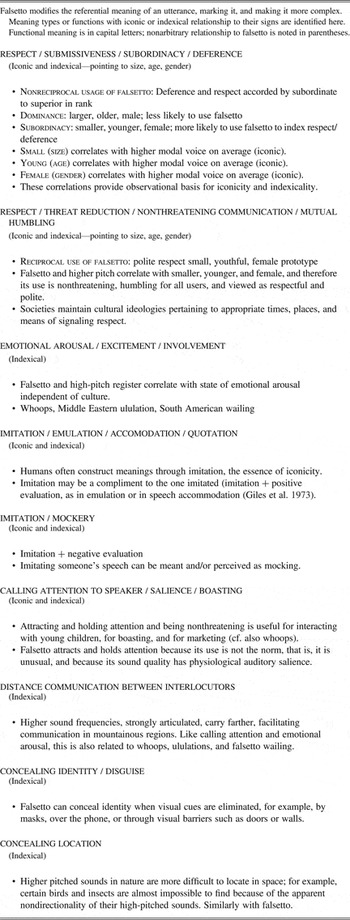
Falsetto, an easy to recognize and meaningful feature of some speech acts, has been used to signal such meanings as respect, excitement, constructing gay identity, mocking gay identity, emulating female identity, mocking female identity, seeking attention, boasting, mocking a boaster, and speaking to a tutelary deity.Footnote 5 Nine categories of expressive meanings (or functions) and their observable use correlations have been collected from various ethnographic accounts as presented in Table 1 and are discussed below.
Nine functions or meanings of falsetto.

Aptly named by a diminutive form of the Italian word for ‘false,’ falsetto voice is generally characterized as the vocal register above the normal (or modal) one, and involves vibration of the vocal cord edges, resulting in a high-pitched sound with a relative lack of overtones, often described as “thin,” and characteristically easy to recognize in speech. Falsetto/modal voice alternation is associated with the voice “cracking” during the lowering of male voices with adolescence, and also with the practice of yodeling. Although “no one acoustic correlate of falsetto can adequately differentiate between falsetto and modal voice (the unmarked phonation type characterizing voiced sounds)” (Podesva Reference Podesva2007:483), articulatory (as opposed to acoustic) correlates are not so difficult to describe (Laver Reference Laver1980).
Many societies assign cultural meanings to falsetto voice, usually of an expressive, nonreferential nature, such as respect, deference, femininity, youth, excitement, or boasting. These meanings tend to vary from one social context to another within the speech community and from one society to another. Individuals may name or describe a particular meaning and usage, or set of usages, for falsetto voice (cf. Anonymous 1938; Grimes Reference Grimes1955; Brown Reference Brown and Coates1998; Sicoli Reference Sicoli2007, Reference Sicoli2010).
Falsetto voice in cultural context
Respect and deference
Living with Tseltal Mayan speakers in Chiapas, Mexico,Footnote 6 I learned that in a number of contexts falsetto use was a sign of polite respect, a signal of deference given in prayers addressed to the saints, deities, and deceased relatives, given by younger women to older ones, used by women in the presence of men, and sometimes heard from men and interpreted as having similar meanings of respect or deference. Tseltals name this kind of phonation with an affect verb, stz'ulet ‘very high-pitched or falsetto respect voice’ (cf. tz'u' ‘sip, suck, chirping sound imitating a kiss,’ tz'ul ‘amaranth [a plant with tiny seeds]’),Footnote 7 which names a kind of valued speech (Stross Reference Stross, Bauman and Sherzer1974:222).Footnote 8 In Spanish, Tseltal speakers describe falsetto voice as una voz muy chillona y pequeñita ‘shrill and tiny voice.’ Tzotzil Mayan has forms similar to those of Tseltal, including tz'u' ‘falsetto voice’ (cf. tz'u' ‘squeak’), and tz'uret ‘talking in polite falsetto (man)’ or tz'u'u'et ‘talking in polite falsetto (man), squeaking (baby mouse)’ (Laughlin Reference Laughlin1975:104, 437).
I noticed other situations where unusually high-pitched or falsetto voice was utilized. For example, in passing on the trails individuals usually delivered a greeting in a tone of voice that appeared to reveal, on a continuum of lower pitch to higher pitch, the speaker's self image as well as speaker's perception of the social status of the individual being greeted—higher pitch for higher status, lower pitch for lower status. When lower pitch was used, the vowel /a/ was sometimes backed and rounded, and consultants saw it as reflecting self-confidence, withholding deference, or possibly insolence (Field notes 1967).
Occasionally in daytime an individual would call a relative across the canyon in falsetto voice; the words were barely comprehensible. I also heard men using falsetto in whoops during the periodic fiestas, resembling the “war whoops” stereotypically attributed to Native Americans.
Brown noticed some similar usage and succinctly characterizes how and in what situations Tseltal women give respect:
women are highly deferential and self-effacing in public; they walk behind the men on the trails, stepping aside to let men pass them if the men come up behind; they speak in a high pitch falsetto voice with kinesic humbling (hunched-over shoulders, avoidance of eye contact); in short, they give avoidance-type respect in the presence of men… And in ritual contexts, when addressing the gods and saints, men's speech takes on many of the vocal and prosodic features that characterize women in daily interaction: exaggerated rhythmicity, falsetto, high trailing-off pitch contours. (Brown Reference Brown and Coates1998:87)
More recently according to Rostas (Reference Rostas1999:336), some younger Tenejapa Tseltal women refuse to convey deference to men through lack of eye contact or use of falsetto, behavior attributed to new religious sects taking root in the community. Reflecting similar change, Sicoli notes that Lachixío Zapotecs use falsetto “when talking to elected members of the town government (Persons Reference Persons1997), but this seems to be falling out of use” (Sicoli Reference Sicoli2010:523). With such evidence of change through time in the patterned social usage of falsetto voice, we have a reminder of both the process and the power of cultural ideology to alter semiosis, and even to contribute patterns of prosody that may run counter to expectations with regard to meaning (cf. Gussenhoven Reference Gussenhoven1999:302).
Western neighbors of Tseltal speakers, Tzotzil Mayans, employ falsetto like Tseltals, as do Tojolabal Mayan speakers to the east, about whom Furbee says:
falsetto speech is not confined to petition. Among the Tojolabal, falsetto is the voice of politeness and deference. Polite conversation carried on with persons of higher status would also be falsetto. Greetings and leavetaking will be delivered in falsetto. (Reference Furbee, Brody and Thomas1988:44)
In Santo Tomás Mazaltepec in Oaxaca, Mexico, Selby has identified humility as an important element of character in self-construction and performance of Zapotecs, illustrating with a sensitive and accurate description of interaction involving petitioning:
A typical situation occurs in Augustino's house when someone comes to ask a favor—usually a small loan. If one has a reputation for humility, as Augustino has, it is known that he will be soft-spoken and kind, and the anxiety that is provoked by the naked vulnerability of the act of petition can be minimized. When the petitioner arrives, there is an endless round of very soft-spoken small talk in a specialized high-pitched tone of voice… Often, both people talk at once in order to put each other at ease, creating a sing-song effect in this tone language… The use of high-pitched voice means that this is a formal visit–a favor is to be asked. (Selby Reference Selby1974:23–25)
Here higher pitched voicing marks speech as deferential and respectful, purporting thus to indicate one's own humility.Footnote 9 Host and guest reciprocally employ the same high-pitched speech, not only to signal respect and humility, but also to put each other at ease. Though the meaning for these Zapotec speakers is cultural, higher pitch observably correlates with small size and youth, so the more general iconicity converges with the symbolism in putting interlocutors at ease.
Sicoli (Reference Sicoli2007) documented pitch and phonation in Lachixío Zapotec in the southern highlands of Oaxaca, Mexico, paying attention to the functions and pragmatic meanings. Although this Zapotec language has phonemic tones and is unrelated to Tseltal (which does not), his results indicate parallels with the use of pitch and falsetto by Tseltal speakers.
High pitch is used in Zapotec to show respect for an interlocutor. Low pitch is an expression of authority over another speaker in Zapotec and the local Spanish. The examples I document demonstrate a gradient pitch continuum, in which higher pitch shows more respect and lower pitch shows more authority. A finding of this research is that speakers can go beyond the laryngeal limits of modal pitch by shifting phonations to show more respect or authority: falsetto phonation shows the greatest respect, breathy phonation the greatest authority. (Sicoli Reference Sicoli2007:xv–xvi)Footnote 10
Respect and deference can be related to social rank; individuals of lower rank often are expected to give respect and deference to those of higher rank. How this is done varies by situation and by culture. In some societies it may be accomplished linguistically by means of marked forms of address, and in others by pronominal marking, special kin and/or fictive kinship terminology, and so on. Paralinguistically it can take the form of falsetto, or high modal voice pitch as noted above. It can also be signaled entirely kinesically by bowing, avoiding eye contact, and so forth.
In situations of particular consequence for quickly establishing relative social rank of interlocutors, such as greetings between less frequently interacting individuals, signs and symbols identifying self-identified rank and lack of aggressive intent, are useful to communicate. Similarly in situations where respect based on rank and/or social distance indexes attitude, respect signs are usually available and their use carefully attended.
Size, age, and gender often participate in assignment of social rank (the “pecking order”), and since voice pitch correlates with body size, age, and gender, it can be used to iconically signal attributes on the dimensions of size, age, and gender. In other words, voice pitch, including falsetto, can be employed as a sign of social rank assertion and/or recognition by virtue of its ability to encode signals implicating respect and deference.Footnote 11 How this is so requires a brief explanation and some documentation.
In most societies adults socialize children, and except in rare situations (e.g. the Dalai Lama) the child is outranked by the adult caregiver who retains authority and power. Children are typically smaller, physically weaker, and possess higher voices than their adult caretakers, so size, age, strength, and voice are stereotypically linked to power, authority, and deference within the family. Thus age, size, strength, and voice pitch can signal rank or deference to rank, and signs representing attributes on these dimensions can by extension signal deference or respect outside the family. Because size and strength as well as voice pitch correlate in a general way with sex, the expression of sex differences often appears to piggyback power and rank differentials, but since sex and power are not of the same order, vocal signs relating to these dimensions cannot be viewed as a subset of power differentiated speech (cf. West Reference West and Coates2011).
Fundamental voice pitch of a person typically correlates with size. The older one gets, up to full maturity, the bigger they get, and the bigger one gets, the deeper the voice on average. Men generally have deeper voices than women. Such stereotyped perceptions persist despite the fact that some women have lower pitched voices than some men, some large men have high voices, and some women have low voices, and some adults have naturally high squeaky voices that may make them sound like children. Moreover, when lower pitch is valued in women, they may lower their pitch, and men might use higher prosodic registers in some circumstances. This human ability to manipulate voice pitch allows us to make nuanced interpretation of signals characterized by variable usage in the formation of spoken messages. Such interpretations take into account the interplay between stereotyped assumptions about observable correlations (relating to size, gender, age, power, state of arousal, distance from speaker, need for attention, etc.) and actual situations of verbal interaction in context, including whatever norming is possible.Footnote 12
Women generally have higher pitched voices than men. While correlated to some extent with body size, this is also a result of men generally having longer and thicker vocal folds as well as greater dimensions in the larynx and somewhat longer vocal tracts (Kreiman & Sidtis Reference Kreiman and van Lancker Sidtis2011).Footnote 13 This sex difference is observable enough for Americans to correctly assign male or female sex of a speaker about ninety-six percent of the time, so individuals almost unavoidably reveal sex identity.
Children speak with higher voice pitch than do adults. From birth to puberty vocal-tract growth proceeds similarly in both boys and girls. After puberty the sex difference in fundamental voice pitch is considerable (Kreiman & Sidtis Reference Kreiman and van Lancker Sidtis2011), and over the next forty years fundamental pitch decreases in both sexes, by as much as 45 Hz. At around fifty male voices tend to increase in fundamental frequency, while female voice pitch continues decreasing slowly (Kreiman & Sidtis Reference Kreiman and van Lancker Sidtis2011).
Because small body size and small vocal cords (as well as taut ones) are related to higher voice, some of our more important observations regarding voice are ultimately based on size, which correlates significantly with age, strength, and sex. Strength and size are also related to dominance and authority, which are in turn components of social rank or “pecking order” and directly related to the respect and deference accorded due to cultural expectations attending social ranking.
We grow up equating voice tone with age—parents, especially men, having low-pitched voices, younger siblings having high-pitched voices. So as adults, we unconsciously ascribe status to variations in voice, even though we know there is no rational connection. Can you imagine a successful politician with a high squeaky voice? (Guthrie Reference Guthrie1976:33)
Guthrie's point concerning unconscious ascription of meaning to voice variations due to observation and generalization is well taken. In context, meanings attributable to voice pitch are additionally nuanced by specific attributes on various dimensional continuums of size, age, gender, and strength.
Voice pitch then can be iconically related to messages of status rank through such dimensions as size, age, and sex that apparently provide the impetus for marking messages for respect and deference when they are so marked. The iconicity is made even more obvious when we look at some of the words and descriptions for falsetto voice. For example, speaking of Lachixío Zapotecs, Sicoli explains:
Lachixío speakers have also described speaking in the high-pitched voice as speaking “small.” Several consultants accompanied this description with kinesic movements that indicated smallness, such as holding the thumb and index finger close together, or rolling the spine and shoulders to the front to make the torso smaller. (Sicoli Reference Sicoli2007:151)
Discussing Zapotec speech to animals and the relationship of size to respectful speech he notes that:
the relevant iconic dimension exploited here is captured in the metalinguistic statements speakers made about speaking big and speaking small. To gain the trust of the animal, one must be small. This is like physically crouching down to get a skittish dog or cat to approach. To shoo an animal one must be bigger than the animal. The voice registers code these relationships of size through an oral iconicity. The parallel for respectful voice and authoritative voice is clear. One can show respect by making oneself small in another's presence, and one can show authority by making oneself big in the other's presence. (Sicoli Reference Sicoli2007:169)
Recall that Tseltal speakers naming falsetto employ words like ‘tiny’ and in Tzotzil the affect verb describing a man talking in polite falsetto also refers to the squeaking of a baby mouse. In fact even our word ‘falsetto’ is the diminutive form of the word for false.
If falsetto can be seen as ‘talking tiny,’ its iconic use for nonreciprocated deference signaled when rank differs between speaker and addressee, and for reciprocal presentation of mutual humility and respect, could also be viewed as a strategy for mitigating face threat acts as defined by Brown & Levinson (Reference Brown and Levinson1987). Importantly, whereas high-pitch modal voice and falsetto can convey respect in many societies, to whom the respect is accorded may vary considerably.
Excitement and arousal
In addition to meanings of respect and deference, iconically related to relationships of power vested in size and correlated with age and sex, other meanings are conveyed by falsetto as, for example, with Huichol speakers in Jalisco and Nayarit, Mexico. Huichols employ falsetto with the meaning “excitement, extreme involvement of the speaker” (Grimes Reference Grimes1955:34). A similar meaning in Huichol is attested as early as the latter part of the nineteenth century. “Now and then the dancers give vent to what is supposed to be an imitation of the hikuli's talk, which reminded me of the crowing of a cock. Beating their mouths quickly three times with the hollow of their hands, they shout in a shrill, falsetto voice, Hikuli vava! which means ‘Hikuli over yonder!’ (Lumholtz Reference Lumholtz1902/1973:368).Footnote 14
Here voice pitch marks a relationship between sign and meaning that is more indexical than iconic. It is commonly observed that when excited, people talk with a higher pitched voice than when they are relaxed. The physical basis is that a relaxed person's vocal cords are also more relaxed, producing a deeper voice—the cords become taut when one is more excited, active, involved, and/or under stress. When taut the vocal cords resonate at higher frequencies producing a higher voice. Apart from the biophysical basis for it, observational logic would also predict a positive correlation of excitement or emotional arousal with higher voice pitch.
Nielsen identified an adolescent African-American's falsetto use as a strategy of indignation and generalized this strategy to African-American English. From a corpus of forty-five exemplars of falsetto speech, his “analysis reveals that falsetto seems to have several related pragmatic functions, including stances of frustration, anger and indignation, as well as general expressiveness” (Reference Nielsen2009:110). I view indignation, anger, and frustration as all related to an elevated state of emotional arousal, so this falsetto use accords with observational logic irrespective of any existing cultural model.
Concurring with the presentation of falsetto as sometimes representing an aroused or excited state, Thomas (Reference Thomas2007) summarized Loman's (Reference Loman, Ringbom, Ingberg, Norrman, Nyholm, Westman and Wikberg1975) work, derived from data collected from African Americans in Washington, DC, as concluding that the speech of African Americans shows a high frequency of primary stresses, a constant and marked shift between pitch levels, and “use of the highest pitch level, often as falsetto ‘typically occurring in the excited speech of Negro men’” (2007:468). He continues:
The only point of overlap in the findings by Tarone and Loman is that both reported that African Americans use a wide pitch range, often becoming falsetto and usually in “excited” states or, as Tarone put it, in “competitive… speech events.” This finding was corroborated by Hudson and Holbrook. (Thomas Reference Thomas2007:468; internal citations omitted)
Similarly, arousal or excitement is also evident in the Tseltal festal falsetto whoops mentioned above, occurring on ceremonial occasions.
Analogues to Tseltal whoops as falsetto expressions of emotional involvement, arousal, or excitement can be heard in many contexts around the world, from Mexican audience appreciation of ranchera music to trilling ululations at an Arab or Berber wedding, or falsetto “victory” whoops from audience members at a football game. Emotional arousal, but signaling grief rather than excitement, occurs in the falsetto cry of Bororo ritual wailing, the intent of which is to strongly express grief in a culturally appropriate manner (Urban Reference Urban1988). In some countries the trilling ululation common at Arab weddings is also heard at funerals, and presumably this emotional involvement is also due to conventionally expressed grief, another kind of emotional arousal.
Imitation: Emulation, simulation, quotation
People often construct meanings of imitation or emulation through imitation, the essence of iconicity, and related to observation. Imitating someone else's signs involves experiencing them first and then replicating them, perhaps expecting that some part of the original message conveyed will also be conveyed by the simulacrum. Falsetto voice is sometimes employed in imitation of another's use of falsetto or high-pitched modal voice, whether in emulation (i.e. with positive evaluation), accommodation—.where a positive attitude towards an interlocutor leads to convergence with their speech styles (cf. Giles et al Reference Giles, Taylor; and Bourhis1973), quotation (little or no evaluation involved), or in mockery (with negative evaluation of the original, for deprecatory or for humorous effect).
In telling the story Goldilocks, one often quotes baby bear in falsetto voice. The quote follows from linguistic ideology that bears can talk, and the falsetto iconically represents the smallest bear as having the highest—and “tiniest”—voice). It might be said too that the falsetto indexes small size or baby bearness, and represents the construction of a baby bear persona.
Falsetto use may signal gender identity emulation as when a gay male uses falsetto or high modal voice pitch to expressively communicate a gay identity or to construct a persona suggesting femininity. An example comes from the work of Podesva, who has investigated phonation in the speech of a gay medical student.
I draw on an analysis of the discourse contexts in which falsetto appears to illustrate that the feature carries expressive connotations. This meaning is employed to construct a “diva” persona and may also participate in building a gay identity. (2007:478)Footnote 15
Similar use of falsetto in Spanish is reported from Juchitán de Zaragoza, on the Isthmus of Tehuantepec in Oaxaca, Mexico, where gay and/or transvestite men are viewed as members of a distinct gender known as muxe'. By virtue of a similar logic, in which some gay males are reported to sound more feminine and use alto voice or falsetto, some lesbian females sound masculine and effect a lower than normal voice. In either case the association of gender affiliation with vocal markers of gender identity is clear, and it is based on observations that are likely not constrained by cultural knowledge but instead tend to constrain it.
Bacigalupo (Reference Bacigalupo2004) discusses a transgendered identity involving a male sexed Mapuche individual in Chile who became a gendered woman upon initiation into shamanic (machi) status. “Every neophyte undergoes a change of identity when he or she becomes a machi, but in Marta's case the transformation was especially dramatic because it involved a change in gender identity and name as well as the incorporation of the identities of Flora's spirit and the Virgin Mary” (Bacigalupo Reference Bacigalupo2004:443). In addition to wearing shirts, shawls, and makeup, Marta speaks in falsetto as an index of her acquired femininity, and the falsetto sign is itself iconic as noted above. It exhibits vocal imitation with positive evaluation in this case, as opposed to mockery, where vocal imitation is combined with negative evaluation.
Qiuana Lopez, analyzing the speech patterns of white characters in American films who are attempting to construct hip-hop personas for themselves, argues that falsetto voice is viewed by the white characters as an index of “blackness” (p.c., 2010). That falsetto could be seen to convey a meaning of blackness suggests that at some point observations by whites of African-American speech patterns isolated a strategic, and to the whites salient, use of falsetto voice in African-American interactions, perhaps especially when involvement, excitement, and/or denial is expressed with emotion. For someone intending to convey an impression of being familiar with or part of hip-hop culture, itself strongly associated with African-Americans, falsetto might then be among the vocal characteristics selected to help represent or characterize the hip-hop persona by virtue of its ability to index blackness. In this situation the imitation is the most relevant meaning dimension, and this imitation is not mockery, but rather an attempt to emulate or fit in by using falsetto when they see it as appropriate. The specific usage patterns of falsetto, by virtue of not being as salient in the white subcultural milieu, stand out all the more when observed in use by hip-hop models or African-Americans behaving in ways seen as appropriate to that reference group, whether it comes from real life or from film. In this case the logic from observations leading to selection of the falsetto voice as an index of the reference group is derived not directly from observations rooted in early family life nor biology, but rather evidences observing traditional cultural expressions that are not of one's own culture, and that therefore can be said unequivocally to be observational rather than cultural logic (whether or not it is informed by the logic or ideology of one's own culture),Footnote 16 and it just as unequivocally distances observational logic from any hardwired biological factors in the meaningful interpretation of such falsetto use. Here the imitation of falsetto use is clearly iconic, and it involves emulating the speech of others, yet the falsetto is imitated or copied in context as a perceived index of blackness.
Ceremonial imitation involving falsetto is well illustrated in Quechua communities of the Peruvian Andes. There young men dressed as Andean bears perform ukuku ceremonial dances, speaking in falsetto in imitation of the cracking voice of adolescent boys (Urton Reference Urton and Urton1985:270). Here the iconicity relating the falsetto sign to vocal changes of adolescent boys is paired with falsetto indexing the speech culturally attributed to the mythical bear-man known as Ukuku, whose mythological duty is to retrieve glacier ice from the mountain peaks because of its healing powers for humans.
Imitation: Mocking
Imitating the speech of another by means of falsetto can also index a meaning that involves an implied negative evaluation of that which is simulated, as in mocking.
In terms of Hymes' (Reference Hymes1974) S.P.E.A.K.I.N.G. model of speech act components, mocking could be seen as a specific key, different from such keys as serious, sincere, scolding, grudging, playful, or respectful; one that may be signaled by a slight exaggeration in the imitation.
Who hasn't heard a teenager using falsetto speech to mockingly imitate the speech of a female acquaintance or of a male that the audience is expected to perceive as effeminate or gay. Here the observational logic is that in imitating or simulating some properties of the speech of another—perceivable as indexing something about the other—one can make others perceive similar indexed features.
A related use of falsetto can be seen when a male imitates female speech for purposes of institutionalized mockery in the context of a ceremonial performance, as during Carnaval in Puebla, Mexico when male Nahuatl speakers imitating females employ falsetto.
Alan Sandstrom (Reference Sandstrom1991:288–290) writes that the celebration lasts about a week and features the appearance of a group of men representing the mecos, or spirits of the underworld, half of whom are dressed as women and speak in falsetto voices… These raucous Nahua beings, according to Sandstrom, similarly mock people, make obscene jokes and gestures, and generally raise havoc. (Klein Reference Klein2001:198)
Here we can see that falsetto is both marking and mocking female identity, occurring in a context that could be described as involving both performance and ritual humor. While signaling their temporary female personae in a ceremonially appropriate manner in performance mode, these men fool nobody into thinking they are females. The gender-related communicative signals of these female impersonators are simply caricatures. It may be that falsetto rather than high modal pitch is used here to mark the fact that this is performance, and inauthentic, recalling that the meaning “false” is in falsetto's etymology.
Mocking by using falsetto may pretend to humor, but such speech play is rarely appreciated by the one mocked, for it can be perceived as insulting. Sometimes, however, the mocking use of falsetto by men to imitate the speech of women, and use of low pitch by women to mock men's speech, serves a more benign purpose as in the following example from Central African Mbutis.
Men take a vine rope on one side, women pull on the opposite side. They sing in antiphony. However if one side or the other were to win that would resolve nothing, so when the men seem to be winning, one of them will abandon his side of the tug and join the women, pulling up his bark-cloth and adjusting it in the fashion of women, shouting encouragement to them in a falsetto, ridiculing womanhood by the very exaggeration of his mime. Then, when the women begin to win, one of them adjusts her bark clothing, letting it down, and strides over to the men's side and joins their shouting in a deep bass voice, similarly gently mocking manhood. (Turnbull Reference Turnbull, Leacock and Lee1982:142–43)
The Mbuti pygmies of the Ituri forest of northeastern Democratic Republic of the Congo, have a “tug-of-war” as one strategy for diffusing tensions between men and women. Falsetto use for mocking is part of performing that strategy.
Salience of falsetto in attention getting
Falsetto is a feature of “baby talk” (caregiver speech) in various speech communities around the world as addressed directly to an infant, child, or pet, and sometimes to a lover (Ferguson Reference Ferguson1964). While usually not mocking in intent, it appears to simulate a voice characteristic indexing youth, vulnerability, and the need for nurturing. This falsetto appears to spring from observations of the higher pitched voices of babies and young pets, vulnerable and lovable. However, this falsetto may more saliently fulfill a different function. It can be seen to bring attention to the speaker, perhaps to demand attention.
Referring to falsetto use by Luo speakers of Kenya in socializing youngsters, Blount says, “Falsetto and exaggerated intonation appear to have greater signaling strength than vowel gemination, as they have greater success in attracting a child's attention. The degree of contrast between falsetto and normal register and between exaggerated and standard intonation operates as a strong code marker, embellishing the speech input to children, and maximizing its attention-attracting potential” (1972:240). Elaborating, he explains, “contrasts which are designed to attract attention also operate to select the features of speech which the children learn first. They imitate the features which attract their attention, and the result is highly stylized early speech” (Blount Reference Blount1972:240).
Dargan & Zeitlin, speaking of expressive styles and occupational choice, illustrate one way that falsetto voice indexes attention getting—by way of communication over distance and obstacles. “Street cries are designed to attract attention; therefore, they often employ sounds which will carry over a long distance, such as long vowels at the end of a phrase and a falsetto voice” (1983:4).
The auditory salience of falsetto when forcefully produced is clearly observable, not only in the attention it attracts, but also in its departure from the normal pitch register, and its salience is also related to the fact that human memory as well as attention tends to focus and dwell on the unusual. Falsetto is a marked feature of human vocalizing, inherently unusual. The fact that it indexes attention attraction, fulfilling vocative function and more, competes with its observable iconicity and its indexing of youth as employed in “baby talk,” as well as its indexicality with respect to distance transmission. Here the potential multiplicity and indeterminacy of social interpretations of linguistic features recalls recent work on indexicality (Silverstein Reference Silverstein2003; Eckert Reference Eckert2008; Jaffe Reference Jaffe2009).
Having established attention getting as one function of falsetto voice, we can look at the case of “boasting” speech and its relation to falsetto. John Haviland notes that in the Tzotzil community of Zinacantan in Chiapas, Mexico, boasting talk is sometimes marked by the use of falsetto voice in addition to the liberal use of affect verbs and vowel elongation.Footnote 17 Such stylization of boasting suggests that falsetto use when it marks boasting speech, warrants explanation in terms of observational logic. This relation of falsetto to boasting talk is not unique. Shona speakers in Zimbabwe, for example, use falsetto to mark “utterances mocking someone thought to be boasting” (LaverReference Laver1994:197). It is apparent that boasting, whatever nuances it may possess when translated into the words of other languages, is a form of attracting, or demanding, attention to the speaker, and one generally evaluated negatively. By indexing the function of attracting attention, falsetto voice for boasting or mocking a boaster usefully marks those expressive meanings. We have seen above that mocking is imitation or simulation in combination with negative evaluation, so with both boasting and mocking of boasting we find that observational logic suggests motivated relations between sign and meaning, entailing a nonarbitrary relationship.
In view of the connection of falsetto to both boasting and the falsetto “yelp,” it is instructive that the Old English noun gielp, antecedent of the word yelp ‘sharp high-pitched cry or bark,’ originally meant ‘boasting.’ Moreover the word whoop, meaning ‘a loud cry or shout, as of excitement or joy,’ is cognate with Gothic hwopan ‘to boast.’
Although one might at first wonder how observations might lead one to connect boasting with falsetto voice, these etymological connections with English words demonstrate such observations over the course of considerable time.
Physical distance
The salience of falsetto in overcoming physical distance and other obstacles to communication, such as external noise, echoes, and so on, is transferred in expressive function to the marking of distance communication in some regions, as mentioned above regarding Tseltal. Mentioned earlier, Dargan & Zeitlin (Reference Dargan and Zeitlin1983:4) also stress the carrying power of falsetto voice over long distances, and observation of this fact may well be related to the stereotyped association of yodeling with such mountainous regions as Switzerland. The observational logic by which sign and meaning are connected in a motivated, nonarbitrary, way stems from an indexical relationship between the falsetto sign and the functional meaning associated with long distance sound propulsion.
Concealing identity
I overheard an American male using falsetto to conceal his identity over the phone. I was present too when a male speaking through a door used falsetto voice to fool the apartment's occupant into thinking he was a woman. A television news story recently aired in which a bank robber, masked and wearing loose fitting clothes, spoke to the teller in falsetto to make sure he wasn't recognized. All three cases involve identity concealment. Visual cues to identity can be effectively eliminated with masks, hats, doors, or walls, and in telephone or radio interactions. Falsetto can then provide auditory identity concealment. This function of falsetto, linking sign to meaning indexically, stems from the common observation that absent visual cues, it is more difficult to recognize or identify someone using falsetto voice.Footnote 18
This indexicality is recognized in West Africa, where Poro initiations involve falsetto as well as masks. Poro is a secret religious society with members in Liberia, Sierra Leone, and the French Ivory Coast. “The masks, an integral part of the Poro, are worn in conjunction with flowing robes and ‘hula’ skirts which completely cover the body. Lest his voice be recognized, the wearer speaks with a throaty, rolling falsetto. Thus mask and voice effectively conceal his identity, as well as serving as a badge of office” (Anonymous 1938:5).
Concealing location
Many have noticed how difficult it can be to locate where some higher pitched sounds are coming from. Certain birds and insects are almost impossible to find, because of the apparent nondirectionality of the high-pitched sounds that they make. Falsetto shares some of this characteristic. The sound is both higher in pitch and less complex than that produced in the modal voice and therefore offers fewer clues to where it originated. I have noticed falsetto squeals used by grade school children for attracting the seeker's attention while concealing their own location in outdoor games of hide-and-seek. When the seeker is having little success, a squeaked hint (and/or distraction) is delivered in falsetto voice, the hider hoping the sound has not given away his location. Falsetto use for concealing location (while attracting attention, and perhaps also hiding identity) may be poorly attested in the ethnographic literature, but that may reflect only that it has not been considered significant enough to record.
Discussion
The hypothesis that most meanings associated with falsetto voice are motivated rather than arbitrary derives from evidence that falsetto voice use correlates with functional meanings expectable in terms of inferences from observable facts of everyday life, here referenced as observational logic. While cultural logic can be considered reasoning from a knowledge base that is learned, shared, traditionally transmitted, and public within a community, observational logic entails reasoning from a knowledge base that is private (cf. Enfield Reference Enfield2000:36), acquired through experience mediated by the senses and informed by culture but not always persuaded by it. Cultural logic is often, though not always, grounded in observational logic.
Observational logic as a position from which to mediate particulars and universals in the interpretation of signs is roughly equivalent to recognizing the importance of both understanding languages and cultures on their own terms (an emic stance) and also taking into account that humans share numerous general biological givens along with many consequences of these givens in shaping human activity, ecology, and even to some extent worldview (cf. Boyer Reference Boyer, Boyer and Wertsch2009:292), so that they might be understood in more culture-free terms or at least terms translatable into the ethnographer's language (an etic stance).
Comparisons and contrasts in searching for universals require an etic grid of technical terms fine grained enough to usefully translate concepts from one language to another, thus being relatively culture free. English words used here for such concepts as respect, excitement, attention, boasting, mocking, and so on represent concepts that are close enough to isomorphic with similar concepts in other languages to be useful for discussing functions and meanings in languages, and specifically functions of falsetto. This etic stance, applied with caution, can serve to describe the particulars of social meanings given to signs within a culture as well as to delineate potential universals through comparison between cultures. Observational knowledge can be seen as similar to an etic grid in its approximate translatability from one language to another with minimal significant differences in meaning.
The use of observational knowledge and logic in discussing falsetto potentially engages the sociolinguistics of the human voice with a growing literature in cognitive studies concerning embodiment, memory, and metaphor. Particularly pertinent here are conclusions derived from studies of embodiment. Gibbs (Reference Gibbs2005:13) reports that recurring patterns of embodied experience, sometimes metaphorically extended, have been found to motivate patterns of linguistic structure and behavior. Lakoff & Johnson (Reference Lakoff and Johnson1999) argue for the semiotic grounding of signs in experience, maintaining that the mind is inherently embodied and that our understanding of abstract concepts relies on basic metaphors originating in sensory experience. Shayan, Ozturk, & Sicoli (Reference Shayan, Ozturk; and Sicoli2011), identifying and exploring metaphors relating to pitch and volume in three different languages, attribute the cultural/linguistic pattern of analogies between sound and “thickness” to observed patterns in the world. Following experiments by Casasanto & Boroditsky (Reference Casasanto and Boroditsky2008) indicating that the metaphorical relationship observed in language between time and space exists also in our nonlinguistic cognitive representations of duration and distance, Merritt, Casasanto, & Brannon (Reference Merritt, Casasanto; and Brannon2010) report on tests showing that rhesus monkeys differ from humans in their conceptualization of space and time in that humans use metaphor, spatializing time, to relate the domains, while simple magnitude seems to underlie the monkeys' conceptions. Casasanto (Reference Casasanto2009) illustrates the importance of embodiment vis-à-vis language with experimental demonstrations that left-handed people showed a pattern of associating rightward space with negative ideas and leftward space with positive ones, just the opposite of right-handers, and of language. This suggests a priority of observed embodiment over cultural propositions. Cross-cultural language studies show much agreement in the acquisition order of wh-questions, and Clancy (Reference Clancy1989) attributes this to universal cognitive processes. More generally and particularly relevant to the thesis presented here, Boyer states that recent findings in cognitive anthropology “converge to show that all normal human minds share a number of cognitive predispositions that make certain kinds of concepts and inferences particularly likely to occur” (2009:291). As evidence accumulates, it is to be expected that the study of language will be afforded more sophisticated theoretical frameworks through cognitive studies, just as cross-cultural findings about language and paralinguistic use will illuminate our understanding of cognition. The notions of observational knowledge and logic may be refined in practice and could be useful in talking about this process.
Conclusion
What we see, hear, and feel may be filtered through a cultural lens, but much of that lens is constructed from the sensory experiencing of real-world phenomena by generally similar human receptors and remains relatively comparable throughout humanity. Thus many signs can be quite successfully translated from one language to another because observational knowledge has provided the experiential basis for such translation as well as the observed characteristics of particular communicative features. I have accordingly isolated relatively intertranslatable functions derived from common experience and contend that few cases will be found where falsetto use cannot be attributed to one or more of the nine functional meanings discussed here.
We have seen that falsetto (and to some extent higher modal pitch) can signal diverse expressive meanings in different societies, including such meanings as respect, excitement, mocking, distance communication, identity disguise, and so on. Although in context many highly specific meanings are created, negotiated, and interpreted for utterances during the process of ongoing interaction, expressive meanings associated with falsetto voice are not arbitrarily related to the signal marked by the falsetto voice, and they appear to be few in number. Falsetto use in societies mentioned above supports the conclusion that iconicity and indexicality provide constraints on the range of expectable functional meanings, and often render them explicable in terms of easily observable, mostly universal, physical, physiological, and social facts concerning the nature of this voice quality.
With observational logic we are not required to know detailed biological facts about the differential lengths of vocal cords, the lengths of pharynxes, nor the vibratory statuses of different components of the vocal folds under various conditions. Nor do we need to know whether or not there is a genetic coding in humans for a predisposition to be submissive in the face of larger size or lower pitched vocalizations. Indeed such questions are mooted by our use of observational knowledge and observational logic to generate motivations for the relationships linking sign to meaning. And by using observational logic in this way it is obvious that we do not need to discount universals in favor of culturally specific motivations for voice qualities, nor the other way around.
Clearly some noticeable tendencies and universal constraints on the meanings of falsetto are evidenced by the nonarbitrary sign-meaning relationships discussed here. However, universal constraints are of limited use so far in selecting from, naming, and understanding the full range of falsetto phonation and interpretation in cultural context. While continuing detailed documentation of falsetto use by individuals in specific cultural contexts is necessary for better understanding its nature, due to the cultural embeddedness of phonation in speech and the indeterminacy of social interpretations, such documentation alone would be of limited use in making explanatory generalizations and seeing the larger picture. I believe it is with the assistance of the notion of observational logic that the potential for productive dialogue envisioned by Sicoli (Reference Sicoli2010) between the different perspectives—those of the universal and of the particular—can best be realized.