Critical CHD is a rare diagnosis with a reported rate of 0.8–15.6 infants/10,000 births. Reference Mai, Riehle-Colarusso and O'Halloran1,Reference Reller, Strickland, Riehle-Colarusso, Mahle and Correa2 With the advent of surgical databases, such as The Society of Thoracic Surgeons Congenital Heart Surgery Database (Chicago, IL), 3 our knowledge of these patients’ postoperative outcomes has increased drastically. Reference Jacobs, O'Brien and Pasquali4,Reference O'Brien, Jacobs and Pasquali5 Moreover, their perioperative outcomes have improved. Reference Boneva, Botto, Moore, Yang, Correa and Erickson6 Unfortunately, one limitation of this and other similar databases is that patients need to undergo surgery to be included. 7 This potentially leaves a dearth of information about patients who do not survive to repair or palliation, which may be due to reasons such as complex heart disease, comorbidities, parental wishes for comfort care, or heart programme decisions on patient candidacy for intervention.
Reports of critical CHD preoperative mortality are primarily limited to single-centre studies with small sample sizes and narrow scopes (e.g. single critical CHD diagnosis studied, focus on prenatal diagnosis, not noting if surgery was attempted). Reference Bonnet, Coltri and Butera8–Reference Kumar, Newburger, Gauvreau, Kamenir and Hornberger13 Two robust works, including one from the Single Ventricle Reconstruction Trial by the Pediatric Heart Network, investigated preoperative mortality in hypoplastic left heart syndrome and other functional single ventricles. Reference Atz, Travison and Williams14,Reference Zielonka, Snarr and Liu15 However, these studies did not investigate whether or not preoperative mortality rates varied across diagnoses or centres. A better understanding of patient and centre-specific risk factors for preoperative mortality could inform family counselling, medical or surgical management, and resource allocation. The purpose of this study is to utilise a large administrative database to describe the overall prevalence and variation of preoperative mortality in neonates with critical CHD.
Materials and methods
Data source
Data were obtained from the Pediatric Health Information System database, a large, multi-institutional administrative database, maintained by over 50 US paediatric hospitals affiliated with the Children’s Hospital Association (Lenexa, KS). 16 These centres contribute clinical and resource utilisation information for inpatient, observation, ambulatory surgery, and emergency department visits. Patient data include basic demographics, diagnoses using the International Classification of Diseases Ninth and Tenth Revision (ICD-9/10), procedures using ICD-9/10 and/or Clinical Transaction Classification codes, billed transactions, and utilisation (pharmaceutical, imaging, and laboratory). There are no standard definitions for any diagnosis or procedure, and there are no dates associated with the diagnoses. Each participating centre’s health information management office is responsible for data extraction and submission. Portions of the data submission and data quality processes for the Pediatric Health Information System database are managed by IBM Watson Health (Ann Arbor, MI). Data undergo deidentification and reliability and validity checks before inclusion in the database. Participating institutions must meet certain data quality thresholds prior to certification of submissions. Datasets from queries of the database include names of institutions and blinded medical record numbers. Individual institutions may not be labelled in public reporting. Fifty-one US paediatric centres contributed to the dataset used for this study. This protocol for this study was reviewed and approved by the Children’s Hospital Association.
Study population
We defined critical CHD as neonates with CHD typically receiving repair or palliative intervention prior to hospital discharge. The Pediatric Health Information System database was queried for the following inclusion criteria: all neonates (Neonate Only flag - APR DRG 580-640) with diagnoses of d-transposition of the great arteries (ICD-9 745.10/ICD-10 Q20.3), hypoplastic left heart syndrome (ICD-9 746.7/ICD-10 Q23.4), interrupted aortic arch (ICD-9 747.11/ICD-10 Q25.21), or truncus arteriosus (ICD-9 745.0/ICD-10 Q20.0) between 1 January 2009 and 30 June 2018 at all participating institutions. These four diagnoses were chosen in an attempt to only include patients that under most circumstances would require surgery or catheter-based intervention, first-stage palliative or corrective, prior to discharge, meeting our definition of critical CHD. Other functional univentricular hearts (i.e. tricuspid atresia and double inlet left ventricle with pulmonary stenosis) may occasionally be balanced and able to be discharged home to grow prior to an intervention. Diagnoses such as pulmonary atresia with intact ventricular septum would have been other candidates, but the use of ICD-9/10 codes was limited, for there are no codes specifying an intact ventricular septum or excluding multiple aortopulmonary collateral arteries. Patients with multiple critical CHD diagnoses were excluded from the study population in an effort to report preoperative mortality rates for individual critical CHD diagnoses with a relatively uniform physiology that would almost invariably necessitate cardiac intervention prior to discharge. For example, patients with transposition of the great arteries and additional CHD diagnoses may be discharged home without intervention if there is balanced physiology due to pulmonary stenosis and no systemic obstruction. The study protocol was reviewed by the Medical University of South Carolina Institutional Review Board for Human Research and determined to be exempt from human research subject regulations because of its use of deidentified data.
Data collection
Data collected included any ICD-9/10 procedure code associated with the admission as well as disposition at discharge. Procedures were then filtered for any procedure requiring cardiac bypass (ICD-9 39.61/ICD-10 5A1221Z) or cardiac surgery or interventional catheterisation (ICD-9 39.0, 00.4x, 35.83, 35.84, 38.34, 38.35, 38.45, 38.64, 38.85, 39.90/ICD-10 02xxxxx). These patients were designated as having cardiac intervention and the remainder as not having cardiac intervention. Balloon atrial septostomy was not designated as an interventional catheterisation, as the majority of patients undergoing this procedure still require surgical or catheter-based repair or palliation. The primary outcome of preoperative in-hospital mortality (from here-on referred to as “preoperative mortality”) was determined to be present if the patient did not have a cardiac intervention and had mortality listed as the disposition at discharge. The following additional information was also obtained: year of birth, gestational age at birth, birth weight, and the presence of coinciding diagnosis of Trisomy 13 (ICD-9 758.1/ICD-10 Q91.7), Trisomy 18 (ICD-9 758.2/ICD-10 Q91.3), Trisomy 21 (ICD-9 758.0/ICD-10 Q90.9), Turner syndrome (ICD-9 758.6/ICD10 Q96.9), or DiGeorge syndrome (ICD-9 279.11/ICD-10 D82.1). Race or socio-economic status data were unavailable for the majority of centres and therefore were excluded. Centre procedural volume data were obtained via Pediatric Health Information System. For centre surgical volume, all procedures during the study period associated with a Risk Adjustment for Congenital Heart Surgery score 1–6 and cardiac transplants (ICD-9: 37.51/ICD-10: 02YA0Z0) were identified and totalled at each centre.
Data analysis
Patient characteristics were examined across all diagnoses, and then, the data were subset to examine characteristics associated with preoperative mortality in only hypoplastic left heart syndrome. A group of patients was noted to not have any cardiac intervention procedure code yet did not have mortality as the designated disposition at discharge. This disposition is somewhat contrary to the concept of “critical” CHD. This cohort is referred to as “no intervention, no mortality recorded” in this analysis. These patients were included in the total population. To estimate surgical centre average volume, the total Risk Adjustment for Congenital Heart Surgery score 1–6 and cardiac transplant procedures identified in Pediatric Health Information System were averaged over 9.5 years and centres were categorised into similar volume categories (<150 surgeries/year, 150–249 surgeries/year, 250–349 surgeries/year, or ≥350 surgeries/year). Independent t-tests or ANOVA testing with Bonferroni post hoc analyses were used to examine differences in continuous variables between critical CHD diagnoses. Chi-square testing, with columnar level z-testing when necessary, was used to examine differences in categorical variables between critical CHD diagnoses. Univariable associations between preoperative mortality and independent risk factors including preterm delivery, birth weight < 2.5 kg, genetic disorder, admission year, and centre surgical volume were assessed by logistic regression analysis. Variables were included in the multivariable model if p < 0.20 in the univariable model and remained in the multivariable model if p < 0.05, or p < 0.10, and its inclusion increased the explanatory power of the model by ≥ 0.03. A p value of < 0.05 was considered statistically significant. SPSS v.25 (IBM, Armonk, NY) was used for analysis.
Results
Study population and preoperative mortality
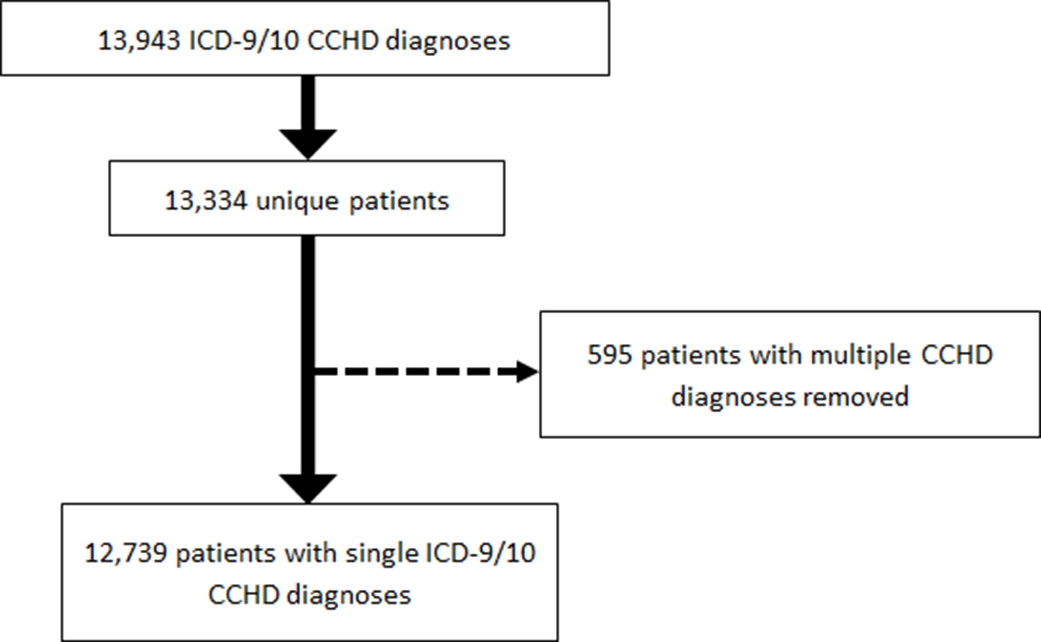
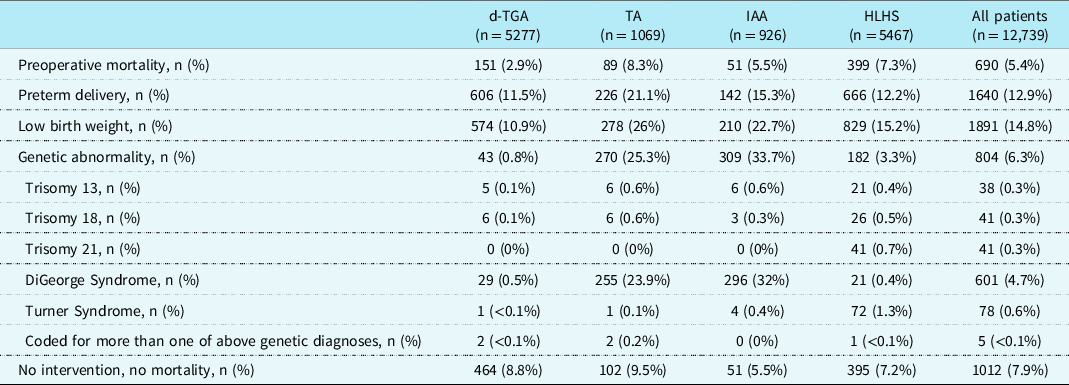
A total of 13,943 critical CHD diagnoses were reviewed. Of these diagnoses, 12,739 patients were included in the study population (Fig 1), which yielded the following distribution of the diagnoses: 5277 (41%) with d-transposition of the great arteries, 1069 (9%) with truncus arteriosus, 926 (7%) with interrupted aortic arch, and 5467 (43%) with hypoplastic left heart syndrome. Overall preoperative mortality was 5.4%. Broken down by diagnosis, preoperative mortality was 2.9% for d-transposition of the great arteries, 8.3% for truncus arteriosus, 5.5% for interrupted aortic arch, and 7.3% for hypoplastic left heart syndrome. Patient characteristics are presented in Table 1.
Study population: diagram depicting initial database query results as number of ICD-9/10 codes, translation into number of patients, removal of patients with multiple critical CHD diagnoses, and the final study population.

Patient characteristics

d-TGA = d-transposition of the great arteries; HLHS = hypoplastic left heart syndrome; IAA = interrupted aortic arch; TA = truncus arteriosus.
Differences between patients with and without preoperative mortality
Patients with preoperative mortality displayed higher rates of preterm delivery, low birth weight, and genetic abnormality (all p < 0.001; Table 2).
Differences between patients with and without preoperative mortality, all patients and HLHS subgroup

HLHS = hypoplastic left heart syndrome.
Centre characteristics
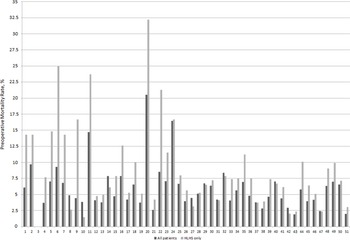
Preoperative mortality varied across centres from 0 to 20.5% (Fig 2). Centre average surgical volume per year ranged from 4 cases per year to 544 cases per year. Centres in the lowest volume category (<150 cases per year) had higher preoperative mortality than centres in the other three categories (p < 0.01; Table 3). There was no difference in preoperative mortality rates between the three higher surgical volume categories. Lower volume centres had a larger range of preoperative mortality compared to higher volume centres.
Graph depicting the variation of preoperative mortality across centres for all patients and hypoplastic left heart syndrome subgroup based on average surgical volume per year. Centres are arranged in order of increasing average surgical volume per year demonstrating relatively low variation across the majority of centres.

Differences in preoperative mortality between groups based on centre surgical volume

Results from chi-square testing with columnar level z-testing. p < 0.05 denotes statistically significantly difference from volume < 150 proportion.
HLHS = hypoplastic left heart syndrome.
Predictors of preoperative mortality
Upon univariable logistic regression analysis, preterm delivery (p < 0.01), birth weight < 2.5 kg (p < 0.01), genetic abnormality (p < 0.01), and centre surgical volume (p < 0.01) were all associated with preoperative mortality and were included in the multivariable model. Independent risk factors for preoperative mortality included preterm delivery (OR 2.3, 95% CI: 1.8–2.9; p < 0.01), low birth weight (OR 3.8, 95% CI: 3.0–4.7; p < 0.01), and genetic abnormality (OR 1.6, 95% CI: 1.2–2.2; p < 0.01). Centre average surgical volume per year was not independently associated with preoperative mortality (p = 0.09).
Subanalysis of hypoplastic left heart syndrome and preoperative mortality
A pre-specified subanalysis of the hypoplastic left heart syndrome subgroup was performed. Largely, the same differences in risk factors were seen in the preoperative mortality group, including higher rates of preterm delivery, low birth weight, and genetic abnormality (Table 2). Centre evaluation showed an even larger preoperative mortality rate range from 0 to 32% (Fig 2). Again, centres with lower average surgical volume displayed higher preoperative mortality (Table 3). A separate multivariable regression model was created for the hypoplastic left heart syndrome population. Independent risk factors for preoperative mortality in the hypoplastic left heart syndrome population included preterm delivery (OR 2.3, 95% CI: 1.7–3.1; p < 0.01), low birth weight (OR 3.0, 95% CI: 2.2–4.1; p < 0.01), and genetic abnormality (OR 3.6, 95% CI: 2.3–5.6; p < 0.01). Once more, centre average surgical volume per year was not independently associated with preoperative mortality (p = 0.051).
Post hoc analysis of patient dispositions
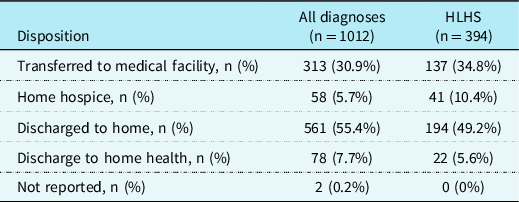
A significant percentage of patients (n = 1047, 7.9%) fell into the cohort of no intervention, and no mortality was recorded. Thirty-seven per cent of these patients were transferred to another medical facility or admitted to home hospice (Table 4). Transfers included short-term general hospital (72%), children’s hospitals (16%), short-term nursing facilities (1%), intermediate care facilities (1%), long term care hospitals (1%), inpatient rehabilitation (1%), and health care institution not otherwise defined (4%).
Disposition at discharge of patients who had no intervention, no mortality

HLHS = hypoplastic left heart syndrome.
Discussion
This study using the Pediatric Health Information System administrative database is the largest analysis of preoperative mortality in neonates with critical CHD with almost 13,000 patients from 51 US centres. For this sample of critical CHD diagnoses, an overall preoperative in-hospital mortality rate of at least 5.4% was identified during the study period. Importantly, preoperative mortality rates varied across critical CHD diagnoses from 2.9% in d-transposition of the great arteries to 8.3% in truncus arteriosus and among Pediatric Health Information System centres from 0 to 20.5%.
Previous studies have suggested similar preoperative mortality rates in patients with critical CHD but have not described variation across diagnoses. In the meta-analysis by Holland et al., Reference Holland, Myers and Woods17 preoperative mortality occurred in 6.6% (90/1373) of patients but rates for specific critical CHD diagnoses were not reported (likely due to relatively small numbers). A strength of the current analysis is the large study population which permitted identification of variation in preoperative mortality rates across multiple critical CHD diagnoses. Truncus arteriosus, which often entails a fragile and dynamic physiology prior to intervention, had the highest preoperative mortality in our study population (approximately one in every 12 infants with truncus arteriosus). Numerous studies examining patients with truncus arteriosus who undergo cardiac surgery have identified important risk factors, advanced operative techniques, and improved postoperative care. Reference Brown, Ruzmetov, Okada, Vijay and Turrentine18–Reference Thompson, McElhinney, Reddy, Petrossian, Silverman and Hanley21 Similar attention and investigation focused on infants who die without undergoing a cardiac intervention is warranted.
The relationship between centre characteristics and critical CHD preoperative mortality has never been investigated to our knowledge. A wide range of preoperative mortality rates (0–21% for all patients and 0–32% for hypoplastic left heart syndrome subgroup) exists across the centres studied, although the majority of this variation falls in the lowest average volume centres. Even when accounting for several outliers, a variation of preoperative mortality rates from 2 to 10% exists between most centres. Previous work has demonstrated that both patient characteristics and perioperative care practices vary significantly among paediatric cardiac surgical programmes, Reference Pasquali, Jacobs and O'Brien22,Reference Pasquali, Ohye and Lu23 and there is an association between higher surgeon and centre volumes and better postoperative outcomes. Reference Hornik, He and Jacobs24–Reference Tabbutt, Ghanayem and Ravishankar28 These findings have been cited as an argument for regionalisation of paediatric cardiac surgical care. Reference Welke, O'Brien, Peterson, Ungerleider, Jacobs and Jacobs29 In the current analysis, our ability to understand why variation exists across centres is limited to the variables available in an administrative dataset. Importantly, centre average surgical volume was not identified as an independent risk factor for preoperative death. Further study with more granular clinical data is needed to understand how case-mix differences and centre-specific practices may impact preoperative mortality rates. Centre variation regarding candidacy for surgery and support of a comfort care approach may also contribute to the differences observed.
Independent risk factors for preoperative mortality identified included preterm delivery, low birth weight, and presence of a genetic abnormality. Previous reports describing preoperative mortality in critical CHD have focused primarily on patients with hypoplastic left heart syndrome and functional single ventricle defects and reported similar results. In a large, recent, single-centre report called the “Philadelphia Fetus-to-Fontan Study,” preterm delivery, low birth weight, and need for ECMO were associated with preoperative mortality in infants born with hypoplastic left heart syndrome. Reference Zielonka, Snarr and Liu15 In the Single Ventricle Reconstruction Trial cohort, patients with preterm delivery, major extracardiac congenital abnormalities, and obstructed pulmonary venous return were more likely to die prior to cardiac surgery. Reference Atz, Travison and Williams14 Awareness of these risk factors for preoperative mortality for all critical CHD diagnoses can help inform prenatal and early postnatal family counselling, preoperative care practices and vigilance, palliative care consultation, and cardiac intervention decision-making.
Due to the heterogeneity within individual critical CHD diagnoses, a subgroup analysis of patients with hypoplastic left heart syndrome was performed. This diagnosis is less susceptible to coding and transcription errors and most determinately requires neonatal intervention prior to hospital discharge to optimise survival. ICD-9 coding for hypoplastic left heart syndrome in administrative data has a sensitivity of 95% and a specificity of 89% which is better than other critical CHD diagnoses. Reference Strickland, Riehle-Colarusso and Jacobs30 Preoperative mortality occurred in at least 7.3% of patients with hypoplastic left heart syndrome which is higher than previous reports. The Philadelphia Fetus-to-Fontan Study and the Single Ventricle Reconstruction Trial demonstrated a preoperative mortality from 3 to 5% for hypoplastic left heart syndrome. Reference Atz, Travison and Williams14,Reference Zielonka, Snarr and Liu15 These studies are limited by more selective populations which came from 15 US centres. Additionally, the “Philadelphia Fetus-to-Fontan Study” included only patients with intention to treat with cardiac intervention. This difference in study populations may explain why the presence of a genetic abnormality has not been previously described as a risk factor for preoperative mortality in patients with hypoplastic left heart syndrome. It is possible some families and cardiac surgery programmes decided not to pursue intervention in infants with hypoplastic left heart syndrome and a genetic diagnosis, but this is not discernible through Pediatric Health Information System.
Our study demonstrates variability of preoperative mortality across critical CHD diagnoses and centres, but, due to limitations of administrative databases, is unable to fully elucidate the factors that drive this variation. Reference Pasquali, He and Jacobs31,Reference Pasquali, Peterson and Jacobs32 Some patients may have had incorrect transcription or coding of their diagnoses or procedures into the Pediatric Health Information System database. The cohort of patients with no intervention and no mortality reported may have been related to incorrect diagnosis, balanced Qp:Qs physiology, or transfer to a different centre. Our focus was on preoperative in-hospital mortality, so these patients were included in our total population, but not assigned as suffering preoperative mortality. Nevertheless, with nearly 1/3 of this subgroup transferred to other medical facilities, some may have had in-hospital mortality. The reason for transfer (surgical management at a different centre versus hospice or withdrawal of care at a local hospital closer to family) and destination of transfer were unable to be elucidated via Pediatric Health Information System. We considered removing any patient who was transferred from the study population (∼5% of patients) but elected to keep them for transparency of the analysis, understanding that we were likely underestimating the true rate of preoperative mortality. This analysis is also limited by evaluating only four risk factors for preoperative mortality (preterm delivery, low birth weight, presence of a genetic abnormality, and centre). A more detailed analysis describing comorbidities such as acute kidney injury, sepsis, necrotising enterocolitis, intracranial injury, mechanical ventilation, and need for inotropes and their impact on surgical candidacy or preoperative mortality was not possible with an administrative dataset and will be pursued. Future studies should utilise or link to clinical registry data to further delineate important risk factors for preoperative mortality in critical CHD. A better understanding of the impact of preoperative care practices on preoperative mortality is needed. Teasing out the aetiology of preoperative mortality in critical CHD, such as clinical deterioration versus programmatic decision not to intervene versus parental decision to pursue comfort care, will likely require multicentre collaboration and granular review of the medical record.
Acknowledgements
None.
Financial support
This research received no specific grant from any funding agency, commercial, or not-for-profit sectors.
Conflicts of interest
The authors have no conflicts of interest relevant to this article to disclose.
Ethical standards
The study protocol was reviewed by the Medical University of South Carolina Institutional Review Board for Human Research and determined to be exempt from human research subject regulations because of its use of deidentified data.