Transposition is the combination of concordant atrioventricular and discordant ventriculo-arterial connections. First described by Baillie in 1797,Reference Baillie 1 the acronym “TGA”, as far as we can establish, was first used by Farre in 1814.Reference Farre 2 Considerable confusion remains, however, regarding terms such as “complete” versus “partial” transposition, and particularly “d-TGA” as opposed to “l-TGA”.Reference Becker and Anderson 3 The definitions provided for the Society of Thoracic Surgeons by Jaggers et alReference Jaggers, Cameron, Herlong and Ungerleider 4 pointed out that all forms of discordant ventriculo-arterial connections were “complete”. Transposition itself, therefore, can be the default option for the variant associated with concordant atrioventricular connections, whereas congenitally corrected transposition is the best term for hearts with a discordant connection at both atrioventricular and ventriculo-arterial junctions. With regard to the use of “d” and “l”, these qualifiers should be used only to describe the relative positions of the aortic and pulmonary valves, with full segmental description needed to eradicate ambiguity. Ideally, these terms should not be used alone, nor in place of the regular or congenitally corrected variants. Transposition, therefore, is preferred to “d-transposition”, and congenitally corrected transposition is preferred to “l-transposition”. When transposition is encountered in patients with usual atrial arrangement, the aorta is usually right-sided and anterior, whereas an anterior and left-sided aorta is the rule in congenitally corrected transposition with usual atrial arrangement. A rare, but important, exception to these rules occurs when, in patients with usual atrial arrangement, the transposed aorta lies to the left and anteriorly, a combination well described as transposition (S, D, L). Such examples of transposition with left-sided aortas are rare entities. Exhaustive search in the English medical literature (Pubmed®, Cochrane®, and Google Scholar®) yielded only one series devoted specifically to this variant. In this series, collated by Houyel et alReference Houyel, Van Praagh and Lacour–Gayet 5 from Marie Lannelongue Hospital in Paris, the variant with a left-sided aorta made up only 2.9% of all patients seen with regular transposition in the extensive experience of Marie Lannelongue Hospital in Paris and the Cardiac registry of the Children’s Hospital of Boston, United States of America.
Since its initial description by Jatene et al,Reference Jatene, Fontes and Paulista 6 the arterial switch operation has become the treatment of choice for regular transposition. A prime determinant for successful early and mid-term outcomes following the procedure is the accurate transfer of the coronary arterial buttons to the new aorta. Given the well-known wide variations in the origin and distribution of the coronary arteries, this can be particularly difficult. The relationship of the arterial trunks, the method of transfer of the buttons, and their final position after reconstruction are aimed so as to avoid tension, torsion, and kinking of both coronary arteries and their major branches. There is limited information available, however, on the methods of coronary arterial transfer in the small subset of patients with leftward aortas. We describe here the technical modifications we discovered to be necessary for a successful outcome in a relatively large cohort of patients undergoing surgical correction in our centre.
Patients and methods
At the All India Institute of Medical Sciences, New Delhi, India, a total of 20 patients diagnosed as having transposition with a left-sided aorta in the setting of usual atrial arrangement and concordant atrioventricular connections underwent an arterial switch procedure between January, 2002 and October, 2013. We performed a detailed review of the preoperative, intraoperative, and postoperative charts. The study protocol was duly approved by the ethics committee of the Institute, along with a waiver of individual patient consent.
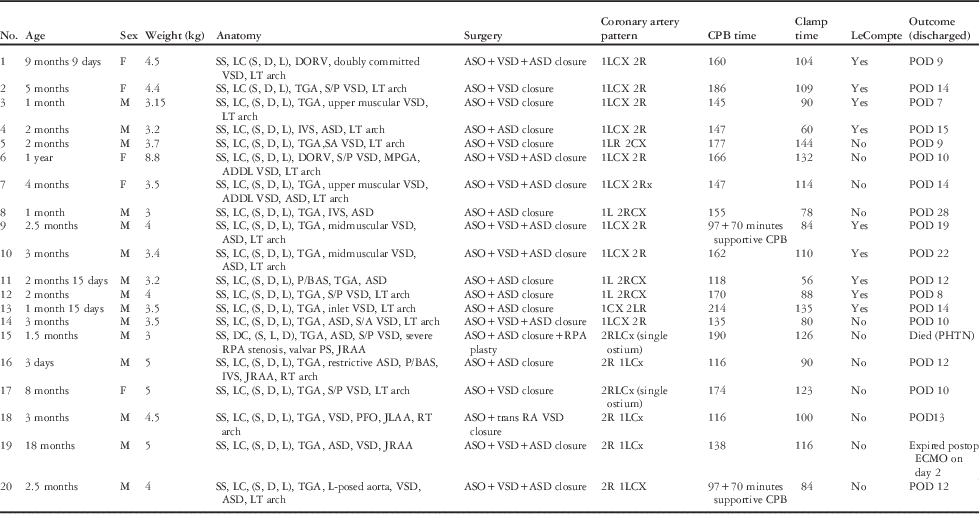
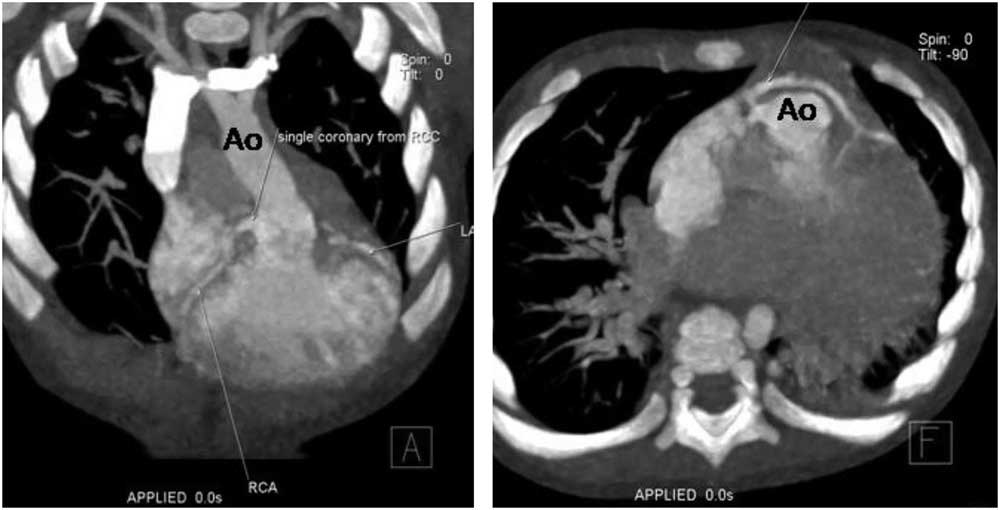
We have summarised the details of the patients in Table 1. The unifying feature of all 20 patients was the leftward and anterior location of the aortic root relative to the pulmonary root. The age at the time of operation ranged from 3 days to 18 months, with a median of 75 days, and weight ranged from 3 to 8.8 kg, with a median of 3.85 kg. In three patients, the ventricular septum was intact, whereas all other patients had an atrial septal defect, a ventricular septal defect, or both lesions. Of the 20 patients, one had a right-sided heart, with the apex pointing to the right, with stenosis of the right pulmonary artery and the pulmonary valve. The right atrial appendage was juxtaposed to the left of the arterial pedicle in three patients, with the left atrial appendage juxtaposed to the right in one patient. The aortic arch was right-sided in two patients. Two patients with an intact ventricular septum and restrictive defects in the oval fossa required preoperative infusion of prostaglandins and balloon atrial septostomy. Our first patient also required enlargement of the right pulmonary artery because of severe narrowing at its origin from the pulmonary trunk. The coronary arterial anatomy was established initially using cross-sectional echocardiography, and then verified intraoperatively, being described using the Leiden convention.Reference Gittenberger-de Groot, Sauer, Oppenheimer-Dekker and Quaegebeur 7 In two patients, both coronary arteries arose from a single orifice within the left-handed sinus or sinus 2 (Fig 1). In one patient, the circumflex artery arose from the right-handed sinus, or sinus 1, whereas the anterior interventricular and right coronary arteries arose from sinus 2. In two patients, it was the anterior interventricular artery that arose from sinus 1, whereas the right and circumflex arteries arose from sinus 2, with the circumflex artery taking a retropulmonary course. Another patient had the anterior interventricular and right coronary arteries arising from sinus 1, with the right coronary artery extending antero-aortically, whereas the retropulmonary circumflex artery arose from sinus 2. The usual pattern of arterial origin, with the anterior interventricular and circumflex arteries arising from sinus 1 and the right coronary artery from sinus 2, was found in the remaining 14 patients.
Summary of patients undergoing arterial switch operation for transposition and left-sided aorta.

ADDL=additional; ASD=atrial septal defect; ASO=arterial switch operation; CPB=cardiopulmonary bypass time; DC=dextrocardia; DORV=double outlet left ventricle; ECMO=extracorporeal membrane oxygenation; IVS=intact ventricular septum; JLAA=juxtaposed left atrial appendages; JRAA=juxtaposed right atrial appendages; LC=levocardia; LT=left; MPGA=malposed great arteries; P/BAS=post-balloon atrial septostomy; PFO=patent foramen ovale; PHTN=pulmonary hypertension; POD=postoperative day; postop=postoperatively; PS=pulmonary stenosis; R=right; RA=right atrium; R/A=right and anterior; RPA=right pulmonary artery; S/A=sub-aortic; SP=subpulmonic; SS=situs solitus; TGA=transposition of the great arteries; VSD=ventricular septal defect
Surgical technique
Following median sternotomy, a quadrangular patch of autologous pericardium was harvested and fixed in 0.6% glutaraldehyde for 6 minutes to allow for better handling. All patients had aorto-bicaval cannulation, and underwent standard hypothermic cardiopulmonary bypass at 28°C. The aortic and pulmonary trunks were separated from each other, and the right and left pulmonary arteries were mobilised to their hilar attachments. The arterial duct was isolated, transfixed, and divided. The aorta was cross-clamped, cold blood cardioplegia was delivered into the aortic root, and cardiac activity was arrested. The left heart chambers were vented and, after snugging the caval veins, the right atrium was opened. The ventricular septal defect, if present, was closed through the right atrium. The coronary arterial anatomy was assessed, and the aorta was transected well above the sinotubular junction. With utmost care, coronary buttons were harvested, taking a solitary button from the two patients in whom both coronary arteries arose from sinus 2. The pulmonary trunk was then divided at its convergence with the right and left pulmonary arteries.
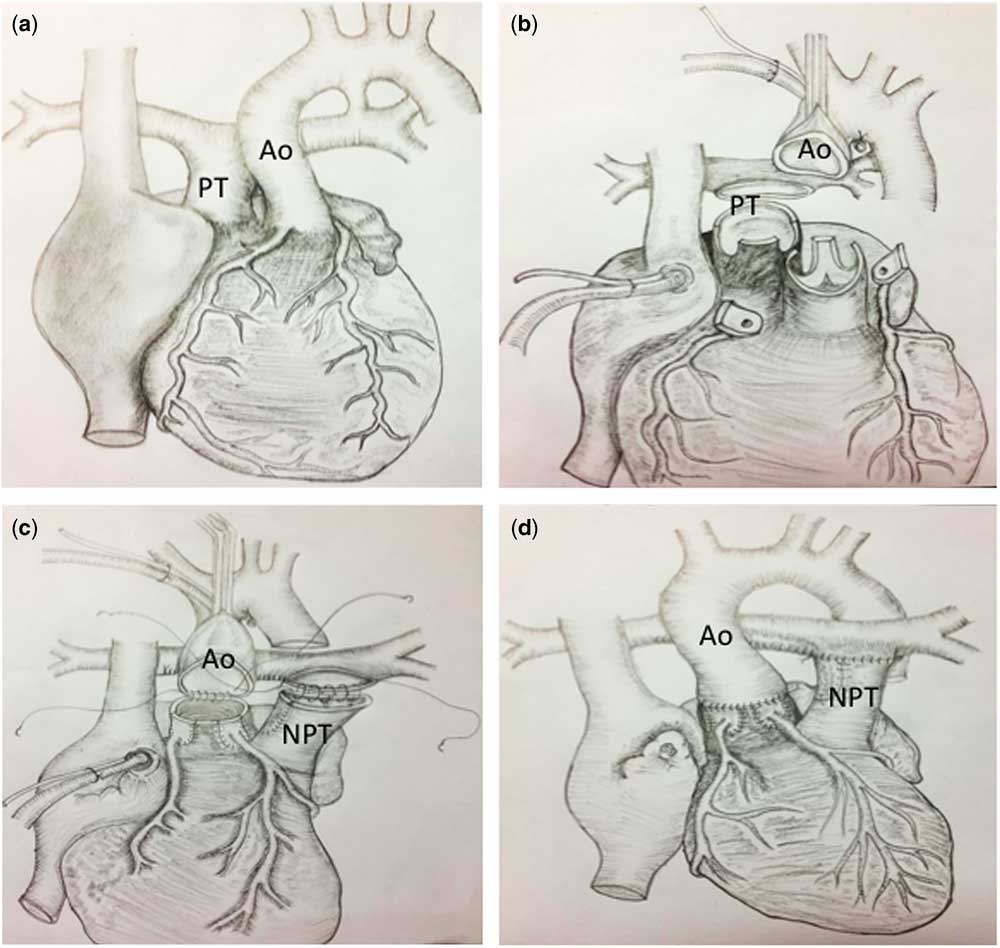
Before performing the coronary arterial transfer, we reconstructed the right ventricular outflow tract. This was achieved by suturing the glutaraldehyde-fixed autologous pericardial patch to the proximally cut end of the aorta, destined to become the new pulmonary trunk. We performed this manoeuvre first in order to avoid any unnecessary handling and manipulation of the coronary arterial buttons, which might have ensued had transfer been carried out before reconstruction of the outflow tract. Transfer was undertaken in such a way as to avoid any traction or kinking of either the buttons or their arteries. After assessment, a longitudinal wedge of the tissue was excised from the proximal pulmonary trunk, destined to become the new aorta. Transfer was accomplished by suturing with a continuous 7-0 polypropylene suture interrupted at both ends. Any decision to perform the LeCompte manoeuvre was delayed towards the end of the procedure. Because of the left-sided aortic location, however, this was required in only nine patients. Noting that the reconstructed right ventricular outflow tract could compromise the transferred coronary arteries, we moved the anastomosis leftwards between the proximal and distal components of the new pulmonary trunk. This was made possible by extending the arteriotomy in the distal pulmonary trunk towards the left pulmonary artery, and suturing closed the right half of the arteriotomy made in the distal part of the pulmonary trunk. The proximal part of the initial aortic trunk, now the new pulmonary trunk, was then anastomosed to the undersurface of the left pulmonary artery. This leftward relocation of the new pulmonary outflow tract served to avoid any potential compression of the coronary arterial buttons (Fig 2).
Results
All patients survived the operation, with the LeCompte manoeuvre required in only nine patients. The mean cardiopulmonary bypass time was 157.5±24.9 minutes, with a median of 161 minutes, and the mean aortic cross-clamp time was 101.2±23.8 minutes, with a median of 102 minutes. One of our patients died subsequent to a sudden onset of ventricular fibrillation on the 2nd postoperative day. Another patient died before discharge because of a severe pulmonary hypertensive crisis. Transthoracic echocardiography in these patients before death had revealed normal bi-ventricular function and normal flow in the replanted coronary arteries. Despite the use of extracorporeal membrane oxygenation, the first patient could not be resuscitated. Consent for autopsy was denied. In two additional patients, we experienced difficulty in weaning from the cardiopulmonary bypass, and supportive bypass was required for around 70 minutes. Their subsequent recovery, however, was normal.
Hospital stay ranged from 2 to 28 days, with a mean of 12.7 days and a median of 12 days. Follow-up ranged from 23 to 41 months, with a mean of 38.04±2.32 months and a median of 38.4 months. At the last follow-up, all 18 survivors were in NYHA class I, and none required cardiac medication. Serial echocardiograms revealed normal bi-ventricular function, with no evidence of residual defects.
Discussion
In patients with regular transposition, in other words the combination of concordant atrioventricular and discordant ventriculo-arterial connections, it is usual to find the aorta in anterior and rightward, or directly anterior, positions when the atrial chambers are usually arranged. It is unusual in such a setting to find the aorta located leftwards and anteriorly. Such patients present both diagnostic and surgical challenges. As was shown previously by the group working at Marie Lannelongue Hospital in Paris,Reference Houyel, Van Praagh and Lacour–Gayet 5 who combined their experience with that obtained from the Boston group, this variant accounts for only about one-fortieth of the overall cohort of patients with regular transposition. The Parisian authors concluded that additional associated anomalies are more common in this subset than in the majority of patients. They emphasised the likely presence of associated anomalies, such as an outlet ventricular septal defect, right ventricular hypoplasia, stenosis of the left ventricular outflow tract, an abnormal cardiac position, and a solitary coronary artery arising from the left-handed aortic sinus. They suggested that it was increasing degrees of leftward rotation of the sub-aortic infundibulum and aortic root that increased the probability of some of these anomalies. They also hypothesised that abnormal leftward and posterior displacement of the coronary bud growing from sinus 1 leads to its non-union with coronary angioblasts developing in the left atrioventricular groove, hence the presence of the solitary right coronary arterial orifice. It is also the case, of course, that such a leftward location of the aorta proves to be an exception to the so-called loop rule,Reference Van Praagh, Ongley and Swan 8 , Reference Van Praagh, Van Praagh, Vlad and Keith 9 which held that the aortic root would always be to the right and anterior of the pulmonary trunk in the setting of concordant atrioventricular connections and right-handed ventricular topology. Such a left-sided location of the aorta was initially anticipated to occur only in the setting of usual atrial arrangement with discordant atrioventricular connections and left-handed ventricular topology, in other words in congenitally corrected transposition, or, alternatively, in the mirror-imaged variant of regular transposition, also associated with left-handed ventricular topology.
Of the patients in the Parisian cohort, 10 were deemed to have an anatomy suitable for the arterial switch, with nine surviving the operative intervention. In our cohort of 20 patients, we were able to achieve arterial correction in all, despite the technically demanding aspects of the operative procedure and the increased incidence of abnormal coronary arterial patterns. The arterial switch procedure, of course, is now the expected treatment for patients with regular transposition. Features once thought to preclude the procedure are no longer considered contraindications in themselves, such as the unprepared left ventricle,Reference Boutin, Wernovsky, Sanders, Jonas, Castaneda and Colan 10 or unsuitable patterns of coronary arterial origin. Mechanical left ventricular assistance has proved a considerable success in mitigating a regressed or unprepared left ventricle, permitting safe completion of the primary arterial switch procedure in patients as old as 2 months.Reference Kang, de Leval and Elliott 11 Coronary arterial patterns initially considered to represent a contraindication have similarly been mitigated by development of appropriate techniques for surgical transfer.Reference Yacoub and Radley Smith 12 – Reference Talwar, Shivaprasad, Kothari and Choudhary 15 Transfer of a solitary arterial button, nonetheless, is still deemed to increase the risk for postoperative mortality.Reference Pasquali, Hasselblad, Li and Sanders 16
We found that the arterial switch procedure, when performed in this group of patients, needs to be further modified to achieve successful outcomes. We have already described our suggested technical modifications.Reference Talwar, Jha, Choudhary, Rajashekar and Airan 17 Thus, the pulmonary trunk is transected well above the sinotubular junction. If needed, flaps can be fashioned out of the wall of the new aorta to provide a long coronary arterial button, thus permitting effective elongation of the reconstructed coronary arteries. Transection of the initial pulmonary trunk at its bifurcation avoids distortion of the neo-aortic root, and also permits the raising of a reciprocal flap, again permitting the coronary arterial button to be placed above the sinotubular junction. We suggested that reconstruction of the new outflow tract for the right ventricle be performed before transfer of the coronary arteries, thus avoiding unnecessary manipulation of the coronary arterial buttons; further, to prevent coronary arterial compression, we shifted the outflow tract leftwards by closing the right half of the arteriotomy made in the initial pulmonary trunk, extending the arteriotomy on the distal stump towards the left pulmonary artery and suturing the proximal part of the aorta, which will be a part of the new pulmonary trunk, to the undersurface of the left pulmonary artery. We also advised delaying the LeCompte manoeuvre to the end of the operative procedure, determining its necessity according to the final position of the coronary arteries and the relation to the arterial trunks. In this way, we avoided performing the manoeuvre in more than half of our patients.
Limitations of the study
We recognise that our review is limited by its retrospective nature, and by the absence of comparisons with our standard approach to the arterial switch procedure for regular transposition. We also recognise a strong surgical bias towards the use of particular techniques. On the other hand, its advantage is that it represents the experience of a single surgical team.
Conclusion
We conclude, based on our experience, that patients with usual atrial arrangement having regular transposition with a left-sided and anterior aorta constitute a specific cohort, which requires special attention. We advise detailed preoperative evaluation, along with intraoperative modifications of the classic arterial switch procedure, so as to achieve successful outcomes.
( a ) CT angiography of patient no. 17 shows the maximum intensity projection (MIP) reformatted image in the coronal plane. ( b ) MIP reformatted image in the axial oblique plane. Ao=aorta; LAD=left anterior descending coronary artery; RCA=right coronary artery; RCC=right coronary cusp (Reproduced with permission from Talwar et al.Reference Talwar, Jha, Choudhary, Rajashekar and Airan 17 Copyright American Association for Thoracic surgery).

Surgical drawing showing the operative steps. ( a ) External cardiac anatomy, ( b ) the aorta is transected and the coronary buttons are harvested. ( c ) Aortic (Ao) reconstruction after coronary transfer. Note that the LeCompte manoeuvre has not been performed and the proximal neo-pulmonary trunk (PT) is anastomosed to the undersurface of the left pulmonary artery. ( d ) Final reconstructed appearance of the cardiac anatomy. NPT=reconstructed proximal right ventricular outflow tract.

Acknowledgements
None.
Financial Support
This research received no specific grant from any funding agency or from commercial or not-for-profit sectors.
Conflicts of Interest
None.
Ethical Standards
The authors assert that all procedures contributing to this work comply with the ethical standards of the relevant national guidelines on human experimentation in India and with the Helsinki Declaration of 1975, as revised in 2008, and has been approved by the institutional committee of the All India Institute of Medical Sciences, New Delhi, India.