Introduction
The quality of assessment of older people with health and social care needs has for some time been a concern of policy makers, practitioners, service users and carers in the United Kingdom (UK) and internationally (Carpenter Reference Carpenter, Challis, Darton and Stewart1998; Challis et al. Reference Challis, Clarkson, Williamson, Hughes, Venables, Burns and Weinberg2004; Byles Reference Byles2000; Howe and Kung Reference Howe and Kung2003; Ikegami Reference Ikegami1997; Jorg et al. Reference Jorg, Boeije, Huijsman, de Weert and Schrijvers2002; Kane and Kane Reference Kane and Kane2000; Otis and Butler Reference Otis and Butler1997). This article seeks to address a key aspect of these concerns, the assessment of older people with complex needs who are likely to require a comprehensive assessment that requires a range of professional expertise. It is considered in the context of the adoption in England in April 2004 of the Single Assessment Process (SAP), a government initiative to improve the standard of assessment for older people with health and social care needs (Department of Health 2001a, 2002). Similar strategies have been introduced elsewhere, such as the Australian Community Care Needs Assessment (Australia, Department of Health and Ageing 2007).
The concept of comprehensive assessment can be traced back to the pioneers in public health and welfare who noted the importance of seeing the older person ‘in the round’ (Warren Reference Warren1946), and who recognised that health and social care needs overlap, are often unrecognised, and that co-ordination between professionals is required if individual needs are to be met (Booth Reference Booth1981; Williamson et al. Reference Williamson, Stokoe, Gray, Fisher and Smith1964). Internationally, the idea of comprehensive geriatric assessment has been advanced as a way of eliciting the full range of needs of older people (Applegate et al. Reference Applegate, Miller, Graney, Elam, Burns and Akins1990; Stuck et al. Reference Stuck, Siu, Wieland, Adams and Rubenstein1993). Despite this history, many UK studies have reported that the assessment of older people is disjointed and compartmentalised (Challis et al. Reference Challis, Darton, Johnson, Stone and Traske1995, Reference Challis, Weiner, Darton, Hughes and Stewart2001; Chevannes Reference Chevannes2002; Glasby Reference Glasby2003; Gray and Hunter Reference Gray and Hunter1983; Hudson et al. Reference Hudson, Lewis, Waddington and Wistow1998; Hunter and Wistow Reference Hunter and Wistow1987; Petch et al. Reference Petch, Cheetham, Fuller, Macdonald, Myers, Hallam and Knapp1996; Weiner et al. Reference Weiner, Stewart, Hughes, Challis and Darton2002). Some have commented that assessors tend to view the subject in isolation from their social world (Webb and Hobdell Reference Webb, Hobdell, Carver and Liddiard1978), and that assessments involve many encounters between individual professionals and older people but poor communication among them (Audit Commission 1997; Department of Health 1993a, 1993b, 1996; House of Commons Health Select Committee 1998; Social Services Inspectorate 1997).
Few recent reviews of the impact of comprehensive assessment have addressed the impact on those at significant risk who are living at home. Studies have focused upon in-patient groups (Ellis and Langhorne Reference Ellis and Langhorne2005), and preventive visiting (Bouman et al. Reference Bouman, Rossum, Ambergen, Kempen and Knipschild2007, Reference Bouman, Rossum, Nelemans, Kempen and Knipschild2008), or on assessments in conjunction with specific, complex interventions (Beswick et al. Reference Beswick, Rees, Dieppe, Ayis, Gooberman-Hill, Harwood and Ebrahim2008). Stuck and Kane (Reference Stuck and Kane2008) concluded that although preventive home visits are not beneficial for high-risk individuals, other more targeted and focused interventions may be (Gill et al. Reference Gill, Baker, Gottschalk, Peduzzi, Allore and Byers2002; Phelan et al. Reference Phelan, Williams, Pennix, LoGerfo and Leveille2004; Naylor et al. Reference Naylor, Brooten, Campbell, Jacobsen, Mezey, Pauly and Schwartz1999). A randomised controlled trial in England found that a comprehensive assessment process targeted on highly vulnerable older people and undertaken by specialist clinicians and social workers reduced functional decline, improved carer wellbeing, and reduced care-home admissions and health-care costs (Challis et al. Reference Challis, Clarkson, Williamson, Hughes, Venables, Burns and Weinberg2004). This was perhaps the study which perhaps most closely embodies the spirit of the implementation of comprehensive assessment through the SAP.
It was long ago argued that no single professional group has sufficient skills or knowledge to be able to carry out comprehensive assessments alone and that ‘teamwork across professional boundaries is needed … if whole person care is to be possible and the optimal use of skills is to be attained’ (Webb and Hobdell Reference Webb, Hobdell, Carver and Liddiard1978: 342). The benefits described by Webb and Hobdell of a multi-disciplinary approach to assessment included making the best use of specialist skills and those that derive from the division of labour. Empirical studies have indeed demonstrated a range of benefits of an integrated approach to assessment, including faster and more appropriate responses to requests and reduced provider costs (Challis et al. Reference Challis, Clarkson, Williamson, Hughes, Venables, Burns and Weinberg2004; Øvretveit Reference Øvretveit1993). Team work is a key component of effective multi-disciplinary comprehensive assessment. Øvretveit (Reference Øvretveit1993) argued that multi-disciplinary comprehensive assessment can only become systematic when multi-disciplinary teams are led by a single manager. Others have suggested, however, that the key to an effective team is when the power to make decisions is equally shared amongst the professional (and para-professional) members (Sheard and Cox Reference Sheard and Cox1998; Webb and Hobdell Reference Webb, Hobdell, Carver and Liddiard1978). In England, the SAP guidance noted that, ‘where joint teams have been established, the integration of assessment, care planning and service delivery across agencies and disciplines is often reported as less difficult to achieve’ (Department of Health 2002: Annex G).
Although there are multi-agency and multi-disciplinary assessment teams in England (Audit Commission 2002; Challis et al. Reference Challis, von Abendorff, Brown, Chesterman and Hughes2002; Hardy, Leedham and Wistow Reference Hardy, Leedham, Wistow and Bland1996), they are not yet mainstream. Studies at the beginning of the millennium indicated that joint assessments, or even consultations with another professional, were not standard practice (Challis et al. Reference Challis, Weiner, Darton, Hughes and Stewart2001; McNally, Cornes and Clough Reference McNally, Cornes and Clough2003; Moriarty and Webb Reference Moriarty and Webb2000; Weiner et al. Reference Weiner, Stewart, Hughes, Challis and Darton2002). Chevannes reported that professionals in health and social care appeared to be ‘driven by the specific brief of their agency’ and to operate ‘outside of an integrated and multi-disciplinary assessment process that enables health and social needs to be considered together’ (2002: 177). The development of the intermediate care sector, including arrangements to prevent unnecessary hospital admissions and facilitate the rehabilitation of older people following hospital discharge, might change this picture. Such services are typically provided by multi-disciplinary teams in diverse locations, including the patients' homes, care homes and community hospitals (Cowpe Reference Cowpe, Roe and Beech2005; Department of Health 2001b; Steiner Reference Steiner2001).
In Australia, by contrast, ‘geriatric assessment teams’ were established following the Nursing Homes and Hostels Review of 1986 (Australia, Department of Community Services 1986), and they formalised multi-disciplinary assessment practice in primary and secondary health care and social care (Challis et al. Reference Challis, Darton, Johnson, Stone and Traske1995; Kendig et al. Reference Kendig, McVicar, Reynolds and O'Brien1992). The Australian experience demonstrates how structural reform at a national level can lead to the integration of assessment at the professional level. On the other hand, the findings of a study that compared old-age psychiatry departments in England and Northern Ireland suggested that professional integration is not an automatic consequence of structural integration (Reilly et al. Reference Reilly, Challis, Burns and Hughes2003). Although there was greater ‘structural integration’ in Northern Ireland, where health and social care are managed by a single body, only limited practice-level integration was found. In sum, although there are challenges in implementing an effective multi-disciplinary approach to the assessment of older people with complex needs, the pursuit of such an approach has been widely seen as a way of improving the assessment of older people.
The Single Assessment Process
In England, the difficulty of co-ordinating assessments across professional groups has been exacerbated by the long-established organisational divide between health and social care (Lewis Reference Lewis2001; Webb and Wistow Reference Webb and Wistow1986). A number of government policies have sought to mitigate this difficulty by, for example, removing structural barriers to integrated budgets and by creating jointly-managed services (Cameron and Lart Reference Cameron and Lart2003; Cm 4818-1 2000; Cm 6737 2006; Department of Health 2001a, 2002; Rummery and Glendinning Reference Rummery and Glendinning2000). Introduction of the SAP was a formal response to the enduring shortcomings of the assessment process, and sought to provide a structure in which multi-disciplinary assessment would flourish. The national implementation introduced shared tools, assessment procedures and a guidance framework, rather than prescribing a specific intervention. Its overall aims were to establish a standardised assessment process, to raise the standards of assessment, and to ensure that older people's needs are assessed ‘in the round’ (Department of Health 2001a: paragraph 2.27).
Four types of assessment are identified in the SAP guidance (contact, overview, specialist and comprehensive), each being triggered by the specific circumstances and needs of an individual (Department of Health 2002). Comprehensive assessment is here defined as an overview together with one or more specialist assessments that are necessary for an older person who is likely to require intensive or prolonged support, which might include permanent admission to a care home, intermediate care (Department of Health 2001b) or complex care packages at home (Department of Health 2002: Annex H). No specific tools were prescribed, although for overview assessments two instruments were used in more than half the localities, namely FACE and Easycare (Clifford Reference Clifford1997; Department of Health 2008; Philp Reference Philp2000). The official guidance describes the possible range and extent of professional involvement in comprehensive assessments as variable and dependent on the person's individual circumstances, but is more prescriptive in its call for the involvement of particular professionals where placement in a care home or care-home-with-nursing is being considered. In these circumstances the guidance states that:
A comprehensive assessment for people who eventually enter care homes should have involved the input of a range of professionals, with geriatricians, old-age psychiatrists, other consultants working with older people, registered nurses, social workers and therapists playing a prominent role. (Department of Health 2002: Annex H)
Additionally it specifies that where the care home provides nursing care, the co-ordinating or leading role in the assessment process should be played by a registered nurse. The policy therefore seeks to establish more specific arrangements between professionals for certain placement settings. The nature and extent of multi-disciplinary working around assessments of older people consequently provides a key area in which to judge the impact of the policy.
Aims of this paper
This article seeks to ascertain the degree and nature of comprehensive assessment across England at the beginning of the 21st century following the introduction of the SAP. It attempts to address whether the comprehensive assessment practice that emerged corresponded to the policy logic that was its instigation (Gostick et al. Reference Gostick, Davies, Lawson and Salter1997). Were patterns of multi-disciplinary working emerging and, if so, what were they? Did the arrangements conform to the envisaged aims of the policy, to promote a multi-disciplinary approach to this type of assessment across the country? Was the setting in or for which assessment took place important in shaping multi-disciplinary approaches?
Design and methods
Data were obtained from a national survey of the lead officers responsible for implementation of the SAP policy across the 150 local authority areas in England (Abendstern et al. Reference Abendstern, Hughes, Clarkson, Sutcliffe, Wilson and Challis2010). A self-completion postal questionnaire was sent to the authorities between October 2005 and May 2006, and there were 122 (82%) completed responses. The local authority was therefore the unit of analysis. A sub-set of these data relating to which types of staff participated in a comprehensive assessment are the basis of the analyses reported in this paper. As a framework for the analysis, the specified different purposes of a comprehensive assessment were identified from the policy guidance (Department of Health 2002). These related to four services for which the assessments are undertaken: placement in a care home, placement in a care-home-with-nursing, intensive domiciliary care and intermediate care. Henceforward, for ease of reference, we refer to these as ‘sectors’ or ‘settings’ while recognising that they represent the circumstances in which assessments are undertaken rather than the locations of the assessors or the case delivery.
The analysis had two stages. The first involved the construction of variables to identify two indicators of multi-disciplinarity: the professional groups and the number of professions involved. Six recognised professional groups were identified: medical consultants (old-age psychiatrists or geriatricians), general (medical) practitioners, nurses, social workers/care managers, occupational therapists, and housing officers. The number of professions involved in comprehensive assessment were coded into four categories (one, two, three to five, and six or more professionals). These variables were examined for each sector.
The second stage involved multi-dimensional cross-tabulations of the indicators of multi-disciplinarity (professional group and number of professionals) by the sector in which they were undertaken. Cramer's V (sometimes termed Cramer's C) was used to determine the strength of associations between these indicators; in effect to determine whether the identified patterns of multi-disciplinary working occurred together (Everitt Reference Everitt1992; Seigel and Castellan Reference Seigel and Castellan1988). As a rule of thumb, Cramer's V scores of 0.3 or above were taken as ‘a fair degree of association between any two variables in a contingency table’ (O'Reilly and Rose Reference O'Reilly, Rose, Rose and O'Reilly1997: 63) and were used as a standard from which to discern whether particular groupings tended to occur together consistently. Using this threshold, we explored the extent to which these associations occurred among the local authorities, the unit of analysis. Only associations found in 5 per cent or more of authorities were included (Challis et al. Reference Challis, Weiner, Darton, Hughes and Stewart2001). We describe the resulting combination of associations as arrangements for the conduct of multi-disciplinary assessments within local authorities.
Findings
Working together: sector and professional group
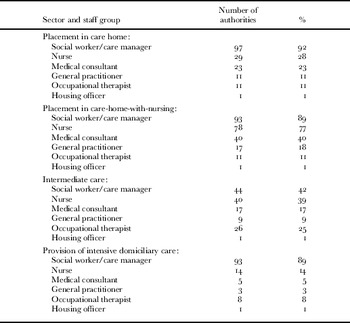
Table 1 shows the distribution of the professionals that the local authorities stipulated were required to undertake a comprehensive assessment by sector. It can be seen that, overall, medical consultants, general practitioners, occupational therapists and housing officers were less frequently involved in comprehensive assessments than social workers/care managers. Medical consultants were most frequently involved (in 40 per cent of the authorities) in assessments for placement in a care-home-with-nursing. Occupational therapists were most likely to be involved in assessments for intermediate care (25%). Social workers/care managers were involved in the majority of local authorities for placements in care homes or care-homes-with-nursing and for intensive domiciliary care, but less so for intermediate care. Nurses were most frequently involved in assessments for care-homes-with-nursing (77%). A housing officer was involved in comprehensive assessments in only one authority, but in all sectors.
Staff contributing to comprehensive assessment, England, 2005–06

Notes: Data were available for 107 local authorities. Sample sizes (minimum, maximum): medical consultants (101, 102), general practitioners (96, 99), nurses (99, 104), social workers/care managers (104, 106), occupational therapists (103, 105), housing officers (99, 100).
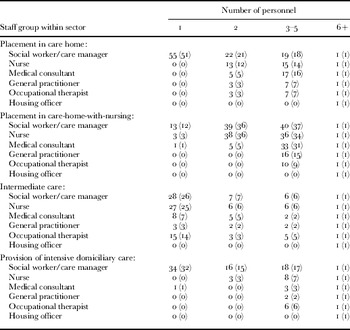
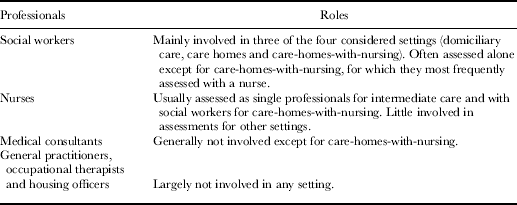
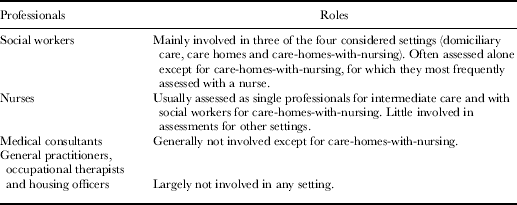
These responses provided evidence about which professionals worked predominantly alone or together with others on a comprehensive assessment in the different sectors. Table 2 presents the cross-tabulations of professional group by the number of professionals involved in comprehensive assessments in the authorities. The figures are presented for each sector, and a number of interesting findings emerge. If we define multi-disciplinarity as three or more professionals involved in an assessment, it is notable that it occurred in only one sector, placements in care-home-with-nursing. More generally, the analysis reveals that medical practitioners (either consultants or general practitioners) were rarely involved in assessments for other care arrangements. For intermediate care, where the responsibility for the assessment was vested in a single professional, this was just as likely to be a social worker/care manager as a nurse. This contrasts with placements in the care-home sector where, if undertaken by a single professional, he or she was most likely a social worker/care manager. These within-sector associations tentatively indicated the existence of some grouping of the local authorities in terms of the level of multi-disciplinary working. Where particular professionals were involved, one could discern whether they worked with other professionals or largely on their own in a particular sector. A summary of the most pertinent findings is provided in Table 3, which synthesises the principal differences in roles for three professions and for a residual group of three professions that were rarely involved.
Professional group by number of personnel contributing to comprehensive assessment, England, 2005–06

Notes: Figures are number (%) of authorities exhibiting each association. Data were available for 107 local authorities. Sample sizes (minimum, maximum): medical consultants (101, 102), general practitioners (96, 99), nurses (99, 104), social workers/care managers (104, 106), occupational therapists (103, 105), housing officers (99, 100).
Summary of who assessed with whom and in which setting
Evidence of systematic multi-disciplinarity
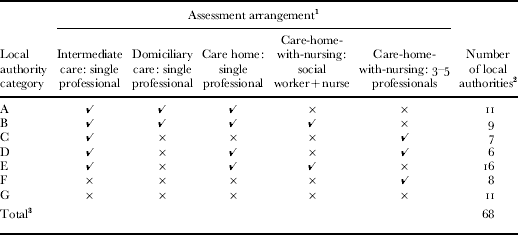
Applying the Cramer's V threshold to identify statistically-significant associations, five distinct arrangements emerged from the analysis (see Table 4). They point to groups of authorities that were organising comprehensive assessments in a similar way, involving similar numbers of professionals across sectors. From this, a typology of the multi-disciplinary arrangements across local authorities in England was produced. Table 4 presents the seven (A–G) most prevalent arrangements. They represent different ways of working that varied in terms of the numbers and types of staff undertaking assessments in particular sectors. The seven categories accounted for almost two-thirds of the local authorities for which a full data set was available (68 out of 107, 64%). The predominant arrangement was assessment by a single professional. Four of the categories (A, B, D and E) described three or more different types of arrangements. Moreover, it would appear that the most frequently cited arrangements were not multi-disciplinary. Category G occurred in 11 authorities in which no systematic associations between professionals across particular sectors were apparent.
Arrangements for multidisciplinary assessments, England, 2005–06
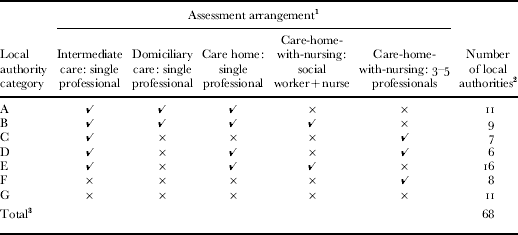
Notes: ✓=present, ×=absent. 1. Only statistically valid associations were used to identify the arrangement categories (Cramer's V ⩾0.3). 2. Only associations found in 5 per cent or more of authorities were included. 3. Data were available for 107 local authorities, 68 have been categorised.
Discussion
This article set out to discover whether assessments for older people with complex needs were being administered systematically across England following a major policy initiative, the SAP. The focus of the analysis was to investigate whether the approaches involved a multi-disciplinary component. Before discussing the findings and their implications, however, it is necessary to provide further information about the data collected from the sample of managers with broad strategic service knowledge and responsibility for local implementation of the policy. Their responses were estimates and present a picture of implementation from their perspectives. In its original form, one question asked whether the nominated professionals were ‘always’, ‘sometimes’ or ‘never’ required in comprehensive assessments in the distinct settings. In order to elicit the degree to which there was a systematic approach to the involvement of particular professionals in particular settings, only those who stated that a member of staff was ‘always’ required were included in the analysis. This, it can be argued, gives the estimates more weight, because if respondents were not sure they were more likely to have responded ‘sometimes’ than ‘always’. This raised the possibility that our figures are under-estimates. However, the quantitative data for around three-quarters of English local authorities has enabled us to describe the combinations of assessors and the extent of multi-disciplinarity. The study could not and was not designed to address attitudinal and behavioural questions about inter-professional working and its facilitators and barriers.
As described in the introduction, the four settings used in the research reflected those outlined in the SAP guidance; they denote the different circumstances in which individuals with complex needs are likely to require a range of professional expertise in assessments. In the terminology of the SAP, this level of need should trigger a multi-disciplinary comprehensive assessment. The findings suggest, however, that approximately two years after the formal introduction of the SAP in England, this by and large had not taken place, but rather that assessments for older people with complex needs were most often undertaken by single professionals. The question arises as to whether such assessments can include a consideration of all the domains required for a full comprehensive assessment (Kane and Kane Reference Kane and Kane2000). In summary, the findings show that, in three of the four considered settings, an assessment by a single professional was most common. For only one setting, care-homes-with-nursing, were two or more professionals from different disciplines always involved.
The second finding relates to the nature of professional multi-disciplinarity, which was rarely found to involve more than two professionals. A third finding relates to whether any logic could be discerned in the patterns of assessment practice across the settings and the country, regarding both which professions were most likely to work with each other and which most likely to be have the ‘lead’ or co-ordinating roles. In this respect intermediate care was distinctive, for the co-ordinating role was most frequently a social worker or care manager, and a community nurse was as likely as a social worker to either assess alone or to co-ordinate the assessment by requesting the involvement of a second professional. Lymbery (Reference Lymbery2005) commented on the neglect of social work input into intermediate care. Our findings suggest that social workers' role had expanded by 2005–06 but had not dominated the setting as had other professionals in other settings. Indeed, intermediate care was distinguished by more varied arrangements, with no one professional predominating. Intermediate care is a relatively new setting (or service) in the care of older people with very complex needs and, although research has identified a number of specific approaches in this area, there remains little knowledge as to the mix of professionals involved (Beech Reference Beech, Roe and Beech2005). This is particularly the case regarding assessments for intermediate care, as opposed to the delivery of such care. The findings here provide useful information regarding practice in this emerging setting but clearly more research is needed.
As noted in the introduction, despite the rhetoric and the strong ‘expert consensus’ that multi-disciplinary teams provide the most effective care for older people with complex needs through their capacity to identify unmet needs and provide appropriate responses (Department of Health 1997; Lingard and Milne Reference Lingard and Milne2004; Social Services Inspectorate Reference Social Services2003), two years and more after the introduction of the SAP in England, such teams were not the norm (cf. Tucker et al. Reference Tucker, Baldwin, Hughes, Benbow, Barker, Burns and Challis2007). The findings reported here do not differentiate between multi-disciplinary assessments which took place within or between teams, but given the rarity of such teams beyond old-age mental health services, they are more likely to be undertaken between teams. The evidence therefore supports the call for the more widespread formation of multi-disciplinary teams, where they may be most likely to follow best assessment practice (Department of Health 2002). The integration of both agencies and professionals working with older people with health and social care needs remains high on the government's agenda in England, and the ambition remains to create joint health and social care managed teams or networks to support those with the most complex needs (Cm 6737 2006).
Finally, the findings suggest that a systematic approach to comprehensive assessments involving a multi-disciplinary component across the country was largely absent. A systematic approach to assessment suggests the establishment of mandatory procedures rather than ‘custom and practice’ arrangements, which are likely to exhibit greater variation between sites. The limited extent of systematic approaches to multi-disciplinary assessment that has been shown suggests that such mandatory procedures have not been fully implemented or have not ‘worked through’ to practice on the ground. One of the key rationales for the introduction of the SAP was to promote a more standardised approach to assessment practice across England. A possible means of achieving this is the implementation of guidelines and protocols between professional groups and agencies regarding triggers for the involvement of specialist clinicians and other practitioners. Such a system would ensure that professionals clearly understand their specific roles and responsibilities as well as offering greater clarity to the older people that are being assessed. The guidance which accompanied the introduction of the SAP sought a level of flexibility in local implementation, however, which may have undermined the process of standardisation. This study suggests that more than one professional was only systematically involved in a comprehensive assessment where a care home provided a nursing element. Interestingly, it is only in relation to this setting that the guidance offered a degree of prescription, as the quotation in the introduction notes. In some ways it is surprising that development of the SAP appears least in the area of comprehensive assessment where the evidence base appears greatest for its potential impact (Challis et al. Reference Challis, Darton, Johnson, Stone and Traske1995, Reference Challis, Clarkson, Williamson, Hughes, Venables, Burns and Weinberg2004). The outcomes of the pressure between local implementation and central guidance clearly varied across the service settings.
The process by which national policies are implemented locally is complex (Hill and Hupe Reference Hill and Hupe2002; Pressman and Wildavsky Reference Pressman and Wildavsky1973; Sabatier Reference Sabatier, Kaufmann, Majone and Ostrom1986; Watt, Sword and Krueger Reference Watt, Sword and Krueger2005; Wilson Reference Wilson1992). Pressman and Wildavsky (Reference Pressman and Wildavsky1973) commented that it is remarkable that any policy initiative achieves a degree of effective implementation given the multifarious factors that can disrupt it. The level of prescription from the centre is one factor that can affect implementation, though not in a single direction. There are different schools of thought regarding the degree of local autonomy that should be encouraged if a national policy is to be both implemented and sustained in a manner which fits the local environment, but which does not result in an untenable level of ‘policy drift’ or modification (Charters and Pellegrin Reference Charters and Pellegrin1973; McIntosh Reference McIntosh and White1985). There are those who argue that too much prescription will lead to a ‘lack of ownership’ by local managers and practitioners and consequently policy failure (Stocking Reference Stocking1985). Others comment that mandatory prescription offers local providers clarity over which parts of a policy to prioritise (Barrett and Fudge Reference Barrett, Fudge, Barrett and Fudge1981; Sabatier and Mazmanian Reference Sabatier and Mazmanian1979). Added to this complex picture is professional discretion at the local level (Lipsky Reference Lipsky1980), which makes any national policy contingent on the attitudes and behaviour of front-line staff for its success.
There are lessons from recent history as to the difficulties in implementation of a national policy, particularly regarding comprehensive assessment, when localities are expected to follow guidance from the centre. An analogous policy to the SAP in the care of older people was that of the implementation of care management as promoted by the community-care reforms of the early 1990s in England. In that policy, linkages between different assessments made by social workers or care managers and other professionals were envisaged and were clearly specified in the policy guidance (Department of Health 1990). This also advocated the assessment of older people's circumstances ‘in the round’ and, for it to become a reality, pointed to the need for all professionals and agencies, including general medical practitioners, primary health-care staff and social housing managers to collaborate in the assessment process (Department of Health 1990: paras 1.7–1.13 and 3.9). Similarly, a subsequent central government directive required agreement on the basis of assessment systems as one of the key tasks in implementing these reforms (Department of Health 1992). It has been argued, however, that the ‘lead agency’ status given to local government social services departments for the conduct of needs assessments as part of the community-care reforms resulted in a lack of attention to the links between health- and social-care assessments (Marks Reference Marks1994). Practice after these reforms was reported as variable with integration being hampered by professional assessments running alongside each other rather than being explicitly linked (House of Commons Health Select Committee 1998; Weiner et al. Reference Weiner, Stewart, Hughes, Challis and Darton2002). Thus, despite strong guidance from central government, locally the policy was not fully implemented in the way intended.
The promotion of the SAP similarly attempted to promote an active, multi-disciplinary structure of professional assessments for older people. It may be that tensions between central and local government, particularly in England (Banwell Reference Banwell1959; Rhodes Reference Rhodes1988), meant that the Department of Health's central prescription had to be tempered by sensitivity to local authorities' control over the way procedures on assessment were implemented. This may have resulted in the policy being rolled out differently in different areas, as some commentators predicted (Glasby Reference Glasby2004). In framing the SAP to address the related difficulties identified before implementation, it appears that central government has therefore sought to balance prescription with support for local authorities' own local efforts. It may be, as some authors commented (McNally, Cornes and Clough Reference McNally, Cornes and Clough2003), that this balance needs to be adjusted towards more central prescription as local areas have struggled with the implementation of the policy, particularly in deciding who should take on the co-ordinating role of bringing separate professional assessments together. Alternatively, approaches might be adopted which relied to a greater extent upon the development of trust and collaboration as mechanisms to support the effective roll-out of policy (Martin and Webb Reference Martin and Webb2009; Webb Reference Webb1991).
Writing 15 years before the introduction of the SAP in England in 1989, Williams commented on the need for legislation to be used to help with the incorporation of multi-disciplinary geriatric assessment into the health and social care system. Williams argued that the complexities of some older people's mental and physical vulnerabilities made comprehensive multi-disciplinary assessment imperative:
To do this sensibly, information must be shared between the various professionals involved … the whole concept of multi-disciplinary geriatric assessment will be successfully implemented only if it is integrated into, or has close liaison with, the rest of the health [and social care] system. (Williams Reference Williams1989: 150–4)
He noted that to realise this end, financial barriers between agencies and approaches that impeded the joint education of relevant professional groups would need to be addressed. This viewpoint is important for the insight it provides in framing the recent drive to improve the assessment process for older people throughout England. The SAP may be seen as a policy that can structure assessment, make it more effective, enable care planning and promote person-centred and more comprehensive care. Williams's comments, written before the recent changes, are still particularly apposite to the continuing project for improving assessment practice for older people with multiple and complex needs. Many of the issues that had been raised, principally the role of information sharing and the need for improved liaison between professionals, were explicitly addressed in the SAP (Department of Health 2002). The present findings suggest that the envisaged patterns of multi-disciplinary assessment for older people with more complex needs were not fully established in the early years, and the hoped for ‘integration of multi-disciplinary assessment into the system’ still had some way to go. The barriers to this, as identified by Williams (Reference Williams1989), remain some of the most pressing issues to consider in improving assessment for older people.
Acknowledgements
This work was undertaken by the Personal Social Services Research Unit (PSSRU) and funded by the Department of Health for England. The views expressed are those of the authors and not necessarily those of the Department of Health. The authors are grateful to Dwayne Johnson, Roger Lightup, Dave McNally, Ian Philp and Keith Wilson for their assistance with the design of the research tool, to Irene Pedersen for her work in promoting an effective response rate to the survey and to Sue Martin who provided secretarial support and was responsible for data entry.