Introduction
Challenging behavior such as aggression, screaming, apathy, or wandering are important and burdening problems in the care of people with dementia in nursing homes (Cohen-Mansfield et al., Reference Cohen-Mansfield, Werner, Watson and Pasis1995; Brodaty et al., Reference Brodaty, Green and Koschera2003; Edberg et al., Reference Edberg, Bird, Richards, Woods, Keeley and Davis-Quarrell2008). The prevalence rates vary between 11% and 65% (Margallo-Lana et al., Reference Margallo-Lana2001; Weyerer et al., Reference Weyerer, Schaufele, Schrag and Zimber2004; Testad et al., Reference Testad, Aasland and Aarsland2007; Savva et al., Reference Savva, Zaccai, Matthews, Davidson, McKeith and Brayne2009), most likely because of the differing instruments and observation times (Zuidema et al., Reference Zuidema, Derksen, Verhey and Koopmans2007). Thus, effective interventions are needed to reduce challenging behavior by people with dementia. These interventions improve the quality of life of people with dementia and reduce the burden and stress of the staff (Murman et al., Reference Murman, Chen, Powell, Kuo, Bradley and Colenda2002).
As pharmacological treatments have demonstrated only moderate effects on challenging behavior (Schneider et al., Reference Schneider2006), non-pharmacological individualized psychosocial interventions are generally recommended as first-line treatments (Ballard and Corbett, Reference Ballard and Corbett2010). However, to initiate individualized interventions, it is first necessary to understand the (challenging) behavior of the patients (Whall and Kolanowski, Reference Whall and Kolanowski2004; Vernooij-Dassen et al., Reference Vernooij-Dassen, Vasse, Zuidema, Cohen-Mansfield and Moyle2010). Here, case conferences could be a valid and important tool for nursing home staff to deal professionally with individual challenging behavior (Holle et al., Reference Holle, Halek, Mayer and Bartholomeyczik2011) because they help the staff, in a structured and goal-oriented way, identify the special needs of people with dementia and react with individual solutions (Bartholomeyczik et al., Reference Bartholomeyczik2007). However, case conferences have not been greatly considered in scientific literature, and the respective advantages or disadvantages and the clinical effects are mostly unknown. To date, no reviews could be identified concerning the use of case conferences for people with dementia and challenging behavior. It is therefore the aim of this paper to describe the core elements and the effects of case conferences both on people with dementia and their challenging behavior and on the staff in nursing homes.
A case conference, as used in this systematic review, is defined as a goal-oriented, systematic method that team members can use to exchange professional opinions on a particular care problem. Here, a theme-centered, solution-oriented approach is characteristic where the reflection process is oriented on a fixed sequence and role structure (King and Roberts, Reference King and Roberts2001; Mitchell et al., Reference Mitchell, Del Mar, O'Rourke and Clavarino2008; Brinkhaus, Reference Brinkhaus2010).
Research questions for the review
-
1. What are the key elements of case conferences held on people with dementia and challenging behavior?
-
2. What impact do case conferences have on people with dementia living in nursing homes and their challenging behaviors?
-
3. What influence do case conferences have on the subjective strain and the competence development of staff working with people with dementia?
Methods
Selection of the studies
It was the aim of this review to describe as comprehensively as possible the literature found dealing with the impact of case conferences. Therefore, the selection of studies was not limited to one particular study design. The authors based their work on the guidelines for integrative reviews (Whittemore and Knafl, Reference Whittemore and Knafl2005).
Search strategy
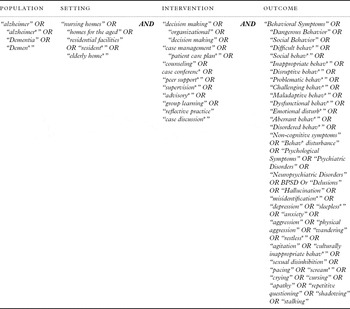
The literature search was performed in two stages. In October 2011, a systematic search of the following databases was performed: Medline (Pubmed), Cinahl (EBSCO), PsycINFO (OVID), Cochrane library for clinical trials, Embase (DIMDI), and Google Scholar. Following this, the reference lists of the included studies and classical treatises were searched for other relevant publications. The key words and their combinations are shown in Table 1.
Search terms

The inclusion criteria for the studies were the following:
-
• Studies on the subject of case conferences published before the end of September 2011;
-
• English or German language;
-
• Studies in nursing homes;
-
• Focus on challenging behavior in people with dementia attended by all those involved with caring for these residents.
The exclusion criteria for the studies were the following:
-
• Investigating solely the effect of supervision;
-
• Case conferences without a focus on people with dementia and challenging behavior.
Quality appraisal
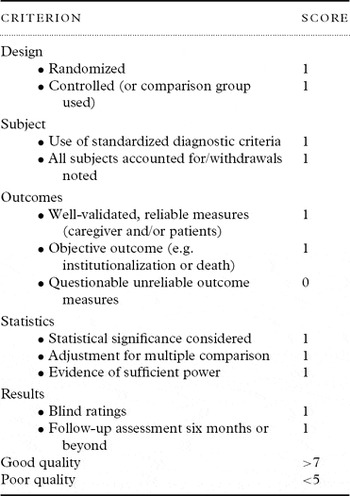
The literature search and screening of abstracts were conducted independently by two of the authors (SR and MND) based on the inclusion and exclusion criteria. The same authors also assessed the methodological quality of the included studies applying a 5-item rating scale (maximum point score = 11) developed by Brodaty et al. (Reference Brodaty, Green and Koschera2003). The rating scale (Table 2) is based on the Cochrane Collaboration Guidelines (van Tulder et al., Reference van Tulder, Furlan, Bombardier and Bouter2003). A “good quality” study has more than 7 points, studies having 5–7 points are stated as “middle-range quality,” and studies with less than 5 points are of “poor quality” (Brodaty et al., Reference Brodaty, Green and Koschera2003). Where there was disagreement, the study was assessed by a third person (MH) and discussed until a consensus was reached.
The criteria for rating the quality of the studies (Brodaty et al., Reference Brodaty, Green and Koschera2003)

Data extraction and synthesis
The content of each study was extracted with the help of a checklist showing the study target, sample, method, type, duration, structure of case conferences, other intervention components, outcomes, tools, and results. To provide a content synthesis, the results of studies with similar methodological quality were collected and compared with each other with regards to the type of intervention, the standardized instruments used, the sample characteristics, and the results (Whittemore and Knafl, Reference Whittemore and Knafl2005).
Results
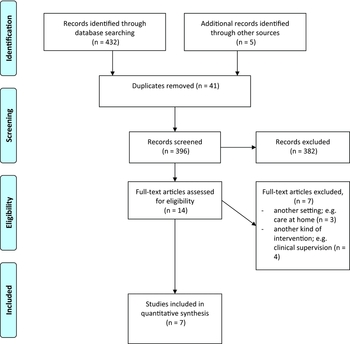
After deleting 41 duplicates, the literature search resulted in 396 references. Applying the inclusion and exclusion criteria, there were 382 papers that were excluded from the review based on their abstracts and a further seven papers based on full-text screenings. Finally, seven papers were suitable to be included in the analysis (Figure 1).
Results of the literature search.

Study overview
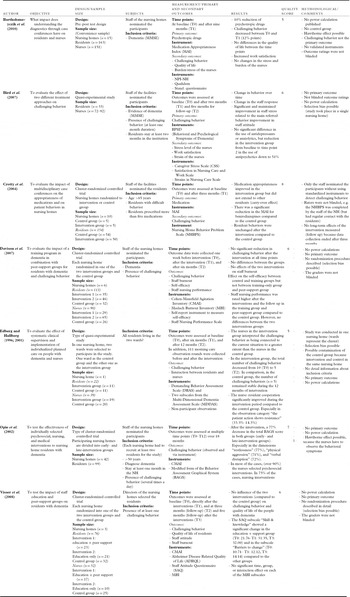
Of the seven studies, four are cluster-randomized, two have a quasi-experimental design, and one has a pre–post design (Table 3). The case conferences were used as interventions with durations varying from 2 to 18 months in all included studies. The number of persons per sample at the beginning of each study varied between 10–165 residents and 11–151 staff members. The number of nursing homes in which the studies were conducted ranged from 1 to 42. The inclusion criterion for the participants of all the studies is, among others, the occurrence of at least one type of “challenging behavior” within a certain time frame. However, the challenging behavior was assessed using a number of different standardized instruments.
Overview of the studies

MMSE: Mini-Mental State Examination; MAI: Medication Appropriateness Index; BPSD: Behavioral and Psychological Symptoms of Dementia; CSS: Caregiver Stress Scale; NHBPS: Nursing Home Behavior Problem Scale; CMAI: Cohen-Mansfield Agitation Inventory; MBI: Maslach Burnout Inventory; DBAS: Demanding Behavior Assessment Scale; MDDAS: Multi-Dimensional Dementia Assessment Scale; BAGS: Behavior Assessment Graphical System; SAQ: Staff Attitude Questionnaire; ADRQL: Alzheimer Disease Related Quality of Life; NPI-NH: The Neuropsychiatric Inventory-Nursing Home Version.
Study quality
The quality of the included studies varied between 5 (middle-range quality) and 8 (good quality). Only one cluster-randomized trial was of good quality (8 points). The other three cluster-randomized trials were of middle-range quality. The two studies with a quasi-experimental design and the study with a pre–post test design were also of middle-range quality (Table 3).
Case conference as an intervention
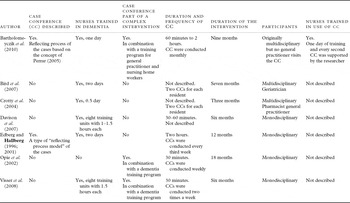
The described case conferences show different structures (Table 4). In two studies (Davison et al., Reference Davison, McCabe, Visser, Hudgson, Buchanan and George2007; Visser et al., Reference Visser, McCabe, Hudgson, Buchanan, Davison and George2008), the case conferences were conducted as part of a staff training on dementia to determine whether case conferences helped consolidate team member knowledge. In four studies (Edberg and Hallberg, Reference Edberg and Hallberg1996; Reference Edberg and Hallberg2001; Opie et al., Reference Opie, Doyle and O'Connor2002; Davison et al., Reference Davison, McCabe, Visser, Hudgson, Buchanan and George2007; Visser et al., Reference Visser, McCabe, Hudgson, Buchanan, Davison and George2008), monodisciplinary case conferences were conducted. In one study (Bartholomeyczik et al., Reference Bartholomeyczik2010), the case conferences were originally a multidisciplinary concept involving the residents and their General Practitioner, but in the end, neither took part. In a further two studies (Crotty et al., Reference Crotty2004; Bird et al., Reference Bird, Jones, Korten and Smithers2007), the case conferences were reported as being multidisciplinarily oriented, but this was not reflected in detail in the papers. The duration of the case conferences ranged from 30 minutes (Crotty et al., Reference Crotty2004) to 2 hours (Bartholomeyczik et al., Reference Bartholomeyczik2010).
Except for the study of Opie et al. (Reference Opie, Doyle and O'Connor2002), the staff members were given training on dementia and on how to perform a case conference before the beginning of each study. The training sessions were performed by the researchers and usually took one day.
The discussed cases differed in their complexity and the length of time taken by the team for the discussions. For instance, case conferences on the use of antipsychotic drugs were less time-consuming (Crotty et al., Reference Crotty2004) than those concerning the search for the reasons for residents’ challenging behavior (Bartholomeyczik et al., Reference Bartholomeyczik2010).
In most studies, at the beginning of the intervention, the staff received assistance so that they would be eventually able to conduct case conferences on their own (Edberg and Hallberg, Reference Edberg and Hallberg1996; Reference Edberg and Hallberg2001; Opie et al., Reference Opie, Doyle and O'Connor2002; Davison et al., Reference Davison, McCabe, Visser, Hudgson, Buchanan and George2007; Visser et al., Reference Visser, McCabe, Hudgson, Buchanan, Davison and George2008; Bartholomeyczik et al., Reference Bartholomeyczik2010). The study by Davison et al. (Reference Davison, McCabe, Visser, Hudgson, Buchanan and George2007) mentions five case conferences that were attended by a research team. The case conferences in the study by Bartholomeyczik et al. (Reference Bartholomeyczik2010) were alternately supported by the researchers or conducted by the staff themselves, with a hotline also available. Crotty et al. (Reference Crotty2004) did not provide any support during the study. Edberg and Hallberg (Reference Edberg and Hallberg1996; Reference Edberg and Hallberg2001), Opie et al. (Reference Opie, Doyle and O'Connor2002), Visser et al. (2007), and Bird et al. (Reference Bird, Jones, Korten and Smithers2007) all attended the case conferences for the entire duration of the intervention. The frequency with which the case conferences were performed varied greatly in the studies. In some cases, a time schedule was defined (weekly/monthly) (Edberg and Hallberg, Reference Edberg and Hallberg1996; Reference Edberg and Hallberg2001; Opie et al., Reference Opie, Doyle and O'Connor2002; Visser et al., Reference Visser, McCabe, Hudgson, Buchanan, Davison and George2008; Bartholomeyczik et al., Reference Bartholomeyczik2010); in others, at least two case conferences per resident had to be conducted (Crotty et al., Reference Crotty2004; Bird et al., Reference Bird, Jones, Korten and Smithers2007). In one study, no information regarding the frequency of the case conferences was given (Davison et al., Reference Davison, McCabe, Visser, Hudgson, Buchanan and George2007). In all studies, the existence of at least one type of “challenging behavior” was the reason to conduct a case conference (Table 4).
Description of the intervention

CC: case conference.
Outcomes and measurements
Only one study (Bird et al., Reference Bird, Jones, Korten and Smithers2007) used challenging behavior as the primary outcome parameter. All other studies (Edberg and Hallberg, Reference Edberg and Hallberg1996; Reference Edberg and Hallberg2001; Opie et al., Reference Opie, Doyle and O'Connor2002; Crotty et al., Reference Crotty2004; Visser et al., Reference Visser, McCabe, Hudgson, Buchanan, Davison and George2008; Bartholomeyczik et al., Reference Bartholomeyczik2010) either determined challenging behavior as a secondary outcome or did not differentiate between primary and secondary outcomes.
Two studies used the amount of prescribed antipsychotic drugs as an outcome parameter besides challenging behavior. The quality of life was assessed as a secondary outcome in two studies (Visser et al., Reference Visser, McCabe, Hudgson, Buchanan, Davison and George2008; Bartholomeyczik et al., Reference Bartholomeyczik2010). The influence of case conferences on the staff working in nursing homes was investigated in five of the seven included papers (Edberg and Hallberg, Reference Edberg and Hallberg1996; Reference Edberg and Hallberg2001; Bird et al., Reference Bird, Jones, Korten and Smithers2007; Davison et al., Reference Davison, McCabe, Visser, Hudgson, Buchanan and George2007; Visser et al., Reference Visser, McCabe, Hudgson, Buchanan, Davison and George2008; Bartholomeyczik et al., Reference Bartholomeyczik2010). Important outcomes of these studies were stress, burnout, attitude, job satisfaction, quality of interaction with the residents, and nurse competence (Table 3).
Standardized instrument used in the studies
The Cohen-Mansfield Agitation Inventory (CMAI) was applied in three studies (Opie et al., Reference Opie, Doyle and O'Connor2002; Davison et al., Reference Davison, McCabe, Visser, Hudgson, Buchanan and George2007; Visser et al., Reference Visser, McCabe, Hudgson, Buchanan, Davison and George2008). All other studies used various standardized instruments to identify the resident and staff-related outcomes such as challenging behavior, quality of life, attitude, and staff burnout (Table 3).
The effects of case conferences on people with dementia and their challenging behavior
In four (Edberg and Hallberg, Reference Edberg and Hallberg1996; Reference Edberg and Hallberg2001; Opie et al., Reference Opie, Doyle and O'Connor2002; Bird et al., Reference Bird, Jones, Korten and Smithers2007; Bartholomeyczik et al., Reference Bartholomeyczik2010) of seven studies, the authors concluded that case conferences are able to reduce residents’ challenging behaviors to a certain extent. Furthermore, two studies (Visser et al., Reference Visser, McCabe, Hudgson, Buchanan, Davison and George2008; Bartholomeyczik et al., Reference Bartholomeyczik2010) showed no effects on the quality of life of the residents, and two studies (Crotty et al., Reference Crotty2004; Bartholomeyczik et al., Reference Bartholomeyczik2010) reported a reduction of antipsychotic drug utilization after the case conferences.
Overall, no adverse or negative effects of the intervention for people with dementia were described in the studies.
High quality studies (>7 points)
The study with the highest rated quality was not able to determine any differences in challenging behavior when comparing the control group and the intervention group (Crotty et al., Reference Crotty2004). The authors noticed a significant reduction in the number of antipsychotic drugs administered to the residents, but they did not report the length of the case conferences.
Middle-range quality studies
The studies with middle-range quality showed various results.
Opie et al. (Reference Opie, Doyle and O'Connor2002) showed that 77% of the 99 residents participating in the study had a reduction in at least one of the challenging behaviors, most frequently in the parts fearless, restlessness, physical violence, and screaming. The case conferences normally took 30 minutes. Visser et al. (Reference Visser, McCabe, Hudgson, Buchanan, Davison and George2008) found no significant differences between the control group and the intervention group (half-hour case conferences) with regards to challenging behavior and quality of life. In addition, the 30–60 minutes case conferences in the study by Davison et al. (Reference Davison, McCabe, Visser, Hudgson, Buchanan and George2007) did not result in a significant change in the total number of challenging behaviors.
In the studies by Edberg and Hallberg (Reference Edberg and Hallberg1996; Reference Edberg and Hallberg2001), the absolute number of challenging behavior patterns per resident was reduced from 10 to 4 in the sector “vocal behavior” and from 10 to 5 in the sector “physical behavior” following two-hour case conferences; this is shown in comparison with the control group, where no reduction was observed. The caregivers in the intervention group found the challenging behavior patterns to be significantly stronger (p = 0.048) compared with the control group and in connection with the actual situation in which the challenging behavior patterns occur. Bird et al. (Reference Bird, Jones, Korten and Smithers2007) concluded that case conferences that took on average one hour reduced the number of residents with challenging behavior (n = 33) by 42.9% (SD = 10.3%) during a two-month period; this result remained unchanged for an additional five months. Administration of antipsychotic medications decreased by 15% in the intervention group (n = 33) within two months. In contrast, the number of antipsychotics prescribed increased by 9% in the control group.
When the residents were compared before and after the intervention, Bartholomeyczik et al. (Reference Bartholomeyczik2010) showed a 12% point decrease in challenging behavior. The most significant decrease was found in the challenging behaviors “fear,” “depression,” and “hyperactivity.” The patient quality of life remained unchanged, but the number of prescribed antipsychotic medications reduced from 75% to 65%. The case conferences usually took at least one hour and were conducted with a structured assessment instrument (Halek and Bartholomeyczik, Reference Halek, Bartholomeyczik, Bartholomeyczik and Halek2009).
The effects on staff
Of the seven studies, there were five (Edberg and Hallberg, Reference Edberg and Hallberg1996; Reference Edberg and Hallberg2001; Bird et al., Reference Bird, Jones, Korten and Smithers2007; Davison et al., Reference Davison, McCabe, Visser, Hudgson, Buchanan and George2007; Visser et al., Reference Visser, McCabe, Hudgson, Buchanan, Davison and George2008; Bartholomeyczik et al., Reference Bartholomeyczik2010) that examined the influence of case conferences on the nurses. The major outcomes were staff competence, attitude, job satisfaction, and stress.
Middle-range quality studies
Using the Staff Attitude Questionnaire (SAQ), Visser et al. (Reference Visser, McCabe, Hudgson, Buchanan, Davison and George2008) were able to determine a significant (p < 0.01) increase in staff “skills and knowledge” when they compared the staff of the intervention group with the staff in the control group. Following the case conference, the challenging behavior was graded as less “severe” and “disruptive.” However, due to that job situation, the caregivers were not in a position to apply the newly gained knowledge in their daily work. Neither Davison et al. (Reference Davison, McCabe, Visser, Hudgson, Buchanan and George2007) nor Visser et al. (Reference Visser, McCabe, Hudgson, Buchanan, Davison and George2008) were able to obtain a reduction of the stress experienced, measured with the Maslach Burnout Inventory (MBI), compared to the control group.
Edberg and Hallberg (Reference Edberg and Hallberg1996; Reference Edberg and Hallberg2001) showed that the case conferences and the related communication in the team helped staff to be more reflective and more self-reliant in their daily work. The staff reported that it was easier to exchange information and knowledge concerning residents, and goals could be agreed on jointly. Furthermore, the authors used a non-participating observation method to investigate to what extent staff communication and interaction with the residents improved following case conferences. A total of 111 observations were made during the early shift. These observations showed that the staff members who had received the intervention were in a better position to respond adequately to the residents’ challenging behavior. The staff members were more often able to enquire about residents’ wishes and needs and were more often empathetic with the residents (Edberg and Hallberg, Reference Edberg and Hallberg1996; Reference Edberg and Hallberg2001). Bird et al. (Reference Bird, Jones, Korten and Smithers2007) reported that the extremely high stress levels were reduced considerably after the intervention.
Bartholomeyczik et al. (Reference Bartholomeyczik2010) found no changes before and after the intervention with regards to certain staff strain and stress indicators, the intensity of residents’ challenging behavior, and the strenuous situations related to these. However, the staff reported that as a result of the case conferences, they felt “more satisfied” and “more confident” about their daily care for the residents (Bartholomeyczik et al., Reference Bartholomeyczik2010).
Discussion
In four of the seven studies, case conferences had a positive influence on the challenging behavior of people with dementia (Edberg and Hallberg, Reference Edberg and Hallberg2001; Opie et al., Reference Opie, Doyle and O'Connor2002; Bird et al., Reference Bird, Jones, Korten and Smithers2007; Edberg et al., Reference Edberg, Bird, Richards, Woods, Keeley and Davis-Quarrell2008; Bartholomeyczik et al., Reference Bartholomeyczik2010). Two of the studies reported a reduction in prescribed antipsychotic medications (Crotty et al., Reference Crotty2004; Bartholomeyczik et al., Reference Bartholomeyczik2010). No significant change in quality of life was observed (Visser et al., Reference Visser, McCabe, Hudgson, Buchanan, Davison and George2008; Bartholomeyczik et al., Reference Bartholomeyczik2010). The majority of the studies also demonstrated a positive effect of case conferences on staff competence, development, and attitude. However, the individually experienced stress load did not appear to be influenced in a similar way (Edberg and Hallberg, Reference Edberg and Hallberg2001; Bird et al., Reference Bird, Jones, Korten and Smithers2007; Edberg et al., Reference Edberg, Bird, Richards, Woods, Keeley and Davis-Quarrell2008). Furthermore, we did not find any type of economic analysis of the intervention case conferences in the papers.
Only one study (Crotty et al., Reference Crotty2004) fulfilled the criteria for a “good quality” study as defined by Brodaty et al. (Reference Brodaty, Green and Koschera2003). In some studies, a control group for direct comparison was missing (Bird et al., Reference Bird, Jones, Korten and Smithers2007; Bartholomeyczik et al., Reference Bartholomeyczik2010). Few studies had adequate power or sample calculation, and frequently, the number of institutions included in the studies was low and had a small number of residents (Edberg and Hallberg, Reference Edberg and Hallberg1996; Reference Edberg and Hallberg2001; Bird et al., Reference Bird, Jones, Korten and Smithers2007; Bartholomeyczik et al., Reference Bartholomeyczik2010). In the two studies (Edberg and Hallberg, Reference Edberg and Hallberg1996; Reference Edberg and Hallberg2001; Bird et al., Reference Bird, Jones, Korten and Smithers2007) with a control group, both the intervention and control groups were in the same institution, which can result in contamination problems.
In addition, the different tools used for measuring the effect variables impede a direct comparison among the studies. Thus, the results of this review strengthen the need for applying uniform instrument sets or at least for giving a detailed description of the changes noted in the various types of challenging behavior (Moniz-Cook et al., Reference Moniz-Cook2008).
A further methodical problem is the potential “detection bias,” as all tools used proxy measures by the staff. The changes in the assessment can either be due to an actual change in a resident's challenging behavior, or changes can be result of changes in staff interpretation of the challenging behavior following the discussions during the case conferences; even both situations may be true. To determine exactly how case conferences affect the care and relationship with residents (and how this in turn affected the residents’ challenging behavior), case studies should be conducted in further investigations.
The heterogeneity of the different types of case conferences used in the studies also restricts the direct comparison of results. Information is lacking on the underlying concepts, theoretical models, or exact procedures of the case conferences used in the studies. Most of the studies did not allow for a definite identification of the core elements of case conferences that have been especially successful. Moreover, in some studies, the case conference is the sole feature of the intervention; in others, it is one part of a complex intervention accompanied by varying training modules. Furthermore, different occupational groups participated in the case conferences.
Protocols with exact procedures of the case conferences were not provided in the studies. For instance, keeping to an exact plan of procedure is described as being an essential feature to introduce to the team the process of understanding the challenging behavior of people with dementia (Brown et al., Reference Brown, Hogg, Delva, Nanchoff-Glatt and Moore1999; Bartholomeyczik et al., Reference Bartholomeyczik2007). When the explicit procedure plans are missing, there is a certain danger that nurses will plan interventions for the residents too quickly without having analyzed and understood the causes and reasons for the challenging behavior.
Moreover, the degree of implementation was not addressed sufficiently. In addition, in many studies, the research team followed the case conferences closely, thus potentially influencing the intervention substantially. However, on the other hand, the authors of two studies (Davison et al., Reference Davison, McCabe, Visser, Hudgson, Buchanan and George2007; Bartholomeyczik et al., Reference Bartholomeyczik2010) noted that nurses required more support than expected from the research team when conducting case conferences and that the results could possibly be improved by monitoring the intervention for longer time periods. Studies in which the intervention period was longer than 12 months had the most positive influence of case conferences on residents’ challenging behavior. It can be assumed that the effect on residents and staff could be increased if, in the future, more time and support were invested in the implementation and execution of case conferences. In future studies, a process evaluation should always be performed and should provide information on how successful the intervention was implemented. Only then can the results of the effect measurements be classified and interpreted and conclusions properly drawn for use in practice. Furthermore, for a better comparison of the results, future studies should better correspond with existing reporting standards such as for complex interventions or Cluster-Randomized Trials (Moehler et al., Reference Moehler, Bartoszek, Koepke and Meyer2012).
Limitations of the review
We used a broad and rigorous search strategy based on previous systematic reviews (Wetzels et al., Reference Wetzels, Zuidema, Jansen, Verhey and Koopmans2010) on the themes of challenging behavior, which was extended with additional search terms and databases. In addition, two independent reviewers conducted the selection of the studies and the quality appraisal. However, it is possible that studies were missed that used other phrases for case conferences (because the unclear definition in the literature) that were not included in the search strategy. We may also have missed studies reported in languages other than English or German. In addition, the authors of the studies were not asked for possible other important papers for this review. Here, only the reference lists of the included papers have been checked.
Conclusions
When caring for people with dementia and challenging behavior, the staff members are confronted with complex needs and situations. Here, case conferences are often viewed as an instrument to understand difficult situations and as a sign of professional practice (Bartholomeyczik et al., Reference Bartholomeyczik2007). Case conferences help a care team cope with recurring care problems and approach cases analytically within a team, and case conferences facilitate critical thinking. This is the basis for a sustainable improvement in caring for people with dementia who show challenging behavior. However, good preparation, introduction, and support appear to be essential for using case conferences as a successful intervention. The results of the studies reviewed here indicate that case conferences can reduce challenging behavior of people with dementia. However, the validity of these results is limited by the insufficient quality of most studies included. Due to the methodological and content-related differences of the studies, it is not possible to determine a definite effect on the competence, strain, and stress experience of staff working in the nursing homes.
The body of evidence regarding the effect of case conferences is weak, and high-quality studies with longer intervention periods are needed. It is necessary to apply similar outcome instruments in different studies.
Conflict of interest
None.
Description of authors’ roles
S. Reuther and M. Halek designed the paper and developed the research question. S. Reuther and M. N. Dichter conducted the literature search and rated the papers independently. S. Reuther, M. Halek, and M. N. Dichter analyzed the data and wrote the paper. S. Bartholomeyczik, I. Buscher, H. C. Vollmar, and D. Holle assisted in the preparation of the paper. M. Halek supervised the project.