As William Roseberry points out, although export economies in Latin America have occupied similar positions within an international division of labour, they have differed markedly in their internal structures and dynamics.Footnote 1 This diversity is well illustrated by the history of coffee. Roseberry identifies two broad patterns of coffee cultivation: the first associated with the expansion of a ‘coffee frontier’ into new territory, as occurred in Brazil, Colombia and Costa Rica; and the second where a coffee zone corresponds with a dense settlement from the colonial or precolonial period, as was the case for example in El Salvador. However, great diversity exists in the basic social relations associated with each pattern, ranging from plantation slavery in Brazil to small-scale peasant production in Costa Rica.Footnote 2 To understand why such fundamental differences in landed property and labour mobilisation occurred and the effects such differences had on their respective societies, Roseberry suggests that we examine Latin American coffee economies
‘ … in the context of pre-existing and emergent fields of power – the occupation of space and transformation of landed property within the regions that turned to coffee; the position of these regions within interregional trade networks; the location and development of roads, ports, and processing facilities; the mobilization and reproduction of labour; the organization and capitalization of markets; the class and ethnic structure of the regions and states …; the relative power of regional landholders in relation to other regional elites as well as power holders in other regions and the central state …’Footnote 3
This article examines the development of the coffee economy in two districts of the southern Mexican state of Chiapas during the period of the Porfiriato (1876–1911), focusing on the demographic factors, the differing processes of land privatisation and the distinct relationship between foreign investors, the national regime and local elites that influenced labour relations. A case study of each district permits a more fine-grained understanding of the nature and function of debt peonage in pre-revolutionary Chiapas and, more broadly, contributes to debates concerning the relationship between export development, liberal modernisation, and unfree labour in Latin America in the nineteenth and early twentieth centuries.
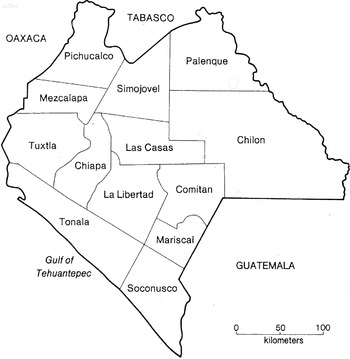
The State of Chiapas: Administrative Districts, c. 1910, reproduced from Thomas Benjamin, A Rich Land, A Poor People: Politics and Society in Modern Chiapas (Albuquerque, 1989)

In the administrative district of Palenque, in the northern highlands, and that of Soconusco on the Pacific coast, direct foreign investment was a key aspect of coffee plantation development. Both regions attracted foreign investors, mainly of German and North American citizenship. A number of smaller private investors settled and reinvested their profits in Chiapas, thus adding to domestic capital formation. However, much of the profits of coffee production were sent abroad. The most important coffee planters, particularly in Soconusco, were Germans who resided in Guatemala, where they had initially established coffee plantations. Another important group of foreigners were representatives of and/or shareholders in companies registered abroad, most commonly in Hamburg or New York, which repatriated the majority of their profits. This was the case with the German American Coffee Company, which dominated production in Palenque, and was the second largest foreign investment in Chiapas in 1910.Footnote 4 In practice, the distinction between investment by foreign citizens resident locally and foreign investment by companies and individuals resident abroad was not always clear, as coffee entrepreneurs often shifted between roles and residencies, investing and reinvesting personal capital and/or acting as agents and administrators for companies located abroad, simultaneously or at different points in time.
Foreign investment was important in both districts; however, the social relations that characterised coffee production differed considerably. In Soconusco, which attracted coffee investment from the mid-1870s onwards, a foreign-owned colonisation company was largely responsible for the privatisation of vacant or sparsely occupied land. The workforce was principally drawn from a migrant population and the development of the coffee economy challenged the economic and political power of the resident landed oligarchy. By contrast, in Palenque, where investors did not begin to establish coffee plantations until the early 1890s, the privatisation and distribution of land was largely patrimonial and the workforce was primarily composed of the resident Indian population that had occupied plantation land before it was privatised. Furthermore, landed interests were relatively weak in Palenque's coffee municipalities before the 1890s, and the new export economy improved economic opportunities for intermediaries and elites in the district. Thus, while Soconusco conforms more closely to Roseberry's ‘coffee frontier’, Palenque constituted a coffee zone in an area of settlement from the colonial or pre-colonial period. These differences were replicated with regard to the mobilisation of labour. In both districts workers were recruited by the payment of wage advances (enganche), which they were then expected to pay off by labouring on coffee plantations. However, while in Palenque debt peonage was consistently and harshly implemented, in Soconusco labour contracts were often not strictly enforced by the local authorities.
The nature and purpose of debt peonage in Latin America and its relationship to the process of nineteenth century capitalist modernisation has been much debated. Revisionist interpretations of debt peonage, such as that of Arnold Bauer,Footnote 5 tend to characterise the institution as paternalist and reciprocal rather than coercive and exploitative, and to regard debt as an incentive rather than a means of compulsion, which may persist beyond the initial stages of capitalist accumulation due to the slow adjustment of the workforce to new market incentives. By contrast, other authors, notably Tom Brass and Phillip Corrigan, argue that ‘rather than an archaic relational form constituting an obstacle to … [agrarian] capitalism, [debt peonage] is an integral aspect of both the initial and continuing accumulation process.’Footnote 6 This is because debt bondage constitutes a means to cheapen and discipline labour by ‘de-proletarianization’; a ‘double dispossession’ where workers are dispossessed from the means of production and from the means of commodifying labour itself.Footnote 7 Consequently, debt bondage is intended ‘not so much to open up a free labour market … but rather to close it down.’Footnote 8 It is for this reason that capitalist expansion may be associated with non-wage coercion and the preservation and even the creation of ‘pre- and non-capitalist modes, methods and mentalities.’Footnote 9 Moving beyond such generalisations, Alan Knight argues that debt may serve as a coercive mechanism or as a way to attract basically proletarian labourers within a market framework. He identifies three distinct types of debt peonage in Latin America. In the first, debt labourers are ‘disguised proletarians’ whose debts are advances designed to attract workers voluntarily to commercial plantations, and to pay interim subsistence or transportation costs; in the second, ‘traditional peonage’, the debts are slight – more a perk than a bond; in the third type, peonage is ‘unmistakably servile and coercive, a new and calculating response to enhanced market demand and reproducing aspects of chattel slavery.’Footnote 10
Although coercive debt peonage was outlawed in Mexico by the federal constitution of 1857, a number of state governments, notably those of Veracruz, Yucatán, Tabasco and Chiapas, continued to enforce local peonage laws.Footnote 11 After 1876 the rapid export-led development of the Porfiriato had different implications for rural labour depending on regional market conditions. In his seminal article, ‘Labour Conditions on Haciendas in Porfirian Mexico: Some Trends and Tendencies’, Friedrich Katz identifies three broad regional patterns. In the north, the particular conditions of market development made it difficult for hacendados to implement coercive labour regimes. Instead they had to offer an incentive to labourers, such as sharecropping arrangements more favourable than those found elsewhere in the republic, paternalist benefits and rising wages. Thus, the north witnessed the gradual development of a free market in wage labour. In central Mexico there was a surplus of labour and hacendados did not need to bond their workforce to the hacienda through debt; instead it often constituted a sought after form of credit. In the southern states of Yucatán, Tabasco, Chiapas, and parts of Veracruz and Oaxaca, the large-scale increase in demand for tropical products on the world market promoted the expansion of plantations and large-scale haciendas. For local planters and entrepreneurs the main problem they faced was gaining sufficient labour at low wages. This meant bypassing the tight labour market and instead mobilising traditional forms of peonage and forced labour. Consequently, debt peonage was the principal means by which workers were bound to plantations and wages were kept low, despite competition between employers for labour.Footnote 12 Alan Knight also argues that by the late nineteenth century the Mexican rural economy was evolving towards a regional division between a more coercive variant of traditional peonage in the south and wage labour in the north.Footnote 13 This typology is supported by a number of empirical cases, which indicate that the trends identified by Katz and Knight pre-dated the beginning of the Porfiriato.Footnote 14
In the nineteenth century the majority of the rural population in the state of Chiapas was concentrated in regions of ‘traditional haciendas’ and communal indigenous towns in the central and northern highlands. The labour system was characterised by labour tenancy and debt peonage on the haciendas and the requisitioning of temporary labour from native communities via an habilitación paid to Indian town councils, along the lines of the colonial repartimientos. After 1876 export-oriented agriculture and logging increasingly developed in the state's tropical lowlands, where the population was much sparser. At the same time, ‘traditional’ landowners in the highlands turned to export production. Consequently, friction intensified between highland and lowland elites over the control of rural labour, and each group sought to convert the continuing enforcement of debt peonage legislation and stricter tax and vagrancy laws into greater control over indivdual workers.Footnote 15 The result in a number of regions, notably the districts of northern and central Chiapas, where Palenque is located, was a more harsh and calculating form of servitude, increasingly stripped of its paternalist elements; and the rise of ‘entrepreneurial’ caciques in Indian villages, state officials who employed extra-economic coercion to traffic debt labourers to lowland plantations and logging camps.Footnote 16 In this context, debt peonage was not a ‘feudal relic’, but rather a coercive institution, compatible with the logic of capitalist efficiency, which served to reduce labour mobility and cheapen the price of labour in the growing agricultural sector.Footnote 17
However, the success of landowners in controlling the rural labour force through non-market mechanisms, and, therefore, the role that debt peonage played in the economy, varied between regions. As discussed below, in Soconusco wage advances served more as a monetary incentive to attract workers into plantation labour than as a mechanism of coercion. Indeed, the cases of Soconusco and Palenque suggest that the nature and purpose of debt peonage during the export boom of the Porfiriato were contingent on a number of local factors – economic, social, historical, geographical and political – which influenced both the needs of coffee entrepreneurs and the relationship that they had with the state. That relationship, which in Porfirian Chiapas turned more upon local planter hegemony than the policies of the still incompletely consolidated national state, influenced the willingness of local state actors to enforce debt peonage in accordance with the needs of coffee elites.
Soconusco and Palenque: a Comparison
During the Porfiriato, the department of Soconusco on the Pacific coast of Chiapas became the most dynamic economic region in the state. Before the coffee boom, the local oligarchy combined the production of cattle, sugarcane and cacao on land between 100 and 500 metres above sea level, but most of the ideal coffee lands at 500 to 1200 metres altitude were largely unexploited.Footnote 18 In neighbouring Guatemala, by the mid-1870s such lands were scarce, and German coffee planters from Guatemala began establishing plantations in the frontier zone of Unión Juárez, Cacahoatán, Tuxtla Chico and La Chicharras near Tapachula.Footnote 19 By 1892, Soconusco contained 85 per cent of the 3,500,000 coffee trees estimated to exist in Chiapas,Footnote 20 by 1898 coffee plantations extended to the river Huehuetán and by the end of the century they had reached the town of Huixtla. The inauguration of the Pan-American railway from the Isthmus of Tehuantepec to the Guatemalan border in 1907 gave a new boost to coffee cultivation and planters began to occupy lands in Escuintla, Comaltitlán and even Mapastepec, a zone of much lower altitude in the contiguous district of Tonalá. They also established plantations on the other side of the cordillera, towards the Grijalva valley.Footnote 21 During this period cash crops, such as cacao and tobacco, were increasingly eclipsed by coffee and rubber and commerce was re-oriented away from Guatemala to international markets further afield.
Similarly, after 1880 in the department of Palenque, the focus of commercial agriculture shifted away from the production of cattle and maize for sale in the neighbouring states of Tabasco and Campeche, to the export of coffee and rubber.Footnote 22 Around 1890, high international coffee prices, the exhaustion of lands suitable for coffee cultivation in Guatemala and the success of plantation development in Soconusco, where access to land was becoming limited and prices high, prompted coffee planters (mainly of German origin) to look to Palenque for new investment opportunities. Thus, by 1911 Palenque had become the second most important destination for foreign capital in Chiapas after Soconusco.
Land Privatisation: Soconusco
In 1880 much of the territory of Soconusco remained uncharted public land. The establishment of the limits between Mexico and Guatemala in 1882 facilitated the entry of surveying and colonisation companies. In 1889, a surveying concession held by the English International Company, which included nearly all the prime coffee land on the Pacific slopes of the Sierra Madre, passed to the Mexican Land and Colonisation Company (MLCC).Footnote 23 By the end of 1905, the MLCC had titled 317,875 hectares in Soconusco of which 51,755 hectares had been sold to third parties.Footnote 24 At the same time that the land company was selling off public land, the state government oversaw the privatisation of much of the communally held ejidal land in Soconusco. Between 1897 and 1910 the value of rural property rose from 5,000,100 pesos to 8,125,625 pesos and the number of registered private properties grew from 1236 to 2040 (240 haciendas, 1568 ranchos and 232 unclassified properties).Footnote 25 Foreign-born investors formed a significant proportion of the new owners,Footnote 26 and by 1911, official foreign investment in rural property in Soconusco was approximately 4,500,000 pesos. The largest investors were Germans, closely followed by North Americans, then Spaniards, British and the French.Footnote 27
What were the social consequences of land privatisation in Soconusco? First, high demand led to soaring prices, above all in areas of prime coffee land, thus excluding many peasants and small investors from ownership of land. For example, according to a customs agent in Tapachula in 1894, many ‘small capitalists’ were arriving in the department keen to cultivate coffee, cacao and rubber; however, the colonisation company sold land at such a high price that it deterred immigration.Footnote 28 According to Thomas Benjamin, the price of land in Soconusco rocketed from 60 centavos a hectare for fertile coffee land in the late 1880s, to 50–100 pesos in the mid 1890s and to over 300 pesos by 1910.Footnote 29 Second, although occupants without titles were given the first choice to purchase the land at a lower tariff, those who could not buy lost their land and homes.Footnote 30 Many smallholders who lost their land joined the workforce on the new fincas.Footnote 31 In fact, investors acquired land outside the prime coffee zones in order to recruit workers for their plantations.Footnote 32 Third, the sale of ejidal lands (along with some national lands) was overseen by members of the state government and their families, which created opportunities for corruption and speculation.Footnote 33 Nevertheless, as we shall see, in comparison with Palenque, access to land in Soconusco was relatively open, competitive and legalistic.Footnote 34
Land Privatisation: Palenque
In the 1890s, large expanses of land were also transferred from the public and communal spheres to private investors in the district of Palenque. However, there was no colonisation company, and in most cases, those public lands that were eventually acquired by foreign investors were first titled by federal employees or members of local landowning families with links to the national government.Footnote 35 Furthermore, unlike the sparsely populated coffee lands of Soconusco, public and communal lands in Palenque were occupied by a relatively large population of Indian peasant producers who were obliged to become labour tenants (baldíos) and permanent debt peons (mozos) on the new plantations. This workforce was then bought and sold as part of a property.Footnote 36 In 1897, the department was said to have 140 fincas worth 428,755 pesos. By 1910 the number of registered private properties had risen to 414 (73 haciendas, 318 ranchos and 23 unclassified properties), the value of rural property had increased to 3,590,550 pesos Footnote 37 and foreigners, principally North Americans and Germans, had officially invested nearly 2 million pesos in the department.Footnote 38
A clear example of monopoly and concentration in the land market in Palenque is to be found in the history of the German American Coffee Company (GACC), which was the most important company in Palenque, and the second most important North American investment in Chiapas. By 1910, besides having acquired the properties El Porvenir, Joluptá, Las Nubes, Machujíl, La Cruzada, Agua Caliente, Bulujíl and El Triunfo, which covered 43,000 acres and employed up to 3,000 workers,Footnote 39 the GACC had also taken over the properties of La Revancha in Tumbalá, Chuctiepa, also in Tumbalá,Footnote 40 and the rubber plantation, Iowa.Footnote 41
The GACC consolidated its landholdings through a series of business transactions and alliances between foreign investors, influential local landowners and federal politicians. Besides acquiring land originally privatised by the family of the former governor, Manuel Carrascosa, and by Victor Manuel Castillo, a senator for Chiapas and a close friend and colleague of the científico Emilio Rabasa, the company was represented in Mexico City from 1902 by Emilio Pimental, another científico and brother of Rafael Pimental, governor of Chiapas from 1899 to 1905.Footnote 42 Such political contacts allowed the company to undermine the property rights of the local population, where and when necessary. For example, in 1911 the local authorities admitted that the plantation, Las Nubes, was illegally occupying part of the former ejido of Salto de Agua. According to residents, protected from the law by the governor of Chiapas, Ramón Rabasa, brother of Emilio Rabasa, the GACC had dispossessed them of the five hectare plots of land which they had been granted when the ejido was divided. The US ambassador in Mexico City complained to the state government that local Indians were trespassing on company land, destroying fences and continuing to use a footpath and bridge now claimed as private property. As a result, Ramón Rabasa instructed the municipal president of Salto de Agua to guarantee the GACC's property rights and to prevent the population from acting against the company's interests in any way.Footnote 43
Demographic Changes: Soconusco
Despite the high price of land, Soconusco and the neighbouring administrative district of Motozintla (later named Mariscal) created in 1893, experienced dramatic population increases after 1880. In 1892 the population of Soconusco was 20,928, 37 per cent of which was classified as Indian.Footnote 44 By 1910 the population of Soconusco had risen by 161 per cent to 54,691 and that of the district of Mariscal had reached 18,583.Footnote 45 The towns of Unión Juárez and Cacahoatán were products of the coffee economy, and Tapachula, which became a city in 1900, grew 275 per cent between 1887 and 1910.Footnote 46 Nevertheless, according to a British consular report of 1907, both skilled and unskilled labour still remained scarce and labour shortages were the chief obstacle to the development of the district.Footnote 47
Much of the population increase was due to the immigration of Guatemalans, who settled on small plots of land in the sierra, in the towns, in hamlets (rancherías) outside the boundaries of the fincas and as resident workers (colonos) on the coffee and rubber plantations. Most Guatemalan immigrants were Mam Indians, who, dispossessed of their best lands and fleeing forced labour in Guatemala, first began to settle in the region after 1870. More were incorporated into Chiapas when the frontier was fixed in 1882. They were welcomed as labourers by the first coffee cultivators and the Mexican government encouraged colonisation by accepting political exiles and granting Guatemalans title to lands in the sierra outside the formal process of land privatisation.Footnote 48 By 1910, over 25 per cent of the total population of the districts of Soconusco and Motozintla were Guatemalans. They constituted the principal source of permanent and, until 1904, seasonal plantation labour; supplied the growing urban markets and plantations with foodstuffs grown on peasant plots; and engaged in small-scale cross-border commerce in flour, cloth, haberdashery, hardware, palm and felt hats, medicines, oil and fruit and vegetables.Footnote 49
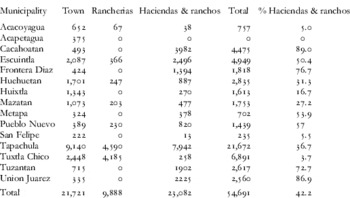
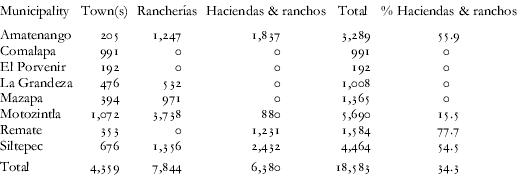
In 1910, according to the census of that year, approximately 42 per cent of the population of Soconusco and 34 per cent of the population of Mariscal lived on haciendas and ranchos.
Population Distribution in the Department of Soconusco, 1910Footnote 50

Population Distribution in the Department of Mariscal, 1910
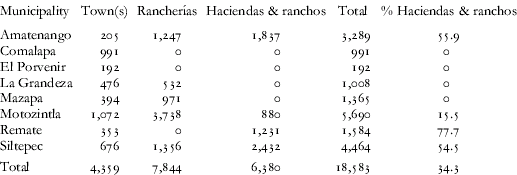
In the municipalities of Cachoatán, Frontera Díaz, Tuzantán, Unión Juárez, and San Pedro Remate more than 70 per cent of the population resided on coffee fincas. In others, such as Tuxtla Chico, Amatenango, Mazapa, Motozintla and Huehuetán, the majority lived in towns and independent settlements and provided seasonal labour on the plantations. The figures suggest that small scale cultivators had difficulty in gaining access to land principally in those municipalities with land highly suitable for coffee: in others, it was easier to retain or settle on land without legal title. Thus, it seems that while the plantations incorporated increasing numbers of permanent labour tenants and debt peons within their boundaries, they also encouraged subsistence and petty commodity production by supplying a market for agricultural products and making it possible to supplement peasant household incomes with temporary labour on the fincas. In addition, the coffee economy provided opportunities for wage labour in the towns where skilled labourers and artisans, such as carpenters and mechanics, could earn relatively high wages.Footnote 51
Demographic Changes: Palenque
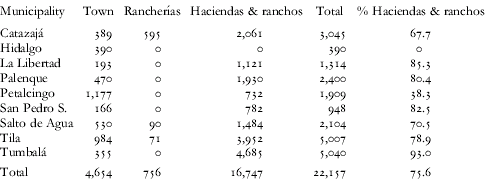
The story was very different in Palenque. Between 1892 and 1910 the district's population increased by 60 per cent, from 13,825 to 22,157, which was in line with the state's average population growth.Footnote 52 Yet, changes in land tenure transformed Palenque's population distribution as many peasants who had previously lived in small independent hamlets became concentrated on large plantations. For example, in 1892 most of the inhabitants of Tumbalá and Tila lived in hamlets dispersed throughout the municipalities;Footnote 53 but by 1897 eight coffee plantations had been established in the municipality of Tumbalá, three in Tila, one in Petalcingo and one in Salto de Agua.Footnote 54 In 1901, the US American anthropologist Frederick Starr reported that:
‘… the town [was] a wretched place, with a worthless and nervous agente [municipal tax collector]. This was once the largest of the Chol towns [but] Tumbalá is now completely ruined by the contract labour system, which has sent its men all through the countryside onto fincas … [the agente] said we would do well to go to El Triunfo as it would take two days to find Indians and bring them to the town.’Footnote 55
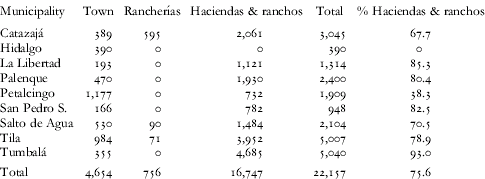
According to a pamphlet of 1903, almost the entire population of Tumbalá had been absorbed on to the coffee fincas.Footnote 56 The census figures of 1910 show that in that year over 75 per cent of the population of Palenque were resident on private haciendas and ranchos.
In the department as a whole approximately 46 per cent of private properties had more than 50 inhabitants and 29 per cent had more than one 100 inhabitants. However, in the coffee zones of Tila and Tumbalá 74 per cent had more than 50 inhabitants and 36 per cent had more than 100 inhabitants. In Tumbalá there were two coffee fincas with more than 600 inhabitants, and the finca Mumunil, which sprawled across much of Tila and into the neighbouring districts of Chilón and Simojovel, had a population of over 1,200.
Labour: Soconusco
In colonial Soconusco a scarcity of labour, in a context of abundant land, favoured debt servitude and labour-tenancy arrangements over wage labour.Footnote 58 After independence, the predominant relations of production continued to rely upon the strict enforcement of contractual servitude by the political and judicial authorities. However, political and administrative changes after 1890 undermined both the power of the local oligarchy and the implementation of debt peonage in Soconusco, with implications for labour supply and labour conditions on the coffee fincas.
Population Distribution in the Department of Palenque, 1910Footnote 57
From 1876 to 1891 the Pax Porfiriana was guaranteed in Soconusco by the cacicazgo of Sebastian Escobar. At first Escobar supported the development plans of the federal government; however, by 1890 his cacicazgo was perceived by federal politicians and investors alike as a major obstacle to economic and political modernisation and it was dismantled by Governor Emilio Rabasa between 1891 and 1893.Footnote 59 The destruction of Escobar's cacicazgo accelerated the local oligarchy's loss of economic, social and political dominance.Footnote 60 Prior to 1890 the elite's economic success had relied on the successful control and manipulation of political and judicial authority through family connections.Footnote 61 Consequently, after 1890 growing market competition and the introduction of new technologies of production weakened their economic position vis-à-vis new investors in agriculture and commerce.Footnote 62 However, rather than the consolidation of a modern bourgeoisie, relations between the oligarchy and newcomers were characterised, on the one hand, by marriage, commercial alliances, and the perpetuation of clientelistic practices; and on the other hand by rivalries and conflicts, which could disrupt capital accumulation, notably by undermining the enforcement of labour contracts on the coffee fincas. Similarly, bureaucratic rationalism did not replace or eradicate the rent-seeking and corruption of the past. Instead, administrative centralisation coupled with high market demand and a lack of public accountability, encouraged caciquismo and speculation by state officials.
Rivalry was particularly marked between Mexicans, especially members of the local elite, and the largely endogenous German colony, which although numerically small (some 86 people in 1910), was socially, culturally, and economically salient. By the beginning of the twentieth century Germans constituted the most powerful economic group in Soconusco. German investors, many of whom owned plantations and occupied political and diplomatic posts in Guatemala, invested considerable sums in coffee plantations after 1890.Footnote 63 According to British consular figures, by 1910, Germans were producing 37 per cent of Soconusco's coffee crop (Mexicans produced 20 per cent, North Americans 14 per cent, Spaniards 13 per cent, French nine per cent and British eight per cent), and three-quarters of fincas had German owners or administrators.Footnote 64 German merchants and moneylenders also became increasingly important in the import-export and credit businesses, specialising in large loans to those who wished to establish coffee fincas.Footnote 65 After the price of coffee dropped from 35 pesos per metric quintal (100 kg) in 1898 to 15 pesos per quintal in 1899 many local finqueros found it impossible to repay, their properties faced repossession,Footnote 66 and they increasingly voiced resentment at dependency on foreign merchants for credit.Footnote 67
Correspondingly, after 1900, German coffee planters increasingly felt themselves to be the victims of Mexican rancour. In 1902 they complained to the president that the governor, Rafael Pimental, and the district governor (jefe politico) – that he had appointed in Soconusco – did not sufficiently defend German interests in matters of taxation, road-building, and the political control of the Indian population. Furthermore, they alleged that Mexican finqueros, the majority of whom had been ruined in the economic crisis of 1899 ‘due to their wastefulness’, relied on the authorities to help them make a living by ‘whatever means they could’. While, the Mexicans had been obliged to auction or sell their fincas to pay their creditors, members of the German colony had survived ‘through sacrifice and the investment of ten million pesos’. As a result, the success of the Germans was increasingly resented. Such bitterness was, they complained, expressed by undermining the ‘individual guarantees’ of German residents and the ‘social guarantees’ upon which the labour system relied. For example, they claimed that after a peon had accused a prominent German finquero of assault, the latter had been taken to Tapachula under duress, thrown in jail with common criminals, eventually convicted without due process and fined 325 pesos. The judge in charge of criminal cases owed German merchant houses money, but the Germans feared that if they tried to recover it the judicial authorities would rule against their interests in court. In addition, the municipal president of Tapachula was a local who hated foreigners and the rural judges, who oversaw the enforcement of labour contracts, allowed the peons to commit many ‘arbitrary abuses’ against ‘their owners’ especially in the district of Motozintla, from where many of the plantation workers came.Footnote 68
In 1905, Rafael Pimental was replaced as governor by Ramón Rabasa, who was more in tune with the needs of foreign investors. Nevertheless, the Germans continued to find that the local authorities in Soconusco habitually worked against their interests. For example, in 1910 the finquero Hermann Widmaier complained to the governor that many of his workers, who resided on a property in Mariscal, were unable to work either in their fields (milpas) or on his finca in Soconusco because, on the orders of the district governor, municipal agents were obliging them to perform public works. He considered that, as they were classified as debt peons, and not wage labourers, they should be exempt from performing such services, as was customary.Footnote 69 Two years later the Progressive Liberal Club of Mariscal complained to the new president, Francisco Madero, about the behaviour of the public authorities. They alleged that as well as issuing arbitrary fines and engaging in gambling rackets and extortion under the guise of tax collection, the former district governor had entered into a series of financial ‘arrangements’ with the coffee fincas of Soconusco. They had had to pay him a ‘subsidy’ of 40 to 60 pesos per month for preferential treatment in labour matters and 50 centavos for every contract in which he intervened.Footnote 70 Poor relations between foreign coffee planters and the local political authorities constitute a crucial factor in evaluating the nature and consequences of the region's labour system.
Even before 1900, German coffee planters in Soconusco had found labour supply and discipline to be deficient. Coffee required ten times more labour than that employed in cattle production; yet at the same time that the demand for labour rose enormously, the enforcement of debt servitude was weakened. By the mid-1890s the available workforce was insufficient, above all on the plantations of the rapidly expanding coffee frontier, which, unlike plantations located nearer the border, could not rely on seasonal migrant labour from Guatemala.Footnote 71 According to the German Karl Kaeger, who visited the region in 1900, plantation owners found it difficult to attract a sufficient number of resident families, even if they offered them land to cultivate maize and beans, and never had enough seasonal workers.Footnote 72
Each plantation employed a labour contractor (habilitador) and one or two assistants in the nearby sierra, who sought out temporary workers, ensured that those who had returned to farm their own plots went back for the harvest, and occasionally pursued runaways. However, labour contractors could not find enough workers, so finqueros had to look further afield and employ alternative strategies to make up the numbers.Footnote 73 Landowners with coffee plantations in Guatemala often brought workers across the border to work on their new properties in Soconusco.Footnote 74 Other investors attempted to import workers from as far away as the Polynesian islands; such schemes generally ended in failure.Footnote 75 Coffee finqueros also replicated the strategies of the chiapaneco landed oligarchy, using land and cash loans as forms of patronage and control. They acquired land in Soconusco and other districts to distribute to seasonal workers in return for a specific quantity of labour per year.Footnote 76 In addition, planters bought established properties which included labour tenants and debt peons; and procured labour by purchasing recently privatised land that was occupied by peasants. Another strategy was to acquire workers by borrowing debt peons (mozos) from other finqueros and/or paying their debts.Footnote 77 Workers were also recruited by enganche from the districts of Comitán, Las Casas and Chamula in central Chiapas.Footnote 78 However, it was not until after 1904 that a regular supply of seasonal labour was established from the central highlands and Mayan Indians from Chamula replaced Guatemalans as the region's principal source of seasonal long-distance migrant labour.Footnote 79
In his doctoral thesis of 1912, the German finquero Paul Furbach detailed the problems faced by coffee planters in Soconusco. He described how the system of wage advances made finqueros dependent on a parasitic group of intermediaries, tied up capital in wage advances and encouraged worker unreliability and low productivity. In addition, labour was still relatively scarce, expensive and could not be assured in sufficient quantities during the crucial harvest period. Labour costs constituted about 60 per cent of total production costs and finqueros often had to borrow at high interest rates in order to pay advances, which were lost if workers or labour contractors (enganchadores) absconded, as was frequently the case.Footnote 80 Therefore, he insisted, landlords not peons were the true slaves of the system. This was so, principally, because the Mexican government, unlike its Guatemalan counterpart, did not oblige the ‘untrustworthy’ Indian to fulfil his obligations.Footnote 81 Karl Kaerger, too, blamed the expensive and inefficient system of labour mobilisation on a lack of appropriate legislation in Chiapas, which left the planter without the means to recover the loan in cash or labour. According to him, almost all plantation workers in Soconusco in 1900 had debts of 100 to 150 pesos, much of which finqueros had to accept as losses because it was difficult to capture those who absconded in the middle of a contract and the seasonal nature of work made it relatively easy for workers to leave the fincas and not return.Footnote 82 The irony is that debt servitude was enforced in the rest of Chiapas. Only in Soconusco – where the power of the local oligarchy had been undermined, where conflict rather than co-operation characterised relations between the local authorities and new investors, and where a new migrant population had become established in response to the needs and opportunities brought by coffee – was the state unable or unwilling to ensure that all debt labourers fulfilled their contractual obligations.
German planters' own testimonies suggest that plantation workers responded rationally to market forces, seeking out the best working conditions and taking advantage of labour demand to obtain higher real wages. Yet, the planters perceived the root of the labour problem to be Indian laziness and lack of material acquisitiveness. They longed for a state sponsored system of forced labour like that in Guatemala, which not only obliged Indian peasants to work in the export sector for low wages, but also to work as and when the planters required, principally during the two to three month harvest period which employed two thirds of the workforce.Footnote 83 Aiming to increase the number of potential labourers, the federal government distributed plots of land to Guatemalan migrants. To encourage them to work on the plantations rather than grow coffee themselves, land titles were generally granted only in the highest parts of the sierra, which were not suitable for coffee cultivation. However, Guatemalans also established themselves in the lowlands and in the coffee zone where they grew coffee and engaged in slash and burn agriculture outside finca boundaries.Footnote 84 Thus, while workers retained access to the means of production and the state did not consistently apply coercive measures to discipline and mobilise the workforce, peasants could choose to work on the plantations if and when it suited them.
In 1896, after attempts to forge an agreement between regional elites over labour reform failed, the state government decreed the creation of a new administrative district, the Partido de Chamula, which placed 90 per cent of the Tzotzil population of the district of Las Casas in the central highlands under direct control of the federal and state governments.Footnote 85 The new district was intended to serve as a state-managed labour reserve for the coffee plantations of the Pacific coast. The measure was slow to have any effect, due to administrative teething troubles and a drop in the demand for labour caused by the sharp fall in international coffee prices in 1898 and the explosion of the Santa María volcano in 1902. However, once the highland elite, which had previously controlled Indian labour through debt servitude and traditional communal obligations derived from the colonial repartimiento, had found a place in the new monetary system as contractors of migrant debt labourers, a system was in place which could respond to rising labour demand in Soconusco after 1904. Thus, by 1909 the central highlands was providing two thirds of the seasonal workforce to the coffee plantations of the Pacific coast, 10,000 men, or 80 per cent of the Indian men in the old department of Las Casas.Footnote 86
Nevertheless, the resulting system of modified debt labour replicated many of the problems that the planters had encountered when recruiting labourers in the sierras of Soconusco and Motozintla, only on a grander scale. According to Jan Rus, highland labour contractors used the system to their advantage, often ‘conjuring up’ debt out of overpriced goods sold to Indians at their stores, imaginary fines, arbitrary taxes, and rent on highland properties, debts for which they were reimbursed in cash by lowland planters. For lowland planters the debts were real, and the problems of enforcing seasonal labour contracts remained. Thus planters had to find ways to entice workers to stay for the duration of the contract and to return the next year by granting them additional wage advances and benefits and better working conditions. Nevertheless, in 1910 some planters claimed that up to two-thirds of the work force absconded before the completion of their contract.Footnote 87
Labour: Palenque
By contrast, in Palenque the federal and state governments supported the enforcement of debt servitude and directed the local state authorities to help recruit plantation labourers in order to overcome labour shortages. For example, in a letter to Emilio Rabasa in November 1892, Porfirio Díaz instructed Chiapas's state governor to protect the interests of coffee cultivators in Palenque by aiding them in matters of labour recruitment. He suggested that the Germans should approach the local authorities, in particular the schoolteachers, so that by means of ‘intelligent and opportune advice and encouragement’ labourers could be mobilised for work on the coffee plantations.’Footnote 88 Rabasa was one step ahead, having given German businessmen in San Cristóbal letters of recommendation for the local authorities in Palenque seven months earlier.Footnote 89 However, in 1893 German planters in the municipality of Tumbalá complained that the schoolteacher (who was also the municipal tax collector and the district governor's cousin) was making excessive profits, as much as 250 to 300 pesos a month, from labour recruitment at their expense.Footnote 90 To smooth out such problems and ensure that the Germans got a better deal, Emilio Rabasa enlisted the services of the president of the Superior Tribunal of Justice in San Cristóbal, Ausencio Ruíz, to mobilise tax collectors and schoolteachers in Indian municipalities in the recruitment of labourers to the export sector.Footnote 91 Soon afterwards a labour system was established in which ladino public officials offered outside investors their experience in the exploitation and control of Indian labour in exchange for financial rewards and enhanced social status in the new economy.
The permanent workforce of the plantations in Palenque was composed of labour tenants (baldíos); meseros who worked half the month on parcels rented from the landlord and the rest of the month on the finca; and peons (mozos) who had debts and no land and who worked for rations and a nominal salary. Most resident workers had occupied the land before it was privatised and became absorbed within the boundaries of the fincas thereafter. However, the local population was not sufficient, especially during the harvest period, and workers were brought from further afield. In 1899 President Díaz received a telegram, unsigned and undated, but most likely from foreign investors in Chiapas, urging him to send Mayo and Yaqui deportees from Sonora to work on the coffee fincas of Palenque and Soconusco, just as they were sent to the sisal plantations of Yucatán.Footnote 92 Whether or not the request was granted is unknown; what is certain is that plantation companies contracted labourers from other districts in Chiapas. For example, in 1901, anthropologist Frederick Starr who visited the finca El Triunfo, noted that the labour force of the GACC was about evenly divided between Chol Indians from Palenque and Tzeltales from Chilón,Footnote 93 and by 1909 Tzotziles from Chamula were being contracted in San Cristóbal to work on El Triunfo.Footnote 94
Temporary labour was also contracted from nearby villages by ladino municipal secretaries and municipal tax collectors and schoolteachers, who were directly employed as labour contractors by the plantations. They obliged the Indian town governments under their jurisdiction to recruit workers to the plantations against their will, sent Indians arbitrarily to the State Security force, an extra-official form of chain-gang labour employed on the roads and plantations, levied unjust fines and disrupted the subsistence production of the communities in order to compel individuals to accept wage advances.Footnote 95 The labour contractors took at least half the salary paid by plantations in the form of commission, and what the workers received often did not even cover the cost of subsistence, meaning that they had to either go without food or become indebted to the plantation.Footnote 96
The emerging labour system, which, as Antonio García de León has noted,Footnote 97 had much in common with that of Guatemala during the same period, was an evolution of Chiapas's own system of unfree labour, rather than an importation from the neighbouring republic. The roots of the system of enganche lay in the repartimientos which had dominated economic and social life in the province during the colonial period, and continued strongly to influence ethnic, political and socio-economic relations thereafter. A key figure in the colonial system of governance was the parish priest, who stood at the interface between the state and the Indian cabildo. Priests, whose authority enabled them to extort goods, cash and unpaid labour services from the population, remained important agents of governance in a number of Indian towns until the defeat of the Conservatives in Chiapas in 1867. For example, in 1860 the French adventurer, Desiré Charney, noted that as well as charging Indians for religious services and extracting tribute in the form of goods and services, priests in Tumbalá in Palenque and Cancuc in neighbouring Chilón, functioned as labour contractors, recruiting porters for ladino landowners and traders in Las Casas.Footnote 98 After 1867 the priests' authority was increasingly usurped by the secular authorities, represented by schoolteachers and municipal secretaries, who promoted the policies of the modernising state while retaining the monopolies and caste privileges previously enjoyed by priests.Footnote 99
The loss of Church authority, the privatisation of Indian lands, the enclosure of the population within the boundaries of the finca, the conversion of independent peasant cultivators into dependent peons and the speculation and sale of Indian labour by the local authorities were all noted by the priest of Tila as early as 1878, over ten years before much of the land in the region was sold to foreign coffee planters.Footnote 100 In 1880 the municipal president of Tila complained that the trading activities of Segundo Trujillo, most likely a relative of the schoolteacher, Don Carmen Trujillo, were harming the interests of the population.Footnote 101 Apparently, Segundo Trujillo failed adequately to recompense the Indians whom he contracted, usually against their will, to transport large quantities of goods to Tabasco. Besides receiving inadequate pay, the Indians were forced to abandon their own agricultural activities for the duration of the trip.Footnote 102 In 1891, the inhabitants of Tila accused the schoolteacher, who was employed by the Körtum brothers of the coffee plantation Mumunil, of destroying their communal cacao plantations and replacing them with private plantings of coffee and rubber.Footnote 103 Four years later, according to the local priest, another particularly ‘savage’ schoolteacher had arrived in Tila, who controlled labour contracting more tightly than his predecessor and charged the priest 25 centavos a day per labourer for repairs to the church. The Indian government also objected to the new schoolteacher, a ladino from Ocosingo. They tried to burn down his house and managed to destroy the 1,000 coffee trees which he had planted in the town.Footnote 104 In 1895, the schoolteacher of Tumbalá, whose official salary was 120 pesos per year,Footnote 105 was making 250 to 300 pesos a month from enganche, charging the population for services, such as funerals and baptisms, which were previously performed by the priest, taking a cut of taxes on transport, the slaughter of livestock and the sale of meat, imposing fines for an assortment of misdemeanours, and receiving free rations of maize, beans, eggs and chickens and the services of a maize grinder (molendera) and schoolchildren who served him as peons (mozos) on a weekly basis.Footnote 106
The close relationship between foreigners and the municipal authorities became the key to the mobilisation of the local population for coffee and later rubber production in Palenque. Besides recruiting workers by means of enganche, the municipal authorities pursued runaway peons and conscripted Indians to build roads and work on the plantations during periods of peak demand. In many cases, plantation owners and administrators also took on positions of authority such as municipal tax collector, rural judge and rural police, blurring further the line between the state and the private enterprises.
In general, owners, administrators and the upper tier of overseers were foreigners.Footnote 107 The coffee boom also created a new tier of ladino middlemen, most of whom came from San Cristóbal, Comitán and Ocosingo. They set themselves up as traders and artisans, were employed as overseers (mayordomos) and foremen (capataces) on the fincas,Footnote 108 and operated as gang-masters, particularly on the rubber plantations, where certain tasks, such as forest clearance, were contracted out to third parties.Footnote 109 Indians, including the local Choles, Tzeltales from neighbouring Chilón and Tzotziles from the central highlands, formed the vast bulk of the plantation workforce.
The period from 1890 until the land reform of Lázaro Cárdenas in the late 1930s is referred to by the Chol Indians of Palenque as ‘mosojäntel’, the time of slavery. During that time they lost their land and independence and were subject to a harsh work regime, which was maintained by means of corporal punishment and the close vigilance of administrators, overseers and the municipal authorities.Footnote 110 According to oral histories collected by José Alejos García in Tumbalá, coffee plantation labourers had to work even if they were sick, and if they refused, they were beaten by ladino overseers (caporales). The rations provided by the finca were not enough for subsistence, making workers dependent on the over-priced company store (tienda de raya) for food. Consequently, although they lived in poverty, their debts were very large. In addition, even though they received no schooling and were punished for trying to learn to read, workers were systematically charged the education tax, much of which was returned to the finqueros to subsidise private road building.Footnote 111 Finally, workers were not allowed to leave the plantations without permission and if they ran away and were caught, they were returned to the plantations with enlarged debts.Footnote 112 Besides enforcing contractual servitude, the state mobilized corvée labour to build roads and work on the plantations.Footnote 113 Conversely, finqueros sent labourers to public works during the off-season and as punishment for misdemeanors such as absconding and absenteeism.Footnote 114
Possibly the most repressive labour regime was found on the plantations of the GACC. The company's wealth and political connections ensured it preferential treatment vis-à-vis competitors and virtual impunity in labour matters. According to Frederic Starr, in 1901 debts were relatively large (equivalent to three years labour) and passed on from parents to children.Footnote 115 In 1904, the governor reported that a series of ‘clandestine’ burials had been discovered on El Triunfo and the manager, Enrique Rau, had been fined, but no arrests were made.Footnote 116 Eight years later, Stanford Neville Morrison of the Esperanza Coffee Company complained that employees of the GACC from the neighbouring finca had entered his property, kidnapped two of his Indians, beaten them and murdered one by burying him alive in an ants' nest.Footnote 117 Judging by the nature of the punishment it is likely that the victims had formerly been employed by the GACC and had left without the permission of Guillermo Fahrholtz, the company's personnel manager.Footnote 118 Two years earlier Fahrholtz had written personally to the governor accusing the new district governor, Rafael Castellaños, of protecting runaway workers from El Triunfo. However, according to the district governor the workers had simply requested the termination of their accounts so that they could be employed on the neighbouring plantation, Primavera. After the workers had returned to El Triunfo to terminate their accounts, as instructed by Castellaños, they were imprisoned and beaten by Fahrholtz and prevented from leaving even though they had another employer willing to pay their debts. Castellaños alleged that the local magistrate (alcalde), telegraphist and telephonist were all in the pay of Fahrholtz and the arbitrary detention and physical abuse of workers, especially those that tried to leave, were habitual.Footnote 119 In response to Castellaños's ‘interference’ Fahrholz requested that the governor order the district governor to prohibit other plantation owners from offering employment to workers from fincas of the GACC, and that he hand over the families of the three workers involved in the case to ‘guarantee’ that the workers would stay.Footnote 120
Conclusions
In this article, instead of focusing on debates about consent versus coercion or reciprocity versus exploitation, I have sought to analyse the role that debt peonage played in the development of a rural labour market, and to address how, when and why coercive peonage may be possible and/or compatible with the needs of agrarian capitalism. As we have seen, the cases of Palenque and Soconusco were similar in a number of respects: predominantly foreign investors were producing the same export crop and were thus subject to the same conditions of international market demand; the principal concern of coffee elites was to maximize production and profit, not to exercise paternalism or seigniorial privilege; both districts suffered from labour shortages, aggravated by the seasonality of coffee, poor transport and relatively basic production technology; before 1890 the state enforced coercive debt peonage in both districts and after 1890 all workers were officially subject to the same labour legislation; and the national government was keen to get workers on to export-oriented plantations throughout Chiapas. Yet the social relations of coffee production in Palenque and Soconusco during the period 1876–1911 were different, conditioned by a number of local factors including the origin and density of the population, changing patterns of land tenure, the economic activities of regional elites, and the relationship between those elites, outside investors, representatives of the state, and the national regime.
In Palenque an alliance between coffee entrepreneurs and the local representatives of the state ensured that the greater control over the population made possible by demography and the particular process of land privatisation restricted the development of a market in labour and encouraged a process of ‘de-proletarianisation’, whereby workers were freed of ownership of means of production, but not able to commodify their labour power.Footnote 121 The local Indian peasant population lost its land and independence and experienced poverty and forced labour on the coffee plantations which were established after 1890. In contrast with Soconusco, where plantations also competed for resources, communications, markets and workers, competition in Palenque led not to higher wages and better working conditions, but to increased debts, deteriorating working conditions and stricter vigilance and control. The labour system was profitable for both investors and locals because the municipal authorities and other ladinos involved in enganche took at least half of workers' wages in commission, and plantation companies were able to recover the better part of what remained through the company store.Footnote 122 The state could successfully foster the revival and adaptation of colonial methods of labour recruitment and control in Palenque because the workforce was largely drawn from local Indian villages where ‘traditional’ social and political relations remained strong, rather than a migrant population, as in Soconusco. Furthermore, the process of land privatisation and the introduction of new technologies of production did not undermine the power of local elites, but instead provided them with increased opportunities for enrichment. Economic change resulted in the expansion and intensification of debt servitude because the close relationship between foreign investors in Palenque, científicos in Mexico City and the Rabasa clique which dominated state politics after 1890 encouraged the federal government to intervene directly in markets in land and labour and because the ladino intermediaries, who represented the state in Palenque, co-operated with plantation owners to ensure the enforcement of debt peonage and corvée labour.
In Soconusco, the particular process of colonisation and land privatisation increased both workers' bargaining power and coffee entrepreneurs' need for the state to intervene in labour recruitment. But rivalry and conflict between coffee entrepreneurs and local state representatives reduced the willingness of the latter to restrict the commodification of labour power and undermine market forces by enforcing debt peonage. Changes in land tenure after 1890 did not directly result in the proletarianisation of the workforce, but land privatisation created a much more diverse rural class structure than in Palenque. On the one hand, dispossessed local peasants and new migrants were incorporated into the plantation workforce as labour tenants (baldíos) and debt peons (mozos); on the other hand, the demand for foodstuffs and opportunities for seasonal labour on the plantations encouraged peasant production outside the boundaries of the fincas. Furthermore, in Soconusco the power of the local oligarchy was undermined as outside investors with capital and new technologies of production acquired land through a relatively competitive land market. As in Palenque, the system of enganche, which brought seasonal workers from the sierras of Soconusco and Motozintla and from the central highlands, appeared to replicate many aspects of colonial repartimiento; however, there were significant differences. For, despite first impressions, wage advances, at least on foreign-owned coffee plantations, no longer served the same purpose that they had in earlier periods (or continued to serve in many other parts of Chiapas), much to the chagrin of German investors. For the Germans and other finqueros, wage advances were supposed to tie labourers to the plantations and reduce wage costs; however, in the absence of an effective coercive apparatus that could control peons and undermine competition between planters, they tended to function as a wage subsidy that attracted workers into the labour market and covered interim transport and subsistence costs.Footnote 123
Paradoxically, by ending the political and economic hegemony of the local oligarchy and sowing the seeds of conflict between foreign investors on the one hand and the local bourgeoisie and remnants of the oligarchy on the other, coffee in Soconusco undermined the enforcement of the very labour system on which it was supposed to depend. Thus, while in the case of Soconusco, wage advances may have constituted a step towards the development of a labour market, in Palenque debt peonage impeded rather than facilitated the development of a market in free wage labour.Footnote 124 These differences, in the same state at the same time, highlight the highly regional nature of the relationship between export development, liberal modernisation, and debt peonage in Latin America in the nineteenth and early twentieth centuries, and underline the importance of analysing the interaction between the geographical, historical, socio-economic and political variables which together conditioned the meaning of debt peonage and the social outcomes of economic modernisation during this period.