Introduction
Bhutan is a small landlocked South Asian country sandwiched between two large countries, China and India. It is small in both area with 38,394 km2 and in population of 757,042 (National Statistics Bureau [NSB], 2015). The percent of agricultural or cultivable area is marginal, about 3%, because most land is under forest cover (70.5%) and the remaining 26.6% is non-cultivable (Ministry of Agriculture and Forests [MoAF], 2014). However, agriculture is the backbone of the Bhutanese economy, contributing about 16.8% to the Gross Domestic Product (NSB, 2015), and providing livelihood to almost 60% of the population (MoAF, 2014). The local agriculture is subsistence, typified by average small land holding of 1.36 ha (MoAF, 2014) and traditional farming practices in carving slopes of valleys and mountain ranges pose challenges to farmers in producing adequate food commodities.
Wheat (Triticum aestivum L.) currently occupies third position both in area and production, next to maize (Zea mays L.) and rice (Oryza sativa L.). In 2014, wheat was grown over an area of 1,964 ha compared to 23,575 ha and 19,549 ha of maize and rice, respectively (Department of Agriculture [DoA], 2014). All the wheat varieties grown are common wheat, both spring and facultative winter types. Although rice is the most consumed and preferred cereal in Bhutan, wheat-based products are gaining in popularity with urbanization, growing purchasing power and changes in dietary habits (Neuhoff et al., Reference Neuhoff, Tashi, Rahmann and Denich2014). Among the cultivated winter crops, wheat continues to be the most dominant.
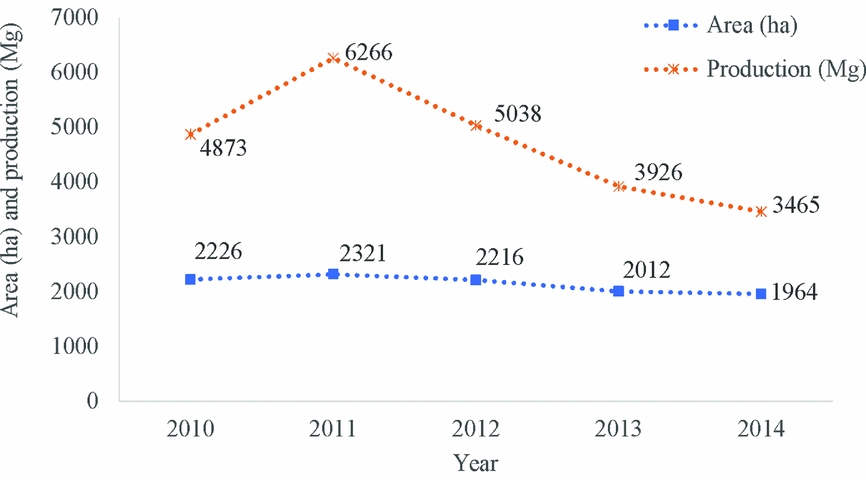
Over the last five years, there has been a decrease in wheat area and production (Figure 1). The current productivity of 1.76 Mg ha–1 (DoA, 2014) is lower than the global average yield of 3 Mg ha–1 (http://data.worldbank.org). Some of the main contributing factors for this low productivity are limited varietal options, poor agronomic management such as low nitrogen fertilization and inappropriate water management, and losses caused by diseases. Poor seed quality was also attributed to low average yield in Bhutan (Neuhoff et al., Reference Neuhoff, Tashi, Rahmann and Denich2014).
Wheat harvested area and production in Bhutan during 2010 to 2014 (Source: Ministry of Agriculture and Forests, 2014).

Wheat Growing Environment
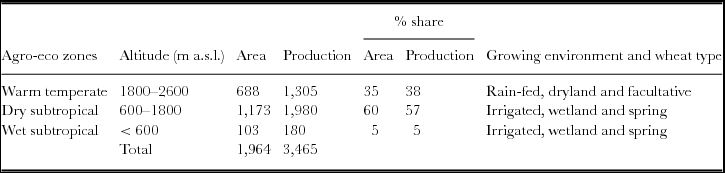
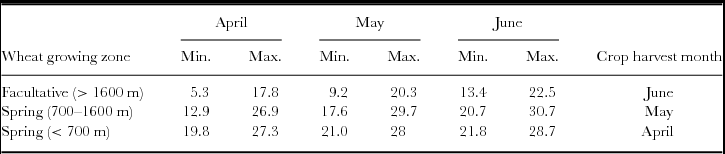
In Bhutan, spring and facultative winter wheat are the most commonly cultivated types, with the former being preferred in terms of cultivated area (Table 1). The spring wheat is generally grown at mid and low elevations (250 to 1800 m a.s.l.) in wetlands after rice harvest as rice–wheat cropping system. Owing to availability of irrigation infrastructures and water, wheat is generally irrigated. It is also the custom of the farmers to apply farm yard manure of 1.6–1.9 Mg ha−1 (Tashi and Wangchuk, Reference Tashi and Wangchuk2016), and a top dressing of urea (40–80 kg ha−1) to increase wheat yield and maintain soil health. Nitrogen application of 38 kg ha−1 to wheat was reported in two major wheat growing districts in central Bhutan (Chhetri et al., Reference Chettri, Ghimiray and Floyd2003).

Facultative winter wheat is cultivated at higher elevations in a dryland non-contoured landscape with steep slopes where high risk of soil erosion leads to nutrient erosion during heavy monsoon in the summer. Further, this wheat is entirely raised as a rain-fed crop because of lack of irrigation infrastructure, and distance of water sources. In addition, facultative winter wheat is grown mostly using residual soil fertility. Farmers do not fertilize crops either at pre-sowing or top dressing as there is little or no realized benefit from such an investment. Even if chemical fertilizer such as nitrogen is applied, its use efficiency is questionable due to low soil moisture. Soils in rain-fed areas are also lightly textured and are deficient in major nutrients such as nitrogen, phosphorus and sulphur (Sharma et al., Reference Sharma, Abrol and Sharma2011). These circumstances limit the expression of the true genetic potential of a variety, resulting in low productivity of wheat. The low wheat yield in northern hills of India was also attributed to poor soil fertility and lack of moisture at critical growth stages (Gupta and Kant, Reference Gupta and Kant2012).
Varietal Improvement
Historically, wheat was an indigenous crop for Bhutanese farmers for which rich varietal diversity existed. Most of these varieties were introduced by ancestors through seed exchange when the barter system was very strong with neighbouring countries (Anonymous, 2011). About 24 wheat land races were documented, of which 19 are still being grown (Katwal et al., Reference Katwal, Dorji, Dorji, Tshering, Ghimiray, Chhetri, Dorji and Tamang2015). These traditional varieties, characterized by being tall, having weak stems, small spikes and low tillering capacity, are mostly concentrated in facultative ecosystems as they possess cold tolerance and provide better eating quality (Mann and Hobbs, Reference Mann and Hobbs1988). Wheat flour is consumed as flattened bread while grains are often used for beveraging local alcohol. Furthermore, farmers in high elevations did not have access to new improved varieties, as the research system did not attend adequately to facultative wheat improvement in the past. Consequently, farmers cultivating these traditional varieties could not achieve high yields.
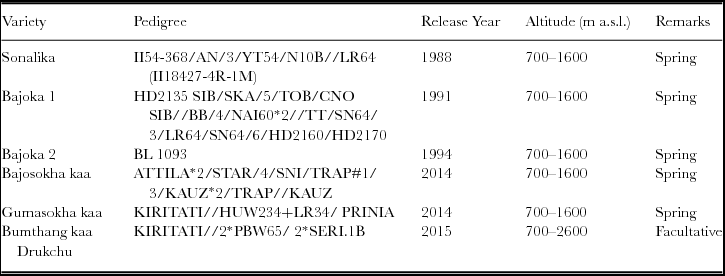
The direction of the national wheat program provided equal priority to facultative wheat since 2011 resulting in the release of a new improved facultative variety from the International Maize and Wheat Improvement Center (CIMMYT) named ‘Bumthangkaa Drukchu’ in 2015 (Table 2). The formal notification of Bumthangkaa Drukchu marks a historic milestone as this is the first ever improved variety released for the facultative winter wheat areas in Bhutan. As varietal diversity is important in sustaining the production, varietal evaluation programs are being expanded for releasing more varieties in the coming years. Bumthangkaa Drukchu was also reported to perform well in the high lands of Nepal, where it was formally released as Danphe≠1 (http://wheatatlas.org.). In general, the institutional linkage between Bhutan and regional and international centres has become very strong, resulting in the release of new wheat varieties in 2014 after a gap of 25 years and drawing global attention and interest towards this small Himalayan country. Such collaborations should be continually maintained and strengthened.
List of released wheat varieties in Bhutan (Source: Department of Agriculture, 2014).

Sonalika, originally introduced from CIMMYT, Mexico, is considered to be one of the Green Revolution wheat varieties because of its high yield potential, and hence averting hunger for poor people in South Asia. In addition, Sonalika was photo-insensitive, making it suitable to delayed planting particularly in rice-based systems without yield penalty to either crop (Singh, Reference Singh1999). As in other South Asian countries, Sonalika's performance was satisfactory even under local Bhutanese agro-ecological conditions, leading to the formal release in 1988 under the same name (Table 2). It possessed wide adaptability from 600–2600 m a.s.l., and suited both in wetland and dryland systems.
Though three improved varieties were officially made available from 1988 to 2013, Sonalika continued to be the main dominant variety and farmers’ preference. The grains were amber coloured, oblong in shape and bold in size which fulfilled the farmers’ expectation of having more flour yield. Further, seed could be readily accessed across the border when needed, as Sonalika was a popular variety during 1980s in north-eastern India (Singh, Reference Singh1999). However, Sonalika was severely affected by stripe rust in Wangdue and Punakha in 1995 (Yeshey, Reference Yeshey2000), and it seems likely that this impact also occurred prior to 1995 but remained unreported. A systematic survey undertaken in collaboration with CIMMYT and the Durable Rust Resistance in Wheat Project since 2012 reported an incidence of stripe rust in Sonalika of up to 30 to 40% severity (Om et al., Reference Om, Thinlay, Tshewang, Dorji, Tashi, Penjor, Tshomo, Prakash, Park, Cisar and Hodson2012). Despite the rust problem, farmers continued to grow Sonalika through their own saved seed or via new purchases in certain years. It was only in 2014 that the farmers were discouraged from cultivating Sonalika by the formal notification of new disease-resistant varieties such as Gumasokha kaa and Bajosokha kaa.
Seed Dissemination
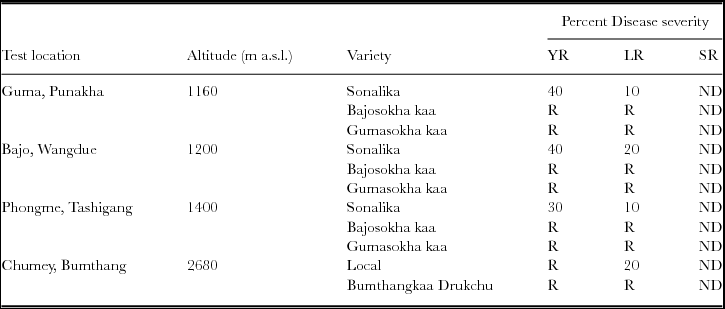
The issue of poor farmers not being able to access improved agricultural technologies, including wheat varieties, in South Asia has been documented previously (Joshi et al., Reference Joshi, Azab, Mosaad, Moselhy, Osmanzai, Gelalcha, Bedada, Bhatta, Hakim, Malaker, Haque, Tiwari, Majid, Kamali, Bishaw, Singh, Payne and Braun2011). It is also essential that growers accept new varietal technology and appreciate the benefit quicker when new wheat seeds are promoted and delivered soon after formal release (Pandit et al., Reference Pandit, Mandal, Hakim, Barma, Tiwari and Joshi2011). As wheat farmers in Bhutan are no different to most other South Asian farmers, Bhutanese scientists and extension agencies have always aimed to deliver a new variety in the shortest time possible. Replacing the obsolete Sonalika, which had dominated for more than 25 years, was a major challenge. Therefore, a parallel seed production program of promising varieties was undertaken in 2012–2015 through registered seed farmers of the National Seed Center, a Government organization entrusted with seed related activities. As envisaged, the parallel seed production was able to produce a substantial quantity of seed of many released varieties that covered ca. 32% of the spring area in the first year of release (National Seed Center, 2014). The other equally important criterion in commercializing these varieties was disease resistance, as the new varieties showed resistance to stripe rust and leaf rust in all locations tested while the widely grown Sonalika succumbed to stripe rust (Table 3). While the yield benefit from newly released varieties was as large as 50% higher than Sonalika (Tshewang, Reference Tshewang2014), it was also expected that a resultant reduction in pathogen inoculum would have considerably reduced and prevented further evolution and selection of new virulence.
Rusts reaction in newly released varieties in Bhutan (data averaged of 2013 & 2014) (Tshewang, Reference Tshewang2014).

YR – Yellow rust; LR – Leaf rust; SR – Stem rust; R – Resistant; ND – Not Detected.
Biotic Constraints
Diseases in cereals are a common recurrent problem in Bhutan, most likely because of its location in the Himalayan range where environmental conditions are conducive for pathogen development. As in other wheat growing countries, wheat production in Bhutan is also constrained by a number of biotic factors with rusts continuing to be of prime concern. Stripe rust is caused by Puccinia striformis f. sp. tritici, a pathogen favoured by cool weather conditions (Chen, Reference Chen2005). Stripe rust remains a major threat owing to cooler winter conditions in most wheat growing regions. However, its appearance in warmer regions elsewhere was reported (Hovmøller et al., Reference Hovmøller, Walter and Justesen2010). Stripe rust is the first disease to appear in the season and consequently the fungus has the potential to destroy crops if left uncontrolled. Its yearly occurrence in most wheat growing areas (Hodson, Reference Hodson2013; Om et al., Reference Om, Thinlay, Tshewang, Dorji, Tashi, Penjor, Tshomo, Prakash, Park, Cisar and Hodson2012) further confirm its potential to cause damage. In fact, there are reports of stripe rust epidemics in Punakha, one of the main wheat areas, as far back as 1985 (Mann and Hobbs, Reference Mann and Hobbs1988).
Leaf rust (caused by Puccinia triticina Eriks.) is the second most common foliar disease of wheat in Bhutan. At the global scale, it is the most prevalent and widely distributed disease (Park and McIntosh, Reference Park and McIntosh1994). It has not been as damaging as stripe rust because it usually appears later. In disease-prone areas, early onset at critical growth stages such as the early reproductive phase can lead to more severe damage (Huerta-Espino et al., Reference Huerta-Espino, Singh, German, McCallum, Park, Chen, Bhardwaj and Goyeau2011). While there are no reports of significant damage caused by leaf rust to date in Bhutan, conditions are highly favourable (Hodson, Reference Hodson2013). Indeed, two lines introduced to the Bajo (1200 m a.s.l.) research station from Nepal were severely infected, leading to their rejection, and indicating that leaf rust can be an issue in Bhutan if susceptible varieties are grown.
Stem or black rust (caused by Puccinia graminis f. sp. tritici) is considered to be the most feared disease in most wheat growing countries (Park, Reference Park2007) given that it can lead to complete crop failure in susceptible varieties even few weeks before harvest (Singh et al., Reference Singh, Hodson, Huerta-Espino, Jin, Njau, Wanyera, Herrera-Foessel and Ward2008). Following the emergence of race ‘Ug99’, global efforts have been made to contain or/and control the disease through respective national program and international efforts such as the Borlaug Global Rust Initiative and the Durable Rust Resistance in Wheat Project (Joshi et al., Reference Joshi, Azab, Mosaad, Moselhy, Osmanzai, Gelalcha, Bedada, Bhatta, Hakim, Malaker, Haque, Tiwari, Majid, Kamali, Bishaw, Singh, Payne and Braun2011) owing to its virulence on Sr 31, a gene widely deployed in CIMMYT wheat germplasm (Singh et al., Reference Singh, Hodson, Huerta-Espino, Jin, Njau, Wanyera, Herrera-Foessel and Ward2008). Although stem rust has endangered wheat in other vulnerable countries, it has not yet been reported in Bhutan. The systematic rust surveys done during 2012–2013 both at early and late seasons did not find any stem rust in all the surveyed areas (Hodson, Reference Hodson2013; Om et al., Reference Om, Thinlay, Tshewang, Dorji, Tashi, Penjor, Tshomo, Prakash, Park, Cisar and Hodson2012). The absence of stem rust may be due to the unsuitability of environmental conditions for infection and disease development, particularly air temperature as this rust is favoured in warmer environments (Eversmeyer and Kramer, Reference Eversmeyer and Kramer2000). In most Bhutanese wheat growing areas, air temperature during April–June, the peak period of active reproductive stages, ranges from 5.3 to 30.7 °C (Table 4), which could be below optimal for stem rust development. Even in locations with air temperature higher than 20 °C, stem rust fungus would be either absent or deprived of living host tissue for survival as the susceptible variety would have been damaged by yellow rust due to its earlier onset. Lack of enough host population due to a very small area under wheat cultivation on locations with favourable temperature could be a reason for absence of stem rust in Bhutan. However, high air temperatures are not essential for severe stem rust infection, as observed through stem rust occurrence in Kenya above 3000 m (Hodson, Reference Hodson2011).

With global warming, changes in farming systems and international travel (Hodson, Reference Hodson2011), the risk of stem rust becoming problematic in Bhutan cannot be ignored. The preparedness is justifiable as all the Bhutanese wheat varieties are susceptible to Ug99 in field tests carried out in Kenya (Newcomb et al., Reference Newcomb, Acevedo, Bockelman, Brown-Guedira, Goates, Jackson, Jin, Njau, Rouse, Singh, Wanyera and Bonman2013). Although varietal evaluation programs are on-going, the release of the Ug99 resistant varieties, Bajosokha kaa and Bumthangkaa Drukchu, is a classic example in this endeavour. With the release of these Ug99 resistant varieties, both the spring and facultative winter wheat areas in Bhutan are secured, if this pathogen race appears. In general, the threat of Ug99 entering South Asian countries has been alarmed, and mitigating measures through the release and delivery of resistant varieties are being pursued vigorously for poor farmers (Joshi et al., Reference Joshi, Azab, Mosaad, Moselhy, Osmanzai, Gelalcha, Bedada, Bhatta, Hakim, Malaker, Haque, Tiwari, Majid, Kamali, Bishaw, Singh, Payne and Braun2011).
Apart from stripe rust and leaf rust, crop losses from other diseases such as powdery mildew (caused by Erysiphe graminis DM f. sp. tritici (Em. Marchal), loose smut (caused by Ustilago tritici (Pers) Rostr.) and leaf blights complex are not reported to be significant in Bhutan; however, current knowledge on the incidence and impact of these diseases is limited. Bhutan is located in a temperate region with cooler environmental conditions suitable for the development and evolution of the powdery mildew pathogen (Te Beest et al., Reference Te Beest, Paveley, Shaw and van den Bosch2008). However, the wide adoption of Gumasokha kaa with the gene Lr34 may have a significant impact on powdery mildew control as Lr34 is associated with enhanced resistance to this disease (Spielmeyer et al., Reference Spielmeyer, McIntosh, Kolmer and Lagudah2005). In a similar manner, the seed of newly released varieties are treated with fungicides for loose smut management.
Weeds are also a concern in wheat cultivation in Bhutan, competing for nutrients and other available resources. Currently, cultural methods continue to be the main form of weed control in wheat. The little seed canary grass (Phalaris minor Retz.), which is a dominant weed in the rice–wheat cropping system, is managed through high seeding rate and broadcasting to minimize the open space for weed invasion. In high and low lands, various broadleaf weeds are controlled by hand weeding in extreme situations. In Bhutan, there is an opportunity to use herbicides to manage different weeds (Chhokar and Malik, Reference Chhokar and Malik2002), but this has not been explored yet. While the significance of weeds cannot be ruled out in the near future, it will be worthwhile to initiate the applied research on weeds by considering the experiences of other South Asian countries to better equip and minimize crop losses. Presently, the national data on weeds in wheat are lacking.
Socio-Economic Constraints
Considering the cultivated area and production, wheat is currently a secondary cereal crop. This is because wheat continues to receive a low priority from the growers’ perspective as wheat farming has not been economical. The lack of productive man power to operate the farm, costly labour charge even if available, and the notion of wheat being of minor importance, are all affecting wheat production. The other challenge of equal magnitude is the availability of affordable imported wheat products from neighbouring India, which account for almost 100% of Bhutan's wheat trade. This discourages Bhutanese farmers from voluminous production as the local production cannot compete with the imported wheat in price. Opinions are often expressed that it is much cheaper to buy the imported products than to grow locally. While this is a concern from a food security perspective, it is the growers’ interests that dictate wheat production in the local context.
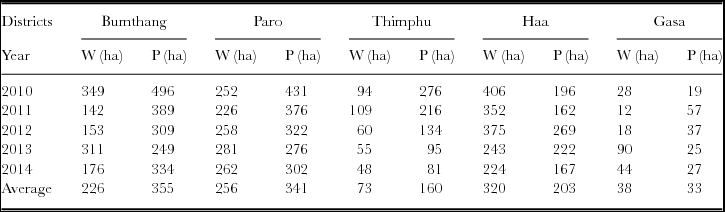
The more profitable cash crops also challenge wheat cultivation. In mid to low altitudes, winter vegetables are more profitable and have established markets. In a similar way, potato (Solanum tuberosum L.) is replacing facultative wheat at high elevations as farmers earn more cash from potato. The average land use data from 2010 to 2014 in some of the major facultative wheat districts shows a considerable increase in the area sown with potato and decrease in wheat area (Table 5). A survey by Wangchuk and Siebert (Reference Wangchuk and Siebert2013) in Bumthang, one of the major wheat growing districts, reported that farmers have voluntarily shifted from wheat to potato cultivation owing to better market opportunities. The same trend of potato and vegetables displacing wheat was also reported by Katwal et al. (Reference Katwal, Dorji, Dorji, Tshering, Ghimiray, Chhetri, Dorji and Tamang2015). Thus, farmers are concentrating on niche crops and leaving the minor cereals such as wheat behind. The farm labour shortage and limited land holding certainly prevent farmers from more diversified cropping. Recently, there has been an increasing trend of rural to urban migration due to better living styles and economic gains, resulting in the abandonment and fallowing of land in rural places and affecting crop production. The concern of rural–urban migration affecting agricultural production was already raised (MoAF, 2014).
Area (ha) under wheat and potato in facultative winter wheat Districts in Bhutan from 2010 to 2014 (Source: Ministry of Agriculture and Forests, 2014).

W – Wheat; P – Potato.
In the dry winter season, the availability of green fodder for livestock is a serious constraint for Bhutanese farmers. Animal husbandry is an indispensable and integrated component of the local agricultural system as it contributes to the human diet and the sustained soil fertility through dairy products and dung manure, respectively (Neuhoff et al., Reference Neuhoff, Tashi, Rahmann and Denich2014). Livestock also provides draught power which is crucial to Bhutan's topographical conditions of narrow and sloppy agricultural fields. With less accessibility and/or low purchasing power of inorganic fertilizers for crop nutrition, farm yard manures are used routinely by local farmers in every crop production cycle. Due to fodder scarcity, a certain percentage of wheat grown for grain purpose has to be inevitably sacrificed as fodder before maturity. Though it is difficult to define the overall percentage of wheat going for fodder due to a lack of systematic studies, Mann and Hobbs (Reference Mann and Hobbs1988) reported that this culture was most dominant in high elevation areas where farmers harvest more than 90% of the wheat as green fodder. Routine observations show that farmers in mid and lower areas also practice such green cuttings as compelled by fodder scarcity in dry winter months.
Input Constraints
The farmers in Bhutan are small land holders and generally current crop production practices are low intensive, primitive and subsistence in nature (MoAF, 2014). This is more practiced with cereals as the concept of production for marketing is yet to be conceived in majority of the farming communities. Given the low inputs, cereals yields including wheat are much lower than the achievable yield.
In Bhutan, the main source of nutrient in any crop is through farm yard manure partly not only because the farmers’ notion that chemical fertilizers deteriorate soil health but also because local manure is available through livestock rearing. The positive benefit of chemical fertilizers in increasing the wheat yield has been adequately documented and widely reported (Cassman et al., Reference Cassman, Dobermann and Walters2002). In the local conditions, the wheat yield benefits from inorganic fertilization have been demonstrated (Tshewang and Legjay, Reference Tshewang and Legjay2013). Long-term experiments by Chettri et al. (Reference Chettri, Ghimiray and Floyd2003) reported that a modest application of nitrogen at 60 kg ha−1 resulted in wheat grain yield increases of 0.69 Mg ha−1. Furthermore and against the common belief of the Bhutanese farmers, no wheat yield improvement was observed even with the application of 7 Mg ha−1 of farm yard manure. Despite advocating and demonstrating the importance of adequate fertilization to farmers, wheat is still grown with little or no inorganic fertilization. The lack of application of external nutrients could be because farmers do not see the economic advantage of additional investing on wheat. The availability of chemical fertilizers and affordability also constrain farmers even if they desire to apply. Under such circumstances, it may be worthy to establish linkage with credit providers to purchase critical inputs as done in India (Biradar, Reference Biradar2013). While growers may be satisfied with any given production, the issue of soil health deterioration through nutrient mining by different crops warrants immediate attention and intervention.
Opportunities
Given the small cultivable area and hence low volume of domestic production, the demand for wheat in Bhutan has never been realised. Considering the volume of yearly import of 23,265 Mg (MoAF, 2014), which is rising exponentially and indicating increased wheat consumption, there is an ample opportunity to increase the domestic wheat production.
Increased production can be achieved following both vertical (increase in productivity) and horizontal (expanding the new areas to cultivation) strategies. The current productivity (1.76 Mg ha−1), one of the lowest in South Asia, has the potential to be elevated and made comparable at least with neighbouring countries. A yield gap of 1.7 Mg ha−1 was reported between the research and farmers’ fields (Tshewang and Legjey, Reference Tshewang and Legjay2013), which indicates the possibility of doubling wheat productivity if proper measures are implemented in farmers’ fields. With the availability of recently released modern varieties, there is good scope to upscale production. Further evaluation and the release of even better varieties would contribute to meet domestic demand. The improvement in nitrogen fertilization both in rate and timing, maintaining optimum plant stand and timely planting are some of the critical factors to be promoted in near future.
There is also a tremendous scope for horizontal expansion through exploitation of productive areas in both wet and dryland ecosystems. Ironically, a majority of this potential land, particularly in mid and low elevations are fallowed in winter and could easily be optimally brought under wheat farming. In a recent study based on GIS technology, an additional area of 19,000 ha was estimated to be suitable for wheat planting (Shahnawaz and Thinley, Reference Shahnawaz and Thinley2015). Should the aspiration of area expansion be pursued, it would be more appropriate and feasible at mid and low elevations of wetlands where there would be virtually no conflict in land use between wheat harvesting and sowing of successive crops. In high elevations where wetland areas would be used for facultative winter wheat, a lack of time between wheat harvesting and field operations for successive rice crop was reported to be one of the major reasons for farmers not growing wheat (Mann and Hobbs, Reference Mann and Hobbs1988).
Dryland wheat, grown as rain-fed in dryland under a maize-based system, also provides additional avenues to increase production. Wheat can be seeded after maize harvesting in the residual soil moisture and fertility with the provision of applying manures or chemical fertilizers in the final land preparation. The maize residues are either removed completely or retained, though the latter practice is desirable in increasing wheat yield by increasing soil moisture in the seeding zone of wheat crop. The yield benefits to both wheat and maize are increased when inorganic fertilizers are applied in combination with the crop residues or farm yard manure (Bhattacharyya et al., Reference Bhattacharyya, Pandey, Gopinath, Mina, Bisht and Bhatt2016). In Bhutan, maize–barley (Hordeum vulgare L.) rotation is common, but most of the areas after maize are fallowed.
Considering the opportunity and to validate maize-based technology in the local context, elite lines from CIMMYT and neighbouring countries were screened. Francolin 1 (WAXWING*2/VIVITSI) showed encouraging results under maize-based system without any conflict in land use (Renewable Natural Resources Research and Development Center, 2015). During the field day/demonstrations, farmers have shown keen interest towards this technology and a seed production program is underway to accelerate dissemination. A similar cropping system of maize–wheat was also reported in other South Asian countries covering about 2.9 million ha (Timsina et al., Reference Timsina, Jat and Majumdar2010) to boost the national food grains production. Concurrent with the opportunities, the concerns of disease such as fusarium head blight (Fusarium graminearum Schwabe) was also raised (Duveiller et al., Reference Duveiller, Singh and Nicol2007). In the last three seasons of field evaluation, fusarium head blight was not found but its appearance in the future cannot be over ruled and screening of materials with resistance against this fungal disease should be initiated through regional and international collaboration.
The use of wheat as fodder provides another opportunity to develop and promote wheat with dual purpose – both green fodder and grain. Use of dual purpose wheat for livestock provides improved nutrition and income opportunities. Superior lines need to be characterized for dual purpose which are generally planted late and crop cut is taken after 50 days. A suitable management of wheat crop for proper cutting time of varieties needs to be investigated in Bhutan.
Future Outlook And Considerations
Wheat production in Bhutan has both challenges and opportunities. It is indisputable that wheat will continue to occupy a strategic place in the local farming system and equally play a significant role in strengthening the food security of Bhutan. Wheat-based products will be an inevitable component of the Bhutanese food diets because of consumers’ health consciousness, and preference towards more protein rich diet such as wheat compared to rice.
Availability and accessibility to improved varieties with adequate and durable disease resistance, and desirable agronomic traits will be the key to sustain and further improve wheat production in Bhutan. This applies to both facultative and spring wheat varieties as available improved ones will be outclassed and/or would succumb to new races of diseases such as stripe rust. Ideally, a variety would to be replaced after 3–5 years of its release (Gupta and Kant, Reference Gupta and Kant2012). The need for varietal improvement is legitimate as the current dominant variety is cultivated over large acreage. Should a virulent race of stripe rust overcome the resistance of this current variety, the occurrence of an epidemic disease will be inevitable. Epidemics resulting from such a monoculture have already been reported (e.g., stripe rust epidemic in 2002 in China – Wan et al., Reference Wan, Zhao, Chen, He, Jin, Jia, Yao, Yang, Wang, Li, Bi and Yuan2004). As wheat area is very small and there are few farmers, it is hard to justify the establishment of a Bhutanese wheat breeding program. Therefore, research examining the adaptability of elite germplasm in nurseries from CIMMYT is expected to satisfy the current germplasm requirements of Bhutan. This can be complemented by the introduction and assessment of released and advanced materials from neighbouring South Asian Association for Regional Cooperation (SAARC) countries, based on the willingness to share as per their national protocols and regulations. More specifically, the varieties from Nepal, northern India and Pakistan are likely to be more adapted to Bhutanese conditions because of similarities in wheat growing environments. Along with the varietal improvement, enhancement of productivity through appropriate crop management and market facilities should also be pursued to motivate growers.
In view of the scarcity of labour in Bhutan, investment in farm mechanization can have a positive encouraging effect to local growers. In areas where fields are levelled and adequately sized to facilitate movement of machinery, mechanization needs to be pursued vigorously. This will be more appropriate in wet lands at mid and lower elevations where the farmlands are widely available after rice harvest. The other most important component in mechanization should be the promotion of mechanical threshers as the current practice of manual threshing is the most tedious operation and likely discourages the cultivation of wheat. There are, however, good prospects as Ministry of Agriculture and Forests is seriously pursuing farm mechanization as a main driver in motivating local farmers (MoAF, 2014).
Soil fertility management is another key issue that will determine the sustainability of not only wheat production but also of other primary crops. In high lands where facultative wheat is grown under rain-fed conditions, soil enrichment with external application of chemical fertilizers is impossible. Instead, rotating with a legume crop with good marketability such as vegetable pea (Pisum sativum L.) may contribute in restocking the nutrients for subsequent crops and maintaining a viable farming system. Similarly, the mid and low lands also need equal attention as the current practice of nutrient management is below the optimal requirement. Application of adequate, balanced and recommended chemical fertilization will be crucial for increasing wheat yield while maintaining soil health. In addition, the other opportunity in these areas is the inclusion of a short duration legume crop such as mung bean (Vigna radiata L.) as there is an adequate time gap after wheat harvesting and rice transplanting. Such a mung bean introduction in a rice–wheat cropping system was reported to be profitable and sustainable when considering soil health management (Laik et al., Reference Laik, Sharma, Idris, Singh, Singh, Bhatt, Saharawat, Humphreys and Ladha2014).
Bhutan's strategic location in the Himalayan region and its location between the two major wheat producing countries (China and India) provides both opportunities and threats from the perspective of disease epidemiology. If rusts are not controlled, there is a possibility of Bhutan serving as a primary source of inoculum in the region owing to wind movement of inoculum. The Himalayan region, in which Bhutan is situated, was recently identified as a source of new and virulent strains of the stripe rust pathogens (Ali et al., Reference Ali, Leconte, Rahman, Saqib, Gladieux, Enjalbert and de Vallavieille-Pope2014b). The other alarming aspect is the similarity of the current prevalent races of stripe rust and leaf rust in Bhutan to ones detected in India, Nepal and Bangladesh (Indian Institute of Wheat and Barley Research, 2015). In addition, Bhutan hosts diverse species of barberries not only in the native vegetation but also in cultivated agricultural lands where wheat is grown. With the confirmation of Berberis acting as an alternate host to Puccinia graminis f. sp. tritici (Jin et al., Reference Jin, Szabo and Carson2010); and stripe rust being a recurrent problem in Bhutan, it would be worth examining the functionalities of the local barberries in this disease epidemiology.
Climate change is inevitable and its consequences such as terminal heat stress, drought, erratic rainfall, to name a few are explicitly discussed at both global and regional context (Meenawat and Sovacool, Reference Meenawat and Sovacool2011). The demand for more food with exponential increasing human population will certainly exert pressure on land for crop intensification including wheat. It is thus important that activities targeting the mitigation of climate change effects are initiated. Some of the possible recommendations include drought and hot environment nursery trials for mid and low areas, where mechanization with adequate irrigation facilities is possible; and evaluation of wheat crops in northern areas, where harvesting coincides with peak monsoon (high rainfall). Likewise, new emerging threats such as wheat blast already reported in Bangladesh (Malaker et al., Reference Malaker, Barma, Tewari, Collis, Duveiller, Singh, Joshi, Singh, Braun, Peterson, Pedley, Farman and Valent2016) also have to be monitored closely and precautionary measures undertaken to avert the disaster.
The degree of success will also depend on the enhancement of technical capacity of national wheat workers to abreast with the evolving technologies and scientific developments. Compared to the past 20 years or so, the current understanding on wheat related issues has been improved by many folds with kind support from projects such as DRRW/BGRI and through support of international institutes such as CIMMYT and regional National Agriculture Research Centers of SAARC countries. Irrespective of the wheat area cultivated or quantities of wheat produced, such support is essential for maintaining and strengthening the collaboration.
Acknowledgements
The major portion of this paper was developed when the first author was on an Endeavour Executive Fellowship of Australian Government at Plant Breeding Institute, The University of Sydney in 2016. He is grateful to Australian Government for providing this unique opportunity in enhancing his professional capacity, and establishing institutional linkage. Robert F. Park thanks the Coffey family and the Australian Grains Research and Development Corporation for financial support. Arun K Joshi acknowledges CIMMYT for financial assistance. Two anonymous referees are also acknowledged for their critical comments in improving the paper.