Depression is one of the leading causes of disability worldwide and has profound public health and economic implications (Murray & Lopez, Reference Murray and Lopez1996). Major depression is the most common mental health disorder in the United States (Kessler, Berglund, Demler, Jin, & Walters, Reference Kessler, Berglund, Demler, Jin and Walters2005) and often is associated with other psychiatric problems, psychosocial impairment, poor health outcomes, and increased hospitalizations (Resnick et al., Reference Resnick, Bearman, Blum, Bauman, Harris and Jones1997; Rohde, Lewinsohn, & Seeley, Reference Rohde, Lewinsoh and Seeley1991; Weissman et al., Reference Weissman, Wolk, Goldstein, Moreau, Adams and Greenwald1999). Identification of the symptoms, causes, and consequences of depression is critical for preventing its onset and recurrence.
Depression often begins during adolescence and has a chronic and recurrent course across the life span (Pine, Cohen, Cohen, & Brook, Reference Pine, Cohen, Cohen and Brook1999; Weissman et al., Reference Weissman, Wolk, Goldstein, Moreau, Adams and Greenwald1999). A significant upsurge in the rates of depression occurs around age 15 (Hankin et al., Reference Hankin, Abramson, Moffitt, Silva, McGee and Angell1998; Kessler & Walters, Reference Kessler and Walters1998). Therefore, adolescence is an ideal time for studying the emergence and growth of depression (Reinherz, Giaconia, Hauf, Wasserman, & Silverman, Reference Reinherz, Giaconia, Hauf, Wasserman and Silverman1999). What accounts for this increase in depression during adolescence? Clinical, family, and epidemiological studies have identified various risk factors for the development of depression including genes, neurobiological dysregulation, negative cognitions, stress and trauma, maladaptive responses to stress, family dysfunction, interpersonal difficulties, being female, and the interactions among several of these variables (e.g., Garber, Reference Garber, Masten and Sroufe2007; Rudolph, Reference Rudolph, Gotlib and Hammen2009).
One of the most potent risk factors for early-onset depression is having a parent with a history of depression (Beardslee, Versage, & Gladstone, Reference Beardslee, Versage and Gladstone1998). Offspring of depressed parents are at least three times more likely to develop a mood disorder as well as other psychiatric problems and impairment compared to children of nondepressed parents (Weissman, Warner, Wickranaratne, Moreau, & Olfson, Reference Weissman, Warner, Wickramaratne, Moreau and Olfson1997; Weissman et al., Reference Weissman, Wickramaratne, Nomura, Warner, Pilowsky and Verdeli2006). By the end of adolescence, an estimated 40% of children of mothers with a mood disorder will have experienced at least one episode of major depression themselves (Beardslee et al., Reference Beardslee, Versage and Gladstone1998).
The cross-generational transmission of depression is a complex and multifaceted process (Serbin & Karp, Reference Serbin and Karp2004). Several excellent reviews have been written about the link between parents' and children's depression (e.g., England & Sim, Reference England and Sim2009; Goodman & Gotlib, Reference Goodman and Gotlib1999; Goodman & Tully, Reference Goodman, Tully, Keyes and Goodman2006; Joormann, Eugene, & Gotlib, Reference Joormann, Eugene, Gotlib, Nolen-Hoeksema and Hilt2009). Goodman and Gotlib (Reference Goodman and Gotlib1999) proposed four general explanations for the transmission of depression from mothers to children: heritability; innate neuroregulatory dysfunction; exposure to maternal negative affect, cognitions, and behaviors; and increased stress in the family. Moreover, these mechanisms do not work in isolation; the interactions and transactions among them likely contribute to the development of depression in high-risk youth (Goodman, Reference Goodman2007).
The present paper tested a “launch and grow” type of cascade model in which an earlier risk factor (e.g., maternal depression) affects certain processes during development (e.g., stress, family relationships), which then sets the course for the growth of children's depressive symptoms over time. Children who experience maternal depression at any point during the first decade of life have been found to be at increased risk for depression during adolescence (Hammen & Brennan, Reference Hammen and Brennan2003). The present study examined whether exposure to maternal depression by age 12 predicted the trajectory of children's depressive symptoms across adolescence, and if so, through what mechanisms? That is, what variables associated with maternal depression launched the development and subsequent course of depressive symptoms during adolescence? We examined several potential mediators of the transmission from mother to child depression, including mothers' current level of depressive symptoms, stressful life events, the family environment, and children's perceived self-worth (SW). These variables are by no means an exhaustive representation of all possible mechanisms. Rather, these constructs were selected because each (a) has been shown to be related to both parent and child depression, which is one requirement of a mediation analysis (Baron & Kenny, Reference Baron and Kenny1986; Kraemer, Kiernan, Essex, & Kupfer, Reference Kraemer, Kiernan, Essex and Kupfer2008); (b) represents a different salient domain of risk (i.e., parental distress, contextual stress, family relationships, and negative cognitions); and (c) is potentially malleable through intervention, which is one important reason for identifying mechanisms of transmission.
Maternal Depressive Symptoms
Both mothers' history of mood disorders and current depressive symptoms are associated with offspring adjustment problems (e.g., Campbell, Cohn, & Meyers, Reference Campbell, Cohn and Meyers1995; Hammen et al., Reference Hammen, Adrian, Gordon, Burge, Jaenicke and Hiroto1987). Less is known, however, about the extent to which mothers' current symptoms mediate the relation between their depression history and their children's depression (Goodman, Reference Goodman2007). The negative impact of mothers' past depressive episodes may be evident only when mothers are currently experiencing depressive symptoms, such as withdrawal and irritability (e.g., an “activating hypothesis”). Conversely, maternal depression history might be a marker of other risk processes (e.g., genes, stress) that persist regardless of the mothers' current mood state (Pettit & Joiner, Reference Pettit and Joiner2006). Parenting problems and negative life events associated with maternal depression continue even after the episode has remitted (e.g., DeMulder, Tarulla, Klimes-Dougan, & Free, Reference DeMulder, Tarulla, Klimes-Dougan and Free1995; Seifer, Dickstein, Sameroff, Magee, & Hayden, Reference Seifer, Dickstein, Sameroff, Magee and Hayden2001). The present study tested whether a history of a diagnosed depressive disorder predicted mothers' subsequent levels of depressive symptoms, which then predicted growth in their children's depressive symptoms across adolescence.
Stressful Life Events
One important consequence of maternal depression is the high level of stress to which their offspring are exposed throughout childhood, even prenatally (Ashman & Dawson, Reference Ashman, Dawson, Goodman and Gotlib2002; Hammen, Reference Hammen, Goodman and Gotlib2002). Some of these stressors are generated by the depressed mothers (Adrian & Hammen, Reference Adrian and Hammen1993) and some are generated by the children themselves (Garber, Reference Garber, Masten and Sroufe2007). Chronic and episodic stressors, such as poverty or maltreatment, are also associated with child psychopathology (e.g., Cicchetti, Rogosch, & Toth, Reference Cicchetti, Rogosch and Toth1998; Eamon & Zuehl, Reference Eamon and Zuehl2001). Interpersonal stressors are especially common among depressed adolescent offspring of depressed parents (Hammen, Shih, Altman, & Brennan, Reference Hammen, Shih, Altman and Brennan2003). Given the strong relation between maternal depression and stress (Hammen, Reference Hammen, Goodman and Gotlib2002) and between stress and depression in youth (Grant et al., Reference Grant, Compas, Stuhlmacher, Thurm, McMahon and Halpert2003), we predicted that high levels of negative life events would mediate the link between maternal depression history and children's depressive symptoms.
Family Environment
The family context also can affect the relation between maternal and child depression. As mothers become depressed, the family environment may worsen, which in turn can lead to increases in depressive symptoms in children (Hammen, Brennan, & Shih, Reference Hammen, Brennan and Shih2004). Mothers' interpersonal deficits may be both a model of maladaptive social interactions as well as a direct stressor for the child (Hammen, Reference Hammen, Goodman and Gotlib2002). Extensive evidence exists showing that family relationships are significantly strained when a parent is depressed (e.g., Garber, Reference Garber, Hudson and Rapee2005; Goodman, Reference Goodman2007). Observational studies have revealed that depressed mothers exhibit more negative (hostile/coercive) and disengaged parenting behaviors and lower levels of positive behaviors than nondepressed mothers (Lovejoy, Graczyk, O'Hare, & Neuman, Reference Lovejoy, Graczyk, O'Hare and Neuman2000). In addition, family environments characterized by high levels of negativity, conflict, disengagement, or otherwise adverse relationships have been found to be associated with depression in youth (e.g., Sheeber, Hops, & Davis, Reference Sheeber, Hops and Davis2001). Thus, families of depressed mothers are characterized by high conflict and low support, and negative family environments have been observed in families of depressed adolescents. Moreover, chronic family stress and negative parenting behaviors (e.g., high criticism) have been shown to mediate the relation between parent and child depression (Hammen, Shih, & Brennan, Reference Hammen, Shih and Brennan2004; Nelson, Hammen, Brennan, & Ullman, Reference Nelson, Hammen, Brennan and Ullman2003). The current study tested whether maternal history of depression launched a dysfunctional family environment, which then predicted the trajectory of depressive symptoms in offspring across adolescence.
Adolescents' SW
Offspring of depressed mothers show early signs of cognitive vulnerability to depression, including greater self-blame, more negative attributions, information processing biases, fewer positive self-descriptive adjectives recalled, and lower self-esteem than children of nondepressed mothers (e.g., Anderson & Hammen, Reference Anderson and Hammen1993; Garber & Robinson, Reference Garber and Robinson1997; Gotlib, Joormann, Minor, & Cooney, Reference Gotlib, Joormann, Minor, Cooney and Canli2006; Jaenicke et al., Reference Jaenicke, Hammen, Zupan, Hiroto, Gordon and Adrian1987; Murray, Woolgar, Cooper, & Hipwell, Reference Murray, Woolgar, Cooper and Hipwell2001; Radke-Yarrow, Belmont, Nottelman, & Bottomly, Reference Radke-Yarrow, Belmont, Nottelman, Bottomly, Cicchetti and Beeghly1990; Taylor & Ingram, Reference Taylor and Ingram1999). Moreover, currently depressed children and adolescents report more hopelessness, cognitive distortions, cognitive errors, low SW, and negative attributions compared to nondepressed children (Abela & Hankin, Reference Abela, Hankin, Abela and Hankin2008; Lakdawalla, Hankin, & Mermelstein, Reference Lakdawalla, Hankin and Mermelstein2007). Thus, low SW is found in offspring of depressed mothers and in youth with depression. The present study examined the relation of maternal depression to their children's low SW, and the contribution of negative self-esteem to the onset and growth of depressive symptoms across adolescence.
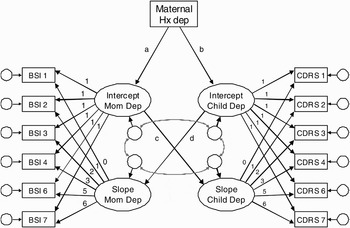
In summary, the purpose of this multiwave, multi-informant study was to test a “launch and grow” type of cascade model (see Figure 1). Paths a and b represent the launch part of the model in which we examined the relation of maternal history of depression to the intercepts of the growth curves for maternal and adolescent depressive symptoms, respectively. Paths c and d represent the grow part of the model in which we tested the effect of the intercept of one construct (e.g., maternal depressive symptoms) on the slope of the growth curve of the other variable (e.g., adolescents' depressive symptoms). We used this launch and grow approach to address the following questions:
1. Does maternal history of depression predict the trajectory of their children's depressive symptoms across adolescence?
2. Does maternal history of depression predict the more proximal risk factors of mothers' current depressive symptoms, stressful life events, family dysfunction, and low perceived SW in the children?
3. Do these putative risk factors predict the trajectory of adolescents' depressive symptoms over 6 years?
4. Does the launching of these risk factors by maternal depression history predict changes in adolescents' depressive symptoms over time?
5. Among these risk factors, which accounts for the most unique variance in explaining the relation between maternal depression history and the trajectory of depressive symptoms during adolescence?
An example of a path diagram of a conditional bivariate latent growth curve analysis of the relationships among maternal history of depression, mother's current depressive symptoms (Brief Symptom Inventory, Depression Scale [BSI]; Derogatis, Reference Derogatis1975, Reference Derogatis1993), and children's depressive symptoms (Child Depression Rating Scale [CDRS]; Poznanski et al., Reference Poznanski, Mokros, Grossman and Freeman1985) assessed at each time point.

Method
Participants
The sample consisted of 240 mothers and children (mean age = 11.87, SD = 0.57). The child sample was 54.2% female; 82% Caucasian; 14.7% African American; and 3.3% Hispanic, Asian, or Native American. The sample was predominantly working class (e.g., nurse's aide, sales clerk) to middle class (teacher, store manager) with a mean socioeconomic status (Hollingshead, Reference Hollingshead1975) of 41.84 (SD = 13.25).
Procedure
Parents of fifth-grade children from metropolitan public schools were invited to participate in a study about parents and children. A brief health history questionnaire comprised 24 medical conditions (e.g., diabetes, heart disease, depression) and 34 medications from several different classes (e.g., antihypertensives, antidepressants) was sent with a letter describing the project to over 3,500 families. Of the 1,495 mothers who indicated an interest in participating, the 587 who reported a history of depressive symptoms, use of antidepressants, or no psychopathology were interviewed further by telephone. The remaining families were excluded, because the mother did not report depression or indicated either other kinds of psychiatric problems without depression or serious medical illness (e.g., cancer, multiple sclerosis). Based on the screening calls, 238 families were further excluded because they did not indicate sufficient symptoms to meet criteria for a depressive disorder (38%), had other psychiatric disorders that did not also include a depressive disorder (19%), they or the target child had a serious medical condition (14%), were no longer interested (21%), the target child was in the wrong grade (6%), or the family had moved out of the area (2%). The remaining 349 mothers who had indicated during the screening calls that they had a history of some depression or had no history of psychiatric problems were interviewed further in person with the Structured Clinical Interview for DSM Diagnoses (First, Spitzer, Gibbon, & Williams, Reference First, Spitzer, Gibbon and Williams1996; Spitzer, Williams, Gibbon, & First, Reference Spitzer, Williams, Gibbon and First1990). Interrater reliability was calculated on a random subset of 25% of these Structured Clinical Interview for DSM Diagnoses interviews. There was 94% agreement (κ = 0.88) for diagnoses of depressive disorders. The final sample of 240 families consisted of 185 mothers who had a history of a mood disorder (high-risk group) and 55 mothers who were lifetime free of psychiatric diagnoses (low-risk group).
Children were first assessed in sixth grade (Wave 1) and again annually through Grade 12 for a total of six waves. Because of a gap in funding, only partial data were collected at Wave 5, which therefore was not included in the analyses. A research assistant, unaware of the mothers' psychiatric history, interviewed and administered a battery of questionnaires separately to the mother and child. Only those measures relevant to the current study are described here.
Measures
The Brief Symptom Inventory (BSI; Derogatis, Reference Derogatis1975, Reference Derogatis1993) is a 53-item self-report measure of psychiatric symptoms completed by the mothers at each time point. The BSI yields nine symptom dimensions (depression, anxiety, hostility, somatization, obsessive–compulsive, interpersonal sensitivity, phobic anxiety, paranoid ideation, psychotic) and three global indices. The 13-item Depression Scale (BSI-D) was used in the current study as the measure of mothers' current depressive symptoms. Each item is rated on a 5-point scale (0–4) with higher scores reflecting greater psychological distress. The BSI has good reliability and validity (Derogatis & Lazarus, Reference Derogatis, Lazarus and Maruish1994; Derogatis & Melisaratos, Reference Derogatis and Melisaratos1983). The alpha reliability for the BSI-D across all time points in this sample was ≥0.84. Median stability across adjacent waves was 0.574 (range = 0.429–0.667).
The Family Inventory of Life Events (FILE; McCubbin & Patterson, Reference McCubbin, Patterson, McCubbin and Patterson1987) was used to assess negative life events affecting the family. This 90-item measure was completed by the mother regarding events that had occurred during the previous year. The FILE includes items about such major life events as deaths, illnesses and accidents, divorce and separations, moves, school transitions, financial difficulties, and employment changes. Correlations of FILE scores across adjacent waves ranged from 0.440 to 0.605 (median = 0.465).
The Family Relationship Index (FRI; Holahan & Moos, Reference Holahan and Moos1983) was used to assess adolescents' perceptions of the quality of their family environment. The FRI is a composite of three subscales from the Family Environment Scale (Moos & Moos, Reference Moos and Moos1986): cohesion, expressiveness, and conflict. Higher scores on the FRI indicated better family functioning (higher cohesion and expressiveness, and lower conflict). The FRI has been found to correlate with other measures of family functioning (Hoge, Andrews, Faulkner, & Robinson, Reference Hoge, Andrews, Faulkner and Robinson1989). The coefficient alpha for the FRI in this sample was ≥0.82 for all time points. Median stability of FRI scores across adjacent waves was 0.609 (range = 0.572–0.672).
The global perception of SW was assessed with the Self-Perception Profile for Children (Harter, Reference Harter1982, Reference Harter1985). The six items of the global SW subscale assess the extent to which children are satisfied with themselves, like the way they are leading their lives, and like the kind of person they are. Each item is presented in a structured alternative format (i.e., “Some kids are often unhappy with themselves” BUT “Other kids are pretty pleased with themselves.”) Participants read or were read both statements and then selected the one that most accurately described them, and whether the chosen statement was “really true” or “sort of true” of them. Responses were scored on a 4-point scale, with lower scores indicating poorer global SW. In this sample, the alpha for the global SW scale was ≥0.82 across all time points. Correlations of SW ratings across adjacent waves ranged from 0.449 to 0.597 (median = 0.516).
Depressive symptoms in adolescents were assessed annually with a modified Children's Depression Rating Scale—Revised (CDRS-R; Poznanski, Mokros, Grossman, & Freeman, Reference Poznanski, Mokros, Grossman and Freeman1985). Mothers and adolescents were interviewed separately about the extent of the youth's depressive symptoms during the previous 2 weeks. Eleven depressive symptoms (e.g., anhedonia, insomnia, suicidal ideation) were rated on a 7-point severity scale; total scores could range from 11 to 77. The alpha value for the CDRS-R at each time point was ≥0.72. Median stability of CDRS ratings across adjacent waves was 0.486 (range = 0.241–0.568).
Results
Descriptive statistics
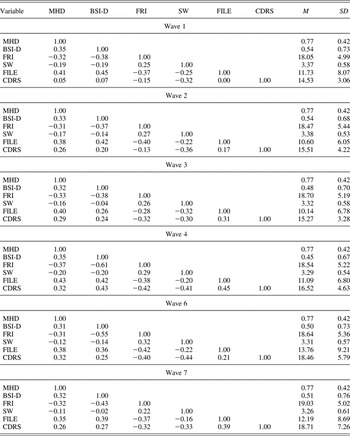
Correlations, means, and standard deviations for all study variables are broken down by wave in Table 1. The pattern of correlations was very consistent from wave to wave, as were the means for most variables. Two exceptions were the means for the FILE and the CDRS, both of which increased in the latter waves of the study, indicating an increase in family stressful life events and an increase in adolescents' depressive symptoms across time.
Correlations, means, and standard deviations by wave

Note: Correlations >.113 are significant at p = .05, >.149 are significant at p = .01, and >.189 are significant at p = .001. MHD, maternal history of depression; BSI-D, Brief Symptom Inventory, Depression Scale; FRI, Family Relationship Index; SW, self-worth; FILE, Family Inventory of Life Events; CDRS, Children's Depression Rating Scale.
Latent growth curve (LGC) analyses
Our primary data analytic strategy involved LGC analysis. This approach involved three steps. First, we conducted a series of unconditional LGCs, one for each time series, to determine if a linear growth curve model was sufficient to explain change in each variable over time. Second, we tested a series of conditional, bivariate LGCs (a) to test the effect of maternal history of depression on the growth trajectory of two variables simultaneously (which two variables changed from analysis to analysis) and (b) to test the effect of each variable on the growth trajectory of the other variable in the model. Third, we tested a single latent growth model in which all predictors were simultaneously considered as predictors of the trajectory of adolescents' depression scores.Footnote 1
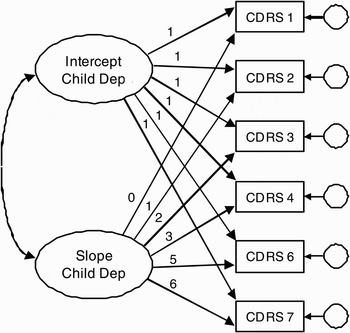
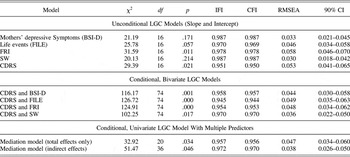
Step 1: Unconditional LGC analyses. First, we fit an unconditional LGC model to each of five time series, one analysis per variable: mother's BSI-D, FILE, the FRI, adolescents' global SW, and adolescents' depressive symptoms (CDRS). In each analysis, we began with a latent intercept and a latent (linear) slope. An example of this model (for the CDRS) is depicted in Figure 2. Loadings of the six time points onto the latent intercept were fixed at unity, and loadings onto the latent slope were fixed at 0, 1, 2, 3, 5, and 6. Setting the Wave 1 slope loading to zero causes the intercept to represent the construct at Wave 1. Latent slope and intercept were allowed to correlate. Manifest variable error terms were orthogonal. As shown in the upper portion of Table 2, this model fit the data well for every one of the five time series. Some of the chi-square values were significant; however, with relatively large sample sizes, small discrepancies can be statistically significant. Large values for the incremental fit index and the comparative fit index revealed that the model explained a large portion of the available information. Further, all estimates of the root mean square error of approximation were less than 0.05, indicating that discrepancies between the model and the data were small. Examination of parameter estimates revealed significant variance for the slope and intercept of every latent growth trajectory. As a final test, we added a latent quadratic variable to each model. In every case, the change in the chi-square value was not significant, suggesting that a model with only a latent slope and intercept was sufficient.
An example of a path diagram of an unconditional latent growth curve (slope and intercept) of the Child Depression Rating Scale (CDRS; Poznanski et al., Reference Poznanski, Mokros, Grossman and Freeman1985) across six waves.

Goodness of fit information about LGC models (N = 294)

Note: LGC, latent growth curve; IFI, incremental fit index; CFI, comparative fit index; RMSEA, root mean square error of approximation; CI, confidence interval; BSI-D, Brief Symptom Inventory, Depression Scale; FILE, Family Inventory of Life Events; FRI, Family Relationship Index; SW, self-worth; CDRS, Children's Depression Rating Scale.
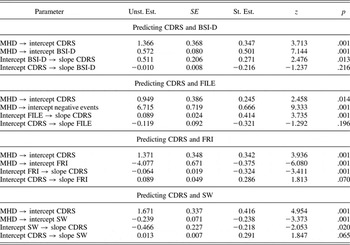
Step 2: Conditional LGC analyses. In the next step, we modeled growth of two variables simultaneously and in conjunction with the time-invariant covariate, maternal depression history. The model represents a “launch and grow” conceptualization. In the launch phase, we examined the relation of maternal history of depression to the intercepts of both growth curves. In the growth phase, we examined the effect of each intercept on the slope of the other growth curve. Figure 1 presents an example of such a launch and grow model in which Paths a and b represent the launch part of the model and Paths c and d represent the grow part of the model. We tested a version of this model for every pair of growth curves. All models fit the data well; however, the grow paths were significant only in those models in which the CDRS served as one of the time series. Consequently, we concentrated on these models. For these four models, goodness of fit information appears in the middle portion of Table 2. For every model, the chi-square test was significant; however, the incremental fit index and comparative fit index were large and the root mean square error of approximation was small, all indicating that the model was highly consistent with the data.
Key parameter estimates are provided in Table 3. Parameter estimates for the launch part of the model revealed that history of maternal depression was significantly related to the intercepts of the growth trajectories of adolescents' depressive symptoms (CDRS scores), mothers' depressive symptoms (BSI-D scores), negative life events (FILE), family environment (FRI), and adolescents' SW. As expected, the relation was positive for the BSI-D, FILE, and CDRS, and negative for the FRI and SW. Parameter estimates for the growth parts of the model revealed that the intercepts for the BSI-D, FILE, FRI, and SW all predicted the slope of the CDRS growth curve. Conversely, the intercept for the CDRS was unrelated to the slopes for all of the other trajectories.
Key parameter estimates from bivariate conditional LGC analyses

Note: LCG, latent growth curve; Unst. Est., unstandardized estimates; St. Est., standardized estimates; MHD, maternal history of depression; CDRS, Child Depression Rating Scale; BSI-D, Brief Symptom Inventory, Depression Scale; FILE, Family Inventory of Life Events; FRI, Family Relationship Index; SW, self-worth.
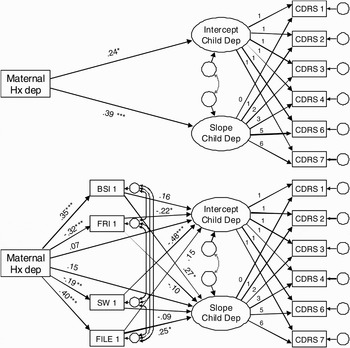
Step 3: Conditional LGC model with multiple covariates. As each predictor of the CDRS slope was examined in a separate analysis, we could not account for overlapping or redundant effects because of collinearity. Consequently, we conducted a single, larger analysis in which Wave 1 estimates of all four predictors were entered simultaneously as predictors of the CDRS growth trajectory (see Figure 3). The model fit the data well, as shown by the goodness of fit indices at the bottom of Table 2. As presented in Figure 3, history of maternal depression significantly predicted Wave 1 estimates of BSI-D, FILE, FRI, and SW; after controlling for the other predictors, however, only the Wave 1 estimates of BSI-D and FILE then significantly predicted the CDRS slope.
The launch and grow latent growth curve analysis of Child Depression Rating Scale (CDRS; Poznanski et al., Reference Poznanski, Mokros, Grossman and Freeman1985) scores, which are conditional on multiple covariates. FRI, Family Relationship Index (Holahan & Moos, Reference Holahan and Moos1983); SW, self-worth; FILE, Family Inventory of Life Events (McCubbin & Patterson, Reference McCubbin, Patterson, McCubbin and Patterson1987).

Discussion
The intergenerational transmission of depression from mothers to children has been a focus of much recent attention because of its important public health implications (England & Sim, Reference England and Sim2009). The present study provided evidence consistent with a “launch and grow model” of the trajectory of depressive symptoms across adolescence. Exposure to maternal depression by age 12 predicted the growth of depressive symptoms across adolescence. Hammen and Brennan (Reference Hammen and Brennan2003) similarly have shown that the experience of maternal depression at any point during the first 10 years of life was associated with elevated depression in adolescence.
The launch perspective is that having a depressed mother sets into motion a cascade of processes, which in turn increase the likelihood of the onset and growth of depressive symptoms in at-risk offspring during adolescence. Each of the specific risk factors tested here represents a different salient domain (i.e., parental distress, contextual stress, family relationships, and negative cognitions), has been shown to be related to both maternal and child depression, and is potentially malleable. Analyses showed that in all of the models tested here, maternal history of depression was a significant predictor (i.e., launch) of each hypothesized risk factor. These results are consistent with other studies that have shown that maternal depression is associated with high levels of stress (e.g., Hammen, Reference Hammen, Goodman and Gotlib2002), dysfunctional family environments (e.g., Lovejoy et al., Reference Lovejoy, Graczyk, O'Hare and Neuman2000), child negative cognitions (e.g., Gotlib et al., Reference Gotlib, Joormann, Minor, Cooney and Canli2006) and depressive symptoms in offspring (e.g., Beardslee et al., Reference Beardslee, Versage and Gladstone1998).
Even more interesting was the growth part of the model, such that the initial values at the beginning of the study (i.e., Wave 1) of each construct significantly predicted growth of adolescents' depressive symptoms across the 6-year duration of the study. Thus, not only was maternal depression history associated with high initial levels of maternal depressive symptoms, stress, family dysfunction, and low perceived SW, but these variables in turn predicted the trajectory of depressive symptoms across adolescence. Tests of the mediation models separately for each variable indicated that these constructs significantly mediated the relation between maternal depression history and growth in their children's levels of depressive symptoms over the course of adolescence.
It is important, however, that the converse was not true. That is, adolescents' depressive symptoms did not significantly predict change over time in mothers' current depressive symptoms, stress, family relationships, and SW. Thus, the direction of these relations appears to go from these risk factors to adolescents' depressive symptoms rather than the reverse. Reciprocal relations have been found between mothers' and children's depressive symptoms, although results have varied as a function of the age of the child (Jaffee & Poulton, Reference Jaffee, Poulton, Huston and Ripke2006) and sex of the parent (Ge, Conger, Lorenz, Shanahan, & Elder, Reference Ge, Conger, Lorenz, Shanahan and Elder1995). For example, Jaffee and Poulton reported reciprocity in the association between mothers' and children's symptoms for younger children (i.e., 5–7 years old), but not for young adolescents (i.e., 11–13 years old). Thus, the transactional nature of the relation between maternal and child depressive symptoms is complex (Sameroff, Reference Sameroff1975) and varies depending on such factors as child age, parent sex, the particular measures of depression used, the time lag between assessments, and the statistical methods used to analyze these relations (e.g., Ferrer & McArdle, Reference Ferrer and McArdle2003).
Given that this was a correlational study, an important alternative explanation for the observed relation between maternal depression history and the trajectory of children's depressive symptoms cannot be ruled out. Some third variable, such as genes, could have caused both the maternal depressive episodes and their children's subsequent depressive symptoms. A related concern is that at least some of the risk factors examined here (e.g., stress, family dysfunction, low SW) could have been present prior to the onset of the mother's depression and may have actually contributed to the mothers' and/or the children's depression. Likewise, the same or different unknown third variable(s) could have caused these risk factors as well. For example, marital discord could produce maternal depression early in children's development as well as subsequent family dysfunction during adolescence. Although we cannot conclude for certain that having a mother with a history of depression necessarily launches children to develop their own depressive symptoms, we can state that the presence of these factors early in adolescence, regardless of their etiology, could affect the trajectory of adolescents' depressive symptoms over time, and therefore might be targets for intervention.
Another important finding from this study was the possibility of overlapping effects among the predictors because of collinearity. When Wave 1 estimates of all four predictors were entered simultaneously into a single, larger analysis to predict the growth trajectory of adolescents' depressive symptoms (CDRS), history of maternal depression significantly predicted the estimates of Wave 1 maternal depressive symptoms, stress, family environment, and adolescents' perceived SW. This is consistent with the notion of multifinality (Cicchetti & Rogosch, Reference Cicchetti and Rogosch1996; Harrington, Reference Harrington1996). That is, a particular developmental pathway (e.g., exposure to maternal depressive disorders) can lead to multiple different outcomes. When all four predictors were tested simultaneously, only mothers' depressive symptoms and stressful life events at Wave 1 uniquely predicted adolescents' depressive symptoms trajectory, over and above the other variables in the model.
This latter result could have been attributable to several factors. First, these two variables (i.e., maternal depressive symptoms, stressful life events) might be stronger predictors of adolescents' depressive symptoms, and contributed variance beyond what was shared among the constructs. Second, the measures might have varied with regard to their psychometric qualities, although we uncovered no evidence to support this idea in the current study; all measures had good internal consistency and comparable stability. Third, all of the predictors were assessed at the same time (i.e., at each annual evaluation). It is possible that these variables were temporally and possibly causally linked. For example, stress is associated with greater family dysfunction (Hammen, Reference Hammen, Goodman and Gotlib2002), and family dysfunction may contribute to the development of negative self-esteem (Goodman, Reference Goodman2007). The models tested in the current study only examined the simultaneous contribution of these variables but did not explore the possible effect of each variable on the other over time.
Other limitations of the study should be noted because they provide directions for future research. First, we did not examine all possible mechanisms (e.g., genes, hypothalamic–pituitary–adrenocortical functioning, emotion regulation, coping). We focused instead on several potentially malleable variables, which may be appropriate targets for preventive interventions. Clearly, many other important biological and psychosocial variables contribute to the intergenerational transmission of depression. Moreover, we did not test possible interactions among the variables such as a diathesis (e.g., low SW) by stress model.
Second, other aspects of maternal psychopathology such as comorbid diagnoses as well as the chronicity, severity, and timing of the mothers' depression (e.g., Brennan et al., Reference Brennan, Hammen, Anderson, Bor, Najman and Williams2000) were not examined. That is, we cannot determine from these analyses whether early versus continued exposure to maternal depressive episodes was the more important predictor of the trajectory of adolescents' depressive symptoms, although the annual measures of mothers' depressive symptoms might be considered a proxy for exposure to subsequent maternal depression. Third, additional outcomes besides adolescents' depressive symptoms, such as other internalizing and externalizing symptoms and diagnosed mood disorders, also should be studied.
Fourth, the possible contribution of fathers as sources of support or additional stress was not explored. Fathers can play a positive role by helping children deal with their mothers' depression and associated stressors (e.g., Goodman, Reference Goodman2007; Tamis-LeMonda & Cabrera, Reference Tamis-LeMonda and Cabrera2002). Evidence also exists of a relation between fathers' psychopathology and children's adjustment (e.g., Connell & Goodman, Reference Connell and Goodman2002; Kane & Garber, Reference Kane and Garber2004). The extent to which the current findings about the relation between maternal depression and adolescents' depressive symptoms are also true with regard to paternal depression should be investigated.
The current study did not find sex differences in the homogeneity of the covariances for the variables used in the models; this may be due to at least two factors. First, although the emergence of sex differences in the rates of depression occurs during adolescence (Hankin et al., Reference Hankin, Abramson, Moffitt, Silva, McGee and Angell1998), the relations between the risk factors and depressive symptoms are not necessarily expected to vary by sex. That is, males and females might differ in their mean levels of depressive symptoms or the risk factors (e.g., stress, family dysfunction, SW), but the relation between these factors and depression might be similar for both sexes (Nolen-Hoeksema & Girgus, Reference Nolen-Hoeksema and Girgus1994). Second, the majority of participants in the current sample were offspring of depressed mothers. Results of other studies examining sex differences in such high risk youth have been inconsistent, with some finding that girls are more affected by maternal depression than boys (Burt et al., Reference Burt, Van Dulmen, Carlivati, Egeland, Sroufe and Forman2005; Davies & Windle, Reference Davies and Windle1997; Fergusson, Horwood, & Lynskey, 1995), others showing that boys are more vulnerable to maternal depression than are girls (Ge et al., Reference Ge, Conger, Lorenz, Shanahan and Elder1995), and still others reporting no sex differences (Brennan, Le Brocque, & Hammen, Reference Brennan, Le Brocque and Hammen2003). Thus, although the rates of depression are higher in adolescent girls, boys who are exposed to similar risk factors, such as maternal depression, stress, and family dysfunction, may be equally likely to show elevated levels of depressive symptoms.
The strengths of this study should also be noted. First, this longitudinal study included multiple waves of data across 6 years of adolescence. Second, data were obtained from different informants. For example, mothers reported about their own depressive symptoms and about stressful life events affecting the family; adolescents reported about their perceptions of the family environment and their SW. Clinicians diagnosed depressive disorders in the mothers, and different clinicians rated adolescents' depressive symptoms on the CDRS. Thus, observed relations among the constructs likely were not simply because of shared method variance.
Conclusion
The results of this study have important clinical implications. The predictors studied here are all potentially modifiable. First, treating maternal depression may positively impact their offspring (Gunlicks & Weissman, Reference Gunlicks and Weissman2008). Of course, preventing mothers from becoming depressed at all during their child's life would be ideal. Once a mother has experienced a mood disorder, then interventions should aim to treat her current symptoms and hopefully reduce recurrences. Second, depression prevention programs should target young adolescents and their depressed mothers for interventions that (a) teach mothers parenting skills to reduce family dysfunction and (b) teach adolescents skills for coping with maternal depression and its associated stressors. Recently, a randomized controlled trial showed that, compared to a written information control condition, a family-based cognitive behavioral program aimed at improving parenting skills and children's coping prevented depression and other psychopathology in offspring of depressed parents (Compas et al., Reference Compas, Forehand, Keller, Champion, Reeslund and McKee2009). Third, the relative efficacy of treating parents' depression compared to intervening directly with depressed parents and their at-risk offspring should be tested. Given that multiple pathways underlie the intergenerational transmission of depression, multifaceted approaches to treatment and prevention are needed. The current study identified several possible targets for interventions aimed at breaking this cycle.