





Introduction
Hand hygiene is the most fundamental infection prevention measure, yet measuring and improving compliance has remained problematic. Reference Boyce and Pittet1 The traditional “gold standard” of measuring compliance by direct observation has many well described limitations. Reference Dhar, Tansek and Toftey2–Reference Bredin, O’Doherty and Hannigan5 Automated hand hygiene monitoring systems (AHHMSs) can monitor orders of magnitude more hand hygiene opportunities with minimal (if any) Hawthorne effect, although correlation of AHHMS measurement with observed monitoring is variable and the impact of implementation of AHHMSs on infection rates are unclear. Reference Doll and Pierce6–Reference Leis, Powis and McGeer12 In addition to measuring overall and individual hand hygiene adherence, some AHHMSs can provide real-time reminders so that improvement efforts can be driven by both providing a large number of observations and by providing immediate feedback to change behavior. However, additional studies are required to maximize the impact of these systems to improve performance. Using a prospective observational cohort design with multiple interventions, we sought to better understand how providing provider feedback and real-time voice reminders improves hand hygiene performance.
Methods
Study setting
The AHHMS (Clean Hands Safe Hands, Atlanta, GA) was installed in five adult intensive care units (ICUs) and two wards at a large urban teaching hospital. All the rooms were single occupancy.
Automated hand hygiene monitoring system
The main components of the automated system included sensors attached to hand hygiene product dispensers (alcohol-based hand rub and soap) inside and outside each room to detect product use and the presence of nearby healthcare worker badges. The study badge doubled as a badge-reel allowing the display of a person’s identification card and emitted a Bluetooth beacon with a unique serial number, allowing the determination of individual hand hygiene compliance rates. In addition, one sensor in each room contained an ultrasound proximity sensor that detected motion across the room’s threshold and a speaker capable of emitting an audio voice reminder. The ward-room layout is shown in Supplemental Figure 1. The sensors were connected by a Zigbee wireless mesh network for bidirectional communication and data transmission to a hub.
Hand hygiene compliance was measured by recording the hand hygiene performance of a study participant within an established time frame after detection of motion at the threshold of the room. Hand hygiene could be performed using a product dispenser inside or outside the patient room or upon leaving an adjacent patient room if the healthcare worker entered the room measuring the event within the established time frame. The timing algorithms were based on motion studies that determined the periods in which hand hygiene was typically performed from each dispenser, based on room entry or exit. Typical time frames varied from 15 to 30 seconds. Additional time was given if the patient was in contact precautions to allow for donning and doffing of personal protective equipment. During the study phases when the voice reminder was active, an audible reminder was triggered if hand hygiene was not performed within five seconds of detection of motion by the ultrasound proximity sensor. After the voice reminder, the badged healthcare worker was considered compliant if hand hygiene was performed within the established timing algorithm. The voice reminder was the voice of the hospital Chief Nursing Officer saying “Thank you for cleaning your hands.”
Study design
The study units were divided into two groups. Group 1 consisted of three 12-room ICUs (cardiothoracic, cardiac/medical, and surgical) and a 38-room surgical ward. Group 2 included a 20-room medical ICU, 12-room surgical ICU and 38-room medical ward. Three of the ICUs (at least one in each arm) had the same physical layout; both wards had the same layout. The phases of the study are listed in Table 1. A period of testing and validation of the automated system, during which the timing algorithms were established, was followed by phase 1, in which hand hygiene compliance data were recorded but not reported back to the units. In phase 2, group-level feedback was provided by posting weekly unit-level compliance data for all units. In phase 3, the voice reminder was activated in one study group. In the other, the participants received weekly e-mails with their individual hand hygiene adherence rates. These interventions were withdrawn in phase 4 in which both groups received only group feedback, and then both interventions were re-introduced to all units in phase 5. To help isolate the impact of each intervention, no other efforts to stimulate hand hygiene performance were performed until phase 6, during which time there were unit-level activities (competitions to improve performance, acknowledgment of top performers, and continuing education) to encourage improvement. The data collection period was March through December, 2017.
Study design and interventions

Table 1. Long description
The table has six columns and three rows, including headers. The columns are labeled Phase, Duration (weeks), Group 1, and Group 2. The rows detail the phases and interventions for two groups over six phases. Row 1: Phase 1, Duration 4 weeks, Group 1 Baseline, Group 2 Baseline. Row 2: Phase 2, Duration 8 weeks, Group 1 Group feedback, Group 2 Group feedback. Row 3: Phase 3, Duration 8 weeks, Group 1 Group feedback + Individual feedback, Group 2 Group feedback + Voice reminder. Row 4: Phase 4, Duration 4 weeks, Group 1 Group feedback, Group 2 Group feedback. Row 5: Phase 5, Duration 8 weeks, Group 1 Individual feedback + voice reminder, Group 2 Individual feedback + voice reminder. Row 6: Phase 6, Duration 8 weeks, Group 1 Enhanced improvement efforts + voice reminder, Group 2 Enhanced improvement efforts + voice reminder.
The objective of this study was to identify which interventions had the greatest impact on improving hand hygiene adherence. We hypothesized that real-time voice feedback would significantly increase adherence compared to weekly individual feedback and that the combination of interventions would produce a statistically significant increase in hand hygiene adherence compared to either intervention alone.
Study population
Participants eligible for enrollment included hospital staff and medical providers whose job roles included patient care duties on study units, including nurses, nurse technicians, physicians, advanced practice providers (nurse practitioners and physician assistants), and therapists. The participants were requested to wear a badge during all work hours. Participation in this study was voluntary. The target enrollment for the study was 80% of eligible providers.
Data analysis
The primary outcome measure was hand hygiene adherence, treated as a binary longitudinal variable. To account for the correlation among repeated measurements within the same participant, data were analyzed using generalized estimating equations (GEEs). Reference Diggle, Liang and Zeger13 Population-averaged hand hygiene adherence proportions (expressed as percentages) were modeled using a binomial distribution and a log link function. Model-derived parameter estimates were subsequently exponentiated to directly obtain the predicted adherence proportions on the original probability scale. This framework robustly controlled for the longitudinal, repeated-measures structure of the data.
Clustering was defined at the individual healthcare worker level (N = 346 clusters) to adjust for the serial correlation of an individual’s compliance habits over time. Given the large scale of the data set (744,769 observations, averaging ∼ 2,000 observations per cluster), an independent working correlation structure was specified to ensure computational feasibility and model convergence. Reference Liang and Zeger14 Because GEE incorporates Huber–White robust sandwich variance estimators, the regression parameter estimates remain unbiased and standard errors are asymptotically valid even if the working correlation structure is misspecified. Reference Huber15,Reference White16
To ensure transparency and reproducibility, a sequential four-tiered modeling approach was executed. Model 1 evaluated the institutional impact of the feedback mechanisms using study phase, intervention group, and their two-way interaction term as the primary predictors. Model 2 expanded model 1 by incorporating fixed effects for shift type (day, night, weekend) and clinical care environment stratified as a two-level designation (ICUs vs standard wards). Model 3 maintained the covariates of model 2 but replaced the broad two-level care designation with a specific, seven-level individual clinical unit classification. Model 4 (Effect Modification) built upon model 3 by formally testing for localized effect modification via higher-order, multi-way interaction terms. All statistical analyses were performed using the PROC GENMOD procedure in SAS (version 9.4; SAS Institute, Inc., Cary, NC).
This study was approved by the Institutional Review Board. The requirement for informed consent from study participants was waived with the assurance that participants’ individual hand hygiene adherence rates would not be shared with supervisory personnel, including hospital leadership.
Results
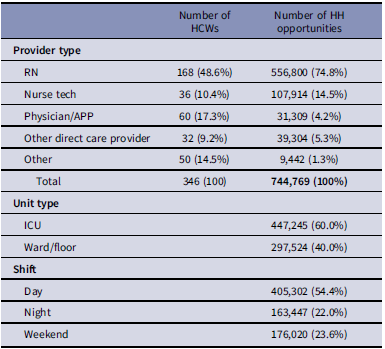
Three hundred and forty-six healthcare workers, 40% of those who were eligible, volunteered to participate. The number of participants enrolled and their job roles are presented in Table 2. Data were available for all six phases from 153 of the 346 participants. In addition to staff turnover, other reasons for gaps in data included participants not working during all study periods (particularly physicians who rotated on/off service), and participants not wearing study badges consistently.
Baseline characteristics of the study cohort

Table 2. Long description
The table presents data on healthcare worker participation and opportunities, categorized by provider type, unit type, and shift. It has 15 rows and 3 columns. The columns are labeled ‘Provider type’, ‘Number of HCWs’, and ‘Number of HH opportunities’. The provider types include RN, Nurse tech, Physician/APP, Other direct care provider, and Other. The table also categorizes data by unit type (ICU, Ward/floor) and shift (Day, Night, Weekend). Each row lists the provider type, the number of healthcare workers (HCWs) and the number of HH (hand hygiene) opportunities. For example, RNs make up 48.6 percent of the healthcare workers with 556,800 HH opportunities. The table shows variations in participation and opportunities across different provider types, unit types, and shifts.
HCWs, healthcare workers.
HH, hand hygiene.
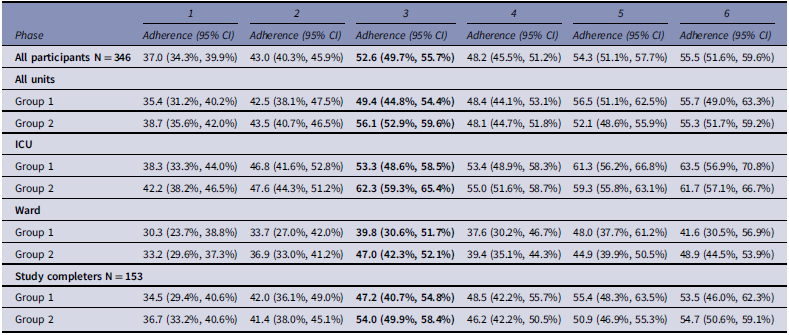
Over the 40-week study period, 744,769 total hand hygiene opportunities were recorded. Overall hand hygiene adherence significantly increased from 37.0% (95% CI: 34.3% to 39.9%) during the baseline phase to 55.5% (95% CI: 51.6% to 59.6%) by the conclusion of phase 6 (Table 3). There was considerable variation in hand hygiene adherence and overall improvement among the study units as shown in the run charts of weekly adherence rates for all study units (Figure 1, panel A). The end of study adherence rates of the high-and low-performing units varied by more than 20%. Hand hygiene adherence rates of nurses increased from 39% at baseline to 57% in the last phase of the study, nurse technologies increased from 28% to 41%, physicians from 59 percent to 70% and advanced practice providers from 43% to 68% (Supplemental Table 1). On an individual level, there was wide variation in adherence, ranging from less than 10% to over 90% (Figure 2). There was a weak inverse correlation between the number of hand hygiene opportunities and adherence rate in phase 1. This inverse correlation was minimal in phase 6.
Unadjusted population-averaged hand hygiene adherence proportions across study phases by intervention group and stratified by unit type (ICU vs ward) and participation in all study phases (study completers)

Table 3. Long description
The table presents unadjusted population-averaged hand hygiene adherence proportions across six study phases, stratified by intervention group and unit type (ICU vs ward), and participation in all study phases (study completers). The table has six columns labeled Phase 1 to Phase 6, each showing Adherence (95% CI). It includes data for all participants, all units, ICU, Ward, and study completers, further divided into Group 1 and Group 2. Each row provides adherence percentages and confidence intervals for the respective groups and phases. Notable trends include an overall increase in adherence from Phase 1 to Phase 6 across all categories. For example, all participants’ adherence increased from 37.0% (34.3%, 39.9%) in Phase 1 to 55.5% (51.6%, 59.6%) in Phase 6. Similar increasing trends are observed in ICU and Ward units, as well as in study completers.
Group 1: group + individual feedback; group 2: group + voice reminder during phase 3.
Panel A. Weekly hand hygiene adherence rates for each of the seven study units. Panel B. (A) Unadjusted longitudinal hand hygiene adherence rates for the overall cohort, (B) all healthcare workers stratified by study group, and (C) those who participated in all six study phases (study completers). Phase 3 is the intervention phase during which group 1 participants received weekly e-mails with individual adherence rates and group 2 received voice reminders on room entry.

Scatterplots showing individual healthcare worker hand hygiene performance as a function of their weekly opportunities for the first and last study phase. Each dot represents one study participant during one week. Solid lines indicate linear regression trends.

Hand hygiene adherence increased in both study groups when group feedback was provided in phase 2 (Figure 1 and Table 3). The study groups diverged in phase 3 with adherence increasing more in the group with voice reminders. Adherence regressed when the voice reminders were removed then increased in both groups when voice reminders and individual compliance feedback were reinstituted. The improvement was sustained to the end of the 40-week study.
To assess the impact of the interventions in phase 3, we applied the sequential modeling as outlined in the methods. Unadjusted model 1 estimates showed group 1 (group + individual e-mail feedback) at 49.4% (95% CI: 44.8%–54.4%) and group 2 (group + voice reminders) at 56.1% (95% CI: 52.9%–59.6%). While a directional trend favoring voice reminders was visible, substantial baseline noise and overlapping confidence intervals remained due to unadjusted differences across individual clinical units (Table 3 and Figure 1 panel B).
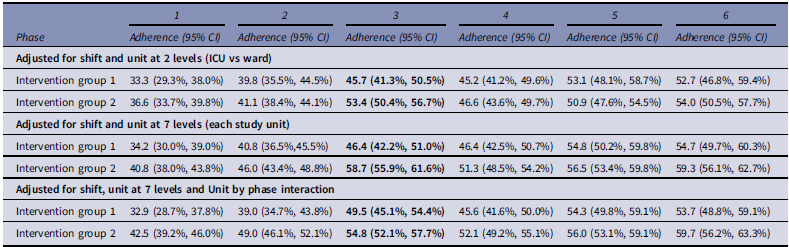
Model 2 expanded upon the baseline framework by incorporating fixed effects for shift type and a broad, two-level clinical environment designation (ICUs vs standard wards). Under this framework, the population-averaged adherence in phase 3 was estimated at 45.7% (95% CI: 41.3%–50.5%) for group 1 and 53.4% (95% CI: 50.4%–56.7%) for group 2 (Table 4 and Figure 3).
Multivariable covariate-adjusted hand hygiene adherence estimates for enrolled healthcare workers (N = 346) across stratified GEE models

Table 4. Long description
The table presents hand hygiene adherence percentages for two intervention groups across six phases, adjusted for shift and unit at different levels. It has six columns labeled Phase 1 to Phase 6, each showing Adherence (95% CI) for the groups. The table is divided into three sections based on adjustment levels: ICU vs ward, 7 levels, and 7 levels with Unit by phase interaction. Each section lists adherence percentages for Intervention group 1 and Intervention group 2. Row-wise data: Adjusted for shift and unit at 2 levels (ICU vs ward): Intervention group 1: Phase 1: 33.3 (29.3, 38.0), Phase 2: 39.8 (35.5, 44.5), Phase 3: 45.7 (41.3, 50.5), Phase 4: 45.2 (41.2, 49.6), Phase 5: 53.1 (48.1, 58.7), Phase 6: 52.7 (46.8, 59.4). Intervention group 2: Phase 1: 36.6 (33.7, 39.8), Phase 2: 41.1 (38.4, 44.1), Phase 3: 53.4 (50.4, 56.7), Phase 4: 46.6 (43.6, 49.7), Phase 5: 50.9 (47.6, 54.5), Phase 6: 54.0 (50.5, 57.7). Adjusted for shift and unit at 7 levels (each study unit): Intervention group 1: Phase 1: 34.2 (30.0, 39.0), Phase 2: 40.8 (36.5, 45.5), Phase 3: 46.4 (42.2, 51.0), Phase 4: 46.4 (42.5, 50.7), Phase 5: 54.8 (50.2, 59.8), Phase 6: 54.7 (49.7, 60.3). Intervention group 2: Phase 1: 40.8 (38.0, 43.8), Phase 2: 46.0 (43.4, 48.8), Phase 3: 58.7 (55.9, 61.6), Phase 4: 51.3 (48.5, 54.2), Phase 5: 56.5 (53.4, 59.8), Phase 6: 59.3 (56.1, 62.7). Adjusted for shift, unit at 7 levels and Unit by phase interaction: Intervention group 1: Phase 1: 32.9 (28.7, 37.8), Phase 2: 39.0 (34.7, 43.8), Phase 3: 49.5 (45.1, 54.4), Phase 4: 45.6 (41.6, 50.0), Phase 5: 54.3 (49.8, 59.1), Phase 6: 53.7 (48.8, 59.1). Intervention group 2: Phase 1: 42.5 (39.2, 46.0), Phase 2: 49.0 (46.1, 52.1), Phase 3: 54.8 (52.1, 57.7), Phase 4: 52.1 (49.2, 55.1), Phase 5: 56.0 (53.1, 59.1), Phase 6: 59.7 (56.2, 63.3).
Group 1: group + individual feedback; group 2: group + voice reminder during phase 3.
Covariate-adjusted population-averaged hand hygiene adherence trajectories for all participants (N = 346). (A) Model 2, adjusting for work shift (day, night, weekend) and 2-level unit clinical care environment (ICU vs wards). (B) Model 3, maintains shift adjustment and uses a 7-level classification for each of the seven clinical units. Same group and phase designations as in Figure 2.

Accounting for variance more granularly at the specific seven-unit level (model 3) minimized institutional noise and revealed a distinct, non-overlapping gap between the groups (Table 4 and Figure 3). This adjusted framework yielded a predicted phase 3 adherence of 46.4% (95% CI: 42.2%–51.0%) for group 1 compared to 58.7% (95% CI: 55.9%–61.6%) for group 2, establishing the statistical superiority of real-time voice reminders over weekly individual e-mails after adjusting for unit-level confounding.
Finally, to formally evaluate localized effect modification over time, unit times phase interaction terms were introduced (model 4; Table 4). In this saturated model, phase 3 estimates shifted slightly to 49.5% for group 1 and 54.8% for group 2. The GEE regression revealed a highly significant main effect for individual unit (P < .001) and a significant multi-way interaction (P < .001), confirming that the behavioral trajectory over time was significantly modified by the specific clinical environment. Intensive care environments exhibited higher baseline compliance ceilings and distinct implementation trajectories compared to general medical/surgical units. This granular unit-by-unit heterogeneity is descriptively mapped across all seven participating clinical units in Supplemental Figure 2.
To confirm that the observed intervention effects were robust and not an artifact of attrition or uneven cohort exposure, a sensitivity analysis was performed on the subset of those who participated in all study phases (N = 153). The same analytical trend held true within this cohort. (Supplemental Table 2 and Supplemental Figure 3), mirroring the primary analysis (Table 3 and Figure 1 panel B).
Discussion
Over the 40-week study period, overall hand hygiene adherence improved by 18.5% following the implementation of an AHHMS that measures compliance based on the detection of hand hygiene product use based on a timing algorithm after activation of a motion sensor. Providing immediate feedback using a voice reminder was associated with greater short-term improvement in hand hygiene adherence rates compared to providing weekly individual feedback by e-mail. A combination of the voice reminder with individual and group feedback on adherence rates along with positive reinforcement in the final phase sustained improved adherence rates to the end of the 40-week study. Other studies that included vendor-sponsored and institution-level improvement efforts after implementing an AHHMS have found enhanced performance with these ongoing efforts. Reference Knepper, Miller and Young10–Reference Leis, Powis and McGeer12,Reference McMullen, Diesel and Gibbs17–Reference Kwok, Harris and McLaws19
There was considerable variation in hand hygiene adherence rates among the seven study units and the modeling showed a highly significant impact of the individual unit on adherence trajectory. This likely reflects the variations in unit-level engagement, leadership, and culture. Others have noted associations between unit-level culture of safety and hand hygiene performance. Reference Kwok, Harris and McLaws19,Reference Wolfe, Domenico and Hickson20 Thus, the implementation of an AHHMS without attention to unit-specific culture change is unlikely to lead to sustained high levels of hand hygiene adherence.
The study also identified considerable individual-level variation in hand hygiene adherence rates among the study participants, an important advantage of badge-based AHHMSs compared to direct covert observations or group monitoring systems. Although the interventions in this study led to overall improved hand hygiene adherence, some participants had poor adherence that persisted through the final study period, a phenomenon reported previously. Reference Knudsen, Hansen and Moller9 Individuals who have many patient contacts (peripatetic healthcare workers) and poor HH compliance may result in pathogen transmission, emphasizing the importance of identifying them. Reference Hornbeck, Naylor and Segre21 These findings highlight the potential of AHHMSs to identify and improve adherence at the individual level, although further study is needed on how best to affect adherence of underperformers. Inefficient workflow with more frequent room entrances and patient encounters may contribute to the low hand hygiene rates of underperformers. Our findings that physicians and advanced practice providers had higher hand hygiene adherence rates than nurses differ from many earlier studies. Although there is heterogeneity in reported physician and nurse hand hygiene adherence rates, most studies measuring adherence by direct observation show that nurse HH adherence rates are higher than rates for physicians. Reference Bredin, O’Doherty and Hannigan5 There are fewer data for provider groups using AHHMSs. A recent multihospital study found that non-nurse providers (not further stratified) had higher adherence rates than nurses, Reference Acree, Ferrelli and Li22 while a small study found nurses with higher adherence rates than physicians. Reference Knudsen, Kolle and Hansen23 Our finding may reflect the performance characteristics of the AHHMS, which used a motion sensor as a surrogate for room entry. Staff, particularly nurses who perform multiple tasks in a patient room could inadvertently trigger the motion sensor, thus creating an additional hand hygiene opportunity.
This study had several limitations. Enrollment was voluntary and did not achieve target; some healthcare workers refused to participate voicing concern about being monitored or having their movements tracked. Individual hand hygiene adherence rates were not shared with any supervisors, removing accountability as a stimulus for improvement. Thus, our study design differed from real-world implementation. We were unable to confirm whether the e-mails sharing individual adherence rates were opened. Fewer than half of the volunteers participated in all phases. However, the sensitivity analysis performed on the subset that participated in all phases had findings concordant with the overall analysis. There was some contamination in phase 3, where participants in the group feedback arm might have entered rooms in other study units and were exposed to the voice reminder. The technology measures hand hygiene based on timing algorithms following the activation of a motion sensor as a surrogate for room entry and exit, badge detection, and product use. These timing algorithms are imperfect and may not always correlate with workflow, such as when hand hygiene performance is delayed when hands are not free. This method of measuring hand hygiene, while standardized, does not measure all of the World Health Organization’s five moments of hand hygiene. Reference Boyce24 Because only some of the staff in each unit participated in the study, unit-based efforts to encourage performance during the final study phase may have been less effective than if there was universal participation. A recent nine hospital implementation of an AHHMS found that improvement of HH adherence correlated with the percentage of staff wearing AHHMS badges. Reference Acree, Ferrelli and Li22 In addition, there was turnover in unit leadership, particularly in underperforming units, which might have affected engagement with the study. Overall, these limitations likely diminish the impact of interventions to improve hand hygiene performance. Finally, we were unable to assess the impact of the interventions on healthcare-associated infection rates.
Despite these limitations, this study has numerous strengths, including the large number of hand hygiene opportunities and the study design, with two comparable study arms testing the impact of different interventions. Large studies testing similar interventions, including one with the same technology used in this study, Reference Liang and Zeger14 had a prepost study design, Reference McCalla, Reilly and Thomas25,Reference Webster, Bishop and Scott26 while some smaller studies had control groups. Reference Fisher, Seetoh and May-Lin27,Reference Ellison, Barysauskas and Rundensteiner28 This study also demonstrated the ability of an AHHMS to track adherence at the individual level and showed a wide variation in adherence among study participants, a finding noted by others. Reference Knudsen, Hansen and Moller9,Reference Iversen, Stangerup and From-Hansen29 The overall hand hygiene rate of 55.5% in the final study period included participants with adherence rates over 90% and under 30 %. This wide variation would be unnoticed without similar technology in place. Future studies on AHHMS should explore how to use this technology to engage and improve the adherence of underperformers.
In conclusion, this study confirmed the results of other studies that found that an AHHMS that provided immediate feedback improved short-term hand hygiene adherence rates. The impact of immediate feedback as an ongoing strategy compared to other interventions such as providing individual performance needs further study. The modest improvements in adherence seen in this study along with wide variation in adherence rates among units and individuals suggest that implementation of an AHHMS alone will not achieve high adherence rates, and such systems need thoughtful implementation with culture change to be optimally effective. A full-scale implementation that includes universal adoption and accountability for individual performance would eliminate some of the limitations observed in this voluntary study and would likely help address whether these systems lower infection rates.
Supplementary material
The supplementary material for this article can be found at https://doi.org/10.1017/ice.2026.10513.
Acknowledgments
None.
Financial support
This study was supported by the Center for Disease Control and Prevention [1U54CK000453-01].
Competing interests
JMB is a consultant and has received travel support from GOJO Industries. All other authors report no conflicts of interest relevant to this article.





 Open access

