For years, western states like Washington and California have pioneered electoral reforms. Many such states, for example, were among the first to adopt term limits in the 1980s and 1990s, open primary elections throughout the latter half of the 20th century, and online voter registration in the early 2000s. While the goals of these reforms have varied, they have boasted wide-ranging levels of effectiveness and have become the subjects of intense popular and academic scrutiny. In their latest electoral reform, California and Washington made headlines in the late 2000s for their adoption of a new kind of primary election, the “top-two” primary. In these primaries, candidates of all parties compete against one another in a single “primary” or “first-round” election, from which the two general-election candidates are selected. Under this system, districts may experience an extreme oddity in American politics: same-party competition in the general election. Policymakers and good-government advocates hope that these same-party general elections—and candidates' anticipation thereof—will lead to the election of more moderate candidates, particularly in partisan-homogenous districts. Rather than perpetuating extremist control of partisan-homogenous districts, proponents argue that the top-two primary provides a means for encouraging meaningful, moderate challenges in these districts.
But while advocates and pundits have touted these potential ramifications, quantitative evidence has provided far less reason for optimism. Indeed, to date, scholarly investigations of the top-two primary have uncovered little evidence of a widespread moderating effect following the reform's institution. Ahler et al. (Reference Ahler, Citrin and Lenz2016), for example, use field-experimental methods to demonstrate that voters struggle to distinguish between moderate and extreme candidates (particularly of the same party), casting doubt on their ability to select more moderate candidates within the top-two system. Other observational studies, such as those by McGhee and Shor (Reference McGhee and Shor2017) and Smith (Reference Smith2016), find the system's effects on candidates to be quite limited. Some studies even add that the introduction of the top-two primary may have harmed the representativeness of the legislature (Kousser et al., Reference Kousser, Phillips and Shor2018).
In spite of these findings, proponents insist that the system has functioned as intended (Reed, Reference Reed2017). In this paper, I address this puzzle by disentangling the conditions under which moderation under the top-two primary ought to occur and demonstrating that these conditions do not obtain as frequently as reformers have hoped. More specifically, I test and find support for the hypothesis that same-party general elections are a necessary condition for the election of more moderate candidates, and that the avoidance of these contests helps to explain the limited effectiveness of the reforms. To do so, I use three different comparison groups for same-party contests to demonstrate that moderate candidates fair better in same-party general elections than they do in similarly situated two-party contests. Drawing on elections and ideology data from all legislative races in Washington (2008–2012) and California (2010–2014), as well as randomly selected US legislative elections over the same time period (2008–2014), I show that winners in same-party general elections are more moderate overall than winners in similar two-party races. In spite of this finding, however, I use a diagnostic test for precise control over exposure to treatment to demonstrate that political actors appear able to systematically avoid same-party general elections. I conclude by exploring channels by which same-party competitions are avoided, and by suggesting how future research may further examine party power in the top-two primary.
The findings in this paper therefore contribute not only to scholarship evaluating the top-two primary and its ramifications, but also to the exercise of party power in the face of institutional challenges. The top-two primary presented party leaders with a historic challenge to their electoral power, as their nearly ten-year legal battle over the system attests. Indeed, the system weakens parties' ability to control the use of their brand name, and it enables potentially contentious campaigns to arise in otherwise “safe” districts. Nevertheless, reformers appear to have relied upon a somewhat deterministic link between district extremity and the incidence of same-party general-election competition. By demonstrating that the actual occurrence of such competition appears to be subject to some level of precise control, this study underscores the importance of accounting for an elite response when designing primary election reform policy.
1. The mechanics of the top-two primary
According to the proponents of the top-two primary, the partisan-neutral, two-stage nature of the system leverages the participation of minority party voters in safe districts in order to elect more moderate winners. In first-past-the-post elections, when one party is particularly strong within a district, the votes of the minority party matter very little: in general elections, the “out-party's” candidate stands little chance of winning, given the district's partisan make-up. Moreover, in many cases, out-party voters cannot participate in the majority party's primary elections because of state laws about primary participation. Even in open-primary states, minority party members often must forfeit their ability to vote in their own party's primary if they wish to participate in the majority-party primary. In closed-primary states, they are forbidden from participating in the majority-party primary altogether.
In the top-two primary, however, the votes of minority party members matter just as much as the votes of the majority party. During the first round, voters are free to vote their affiliation: if a Democrat in a majority-Republican district still desires to vote for a Democrat, she is free to do so. But if the district is sufficiently Republican, the Democrat may fail to reach the general election. In this case, the Democrat must choose among two different Republican candidates—one ostensibly more moderate than the other. If the proponents of the top-two primary are correct, the moderate candidate should win the election in most cases, because she will win the votes of the minority party members.
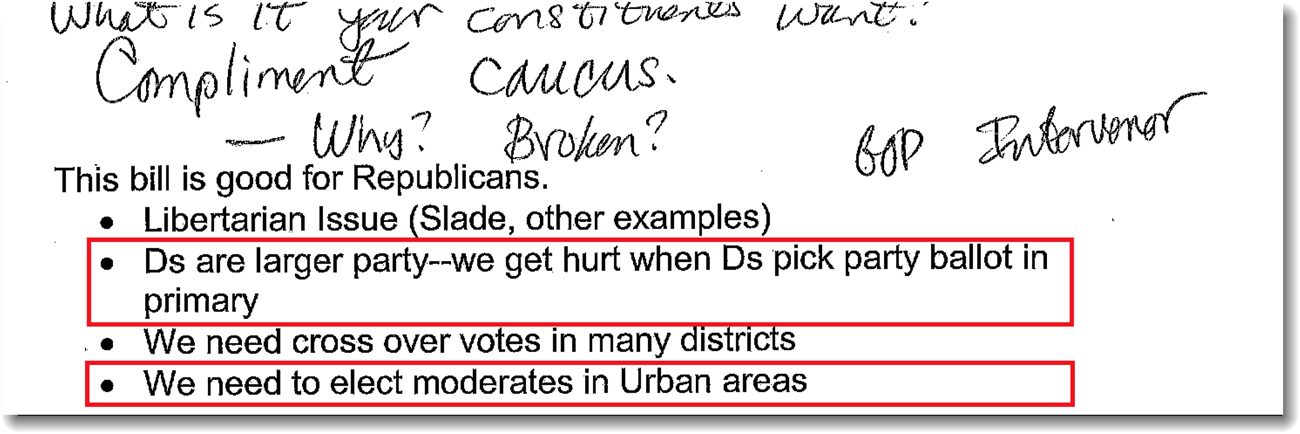
This dynamic, in fact, was crucial for the top-two's architects and their case for reform. For example, appearing before the Republican caucus in the Washington House and Senate during a legislative debate about the top-two, Washington Secretary of State Sam Reed—the primary creator of Washington and California's current primary election system—underscored the importance of leveraging out-party votes. Figure 1 depicts a small portion of Reed's speech notes from one such meeting.Footnote 1 During his remarks, Read (himself a Republican) stressed the importance of “electing moderates in Urban [sic] areas,” where Democrats dominate legislative elections. As the smaller party statewide, Reed argued, Republicans would be harmed if the state transitioned to a traditional “pick-a-ballot” primary, all but guaranteeing the election of strongly progressive candidates in districts throughout the state.
Speech notes from SOS Sam Reed (presented in private meeting to legislative Republicans).

Same-party, general-election competition is therefore central to the potential moderating effect of the top-two primary. However, if such competition fails to occur, the moderating effect is more ambiguous. On one hand, it is possible that even in the absence of same-party competition, the top-two primary system could moderate candidates: the mere threat of same-party general elections could induce candidates to adjust their ideological position-taking before the general election ever takes place. On the other hand, party loyalty could simply lead voters in top-two elections to vote for their co-partisan candidate, regardless of whether she is the more moderate candidate in the election. While I address this possibility below, this ambiguity thus focuses my scope to same-party cases. Specifically, I test whether the moderating mechanism of the top-two—same-party, general-election competition—actually leads to the election of a more moderate general election candidate, as intended. Not only is the theoretical connection between same-party competition and moderation stronger than in traditional two-party races, but also such competition was central to reformers' own understanding of how the system would generate moderation.
As noted earlier, previous empirical investigations of the top-two primary have found mixed evidence regarding the system's moderating effects. Anecdotal examinations of post-reform Washington and California (e.g., Cohn, Reference Cohn2014; Walters, Reference Walters2014; Sinclair, Reference Sinclair2015) underscore the ability of the top-two primary to encourage the election of moderates. In addition to these qualitative studies, Grose (Reference Grose2014) finds that legislators in post-reform California were more moderate and the parties overall were less extreme. In the most thorough examination of the top-two primary to date, however, McGhee and Shor (Reference McGhee and Shor2017) find only partial support for the hypothesis that the top-two primary leads to the election of more moderate candidates. According to their findings, the reforms have had the intended effect for California Democrats, but not for California Republicans (nor for either party in Washington). Other studies find no support for the moderating effect of the top-two primary. Smith (Reference Smith2016) finds that, on average, candidates in Washington and California were no more moderate overall after reform than they were before. Kousser et al. (Reference Kousser, Phillips and Shor2018) even find suggestive evidence that the top-two primary elects legislators more extreme than their district. Finally, Ahler et al. (Reference Ahler, Citrin and Lenz2016) call into question the ability of voters to distinguish between extreme and moderate candidates altogether.
While these studies provide important information about the aggregate impact of top-two primaries, one possible reason for these mixed findings derives from the fact that previous studies do not examine the influence of same-party competition specifically. McGhee and Shor (Reference McGhee and Shor2017), for example, examine whether legislators were, on average, more moderate before and after reform (broken down by party and incumbency status), and whether legislators elected in California were, on average, more or less moderate than their counterparts from similar districts in other states. Here, the outcome of interest is the ideology of winning candidates—irrespective of the ideology of the winner's opponent and the partisan dynamics of the general election. Were same-party competition sufficiently widespread, this broad focus may not matter: the potential moderating effect of same-party competition may be strong enough to influence the results of aggregate studies like that of McGhee and Shor. However, without examining the influence of same-party competition specifically, it is difficult to know whether same-party competition is effective but insufficiently widespread, or whether the top-two system as a whole simply fails to elect more moderate candidates. Thus, in the foregoing analysis, I examine two main questions. First, does same-party competition encourage the election of more moderate candidates than similarly situated two-party contests? Second, if such competition does lead to moderation, does it occur as frequently and deterministically as reformers had hoped? These questions not only interrogate the effectiveness of arguably the most important feature of one of the United States' most notable electoral reforms in recent history, but they also point to the importance of understanding how adversely affected political actors may work to resist reform efforts.
2. Exploring same-party competition: empirical strategy and data
At the most basic level, this study relies upon a quantitative comparison of electoral outcomes between two groups—a “treated” group (districts subject to same-party elections) and a “control” group (those not subject to such elections)—to test the aforementioned hypothesis concerning same-party competition. Treated districts should elect more moderate candidates than those districts in the control group. Thus, the first and perhaps most important step of the analysis comes in defining these groups. Defining the treatment group, races in California and Washington that resulted in same-party general elections, is relatively straightforward. According to electoral results compiled from the Secretaries of State in Washington and California (Elections & Voting 2018; Prior Elections, 2018), 82 elections in California and Washington's state legislatures and congressional delegations experienced same-party general elections in the time period covered in this study (2008–2012 in Washington and 2012–2014 in California).Footnote 2 These cases serve as the treatment group in our comparison.Footnote 3
Defining the relevant comparison group is slightly more complicated. Should one compare results from similar districts pre- and post-reform? Or between similar same-state districts that nevertheless did not experience same-party competition? Further still, should one turn to similar districts outside the state that did not face a top-two primary system at all? Each approach entails a variety of advantages and disadvantages. First, comparing results pre- and post-reform carries with it the potential to hold district characteristics (mostly) constant. However, because the implementation of the top-two primary also coincided with the rollout of new legislative districts in 2012, such an approach faces serious challenges—particularly in California, which introduced a new, independent redistricting commission in 2010.
Another possible approach might be to compare districts with same-party competition to similar districts in the same state that did not face such competition. Doing so allows one to hold state-level factors constant. However, this approach may obfuscate the impact of year- or cycle-specific factors on the election of moderates. To address such concerns, a final approach compares districts facing same-party competition with similar districts outside the top-two states. This approach allows one to account for potential nationwide electoral trends. However, such a design may mask key cross-state factors that influence the election of moderates.
Given these advantages and disadvantages, I make use of the versions of all three comparisons. First, I compare similar pre- and post-reform districts within the same state, testing whether exposure to (1) the top-two primary in general and (2) same-party competition specifically is associated with (1) the election of more moderate candidates and/or (2) an increased probability that the more moderate between the general-election candidates wins. Second, I compare similar post-reform districts within the same state to examine how same-party competition is associated with winning candidates' ideologies and election rates for the more moderate candidate. Finally, I compare districts in Washington and California with similar districts in other states—first to establish whether same-party competition is associated with moderate candidate election, and then to explore whether the top-two primary itself appears to be associated with higher moderate win rates.
3. Data and methods
Before discussing findings from each of these tests, I first detail my measurement strategy, data sources, and empirical methodology. I measure the two main outcome variables in the following way. To measure the first outcome variable, Winner Extremism, I make use of Adam Bonica's CFscores (Bonica, Reference Bonica2013, Reference Bonica2014) from his Database on Ideology, Money in Politics, and Elections (DIME).Footnote 4 These data rely upon campaign donations from various interest groups and committees to generate ideal point estimates for every candidate who received donations within a given election cycle.Footnote 5 Because Bonica's scores are centered near 0, the outcome variable in my models is measured simply as |ideologywinner|. The second outcome variable, Election of Moderates, is defined as a “success” (coded as a “1”) if the most moderate candidate within a district's general election wins, and a “failure” (coded as “0”) otherwise. Formally, Election of Moderate takes on the value “1” if |ideologywinner| <|ideologyloser| and zero otherwise. Because Bonica's CFscores provide a means for measuring the ideology of all candidates for office, including both the winner and losers in each election, these scores are ideal for testing this study's basic race-level hypotheses.
I label the primary explanatory variable of interest as Same Party. This variable takes on the value “1” if the general election involved a two-way race between members of the same party and zero otherwise. I anticipate that races with same-party general-election competition will be more likely to result in both more moderate candidates winning, as well as the more moderate of the two general-election candidates winning. These data are drawn from official election returns from the Secretary of State offices in Washington and California.
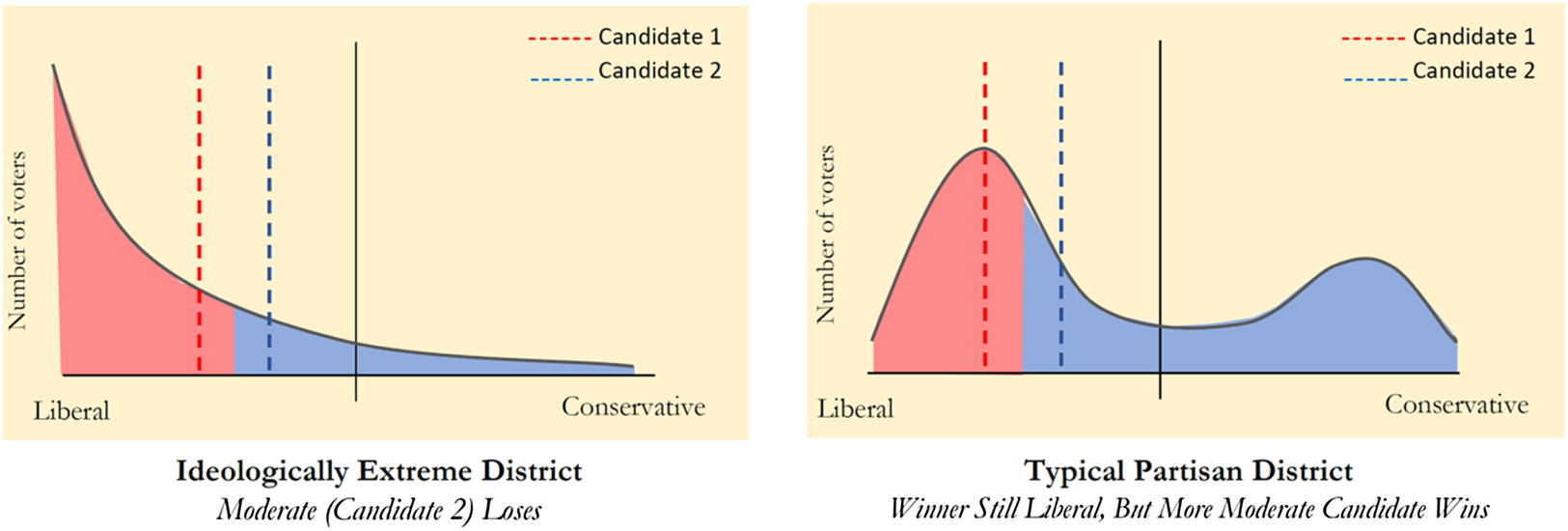
In addition to these primary variables, each model includes several important secondary variables. Perhaps most importantly, the models control for the area- and race-specific characteristics that may influence a district's propensity for selecting moderate candidates. First, the models include a term, District Extremism or the absolute value of district ideology, which allows for the possibility that some districts are so extreme that even a same-party election would not lead to the selection of a moderate candidate. Indeed, whereas most partisan-homogenous districts possess at least some mass of voters from the opposite party (who would choose the more moderate candidate in a same-party election), some districts may prove so homogenous that even a same-party general election will not encourage the election of a moderate candidate. Figure 2 illustrates this possibility through hypothetical voter density plots comparing this sort of extreme district to a more “typical” partisan homogenous district. I measure District Extremism using Tausanovitch and Warshaw's (Reference Tausanovitch and Warshaw2013) measure of district ideology, publicly available at americanideologyproject.com.
Extreme districts, the election of moderates, and the need to control for area characteristics.

In addition to accounting for the ideological preferences of the district itself, I also account for another important variable, Difference in Extremism that likely influences a district's propensity for choosing moderate candidates. According to Ahler et al.'s (Reference Ahler, Citrin and Lenz2016) field experimental findings, voters in the top-two primary appear unable to discern small differences in candidate extremity. I posit that voters' inabilities may be less pronounced when there are clearer differences in candidates' extremity and moderation. This variable allows my models to control for this possibility, and I define it as follows:

Given that the ideology measure is centered near 0, Difference in Extremism captures how extreme the two candidates are relative to one another. Thus, if one candidate in a race is completely out-of-touch with the center of the political spectrum relative to the other candidate, it is not likely she will win the race (e.g., Canes-Wrone et al., Reference Canes-Wrone, Brady and Cogan2002). Much like Election of Moderate, the inclusion of Difference in Extremism is not possible in the absence of candidate ideology scores, once again rendering Bonica's CFscores as ideal underlying measures.
The models presented below also include a variety of other control variables. Though available from other sources, I measure most of these variables using the DIME dataset.Footnote 6 First, I have created an indicator for whether the winning candidate in the race was an incumbent (Incumbent Winner = 1) and whether the seat in question was an open seat (Open Seat = 1). I expect incumbent winners may be more insulated from the effects of same-party competition, as incumbents can anticipate challenges that may come from primaries or from a same-party election. Additionally, I have coded Upper Chamber as a binary variable indicating whether or not a race was at the state-upper-chamber level. I do not have strong hypotheses about the directionality of the associated coefficient for this variable, but it is possible that larger, more diverse constituencies (in states for which upper and lower chamber districts are not identical) are pre-disposed to electing more moderate candidates. I also include a Party variable, which represents the party of the winning candidate.Footnote 7 McGhee and Shor (Reference McGhee and Shor2017) in particular find significantly different results by party in their study of the top-two primary, so I have chosen to include this covariate in each of my tests.
Given that the outcome variable in these tests is continuous in one case (Winner Extremism) and binary in another (Election of Moderate), I first turn to linear regression and logistic regression (both with state and year fixed effects where appropriate), respectively, to analyze these data. However, like any other regression, linear and logistic regressions impose a functional form on the data, so I use matching as a robustness check on my findings.Footnote 8 In each case, I use nearest-neighbor matching implemented by GenMatch() in R (Diamond and Sekhon, Reference Diamond and Sekhon2013), to optimize post-match balance. I report balance statistics in each table as the smallest p-value resulting from difference-in-means tests between pre- and post-matching X covariates.
4. Results
4.1 Test 1: election of moderates in pre- and post-reform Washington and California
In the above sections, I have argued in favor of the general assertion that same-party competition in the general election should lead to the election of more moderate candidates. In this first test, I attempt to hold the state (and district, as much as possible) constant, and leverage policy changes over time in order to examine my main assertion. More specifically, I test whether exposure to same-party general election competition after top-two reform increases the probability that a race will end in the election of the more moderate candidate.
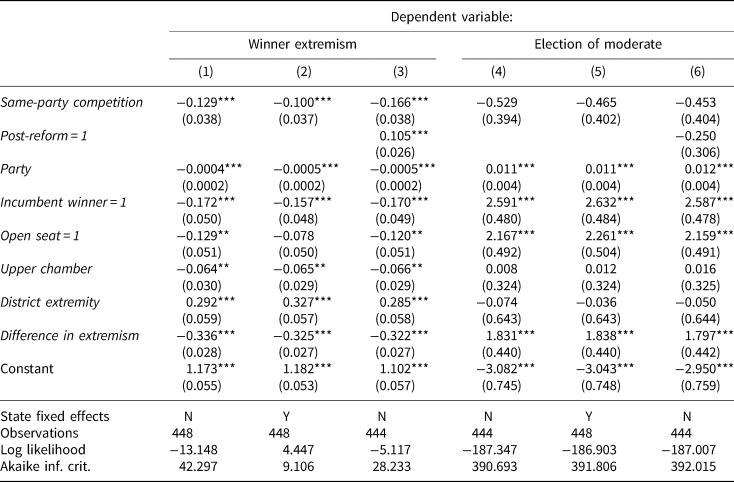
In this test, I report six models, which differ on the combinations of outcome variables, “treatment” variables, and the presence of fixed effects. However, each model includes the same basic set of control variables. Thus, the most basic model (Model 1 in Table 2) takes the form

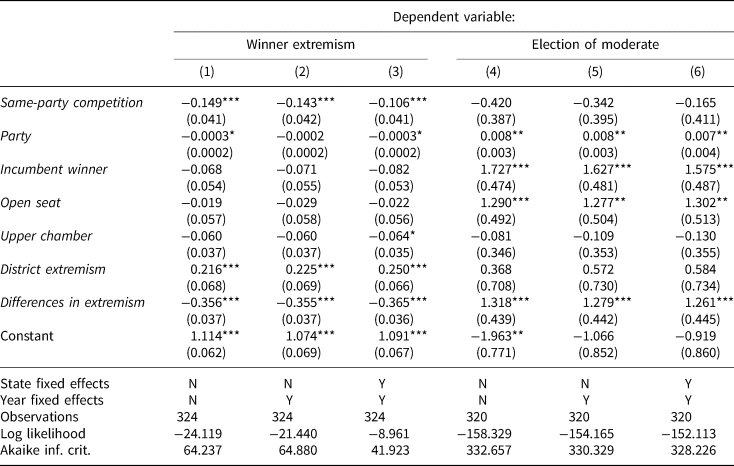
Model 2 is identical to Model 1, only Model 2 includes fixed effects by state. McGhee and Shor (Reference McGhee and Shor2017) find systematic differences between Washington and California in their data, so including state fixed effects may have particularly important empirical ramifications. Model 3 is similar to Model 2, but instead of including fixed effects by state, it substitutes those fixed effects for a binary pre-/post-reform indicator. Models 4–6 are identical to Models 1–3, only changing Winner Extremism to Election of Moderate, respectively. Table 1 reports the results of each of these regressions.
Regression results for Test 1

*p < 0.1; **p < 0.05; ***p < 0.01.
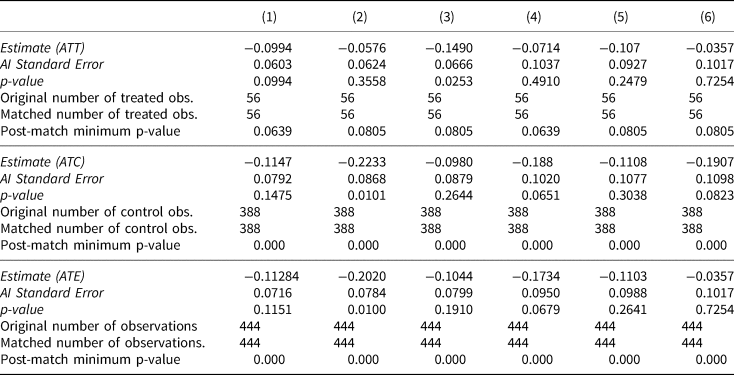
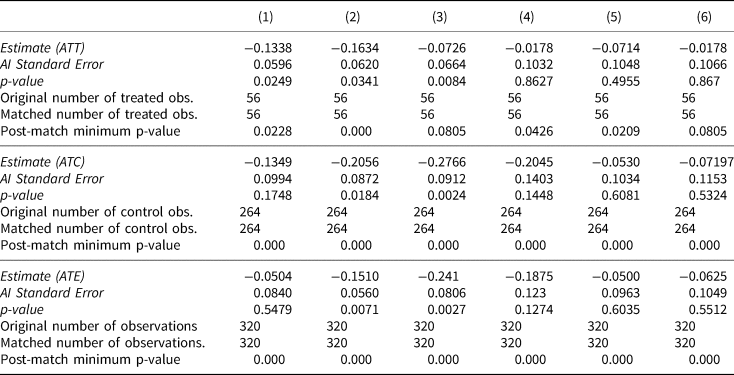
The matching analyses, reported in Table 2, proceed similarly. That is, analysis numbers in Table 2 include the same variables as the corresponding models in Table 1. For models that include fixed effects in Table 2, I include binary indicators for each state in the X vector to ensure that matches for treated cases are drawn from the same state. As in the regression models, I include the variables Incumbent, Open, Party, Upper Chamber, District Extremism, and Difference in Extremism in X as well. Analyses 1 through 6 vary outcome variables and the inclusion of fixed effects in the same way described above in the regression models.
Matching analyses for Test 1

While results reported in Tables 1 and 2 are somewhat mixed, a preponderance of evidence suggests that same-party competition in the general election is associated with the election of more moderate candidates, but not with the election of the more moderate candidate within a given general election. Throughout the regression models and many of the matching models with Winner Extremism as the outcome variable, same-party general election competition is a negative predictor of a winning candidate's extremity. Indeed, on average, winning candidates appear to be anywhere between 0.1 and 0.166 ideological units more moderate than similarly situated races that either did not face same-party competition or did not face the top-two primary altogether.Footnote 9, Footnote 10 Paradoxically, though, post-reform winners on the whole are not more moderate than similar races pre-reform.
These trends were not the case, however, with regard to within-election selection of the more moderate candidates (Election of Moderate). Indeed, neither post-reform status nor same-party general election competition was associated with voters' selection of the more moderate candidate in the election. This could perhaps be related to the strategic considerations candidates face in anticipating same-party competition. However, relative extremism of candidates within an election does not appear to matter differently in treated and non-treated races. This is not to say that differences in winner extremism did not matter at all. Instead (and perhaps encouragingly), Difference in Extremism is strongly associated with the probability that the more moderate candidate in an election is in fact selected by voters. This may suggest that such differences, when large enough, are detectable to voters, and that such differences matter to them. However, voters' willingness to select on relative extremism does not appear to differ between same-party and two-party general elections.
As noted above, the general patterns observed in the regression results also appear in the matching analysis, albeit with lower levels of statistical significance on average. These results are summarized in Table 2. In matching analyses 1–3, treatment (same-party competition) was negatively associated with the outcome variable of Winner Extremism. Across Models 1–3, at least one of the ATT, ATC, or ATE is significantly and negatively associated with the winning candidate's ideological extremity. Overall, when combined with the regression results reported above, these data are largely consistent with the idea that exposure to same-party general election competition ends with a race electing “moderate” candidates, but not the more moderate of the two candidates in the election. Still, because units before and after the reform are not comparable on one extremely important dimension, exposure to the top-two primary, I turn now to post-reform data alone to hold exposure to the primary system constant.
4.2 Test 2: election of moderates in post-reform Washington and California
In this test, I compare similar districts within post-reform Washington and California to again assess whether same-party competition and moderate election covary as expected. I estimate regression models and conduct a series of matching analyses, using incumbency, partisanship, chamber, and difference in extremity as control variables. In this test, however, I also include a dummy variable for the election cycle (and match on election cycle in the matching analysis) and state.
In Model 1, I estimate the simplest specification—one with no fixed effects of any kind. In Model 2, I introduce year fixed effects, and in Model 3, I introduce state fixed effects. Models 4–6 are identical but include the Election of Moderate outcome variable. One complication to these models is that California and Washington implemented reforms at different times. Thus, in this dataset, data for California come from 2012 and 2014 while data from Washington covers the period 2008–2012. This means that the year fixed effects function somewhat differently than usual, since only Washington has data in 2008 and 2010. Nevertheless, inclusion of fixed effects for those years does allow the models to cover unobserved confounders specific to those years in Washington and California.
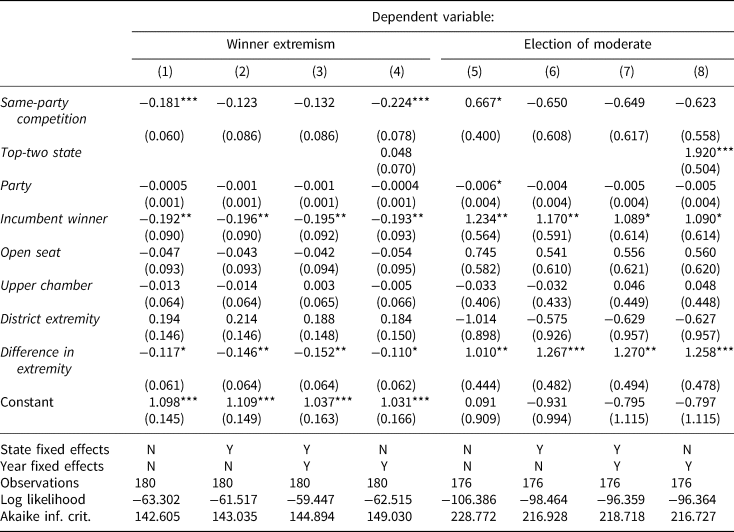
Table 3 summarizes the results of these regressions. As in Test 1, Test 2 also reveals a persistent association between same-party competition and the election of less extreme candidates, particularly in the regression models. These results are similar in magnitude to Test 1, with effect sizes ranging from 0.1 to 0.149 units of ideological moderation. However, the test fails to find any connection between same-party competition and the election of the more moderate candidate within the election. Some fixed effects, although not fully reported in the table, did exhibit coefficients that reached conventional levels of statistical significance. In particular, the year 2008 (Model 3) and the California state fixed effect (Models 3 and 6) were negative predictors of Winner Extremism. This latter finding is consistent with previous findings by McGhee and Shor (Reference McGhee and Shor2017), who uncover ideological moderation by California Democrats.
Regression results for Test 2

*p < 0.1; **p < 0.05; ***p < 0.01.
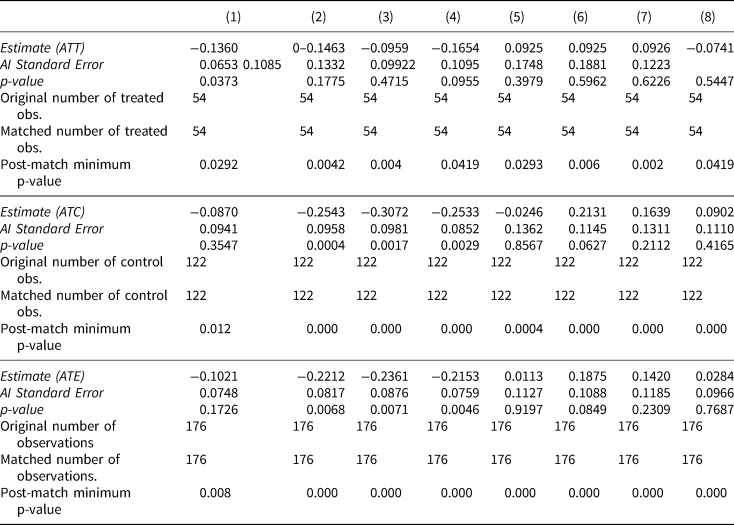
The results of the matching results are summarized in Table 4. As in Test 1, the matching models exhibit weaker results, though they generally provide evidence at least somewhat consistent with the regression results in Table 5. Overall, the only significant results in the matching analyses involve Winner Extremism as the outcome variable, much as in the regressions. Same-party competition does appear to be negatively associated with Winner Extremism. However, one should exercise caution in interpreting a number of the results presented in Table 4, as covariate balance is poor for some specifications—typically those including binary indicators for states and years. Overall, though, while the matching results are weaker than those in the regression analysis, they are nevertheless consistent with the hypothesis that same-party competition is negatively associated with a winning candidate's level of extremism.
Matching analyses for Test 2

Regression results for Test 3

*p < 0.1; **p < 0.05; ***p < 0.01.
4.3 Test 3: same-party competition and election of moderates across states
In Tests 1 and 2, I focus solely on the top-two primary states, Washington and California, in an attempt to hold state-specific factors constant. However, doing so may fail to capture national electoral trends influencing the election of moderate or extreme candidates. Thus, in my final test, I turn outside of Washington and California for comparison districts. To assemble this comparison group, I have taken a random sample of 100 state legislative and congressional races from outside Washington and California, using the DIME database. The sample spans the 2008, 2010, 2012, and 2014 election cycles, and varies considerably with regard to state (38 of 50 states represented), district ideology, partisanship (roughly 50 percent won by both Republicans and Democrats), chamber, and other characteristics of interest.Footnote 11 In addition, I include a random sample of 50 districts within Washington and California that did not experience same-party competition so that I can include state fixed effects that are not perfectly colinear with the same-party competition variable.
The models in this test differ in four ways: the inclusion of state fixed effects, year fixed effects, and a post-reform dummy variable, as well as differences in outcome variable. Model 1 regresses Winner Extremism on the same set of control variables present in Tests 1 and 2, and it does not include any type of effects. Model 2 includes year fixed effects only, and Model 3 includes both state and year fixed effects. Model 4 drops state fixed effects in favor of a Top-Two State indicator and also includes year fixed effects. Models 5–8 are identical to Models 1–4, except that they are models of Election of Moderate instead of Winner Extremism.
Table 5 summarizes the regression results. As predicted, same-party competition in the general election is again a negative predictor of a winning candidate's level of extremism—consistent with the findings in Tests 1 and 2. However, in two of the models with year fixed effects and indicator variables for Washington and California, same-party competition is not quite significantly associated with winner extremism. It is not clear why these models behave differently, though it is important to note that the sample sizes are the smallest in this test. Sample size, however, cannot explain why same-party competition appears to behave differently in these Election of Moderate models than in previous ones. In Model 5, for example, same-party competition was positively and significantly associated with the more moderate candidate winning.
While these results fall out when year and state effects are added, another variable, the Top-Two State status indicator, also behaves differently in one of the models. Indeed, Model 8 displays a strong, positive association between being in a primary state and selecting the more moderate of the two candidates in an election. These results stand in stark contrast to the null findings of previous models, though they likely do not have sufficient evidence to claim that same-party competition or the top-two primary generally had an influence on the selection of the more moderate candidate within an election.
Similar to Tests 1 and 2, the matching analyses vary in specification in exactly the same ways as the regression analyses. Table 6 documents the findings of the matching analyses, which exhibit similar trends to the regression models.Footnote 12 While same-party competition ATT misses significance in the models, including dummy variables for states and years, it achieves significance for other specifications and estimates. However, unlike the regression results, the matching data uncover no relationships between same-party competition and within-race selection of the most moderate candidate. Along with the preponderance of null results for this outcome variable in Tests 1 and 2, this finding also calls into question how notable the findings in the Test 3 regression models really are with regard to within-race selection of the more moderate candidate.
Matching analyses for Test 3

It is worth noting here that in Test 3, Difference in Extremism continues to behave as expected—much as it has done consistently throughout each of the tests. Indeed, the larger the difference in how extreme one candidate is relative to the other in the general election, the more likely voters are to select the most moderate candidate presented to them. Moreover, when there is a large gap between the candidates' levels of extremism, winning candidates are also found to be more moderate on average. As noted earlier, this result suggests that voters may in fact be able to detect large ideological differences between candidates for office, even when they may lack a great deal of information about a candidate (as is often the case in state legislative elections). While it is not clear how to explain the differences between these findings and the experimental ones reported by Ahler et al. (Reference Ahler, Citrin and Lenz2016), future research should examine whether and how voters can discern candidate extremism.
5. Does same-party competition occur deterministically?
By comparing races ending in same-party, general-election competition with pre-reform races (Test 1), two-party general election contests in-state (Test 2), and non-top-two races (Test 3), I have shown that same-party competition consistently covaries with how extreme or moderate winning candidates are in Washington and California. Much as architects of the system claim, candidates who prevail under this type of competition tend to be more moderate than candidates in similarly situated (but two-party) contexts. Still, counter to proponents' expectations, the mere threat of same-party competition does not appear sufficient to make a discernable difference on the extremity of winning candidates.
These results suggest that the system design has not itself failed to achieve its intended aims. Instead, while the top-two primary seems to be falling short of its overall goal (widespread candidate moderation), the internal mechanism designed to moderate candidates appears to be functioning as desired. Given this finding, how might the proponents of the top-two primary address its apparent failures? I suggest the answer to this puzzle lies in the failure of many extreme districts to facilitate same-party competition. That is, same-party competition may not occur as deterministically as reformers might have hoped.
To address this puzzle, I again turn to the post-reform data found in Test 2. One advantage of comparing post-reform units within the same state is that all districts were, in theory, subject to the source of the same-party “treatment” of interest, the top-two primary. However, the threat of actual same-party competition is not equally strong in all districts: some races exhibited tight three-way competition in the first round that just barely exposed (and just barely failed to expose) candidates to same-party competition in the general election, while others faced no such competition. Given that post-reform winners in Test 1 were, overall, no more moderate than pre-reform winners, this raises the question: if same-party competition holds the key to the top-two primary's success or failure, do political actors exercise any control over whether a race ends in same-party competition? In other words, do simple district characteristics (like partisan homogeneity) deterministically govern which races are “treated,” or are local political parties, strong incumbents, or both able to avoid same-party competition?
I use data from both successful and failed in-party challenges to examine this potential control. One way to leverage such data is through regression discontinuity (hereafter, RDD). In this case, “treatment” occurs only after election returns cross a clear cutpoint: when the nearest copartisan (in terms of electoral support) to the top vote-getter earns the second most votes in that primary, same-party competition will occur. This generates a criterion for exposure to same-party competition that resembles a forcing variable in an RDD. Formally, if

where c i refers to the highest-ranking copartisan to the top vote-getter in race i and o i to the highest-ranking non-copartisan candidate, then

where τ i refers to the treatment status for race i, that is, whether or not a race exhibits same-party general-election competition.
To make inferences within the RDD framework, races should be randomly distributed (at least locally) on either side of the cutpoint. In other words, besides exposure to treatment, there should be no confounding variables that explain why some races just missed out on same-party competition, while others were narrowly exposed to it. However, if there is sorting around the cutpoint—that is, if actors are able to influence their own exposure to treatment, RDD inference breaks down. While such a phenomenon is normally an unfortunate result for the researcher, it offers an interesting insight in this case into the dynamics of exposure to same-party competition. Indeed, because standard statistical tests exist for cutpoint sorting, one can examine whether units exercise control over treatment. Within the RDD literature, such a phenomenon has been referred to as “precise control” (see, e.g., Jacob et al., Reference Jacob, Zhu, Somers and Bloom2012).
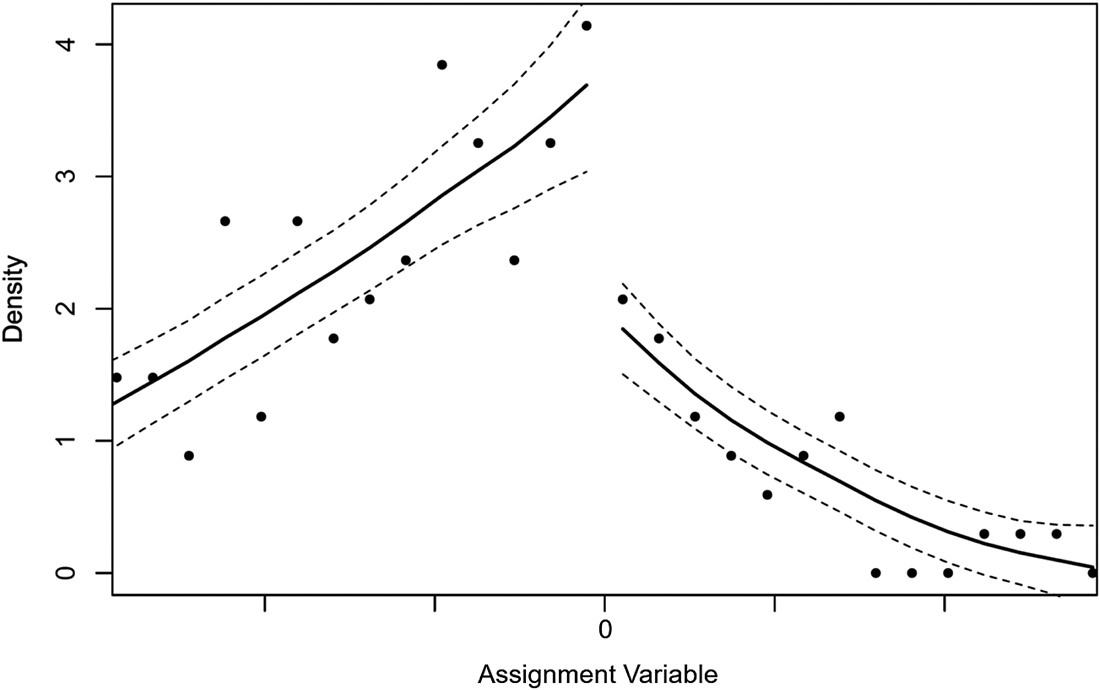
To test for control around the cutpoint of the forcing variable, McCrary (Reference McCrary2006) has developed a now widely used test, which allows the researcher to examine whether discontinuities in density occur near the relevant cutpoint in the forcing variable. Figure 3 displays a McCrary test for sorting. Were there no sorting present, the confidence intervals around the curves should overlap. However, as the figure indicates, the test cannot reject the null hypothesis of no sorting (p < 0.05). These results suggest that some actor, be it a political party, incumbent, or both, appears to be exercising some control over whether or not a candidate faces same-party general election competition. Were the top-two primary associated with the election of moderates regardless of the occurrence of same-party competition, this type of control may not matter. However, as the above tests demonstrate, this latent threat alone is not enough to moderate candidates. Instead, actual same-party competition is instrumental for moderates to be elected.
McCrary test for sorting around cutpoint.

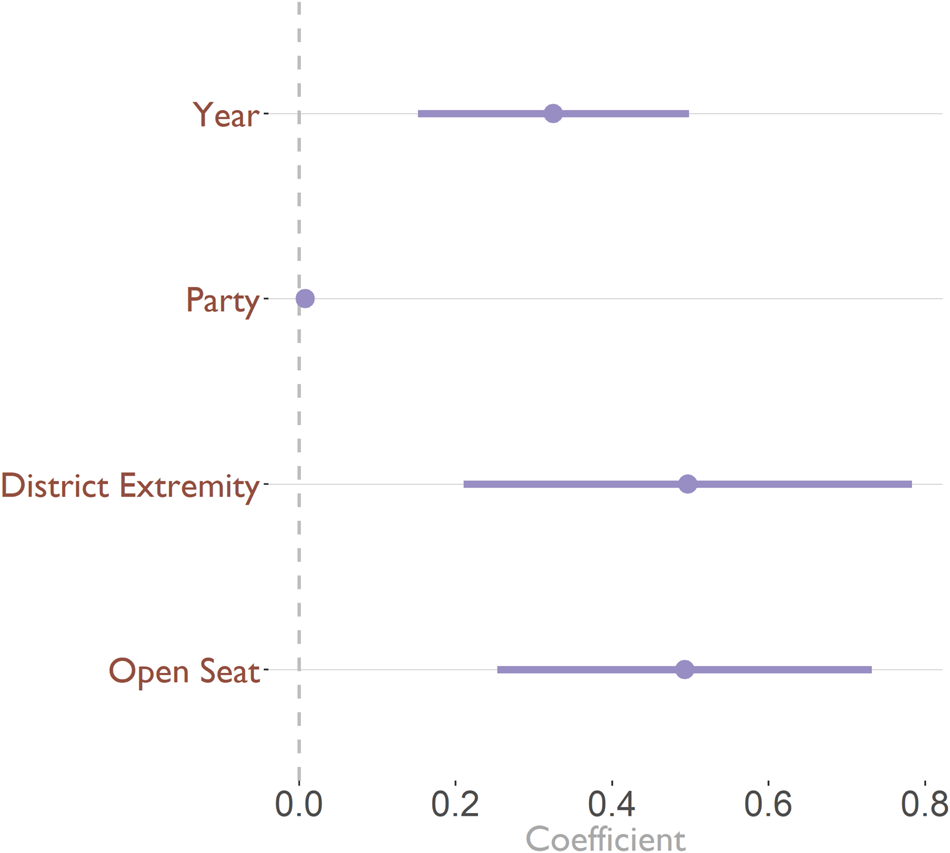
Though compelling, these results do not indicate which actors control this exposure, of course. Thus, Figure 4 displays the results of a logistic regression, in which I explore some potential explanations for the avoidance of same-party competition. As one might expect, district extremism is positively associated with same-party competition. Additionally, the positive coefficient on “party” indicates that Republicans are more likely to face same-party competition than Democrats, though the practical implications of that result are not immediately clear. The results also provide modest evidence that same-party competition has become more common over time.
Predictors of same-party competition.

One plausible explanation for this development is the fact that same-party competitions are more common in open races. In other words, when incumbent legislators are not running, same-party general elections are more likely to occur—an explanation consistent with the results shown in Figure 4. This may indicate that incumbents are better able to insulate themselves from co-partisan challenges than are candidates in open seats. Consequently, if more districts experience same-party competition as incumbents retire over time, the top-two primary may yet have a noticeable aggregate impact on legislator extremism in Washington and California. Even still, this result does not negate the possibility that party leaders also may exert influence over exposure to same-party competition. Indeed, party leaders are unlikely to ignore the potential damage to party brand that prolonged same-party competition could cause, and future work should examine whether party leaders have successfully resisted the moderating influences of the same-party system.
6. Conclusion
Political polarization is among the most critical challenges to modern American democracy today. Scholars and pundits alike worry that polarization will lead to a litany of governmental and societal ills, including legislative gridlock and increasing personal resentment of political opponents. While primary election reform has a mixed record in addressing polarization, reformers in California and Washington remain optimistic about the top-two primary's ability to drive candidates—and winners, in particular—closer to the center of the political spectrum. To date, research has called into question the effectiveness of these reforms. Nevertheless, by departing in key ways from these studies, I do find evidence that the key mechanism of the top-two primary—same-party, general-election competition—has functioned as intentioned. More specifically, when top-two primaries lead members of the same party to compete against one another in the general election, winners in such districts are more moderate than similar situated districts facing traditional two-party competition.
Still, the failure of the top-two to appreciably alter overall ideological polarization underscores the importance of understanding how political parties and incumbents will react to institutional reforms, particularly when those reforms are not likely to benefit them. Indeed, while reformers appear to have hoped same-party competition would occur at high rates in partisan-homogenous districts, the sorting analysis presented here suggests that political elites are able to avoid such competition. Taken together, these findings suggest that political scientists' claims that the top-two primary has had “no effect” are premature and that the key to the system's effectiveness lies in reformers' ability to find ways to encourage more same-party competition. An important first step toward realizing this goal will be to determine what or who, exactly, prevents races from experiencing same-party competition. Are parties actively discouraging same-party challenges in post-reform Washington and California? Or are incumbents ramping up their efforts to scare off primary challengers? Future research should explore these and other sources of sorting.
Political polarization has swept across the nation, far from a phenomenon tied only to Congress or the federal government (e.g., Shor and McCarty, Reference Shor and McCarty2011). Moreover, whether through partisan gerrymandering or organic geographic polarization of voters, legislative districts have become increasingly partisan-homogenous. Given these challenges, and given the promise of the top-two primary when introduced in Washington and California, more research is needed to understand how, when, and why the system can address legislator extremism. I argue that same-party competition provides a useful tool for combatting such extremism, but that additional work must be done to understand why and when such competition occurs.
Supplementary material
The supplementary material for this article can be found at https://doi.org/10.1017/psrm.2020.7.
Acknowledgements
The author wishes to thank George Tsebelis, Doug Ahler, Seth Masket, Justin Kirkland, Boris Shor, participants at the 2018 State Politics and Policy Conference, and anonymous reviewers for helpful feedback, and Talha Mirza, Chris Olson, Carolyn Phillips, and Harrison Weimer for excellent research assistance.