Obesity and its major consequences, diabetes and cardiovascular disease, are highly prevalent among adults in the developed world and are increasingly so in countries undergoing the nutritional/epidemiologic transition. Rates of obesity have mushroomed in children across the world, in whom excess adiposity causes asthma and orthopedic problems, undesirable cardiometabolic risk profiles and psychosocial adversity. Increasing obesity rates have affected all age groups, even infants.Reference Kim, Peterson and Scanlon 1 Once obesity exists, tenacious physiological processes resist weight loss.Reference Leibel 2 By age 5 years, childhood obesity appears relatively resistant to change.Reference Gardner, Hosking and Metcalf 3 For these reasons, early childhood prevention of obesity is crucial.Reference Gillman 4 In this review, I focus on the first few months of life as a potentially critical period for the development of obesity, and therefore a key period for prevention. Most of the emphasis is on studies from the developed world, although I briefly contrast these with studies from low- and middle-income countries.
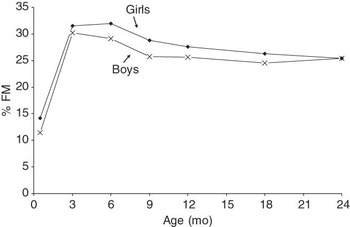
Early infancy is a period of many rapid changes. In the United States, in relative terms weight gain in the first 6 months of life primarily comprises gain in fat, whereas fat-free mass accumulates faster after that age. This phenomenon is depicted in Figure 1: percent fat mass rises in the first half-year before falling gradually in the ensuing year-and-a-half (Fig. 1).Reference Veldhuis, Roemmich, Richmond and Bowers 5 , Reference Butte, Hopkinson, Wong, Smith and Ellis 6
Changes in percent fat mass (%FM) during the first 2 years of life. Adapted from Butte et al.Reference Butte, Hopkinson, Wong, Smith and Ellis 6

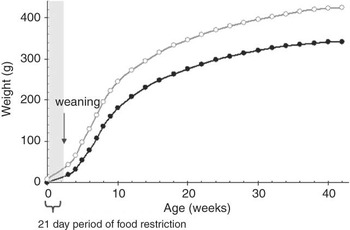
During early infancy, organs and systems are in developmentally plastic stages. In classic experiments from about 50 years ago, reducing energy intake in the first few weeks of life among rat pups produced a lower trajectory of weight gain for the animal’s lifespan even if normal energy intake was restored afterward (Fig. 2).Reference Widdowson and McCance 7 In contrast, energy reduction during ‘adolescence’ had only a transient effect on weight gain. In a more recent rat model, administration of leptin in the first two postnatal weeks abolished the otherwise permanent offspring metabolic effects of prenatal maternal energy restriction.Reference Vickers 8 These and other animal experiments raise the possibility that the early postnatal period may be critical to development of healthful energy homeostasis, although one must remember that some aspects of postnatal development in the rat are equivalent to prenatal development in the human.
Lifelong lower trajectory of weight gain programmed by a reduction in energy reduction during the lactation period in the rat. Adapted from Widdowson and McCance.Reference Widdowson and McCance 7

Epidemiologic evidence from developed countries
A large number of epidemiologic studies, mostly from the developed world,Reference Baird, Fisher and Lucas 9 – Reference Monteiro and Victora 11 have now addressed the role of weight gain during infancy as a predictor of later adiposity. For example, in a 2005 review of 10 studies, Baird et al.Reference Baird, Fisher and Lucas 9 found that relative risks of later obesity ranged from 1.2 to 5.7 among infants with more rapid weight gain in the first year of life. Associations were consistent for obesity at different ages and for births from 1927 to 1994. In these studies, most outcomes were limited to body mass index (BMI) rather than more direct measures of adiposity or its physiologic consequences. Furthermore, in these studies the typical predictor was gain in weight during infancy, rather than any measure of weight-for-length or, even better (but rare to date), body composition.
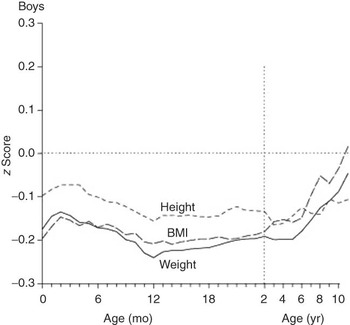
Since 2005, more observational studies have appeared, mostly from developed countries, and some with measured adiposity outcomes in addition to BMI. Yliharsila et al.Reference Yliharsila, Kajantie and Osmond 12 used a bioimpedance technique to measure body composition among almost 2000 Finnish adult men and women whose weights and heights were available from child records. Gain in BMI from birth to age 1 year, or 1 to 2 years, was associated with later lean, but not fat, mass. The authors did not subdivide the first year of life, but the visual impression from the published figures in Barker et al.Reference Barker, Osmond, Forsen, Kajantie and Eriksson 13 from the same cohort suggests that the BMI of Finnish boys who eventually developed coronary heart disease increased in approximately the first 3 months before decreasing (Fig. 3).
Mean z (sd) scores for height, weight and body mass index (BMI) in the first 11 years after birth among boys who had coronary heart disease as adults. The mean values for all boys are set at zero, with deviations from the mean expressed as standard deviations (z-scores). Reproduced with permission from Barker et al.Reference Barker, Osmond, Forsen, Kajantie and Eriksson 13

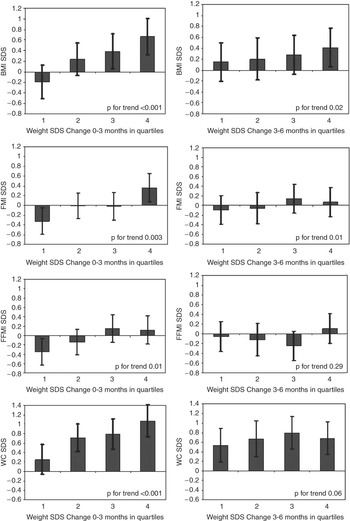
Among several hundred French boys and girls, also using a bioimpedance technique, Botton et al.Reference Botton, Heude and Maccario 14 showed that weight gain velocity at 3 and 6 months predicted adolescent fat mass better than weight gain velocity at 1 or 2 years. In agreement with that study, among 234 British 4- to 20-year-olds with gold standard body composition measures from a four-compartment model, Chomtho et al.Reference Chomtho, Wells and Williams 15 showed that weight gain from birth to 3 months predicted both fat mass and fat-free mass; weight gain from 3 to 6 months predicted fat mass only; and weight gain from 6 to 12 months predicted neither. Weight gain in the early months also predicted centrally deposited fat as indicated by waist circumference and (less so) by dual X-ray absorptiometry (DXA; Fig. 4).
Adjusted mean sd (z) scores for later body mass index (BMI), fat mass index (FMI), fat-free mass index (FFMI) and waist circumference (WC), stratified according to change in weight sd scores quartiles from 0 to 3 months and 3 to 6 months of age. Error bars indicate 95% CIs. Data from general linear models adjusted for birth weight SDS, sex, puberty, physical activity, socioeconomic class, ethnicity and parental BMI. Reproduced with permission from Chomtho et al.Reference Chomtho, Wells and Williams 15

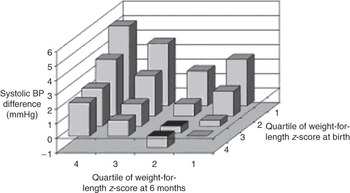
Data are emerging on the relationship of infant weight gain with cardiometabolic risk factors. In the US cohort study Project Viva, gain in weight-for-length from 0 to 6 months predicted not only a higher BMI and sum of skinfolds but also blood pressure at age 3 years.Reference Belfort, Rifas-Shiman, Rich-Edwards, Kleinman and Gillman 16 , Reference Taveras, Rifas-Shiman and Belfort 17 In the UK’s Barry Caerphilly cohort, a steeper trajectory of weight gain in the first 5 months of life predicted higher blood pressure in adulthood.Reference Ben Shlomo, McCarthy and Hughes 18 In the Project Viva cohort, the association of infant weight-for-length gain with 3-year blood pressure was stronger among infants born small-for-dates (Fig. 5), but no similar effect modification by fetal growth was evident for BMI or skinfold outcomes.Reference Taveras, Rifas-Shiman and Belfort 17
Predicted difference in systolic blood pressure (BP) at age 3 years according to quartile of weight-for-length z-score at birth and age 6 months, adjusted for child age, sex, height and blood pressure measurement conditions, and maternal income, education, race, ethnicity and smoking status. Reproduced with permission from Belfort et al.Reference Belfort, Rifas-Shiman, Rich-Edwards, Kleinman and Gillman 16

In the SWEDES study, weight gain from 0 to 6 months predicted both adiposity and a metabolic risk score at age 17, but gain from 3 to 6 years was not associated with this cluster of metabolic risk factors.Reference Ekelund, Ong and Linne 19 Similarly, in a small Dutch cohort, Leunissen et al.Reference Leunissen, Kerkhof, Stijnen and Hokken-Koelega 20 reported that weight gain in the first 3 months of life was associated with central obesity, abnormal insulin response and adverse lipid levels in young adulthood.
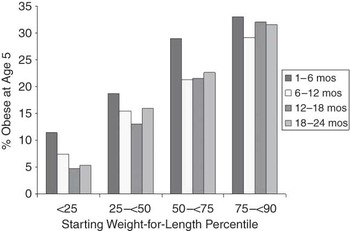
These studies, which together point to the importance of weight gain in the first half of infancy, agree with recent findings from a cohort culled from electronic medical records of well-child visits in a managed care organization. In this group of over 22,000 children 0–5 years old, my colleagues and I observed that upward crossing of two major weight-for-length percentile lines on the Centers for Disease Control and Prevention (CDC) growth charts 21 in the first 6 months was both common and predicted a high risk of obesity 5 years later.Reference Taveras, Rifas-Shiman and Oken 22 Upward crossing from 6 to 12, 12 to 18 or 18 to 24 months was less common and less predictive (Fig. 6).
Prevalence of obesity at age 5 years (body mass index greater than 95th percentile) predicted by crossing upwards two major percentile lines on the CDC growth charts 21 from 1 to 6, 6 to 12, 12 to 18 and 18 to 24 months of age. Taveras et al. unpublished data.

Data presented in abstract form at the 6th World Congress of DOHaD adds to the evidence of long-term effects of early infancy weight gain. In the Dutch ABCD study, more v. less rapid weight gain in the first 6 months of life was related to higher fat mass 5 years later.Reference deBeer, van Eijsden, Vrijkotte and Gemke 23 A sib-pair analysis from the US National Collaborative Perinatal Project confirmed the association of early infancy weight gain with BMI at age 7 yearsReference Terry, Wei, Esserman, McKeague and Susser 24 although weight gain in later infancy and preschool years also predicted 7-year BMI.
Data from randomized trials are not only scarcer than from observational studies but also harder to interpret. That is because weight gain can result from many determinants, and existing trials use only variations in infant feeding to effect changes in growth. Nevertheless, the studies of Lucas and Singhal are instructive. Findings from a series of observational follow-up studies of a subset of participants in feeding trials of premature infants suggest that weight gain in the first few weeks is directly associated with adolescent blood pressure and plasma levels of insulin and leptin.Reference Singhal and Lucas 25 In their more recent trials, term small-for-gestational age infants randomized to energy-enriched formula had more rapid weight gain from 0 to 9 months and higher fat mass and diastolic blood pressure at age 6–8 years.Reference Singhal, Cole and Fewtrell 26 These findings are consistent with those of Stettler et al.Reference Stettler, Stallings and Troxel 27 who showed that weight gain in the first week of life in a formula-only fed population was directly associated with overweight in adulthood.
Evidence from developing countries
In summary, mounting evidence from the developed world suggests that the first few months of life are critical for development of obesity and its related health conditions. Representation from developing countries, however, where wasting and (especially) stunting are still prevalent, is limited. The same is true for lower-income and racial/ethnic minority populations in western societies. The COHORTS collaboration of five longitudinal studies from low- and middle-income countries is poised to make substantial contributions to this literature. In a pooled analysis from these studies, Adair et al.Reference Adair, Martorell and Stein 28 reported that weight gains in the first, second and third-fourth years of life predict higher adult blood pressure level, through their contribution to adult BMI. Two of the component studies are from Delhi, India and Cebu, Philippines. In the Delhi cohort, gain in BMI in the first 6 months was related to BMI, lean mass and (less strongly) to the sum of skinfolds in adulthood.Reference Sachdev, Fall and Osmond 29 In an Indian cohort from Pune, however, an abstract from the DOHaD Congress indicated that weight gain during the first 6 months did not appear to predict cardiovascular risk factors at age 12 years.Reference Joglekar, Yajnik, Osmond and Fall 30 In data from the Cebu longitudinal study presented at the DOHaD Congress, weight gain from birth to 4 months predicted a (non-significant) 33% increase in insulin resistance 22 years later, apparently mediated by the association of early infant weight gain with adult BMI.Reference Slining and Adiar 31 In other DOHaD abstracts, in a low-income population from Brazil, weight gain from birth to 6 months conferred a greater than 4-fold increase in the prevalence of obesity at age 10 years.Reference Fernandes, Ferraro, Bassotto, Santos and Schwartsman 32 In addition, in a Chilean cohort, one of the few to incorporate length and weight measures during infancy, gain in BMI from birth to 6 months, as well as gain after 6 months, was associated with higher BMI, fat mass and fat-free mass at age 5 years.Reference Corvalan, Uauy, Lera, Galvan and Kain 33 Future analyses from the COHORTS group and other studies from developing countries will benefit from evaluating weight-for-length (or BMI), rather than weight alone, during infancy because length faltering in the first 1–2 years of life is often still common in these populations.
Areas for research
A number of research advances are needed to understand more clearly the impact of gain in adiposity in the first few months of life. The first is longitudinal body composition measures during infancy (the exposure period). As weights during infancy are typically available and relatively accurate, most studies have employed only weight measurements. Using weight-for-length is an improvement if length is measured by research standards,Reference Rifas-Shiman, Rich-Edwards, Scanlon, Kleinman and Gillman 34 but even the addition of length is suboptimal. While weight and length are relevant for clinical decision-making, relying on these as exposures in research studies does not provide sufficient information to investigate mechanisms and determinants. Part of the weight (or weight-for-length) gain during infancy comprises lean mass in addition to fat mass. It is not known whether rapid increase in lean mass predicts later obesity and its adverse consequences as strongly as does fat mass. However, this information is key to understanding etiology and thus potential preventive measures. Unfortunately, many body composition techniques are not feasible for large epidemiologic studies. For example, DXA requires babies to be still for a few minutes and emits a small amount of radiation. PEAPOD – a device based on air displacement plethysmography – will not fit babies >8 kg. Magnetic resonance imaging is expensive. Skinfold thicknesses are inexpensive and portable but require good training. One technique under investigation for this age group is bioimpedance, which may represent a good compromise for estimating fat and lean mass over time in infants and children.
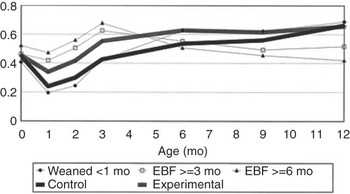
The second challenge is identifying modifiable determinants of gain in adiposity in the first few months of life that also predict risk of later obesity. One common assumption is that the mode of infant feeding is the main factor, but this assumption is not necessarily true. First, many but not all studies show that having been breastfed is associated with lower rates of later obesity.Reference Owen, Martin, Whincup, Davey Smith and Cook 35 Second, in Project Viva, while a longer breastfeeding duration was associated with lower prevalence of obesity at age three, this effect did not appear to be mediated by weight gain in the first 6 months (van Rossem et al., unpublished data). In addition, in many studies breastfeeding actually results in faster weight gain than formula feeding in the first few months; only later in infancy do breastfed infants have lower weights (Fig. 7).Reference Kramer, Guo and Platt 36 , Reference Kramer, Guo and Platt 37 Nevertheless, some dietary components may play a role. In a recent randomized trial, Koletzko et al.Reference Koletzko, von Kries and Closa 38 showed that among formula-fed babies, increased protein as a fraction of energy intake resulted in lower gain in weight-for-length over the first 2 years.
Weight-for-age z-score in the first year of life in experimental v. control trial groups and three observational groups. Data from a PROBIT randomized controlled trial of breastfeeding promotion in the Republic of Belarus. Reproduced with permission from Kramer et al.Reference Kramer, Guo and Platt 36

It is also plausible that prenatal factors could be involved in entraining postnatal gain in adiposity, especially hormonal adaptations in the maternal-placental-fetal unit.Reference Gillman, Rifas-Shiman and Kleinman 39 A preliminary analysis from Project Viva shows that gestational diabetes, as well as higher umbilical cord blood leptin concentration, is associated with less rapid gain in weight-for-length from birth to 6 months.Reference Parker, Rifas-Shiman and Belfort 40 In abstracts presented at the 6th DOHaD Congress, several other putative determinants were presented, including FTO genotype AA,Reference Pennell, Ang and Marsh 41 , Reference deBeer, Vrijkotte, van der Wal, van Weissenbruch and Gemke 42 lower maternal triglyceride levelReference Algera, Twickler, van Eijsden and Vrijkotte 43 and higher cord blood level of c-peptide.Reference Regnault, Dargent-Molina and Botton 44 Additional potential determinants of variation in weight gain during infancy, as yet understudied, include exposure to endocrine disruptors such as bisphenol AReference Lang, Galloway and Scarlett 45 and effects of the microbiota.Reference Turnbaugh, Ley and Mahowald 46
The actions of leptin may be of particular importance. Leptin, sometimes called the ‘fullness hormone,’ is elaborated by adipoctyes and other tissues. In older children and adults, leptin levels are associated with subsequent weight gain, presumably due to leptin resistance.Reference Fleisch, Agarwal and Roberts 47 , Reference Johnson, Huang, Figueroa-Colon, Dwyer and Goran 48 In younger children, however, the situation appears different. In Project Viva, cord blood leptin level – which is derived partly from fetal fat and partly from the placenta – predicted not only slower infant weight gain but also lower BMI at age 3 years.Reference Mantzoros, Rifas-Shiman and Williams 49 In the mouse, experiments suggest that the surge of leptin observed in postnatal weeks 1–2 is critical for maturing neural projections in hypothalamic regions responsible for appetite regulation.Reference Bouret, Draper and Simerly 50 Leptin administration to adult leptin-deficient mice does not result in the same maturation. In the rat, parenteral leptin administration abolishes the otherwise deleterious metabolic effects of prenatal undernutrition.Reference Vickers, Gluckman and Coveny 51 In addition, oral leptin administration during lactation causes reduced food intake, less weight gain and reduced insulin and leptin resistance in the adult rat.Reference Sanchez, Priego and Palou 52 Taken together, these observations raise the possibility that sufficient leptin during critical hypothalamic developmental periods may have long-lasting beneficial effects on appetite regulation and thus obesity prevention.
Clinical and public health implications
Another challenge is mounting interventions to modify any determinants discovered through observational studies. As the nutritional, hormonal or other pathways that lead to harmful levels of weight gain are likely to be complex, so must any interventions to modify them take these complexities into account. Modifying an infant weight trajectory by any means available may or may not do more metabolic good than harm in the long run.
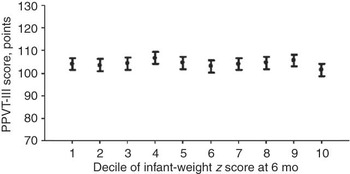
In addition, interventions that improve some health outcomes may not do the same for others. The amount of weight gain that optimizes both neurocognitive and cardiometabolic risk may differ by gestational age. Among infants born preterm, more rapid weight gain in early infancy predicts better neurocognitive outcomes in childhood,Reference Ehrenkranz, Dusick and Vohr 53 , Reference Casey, Whiteside-Mansell, Barrett, Bradley and Gargus 54 whereas its effects on obesity and cardiovascular risk factors is less clear.Reference Belfort, Martin, Gillman and McCormick 55 , Reference Washburn, Nixon, Snively and O’Shea 56 In term infants, infant weight gain does not appear to be a major factor in predicting later cognition (Fig. 8).Reference Belfort, Rifas-Shiman and Rich-Edwards 57
Peabody Picture Vocabulary Test III (PPVT-III) score (standard error) within deciles of infant weight z-score at 6 months. Estimates adjusted for child birth weight z-score, sex, age at cognitive assessment, gestational age, breastfeeding duration, race/ethnicity and English as second language status; maternal age, parity, smoking status and PPVT-III score; parental educational levels; and annual household income. Reproduced with permission from Belfort et al.Reference Belfort, Rifas-Shiman and Rich-Edwards 57

Ultimately, the need will exist to educate clinicians, policy makers and parents about the findings from these studies. It will not be enough to have pediatric clinicians identify infants who gain rapidly from the usual growth charts, because the proper response is not yet known. Attempting to modify energy intake or expenditure among infants who are entrained by prenatal hormonal or genetic pathways to gain weight on a certain trajectory may be ineffective or harmful.
Researchers need to find the optimal amount of gain in weight and length in early infancy for a variety of populations. Clinicians and the public health community will be interested in those findings, but they will be more informed by research that addresses the challenge of how to achieve the optimal size for each infant. The answers hold great promise for prevention of obesity and its myriad adverse health sequelae.
Acknowledgment
This study is supported by a grant from NIH (K24 HL 068041).