Introduction
Cochlear implantation has become increasingly utilised for addressing sensorineural deafness by converting sound signals into electrical stimulation, thereby stimulating auditory nerve fibres to restore hearing.Reference Blebea, Ujvary, Necula, Dindelegan, Perde-Schrepler and Stamate1 Patient outcomes are influenced by various factors such as the underlying causes of deafness, age at implantation, coding strategy, duration of deafness, and inner-ear anomalies.Reference Dazert, Peter Thomas, Loth, Zahnert and Stöver2 However, there remains a need to explore additional factors that might affect cochlear implantation outcomes, as the aforementioned variables do not encompass all variations in cochlear implantation performance.
Two primary approaches for implant insertion are the round window route and cochleostomy.Reference Deep, Dowling, Jethanamest and Carlson3 Cochleostomy offers a larger area for electrode insertion without the need for the hook region of the basal turn, but advancements in electrode array design and hearing preservation have led to the round window site being considered less traumatic for insertion.Reference Avasarala, Jinka and Jeyakumar4–Reference Richard, Fayad, Doherty and FH6
Prior studies comparing round window and cochleostomy approaches have produced conflicting findings.Reference Elafandi, Khalifa and Elguindy7–Reference Briggs, Tykocinski, Stidham and Roberson9 While some studies have shown differences in electrode impedance, residual hearing, insertion depth, and speech perception, others have found comparable results between the two approaches. However, few studies have conducted a comprehensive evaluation comparing the effects of these surgical approaches using the same type of electrode.Reference Adunka, Dillon, Adunka, King, Pillsbury and Buchman5, Reference Cheng, Wang, Liu, Yuan, Shu and Chen10–Reference Jiam, Jiradejvong, Pearl and Limb12
Various parameters, such as electrode impedance and speech perception, are used to assess the integrity and function of the cochlear device during and after implantation. Electrode impedance reflects the condition of the tissue-to-electrode interface and surrounding cochlear environment, serving as an important indicator of device function.Reference Schraivogel, Aebischer, Weder, Caversaccio and Wimmer13 Speech perception, an essential subjective measure, indicates the functional outcomes of the cochlear implant.
The aim of this study was to investigate whether the round window and cochleostomy approaches result in differing impedance and functional outcomes. We compared electrode impedance and speech perception in two groups of patients undergoing cochlear implantation via round window versus cochleostomy approaches.
Methodology
This is a double-arm, single centre prospective observational study conducted after obtaining permission from the institutional ethical committee. Ninety prelingually deafened children who underwent unilateral cochlear implantation were enrolled in this study. Allocation of patients to the round window and cochleostomy groups was based on surgical anatomy and the surgeon’s discretion during the procedure. Factors such as anatomical variations and accessibility of the round window niche played roles in determining the insertion technique. The entire cohort was divided into cochleostomy and round window insertion groups. The post-switch-on speech scores was assessed at 12- and 18-month post-switch-on.
Surgical procedure
All patients underwent cochlear implantation by Veria technique.
Cochleostomy
Cochleostomy is done by incising mucosa over the promontory and elevating the flap antero-inferiorly towards the round window. A 1-mm burr is taken to drill the cochleostomy site until blue line, then an opening is made using a curved pick, then using a smaller burr, the margins of the drilled area are widened inside-out, and then using a diamond burr, the margins are smoothened.
Round window
Anterior and superior lips of the round window niche were drilled to expose the round window membrane, which is then mobilised. To make an adequate opening, drilling of the hook area is done in some cases.
Electrode array
The MED-EL (Innsbruck, Austria) implants Standard was utilised. The Standard electrode comprises 24 platinum electrode contacts, with a diameter of 1.3 mm at the basal end and 0.5 mm at the apical turn. These electrodes are wired in pairs, resulting in a total of 12 electrodes. The total length of the electrode array is 31.5 mm.
Impedance measurement
Impedance was assessed utilising Maestro 9.0 System Software (MED-EL, Innsbruck, Austria) with default parameters. Multiple tests were performed at each time interval, totalling at least three repetitions, to obtain an averaged result. Electrodes 1–7 corresponded to the apical turn, electrodes 8–14 corresponded to the middle turn, and electrodes 15–22 corresponded to the basal turn.
Speech recognition
Pre-operative assessments utilise speech perception measures, including the word recognition score WRS65(HA), which evaluates the recognition of phonemically balanced bisyllable words at a conversational level of 65 dB with a hearing aid. Another measure, known as WRSmax or PBmax, determines the maximum recognition score for phonemically balanced monosyllabic words. WRSmax is assessed as part of the performance-intensity function using air-conduction headphones.
Besides measuring WRSmax with headphones, aided monaural bisyllable perception was evaluated in free field within a 6 × 6-m anechoic booth at 65 dB, referred to as WRS65(HA). During this assessment, a loudspeaker positioned 1.5 m in front of the patient (at 0° azimuth) was utilised. To prevent interference from the contralateral ear, wideband noise was appropriately applied through headphones (MAICO Diagnostics, Eden Prairie, Minnesota, USA). All candidates for cochlear implants had prior experience of at least three months with hearing aids, with the most recent fitting occurring within the three months before the audiometric assessment.
Before conducting measurements, the functionality of hearing aids was verified by the audiologist. This verification process included visual inspection, feedback testing, and ensuring that the prescribed hearing aids provided adequate amplification tailored to the individual’s degree of hearing loss. In cases where any issues arose during fitting, either coupler or in-situ measurements were performed to ensure appropriate acoustic amplification.
Post-operative word recognition scores were calculated at 6 months, 12 months and 24 months post-switch-on.
Bisyllable recognition in quiet and in noise
Bisyllable stimuli consist of a standardised list of 25 phonetically balanced, bisyllable words, which were presented to the child at a comfortable loudness level. The bisyllable words were randomly grouped into five groups. Each group contained five images representing the five bisyllables. During the testing phase, a random selection process was employed to choose a group, followed by another random selection to pick a bisyllable stimulus from within that group. This stimulus was then presented to the subject, who was tasked with responding by clicking on one of the five pictures labelled according to the bisyllables within the selected group. Importantly, no trial-by-trial feedback or training was given during the testing procedure. Each correctly identified figure was assigned a score of 4 per cent.
Similarly, the words were presented at 30 dB suprathreshold speech reception threshold with white noise at a noise-detection level.
Sentence recognition test
Sentence recognition consisted of four groups of five sentences, each stimulus set included 50 key words. During testing, a list was randomly selected and a sentence was randomly selected from the list and presented to the subject, who repeated as many words as possible. The experimenter scored the correct key words.
Vowel recognition test
In the set of Hindi vowel stimuli, there were 25 groups, each comprising three vowels. The initial consonant for each group remained consistent throughout. These groups were as follows: (1) अ (a), आ (ā), ए (e); (2) इ (i), ई (ī), उ (u); (3) ऊ (ū), ऋ (ṛ), ॠ (ṝ); (4) ए (e), ऐ (ai), ओ (o); (5) औ (au), अं (aṅ), अः (aḥ); (6) अं (aṅ), अः (aḥ), अँ (ã); (7) अँ (ã), अः (aḥ), अं (aṅ); (8) अः (aḥ), अँ (ã), अं (aṅ); (9) अँ (ã), अं (aṅ), अः (aḥ); (10) आ (ā), अः (aḥ), अं (aṅ); (11) आ (ā), अं (aṅ), अः (aḥ); (12) आ (ā), अः (aḥ), अँ (ã); (13) आ (ā), अँ (ã), अं (aṅ); (14) आ (ā), अँ (ã), अः (aḥ); (15) ए (e), अँ (ã), अं (aṅ); (16) ए (e), अँ (ã), अः (aḥ); (17) ए (e), अं (aṅ), अः (aḥ); (18) ऐ (ai), अँ (ã), अं (aṅ); (19) ऐ (ai), अँ (ã), अः (aḥ); (20) ऐ (ai), अं (aṅ), अः (aḥ); (21) ओ (o), अँ (ã), अं (aṅ); (22) ओ (o), अँ (ã), अः (aḥ); (23) ओ (o), अं (aṅ), अः (aḥ); (24) औ (au), अँ (ã), अं (aṅ); (25) औ (au), अँ (ã), अः (aḥ).
During testing, a group was randomly selected, and a vowel stimulus was then randomly chosen from within the group. The subject responded by clicking on one of the three pictures labelled according to the vowels in the selected group. No trial-by-trial feedback or training was provided.
Statistics
Descriptive statistics were computed for all variables encompassing demographic characteristics such as age at implantation and gender distribution, as well as surgical techniques (cochleostomy vs round window insertion), and outcome measures including speech-perception scores, speech-intelligibility measures, language-development metrics, and impedance values. Repeated measure analysis of variance (ANOVA) was performed to compare each outcome measure (speech audiometry and impedance). Additionally, analysis of covariance was performed, controlling for potential confounding variables such as age at implantation or duration of implant use. Spearman’s rank correlation analysis was conducted to explore associations between impedance values and speech-outcome measures within each surgical group. Subgroup analyses were conducted based on factors such as age at implantation, duration of implant use, or aetiology of deafness.
Results
Demography
Table 1 presents the demographic details of the 90 participants enrolled in the study. No statistically significant variations were noted between the round window and cochleostomy groups concerning gender distribution, implanted ear, duration of deafness, or age at implantation. Ninety children who underwent cochlear implantation were selected and were divided into cochleostomy group (Group C), and round window group (Group R). Forty-five participants were allotted in each group. The median age of the sample was three years (age range: 2–5 years). Male to Female ratio was 58:32.
Demographic features of the study population

Comparison of impedance
Figure 1 illustrates the mean impedances recorded for both groups across various evaluation time points. In the round window group (n = 45), the mean impedance values were 1.72 kΩ (standard deviation (SD) = 0.59), 4.96 kΩ (SD = 0.91), 6.66 kΩ (SD = 1.97), and 8.16 kΩ (SD = 2.11) at 0, 6, 12, and 24 months post-implantation, respectively. Conversely, for the cochleostomy group (n = 20), the mean impedances were 2.16 kΩ (SD = 1.74), 5.73 kΩ (SD = 1.05), 7.12 kΩ (SD = 1.89), and 9.82 kΩ (SD = 3.19) at the same intervals.
Line diagram showing the comparison of electrode impedance between cochleostomy (C) and round window (R) groups across various time points.

Utilising a repeated-measures ANOVA, with test time points as the within-subject factor and group as the between-subject factor, revealed a significant effect for test time points (F (6, 109) = 52.61; p = 0.000), while no significant effect was observed for group (F (1, 38) = 1.84; p = 0.184). Moreover, there was no significant interaction (F (3, 114) = 0.60; p = 0.515). Post-hoc Bonferroni pairwise comparisons indicated no significant differences between the two groups at 0 (p = 0.66), 6 (p = 0.98), 12 (p = 0.36), and 24 (p = 0.13) months post-implantation.
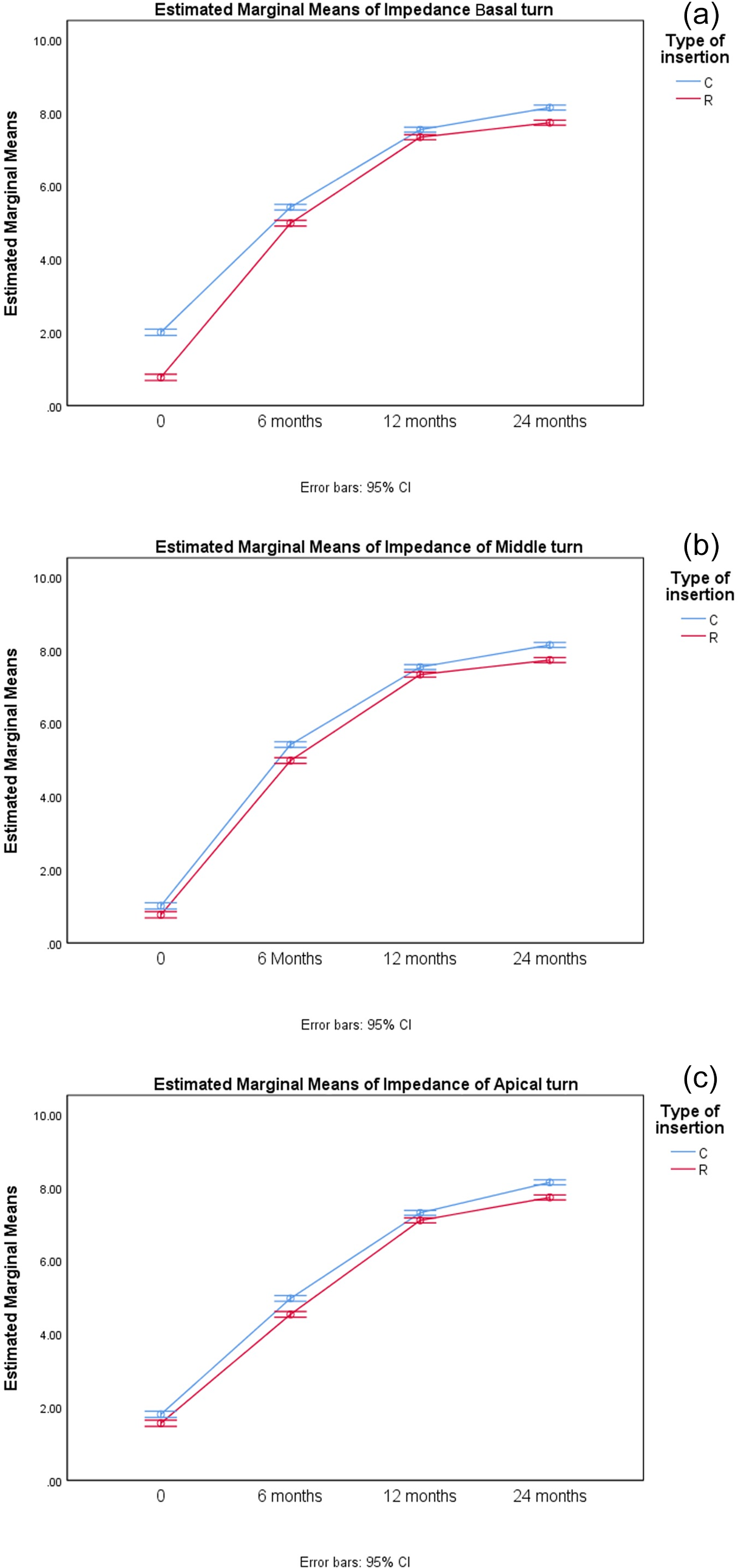
Figure 2 demonstrates the impedances for the apical, middle, and basal turns following the two surgical approaches across different time points. For the round window group, a repeated-measures ANOVA was conducted, with test time points as the within-subject factor and different turns as the between-subject factor. The analysis revealed a significant effect for test time points (F (3, 171) = 106.96; p = 0.000) and an interaction (F (6, 171) = 4.84; p = 0.006). There was a significant difference in impedance of basal turn at switch-on with cochleostomy showing higher impedance (F (2, 57) = 3.38; p = 0.041), but the rest of the turns did not show significant difference.
Line diagram showing the comparison of electrode impedance between cochleostomy (C) and round window (R) groups across three turns of cochlea at various time points: (a) basal turn, (b) middle turn, (c) apical turn.

Comparison of speech outcome
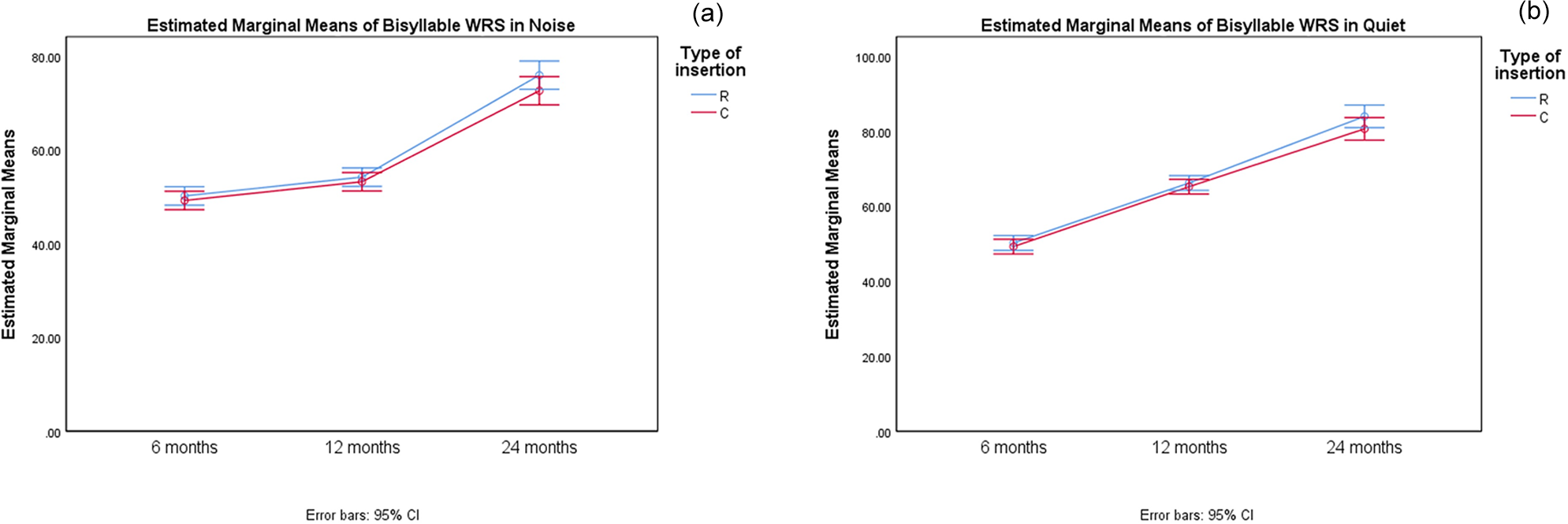
The mean bisyllable WRS65 in quiet and WRS65 in noise recorded for both groups across various evaluation time points are illustrated in Figure 3. In the round window group (n = 45), the mean WRS65 in quiet values were 63.9 per cent (SD = 4.22), 64.2 per cent (SD = 7.22) and 96.2 per cent (SD = 7.3) at 6, 12 and 24 months post-implantation, respectively. The mean WRS65 in noise values for the same group were 60.8 per cent (SD = 5.2), 64.1 per cent (SD = 4.22) and 88.8 per cent (SD = 8.1) at the corresponding intervals. Conversely, for the cochleostomy group (n = 45), the mean WRS65 in quiet were 60.3 per cent (SD = 5.1), 65.22 per cent (SD = 6.003) and 95.3 per cent (SD = 10.36), while the mean WRS65 in noise were 60.11 per cent (SD = 5.8), 65.1 per cent (SD = 5.2), and 87.4 per cent (SD = 6.2) at the same intervals. Utilising a repeated-measures ANOVA, with test time points as the within-subject factor and group as the between-subject factor, revealed a significant effect for test time points (F (3, 111) = 56.17; p = 0.031), while no significant effect was observed for group (F (1, 40) = 1.23; p = 0.372).
(a) Line diagram showing comparison of bisyllable word recognition scores in noise between cochleostomy (C) and round window (R) groups across various time points. (b) Line diagram showing comparison of bisyllable word recognition scores in quiet between cochleostomy (C) and round window (R) groups across various time points. WRS = word recognition score.

Moreover, there was no significant interaction (F (3, 111) = 1.08; p = 0.55). Post-hoc Bonferroni pairwise comparisons indicated no significant differences between the two groups at 0 (0.33), 6 (0.09), and 12 (p = 0.42) and 24 (p = 0.19) months post-implantation (Figure 3).
The mean sentence recognition test scores at 12 months and 24 months for the round window group were 55.3 per cent (SD = 5.40) and 78.2 per cent (SD = 8.22), whereas in the cochleostomy group the scores were 53.2 per cent (SD = 4.3) and 77.3 per cent (SD = 6.12). A repeated-measures ANOVA, with test time points as the within-subject factor and group as the between-subject factor, revealed a significant effect for test time points (F (9,87) = 68.4, p = 0.01), but not between groups (Figure 4A).
(a) Line diagram showing comparison of sentence-recognition scores between cochleostomy (C) and round window (R) groups across various time points. (b) Line diagram showing comparison of vowel-recognition scores between cochleostomy (C) and round window (R) groups across various time points.

The mean vowel recognition test scores at 12 months and 24 months for the round window group were 82.3 per cent (SD = 6.34) and 91.2 per cent (SD = 7.52), whereas in the cochleostomy group the scores were 80.7 per cent (SD = 7.76) and 90.1 per cent (SD = 8.21). A repeated-measures ANOVA, with test time points as the within-subject factor and group as the between-subject factor, revealed a significant effect for test time points (F (6,95) = 68.4, p = 0.01), but not between groups (Figure 4B).
Correlation of impedance and speech outcome
Pearson correlations analysis revealed a moderate negative correlation between impedance and word recognition score at particular time points, but this correlation was not statistically significant (r: −0.35, df: 40, p: 0.08). Subgroup analysis was done for type of insertion which did not demonstrate any difference between the groups (Figure 5).
Scatter plot showing correlation of bisyllable word recognition scores (WRS) and impedance at 24 months of follow up.

Discussion
In recent years, numerous investigations have proposed that inserting electrodes through the round window could cause less damage inside the cochlea compared to accessing the scala tympani, which prompted reconsideration of the round window membrane as a viable insertion site.Reference Adunka, Dillon, Adunka, King, Pillsbury and Buchman5, Reference Richard, Fayad, Doherty and FH6, Reference Roland, Wright and Isaacson14, Reference Mittal, Raj and WVBS15 However, few studies have thoroughly explored how electrode impedance and functional outcomes differ between the round window and cochleostomy methods using the same type of electrode.
In our research, we evaluated impedance both during surgery and at various intervals post-implantation (0, 6, 12, and 24 months). Our results indicated no significant variance in impedance between the round window and cochleostomy groups. Similarly, Hamada et al.Reference Hamada, Omara, Sefein and Younes16 reported comparable findings in their examination of 69 paediatric and adult cochlear implant recipients. However, Gu et al.Reference Gu, Jiang, Gao, Huang, Yuan and Wang17 observed lower impedance values in a modified minimal-access cochlear implantation group compared to a cochleostomy group at the initial activation stage. Nevertheless, this discrepancy was linked to the use of dexamethasone in the minimal-access cochlear implantation group, which may mitigate tissue scarring and consequently decrease electrode impedance. Nonetheless, our study suggests that the chosen surgical approach may not notably influence electrode impedance, in contrast to prior findings associating higher impedance with the growth of fibrous tissue.Reference Wilk, Hessler, Mugridge, Jolly, Fehr and Lenarz18
We also analysed impedance across different cochlear turns and found no significant distinction between the round window and cochleostomy groups in the apical, middle, and basal turns, except for a slight difference in the basal turn immediately after implantation. This implies that the cochleostomy method may induce more initial fibrosis in the basal region; but overall, surgical techniques do not substantially affect long-term impedance. Similarly, the prospective study by Cheng et al.Reference Cheng, Wang, Liu, Yuan, Shu and Chen10 to evaluate the change in impedance in three turns of cochlea across various time lines showed similar results.
In our investigation, we also evaluated whether different surgical techniques influenced patients’ performance. The mean word recognition score at 24 months was 96.3 per cent, suggesting adequate development of speech, and this outcome did not differ between the study groups. Our findings align with previous studies regarding bisyllable word recognition score in quiet and noise, vowel recognition, and sentence recognition in both the round window and cochleostomy groups.Reference Chang, Chang, Lin and Luo19–Reference Chen, Wong, Chen and Xi21 Adunka et al.Reference Adunka, Dillon, Adunka, King, Pillsbury and Buchman5 conducted a study comparing residual hearing and speech perception (using consonant-nucleus-consonant words and City University of New York sentences) between cochleostomy and round window patients 12 months post-surgery, and found no statistically significant differences in hearing preservation and speech perception. Similarly, Kang and KimReference Kang and Kim22 evaluated speech perception in two groups of cochlear implant users employing different electrodes at various intervals post-implantation. They demonstrated comparable speech-perception results between the round window and cochleostomy insertion groups.
Our results indicate that while different surgical approaches may affect short-term sentence perception, there appears to be no significant effect on long-term sentence perception. Moreover, since the speech materials used in our study were primarily designed for assessing children’s speech perception, they may have been relatively easy for adult patients, potentially influencing the observed differences in speech perception between the two groups.
Avasarala et al.Reference Avasarala, Jinka and Jeyakumar4 conducted a systematic review and meta-analysis comparing the various aspects of cochleostomy and round window insertion. A total of 3797 patients with cochlear implants underwent evaluation in this study. Comparing the round window approach to the cochleostomy approach, the former resulted in a smaller electrode-to-modiolus distance by an average of 0.15 mm (statistically significant at p < 0.05). Additionally, the round window approach demonstrated superior hearing preservation rates (93.0 per cent) compared to the cochleostomy approach (84.3 per cent), with statistical significance (p < 0.05). Furthermore, the round window approach showed advantages in terms of speech perception, ease of scala tympani insertion, and reduced scalar shift. However, there were no significant differences between the two approaches regarding trauma, electrical impedance, and vestibular dysfunction. These findings suggest that the round window approach offers several advantages over the traditional cochleostomy approach.Reference Avasarala, Jinka and Jeyakumar4
• No significant differences in impedance between the groups, except for higher basal-turn impedance at switch-on in the cochleostomy group
• The cochleostomy method may induce more initial fibrosis in the basal region, but overall, surgical techniques do not substantially affect long-term impedance
• Speech outcomes, including word recognition in quiet and noise, sentence recognition, and vowel recognition, were comparable between the groups at 24 months
• The choice of surgical approach does not significantly affect long-term impedance or functional outcomes in cochlear implantation patients
Conclusion
In conclusion, our study suggests that there were no statistically significant differences between the round window and cochleostomy groups in impedance measurements, indicating that the chosen method may not notably influence electrode impedance over time. Furthermore, speech outcomes, including word recognition scores in quiet and noise, did not significantly differ between the round window and cochleostomy groups at various evaluation time points, suggesting comparable performance between the two methods in terms of speech perception. Our results align with previous studies that also reported no significant differences in hearing preservation and speech perception between the round window and cochleostomy approaches.
Availability of data and material
The datasets used and analysed during the current study are available from the corresponding author on reasonable request.
Authors’ contributions
All authors were equally involved in conception of the work, data collection, data analysis and interpretation, drafting the article, critical revision of the article and final approval of the version to be published.
Funding interests
The authors declare that they have no known competing financial interests or personal relationships that could have appeared to influence the work reported in this paper.
Competing interests
All authors declare that they have no conflicts of interest.
Ethics approval
Approved by Institutional Ethical Committee, All India Institute of Medical Sciences, Jodhpur (AIIMS/IEC/2021/3375).
Consent for publication
Case was selected after obtaining informed consent of patient for publication.