Introduction
Individuals with major mental disorders are at increased risk of violence (Brennan et al. Reference Brennan, Mednick and Hodgins2000), but our understanding of how to reduce this risk is limited. A wealth of literature suggests that offender programmes, particularly cognitive skills programmes, can lead to a significant, albeit small, reduction in recidivism in offenders without mental illness (Hollin, Reference Hollin1999; McGuire, Reference McGuire, Hodgins, Viding and Plodowski2009). However, randomized controlled trials (RCTs) of treatments aimed at reducing violence in individuals with mental disorders often exclude those with psychosis (Davidson et al. Reference Davidson, Tyrer, Tata, Cooke, Gumley, Ford, Walker, Bezlyak, Seivewright, Robertson and Crawford2009). Therefore, the effectiveness of these programmes in offenders with mental illness, also known as mentally disordered offenders (MDOs), is unknown. There is a need to evaluate the effectiveness of these programmes with MDOs (Hodgins & Müller-Isberner, Reference Hodgins and Müller-Isberner2000, Reference Hodgins and Müller-Isberner2005), who constitute the majority of patients within secure forensic hospitals.
Cognitive skills programmes aim to promote pro-social functioning by targeting thinking styles and criminal attitudes (Young, Reference Young, Brown and Campbell2010). Evidence suggests that MDOs may also benefit from these interventions. Two small non-randomized studies (Donnelly & Scott, Reference Donnelly and Scott1999; Clarke et al. Reference Clarke, Cullen, Walwyn and Fahy2010) demonstrated improvements in social problem-solving, coping responses and criminal attitudes in MDOs who completed the Reasoning and Rehabilitation (R&R) programme (Ross & Fabiano, Reference Ross and Fabiano1985). Similarly, evaluations of other cognitive skills programmes with MDOs have reported improvements in social problem-solving and thinking styles (Tapp et al. Reference Tapp, Fellowes, Wallis, Blud and Moore2009), reductions in disruptive behaviour and violent attitudes (Young et al. Reference Young, Chick and Gudjonsson2010), and lower arrest rates (Ashford et al. Reference Ashford, Wong and Sternbach2008). Preliminary findings with MDOs are therefore encouraging. However, to date no study of a cognitive skills programme with MDOs has been randomized, and few have included an appropriate control group, thus it is possible that these improvements are unrelated to the effects of treatment. Furthermore, a high proportion of participants in these studies failed to complete treatment and there has been an inconsistency across studies regarding the treatment of non-completers in statistical analyses.
This is the first RCT of a cognitive skills programme with MDOs. The objective was to evaluate the effectiveness of the R&R programme with MDOs treated in medium-secure forensic psychiatric hospitals, known as medium-secure units (MSUs). MSUs in the UK are small, thus multiple sites are needed to recruit sufficient participants to measure treatment effectiveness. To our knowledge only one RCT has included MSU patients (Haddock et al. Reference Haddock, Barrowclough, Shaw, Dunn, Novaco and Tarrier2009); a heterogeneous population of MDOs from both out-patient and in-patient settings was recruited. As this was the first RCT to be conducted strictly within an MSU setting, an additional benefit was that we were also able to assess the feasibility of this approach.
R&R is the most widely adopted and investigated of the cognitive skills programmes (Wilson et al. Reference Wilson, Bouffard and Mackenzie2005). The programme was developed on the premise that many offenders have failed to develop core social–cognitive skills and are therefore non-reflective, impulsive, egocentric and concrete in their thinking, and tend to externalize blame for their actions (Ross et al. Reference Ross, Fabiano and Ewles1988; Porporino et al. Reference Porporino, Fabiano and Robinson1991). By targeting social–cognitive deficits and maladaptive thinking styles, offenders are encouraged to develop a repertoire of pro-social skills and behaviours. R&R is supported by a large evidence base in non-mental health settings; participation has been associated with changes in a number of domains targeted by the programme including: impulsivity, empathy, criminal attitudes, risk-taking, egocentricity, social perspective-taking and cognitive skills (Porporino et al. Reference Porporino, Fabiano and Robinson1991; Robinson et al. Reference Robinson, Grossman and Porporino1991; Pullen, Reference Pullen1996; Berman, Reference Berman2005). Additionally, a recent meta-analysis reported a 14% reduction in recidivism amongst R&R programme completers (Tong & Farrington, Reference Tong and Farrington2006). Like offenders without mental illness, MDOs demonstrate pro-criminal thinking styles (Morgan et al. Reference Morgan, Fisher, Duan, Mandracchia and Murray2010) and social problem-solving deficits (McMurran et al. Reference McMurran, Egan, Richardson and Ahmadi1999). Furthermore, many MDOs display a pattern of antisocial behaviour that onsets in childhood and remains relatively stable across the lifespan (Hodgins, Reference Hodgins2008); their criminal histories are similar to offenders with antisocial personality disorder (ASPD; Hodgins & Cote, Reference Hodgins and Cote1993). Thus, there is some evidence to suggest that MDOs might also benefit from R&R.
This study sought to determine whether MDOs who participate in R&R show changes in the social–cognitive skills and thinking styles targeted by the programme, and to examine the extent to which any improvements are maintained for 12 months after treatment. Our primary objective was to determine whether R&R participation was associated with changes in social problem-solving. The secondary objectives were to examine the effect of R&R on criminal attitudes, blame attribution, anger experience and empathy. Initially, an intention-to-treat analysis was conducted. However, as only 50% of participants allocated to receive R&R completed the programme (Cullen et al. Reference Cullen, Soria, Clarke, Dean and Fahy2011), analyses were performed to determine the impact of R&R in the subgroup of patients who completed the full programme.
Method
Trial design
A multi-site, parallel-group RCT was conducted in six MSUs across Greater London. MSUs are in-patient psychiatric hospital units catering for patients who typically have a history of serious offending behaviour and mental illness. The majority of MSU patients are admitted from the courts or prison, and the average admission length is approximately 2 years. Within each site participants were independently and individually randomly allocated (1:1) to receive the R&R programme or treatment as usual (TAU). Recruitment phases were staggered across sites to facilitate data collection. Assessments occurred at four time points: baseline, end of treatment, 6 months post-treatment, and 12 months post-treatment. Ethical approval for the study was obtained from the Joint South London and Maudsley and Institute of Psychiatry National Health Service (NHS) Research Ethics Committee and the trial was registered prior to data collection (ISRCTN 46561083).
Participants
Unit staff referred potential participants to the research team; the study was restricted to men, as the majority of units did not provide care for women. Referrals were assessed to ensure that they met the following inclusion criteria: (1) a primary clinical diagnosis of psychotic disorder [schizophrenia, schizo-affective disorder, bipolar disorder or other psychotic disorder according to the Diagnostic and Statistical Manual of Mental Disorders, 4th Edition (DSM-IV) or International Classification of Diseases, tenth revision (ICD-10)]; (2) a history of violent behaviour (not exclusively sexual violence) leading to the current admission; (3) not having participated in R&R or a similar programme previously; (4) not actively psychotic as defined by a score <4 on each of the P items of the Positive and Negative Symptom Scale (PANSS; Kay et al. Reference Kay, Opler and Fiszbein2000); (5) absence of significant cognitive impairments (e.g. IQ <70) which might lead to inability to cope with the demands of the group; and (6) proficiency in English language sufficient to allow participation in the programme. Patients with co-morbid personality or substance-use disorders were not excluded from the study. All participants provided informed consent.
Interventions
R&R programme
The R&R programme consists of 36 two-hour sessions covering eight modules: (1) problem solving; (2) assertiveness skills; (3) social skills; (4) negotiation skills; (5) creative thinking; (6) emotion management; (7) values reasoning; and (8) critical reasoning. The programme was delivered to groups of five to eight patients, and sessions were held either twice or three times weekly. Groups were led by staff who had received training from programme developers during intensive 3–5 day workshops provided by the Institute of Psychiatry, King's College London, UK. Given the degree of similarity in content and materials between the original R&R programme (Ross & Fabiano, Reference Ross and Fabiano1985) and the revised programme (Porporino & Fabiano, Reference Porporino and Fabiano2000), units were given the flexibility to run either version. Treatment fidelity was monitored throughout the trial by A.Y.C., a clinical psychologist with extensive experience of delivering R&R. Treatment sessions were recorded and a number of randomly selected sessions were assessed using an objective rating scale provided by the Cognitive Centre Foundation (UK). Formal feedback was provided to facilitators to ensure that therapists adhered to the treatment manual.
Treatment completion
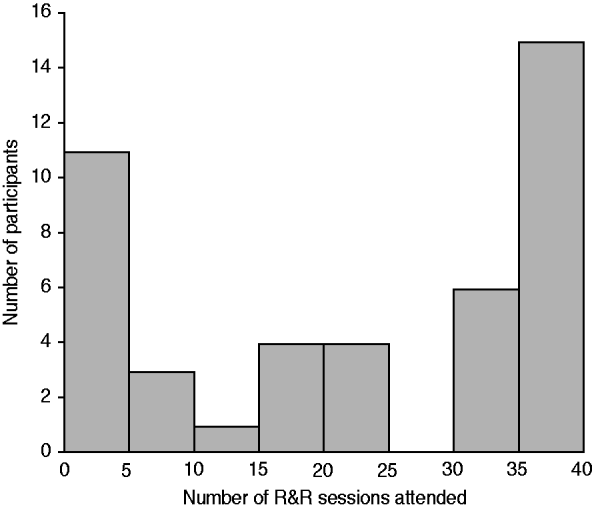
Based on the bimodal distribution of the number of R&R sessions attended (see Fig. 1) we used a cut-off of 30 or more sessions, equating to 80% of the programme, to classify participants as completers (⩾30 sessions) or non-completers (<30 sessions) (Cullen et al. Reference Cullen, Soria, Clarke, Dean and Fahy2011).
Histogram showing the number of Reasoning and Rehabilitation (R&R) sessions attended by mentally disordered offenders randomized to receive the programme (n=44).

Treatment as usual
All participants were free to receive any interventions considered to be part of their usual treatment with the exception that the TAU group were not permitted to attend R&R sessions.
Measures
Baseline assessments
Participants were interviewed prior to randomization by a research clinician to ascertain clinical diagnosis (DSM-IV or ICD-10 criteria) based on the diagnosis assigned by the treating team. Clinicians also completed the positive and negative symptom scales of the PANSS to assess schizophrenia symptoms; the HCR-20 (Webster et al. Reference Webster, Douglas and Eaves1997), a violence risk assessment tool incorporating both static (Historical – 10 items) and dynamic risk factors (Clinical – five items; Risk management – five items); the ASPD section of the Structured Clinical Interview for DSM-IV Personality Disorders (SCID-II; First et al. Reference First, Gibbon, Spitzer, Williams and Benjamin1997); and the 12-item screening version of the Psychopathy Checklist (PCL:SV; Hart et al. Reference Hart, Cox and Hare1995). For the PCL:SV we adopted the European cut-off (total score ⩾16) used in other UK studies to define psychopathy (Dolan & Blackburn, Reference Dolan and Blackburn2005). Demographic, clinical and forensic characteristics were obtained via patient interview and clinical file review at the start of the study.
Outcome measures
At baseline and at each of the three follow-up interviews participants completed a battery of psychometric tests to assess the primary (social problem-solving) and secondary outcomes (criminal attitudes, anger, blame externalizing and perspective-taking).
Social problem-solving
Social problem-solving was assessed via the Social Problem-Solving Inventory – Revised, Short Form (SPSI-R:S; D'Zurilla et al. Reference D'Zurilla, Nezu and Maydeu-Olivares2002), a 25-item questionnaire consisting of five subscales, two measuring problem-solving orientation (positive problem orientation and negative problem orientation) and three assessing problem-solving style (rational problem-solving, impulsivity/carelessness and avoidant). Subscales can be grouped as adaptive approaches (positive problem orientation and rational problem-solving; higher scores indicate more adaptive functioning) and maladaptive approaches (negative problem orientation, impulsivity/carelessness, avoidant; higher scores indicate poorer functioning). Higher total scores reflect better problem-solving ability. The SPSI is one of the most widely-used social problem-solving measures (McGuire, Reference McGuire, McMurran and McGuire2005). The authors report high test–retest reliability and internal consistency, and positive correlations with other social problem-solving measures (D'Zurilla et al. Reference D'Zurilla, Nezu and Maydeu-Olivares2002).
Criminal attitudes
The Crime Pics II (Frude et al. Reference Frude, Honess and Maguire1994) is a 20-item measure of criminal attitudes, recommended by the Home Office (Colledge et al. Reference Colledge, Collier and Brand1999), comprising four subscales: general attitude to offending, anticipation of reoffending, victim hurt denial and evaluation of crime as worthwhile (higher scores indicate more pro-criminal attitudes). The test demonstrates moderate test–retest reliability, moderate-to-high internal consistency and positive correlations with risk of reoffending and criminal history (Frude et al. Reference Frude, Honess and Maguire1994).
Anger
The Novaco Anger Scale (NAS; Novaco, Reference Novaco, Monahan and Steadman1994) is a well-established measure of anger with high internal and test–retest reliability. The current study used only data from part A of the NAS, a 48-item scale assessing three domains of anger experience: cognitive, arousal and behavioural (higher scores on all subscales indicate higher anger levels). The NAS adequately discriminates between clinically aggressive patients and non-clinical controls (Jones et al. Reference Jones, Thomas-Peter and Trout1999) and has been shown to predict violence in MDOs (Monahan et al. Reference Monahan, Steadman, Silver, Appelbaum, Robbins, Mulvey, Roth, Grisso and Banks2001).
Blame externalizing
Blame externalizing was assessed via the 15-item external attribution subscale within the Revised Blame Attribution Inventory (Gudjonsson & Singh, Reference Gudjonsson and Singh1989), which is widely used within offender samples (Batson et al. Reference Batson, Gudjonsson and Gray2010). This subscale measures the extent to which the individual blames their offence on external factors (e.g. society or victims), and was selected on the basis that blame externalizing is specifically targeted by the R&R programme. The external attribution scale demonstrates high internal consistency (Fox et al. Reference Fox, De Koning and Leicht2003), and correlates with personality traits such as psychoticism and hostility, which are associated with criminality (Gudjonsson & Singh, Reference Gudjonsson and Singh1989).
Perspective-taking
The seven-item perspective-taking subscale of the Interpersonal Reactivity Index (Davis, Reference Davis1980), a widely-used empathy measure (Beven et al. Reference Beven, O'Brien-Malone and Hall2004), was analysed (higher scores indicate better perspective-taking ability). Perspective-taking is relevant to the aims of R&R and the ability to take the point of view of others is emphasized throughout the programme. The perspective-taking subscale demonstrates moderate internal and test–retest reliability (Davis, Reference Davis1980), and adequately distinguishes between offenders and non-offenders (Beven et al. Reference Beven, O'Brien-Malone and Hall2004).
Randomization
Randomization was conducted independently by the Clinical Trials Unit, Institute of Psychiatry, King's College London. The trial employed block randomization stratified by centre using equal block sizes. For each MSU, the Clinical Trials Unit was provided with the participant details for all participants who were to undergo randomization. Once all participants from that unit had been randomized the research team were informed of the allocation status for each participant; this information was then communicated to the unit. Randomization was therefore conducted with concealed allocation, as patients from each site were randomized together. Researchers were not blind to allocation status subsequently, as this was often revealed in the clinical notes or by the patients themselves.
Statistical analyses
Descriptive statistics for the demographic, clinical and forensic baseline characteristics are presented as means and standard deviations (s.d.) for normally distributed continuous variables, as medians and range values for non-normal continuous variables, and counts and percentages for categorical variables. Independent-samples t tests (Mann–Whitney U for non-normal) and χ2 tests were used to examine group differences in continuous and categorical baseline data, respectively. Following consultation with a statistician, an analysis plan was agreed prior to data analysis. Outcome data were initially analysed on an intention-to-treat basis. First, within-group, paired-samples t tests were used to identify significant changes from baseline to the end of treatment and then from baseline to 12 months post-treatment. Cohen's d effect sizes (Cohen, Reference Cohen1992) were computed from the original baseline (B) and follow-up (FU) means (M) and standard deviations [(MB – MFU)/pooled s.d.] to quantify the level of change. Linear regression models were then used to determine between-group differences in change; the dependent variable was the change score on the outcome measure and the independent variable was presence or absence of R&R treatment. Finally, post-hoc treatment-received analyses were performed on the subgroup of participants who completed the full R&R programme. All analyses were conducted using SPSS (version 15; SPSS Inc., USA).
Power calculation
Sample size calculations were based on post-treatment data obtained in our non-randomized pilot study (Clarke et al. Reference Clarke, Cullen, Walwyn and Fahy2010) comparing R&R (n=15) with TAU (n=17). Calculations performed at 80% power with an α level of 0.05 suggested that nine participants per group were needed to detect a difference in total SPSI scores with an effect size of 1.2 [R&R, mean 75.6 (s.d.=12.9); TAU, mean 59.3 (s.d.=13.4)] and 14 participants per group were required to detect a difference with an effect size of 0.97 in general attitude subscale scores of the Crime Pics II [R&R, mean 31.1 (s.d.=11.0); TAU, mean 40.2 (s.d.=8.1)]. The target sample size was increased to account for potentially weaker effects obtained in the RCT and to allow sufficient power to detect changes in other social–cognitive domains and behavioural measures.
Results
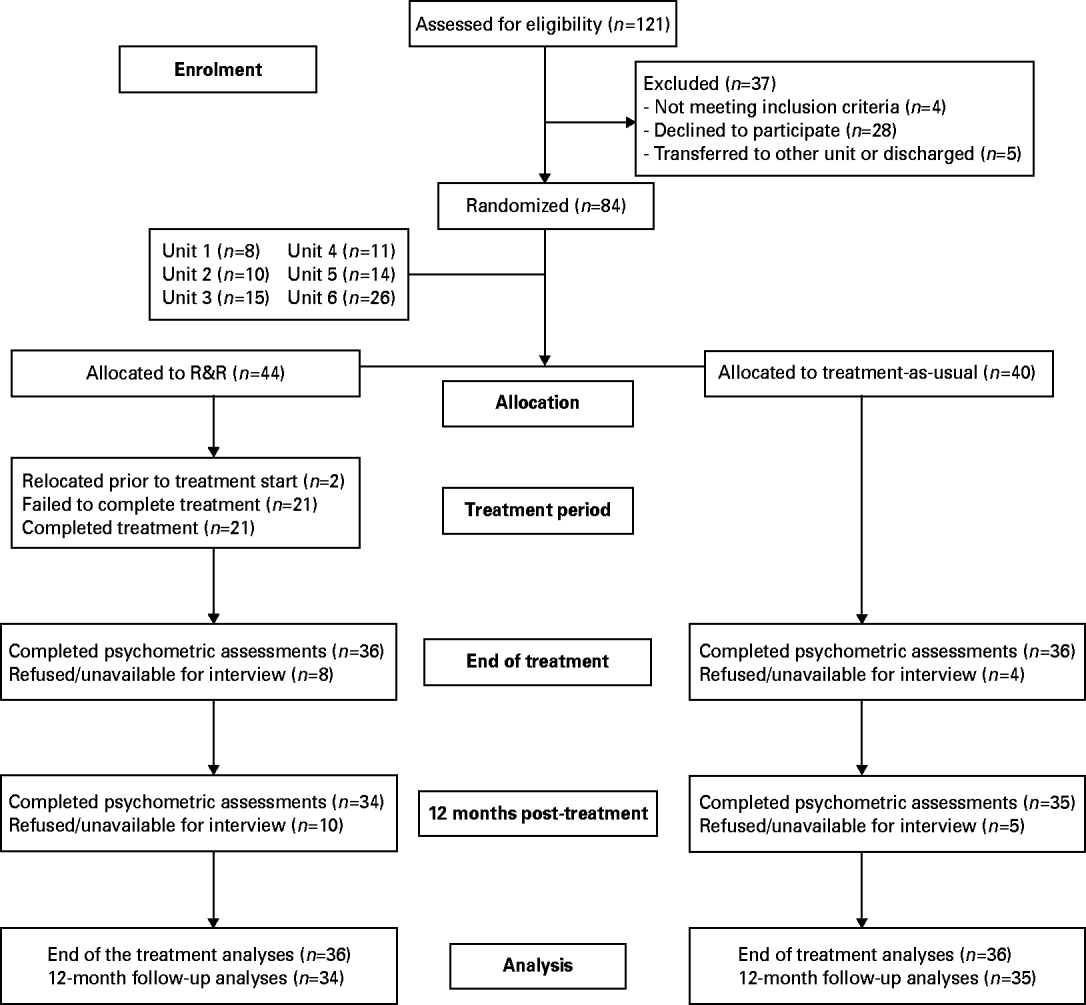
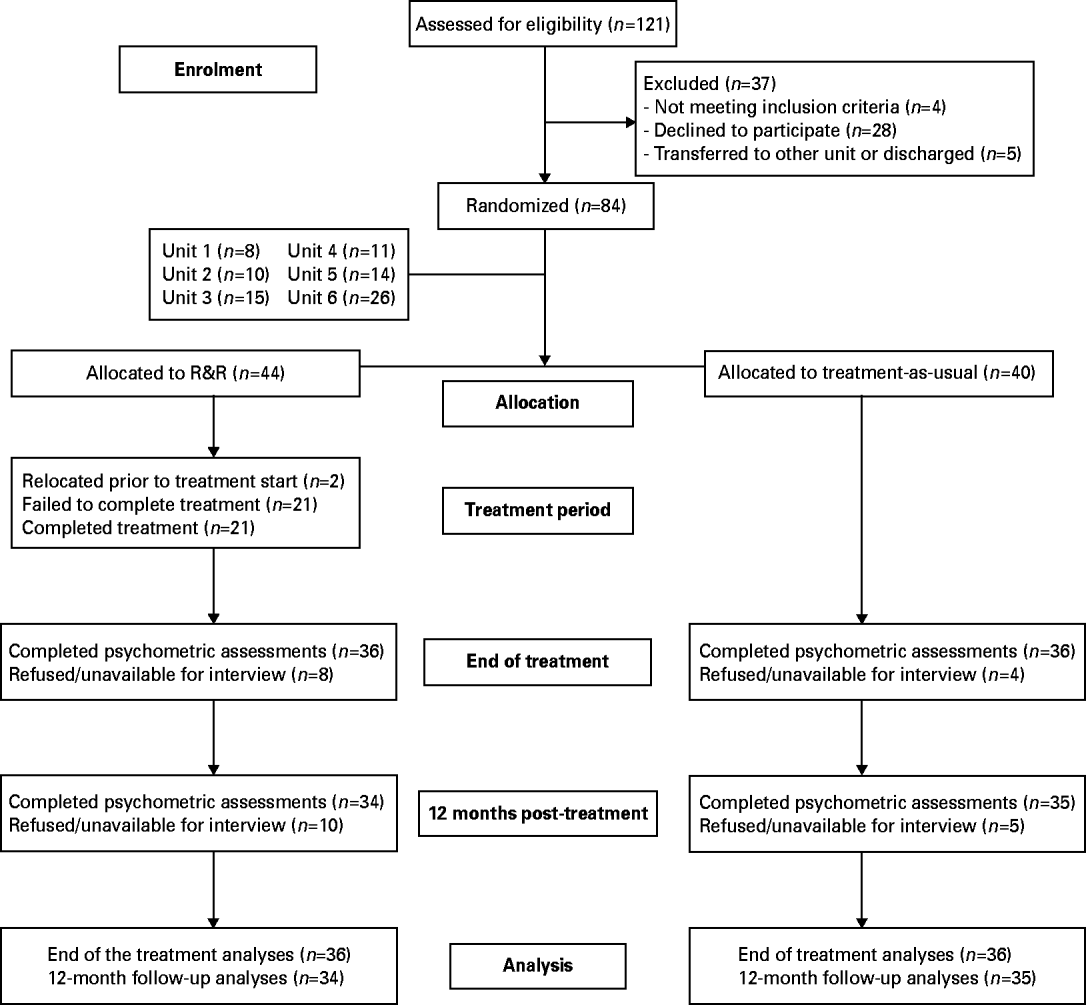
Details of participant recruitment and flow through the study are presented in Fig. 2. Between March 2003 and June 2008, 121 patients in total were referred to the study from the six centres, four (3%) did not meet inclusion criteria, 28 (23%) refused to participate, and five (4%) were either transferred to another unit or discharged from hospital prior to randomization. A total of 84 patients were randomized to receive R&R (n=44) or TAU (n=40). Of those allocated to the R&R group, two were unable to commence treatment for reasons outside of their control; one participant was transferred to prison (interviewed in prison) and the other was deported from the UK (unavailable for follow-up). Of the 42 participants allocated to receive R&R and able to attend the programme, only half (n=21) completed treatment. Across the total sample, all participants were interviewed at baseline, 72 (86%) completed assessments at the end of treatment and 69 (82%) completed the 12-month follow-up.
Participant flow through the study and adherence to the Reasoning and Rehabilitation (R&R) programme.
Baseline characteristics
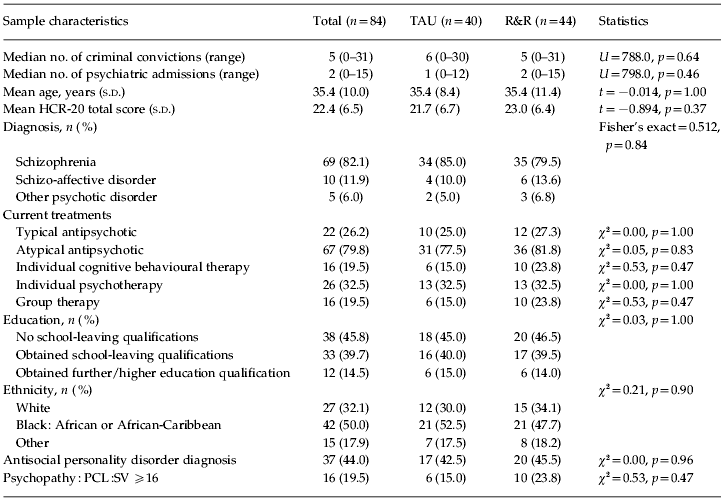
Table 1 presents the sample characteristics. Participants were on average 35 years of age and 50% were of black African or African-Caribbean heritage. Across the total sample the median number of previous convictions and prior psychiatric hospitalizations was five and two, respectively. The majority of participants (82%) had a diagnosis of schizophrenia, 44% had a co-morbid diagnosis of ASPD, 20% fulfilled criteria for psychopathy (PCL:SV score ⩾16) and the mean total HCR-20 score was 22.4. Most patients were currently treated with atypical antipsychotics (80%), and one-fifth to one-third were engaged in psychological therapy at the start of treatment. Nearly half of the participants (46%) had not obtained any qualifications upon leaving school. Statistical tests confirmed that the two groups did not differ significantly on demographic, clinical or forensic characteristics.
Demographic, clinical and forensic characteristics obtained at baseline shown for the total sample and both treatment groupsFootnote a
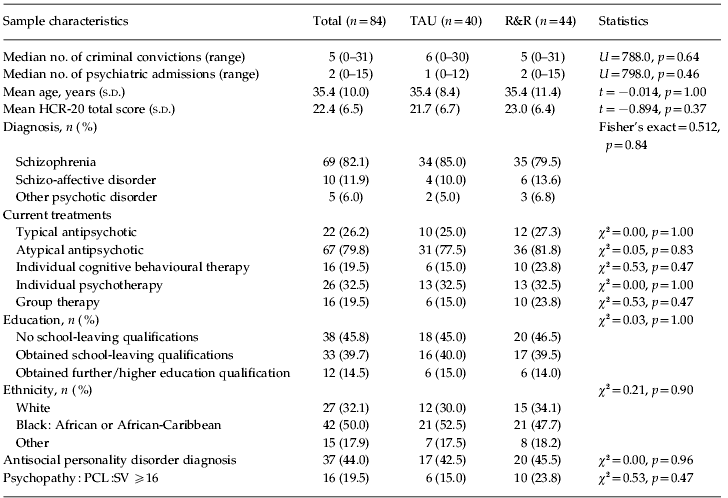
TAU, Treatment as usual; R&R, Reasoning and Rehabilitation; s.d., standard deviation; PCL:SV, Psychopathy Checklist Screening Version.
a Data missing for: number of criminal convictions, n=2; total HCR-20 scores, n=2; current cognitive–behavioural therapy, n=2; current psychotherapy, n=4; current group therapy, n=2; education, n=1; and psychopathy, n=2.
Outcome measures: end of treatment
Within-group changes
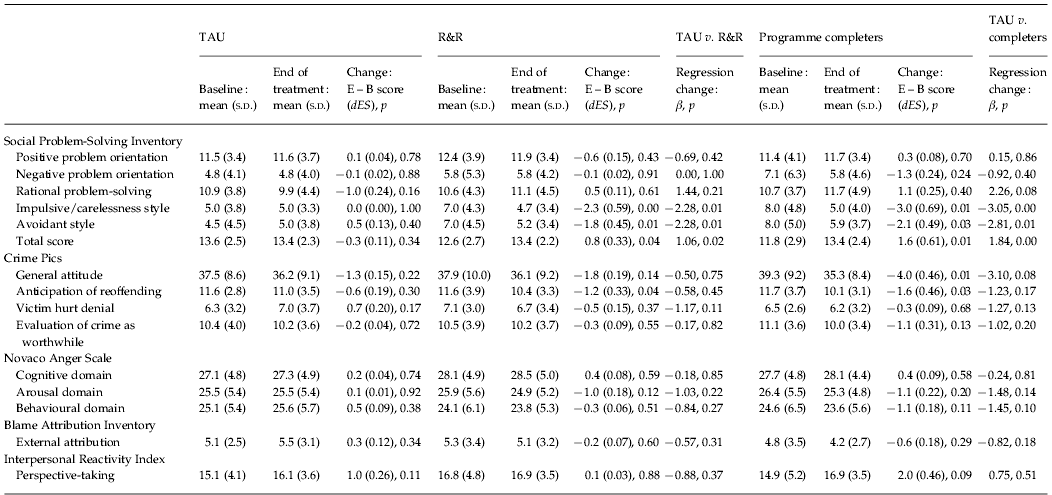
Scores on the outcome measures for the R&R and TAU participants at baseline and at the end of treatment are presented in Table 2. The R&R group showed statistically significant changes on four of the subscales. Improvements were small for the Crime Pics II anticipation of reoffending subscale (p=0.04) and total SPSI score (p=0.04), small-to-moderate for the SPSI avoidant style subscale (p=0.01) and moderate for the SPSI impulsive/carelessness style subscale (p=0.004). In contrast, the TAU group did not demonstrate statistically significant changes on any of the subscales.
End of treatment data: descriptive statistics for baseline and end of treatment assessments, change scores and effect sizes of change, results of within-group analyses of change scores, and results of between-group analyses of change scoresFootnote a
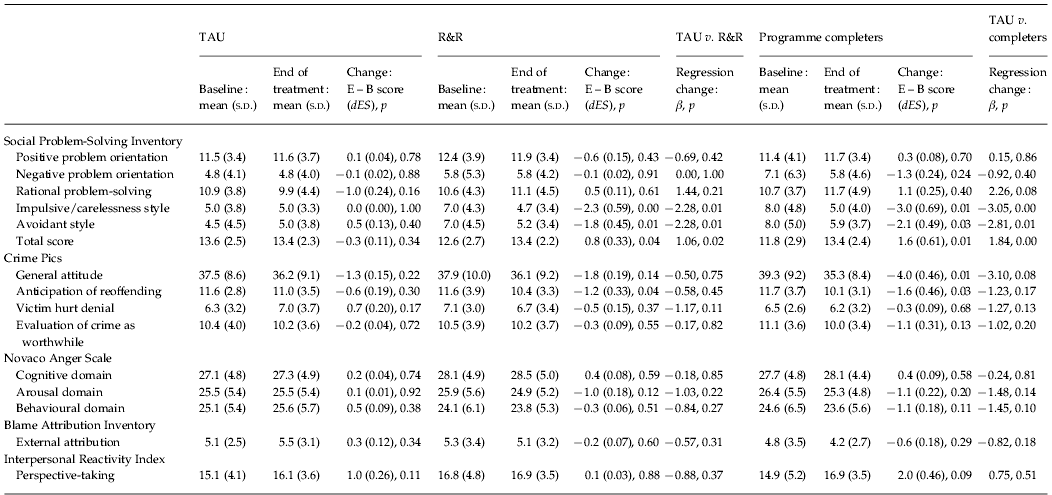
TAU, Treatment as usual; R&R, Reasoning and Rehabilitation; E – B, end of treatment minus baseline scores; s.d., standard deviation; dES, effect size of change.
a Data are presented for the subset of participants with both baseline and end of treatment follow-up data (R&R, n=36; TAU, n=36; programme completers, n=20).
Between-group analyses
Results of the linear regression analyses estimating the strength of association between treatment group and change scores are displayed in Table 2. Treatment group was a significant predictor of change scores on the SPSI impulsive/carelessness style [B=−2.28, 95% confidence interval (CI) −4.04 to −0.52] and avoidant style (B=−2.28, 95% CI −4.06 to −0.50) subscales, and the total SPSI score (B=1.06, 95% CI 0.14–1.98), indicating larger improvements in the R&R group relative to the TAU group.
Outcome measures: 12 months post-treatment
Within-group changes
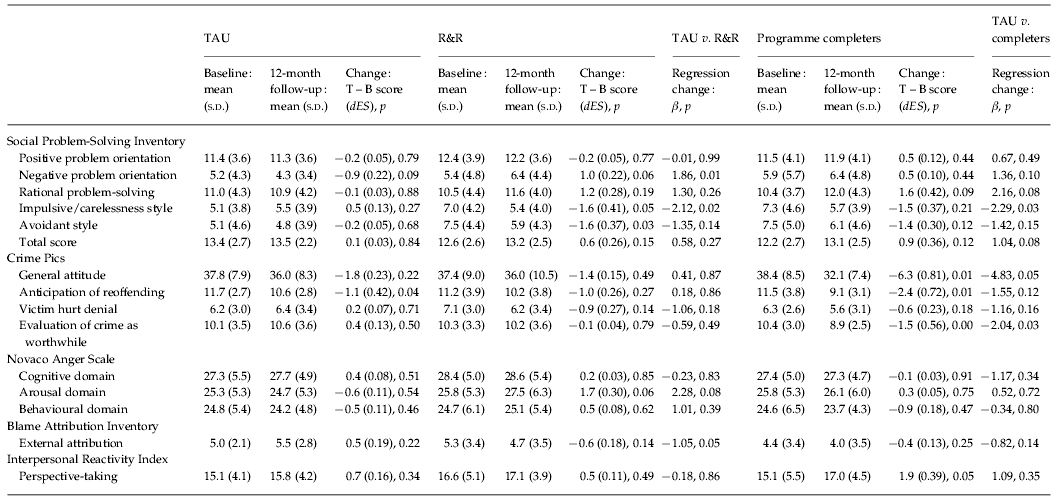
Data obtained at the 12-month follow-up are presented in Table 3. The R&R group demonstrated significant, small-to-moderate improvements on the SPSI impulsive/carelessness style (p=0.05) and avoidant style subscales (p=0.03). The TAU group demonstrated statistically significant improvements on the anticipation of reoffending scale of the Crime Pics II (p=0.04).
Twelve-month follow-up data: descriptive statistics for baseline and 12-month assessments, change scores and effect sizes of change, results of within-group analyses of change scores, and results of between-group analyses of change scoresa
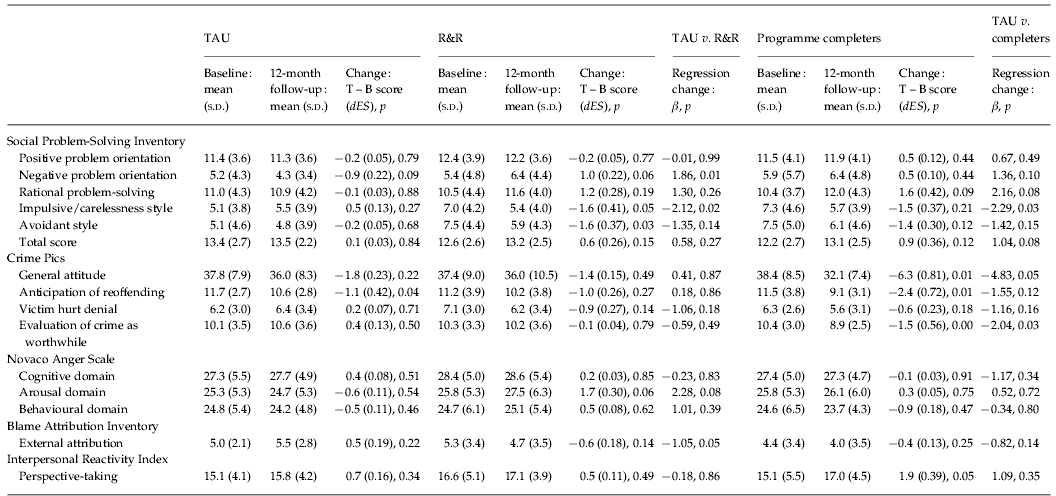
TAU, Treatment as usual; R&R, Reasoning and Rehabilitation; T – B, 12-month follow-up minus baseline scores; s.d., standard deviation; dES, effect size of change.
a Data are presented for the subset of participants with both baseline and 12-month follow-up data (R&R, n=35; TAU, n=34; programme completers, n=19).
Between-group analyses
Linear regression analyses demonstrated a significant effect of treatment group on change scores on the SPSI negative problem orientation subscale (B=1.86, 95% CI 0.45−3.27) and impulsive/carelessness style scale (B=−2.12, 95% CI −3.89 to −0.36). Participation in the R&R group was associated with less improvement in negative problem orientation than TAU.
Post-hoc analyses
End of treatment
Table 2 presents the scores obtained by the subgroup of participants who completed the R&R programme. Statistically significant, moderate, improvements were observed on two of the SPSI subscales (impulsive/carelessness style and avoidant style) and the total SPSI score, and small-to-moderate improvements on two of the Crime Pics II subscales (general attitude and anticipation of reoffending). Regression analyses showed that programme completion was associated with significantly larger improvements than TAU on the two SPSI subscales and the total SPSI score.
Twelve months post-treatment
Table 3 presents the scores on the outcome measures obtained at the 12-month follow-up for the participants who completed R&R. Programme completers showed statistically significant, small-to-moderate improvements on the IRI perspective-taking scale, moderate improvements on two of the Crime Pics II subscales (anticipation of reoffending and evaluation of crime as worthwhile), and large improvements on the general attitude subscale of the Crime Pics II. Linear regression analyses detected a significant effect of programme completion, relative to TAU, on change scores on two of the Crime Pics II subscales (general attitude and evaluation of crime as worthwhile), and the SPSI impulsive/carelessness style scale.
Discussion
This is the first RCT of a cognitive skills programme with MDOs. Relative to the TAU group, participants allocated to receive R&R showed greater improvements in social–cognitive skills and thinking styles specifically targeted by the programme. Improvements in specific social problem-solving domains were maintained at 12 months post-treatment. Post-hoc analyses of participants who completed the full R&R programme indicated additional changes on measures of criminal attitudes at 12 months post-treatment. This study also establishes that it is feasible to conduct a multi-site RCT in medium-secure forensic units and opens the door to further trials aimed at measuring treatment effectiveness in this setting.
Proximal and longitudinal effects of treatment
R&R participation was associated with significant improvements in social problem-solving at the end of treatment; a reassuring finding given that the R&R programme primarily targets deficits in this domain. These findings are consistent with our pilot study (Clarke et al. Reference Clarke, Cullen, Walwyn and Fahy2010) in which we observed changes in the exact same subscales of the SPSI (impulsive/carelessness style, avoidant style and total score). Thus in MDO populations, R&R may specifically reduce the tendency to rely on maladaptive approaches to solving problems. Improvements in social problem-solving have also been demonstrated in evaluations of other cognitive skills programmes with MDOs (McMurran et al. Reference McMurran, Egan, Richardson and Ahmadi1999; Tapp et al. Reference Tapp, Fellowes, Wallis, Blud and Moore2009). The current study therefore provides further evidence that specifically targeted interventions might be able to improve social problem-solving in this population. These findings are important, as social problem-solving deficits have been associated with a number of negative outcomes including recidivism, poor adjustment in prison and homelessness in offender populations (McGuire, Reference McGuire, McMurran and McGuire2005).
MDOs allocated to receive R&R continued to show significant improvements on two of the SPSI subscales at 12 months post-treatment, although changes were significantly greater than those observed in the TAU group for only one subscale. One unexpected finding was that that R&R participation was associated with less improvement in negative problem orientation change scores than TAU at the 12-month follow-up. However, within-group tests indicated that the R&R group did not significantly worsen; neither did the TAU group significantly improve. These findings suggest that booster sessions may be necessary to help reinforce the principles of treatment and maintain improvements.
Effect of programme completion
Our findings tentatively suggest that MDOs who complete the full R&R programme may do better than those who prematurely leave treatment. Programme completers showed significant improvements in social problem-solving and criminal attitudes at the end of treatment; effect sizes demonstrate that these changes were generally larger than those observed in the R&R group as a whole. Furthermore, at 12 months post-treatment programme completers showed significantly greater improvements in social problem-solving and criminal attitudes relative to the TAU group. Given the strong link between criminal attitudes and recidivism (Gendreau et al. Reference Gendreau, Little and Goggin1996) these improvements are encouraging, but need to be understood as indicative, given the post-hoc, non-randomized nature of such analyses. One interpretation of these findings is that they reflect a ‘completion effect’ (Hollin & Palmer, Reference Hollin and Palmer2009), and that a full dose of treatment leads to greater improvements. An alternative and perhaps more likely explanation is, however, that this finding reflects pre-treatment differences between programme completers and drop-outs. Our previous analyses conducted on this sample indicated that non-completers were more likely to have a co-morbid diagnosis of ASPD or psychopathy (Cullen et al. Reference Cullen, Soria, Clarke, Dean and Fahy2011). Given that individuals with these diagnoses are often treatment-resisting (Bateman & Tyrer, Reference Bateman and Tyrer2004), and by definition have more pro-criminal attitudes, it seems possible that stronger effects were obtained in the treatment-received analyses due to having fewer patients with these diagnoses in this subgroup. Whether MDOs with co-morbid ASPD and psychopathy can benefit from programmes such as R&R requires further exploration.
Implications
This RCT confirms and extends previous findings from our non-randomized pilot study (Clarke et al. Reference Clarke, Cullen, Walwyn and Fahy2010), and provides support for the suggestion that MDOs can benefit from cognitive skills programmes (Ashford et al. Reference Ashford, Wong and Sternbach2008; Tapp et al. Reference Tapp, Fellowes, Wallis, Blud and Moore2009; Young et al. Reference Young, Chick and Gudjonsson2010). Our findings demonstrate that MDOs can learn social–cognitive skills and thinking styles that are thought to support pro-social behaviour. Such improvement may be the precursor to behavioural change. The ongoing collection of data on antisocial behaviour and reoffending will allow us to explore the relationship between changes in social–cognitive skills and antisocial behaviour. A recent RCT reported a reduction in aggressive behaviour in MDOs who received a cognitive behavioural therapy (CBT) programme targeting anger and psychotic symptoms (Haddock et al. Reference Haddock, Barrowclough, Shaw, Dunn, Novaco and Tarrier2009). These findings are encouraging and suggest that cognitive–behavioural approaches may be effective in reducing violence in MDOs. R&R is a demanding programme for both patients and treating clinicians and, like other evaluations of cognitive skills programmes with MDOs (Ashford et al. Reference Ashford, Wong and Sternbach2008), we found a high treatment drop-out rate. Given that schizophrenia is associated with moderate-to-large cognitive impairments (Mesholam-Gately et al. Reference Mesholam-Gately, Giuliano, Goff, Faraone and Seidman2009), breaking the programme down into shorter modular components may help to improve retention in this population. In contrast, Haddock and colleagues reported excellent retention rates in their evaluation of a 25-session CBT programme, which may reflect the fact that the treatment included additional motivational strategies to promote engagement (Haddock et al. Reference Haddock, Barrowclough, Shaw, Dunn, Novaco and Tarrier2009). Improving therapeutic alliance might also help to reduce drop-out; for example, dialectical behavioural therapy (Linehan, Reference Linehan1993), which specifically focuses on developing a strong therapeutic relationship, demonstrates high retention rates in treatment-resistant patients (Verheul et al. Reference Verheul, Van Den Bosch, Koeter, De Ridder, Stijnen and Van Den Brink2003). Future evaluations might aim to explore whether improving therapeutic alliance, motivational interviewing, and developing a modularized programme help to reduce drop-out from cognitive skills programmes in MDOs.
Limitations
It is likely that our failure to find significant differences in post-hoc tests, despite moderate effect sizes, was due to reduced statistical power in this small sample. However, this is the first attempt to conduct an RCT in this setting and we have demonstrated that such studies are feasible with the caveat that a longer recruitment phase may be necessary. A related issue is the multi-site aspect of the study. It was necessary to involve multiple MSUs in order to increase sample size, but this heterogeneity was difficult to account for statistically in a sample of this size. However, the inclusion of patients from multiple units increases generalizability. Selection bias is also a possibility. At the initial recruitment phase 23% of referred patients refused to participate in the study. Whilst we did not have ethical approval to obtain further details on those who declined, it is likely that these patients were more antisocial and/or unwell. Similarly, these factors may also be associated with non-participation at follow-up. Given that antisocial traits and psychotic symptoms might conceivably influence treatment response we cannot rule out the possibility that non-response bias and attrition have led to an over-estimate of the effects of R&R in this sample. Conversely, the effects of R&R may have been underestimated by comparing the programme with TAU, which may itself have led to improvements on the outcome measures. However, the control group significantly improved on only one of the measures during the trial, thus suggesting that TAU does not address the specific skills targeted by R&R. Another limitation is the potential for type 1 errors arising from multiple comparisons although we attempted to mitigate against this by a priori selecting for analysis only those questionnaire subscales assessing domains specifically targeted by the R&R programme. Finally, interviewers were not blind to treatment group; however, all outcome data presented in the current paper were obtained via self-report questionnaires, therefore reducing the likelihood of interviewer bias.
Conclusions
This study demonstrates that RCTs can be conducted in secure forensic psychiatric hospitals. Participation in the R&R programme was associated with improvements in social–cognitive skills and thinking styles specifically targeted by the programme and known to be associated with risk of antisocial behaviour. These findings add to emerging evidence suggesting that offenders with severe mental illness may be able to benefit from cognitive skills programmes.
Acknowledgements
The authors would like to thank Katy Lye and Hannah Rogers for their assistance with participant recruitment, trial management and data collection. The authors are grateful for the financial support provided by the NHS National Research and Development programme on Forensic Mental Health, UK. We would also like to thank the staff and patients at participating units.
Declaration of Interest
None.