


Introduction
Trauma-focused cognitive-behavioural treatments are recommended as one of the best psychological interventions for post-traumatic stress disorder (PTSD; Foa et al. Reference Foa, Keane and Friedman2000). Such interventions vary in the degree to which traumatic events are discussed and processed, ranging from detailed narrating of the traumatic event in imaginal exposure (e.g. Foa et al. Reference Foa, Hembree, Cahill, Rauch, Riggs, Feeny and Yadin2005), writing about the traumatic experience in cognitive processing therapy (Resick et al. Reference Resick, Nishith, Weaver, Astin and Feur2002), or cognitive therapy targeting trauma-related beliefs (see Resick et al. Reference Resick, Galovski, Uhlmansiek, Scher, Clum and Young-Xu2008).
In recent years a number of researchers have investigated the utility of Pennebaker's expressive writing for ameliorating trauma symptoms. In his seminal writing study, Pennebaker (Reference Pennebaker and Berkowitz1989) reported that expressive writing (i.e. writing during which the writer focuses on their deepest thoughts and feelings, typically those associated with a negative event) was associated with improved health outcomes. Despite design variations (e.g. instructions, number and duration of writing sessions), compared to control conditions, a meta-analysis conducted by Smyth (Reference Smyth1998) reported benefits of expressive writing in various domains such as physiological functioning, psychological well-being, self-reported health, and general functioning, with an overall effect size of d = 0.47.
However, the benefits of expressive writing about negative events has not resulted in reductions in PTSD symptoms in either trauma-exposed samples, e.g. rape victims (Brown & Heimberg, Reference Brown and Heimberg2001); childhood sexual abuse survivors (Batten et al. Reference Batten, Follette and Palm2002); clinical samples with high rates of PTSD (e.g. domestic violence; Koopman et al. Reference Koopman, Ismailji, Holmes, Classen, Palesh and Wales2005); individuals with PTSD (Gidron et al. Reference Gidron, Peri, Connolly and Shalev1996; Smyth et al. Reference Smyth, Hockemeyer and Tulloch2008), or in those with significant acute stress disorder symptoms and at risk of developing PTSD (Bugg et al. Reference Bugg, Turpin, Mason and Scholes2009). It is worth noting that the majority of these studies had relatively brief writing periods, typically three occasions of 20-min duration as per Pennebaker (Reference Pennebaker and Berkowitz1989); thus, whether this is sufficient for clinical samples, especially those with PTSD, must be questioned. Indeed, on one occasion that writing was observed to be clinically beneficial for individuals with PTSD (Resick et al. Reference Resick, Galovski, Uhlmansiek, Scher, Clum and Young-Xu2008) it required substantial writing (>5 sessions of 45–60 min), reading the narrative to an empathetic therapist (who did not provide cognitive restructuring, but did get the client reflect on what they learnt from the writing experience), and required the client to read the narrative daily as homework. While this study had other key differences from previous research beyond length of writing that may account for its discrepant outcomes, it is not unique in having clients develop structure and looking for benefit/meaning across writings (cf. Batten et al. Reference Batten, Follette and Palm2002; Smyth et al. Reference Smyth, Hockemeyer and Tulloch2008).
Research with expressive writing continues to evolve and relevant to the present study, there is some suggestion that emotional processing of negative events might not be essential for positive benefits in expressive writing. For example, a study by Greenberg and colleagues suggested that a participant's ability to confront and control negative emotion, irrespective of such emotion being real or imaginary, fostered a greater sense of current and future self-efficacy (Greenberg et al. Reference Greenberg, Wortman and Stone1996). Furthermore, recent investigations suggest that health benefits can also be obtained through expressive writing with a positive rather than negative focus. Studies have reported that writing about the positive aspects of a traumatic experience (e.g. personal change or growth) resulted in less emotional distress and the same physical and psychological health benefits experienced by participants who focused purely on writing about the negative aspects of the trauma itself (King & Miner, Reference King and Miner2000; Stanton et al. Reference Stanton, Danoff-Burg, Sworowski, Collins, Branstetter, Rodrigues-Hanley, Kirk and Austenfeld2002).
Relevant to the present study is that investigations have also reported benefits attributed to positive future-oriented expressive writing without exposure to trauma-related information (e.g. King, Reference King2001; Frayne & Wade, Reference Frayne and Wade2006). King (Reference King2001) observed that benefits were obtained through non-emotive future-oriented writing topics based on self-regulation (e.g. goals, priorities). Specifically, when participants who wrote a detailed and personally relevant trauma account were compared to those who wrote about their life goals and other future events (e.g. what their best possible self would look like), the results indicated the latter group were less distressed during participation, rated higher psychological well-being at 3 weeks post-writing, and also visited their physician less often at 5-week follow-up (King, Reference King2001). Researchers have suggested that focusing on positive emotions, without having to confront painful trauma-related emotions, might act as a buffer to negative emotions, and may indirectly lead to restructuring negative beliefs, increase self-efficacy, and strengthen social ties (Lepore et al. Reference Lepore, Greenberg, Bruno, Smyth, Lepore and Smyth2002). Indeed, in trauma-related studies, control group participants have reported positive changes when writing about daily plans, e.g. improvements in pain ratings (Koopman et al. Reference Koopman, Ismailji, Holmes, Classen, Palesh and Wales2005); a trend for reduced depression ratings (Batten et al. Reference Batten, Follette and Palm2002).
We believed that the above findings had relevance in improving expressive writing for PTSD. A theme of the positive non-trauma-focused writing results (even control group findings) is the focus on the future even if the initial topic is mundane (e.g. writing plans for future daily activities). Current conceptualizations of PTSD focus on the role of cognitive processes in the development and maintenance of PTSD (Brewin et al. Reference Brewin, Dalgleish and Joseph1996; Ehlers & Clark, Reference Ehlers and Clark2000). Ehlers & Clark (Reference Ehlers and Clark2000) argue that PTSD is maintained in individuals because they fail to view their trauma as a past event and thus experience a sense of current threat whereby the trauma and associated potential dangers are perceived as an ongoing traumatic experience rather than a time-limited autobiographical event (Ehlers & Clark, Reference Ehlers and Clark2000). A belief regarding a lack of control over the trauma and later events contributes to symptomatology (Foa et al. Reference Foa, Zinbarg and Rothbaum1992). Subsequently, poorer psychological functioning among PTSD sufferers is associated with feeling ‘frozen in time’ and ‘disconnected from their former self and their life goals’ (Ehlers & Clark, Reference Ehlers and Clark2000, p. 334) as such goals are perceived to hold less meaning and no longer seem achievable (Foa et al. Reference Foa, Ehlers, Clark, Tolin and Orsillos1999; Conway & Pleydell-Pearce, Reference Conway and Pleydell-Pearce2000). Indeed, the PTSD symptom of foreshortened future is a good example of how PTSD sufferers are unable to meaningfully put their traumatic experience behind them and entertain future goals.
Accordingly, we were interested in whether a positive, future-oriented therapeutic writing approach with an aim to assist individuals in placing their plans for the future in an autobiographical context would benefit individuals with PTSD. This future-oriented approach involved focused discussion and expressive writing on various self-regulation topics previously shown to be associated with improved psychological and health outcomes (e.g. goal setting, personal behaviours). We hypothesized that such an approach would reduce post-traumatic symptom severity and have a concomitant impact on associated PTSD psychopathology such as depression and unhelpful trauma-related beliefs.
Method
Participants
Participants were referred to the study for treatment by victim support agencies, police, local doctors or self-referred after seeing advertising of the study in the community. In total, 55 individuals contacted the researchers regarding the study, of these, 18 decided they were not interested in seeking therapy at that time and eight met exclusion criteria (e.g. suicidality, substance dependence) through a phone screen. Of the remaining 29, eight completed a partial pre-treatment assessment but then withdrew and 21 participants were fully assessed. Of these three completed the assessment but did not begin therapy, four started therapy and dropped out, and one participant was excluded during therapy due to emerging psychotic symptoms not apparent in the initial assessment. Of the 13 treatment completers, 10 were contactable for the 3-month follow-up. Of the treatment completers, five also met diagnostic criteria for major depression, three met criteria for panic with agoraphobia, and one participant also had comorbid generalized anxiety disorder. The 13 treatment completers (11 women, 2 men) had an age range of 21–44 years (mean = 31.85, s.d. = 7.46), with years of education completed by participants ranging from 10 to 18 (mean = 12.92, s.d. = 2.64). Table 1 details the trauma characteristics of the treatment completers.
Trauma-related characteristics of participants who completed therapy (n = 13)
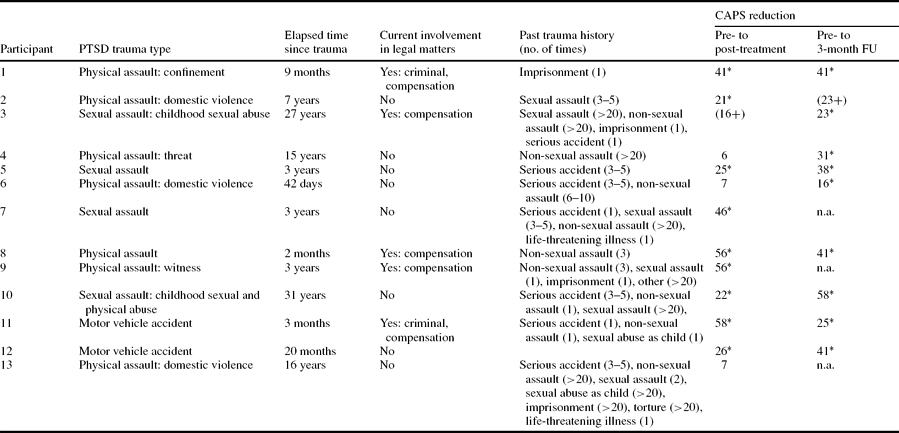
CAPS, Clinician-Administered PTSD Scale (where a reduction of 10–15 points is considered clinically relevant; Schnurr et al. Reference Schnurr, Friedman, Engel, Foa, Shea, Chow, Resick, Thurston, Orsillo, Haug, Turner and Bernardy2007; Weathers et al. Reference Weathers, Newman, Blake, Nagy, Schnurr, Kaloupek, Charney and Keane2004); FU, follow-up; n.a., not available.
* These participants demonstrated reliable (i.e. significant) reductions on CAPS (as per Jacobson & Truax, Reference Jacobson and Truax1991) and moved from a severity category (e.g. moderate PTSD severity to mild PTSD severity). Positive sign (+) reflects an increase in symptoms.
Measures
The Clinician-Administered PTSD Scale (CAPS; Weathers et al. Reference Weathers, Newman, Blake, Nagy, Schnurr, Kaloupek, Charney and Keane2004) and Structured Clinical Interview for DSM-IV (SCID-IV; First et al. 1996) were used to assess for PTSD and comorbidity by trained interviewers. Self-report measures were used to assess PTSD severity, depression, and unhelpful trauma-related beliefs. Other measures used were: Post-traumatic Stress Diagnostic Scale (PDS; Foa, Reference Foa1995); Depression Anxiety and Stress Scale (DASS-21; Lovibond & Lovibond, Reference Lovibond and Lovibond1995); and Post-traumatic Cognitions Inventory (PTCI; Foa et al. Reference Foa, Ehlers, Clark, Tolin and Orsillos1999). A self-report questionnaire adapted from Resick et al. (Reference Resick, Nishith, Weaver, Astin and Feur2002) was used at the pre-treatment assessment to determine the frequency of previous traumatic experiences. A 4-item, self-report measure was used to determine participants’ expectancies regarding therapy outcomes. Two forms of this questionnaire were used at the beginning (e.g. ‘How logical does this type of treatment seem to you?’) and at the end of therapy (e.g. ‘How successful was this treatment in reducing your trauma-related symptoms?’), where 1 = not at all, 9 = extremely. To reduce demand effects, participants returned their completed questionnaires in sealed envelopes which were opened after post-treatment assessment. At the end of each writing session a post-writing reflection questionnaire was administered. This 5-item self-report measure was used to assess participants’ engagement with writing tasks (e.g. ‘To what degree did you express your deepest thoughts and feelings?’) and their post-writing emotional state (‘To what degree do you currently feel happy?’), where 0 = not at all, 10 = completely.
Procedure and treatment overview
Therapy was provided by Masters- or Ph.D.-level student psychologists who received weekly supervision from the first author to ensure treatment fidelity. Participants received eight weekly sessions of 90-min duration and the manualized therapy involved the provision of psycho-education, weekly writing tasks, post-writing reflections, non-directive supportive counselling and homework setting and review. Participants were left in privacy to write on the session's task for 40 min. Following the writing component, the therapist obtained a photocopy of their writing while they completed their post-writing reflection questionnaire. The remaining time was spent discussing the writing task in a non-directive supportive counselling fashion and setting homework (i.e. daily re-write, re-read and re-cite of the relevant week's writing task). Topics covered in writing tasks included: goals for therapy, controllability and ability to exercise personal control, goal setting, social support and important people in one's life, interpersonal view (e.g. view of self today, best possible self), and life goals. Cognitive restructuring, specific discussions regarding the actual traumatic event, or imaginal/in-vivo exposure were not undertaken in the protocol. Following treatment, post-treatment and 3-month follow-up assessments were conducted by independent assessors. These assessors had not conducted the participants’ pre-treatment assessments.
Statistical analyses
Paired t tests were complemented by calculating a reliability of change index (RCI) for each participant as set out by Jacobson & Truax (Reference Jacobson and Truax1991). The clinical significance of change was also assessed conservatively by determining whether a significant RCI moved the participant from the clinical range to below the clinical cut-off for that measure, indicating good end-state functioning (i.e. clinical movement). Effect sizes (Cohen's d) are reported where the pre-treatment mean minus the post-treatment (or follow-up) mean was divided by the pooled standard deviation.
Results
To provide a snapshot of individual change, PTSD severity change (CAPS) is reported in Table 1. Means and standard deviations and effect sizes for treatment completers are reported in Table 2 and there were significant reductions on most measures. Effect sizes ranged from medium to large. At post-treatment seven participants still had PTSD (54%), with four participants (40%) remaining PTSD-positive at follow-up. At 3-month follow-up, only one participant had maintained their pre-treatment comorbid disorder (major depression). Individuals who dropped out of therapy were not significantly different from completers on demographic or pre-treatment symptom severity variables.
Means, standard deviations, descriptive statistics and effect sizes (ES) for treatment completers

CAPS, Clinician-Administered PTSD Scale; PDS, Post-traumatic Stress Diagnostic Scale, DASS-21, 21-item Depression Anxiety Stress Scale – Depression subscale; PTCI, Post-traumatic Cognitions Inventory.
† p < 0.10, *p < 0.05, **p < 0.01, ***p < 0.001.
Reliable and clinical change
Clinically significant reductions of PTSD severity using RCI analyses were modest, with between 8% and 12%, and 30% and 44% of individuals making both statistical and clinically significant change at post-treatment and 3-month follow-up, respectively (see Table 3). The RCI analyses conducted are quite conservative. For example, a cut-off of ≤19 for CAPS was adopted which essentially indicates very mild symptoms or being asymptomatic. It could be argued that an individual who makes a reliable (statistically significant) change and who moves from an extreme range to a lesser range on a symptom scale still demonstrates a clinically relevant response to treatment that is not captured by the current RCI analyses. To illustrate, 46% (n = 6) of participants who were initially in the moderate-to-extremely severe range on CAPS reliably moved to the mildly symptomatic range at post-treatment, although they failed to fall into the asymptomatic range. Another index of clinically meaningful improvement is a reduction of 10-points on CAPS (Schnurr et al. Reference Schnurr, Friedman, Engel, Foa, Shea, Chow, Resick, Thurston, Orsillo, Haug, Turner and Bernardy2007). In this study, nine participants showed such reduction at post-treatment and follow-up (69% and 90%, respectively). In terms of adverse responses, at post-treatment one participant reported a significant exacerbation of symptoms but attributed this to the death of her abuser during treatment (who also made her executor of his estate). At 3-month follow-up, her score on CAPS had reduced significantly relative to her pre-treatment level. Another participant reported significant gains at post-treatment on CAPS, but at follow-up her score was significantly higher than pre-treatment levels. Although five participants were involved in compensation matters at the time of treatment, this did not appear to prevent symptom change with these participants all demonstrating reliable reductions in PTSD severity at post-treatment and follow-up.
Participants who demonstrated reliable change and significant clinical movement from pre-treatment to post-treatment and follow-upa,b

CAPS, Clinician-Administered PTSD Scale, PDS, Post-traumatic Stress Diagnostic Scale; DASS-21, 21-item Depression Anxiety Stress Scale – Depression subscale; PTCI, Post-traumatic Cognitions Inventory.
a Table only includes those who were initially above the relevant clinical cut-off at pre-treatment and for whom there is complete data for the comparison under inspection.
b Psychometric and cut-off information required for reliability of change index analyses came from the following sources: CAPS (Weathers, Reference Weathers2004; Resick et al. Reference Resick, Galovski, Uhlmansiek, Scher, Clum and Young-Xu2008); PDS (Foa, Reference Foa1995; Sheeran & Zimmerman, Reference Sheeran and Zimmerman2002); DASS-21 (Antony et al. Reference Antony, Bieling, Cox, Enns and Swinson1998); PTCI (Foa et al. Reference Foa, Ehlers, Clark, Tolin and Orsillos1999).
Although space limitations preclude reporting of intent-to-treat analyses, it should be noted that assuming all therapy non-starters (n = 3) and drop-outs (n = 4) maintained their PTSD at future assessments, 70% and 55% of the intent-to-treat sample would have had PTSD at the post-treatment and 3-month follow-up assessments, respectively.
Therapeutic engagement and treatment credibility
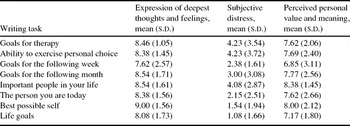
A summary of the post-writing task feedback for each writing session is summarized across participants in Table 4. Overall, participants reported that they consistently expressed their deepest thoughts and feelings when writing, experienced minimal subjective distress and considered the writing tasks to be personally valuable and meaningful. Participants’ also rated their perceived credibility of therapy at pre- and post-treatment [values given are mean (s.d.)]. At pre-treatment participants rated the treatment rational as logical [7.45 (0.93)], were somewhat confident it would reduce their PTSD symptoms [6.64 (1.21)], thought it possibly might help with other personal problems [5.82 (1.33)], and were somewhat confident in recommending the therapy approach to a friend [6.18 (2.09)]. These ratings remained relatively stable when re-assessed at post-treatment [7.73 (1.27); 6.64 (1.29); 5.82 (1.78); 8.00 (1.41), respectively], with the exception that there was a significant increase in participants’ reported confidence in recommending the therapy to others from pre-treatment (p < 0.05).
Summary of post-writing feedback in response to individual writing tasks

Participants were asked to rate their responses on a scale where responses could range from 0 = not at all to 10 = completely.
Discussion
Therapy appeared to significantly reduce PTSD, depressive symptoms, and unhelpful trauma-related beliefs, and these changes were associated with medium-to-large effect sizes. The majority of participants in the present study did reliably move from PTSD severity categories (as measured by CAPS) in a positive direction (e.g. from severe to mild, severe to moderate, and moderate to mild, etc.). Four of the 17 participants who began treatment dropped out (24%), with this rate higher than the 13% drop-out from present-centred therapy, a non-trauma-focused intervention used by Schnurr et al. (Reference Schnurr, Friedman, Engel, Foa, Shea, Chow, Resick, Thurston, Orsillo, Haug, Turner and Bernardy2007), but comparable to rates of 30–40% in studies that required detailed discussion or writing of traumatic experiences (e.g. Schnurr et al. Reference Schnurr, Friedman, Engel, Foa, Shea, Chow, Resick, Thurston, Orsillo, Haug, Turner and Bernardy2007; Resick et al. Reference Resick, Galovski, Uhlmansiek, Scher, Clum and Young-Xu2008). The findings need to be tempered by examination of the clinical impact of the treatment. In a sense, depending on how clinical significance is judged, the results could be interpreted either as disappointing (using conservative criteria requiring complete remission of PTSD), or showing some promise if a clinically meaningful change, but not complete remission, is considered relevant. Given these considerations as well as the small sample size and uncontrolled design, we would argue that the results provide some interesting findings, but by no means can compare with the multitude of well controlled studies that demonstrate the efficacy of CBT for PTSD. It is worth noting that the majority of participants in the present study did reliably move from PTSD severity categories (as measured by CAPS) in a positive direction (e.g. from severe to mild, severe to moderate, and moderate to mild, etc.).
Despite the therapy appearing to have some utility, the clinical effectiveness was modest. However, the results from the 3-month follow-up data suggested that participants continued to make gains after the cessation of weekly sessions, thus it may be the case that there is a delayed effect for some of the therapeutic techniques or that more time is necessary for participants to consolidate skills and put into practice the skills learnt in therapy. Without a control comparison, of course an alternative explanation is that these gains reflect natural recovery; however, given the chronic nature of the participants’ PTSD in this study, we think this is an unlikely explanation.
Despite the modest results, the present study makes several useful contributions to the field. There is a need to explore theoretically based, but less distressing, alternatives to exposure-based therapies (Becker et al. Reference Becker, Zayfert and Anderson2004). This study is the first, to our knowledge, to examine the efficacy of a structured, future-oriented, non-trauma-focused treatment for a quite severe clinical population of PTSD sufferers. Not only is this novel in the PTSD treatment area, it extends the expressive writing field by investigating non-trauma-focused writing beyond the analogue student samples with which the majority of this research has been tested. Although clinically modest gains were observed, these changes were superior to those observed from previous expressive writing studies with trauma-exposed samples or individuals with PTSD. Future research is clearly necessary to explore whether the present results were due to increased writing times, the content of the writing task (future-oriented), or possibly a combination of both. Similarly, an increasing amount of research is being undertaken to investigate the potential mechanisms underlying the effects of traditional expressive writing that has focused on negative events (e.g. Sloan & Marx, Reference Sloan and Marx2004a, Reference Sloan and Marxb; Sloan et al. Reference Sloan, Marx and Epstein2005). If the finding that positive change can occur when individuals write on future planning and similar topics continues to be replicated, future research will be necessary to better understand the possible mechanisms involved. The present findings also add to the growing literature that indicates it is possible to modify unhelpful beliefs indirectly, without directly targeting these through cognitive restructuring methods (see Jacobson et al. Reference Jacobson, Dobson, Truax, Addis, Koerner, Gollan, Gortner and Prince1996; Foa & Rauch, Reference Foa and Rauch2004). Indeed as the writing tasks targeted core features of PTSD (e.g. sense of: uncontrollability, current threat, social isolation) and aimed to enhance self-efficacy through self-regulation and goal setting, participants are likely to experience greater psychological functioning in the long term (Foa et al. Reference Foa, Ehlers, Clark, Tolin and Orsillos1999; Conway & Pleydell-Pearce, Reference Conway and Pleydell-Pearce2000). Research suggests that as a person engages in an active lifestyle, positive reinforcers return and ultimately disconfirm maladaptive thoughts (Jacobson & Gortner, Reference Jacobson and Gortner1998; Hopko et al. Reference Hopko, Lejuez, Ruggieroc and Eiferta2003).
We acknowledge several limitations. First, the modest sample size and lack of a control group preclude firm conclusions about the efficacy of the intervention although the preliminary data is promising. PTSD is a chronic condition with a substantial proportion of individuals failing to remit naturally (Kessler et al. Reference Kessler, Sonnega, Bromet, Hughes and Nelson1995), and it is important to emphasize that when previous studies have used control groups (e.g. Resick et al. Reference Resick, Nishith, Weaver, Astin and Feur2002; Chard, Reference Chard2005), remission of symptoms is minimal. With a small sample size, our failure to obtain follow-up data on three participants has the potential to significantly skew the findings, especially if those participants were non-responders. This is probably not a significant issue as two of these participants had made substantial treatment gains from pre- to post-treatment. Although we did not observe any obvious contraindications in this sample in relation to the future-oriented approach, clinically it would be essential to ensure that adopting such an approach did not foster a perception from the client that the significance of his/her traumatic experience was being minimized. Finally, the sample size precluded statistical analysis to determine what factors were associated with good or poor response to treatment; in particular, whether certain individual differences lend themselves to a future-oriented expressive writing approach.
Summary
• The effects of expressive writing in a PTSD sample were superior to those observed in previous research; however, this may have been due to the increased writing time in the present study or a function of the future-oriented writing instructions.
• Medium-to-large effect sizes were obtained in relation to reductions in symptoms of PTSD, depression and unhelpful cognitions.
• The clinical significance of change in participants was modest, suggesting that future research should investigate the utility of future-oriented writing as a possible adjunct to established CBT protocols for PTSD.
• Clients reported high levels of engagement in the writing and satisfaction with the therapy approach.
• Future research should attempt to replicate the findings and investigate the potential mechanisms underlying positive symptoms change as a result of future-oriented writing.
Acknowledgements
This research was supported in part by a Flinders Medical Centre Foundation Grant awarded to R. D. V. Nixon.
Declaration of Interest
None.
Learning objectives
It is hoped that the reader will gain the following through reading this paper:
• An understanding of the current state of the literature in relation to the effectiveness of expressive writing for clinical samples of traumatized individuals.
• An awareness of the importance of considering new therapy techniques for PTSD treatment while appreciating that novel techniques need to be methodically tested.
• Might consider the role of future-oriented thinking in clients’ presentations and the relative merits of incorporating aspects of this (where appropriate) during case conceptualization.





Comments
No Comments have been published for this article.