Major depressive disorder (MDD) affects approximately 280 million people worldwide, standing as one of the leading causes of disability and non-fatal health loss(1–3). Despite existing treatments, substantial unmet needs remain. Many individuals do not receive adequate therapy due to financial constraints, limited health literacy, or persistent stigma and misconceptions on mental health. Even for those who do receive clinical care, existing treatment options often fail to provide satisfactory symptom relief, carry notable side effects and/or demand long-term commitment that some find difficult to maintain(Reference Rush, Aaronson and Demyttenaere4–Reference Cipriani, Furukawa and Salanti6).
Creatine is widely used for enhancing sports performance and has recently garnered attention as a potential therapeutic for brain health(Reference Roschel, Gualano and Ostojic7,Reference Forbes, Cordingley and Cornish8) . Creatine plays a pivotal role in brain energy homoeostasis, and altered cerebral energy metabolism at a cellular level may be involved in the pathophysiology of depression(Reference Sarris, Murphy and Mischoulon9). Lower brain creatine levels are associated with both depressive symptoms and resistance to established treatments(Reference Kious, Kondo and Renshaw10–Reference Pazini, Cunha and Rodrigues12), and inverse associations were found between dietary creatine intake and prevalence of depression(Reference Bakian, Huber and Scholl13). Oral creatine administration has been shown to increase brain phosphocreatine concentrations(Reference Dechent, Pouwels and Wilken14,Reference Lyoo, Kong and Sung15) , providing a reasonable physiological basis for its clinical efficacy.
Despite promising evidence, creatine is not currently recommended by major clinical guidelines(Reference Sarris, Ravindran and Yatham16), and previous systematic reviews of nutraceuticals for psychiatric disorders found limited evidence assessing its efficacy(Reference Sarris, Murphy and Mischoulon9,Reference Ashton, Kavanagh and Marx17,Reference Bozzatello, Novelli and Montemagni18) . Several clinical trials are available to determine the effects of creatine on symptoms of depression, but these efforts have not yet been systematically synthesised. In this study, we present a first-in-field systematic review and meta-analysis of published and unpublished randomised trials to assess the efficacy of creatine supplementation on depression outcomes.
Methods
This is a systematic review and meta-analysis investigating the effects of creatine supplementation to treat symptoms of depression. It was reported according to the Preferred Reporting Items for Systematic Reviews and Meta-Analysis (PRISMA) 2020 guidelines(Reference Page, McKenzie and Bossuyt19) and conducted according to the Cochrane Handbook for Systematic Reviews of Interventions(Reference Higgins, Thomas and Chandler20). The protocol for this research was pre-registered in the International Prospective Register of Systematic Reviews (CRD42025649236).
Selection criteria
Studies were eligible if they met the following criteria: (1) study design was a randomised controlled trial; (2) the intervention group received oral creatine; (3) the control group received placebo; and (4) reported outcome data on depressive symptoms measured by a validated questionnaire. Only randomised controlled trials were included because high placebo responses, symptom fluctuation, and treatment selection processes in routine care can confound non-randomised comparisons in depression research; randomised controlled trials minimise these biases, allowing the effect of creatine to be distinguished from non-specific influences and time trends, thus providing the most reliable estimates of intervention efficacy(Reference Higgins, Thomas and Chandler20).
We included studies that used co-interventions (such as psychotherapy, antidepressants or exercise), as long as it was provided to both groups. We did not restrict our review to studies where participants had a diagnosis of depression or other mood disorders, as assessing the effects of creatine in the general population may also be relevant for decision-making. No exclusions were made based on the type of creatine or dose.
Search strategy
Four databases were searched: MEDLINE, Web of Science, Embase and Cochrane Library, from inception to 17 February 2025. Full structure of the search strategy used in each database can be found in the Appendix (online Supplementary Table S2). Unpublished and grey literature were sought through clinical trial registries, conference proceedings, theses and dissertations. We also searched for studies in the bibliographies of potentially eligible trials upon full-text evaluation.
Study selection and data extraction
In stage 1 of the selection process, retrieved records were uploaded to Rayyan(Reference Ouzzani, Hammady and Fedorowicz21), where two reviewers (J. L. and A. D.) independently screened their titles and abstracts. In stage 2, the full text of potentially eligible articles were evaluated before a final decision, also performed independently by JL and AD. Disagreements at both stages were resolved by discussion with a third author (I. E.). Data collection commenced on 20 February 2025. Two reviewers (J. L. and A. D.) independently extracted study and sample characteristics, the data required for meta-analyses and funding/material provision information to standardised Microsoft Excel® spreadsheets. Disagreements were resolved by inspecting and cross-checking the original data source with a third reviewer (I. E.).
Data analysis
We performed pairwise frequentist meta-analyses using the meta package in R version 4.4.1. Continuous outcomes were calculated using an inverse-variance model and presented as standardised mean differences (SMD) in Hedge’s g, as it tends to produce less biased results for studies with smaller samples and when sample sizes differ substantially between studies(Reference Lin and Aloe22). The restricted maximum likelihood variance estimator was used following published methodological guidance for continuous outcome data(Reference Veroniki, Jackson and Viechtbauer23). For dichotomous outcomes, we presented results using OR, calculated using an inverse-variance random-effects model with the Paule–Mandel estimator. As pre-specified in our protocol, random-effects were chosen as we expected significant between-study heterogeneity due to diverse patient populations, intervention protocols and outcome measures. All analyses included a Hartung–Knapp–Sidik–Jonkman adjustment, as it provides a better estimation of between-study variance by accounting for small sample sizes(Reference Sidik and Jonkman24). Random-effects were pre-specified as the primary model; however, in outcomes with very few trials or unstable/near-zero τ² (where HKSJ intervals can be extremely wide due to imprecise τ²), we additionally report a fixed-effect estimate as a sensitivity analysis, alongside the RE result. These fixed-effect estimates are provided solely to aid the interpretation under a common-effect assumption and should be regarded as supplementary and exploratory.
We preferred to use intention-to-treat data to minimise potential biases often associated with post-randomisation exclusions. Data from per-protocol analyses were extracted and utilised only if intention-to-treat data were not available. For depression symptomatology as a continuous variable, according to our pre-specified analysis plan, we only used post-treatment values. All studies provided post-treatment data, but one study (Butchart et al., 2022) reported 95 % CI of post-treatment means instead of standard deviations, which were transformed into sd.
Where studies reported data for multiple arms against a single control group, we have split each study into multiple reports. This decision was based on chapter 16.5.4 of the Cochrane Handbook, which states that in order to overcome the issue of unit-of-analysis error it is possible to split the ‘shared’ group (i.e. the control group receiving placebo) into two groups with smaller sample size and include two (reasonably independent) comparisons. Such a statistical manoeuvre was performed in only one study (Kondo 2016), which compared three creatine groups against a single placebo group. Nemets et al. (2013) and Alves et al. (2013) reported data for four groups, allowing for two completely independent comparisons of creatine v. placebo in each study.
Interpretation of findings
We generated estimates using SMD as studies measured depression with different instruments. However, presenting results in sd units has major limitations: clinicians and their patients are unlikely to be able to relate to this way of presenting results; if the variability or heterogeneity in the severity of patients’ condition varies between trials, the sd will also vary; and if very homogenous populations are enrolled, sd units can give a misleading inflated impression of the magnitude of effect(Reference Guyatt, Thorlund and Oxman25). Thus, we have converted SMD to the natural units of the Hamilton Depression Rating Scale (HDRS-17), with which many clinicians are familiarised and there is an established minimal clinically important difference available. In accordance with the National Institute for Health and Care Excellence (NICE) guidelines, we chose a cut-off of 3 points to represent the minimal difference considered important to patients(26,27) .
Risk of bias assessment
Two reviewers (I. E. and J. L.) evaluated each trial using the revised Cochrane risk of bias tool for randomised trials version 2.0 (RoB 2)(Reference Sterne, Savović and Page28) according to the most recent guidance(Reference Higgins, Li and Deeks29). The tool comprises five domains, which were used to inform an overall risk of bias for each trial, based on (1) bias arising from the randomisation process, (2) bias due to deviations from intended interventions, (3) bias due to missing outcome data; (4) bias due in the measurement of the outcome; and (5) bias in the selection of the reported result. Results of the RoB 2 informed domain 1 (within-study risk of bias) of our Grading of Recommendations, Assessment, Development and Evaluation (GRADE) quality of evidence assessment.
Prediction intervals
Prediction intervals (PI) were calculated and reported to show the expected effect range of a similar future study, in a different setting. In this sense, PI provide a clinical meaningful measure, estimating where the true effect is expected for 95 % of similar studies conducted in the future and allowing more informative inferences(Reference IntHout, Ioannidis and Rovers30).
Assessment of heterogeneity
We used I2 statistics to assess the proportion of variability in a pooled analysis that was explained by between-study heterogeneity and to reflect the extent to which 95 % CI from the different original research articles overlapped with each other(Reference Borenstein, Higgins and Hedges31,Reference Borenstein32) . For GRADE assessments, we interpreted I2 statistics as recommended in the Cochrane Handbook: (1) 0 % to 40 % might not be important; (2) 30 % to 60 % may represent moderate heterogeneity; (3) 50 % to 90 % may represent substantial heterogeneity; and (4) 75 % to 100 % suggest considerable heterogeneity.
In a random-effects model, within-study measures of variability such as CI are not informative about the range of potential treatment effects given the heterogeneity between studies(Reference Spineli and Pandis33). For this reason, we also used PI as an indicator of variation between studies, which can inform judgements regarding domain 2 (inconsistency) of our GRADE assessment in addition to traditional indicators(Reference Borenstein34,Reference Guyatt, Zhao and Mayer35) .
Subgroup analyses and meta-regression
To assess for potential effect modifiers and explain statistical heterogeneity, we performed three pre-specified subgroup analyses: (1) studies that included populations diagnosed with affective disorders v. studies including otherwise healthy individuals; (2) studies that provided creatine as an adjuvant therapy v. studies that provided creatine as monotherapy; and (3) studies of higher v. lower risk of bias. A P-value of < 0·05 was considered statistically significant for subgroup interaction tests.
We performed exploratory univariate meta-regression analyses using a mixed-effects model based on the following continuous variables as predictors: (1) treatment duration (in weeks); (2) daily creatine dose (in grams); and (3) baseline depression scores. As studies measured depression using different scales, we standardised baseline depression scores from 0 to 100 in each study using the Proportion of Maximum Possible (POMP) method(Reference Cohen, Cohen and Aiken36).
Sensitivity analyses
Exclusion sensitivity analyses using the leave-one-out method were performed and displayed in forest plots to investigate the potential influence of individual studies on the overall results of the meta-analysis. We also performed a sensitivity analysis to determine if our pre-specified analytical choice affected our primary findings by reanalysing it using the traditional DerSimonian and Laird model without the Hartung–Knapp–Sidik–Jonkman adjustment(Reference DerSimonian and Laird37).
Assessment of publication bias
Publication bias was investigated through visual inspection of a funnel plot, in conjunction with statistical tests using Egger’s regression(Reference Egger, Smith and Schneider38,Reference Sterne, Sutton and Ioannidis39) . In order to adjust for potential small-study effects and attain a corrected effect estimate, we used the Duval and Tweedie trim-and-fill method(Reference Duval and Tweedie40).
Quality of evidence assessment
The quality of evidence was assessed using the Grading of Recommendations Assessment, Development and Evaluation (GRADE) system(Reference Guyatt, Oxman and Akl41). Each outcome was initially determined as ‘high quality of evidence’, which could be downgraded to ‘moderate’, ‘low’ or ‘very low’ based on the five following domains: (1) within-study risk of bias; (2) inconsistency; (3) imprecision; (4) indirect evidence and (5) publication bias. The interpretation of each outcome was based on GRADE guidelines 26, which presented informative statements to communicate the findings of systematic reviews of interventions(Reference Santesso, Glenton and Dahm42).
Results
Study selection
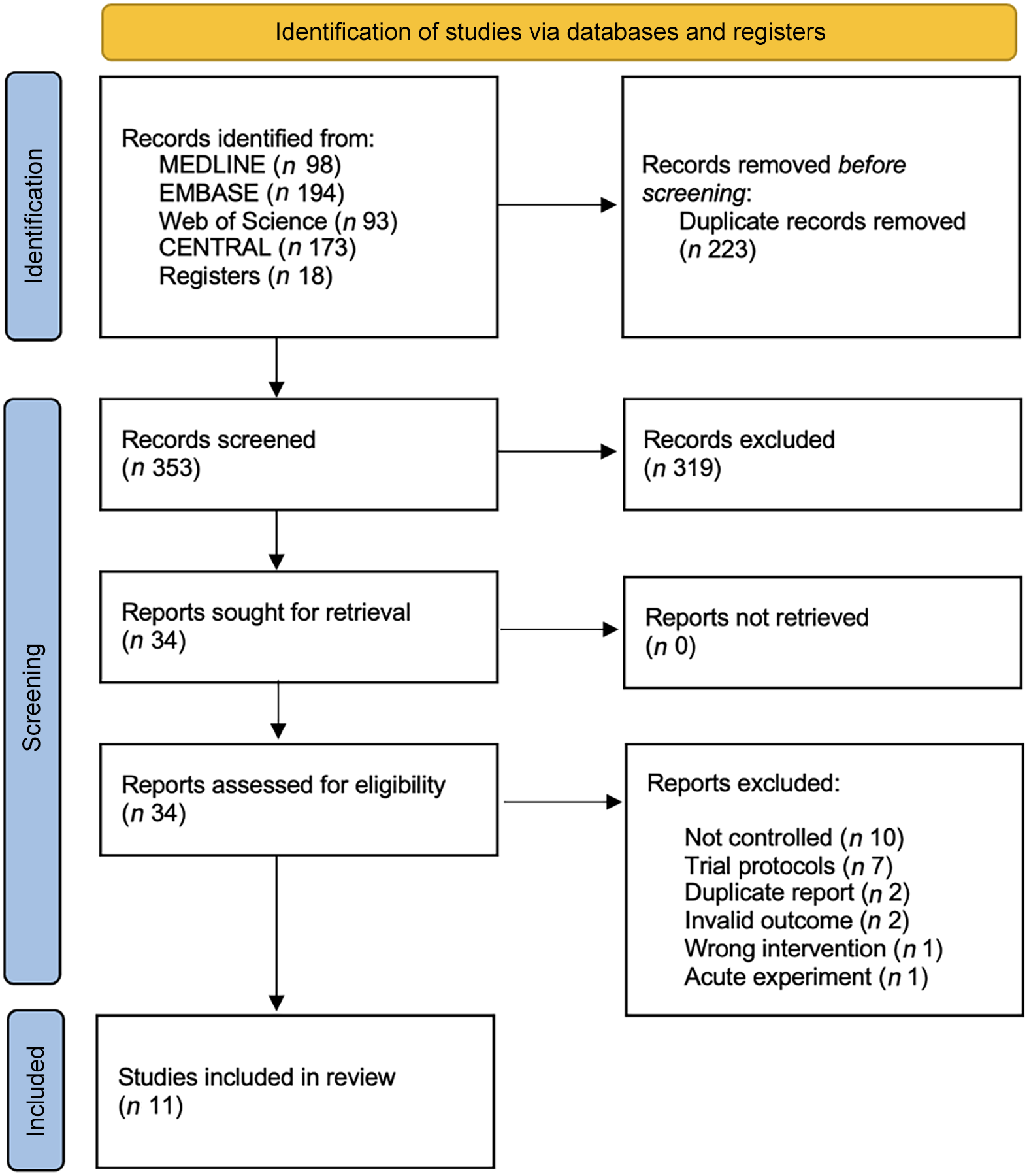
A total of 558 records were identified in our initial search, of which 353 were screened after excluding duplicate records. We subsequently examined the full text of thirty-four potentially eligible studies, of which eleven were included in our systematic review: nine studies from indexed journals(Reference Sherpa, De Giorgi and Ostinelli43–Reference Lyoo, Yoon and Kim51) and two unpublished studies (Kious, 2024; Renshaw, 2024) found on ClinicalTrials.gov. The selection process is presented in Figure 1. A list of all excluded studies is presented in the Appendix.
PRISMA flow chart of the study selection process. PRISMA, Preferred Reporting Items for Systematic Reviews and Meta-Analysis.

Characteristics of the included studies
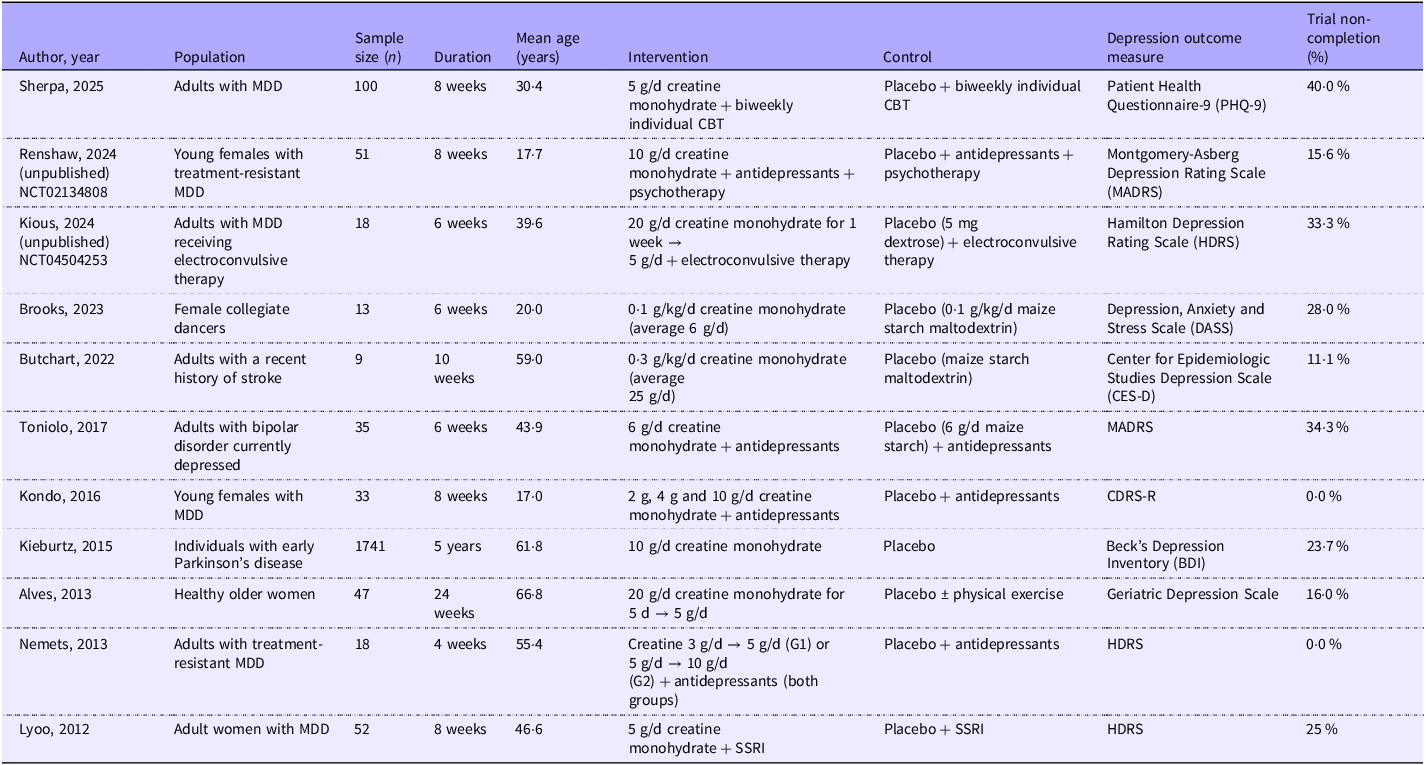
Eleven studies (with 2117 randomised individuals) were included. Most trials were small, with sample sizes ranging from 9 to 100, with the exception of Kieburtz et al., a multicentre trial that randomised 1741 participants. Three studies explicitly self-identified as pilot trials (Nemets, 2013; Toniolo, 2017; Kious, 2024; Sherpa, 2025). Trials were conducted in India (Sherpa, 2025), South Korea (Lyoo, 2012), Israel (Nemets, 2013), Canada (Butchart, 2022), USA (Kieburtz, 2015; Kondo, 2016; Brooks, 2023; Kious, 2024; Renshaw, 2024) and Brazil (Alves, 2013; Toniolo, 2017).
All studies were of parallel-group design comparing creatine to placebo. Creatine was always offered via oral administration, with a median daily dose of 5 g across studies. Only two trials prescribed creatine based on each subject’s body weight (Butchart 2022; Brooks 2023). Two trials (Kondo, 2016; Nemets, 2013) had multiple intervention groups in order to test different doses. Kondo et al. tested three different doses in three groups (2 g, 4 g and 10 g) compared with a single placebo group, while Nemets et al. had two creatine groups (5 g and 10 g) and two placebo groups. Out of all studies, only Nemets et al. implemented a creatine dose titration regimen to reduce the risk of potential adverse events (AE), starting with lower doses of creatine during the first week. In contrast, Kious et al. (2024) implemented a high-dose creatine load of 20 g/d for 1 week, followed by 5 weeks of usual doses (5 g/d). In four studies, both groups received standard pharmacological treatment with antidepressants (Lyoo, 2012; Nemets, 2013; Kondo, 2016; Toniolo, 2017); in one study, both groups received electroconvulsive therapy (Kious, 2024); in one study, both groups received psychotherapy (Sherpa, 2025); and in four studies no additional intervention for depression was offered (Alves, 2013; Kieburtz, 2015; Butchart, 2022; Brooks, 2023). Treatment duration was generally short term, ranging from 4 weeks (Nemets, 2013) to 10 weeks (Butchart, 2022). The exceptions were a 24-week trial (Alves, 2013) and a 5-year trial (Kieburtz, 2015).
Six trials recruited individuals with a diagnosis of an affective disorder (either MDD or bipolar disorder) and the remaining recruited otherwise healthy individuals (Alves, 2013; Kieburtz, 2015; Butchart, 2022; Brooks, 2023); of these studies, one recruited a population with Parkinson’s disease (Kieburtz, 2015). The average participant age in each trial ranged from 17·0 (Kondo, 2016) to 66·8 years old (Alves, 2013). All studies measured depressive symptomatology with appropriate scales, but their choices were highly variable (see Table 1). The most common questionnaire was the HDRS.
Characteristics of the included studies

MDD, major depressive disorder; RCT, randomised controlled trial; CBT, cognitive behavioural therapy; SSRI, selective serotonin reuptake inhibitors.
Funding and material provision
Among the included trials, most (7/11) reported public/academic or non-profit support and four did not report funding. One trial reported industry in-kind involvement (creatine supplied by AlzChem LLC). For most studies, the mode of creatine acquisition was not reported (one in-kind; one brand named without donation stated), and only three trials explicitly stated a funder role (two: no role; one: funder involved). Details by study are provided in the Appendix (online Supplementary Table S10).
Risk of bias assessment
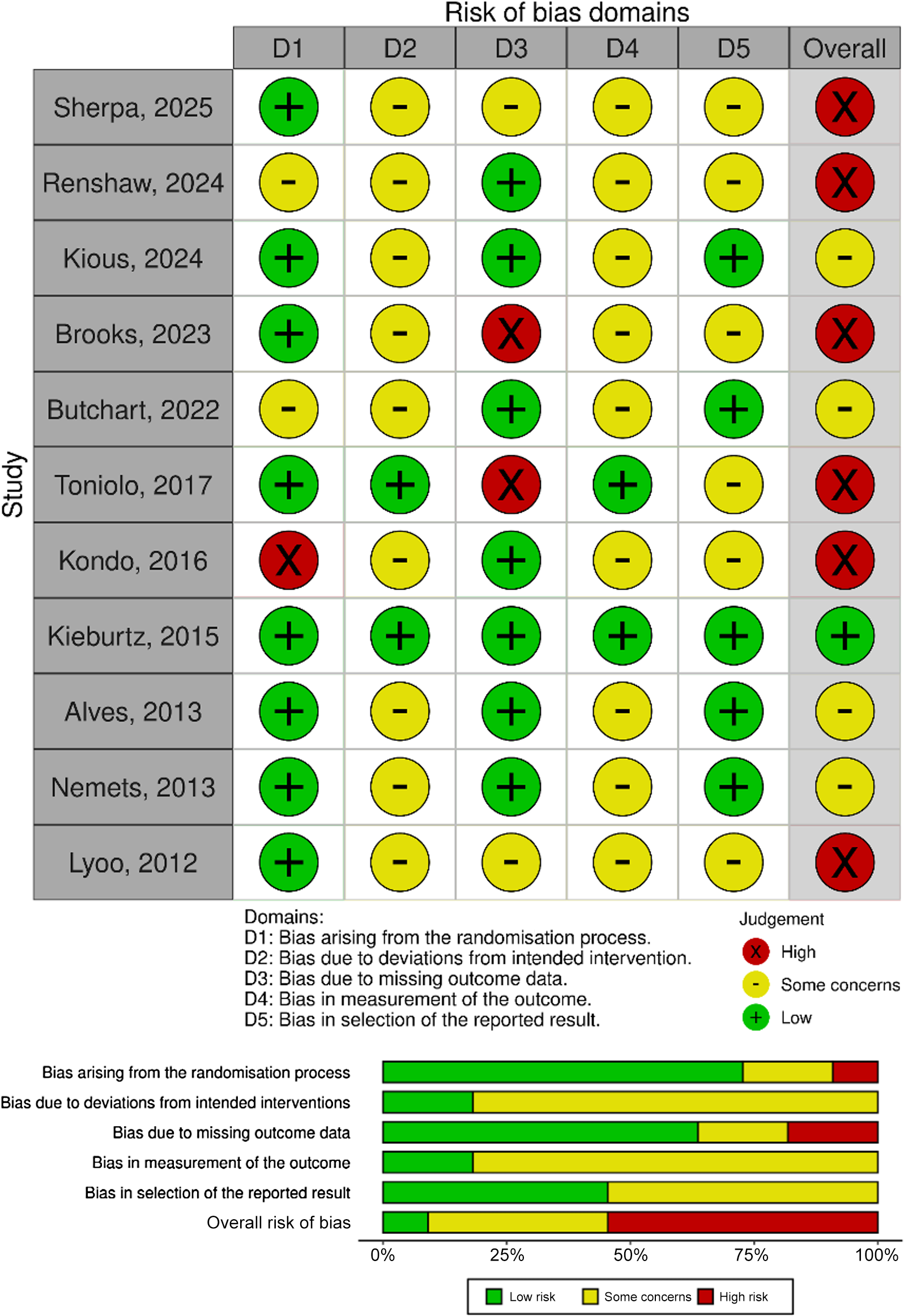
Six studies were judged as overall high risk of bias, and only one trial was judged as low risk of bias (Kieburtz, 2015). The most common concern was related to deviations from intended interventions, especially in trials providing co-interventions, where unbalanced treatments due to chance or unblinding could introduce bias. Measurement bias, particularly due to risk of unblinding, was also a common concern. Eight trials had a pre-registered protocol, of which only one presented a statistical analysis plan with pre-planned methodological decisions such as statistical models, how to deal with missing data and rules for excluding participants from their analyses (Kieburtz, 2015). The overall RoB assessment is presented in Figure 2, and detailed rationale for the judgement of each domain can be found in the Appendix (online Supplementary Table S7).
Risk of bias assessment.

Meta-Analyses
Primary outcome: depressive symptomatology
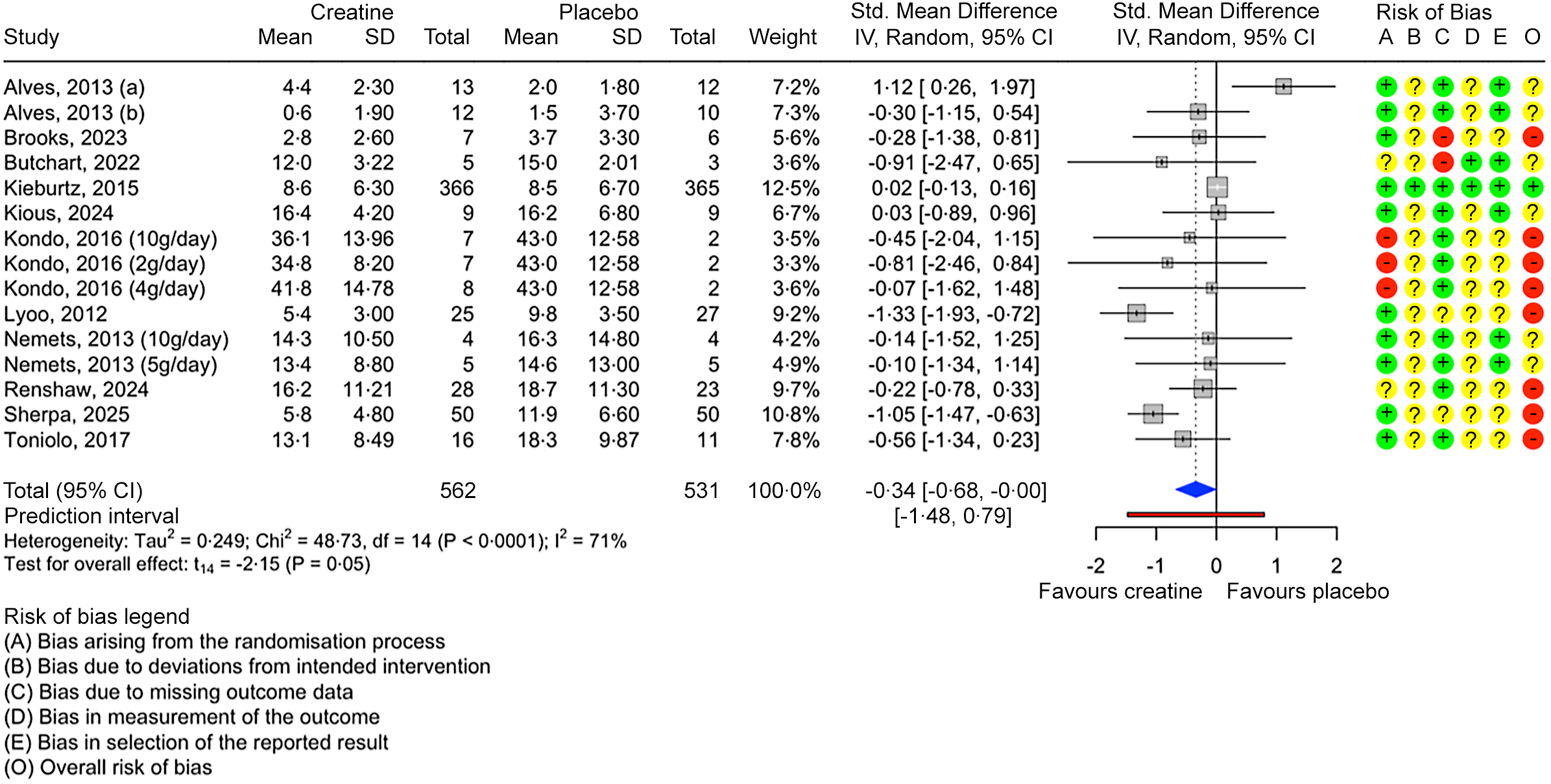
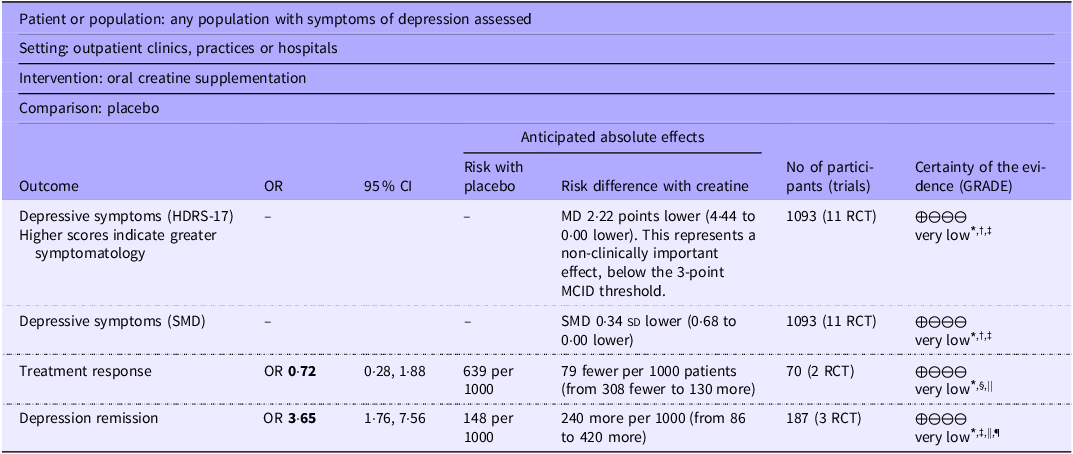
Eleven studies (1093 participants) provided data on depressive symptoms and were included in the analysis. Creatine supplementation was associated with a greater reduction in depressive symptoms compared with placebo (SMD –0·34, 95 % CI −0·6831 to −0·0004, but there was substantial between-study heterogeneity (Figure 3). Using the GRADE criteria, we judged the certainty of the evidence to be very low (Table 2). CI range between large to trivial effect sizes, suggesting uncertainty with regard to its clinical importance. In HDRS units, these results are compatible with a difference of −2·22 (95 % CI −4·4404 to −0·0028).
Forest plot of creatine v. placebo for depressive symptoms as a standardised mean difference.

Summary of findings (SoF) table

GRADE, Grading of Recommendations Assessment, Development, and Evaluation; HDRS-17, Hamilton Rating Scale for Depression; MD, mean difference; MCID, minimal clinically important difference; RCT, randomised controlled trial; SMD, standardised mean difference.
* Downgraded by two levels due to serious risk of bias: most of the contributing studies were judged as high risk of bias.
† Downgraded by two levels due to serious heterogeneity: very high I 2, effect size variability and wide prediction intervals.
‡ Downgraded one level due to imprecision: CI include both clinically relevant and clinically irrelevant benefits.
§ Downgraded by two levels due to serious imprecision: CI include both clinically relevant benefits and clinically relevant harms.
|| Downgraded by one level due to evidence of publication bias caused by selective non-reporting of outcome data.
¶ Downgraded by one level due to heterogeneity: a non-trivial amount of inconsistency was observed with variable effect sizes and wide prediction intervals.
Secondary outcome: remission of depression
Based on two trials (seventy participants), in a fixed-effect meta-analysis model, there was no evidence of a difference in response rates following creatine supplementation compared with placebo: OR 0·72 (95 % CI 0·28, 1·88). CI include the possibility of large benefits and harms (72 % reduction to 88 % increase). Results from random-effects had excessively wide CI (online Supplementary Appendix Figure S1). Using the GRADE criteria, the evidence was judged as very low certainty.
Secondary outcome: treatment response
Based on three trials (187 participants), in a fixed-effect meta-analysis model, results were in favour of creatine supplementation compared with placebo: OR 3·65 (95 % CI 1·76, 7·56), but CI were very wide. Random-effects analysis revealed similar but more imprecise results (95 % CI 0·99, 13·15) (online Supplementary Appendix Figure S1). Using the GRADE criteria, the evidence was also judged as very low certainty.
Secondary outcome: quality of life
Only one study reported quality of life (Kieburtz, 2015), measured by the EuroQOL instrument (EQ-5D). The mean baseline values were 0·8 (±0·2) for both groups. After 5 years, both groups experienced a mean reduction of 0·1 points (representing a non-significant and clinically unimportant 0·005 mean difference between groups; 95 % CI −0·03, 0·04).
Secondary outcome: safety and adverse events
Lyoo et al. (2012) reported similar frequencies of AE between groups (43·4 % v. 46·4 %; P = 0·69). A mild elevation of serum creatinine was observed exclusively in patients receiving creatine (0·79 v. 0·67 mg/dl; P = 0·03). Although not statistically significant, levels of liver enzymes (alanine aminotransferase and aspartate aminotransferase) were also elevated in the creatine group (23·5 v. 20·0 units/l and 23·6 v. 21·6 units/l, respectively). Kieburtz et al. (2015) reported an immediate increase in creatinine levels in the intervention group at the first post-baseline visit, which then stabilised, but no notable changes in other laboratory values over time. Kondo et al. (2016) reported that the AE most commonly affected the placebo group (four out of six individuals), but no information was reported regarding the creatine groups. Small mean differences in serum creatinine were also observed (0·79 v. 0·88 mg/dl in the control group and 10 g/d creatine group, respectively). In Toniolo et al. 2017, the control group reported nearly double the amount of AE in the creatine group (17 v. 33 events). The authors reported that no patient exhibited serum blood urea nitrogen or creatinine levels above the upper limits of normality after 6 weeks of treatment, but data were not shown. Sherpa et al. (2025) reported a total of 127 AE (69 v. 58 in the creatine and placebo groups, respectively). There were a total of twenty-nine reports related to gastrointestinal AE (either constipation or diarrhoea) in the creatine group v. seventeen in the placebo group. Abdominal pain was reported by nine participants in the creatine group v. one in the placebo group. The proportion of other AE was generally similar between groups. No side effects or AE were reported in Nemets 2013, Butchart, 2022 or Brooks, 2023.
Subgroup and meta-regression analyses
Even though the number of studies and overall participants were low, we decided to present additional, exploratory analyses as they still may be somewhat informative. These analyses were conducted only for the primary outcome due to limited data availability. Forest plots are presented in the Appendix (online Supplementary Figure S4–S6).
Subgroup analysis based on risk of bias
There was evidence of smaller effect sizes in depressive symptomatology in studies of lower risk of bias (five trials, SMD: 0·06; 95 % CI −0·38, 0·49) compared with studies of higher risk of bias (six trials, SMD: −0·71; 95 % CI −1·10, −0·32), with statistically significant subgroup differences (P = 0·0016). The heterogeneity within each subgroup was significantly reduced compared with the overall analysis (34·2 % and 28·3 % for the subgroup of higher and lower risk of bias, respectively).
Subgroup analysis based on primary diagnosis of affective disorders
Greater effect sizes were observed in the subset of studies including individuals with a diagnosis of an affective disorder (seven trials, SMD: −0·59; 95 % CI −0·95, −0·22) compared with studies with otherwise healthy participants (four trials, SMD: 0·04, 95 % CI −0·78, 0·86), but the test for subgroup differences was not statistically significant (P = 0·0637). CI for the subgroup with a primary diagnosis of affective disorders were still compatible with both important and non-clinically important effects on the HDRS scale (–6·18 to −1·43).
Subgroup analysis based on creatine as adjuvant v. monotherapy
Results for this subgroup analysis were identical to the subgroup analysis based on primary diagnosis of affective disorders, as the studies that provided creatine as an adjuvant therapy were exactly the same studies that included participants with affective disorders.
Meta-Regression analyses
We found a statistically significant, inverse association between baseline depression scores (standardised from 0 to 100 across different scales) and a favourable effect for creatine (β = −0·0192; P = 0·0132; R2 = 57·99 %). Each ten-point increase in baseline depression score was associated with a 0·19 greater SMD in favour of creatine (equivalent to a 1·25-point reduction in HDRS scale) for improving symptoms of depression. We found no clear evidence of an association between treatment effect and treatment duration (P = 0·3639) or daily creatine dose (P = 0·8257).
Funnel plot
The linear regression test of Egger was not statistically significant (P = 0·2793), but the funnel was somewhat suggestive of an asymmetry (online Supplementary Appendix Figure S2). We explored an additional analysis with the Duval and Tweedie trim-and-fill method, which filled six effect sizes. The bias-corrected estimate was closer to the null (SMD: 0·01; 95 % CI −0·34, 0·37; PI: −1·48 to 1·51) but remained highly heterogeneous (I 2 = 80·8 %).
Sensitivity analyses
We recalculated the results of our meta-analysis fifteen times, each time leaving one study out (online Supplementary Appendix Figure S3). Effect sizes varied from −0·24 (when Lyoo 2012 was omitted) to −0·46 (when Alves 2013 was omitted). These results are consistent with mean reductions in HDRS-17 of 1·56 to 2·99 points. Only two analyses remained statistically significant (when removing Alves 2013 and Kieburtz 2015), but none of the fifteen analyses resulted in clinically important effect estimates. Statistical heterogeneity (I 2) remained moderate to high in every analysis, ranging from 56 % to 73 %. Sensitivity analysis removing both unpublished studies (Kious 2024 and Renshaw 2024) resulted in a non-statistically significant result (SMD: −0·38; 95 % CI −0·78, 0·02). Sensitivity analysis using the DerSimonian and Laird model without the Hartung–Knapp–Sidik–Jonkman adjustment was also not statistically significant (SMD: −0·34; 95 % CI −0·70, 0·01; PI: −1·51 to 0·82; I 2:71·3 %).
Discussion
Summary of the main results
Our meta-analysis included a total of eleven trials involving 1093 participants. The evidence shows statistically significant lower mean depression scores in creatine groups compared with placebo, with imprecise and highly variable results across studies. Mean depressive symptomatology in creatine groups was approximately 2·2 points lower, representing a mean reduction below what is considered as clinically important in HDRS-17 score. CI were compatible with a clinically meaningful effect on the upper end but also included an effect of negligible magnitude on the lower end. The certainty of the evidence was very low (see Certainty of the evidence).
Meta-analysis of treatment response (two trials) suggested no clear evidence of an effect, while in the meta-analysis of depression remission (three trials), the average OR was compatible with substantial benefit. However, these results were highly imprecise and mostly inconclusive due to limited data availability. The certainty of the evidence was also very low.
AE were generally similar between intervention and placebo groups, occurred at an early phase and were reported to have improved without specific interventions. However, most studies did not describe how AE were identified and investigated in sufficient detail. Data reporting was widely variable, which precluded data pooling. In general, there was some evidence of an increased occurrence of gastrointestinal AE and slightly increased serum creatinine associated with creatine supplementation.
Rates of trial non-completion (including dropouts, loss of follow-up, withdrawals and exclusions) were generally high across studies but fairly similar between intervention and placebo groups, with the exception of Toniolo et al., which excluded nearly 40 % of the patients randomised to placebo v. only 6 % of those randomised to the creatine group.
Overall interpretation of the evidence
The evidence for all outcomes is limited and highly heterogeneous, with findings that are imprecise and potentially biased. First, most available studies were very small, single-centre trials. Most of the data in the primary analysis derive from six trials at high risk of bias. The studies available were also highly heterogeneous: we found considerable differences in the type of participants involved, the type of standard care co-interventions, the duration of supplementation and the range of different questionnaires used to measure depressive symptoms. Subgroup analyses were performed in order to reduce statistical heterogeneity and identify potential effect modifiers, but they were limited due to the small number of trials and several shared characteristics at study level (e.g. studies investigating creatine as an adjuvant were also the same studies that recruited individuals with a diagnosis of an affective disorder). Corrected estimates addressing publication bias further suggest that the results of our primary analysis are biased towards a benefit for creatine supplementation.
Studies that did not provide other interventions in addition to creatine tended to result in smaller, non-significant effect sizes. This is consistent with a hypothesis that creatine per se may not provide an additional biological effect but rather enhance the antidepressant effects of other therapies through a particular mechanism (e.g. enhancing reuptake inhibition of monoamines). However, even within the subgroup of trials assessing the effects of creatine as an augmentation agent, results were highly heterogeneous: two trials (Lyoo, 2012; Sherpa, 2025) found very large effect sizes; two trials (Kondo, 2016; Toniolo, 2017) found a moderate effect size; two trials (Nemets, 2013; Renshaw, 2024) found small effect sizes; and one trial (Kious, 2024) found a null result. Trials that used creatine as the only treatment may also have found smaller effects due to other clinical differences (e.g. populations without affective disorders) or simply by chance. In addition, trials offering co-interventions may be at a greater risk of bias due to deviations from intended interventions in case of unblinding or due to small sample sizes, which will be discussed later on. It is currently not possible to determine if the effects of creatine were greater in some trials because (1) they were affected by biases related to unblinding and deviations from intended interventions; (2) creatine is actually effective only in individuals with affective disorders; (3) creatine is actually effective only when used as an adjunctive therapy that augments the efficacy of standard care treatments; or (4) other unknown or unmeasured variables (e.g. average baseline intake of dietary creatine in each study). In general, until more studies with different characteristics and larger samples are conducted, it will be difficult to explain the heterogeneity of effects.
Subgroup analyses showed larger effect sizes in studies at higher risk of bias compared with studies at lower risk of bias, with substantially smaller heterogeneity in each subgroup. These findings are consistent with meta-epidemiological evidence that shows higher risk of bias trials (especially of small sample sizes and single centre) tend to overestimate the effects of interventions(Reference Pildal, Hróbjartsson and Jørgensen52–Reference Dechartres, Trinquart and Boutron54). However, it is important to acknowledge the limitations associated with small amounts of studies within each subgroup, and the fact that all included studies (including those judged as overall ‘some concerns’) shared similar limitations and risk of bias concerns, with the exception of Kieburtz et al. (2015). In addition, most trials at high risk of bias were also trials that studied individuals with affective disorders; thus, it is not possible to clearly determine whether these positive findings are due to bias, real effect, or a combination of both.
Imprecise effect sizes were found for all results, especially for remission and treatment response, due to limited data availability. For our primary outcome, the mean difference was smaller than the minimal clinically important difference selected in our pre-specified protocol (3 points in the HDRS-17 scale). However, CI range from clinically important benefits to practically null effects. While this imprecision alone would not preclude recommendations in favour of creatine supplementation for many individuals, such uncertainty needs to be taken into consideration in conjunction with the currently unexplained heterogeneity, the overall within-study high risk of bias for most trials and small-study effects.
Certainty of the evidence
Using the GRADE criteria, the certainty of the evidence for all outcomes was considered very low due to serious imprecision, serious within-study risk of bias and statistical heterogeneity that remained unexplained after subgroup analyses. We also found evidence to suggest that publication bias is present. Our judgements for each outcome can be found in the Summary of Findings (Table 2).
Much of the evidence (53·5 % weight) of our overall analysis derived from trials at high risk of bias, for which the certainty of the evidence was downgraded by two levels. The most critical limitation of the published clinical trials is the lack of adequate methods to control for and/or identify potentially unbalanced co-interventions. For ethical reasons, studies on individuals with psychiatric diagnoses will typically receive creatine as an adjuvant (not monotherapy). Theoretically, when two groups receive the same treatments, it is possible to estimate the effect of an adjuvant intervention by prescribing it to one group while giving placebo to another. For instance, in Lyoo et al., as all patients received selective serotonin reuptake inhibitor, any difference between groups could be attributable to creatine. However, this inference is only acceptable as long as it is reasonable to assume that the selective serotonin reuptake inhibitor treatment was equally safe and effective in both groups (i.e. they would have ended up with no differences in symptoms had they not received an additional treatment). For that to be true, patients in both groups should be equally tolerating and benefitting from the standard care and receiving the same opportunities for successfully optimising it. While randomisation can provide such isonomy in theory, it does not always work in practice. An example of this can be found in Toniolo 2017, where thirty-five patients were randomised to two groups (17 v. 18 patients). Soon after randomisation, three patients in the placebo group were lost, while three other patients in the placebo group changed medications in a way that deviated from the study protocol. In the creatine group, two patients presented worsening of their clinical depression and were excluded from the trial. Within 2 weeks, possibly due to chance, > 22 % of the study sample presented issues in an unbalanced manner, which may have biased the results in favour of the intervention. Many other issues in real life that affect depressive symptoms may not even be identified by (or reported to) the investigators, such as non-responsiveness or non-compliance to pharmacological/psychological treatments. Adequate randomisation creates groups with fairly similar prognosis at baseline, but unintended deviations and life events may ensue unpredictably during treatment period. Most of the currently available trials are very small, where participants in one group may end up having better prognosis simply due to chance, even after a perfectly randomised allocation. Future trials should be performed with larger sample sizes and consider implementing a run-in period before treatment allocation for accomodation/familiarisation with the standard care and study procedures, effectively reducing the risk of bias due to potential post-randomisation deviations.
Another issue in creatine trials, particularly for subjective outcomes (such as depressive symptomatology), is the risk of unblinding during the treatment period(Reference Moustgaard, Clayton and Jones55). Creatine, especially in high doses, may provoke mild and transient gastrointestinal side effects that could influence participants’ perception of what treatment is being received. If those assigned to creatine report minor side effects more frequently to caregivers and/or outcome assessors, it may amplify biases related to deviations from intended interventions and/or introduce bias in the measurement of the outcomes due to unblinding. Creatine supplementation may also lead to benign changes in biochemical tests, especially serum creatinine levels. If patients, caregivers and/or outcome assessors are aware of the results from their biochemical tests, they may be able to tell apart patients receiving creatine and those receiving placebo, partially or totally breaking study blinding. Trialists can easily avoid this issue by blinding patients and study personnel to the results of biochemical tests; recommending patients to not take out-of-study blood tests; and have dedicated investigators (other than caregivers and outcome assessors) to handle biochemical data. Unfortunately, only one study included in this review has taken such precautions (Kieburtz, 2015).
Our interpretation of the funnel plot was suggestive of an asymmetry, with small to moderately sized trials showing unfavourable (or less favourable) results potentially missing. Indeed, we found several records of clinical trials that were terminated, withdrawn or completed but not published (online Supplementary Appendix Table S9) – which are typically associated with smaller treatment effects than published trials(Reference Hopewell, McDonald and Clarke56). We explored an additional analysis to address publication bias with the trim-and-fill method, which provided results much consistent with a null effect (SMD: 0·01; 95 % CI –0·34, 0·37), with CI excluding clinically important differences in the HDRS scale. Overall, the trim-and-fill method indicated that the pooled SMD of –0·34 in our main analysis is probably overestimated due to small-study effects, and the real effect may be considerably smaller. Of note, although publication bias can lead to an asymmetrical funnel plot, there are also other causes that may produce similar patterns(Reference Doleman, Borlase and Leonardi-Bee57). Differences in study populations, treatment duration, effectiveness of co-interventions and risk of bias between smaller v. larger trials may have contributed to the observed asymmetry. It is also possible that funnel plot asymmetry simply occurs by chance, especially when there are few trials. For those reasons, we decided to take a conservative approach in our GRADE assessment and not downgrade the certainty in our primary outcome due to publication bias. However, the data unavailability that led to non-inclusion of several studies in our meta-analyses of secondary outcomes was considered as a clear reason for downgrading the certainty of evidence by at least one level.
In summary, the evidence for all outcomes was considered as of very low certainty. Currently, available body of evidence is composed of limited, predominantly small single-centre trials, within which there was substantial heterogeneity that remains unexplained even after subgroup analyses. In addition, the fact that much of the contributing data derived from studies at high risk of bias suggests considerable need for caution.
Potential biases in the review process
This is the first systematic review of creatine supplementation for treating symptoms of depression. We restricted our inclusion to randomised trials, thoroughly searched for unpublished studies (leading to the inclusion of two additional trials), provided formal quantitative syntheses of the available trials, performed plausible pre-specified subgroup analyses and presented transparent assessments of the certainty of the evidence and risk of bias. This review was strictly based on the most up-to-date Cochrane recommendations, followed a pre-specified protocol and adhered to PRISMA guidelines for appropriate reporting. However, as with any systematic review, the findings of our study are as reliable as the extent of which the available evidence contributes to our analyses. For secondary outcomes, only a very limited number of studies reported usable data. For our primary outcome, the available evidence is limited mainly due to the substantial influence of trials at high risk of bias and the small number of studies. Outcome reporting did not always follow a pre-specified protocol registration, and we relied heavily on available information within the manuscripts, meaning that biases due to selective reporting are possibly present. Our database searches were probably more likely to detect articles published in English and in peer-reviewed, indexed journals. It is also possible that our searches did not find closed-access articles that mentioned terms related to depressive symptoms only in the full text. In order to minimise these issues, we also performed searches in Google Scholar, grey literature databases such as OpenGrey and preprint servers, and avoided restricting our searches to title and abstract fields. Regarding our meta-analyses, studies were combined regardless of differences in study methodology and sample characteristics, as our review intended to answer a broad clinical question regarding the effects of creatine supplementation on improving symptoms of depression, which may have resulted in statistical heterogeneity. We performed subgroup analyses to identify effect modifiers and provide explanations for heterogeneity; however, the paucity of data and co-existing study-level characteristics of key potential variables (e.g. subgroups of ‘diagnosis of mood disorder’ and ‘creatine as adjuvant therapy’ were composed of exactly the same studies) are challenging to interpret. Thus, caution is warranted in extrapolating from our subgroup analyses before more trials are available.
Agreements and disagreements with other studies or reviews
There are many published non-systematic reviews on the potential effects of creatine supplementation for a number of clinical conditions and outcomes related to brain health, including cognitive processing, psychiatric disorders, dementia and traumatic brain injury(Reference Kious, Kondo and Renshaw10,Reference Candow, Forbes and Ostojic58,Reference Forbes, Cordingley and Cornish59) . In reviews where depression or its symptoms have been discussed, there were no attempts to implement systematic methods for study retrieval, study selection or a qualitative critical appraisal through appropriate risk of bias tools and GRADE criteria. Previous reviews have only narratively explored the results of a few published trials, along with discussions of potential biological mechanisms through which the intervention could work, and generally concluded that the evidence is promising. In some cases, authors have even stated that ‘significant evidence’ exists of its effectiveness for treatment-resistant depression(Reference Balestrino and Adriano60). In contrast, we present a more complete dataset of published and unpublished studies, and our analyses suggest that current evidence is largely consistent with non-clinically important benefits, which are likely to be biased towards creatine therapy due to publication bias and within-study risk of bias.
We were surprised to not have found Kieburtz et al. (2015) cited (or thoroughly discussed) in many of the previously published reviews(Reference Pazini, Cunha and Rodrigues12,Reference Avgerinos, Spyrou and Mantzoros61–Reference Turner, Byblow and Gant63) , considering it is a high-quality, adequately powered multicentre randomised trial. On the other hand, often-cited studies include single-arm, non-randomised, open-label small trials inherently at high risk of bias due to regression to the mean, spontaneous improvements and many other confounding factors(Reference Hellem, Sung and Shi64–Reference Roitman, Green and Osher66). Improvements in these single-arm trials may be completely attributable to several factors associated with placebo response(Reference Arnold, Murphy-Smith and Ng67). Importantly, Kieburtz et al. (2015) should be considered a design model for future trials as it was the only study that implemented important methodological precautions that effectively preserved its internal validity, mainly related to its pre-specified statistical analysis plan and proper blinding to the results of biochemical tests; however, we have not found such key recommendation for future trials in previous reviews. Similarly, a multicentre trial creatine supplementation for Huntington disease including 553 participants (the CREST-E (Creatine Safety, Tolerability, & Efficacy in Huntington’s Disease) study) has also taken necessary (but rarely seen) precautions to maintain study blinding(Reference Hersch, Schifitto and Oakes68). The authors instituted random suspensions to help mask suspensions due to true elevations caused by creatine metabolism and redacting potentially unblinding creatinine results, which were only visible to the clinical monitor. However, they recognise that AEs or other factors may have enabled some correct guessing about treatment assignment, which could also explain the positive results in small trials included in our systematic review (especially those at high risk of bias).
Implications for practice
Previous clinical guidelines regarding the use of nutraceuticals and phytoceuticals have not recommended creatine supplementation for adjunctive or monotherapy in MDD, mainly due to lack of convincing evidence of benefit(Reference Sarris, Ravindran and Yatham16). In the WFSBP (World Federation of Societies of Biological Psychiatry) and CANMAT (Canadian Network for Mood and Anxiety Treatments) guidelines, only two trials were cited (Lyoo, 2012; Nemets, 2013), and no systematic review of the literature was available. Many published non-systematic reviews have optimistically discussed potential benefits of creatine, usually over-emphasising the results of positive randomised and non-randomised trials. Our analyses otherwise suggest that the available data is consistent with non-clinically beneficial (or null) effects, based on very uncertain evidence. The average treatment effect was found to be approximately 2·2 points on the HDRS-17 scale, which can be undetectable by clinicians(Reference Leucht, Fennema and Engel69) and lies below the assumed minimally clinically relevant effect. While CI do not exclude the possibility of an important benefit, there is considerable need for caution. Subgroup analyses based on risk of bias and trim-and-fill estimates have suggested that our main results are likely biased towards a positive finding of creatine supplementation, meaning that the true effect is probably smaller than observed. It is possible that creatine could be effective for specific subset of patients (e.g. as an adjunct therapy to individuals with a diagnosis of an affective disorder), but five out of the seven trials addressing this population are at high risk of bias, and pooled results in this subgroup were highly heterogeneous and imprecise, suggesting effects consistent with both clinically important and unimportant effects. Concerns regarding harms are low, and it is unlikely that creatine would increase depressive symptoms; however, failure to seek for or adhere to conventional treatments can be unintended consequences of treatment with therapies such as creatine, representing a potentially dangerous opportunity cost.
Implications for research
More adequately powered, well-designed studies are required to improve our assessment of the efficacy of creatine on depressive symptoms and to understand the heterogeneity between-study effects. It is important that future studies are performed in a way that overcomes limitations and biases in the available trials. Recently, guidelines on trial design, conduct and reporting in nutritional psychiatry have been published with key recommendations that should be incorporated in future studies of creatine for depression(Reference Marx, Visser and Wallace70). Our evaluation suggests a need for a more careful consideration regarding the isonomy of background treatments (e.g. antidepressants and/or psychotherapy) to reduce the risk of bias related to unbalanced co-interventions between groups typically associated with unblinding and small samples. Adding a run-in period prior to randomisation will also help in this sense, with the added benefit of improving trial retention rates. Using a creatine dose titration, as seen in Nemets et al. (2013), may also be considered in order to minimise differences in side effects that could potentially subvert study blinding. Furthermore, concerns regarding blinding integrity related to the knowledge of biochemical tests can also be reduced by following the methodological approach of Kieburtz et al. (2015) and Hersch et al. (2017). Finally, studies should be performed according to a detailed, pre-specified statistical analysis plan, publicly shared in online platforms such as ClinicalTrials.gov. More precise and complete reporting will also be extremely valuable for future meta-analyses, risk of bias assessments and overall interpretation of the evidence.
Supplementary material
For supplementary material/s referred to in this article, please visit https://doi.org/10.1017/S0007114525105588
Acknowledgements
The authors acknowledge the support of the Coordenação de Aperfeiçoamento de Pessoal de Nível Superior (CAPES, Brazil) – the Brazilian Federal Agency for Support and Evaluation of Graduate Education – which provides institutional access to full-text articles for researchers and students associated with Universidade Federal do Rio Grande do Sul (UFRGS). CAPES and UFRGS had no role in the study design, data collection/analysis, interpretation, writing or the decision to submit this manuscript.
This research received no specific grant from any funding agency, commercial or not-for-profit sectors.
I. E. and J. L. designed and conceptualised this work; J. L. and A. D. contributed to the acquisition of data; I. E. performed data analyses and drafted the work; I. E., J. L. and A. D. have contributed to the interpretation of the data; I. E., J. L. and A. D. have critically reviewed the draft for important intellectual content. All authors have approved the final manuscript version to be published. All authors agree to be accountable for all aspects of the work in ensuring that questions related to the accuracy or integrity of any part of the work are appropriately investigated and resolved.
All authors (I. E., J. L. and A. D.) declare no conflicts of interest related to this work.