At the beginning of the 16th century, Niccolò Machiavelli, in his political treatise “The Prince,” maintained that, during a storm, the overflowing impetuous river could destroy everything in its path, and that a good governor was one who built banks in calmer times. 1 Following a natural or manmade disaster, patients present to local hospitals, whose emergency departments (EDs) are often chronically overcrowded.Reference Schneider, Gallery and Schafermeyer 2 Additionally, the hospital itself can be damaged by the disaster or itself suffer a major incident like fire, power, and telecommunication breakdown.Reference Salamati Nia and Kulatunga 3 , Reference Dami, Carron and Yersin 4 The 2 key determinants required to minimize the impact of those events are the existence of a disaster plan and regular training through simulation exercises,Reference Hirsch, Carli and Nizard 5 , Reference Russo, Galante and Jacoby 6 as demonstrated recently during the bombing of the Boston Marathon (2013) and the Paris attacks in 2015.Reference Hirsch, Carli and Nizard 5 , Reference Landman, Teich and Pruitt 7 Since the terrorist attacks on September 11, 2001, in New York, drills have become part of the National Bioterrorism Hospital Preparedness Plan in the United States,Reference McIsaac 8 and the Federal state incites simulation development and provides financial support and coordination.Reference De Lorenzo 9 , Reference Barbera, Yeatts and Macintyre 10
Switzerland is a federation of 26 states. As in the United States or in Germany,Reference Domres, Schauwecker and Rohrmann 11 the health care system is fragmented and highly decentralized. Each state is sovereign to rule on hospital disaster preparedness legislation.Reference Wyss and Lorenz 12 There is no national, legally binding medical standard,Reference Osterwalder 13 except for pandemic crises, 14 infectious diseases such as the human immunodeficiency virus/acquired immunodeficiency syndrome (HIV/AIDS), vaccines,Reference Wyss and Lorenz 12 and nuclear incidents. 15 Switzerland is among the richest countries in the worldReference Wyss and Lorenz 12 and has a system of public health surpassed only by the United States in per capita costs. 16 However, disaster preparedness is costly to achieve and maintain for hospitals, with costs ranging from 1 to more than 3 million dollars per hospital in the United States.Reference De Lorenzo 9 , Reference Petinaux 17 Furthermore, for-profit, privately funded hospitals are more exposed to competition in the hospital or insurance markets than public institutions,Reference Wyss and Lorenz 12 and some data suggest that their level of preparedness may be less efficient.Reference Mahdaviazad and Abdolahifar 18
In 2006, only 82% of Swiss hospitals had a disaster plan following a national survey.Reference Dami, Yersin and Hirzel 19 Many hospitals have since updated their disaster plan, in particular, since Switzerland co-hosted the Eurofoot in 2008. Unlike in the United States, however, there is neither financial support nor coordination to organize drills on a national level within Switzerland.
The main objective of this study was to compare the proportion of hospitals with a disaster plan in 2016 with the proportion in 2006. Secondary objectives were to assess the type of risks that hospitals were prepared for, and their declared level of preparedness.
MATERIALS AND METHODS
Because no validated questionnaire exists in the literature, a specific questionnaire was prepared for this survey, based on the main criteria of hospital disaster preparedness identified in a review of the literature. Queries from the 2006 survey were included to allow for comparisons with our initial survey. An e-mail invitation to participate was sent to all heads of EDs if the ED was hospital-based and open on a 24/7 basis. The list of participating hospitals from the last survey was updated with data from the Federal Office of Public Health. Hospital-based EDs admitting adult as well as pediatric patients were included. Specialty EDs dedicated only to ophthalmology or psychiatry were excluded on account of their highly specialized structures and technical capabilities. In the case of multisite hospital EDs, the head of the ED decided either to consider the hospital as a single hospital or as several hospitals. Pediatric ED plans were considered only if they were different from the adult ED.
Compared to the 2006 paper format questionnaire, digital format was used this time using the online platform SurveyMonkey. It is quicker and easier to answer because it allows to skip unnecessary questions. This may offer a higher response rate. In addition, data are transferred directly to an Excel sheet, thus avoiding any transcription errors. If no answer was received, as in 2006, a letter containing the questionnaire in paper format was sent. The time frame of the study as well as actions to spur compliance (reminders) were similar in the 2 studies. Data collection was conducted from May to December 2016.
The Human Research Ethics Committee of the State of Vaud, Switzerland, was consulted; however, because no data from patients were processed, no further documentation was required.
Statistical Analysis
Statistical analyses were performed using Stata 14.1 (StataCorp, College Station, TX). Data are presented as mean ± SD, median and interquartile (IQR) range, or as percentages. Proportions were compared using the chi-square test or Fisher exact test, and means using unpaired student’s t-test or Wilcoxon rank sum test, as appropriate. A bilateral P value of<0.05 was considered statistically significant. Missing data were not imputed.
RESULTS
In 2016, there were 107 hospitals (138 in 2006) open 24/7, which equates to 26 hospitals/10,000 km2. Of those, 83 (78%) hospitals completed the questionnaire, with a rate that was similar to the 78% reported in the 2006 study. In 2006, 89 (82%) hospitals had a disaster plan in case of a mass casualty incident; this increased to 92% in 2016 (P=0.088). Public hospitals more frequently had a disaster plan than private ones in 2006 (P=0.017), and, although a difference still existed in 2016 (94% for public hospital vs. 80% for private ones), it was no longer statistically significant (P=0.107). The number of hospital beds was not associated with the existence of a disaster plan in both study periods. In 2006, there were no statistically significant differences in the percentage of disaster plans between the three main linguistic parts of the country. In 2016, however, we noticed that the French part of Switzerland had a significantly lower proportion of hospitals with disaster plans (P=0.040). As in 2006, all university hospitals that responded had a plan in 2016 (Table 1).
Hospitals’ Characteristics: 2006 vs. 2016

ED=emergency department.
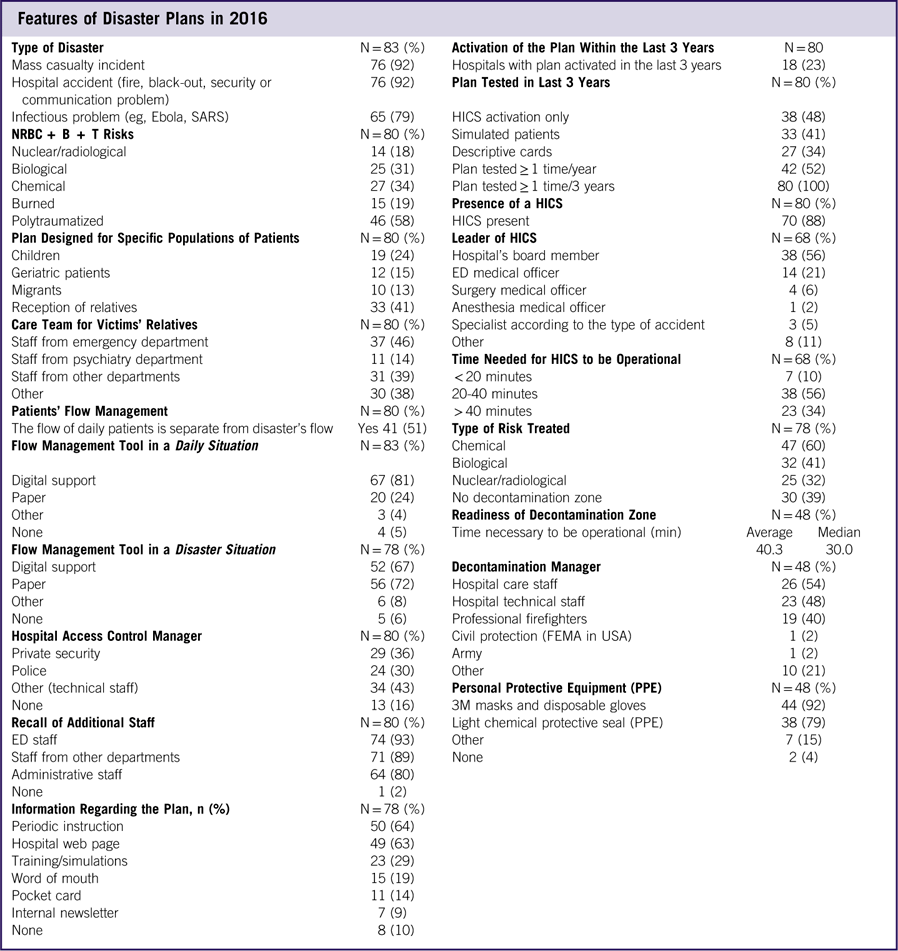
Disaster Plan Features in 2016 (Table 2)
Most hospitals had a plan in case of a mass casualty incident or in the case of an accident within the hospital itself (76; 92%). Plans regarding casualties of specific types of disasters were present in the following proportions: polytrauma (n=46; 58%), chemical (n=27; 34%), biological (n=25; 31%), nuclear/radiological (n=14; 18%), and burns (n=15; 19%). Plans addressing the needs of specific types of patients existed in a minority of hospitals: children (n=19; 24%), elderly (n=12; 15%), and migrants (n=10; 13%).
The control of hospital ED access was performed in 34 (43%) hospitals by its own technical staff, by private security services in 29 (36%), and by police forces in 24 (30%). Most hospitals (n=41; 51%) planned to separate the flow of daily patients from that of the disaster. Regarding the patient flow management, 67 (81%) hospitals used digital support on a daily basis, whereas 52 (67%) would still use such support during a disaster situation. In 79 (98%) hospitals, the plan anticipated the potential recall of additional staff; in 74 hospitals (93%), the recalled staff were from the ED, whereas in 71 (89%) hospitals, staff from other departments were likely to be recalled. Finally, 64 (80%) hospitals could also recall administrative staff.
Plan Knowledge, Learning, and Drills
In most cases, the medical staff was informed about the plan through periodic instruction (n=50; 64%) or by consulting the hospital website (n=49; 63%). Word-of-mouth (n=15; 19%) and pocket card (n=11; 14%) were also reported means of communication. Half of the hospitals (n=42; 52%) performed at least 1 simulation drill per year, whereas all hospitals organized at least 1 exercise per a 3-year period. The most frequently used drill mode was activation of the hospital incident command system (HICS) alone (n=38; 48%). The use of simulated patients (n=33; 41%) and cards (n=27; 34%) was less frequent (Table 2).
Features of Disaster Plans in 2016

ED=emergency department; FEMA=Federal Emergency Management Agency; HICS=hospital incident command system.
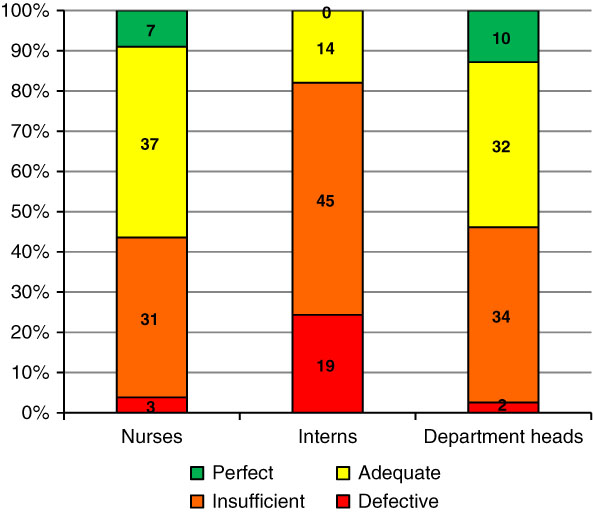
Degree of Awareness of the Plan From the Staff According to the Heads of EDs.

Hospital Incident Command System (HICS) (Table 2)
Most hospitals (n=70; 88%) had a HICS, the leader of which was a member of the hospital management (n=38; 56%) or the medical officer of the ED (14; 21%), in most cases. The majority (n=38; 56%) estimated the time necessary for the HICS to be operational to be 20 to 40 minutes.
Decontamination (Table 2)
Sixty percent of hospitals (n=47) had a decontamination zone for a chemical accident, 32 (41%) had one for a biological accident, 25 (32%) for a nuclear one, and 30 (39%) had no decontamination zone. The decontamination area was operational within 40 ± 25 minutes on average, with a median time of 30 minutes (IQR 60-20). The medical staff was responsible for decontamination in 26 (54%) hospitals, the hospital technical staff in 23 (48%), and firefighters in 19 (40%). Among hospitals equipped with a decontamination zone, 44 (92%) reported having protective masks with disposable gloves, and 38 (79%) reported providing lightweight chemical protection (personal protective equipment [PPE]).
Plan Development
Most of hospitals (46; 58%) had developed their plan through States’ coordination, and 29 (36%) with other hospitals in their region (Annex 1). Rescue agencies were also involved in the development of the disaster plan: emergency medical services (EMS) in 43 (54%) situations, firefighters in 33 (41%), and the police in 23 (29%). The Federal state and its entities (Army, Federal Office for the Protection of Population) cooperated in less than 10% of the disaster plan developments. In half of the cases (39; 49%), the Federal state required hospitals to develop a disaster plan, but, more frequently, the disaster plan development resulted from the initiative of a sole executive of the hospital (n=30; 38%) or due to preparation for an important event in the region (19; 24%) (Annex 2).
DISCUSSION
This study is the first to provide a comprehensive analysis of the evolution of the disaster and in-hospital event preparedness of Swiss hospitals. We noticed a decrease in the total number of disaster plans in 2016. This can be explained by the decrease in the number of eligible hospitals; in 2016, multisite hospital EDs with the same disaster plan were often counted as one. This phenomenon mainly affected the French region, which may explain the absolute reduction of disaster plans in this part of the country.
However, compared with 2006, the proportion of hospitals with a disaster plan in case of a mass casualty incident in 2016 had increased to 92%. In 2012, in a similar survey covering the European Union, a rate of 82% covering the same risk was reported.Reference Djalali, Della Corte and Foletti 20 All university hospitals have a plan; the size of the hospital does not seem to affect the presence of a plan.
The general structure of the disaster plan (HICS activation, staff recall, management of patient flows) is similar for different incidents.Reference Born, Briggs and Ciraulo 21 However, other elements such as type of care, triage, decontamination, or material used are definite to each type of incident and need specific plans and simulations, in particular, for NRBC + B situations.Reference Koenig, Boatright and Hancock 22 Furthermore, the age of the victims can influence the type of treatment. 23
The 2015 Swiss Federal Office for the Protection of Population report approximates that severe chemical or biological accidents may occur more than once in 100 years, nuclear accidents once in 30,000 years, and that international events of a social nature (eg, terrorist attacks with NRBC) are impossible to estimate. 24 When these disasters occur, decontamination is indispensable to prevent the spread of toxic agents in the hospital, thereby contaminating both patients and staff.Reference Koenig, Boatright and Hancock 22 In this research, only half of hospitals had a decontamination area, only a third had a specific plan for NRBC + B patients, and another third had no decontamination area at all. This is a major weakness because decontamination is not always done at the site of the accident. Furthermore, walking-wounded patients often bypass on-site treatment and decontamination stations to go directly to the nearest hospitals.Reference Auf der Heide 25 In a similar study conducted in 2012 in Europe, 70% of hospitals had a specific plan dedicated to chemical incidents,Reference Djalali, Della Corte and Foletti 20 whereas, in another study conducted in 2008 in the United States, 67% of hospitals from the sample had response plans for all 6 categories of expected incidents.Reference Niska and Shimizu 26 The 2016 questionnaire did not investigate whether hospitals had developed a plan for the Ebola outbreak.
Most hospitals believed that the decontamination area should be handled by care staff or by firefighters, but health care providers may not be properly trained and already busy in other tasks, with firefighters deployed at the accident site.Reference Barbera, Yeatts and Macintyre 10 Another issue is the time needed to set up an operational decontamination area (30-40 minutes), while the first patients may arrive in the ED within 5-30 minutes.Reference Powers 27 Contaminated patients could contaminate equipment and the ED staff if they are not adequately protected. Our results in NRBC + B disaster preparedness are therefore worrying. As noted by Noto (1994), despite that pure NRBC + B incidents are rare, a disaster can include NRBC + B components with related casualties; therefore, NRBC + B victims are more frequent than expected.Reference Noto, Huguenard and Larcan 28 However, this survey shows that basic PPE and protective masks are available in most hospitals in a proportion similar to a recent survey of chemical hazard preparedness in hospitals in Michigan,Reference Belsky, Klausner and Karson 29 and as proposed by Koenig et al.Reference Koenig, Boatright and Hancock 22
Disaster plans specifically designed for particular populations of patients (elderly, children, migrants) have already proven their benefits.Reference Mace and Bern 30 , Reference Burke, Bethel and Britt 31 However, most Swiss hospitals do not have such plans. As a fifth of the population is over 65 years old with a projection of more than a quarter in 2030, 32 an awareness of the lack of a dedicated plan is a first step toward preparing better Swiss hospitals ourselves. Similarly, children are often involved in disasters, and their health needs may be specific. Foltin et al. recommended that children should be given primary transport to pediatric centers; however, if this is not possible, general hospitals that normally deal with adults should have plans in place to adequately take care of children. Pediatric exercises, equipment, and expertise are therefore essential in every hospital. 23
In case of disasters, the presence of a care team for patients’ families is essential.Reference Noto, Huguenard and Larcan 28 This enables the ED to focus exclusively on patient care. Most hospitals report not having such resources, whereas half consider the care of victims’ relatives to be an ED task.
During a major disaster, it is often necessary to call for additional staffReference Schultz and Stratton 33 ; most hospitals have such a plan. However, regarding the size of Switzerland and its borders, staff may live in another country, where borders may be closed for security reasons (terrorism, natural disaster). This eventuality must be considered. A difficulty that could also arise is the arrival of volunteers not included in the disaster plan, general practitioners, or medical students, for example, who are not familiar with the plan nor the hospital’s operations; they could be more of a hindrance than an asset.Reference Somers, Maxfield and Drinkwater 34 , Reference Mortelmans, Bouman and Gaakeer 35
Knowledge of the Disaster Plan
Interns seem to be the least prepared professional category (Figure 1). This may be explained by the short periods that interns experience in the ED in Switzerland; there is not enough time to participate to the drills nor to learn the procedures when dealing with a major incident. A 2013 Germany survey showed similar results, with only 53% of physicians knowing that there is a plan in their hospital.Reference Fischer, Wafaisade and Neugebauer 36
Only half of hospitals perform at least 1 simulation per year while they all declare to go through at least 1 exercise every 3 years. As suggested by many, the retention of knowledge regarding disaster plan rules is directly related to the time since the last training session.Reference Powers 37 Additionally, 69% of hospitals that normally use digital support in a daily situation will use paper support in a disaster situation. More frequent exercises are therefore essential to accustom the staff to this important change. Unfortunately, the lack of tangible immediate benefits makes it difficult to justify those drills, especially when time, structures, and money are limited.Reference Barbera, Yeatts and Macintyre 10 In addition, the chronic shortage of care staff makes the participation of key workers in simulations, rather than their use for daily management duty, difficult. On the other hand, poor management of a disaster can result in poor publicity for the hospital, a more serious psychological impact of the disaster on employees and patients, and even lead to the closure of the hospital.Reference Barbera, Yeatts and Macintyre 10 These factors therefore contribute to heterogeneity in the degree of disaster preparedness. One possible solution is the joint conception of disaster plans between hospitals.Reference Barbera, Yeatts and Macintyre 10 Interestingly, unlike the rest of Switzerland, all hospitals in the Italian-speaking region have developed a plan through regional coordination. This probably explains the widespread uniformity of responses among hospitals of the Italian-speaking region with a disaster plan rate that reaches 100%.
According to Barbera et al. (2009), an additional factor that promotes hospital disaster preparedness is the presence of federal funding and guidance.Reference Barbera, Yeatts and Macintyre 10 The Swiss Federal Office for the Protection of Population supports the state’s prehospital organizations (EMS, police, firefighters, Civil Protection, Army) to exercise their disasters plans.Reference Guggisberg and Herren 38 However, this support does not extend to hospitals that are under the state’s responsibility only.Reference Wyss and Lorenz 12 Half of all hospitals declare that their state obliges them to develop a plan, while a minority even declares that they developed a plan because of Federal obligation. However, such obligation does not exist. Unlike in the United States, there is neither federal nor state financial support for hospitals to organize drills in Switzerland. This lack of national coordination and funding induces a large heterogeneity in the degree of achievement of disaster plans and their testing within hospitals.
LIMITATIONS
Only 78% of eligible hospitals participated in the survey; because there are no data from non-responding hospitals, we cannot assess whether their characteristics differed significantly. We have identified 53 determinants of disaster preparedness from a medical perspective based on the literature. However, we have not investigated other aspects of disaster preparedness such as administrative or logistics preparedness. The invitation to complete the questionnaire was sent to the heads of the Swiss emergency services. The answers obtained reflect their knowledge and not necessarily the reality of the plan.
CONCLUSION
The 2006-2016 analysis of Swiss hospital disaster preparedness shows improvements, with 92% of hospitals declaring having a plan in the case of a mass casualty incident. However, some specific situations are not covered, especially NRBC risks and pediatric victims. National guidelines, financial incentives, and simulations are still lacking.
Acknowledgments
We are thankful to all of the ED heads who returned our questionnaire and for their insightful suggestions. We would like to thank Michele Dell’Era for his helpful comments on the statistical analysis.
Conflict of Interest Statement
The authors declare no conflict of interests.
Supplementary materials
To view supplementary material for this article, please visit https://doi.org/10.1017/dmp.2018.59