INTRODUCTION
Mounting evidence points to the presence of numerous regional offsets in radiocarbon (14C) concentrations. While no such offset is currently known for the U.S. Southeast, we hypothesize that we can expect a difference in 14C for this locale based on the distinctive circulation patterns and growing seasons associated with the area. To test this hypothesis, we have obtained samples from 107 bald cypress (Taxodium distichum) trees from a massive subfossil deposit located at a state-managed site at the mouth of the Altamaha River in Georgia. Radiocarbon dates from these trees indicate that the bald cypresses at this site span a wide temporal range, reaching back to ca. 5.7 ka 14C years before present. We are developing a ring-width chronology, which crossdates with and extends Stahle’s Reference Stahle1985 chronology developed at a location about 45 km up the Altamaha River, which covers the years from 929 CE to 1985 CE (Stahle Reference Stahle1985). As a necessary preliminary step in order to develop a high-resolution 14C chronology from these samples and determine if a regional radiocarbon offset exists in the U.S. Southeast, we sampled individual rings from three trees with the goal of determining the best technique for pretreatment for accelerator mass spectrometry (AMS) dating. As some studies have indicated that ABA pretreatment may not be sufficient for certain samples (Santos et al. Reference Santos, Bird, Fifield, Alloway, Chappell, Hausladen and Arneth2001; Southon and Magana Reference Southon and Magana2010), we tested 3 pretreatment methods (traditional ABA treatment and extraction of holocellulose and α-cellulose fractions) to determine the most effective method.
Regional Radiocarbon Offsets
Tree rings can be dated by dendrochronology to an exact calendar year and thus offer the best material for use in radiocarbon calibration to develop the more recent portions of the curves. The current standard radiocarbon calibration curve for the Northern Hemisphere, IntCal13, was developed in part from radiocarbon measurements of western North American and western and central European tree-ring chronologies extending to 13.9 cal ka BP (Reimer et al. Reference Reimer, Bard, Bayliss, Beck, Blackwell, Ramsey, Buck, Cheng, Edwards, Friedrich, Grootes, Guilderson, Haflidason, Hajdas, Hatté, Heaton, Hoffmann, Hogg, Hughen, Kaiser, Kromer, Manning, Nui, Reimer, Richards, Scott, Southon, Staff, Turney and Van der Plicht2013), while the Southern Hemisphere curve, SHCal13, is based on chronologies from New Zealand, Chile, South Africa, and Tasmania, with the older portion of the curve based on IntCal13’s data and incorporating interhemispheric offsets (Hogg et al. Reference Hogg, Hua, Blackwell, Niu, Buck, Guilderson, Heaton, Palmer, Reimer, Reimer, Turney and Zimmerman2013).
A number of local or regional radiocarbon offsets from these standard curves, however, have been found in recent years through the analysis of precisely dated tree rings (e.g., Hogg et al. Reference Hogg, Palmer, Boswijk and Turney2011; Manning et al. Reference Manning, Griggs, Lorentzen, Bronk Ramsey, Chivall, Jull and Lange2018; Pearson et al. Reference Pearson, Brewer, Brown, Heaton, Hodgins, Jull, Lange and Salzer2018). These offsets appear in some cases to be related to either shifts in the growing season of specific tree species or populations involved, which can be driven by factors including elevation and local environmental or climate fluctuation (Dellinger et al. Reference Dellinger, Kutschera, Nicolussi, Schießling, Steier and Wild2004; Manning et al. Reference Manning, Griggs, Lorentzen, Bronk Ramsey, Chivall, Jull and Lange2018). Given that levels of atmospheric radiocarbon vary throughout the year, the timing and duration of growing seasons can alter the amount of 14C incorporated into annual rings, particularly during periods of deviant solar activity or climate change when these seasonal differences may be enhanced (Kromer et al. Reference Kromer, Manning, Kuniholm, Newton, Spurk and Levin2001: 2531). In other cases, offsets may stem from the incorporation into wood of 14C-depleted CO2 released from the deep ocean in locale-specific upwelling or ocean circulation patterns (Hong et al. Reference Hong, Park, Park, Sung, Park and Lee2013; Nakamura et al. Reference Nakamura, Kimiaki, Miyake, Nagaya and Yoshimitsu2013).
Annual-resolution dating of tree rings has also revealed the presence in multiple locales of sudden, anomalous deviations from the standard calibration curves, which appear to stem from solar activity or other extraterrestrial events (Neuhäuser and Neuhäuser Reference Neuhäuser and Neuhäuser2011; Miyake et al. Reference Miyake, Nagaya, Masuda and Nakamura2012, Reference Miyake, Masuda and Nakamura2013; Jull et al. Reference Jull, Panyushkina, Lange, Kukarskih, Myglan, Clark, Salzer, Burr and Leavitt2014).
Bald Cypress Chronologies in the U.S. Southeast
This species of bald cypress (T. distichum) has been successfully employed in the construction of numerous ring-width chronologies, extending spatially from the northern limit of the species’ modern range (southern Delaware) to its southern limits in southern Florida (Stahle et al. Reference Stahle, Burnette, Villanueva, Cerano, Fye, Griffin, Cleaveland, Stahle, Edmondson and Wolff2012). Stahle and colleagues have created a network of these chronologies, several covering over 1000 years (Stahle et al Reference Stahle, Burnette, Villanueva, Cerano, Fye, Griffin, Cleaveland, Stahle, Edmondson and Wolff2012). As Stahle et al. (Reference Stahle, Burnette, Villanueva, Cerano, Fye, Griffin, Cleaveland, Stahle, Edmondson and Wolff2012) note, however, the length of these chronologies is limited by the availability of appropriate samples. Buried bald cypress logs are present throughout the U.S. Southeast, but the difficulty of locating and sampling these specimens constrains many studies.
The work of Stahle and coauthors shows that ring width in bald cypress is closely tied to precipitation, with growing season moisture the major driver of growth, accounting for 50–70% of ring-width variability. The residual variability of bald cypress growth in the Southeast is partially explained by large-scale climate forcing, including seasonal climatic anomalies in the region as well as the zonal positions of the Bermuda High, North Atlantic Oscillation, and Southern Oscillation (Stahle et al. Reference Stahle, Cook and White1985; Stahle and Cleaveland Reference Stahle and Cleaveland1992, Reference Stahle and Cleaveland1996), indicating the value of bald cypress chronologies to both paleoclimatic reconstructions of the local environment as well as analyses of larger climate patterns and shifts.
Possibility of a Regional 14C Offset in the U.S. Southeast
No multimillennial 14C tree-ring chronology has ever been developed for the U.S. Southeast, so it is not known at this time if any radiocarbon offset exists for this region. Atlantic Ocean and Gulf of Mexico circulation patterns could contribute to such an offset in the region. Evidence of the rapid incorporation of depleted 14C from recent human-caused oil spills into Gulf of Mexico deep-ocean reservoirs as well as offshore plankton illustrates the dynamism of Gulf circulation patterns (Chanton et al. Reference Chanton, Cherrier, Wilson, Sarkodee-Adoo, Bosman, Mickle and Graham2012; Walker et al. Reference Walker, Druffel, Kolasinski, Roberts, Xu and Rosenheim2017); similarly, large natural seepages of hydrocarbons—huge reserves of which are located in the Gulf—may have had the potential to affect radiocarbon levels in the area in the past. The specific climatic conditions and internal circulation patterns to which the U.S. Southeast is subject, some of which are associated with larger-scale environmental fluctuations (Seager et al. Reference Seager, Tzanova and Nakamura2009), may also influence levels of 14C. Finally, the comparatively long growing seasons of trees in the U.S. Southeast, which differ between species (Jackson Reference Jackson1952), are yet another potential source of 14C discrepancies. Given recent articles that indicate such regional offsets can and do exist (e.g., Hogg et al. Reference Hogg, Hua, Blackwell, Niu, Buck, Guilderson, Heaton, Palmer, Reimer, Reimer, Turney and Zimmerman2013; Manning et al. Reference Manning, Griggs, Lorentzen, Bronk Ramsey, Chivall, Jull and Lange2018), we have initiated a study to examine the possibility of regional offsets in the U.S. Southeast.
MATERIALS AND METHODS
Field Site
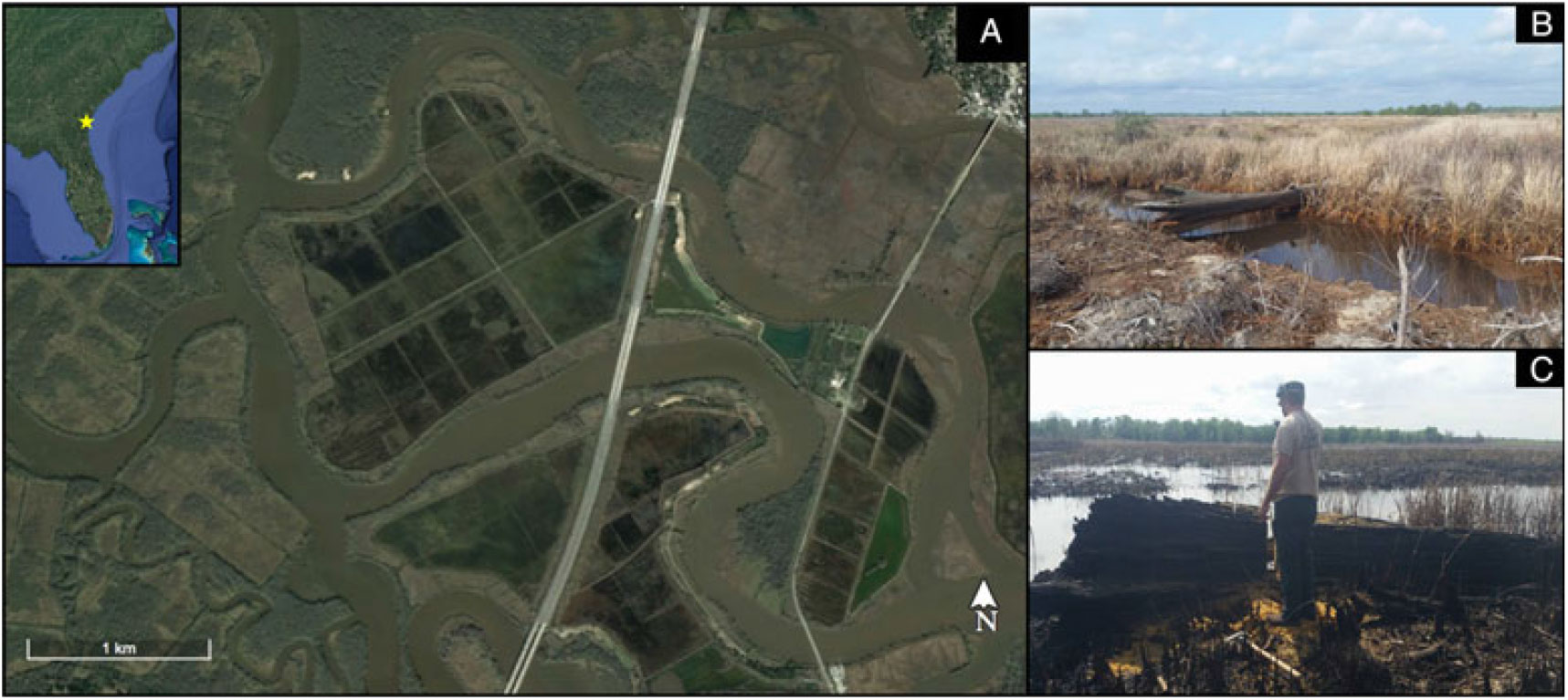
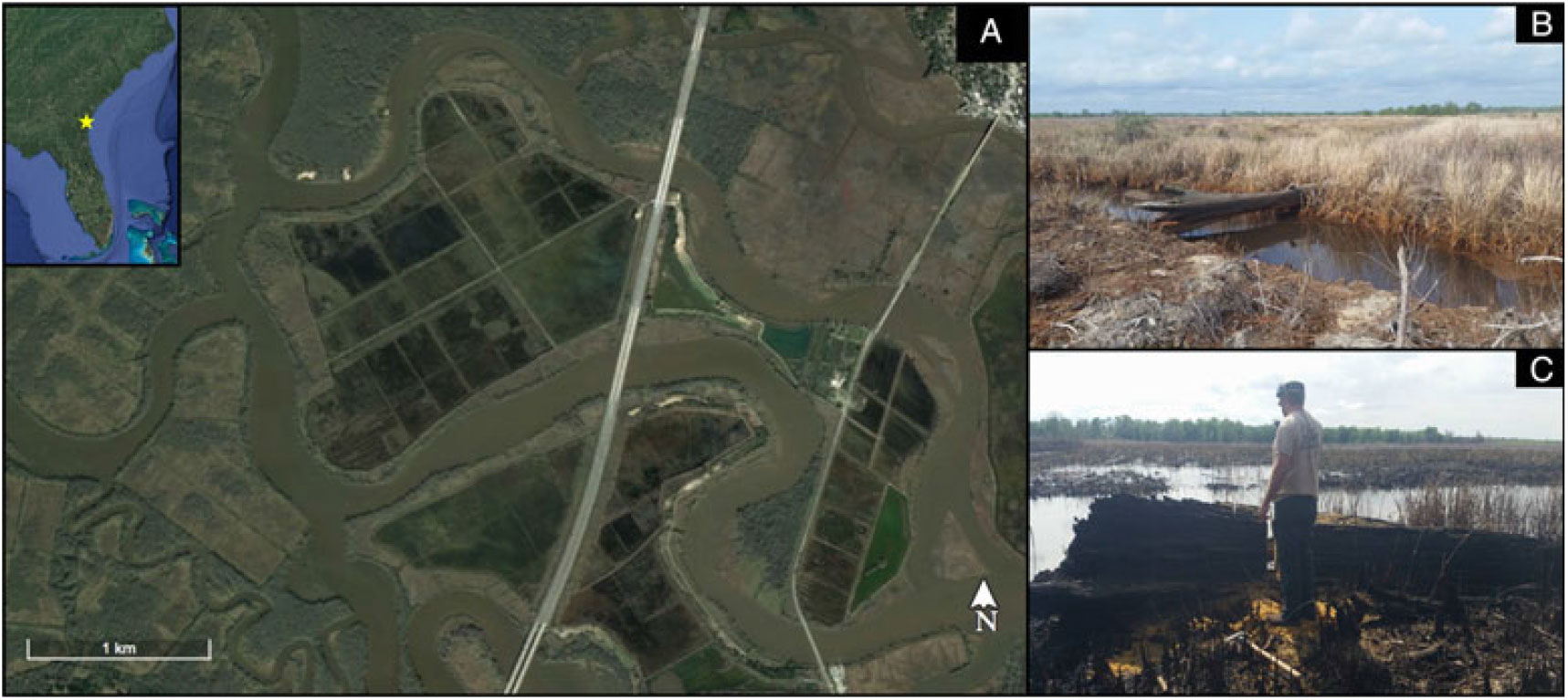
The Altamaha Wildlife Management Area (WMA) in Darien, Georgia, USA, comprises a series of islands managed by the state for waterfowl hunting, consisting of large, rectangular ponds, each surrounded by deep canals, with ponds linked by elevated earthen roadways. During maintenance work at the Altamaha WMA, which is largely continuous due to erosion as well as the impact of strong storms, numerous stumps and trunks of trees, the vast majority of which are bald cypress, are hauled up from the canals, which can be up to 10 m deep (Figure 1).
Location of the Georgia Department of Natural Resources-managed Altamaha Wildlife Management Area (WMA) in the U.S. Southeast (A), an ancient cypress lying across one of the canals separating an elevated earthen roadway from a pond (B), and sampling of a cypress at the site (C). Partially adapted from a Google Earth basemap.
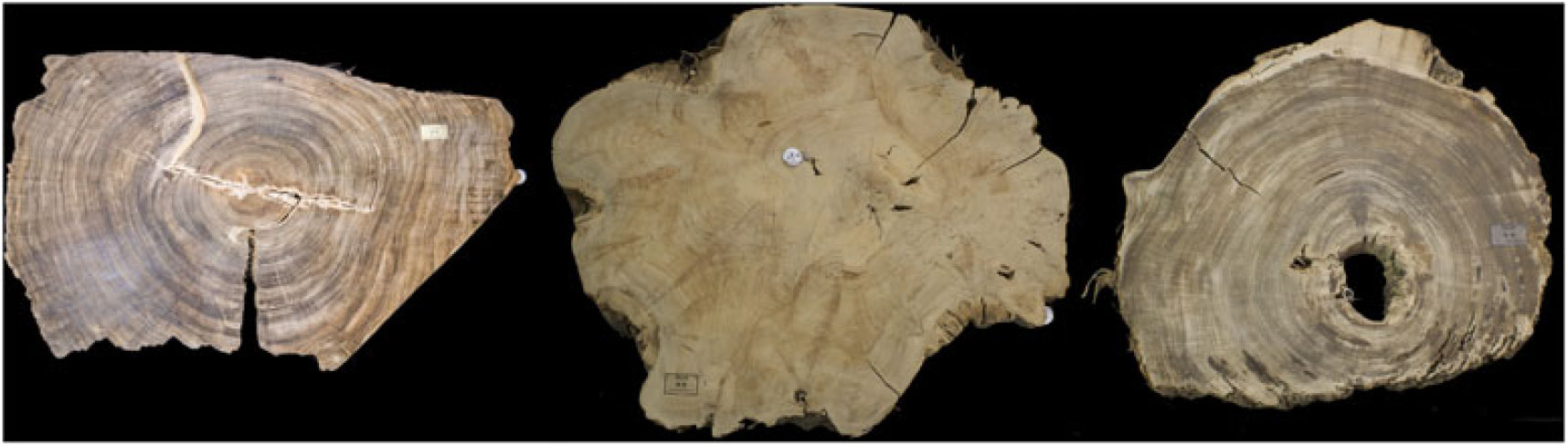
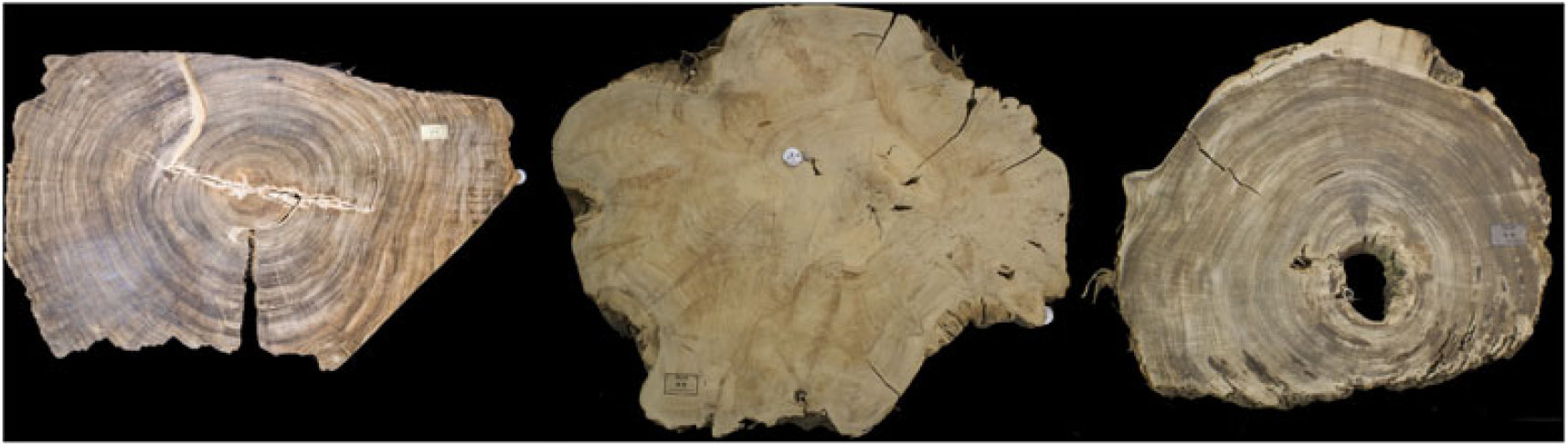
The state of preservation of trees from the waterlogged conditions under the WMA is extremely high; in some cases, bark is still present. We have obtained whole or half cookies (cross-sections of trees) when possible (Figure 2). Many samples, however, include only portions of the outer tree rings, since the WMA ponds are periodically burned to encourage the growth of waterfowl-attracting plants, which destroys those portions of remnant trees not submerged in mud. In many cases, therefore, entire logs have been burned away except for a part of the circumference including the outermost preserved centuries’ worth of growth rings, which remain submerged.
The three bald cypress cookies from the Altamaha WMA sampled for the pretreatment comparison (L to R, Tree 1, Tree 19, and Tree 22).
Sample Preparation
After the cookies were dried, they were sanded with an industrial table-mounted belt sander followed by a handheld random orbit sander using various grits of sandpaper, finishing with 600 grit. After completion of this sanding, cookies were finished with a metal scraper to increase the visibility of growth rings and individual cells, a necessity for dendrochronological analysis.
Samples for AMS dating were obtained from individual rings by shaving with a Husky® single edge razorblade (if the ring was accessible for this type of sampling, e.g., an exposed outer ring) or cutting into the ring with an X-ACTO® precision knife, both with carbon steel blades. Wood samples were treated using standard ABA protocols. In brief, samples are treated with 1 N HCl at 80°C for 1 hr to remove carbonates, then washed with deionized water on fiberglass filters and rinsed with diluted 0.1 M NaOH to remove possible contamination by humic acids. Finally, these samples were again treated with 1 N HCl at 80°C for 15 min to remove possible carbonate contamination from the NaOH treatment, washed with ultrapure water (Milli-Q), and dried at 60°C.
All samples were combusted at 900°C in evacuated and sealed quartz ampoules in the presence of CuO. The resulting carbon dioxide was cryogenically purified from other reaction products and catalytically converted to graphite using the hydrogen-iron reduction method described in Vogel et al. (Reference Vogel, Southen, Nelson and Brown1984). Graphite 14C/13C ratios were measured at the Center for Applied Isotope Studies at the University of Georgia (NEC 0.5MV 1.5DH-1 Pelletron AMS) (Cherkinsky et al. Reference Cherkinsky, Culp, Dvoracek and Noakes2010). The sample ratios were compared to the ratio measured from the oxalic acid I (NBS SRM 4990). The sample 13C/12C ratios were measured separately using a stable isotope ratio mass spectrometer and expressed as δ13C with respect to PDB, with an error of less than 0.1‰. 14C ages were corrected for isotopic fractionation and calibrated using OxCal 4.3.2 (Bronk Ramsey Reference Bronk Ramsey2009) and the IntCal13 terrestrial calibration model (Reimer et al. Reference Reimer, Bard, Bayliss, Beck, Blackwell, Ramsey, Buck, Cheng, Edwards, Friedrich, Grootes, Guilderson, Haflidason, Hajdas, Hatté, Heaton, Hoffmann, Hogg, Hughen, Kaiser, Kromer, Manning, Nui, Reimer, Richards, Scott, Southon, Staff, Turney and Van der Plicht2013) and ranges were rounded off by 5 years.
The first 26 trees we analyzed were radiocarbon dated at both an inner and an outer ring; once dendrochronological analysis confirmed that the number of rings fit within the 14C-determined lifespan range, we continued dating at only outer extant rings.
Initial Radiocarbon Results
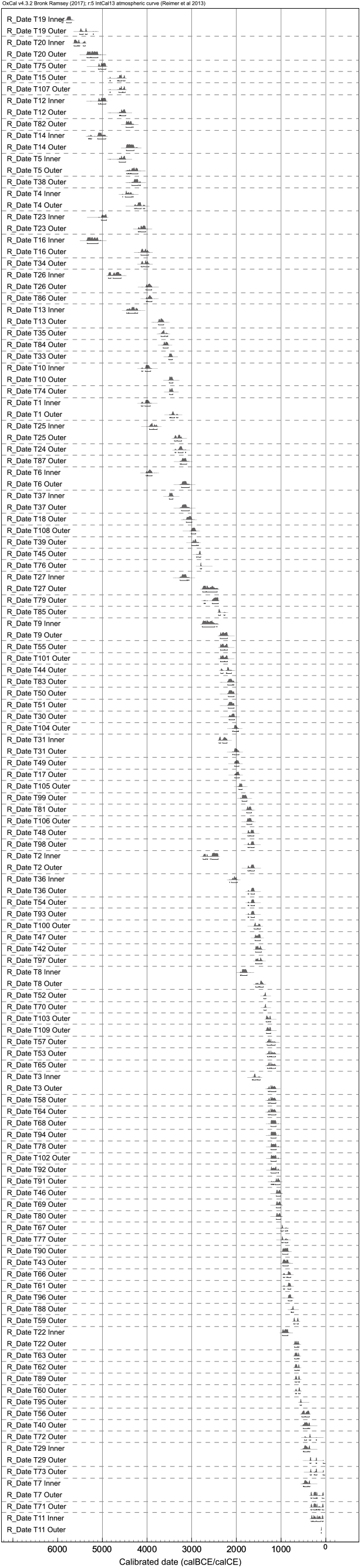
The AMS dates from the 107 bald cypresses dated using ABA pretreatments indicate that the trees obtained from the Altamaha WMA represent a unique source of paleoclimate data, providing an opportunity to extend the Altamaha River chronology back into the deep past. The lifespans of these 107 individuals together encompass approximately 5700 14C years (Figure 3). We are in the process of developing a multimillennial chronology for this locale, which crossdates with and extends Stahle’s Reference Stahle1985 chronology.
Calibrated probability distributions for radiocarbon dates from 105 of the 107 bald cypress trees obtained at the Altamaha WMA. Two other bald cypress trees were shown to be modern in date. Some cookies were dated at both rings close to the pith (>10 rings from the pith) and outer rings, while other cookies were dated at only outer rings. Dates on individual trees are separated by horizontal dashed lines. Radiocarbon calibration was conducted employing OxCal 4.3.2 (Bronk Ramsey Reference Bronk Ramsey2009) and the IntCal13 curve (Reimer et al. Reference Reimer, Bard, Bayliss, Beck, Blackwell, Ramsey, Buck, Cheng, Edwards, Friedrich, Grootes, Guilderson, Haflidason, Hajdas, Hatté, Heaton, Hoffmann, Hogg, Hughen, Kaiser, Kromer, Manning, Nui, Reimer, Richards, Scott, Southon, Staff, Turney and Van der Plicht2013), with ranges rounded off by 5 years. From OxCal v.4.3.2 online.

Sample Pretreatments for Comparison
To determine whether ABA pretreatment would be sufficient for the development of a high-precision radiocarbon chronology developed from the Altamaha WMA bald cypresses, or if a more involved form of pretreatment would provide more accurate results, we AMS dated duplicate samples pretreated via different methods for statistical comparison.
Individual tree rings sampled for pretreatment comparisons were selected based on first, the age of the tree, with individuals who together represented a broad span of time chosen for sampling, and, second, the availability of enough material, which guided the choice of the specific rings sampled. We chose three trees (Tree 19, Tree 1, and Tree 22), each of which grew during a different period, to test for dating differences based on pretreatments of annual growth rings. Tree 19 was the oldest specimen recovered (inner ring: 4980 BP ± 25; outer ring: 4610 BP ± 25). Tree 1 represented the mid-range of the 14C timespan from the Altamaha WMA (inner ring: 3640 BP ± 25; outer ring: 3140 BP ± 25). Tree 22 was the most recent-living tree sampled (inner ring: 940 BP ± 25; outer ring: 610 BP ± 20).
Two rings were sampled from each of these three trees. Obtaining 200 mg of wood from each individual ring was necessary; wide rings were thus selected to ensure that samples came only from a single annual ring. Samples from Tree 19 were designated as ALT-cali-19-1 and ALT-cali-19-2 (29 rings between samples); from Tree 1, ALT-cali-1-1 and ALT-cali-1-2 (91 rings between samples); and, from Tree 22, ALT-cali-22-1 and ALT-cali-22-2 (120 rings between samples).
The samples were then milled using a Spex SamplePrep 8000D Mixer/mill for 5 min to homogenize the sample and reduce the wood to fine particles. The milled samples were treated using standard ABA methods, as described above. A pretreated ABA aliquot was then collected from each sample. Following ABA pretreatment, the sample was reacted at 80°C with a solution of 1N HCl and 1M NaClO2 (1:2 ratio) for 6 hr; the solution was changed every 2 hr. An aliquot of resulting holocellulose was then taken for analysis. The remaining material was then subject to α-cellulose extraction following Southon and Magana (Reference Southon and Magana2010) using 5N NaOH at room temperature for 1 hr. The resulting α-cellulose was treated with 1N HCl at 80°C to remove any absorbed CO2 then rinsed multiple times with Milli-Q water and freeze dried. All sample aliquots were then prepared and analyzed using the methods described above.
RESULTS AND DISCUSSION
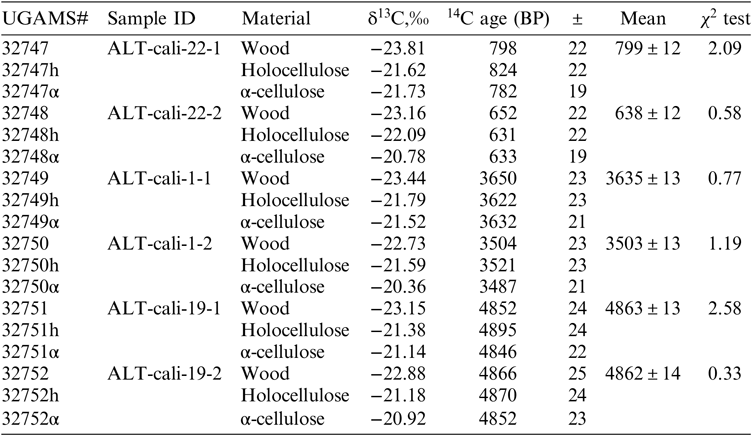
The 14C results for the different wood fractions are summarized in Table 1. Samples from each tree have comparable results. Statistical analysis of the 14C results has shown that in all cases differences among fractions are within 1 sigma, and chi-square in all cases is significantly lower than the limit of χ 2 = 5.99 for 95% probability. We therefore conclude that standard ABA pretreatment is sufficient for accurate radiocarbon dating of well-preserved bald cypress wood within the represented time period.
Summarized AMS 14C results of standard ABA, holocellulose extraction, and α-cellulose extraction pretreatments. 2 rings each from 3 trees of varying ages (trees 22, 1, and 19) were sampled for a total of 6 samples (“Sample ID”), after which each sample was divided into 3 parts and subjected to different pretreatments.

As previous research has indicated, differences in tree species, locales, and preservation environments appear to necessitate the initial comparison of pretreatments in previously unstudied geographic areas and species to ensure optimal radiocarbon dating results. While in some cases ABA pretreatment has been found to be sufficient for radiocarbon dating (e.g., Santos and Ormsby Reference Santos and Ormsby2013; Hajdas et al., Reference Hajdas, Hendricks, Fontana and Monegato2016), in other cases, notably in some studies of contaminated kauri (Agathis australis) wood, different pretreatment techniques may be required (e.g., Santos et al Reference Santos, Bird, Fifield, Alloway, Chappell, Hausladen and Arneth2001; Southon and Magana Reference Southon and Magana2010). This study indicates that bald cypress, the most important species for the development of long tree-ring records in the U.S. Southeast, can be appropriately radiocarbon dated with ABA pretreatment under conditions of high preservation.
Very well-preserved logs as well as entire forests of bald cypress are found frequently throughout the U.S. Southeast, many in submerged anoxic conditions analogous to those at the Altamaha WMA, though until now few buried or submerged specimens have been scientifically investigated (e.g., Knox Reference Knox1966; Stahle et al. Reference Stahle, Burnette, Villanueva, Cerano, Fye, Griffin, Cleaveland, Stahle, Edmondson and Wolff2012). The presence of these extensive deposits of ancient bald cypress extends the potential applicability of this study to a wide geographic region and a very large number of specimens.
CONCLUSIONS AND FUTURE WORK
As Hajdas et al. (Reference Hajdas, Hendricks, Fontana and Monegato2016: 735) and Santos and Ormsby (Reference Santos and Ormsby2013) note, cellulose extraction may be necessary both for certain types of wood as well as for certain forms of preservation. The Altamaha WMA trees, the vast majority of which are bald cypress, are all extremely well-preserved from burial in the anoxic mud. Based on the high level of preservation of all of the Altamaha samples, taken in conjunction with the results of this pilot study, we conclude that standard ABA protocols are sufficient for pretreatment of well-preserved bald cypress from the Altamaha deposits that will be used for the establishment of a high-resolution radiocarbon chronology. This method will be used in all AMS dating pretreatments for the larger project, which seeks to determine whether a localized radiocarbon offset exists for the coastal Southeastern United States.
ACKNOWLEDGMENTS
The authors thank Brent Wood and Kirby Strickland for the professional preparation of samples, the staff of the Altamaha WMA, especially Nicholas Crosby, for their help with equipment and sampling, Dr. Carla Hadden for her expertise, Kelsey McShane and Edgar Alarcón for their help locating and sampling ancient remnant trees and stumps, and the anonymous reviewers for their constructive comments. This work was also supported, in part, by a grant in association with the Georgia Coastal Ecosystems LTER project supported by the National Science Foundation (NSF grant OCE-0620959; OCE-123714).