Why is there a tendency for states with an equal distribution of observable military capabilities to engage in militarized conflict? Why might an equal balance of power cause bargaining to break down? Is the empirical relationship between power parity and conflict an artifact of the relationship between uncertainty about who is likely to win a war and equal distributions of power? These were important questions during the Cold War as the distribution of power between the United States and the Soviet Union was posited by some to maintain the peace but to promote conflict by others. These questions remain relevant today as China approaches parity with the United States, as Pakistan pursues nuclear parity with India, and as tensions on the Korean peninsula deepen.
In his seminal work on bargaining and war, Fearon (1995) specifies three conditions that may lead to war in cases such as these.1
For a summary and review of bargaining theory as it has been applied to world politics see Reiter 2003.
The conditions include uncertainty about the distribution of power, the inability to commit to a bargained outcome short of war, and the indivisibility of the stakes of war. Paramount among these conditions is that there may be disagreement between the two sides (challenger and defender) about the balance of power. Uncertainty about the balance of power can cause the challenger to demand too much from the defender. Likewise, uncertainty about the distribution of power can cause the defender to underestimate the challenger's willingness to fight. During the Cold War, foreign policy makers speculated about the willingness of the Soviet Union and the United States to fight. This condition is an issue today as analysts' opinions about the war fighting capabilities of China vary widely and there is substantial uncertainty about the maturity of North Korea's nuclear weapons program. Moreover, in the dispute over the Kashmir territory it is unclear how Pakistan's nuclear capabilities balance India's apparent overwhelming conventional military advantage.
Abstracted away from many of the everyday details of world politics, a related theoretical debate highlights the effect of balanced power versus power preponderance on the likelihood of war. With few exceptions, the scholarly consensus is that pairs of states with relatively equal amounts of observable capabilities are more likely to experience conflict (Kugler and Lemke 1996). However, traditional explanations for this empirical pattern are unconvincing. I offer bargaining theory as a structure for examining the relationship between the distribution 2 of power and conflict. I tie together traditional treatments of power and conflict with recent research about bargaining and conflict to provide an alternate explanation for the observed relationship between the balance of power and conflict caused by the challenger's uncertainty about the distribution of power (i.e., the expected outcome of a conflict).
In contrast to the conventional argument that the distribution of power causes conflict, I maintain that uncertainty about the distribution of power is as important a predictor of the probability of conflict as is the observed balance of power (Wittman 2001). I use a bargaining model to explore these questions formally and use Bayesian statistics to evaluate the empirical credibility of that bargaining model.
POWER AND CONFLICT
Many theories of international politics rely on the concept of power to explain international interactions. Early work claims that the probability of war is enhanced by unequal distributions of power. This “balance of power” approach asserts that the likelihood of conflict is lowest when there is an equal distribution of power (Morgenthau 1948). The logic underlying the balance of power perspective is that equality of power makes it impossible for opponents to believe in assured victory and, thus causes states to proceed with caution, thereby avoiding conflict. Since the balance of power approach associates equal distributions of power with uncertainty, the distribution of information is central. Even the earliest theoretical work implicitly connects uncertainty to power distributions.
In studies examining dyadic interactions between challengers and defenders, a recurring empirical pattern has emerged. Specifically, balances of power within dyads are conflict enhancing rather than inhibiting (Bremer 1992). An explanation for this pattern is found in early work on power transition theory. Countering balance of power claims, power transition theorists assert that parity makes conflict more likely because dissatisfied states are willing to tolerate the risk of defeat in light of the possibility of victory, which offers the opportunity to modify the status quo to suit their tastes. This relationship is especially robust in the context of interactions between dissatisfied challengers and defenders of the status quo. For example, Lemke and Werner (1996) claim that pairs of states relatively equal in observable capabilities are more conflict prone because they have an opportunity to engage in conflict. Dissatisfaction with the status quo provides the incentive or willingness to wage war (Werner 2000). For power transition theory, uncertainty in the form of asymmetric information about who might prevail in a potential conflict makes conflict more likely. Importantly, the challenger is uncertain about the outcome of a militarized conflict because it is unsure about the true distribution of power.2
It is also important to note that the hegemonic defender may be uncertain about the outcome of a conflict because of uncertainty about the balance of power and uncertainty about the challenging state's preferences for or against the prevailing status quo.
Nevertheless, if the challenger values its expected value for war more than the status quo distribution of benefits, it is willing to fight.
In sum, balance of power theory and power parity theory agree that an equal distribution of power enhances uncertainty about the outcome of a militarized clash. Specifically, this uncertainty can be conceptualized in terms of asymmetric information about the distribution of military capabilities. What these theories disagree over is how uncertainty affects the prospects for militarized conflict. Balance of power approaches assume that uncertainty makes states cautious, thus reducing conflict. Power parity theorists believe that uncertainty makes dissatisfied states more likely to use force to alter the status quo.
INFORMATION AND CONFLICT
My emphasis on information is not novel. Influential research demonstrates various ways in which information asymmetries can affect the probability of conflict (Powell 1999).3
I am specifically interested in uncertainty about the distribution of power, but actors could also be uncertain about the stakes or the costs of the conflict, the beliefs their opponents have about them, their opponent's preferences for different outcomes, etc. For a detailed discussion of different types of uncertainty that could cause conflict see Jervis 1968.
Information is asymmetric when states hold different beliefs about the context of an international interaction. For example, one state may hold private information about its chances for victory in the event of conflict. Most relevant to this argument is the notion that states are uncertain about their opponent's military capabilities (see, e.g.,
Blainey 1973,
Fearon 1995, and
Morrow 1989).
When states are uncertain about their opponent's capabilities, they may either overestimate or underestimate their own bargaining leverage. Such miscalculation may enhance the probability of a militarized clash by shrinking the range of acceptable nonviolent agreements. Conversely, if both states are fully informed and militarized conflict is costly, the probability of conflict is zero. The challenger knows what the defender is willing to concede (i.e., the disagreement point or reservation value), and likewise the defender knows precisely how much it must give to appease the challenger and thereby avoid the costs of a militarized clash. In such a scenario, the challenger makes a demand exactly equal to the maximum concession the defender is willing to make. The bargain is made by the defender accepting the challenger's initial offer. However, when information asymmetries arise about relative capabilities, the challenger may overestimate its bargaining leverage and demand more than the defender is willing to concede. This may lead the defender to reject the challenger's offer, thereby making militarized conflict more likely. Asymmetric information may also lead the challenger to overestimate the defender's capabilities and thus make an inadequate opening offer, resulting in the defender's acceptance of the initial offer.
In the second scenario, asymmetric information decreases the probability of militarized conflict, just as balance of power theory suggests. In the first one, asymmetric information increases the probability of conflict, just at power transition theory suggests. Thus, the relationship between information and militarized conflict is not as clear as might be expected based on existing theories. It is important to consider how the expectations of these existing theories relate to bargaining arguments about the effect of uncertainty. What can be said is that in the ultimatum bargaining framework, asymmetric information is necessary for the emergence of militarized conflict. That is, when conflict is costly and states are fully informed, the probability of militarized conflict is zero.4
This conclusion is consistent with several formal treatments of the bargaining process in both the formal theory literature and applications of bargaining models to international interactions (Fearon 1995). For an important paper critical of this result, see Slantchev 2003.
BASIC INGREDIENTS
A concrete example of the operation of asymmetric information may be useful at this point. The Russo-Japanese War emerged from the competing interests of Russia and Japan over Manchuria and Korea and, arguably, was heavily influenced by Russia's inability to assess Japan's military capabilities accurately. Russia's eventual goal was the occupation of Korea. Japan also sought to extend its realm of influence to Korea and to extract revenge for Russia's interference during the 1894–95 Sino–Japanese War, in which Russian troops had seized Port Arthur and limited Japanese occupation of the Liaotung Peninsula. Between 1900 and 1903, Russian soldiers covertly moved across the Yalu River into northern Korea and prepared to fight the Japanese for control of the country. Russia's refusal to withdraw from Manchuria and subsequent penetration into North Korea were countered by Japanese attempts to negotiate a division of the disputed area. Russia remained inflexible and confident that it could defeat Japan in a military contest. However, Japan estimated that it had an even chance of defeating Russia and, on the basis of this information, ended negotiations and terminated domestic relations with Russia on February 6, 1904. Two days later Japan attacked Port Arthur, where the Russian Pacific fleet lay. A series of quick Japanese victories culminated in the fall of Port Arthur in January 1905. The Japanese successes continued under General Oyama at Shenyang in March of the same year. Admiral Togo destroyed a second Russian fleet at Tsushima in May. Russia's inability to estimate Japan's military might resulted in a disastrous outcome that paved the way for the Russian Revolution of 1905 (Nish 1985). This historical example fits the claim that war is commonly the outcome of a crisis in which states' opinions about the distribution of power (i.e., thus about bargaining power) differ (Blainey 1973). Although the Russo–Japanese example seems to support such a claim, the question remains of whether uncertainty about the distribution of power is a general cause of conflict or matters only in particular historical instances.
To illustrate these claims formally, consider a fully informed risk-neutral challenger (C) and status quo defender (D) in a dispute with stakes, π, where π>0. For the sake of simplicity, I assume that π=1.5
This formalization draws on previous work on international politics by Fearon (1995) and parallels work on law and economics by Bebchuk (1984). Moreover, it is the simplest possible bargaining model. Much richer formal models appear in the literature (Filson and Werner 2002; Powell 1999). My choice of the simplest model is useful for motivating the statistical analysis reported in the empirical section of the manuscript.
The stakes could be territorial, as they were in the Russo–Japanese War, or more ideological, as they were between the United States and the Soviet Union during the Cold War.
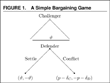
The model here is a bargaining problem in which the outside option is a costly lottery, specifically, militarized conflict (Figure 1). Bargaining begins when the challenger makes a demand ϑ that would leave the defender with −ϑ. I assume that if a conflict breaks out, the challenger will prevail with likelihood p, and in the event of militarized conflict the winner gets π. The challenger's expected value for such a militarized conflict is p−δC, and the defender's is −p−δD. The costs of conflict are indexed by δi, i∈(C,D), and κ denotes the sum of the challenger's and defender's costs of conflict.
The structure of the interaction between the challenger and the defender is a take-it-or-leave-it bargain, with the outside option of the costly lottery that is militarized conflict. If the defender rejects the challenger's demand, some form of militarized force is used to settle the disagreement. I assume that the challenger's expected value for conflict is greater than zero—the status quo payoff. Conflict always occurs if the defender rejects the challenger's demand, and the defender rejects the demand only if it values the challenger's demand less than its expected value for conflict. Because the actors are fully informed, the challenger and defender know each other's reservation values. As a result, the challenger makes a demand equal to the defender's disagreement point, ϑ*=p+δD. This is the subgame perfect equilibrium of the game because such an offer makes the defender indifferent between its expected value for militarized conflict and for appeasing the challenger. Thus, when the costs of conflict and the odds of success are known to both the challenger and the defender, they are always able to settle their differences without a militarized clash.
However, it is unrealistic to assume that the challenger and defender are completely informed. Instead it is more reasonable to assume that the challenger is uncertain about the disagreement point. In many cases the challenger is unsure about the defender's costs of conflict, the quality of the defender's military, and the defender's resolution with respect to the issue at stake (Morrow 1989). I assume that the challenger has only a rough estimate of the disagreement point and is faced with the dilemma of either making a demand that is too small, which would be inefficient as it would let the defender keep too much of the stakes, or too large, which would lead to a militarized clash. I introduce uncertainty by assuming that the defender has some private information about the challenger's likelihood of prevailing in a militarized clash or about the distribution of power, p.6
Asymmetric information of this sort is the most common approach to introducing uncertainty. It may be that the defender and the challenger are both uncertain about the balance of power. See Gartzke, Li, and Boehmer (2001) for a treatment of two-sided uncertainty.
The defender may be better equipped to assess the likelihood of the challenger winning because of private information that the defender holds about its own military forces. On the basis of its private information, the defender estimates
p. A defender with an estimate of
p is referred to as being of type
p, where defenders with low estimates of
p have a higher expected value for conflict than defenders with high estimates of
p. The challenger does not know the defender's type. However, it does know that
p is distributed with a density function
f(·) and a distribution function
F(·). I assume that
f(·) is positive in the interval (
a,
b), 0<
a<b<1, and zero outside that interval. Finally, I assume that
f(·) is continuous and twice differentiable throughout, with some neighborhood of b where
f(·) is nonincreasing.
Because the defender will accept an offer if, and only if, its utility for the offer is greater or equal to its expected value for militarized conflict, it gives in to the challenger's demand only if ϑ≤p+δD. Equivalently, the defender accepts the challenger's offer only if p≥ϑ−δD. Therefore, the defender will accept the challenger's offer only if its type p is equal to or greater than q(ϑ), where
The value of q(ϑ) represents the borderline type of challenger associated with an offer ϑ and splits defenders into two groups. Defenders of type higher than q(ϑ) give in to the challenger's demand, whereas defenders of type less than q(ϑ) fight. An increase in the challenger's demand raises the borderline type and increases the probability of conflict. It is also useful to note that q(ϑ) and ϑ are linearly related. Therefore the challenger's problem can be seen as choosing an optimal demand or selecting an optimal borderline type. The challenger is faced with a difficult decision. The challenger knows that if it makes a demand ϑ, the probability that the defender will accept the offer is 1−F[q(ϑ)] and the probability of conflict is F[q(ϑ)]. If the defender rejects the offer, its type is lower than q(ϑ), and a militarized clash will occur. The challenger makes a conditional probability calculation to determine the probability of winning such a conflict. Given that the defender fights, the probability that the challenger wins is ∫q(ϑ)axf(x)dx/F[q(ϑ)], the average probability of defender types lower than q(ϑ). Thus, the challenger's expected value for a demand ϑ is
The first part of (2) is the product of the probability that the defender gives in to the challenger's demand, (1−F[q(ϑ)]), and value of the challenger's demand, (ϑ). The second part of (2) is the product of the probability that the defender rejects the challenger's offer, F[q(ϑ)]), and the challenger's expected value for a militarized clash. The challenger chooses ϑ to maximize this function. Using Leibniz's rule to differentiate the right-hand side of (2) with respect to ϑ and rearranging slightly shows that
The first expression in (3) represents the benefits the challenger receives with a marginal increase in ϑ. The challenger can expect to receive this marginal increase with probability 1−F[q(ϑ)]. The second expression in (3) represents the costs to the challenger of a marginal increase in ϑ. An increase in ϑ raises the likelihood of conflict. This is the case because, if the defender's type is equal to q(ϑ), it will accept any demand ϑ but will reject a higher demand. That is, a marginal increase in ϑ increases the probability of conflict by dF[q(ϑ)]/dϑ=f[q(ϑ)].
Let ϑ* solve the challenger's problem (3), and let q* denote q(ϑ*). This is the perfect Bayesian equilibrium of the game. Note that the challenger's choice of ϑ* determines the probability that the defender will accept the settlement offer. I denote the probability of conflict:
This suggests that the defender's decision to accept or reject any demand is a function of its private information. Therefore, in contrast to the complete information result, there is a positive probability of conflict. In this model, uncertainty is necessary but not sufficient for militarized conflict. A numerical example illustrates the predictions of the model. Consider a challenger and defender bargaining over $1,000. I assume that the costs of conflict are $100 for both challenger and defender. A triangular distribution over the range of 0.4 and 0.8 describes the challenger's beliefs about the distribution of power. In such a scenario, the challenger makes a demand of about $646 and the probability of conflict is about 26%.
COMPARATIVE STATICS
This simple model, while consistent with several analyses that adopt the bargaining framework (see, e.g., Reiter 2003), illustrates the relationship among the probability of conflict and the stakes of the contest, the magnitude of the challenger's demand, and the actors' costs of conflict. But unlike most previous research, I use it to explore the relationship between characteristics of the challenger's information about the distribution of power and the probability of conflict (Bueno de Mesquita and Lalman 1992; Bueno de Mesquita, Morrow, and Zorick 1997; Wittman 2001). I operationalize the challenger's uncertainty as variance in their belief about the distribution of power [e.g., variance in f(·) and F(·)]. Thus, the formalization combines scholarly interest in the relationships among uncertainty, conflict, and the distribution of power in a novel way.
Distribution of Information
Most bargaining research focuses on the effect of asymmetric information on the probability of a militarized clash. Here the important difference is that the probability of militarized conflict is affected by characteristics of the distribution describing the challenger's beliefs about the defender's odds of winning a militarized clash (i.e., the distribution of power).
Consider the effect of expanding or contracting the range of the distribution of the challenger's information about the distribution of power without altering the mean. What effect does a change in the variance in the challenger's estimate of the distribution of power have on the probability of a militarized clash? To assess the effect of such incremental changes, I denote μ to be the mean of the distribution f(·), and assume that p is distributed in the interval (μ−σ(μ−a), μ+σ(b−μ)), with a density function h(·) and a cumulative distribution function H(·) defined by
and
Varying the values of σ gives a family of distributions with the same mean but with different higher moments. This allows me to assess the impact of variance in the challenger's estimate of the distribution of power on the probability of conflict. For σ=1, h(·) is equivalent to f(·). However, for σ>1, h(·) is an expanded version of f(·), and for σ<1, h(·) is a contracted version of f(·).
Proposition 1.
A marginal expansion in the variance of the challenger's estimate of the distribution of power has an indeterminate effect on the challenger's demand and will increase the probability of conflict.
Likewise, as σ goes to zero, so does the probability of conflict. As the variance in the challenger's estimate of the distribution of power goes to zero, the incomplete information result converges on the complete information result. If there is no variance in the challenger's estimate of the distribution of power, the challenger is able to select an optimal demand, thereby making the defender indifferent between its expected value for conflict and its utility for the challenger's demand.7
Of course the probability of conflict only goes to zero if the uncertainty about the defender's reservation value is focused only on a disagreement about the distribution of power. It is certainly possible for the challenger to be uncertain about other important variables such as the defender's costs of conflict. In this case, conflict would still occur with some positive probability.
Consider a numerical example. When the challenger's estimate of the distribution of power is bounded by 0.5 and 0.7, the probability of conflict is about 10%. However, when the distribution ranges from 0.2 to 1.0, the probability of conflict is 50%. When there is greater uncertainty about the distribution of power, the probability of conflict is significantly higher.
Increasing the variance in the challenger's estimate of the distribution of power enhances the likelihood of conflict because it increases the differences among types in the expected outcome of a militarized clash. This comparative static is consistent with Wittman 2001, and central to my argument. The effect of variance in the distribution of types of defenders on the probability of conflict provides a rational explanation for the recurring empirical pattern that relates equal distributions of observable capabilities to the onset of militarized conflict.8
Proof of Proposition 1: The proposition is proved by differentiating the first-order condition, using h and H instead of f and F, with respect to σ:∂(1−F(q*))/∂σ=−[κf(q*)/σ2. The effect of σ on q* and, as a result, on the size of the challenger's demand is ambiguous.
In order to interpret the relationship between power distributions and the emergence of militarized conflict, it is important to consider what types of power distributions are most likely to affect the variance in the challenger's estimate of the distribution of power. As discussed earlier, this is a topic upon which the balance of power and power transition approaches concur. These traditional theories claim that uncertainty about the outcome of militarized conflict is greatest when states are relatively equal in power. That is, at parity, the distribution of defender types is likely to have the greatest variance. States can observe much of their opponent's capabilities, through the size and technological sophistication of the opponent's military. Thus, information asymmetries about the distribution of power are most likely to come from such unobservable factors as resolve or military tactics. Resolve is an important component of military power, but resolve goes only so far against an opponent whose observable military power is great. For example, regardless of Denmark's resolve, in a crisis with the United States its resolve would do little to make its expected leverage greater than whatever demand the United States might make. However, when two states with relatively equal observable capabilities bargain, unobserved resolve is an important factor for them to estimate their bargaining leverage. In such situations, information asymmetries arise naturally, and states have an incentive to bluff in order to secure a better deal.
Following Wittman (2001), I incorporate this dynamic into the bargaining model by assuming that σ is a function of the distribution of power. As states approach parity, σ increases, leading to an expanded distribution of defender types. Likewise, as the distribution of power moves away from parity, σ approaches zero, and the variance in the challenger's estimate of the balance of power shrinks. Ceteris paribus, I expect the probability of conflict to be greatest at equal distributions of power specifically due to the relationship between equal distributions of power and variance in the challenger's estimate of the distribution of power. This explanation for conflict emergence is consistent with power transition arguments as well as with the wealth of empirical evidence pointing to the conflict-enhancing effect of equal distributions of power. It implies a rational explanation for the observed conflict-enhancing effect of equal distributions of power, while remaining consistent with the logic of both balance of power and power transition theories. If one equates power distributions with σ, two testable hypotheses can be deduced from the bargaining model.
HYPOTHESIS 1.
The more equal the distribution of power, the more variable the distribution of defender types.
The first hypothesis follows from the logic of the traditional international politics theories and from the expectation that σ is a function of the distribution of power.
HYPOTHESIS 2.
The greater the variance of the distribution of defender types, the greater the probability of militarized conflict.
The second hypothesis is deduced directly from the bargaining model. I analyze historical data to examine the empirical validity of the hypotheses. To facilitate comparison with previous research, I use data from Oneal and Russett 1997. These data contain observations on 20,990 pairs of states, 1950–1985. The unit of analysis is the dyad year, and there is information on 827 politically relevant dyads. Each dyad is observed once for every year it appears in the data file. The dependent variable is the existence of a militarized dispute. The coding of this dependent variable and the collection of the militarized interstate dispute data are discussed in Jones, Bremer, and Singer 1996. In this sample there are 947 disputes, resulting in an average value of .045 for the dependent variable. The crucial independent variable is the distribution of power, indexed as the ratio of the stronger state's power to the weaker state's power with the Correlates of War composite capabilities index (Singer 1987). At parity, this variable is equal to one.9
It is also possible to operationalize this variable as the ratio of the weaker state to thestronger state. The weaker to stronger index lies between zero and one. I use the stronger to weaker measure to be consistent with Oneal and Russett 1997. Moreover, normalizing the index makes the visual presentation in the second figure difficult to interpret. This is because pairs of states characterized by substantial preponderance are drawn back toward the values of dyads with less significant preponderance.
Drawing on past research and the logic of the bargaining model, I expect the effect of this variable to be negatively related to militarized conflict. Measures of joint democracy, economic growth, alliance membership, territorial contiguity, and economic interdependence are included as controls. The measurement of these control variables is discussed in
Oneal and Russett 1997. I also include a spline to correct for temporal dependence in the data (
Beck, Katz, and Tucker 1998).
STATISTICAL ANALYSIS
The goal of the statistical analysis is to estimate the relationship between the distribution of power and σ from (5) and (6). In previous statistical studies the onset of conflict has been modeled using special cases of generalized linear models for indicator variables (Oneal and Russett 1997). These models are ill equipped to assess heterogeneity in conflict behavior as a function of the distribution of power. One weakness of previous treatments is their assumption that there is no observed heterogeneity in the conflict data. The current literature considers variation in conflict behavior only in the mean rather than in the variance. Not only is this an unrealistic practical assumption, but also it is at odds with international relations theories whose explanations rely on power distributions.
It is standard practice to pool pairs of states such as the United States and Canada or India and Pakistan and assume that the variation in their conflict behavior is identical. These models further assume that the variance among Western European dyads is the same as that among African dyads. This seems highly unrealistic. Bargaining models anticipate heterogeneous behavior as a function of asymmetric information and, specifically, variance in the challenger's estimate of the distribution of power. I expect the variance of the error in the challenger's estimate of the defender's type (its unobservable capabilities) to vary with the distribution of power. As the challenger and defender approach power parity, the variance in the challenger's estimate of the defender's power is expected to be greatest. This leads to an enhanced probability of mistakes and a nonzero probability of conflict onset. To address this deficiency in the standard models and to evaluate my claims about variance in the challenger's estimate of the defender's unobserved capabilities, I incorporate heteroscedasticity in the probit model as given in the following hierarchical specification:
where y is an n×1 vector containing information on conflict onset. The matrix X represents the explanatory variables in the analysis. I assume that ∈ is an n×1 vector of normally distributed errors with nonconstant variance. The prior on β is normal and diffuse. The relative variance terms (v1, v2, …, vn) are assumed to be fixed but unknown parameters that have to be estimated. Estimating n variance parameters in addition to β and σ using n observations seems problematic. However, Bayesian methods do not encounter the standard degrees of freedom constraints because informative priors are placed on the parameters. Because I assign the vi terms an independent χ2(r)/r prior, the prior is centered on one with a variance 2r, and only a single parameter r is added to the estimation procedure. The parameter r is updated based on the Γ prior.
The hypotheses I deduced from bargaining theory anticipate that the variance in the challenger's estimate of the distribution of power is greatest at parity and that this variance will enhance the likelihood of a militarized clash. Therefore, the presence of heteroscedastic errors that are related to different distributions of power is consistent with the expectations derived from bargaining theory and provides some support for my hypotheses.
The multiple integrals in the reparameterized probit likelihood function make computation difficult. To minimize the computational costs of evaluating the likelihood function, I analyze the conflict data with Bayesian tools. Utilizing Bayesian simulation (MCMC), I am able to make inferences based on the posterior. I use the Gibbs sampler to obtain posterior samples.10
The Gibbs sampler is the most widely used MCMC method. If one can express each of the coefficients in the model conditioned on all of the other coefficients, the Gibbs sampler can cycle through these conditional statements and eventally find the true distribution of interest. See Jackman 2000 for a discussion of the Gibbs sampler in a political science context. A more general discussion may be found in Carlin and Lewis 1996 and Gelman, et al. 1995.
Obtaining samples directly from the posterior is difficult because of the presence of several integrals and the probit function Ψ in the likelihood. To overcome these difficulties, I use the auxiliary variable technique of
Albert and Chib (1993).
11 For an alternate approach to modeling heterogeneity in the context of a probit regression, see Alvarez and Brehm 1995. To check the robustness of my result, I also estimate the model they suggested. The results from this analysis also suggest that the variance in the model of conflict onset is correlated with the distribution of power.
This approach augments the observed data with a quantity
Z. From both the observed data and
Z, it is possible to calculate the posterior density. Because the data are augmented with
Z=(
z1,
z2, …,
zN), the likelihood is equivalent to the standard linear model. As a result, the posterior is computationally manageable. I ran 10,000 Gibbs samples to recover the posterior densities with a burn-in period of 1,000 samples.
12 See Smith 1999 for a discussion of estimating the posterior of β though data augmentation in the context of crisis escalation.
RESULTS AND INTERPRETATION
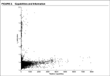
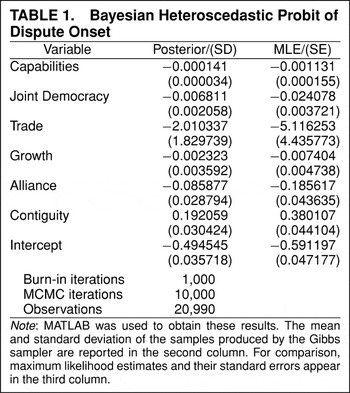
Results from the estimation are presented in Figure 2 and in Table 1. In the second column in the table, I report the means of the posterior densities for each explanatory variable. These mean values are comparable to conventional maximum likelihood estimates and are consistent with results reported elsewhere (Beck, Katz, and Tucker 1998). I report the results from a standard maximum likelihood probit model in the third column in Table 1 for comparison. Inspection shows that the maximum likelihood estimates and the means of the posterior distributions are similar. Past research reporting a negative relationship between power preponderance and militarized conflict is confirmed. The mean of the posterior density of the relative power variable is negative and credibly different from zero. As states approach power parity, the probability of militarized conflict increases. The effects of the control variables are also consistent with the empirical patterns reported in the literature. Jointly democratic dyads are less likely to experience militarized conflict. States sharing a border are more likely to fight. States sharing an alliance, experiencing economic growth, and engaged in trade are all moderately less prone to conflict.13
The effect of alliances on bargaining is an especially fruitful area of emerging research. For a detailed discussion of alliances in the context of bargaining and militarized conflict onset, see Leeds 2003.
These results are consistent with the comparative statics from the bargaining model in terms of the effect of the stakes and the costs of conflict on the probability of a militarized clash.
I refer to Figure 2 to evaluate the credibility of the hypothesis about the relationship between variance in the distribution of types of defenders and the distribution of capabilities. I plot the means of the posterior samples of vi against different distributions of power in order to assess the possibility that the posterior means of vi are a function of the distribution of power. The assumption of constant variance in the errors and independence between the errors and the explanatory variables can be evaluated visually. The formalization suggests that the variance will increase as the distribution of power approaches parity, and increases in the variance will be associated with the onset of militarized conflict.
Inspection of Figure 2 illuminates the relationship between information and power distributions. This figure plots the mean of the posterior densities of the variances against the distribution of power. Each plotted point is the mean of the draws from the posterior distribution of vi. Following research that equates increasing uncertainty with greater error variance (Alvarez and Brehm 1995; Downs and Rocke 1979), the relationship between power distributions and variance in the distribution of types of defenders is striking. Variance in the distribution of types of defenders and its proxy, the mean of the posterior distributions for the variances, increases as states approach an equal distribution of power. These results indicate that there is more variance in the model as the ratio of power approaches parity and that a strong positive correlation exists between power parity and greater variance in the challenger's estimate of the distribution of power. This illustration thus provides support for the first hypothesis.
Not only is there a significant amount of unexplained heterogeneity in the data, but the heterogeneity is correlated with the distribution of power. Because the probit model is known to be inconsistent and the covariance matrix may be incorrect when the variance of the errors is heteroscedastic (Yatchew and Griliches 1985), the implications of this analysis are far-reaching. Specifically, analyses that fail to address the relationship between the variance in the error and the distribution of power may be incorrect. Although I demonstrate a potential source of the heterogeneity, a much richer model is needed to model the heterogeneity explicitly. Additionally, this result provides support for formal bargaining models of international interactions. Increases in the variance of the distribution of types of defenders appear to exhibit the expected effect of creating the conditions for bargaining to break down, leading to the use of force to settle disputes. States with relatively equal amounts of power, knowing the similarity between their observable capabilities and those of their opponent, have an incentive to misrepresent their unobservable capabilities in order to strike a better bargain. The paramount role that these unobservable capabilities play in the bargaining process and the clear incentive to bluff about them result in an enhanced probability of militarized conflict.
CONCLUSION
Is there greater uncertainty about the distribution of power when observable military capabilities are relatively balanced between two states? Is the observed relationship between the distribution of power and conflict an artifact of the relationship between uncertainty about the distribution of power and conflict? In the context of the Russo-Japanese War of 1904, the evidence suggests that Russia's inability to assess the distribution of power accurately led Russia to refuse to bargain with the Japanese and, thus, was a central cause of the war. The relatively equal distribution of observable capabilities probably also enhanced Russia's uncertainty about the distribution of power. The bargaining model illustrates this dynamic formally, and the statistical analysis suggests that this pattern operates more generally. Pairs of states with equal distributions of power exhibit greater variance, and greater variance is correlated with the onset of conflict.
These results suggest that a focus on observable power alone is insufficient. Instead, the distribution of information and its relationship to power are important determinants of international interactions. I illustrate the effect of information formally and provide a rational explanation for the assertions of more traditional power-centric theories of world politics. While balance of power theorists and power transition theorists disagree about the relationship between specific power distributions and war, they agree that uncertainty is greatest when power is distributed equally. Their convergence on the topic of uncertainty is consistent with bargaining models of international interactions. Further, bargaining models provide an exciting opportunity to subsume balance of power and power transition assertions within a single theoretical framework. The results I report provide encouraging support for the use of a bargaining framework to understand such international interactions.
My arguments and results are consistent with those of others utilizing a bargaining framework and suggest a much richer relationship between power distributions and the probability of militarized conflict than do the traditional power-centric theories. I find that asymmetric information and greater variance in the distribution of types of defenders are related to power parity. I claim that the often debated relationship between power parity and militarized conflict may, at least to some extent, be an artifact of the relationship between power distributions and the distribution of information. Evidence is building to suggest that heterogeneous data are the norm in international politics (Lemke 2002). As a result, it seems essential that future research start to recognize the threat that such heterogeneity poses for inferences about international interactions.
For their feedback on this project I am grateful to David Clark, Justin Fox, Scott Gates, Jeff Gill, Kristian Gleditsch, Jim Granato, Indridi Indridason, Mark Jones, Jiyoung Kwon, Ashley Leeds, Jim LeSage, Doug Lemke, Andrew Martin, Cliff Morgan, Karoline Mortensen, Irfan Nooruddin, Kevin Quinn, Dan Reiter, Eric Reinhardt, Mark Souva, Randy Stevenson, Ric Stoll, Suzanne Werner, Ken Williams, and Rick Wilson.






Comments
No Comments have been published for this article.