Antibiotic heterogeneity is the concept of using a variety of antibiotics for specific clinical indications to improve hospital ecology, resulting in limiting the emergence of multidrug-resistant organisms (MDROs). Reference Kollef and Fraser1 One of the antibiotic heterogeneity strategies is called Periodic Antibiotic Monitoring and Supervision (PAMS). This strategy has been recommended by Asian experts despite limited evidence. Reference Apisarnthanarak, Kwa and Chiu2 Using a hospital-wide PAMS strategy, Takesue et al Reference Takesue, Nakajima and Ichiki3 changed the recommended classes of antibiotics for various conditions every 3 months according to the calculated antibiotic heterogeneity index. They noted a decrease in the overall incidence of multidrug-resistant gram-negative bacilli (MDR-GNB). Reference Takesue, Nakajima and Ichiki3 Another study reported that implementation of PAMS in a noncritical-care surgical unit did not reduce MDR-GNB. Reference Takesue, Ohge and Sakashita4 Because data on PAMS interventions in medical units are limited, we performed a quasi-experimental study to evaluate the role of PAMS in 2 different medical units with different MDR-GNB prevalences.
Methods
From December 1, 2018, through November 30, 2020, at Thammasat University Hospital (TUH), we performed a quasi-experimental study to evaluate the role of PAMS in an intensive care unit (ICU) with a high incidence of MDR-GNB and in a general medicine unit with a low incidence of MDR-GNB. All patients in these units were prospectively followed for the primary and secondary outcomes. The study periods consisted of 1 year before the implementation of PAMS (December 1, 2018, through November 30, 2019) and 1 year after the implementation of PAMS (December 1, 2019, through November 30, 2020). PAMS was conducted by a multidisciplinary antibiotic stewardship program (ASP) team.
During the entire study period, the antibiotic heterogeneity index, defined daily doses (DDD), and antibiotic usage density were prospectively followed by a clinical pharmacist. The antibiotic usage density was defined as the cumulative use of the specific antibiotics class in DDD divided by the cumulative use of the overall antibiotics classes. During the entire study period, the infection prevention interventions to reduce MDR-GNB included hand hygiene, contact precautions, environmental cleaning and disinfection, and weekly admission active surveillance cultures for CRE. The incidence of MDR-GNB was prospectively monitored by the infection prevention team. The prevalences of MDROs (isolates per 1,000 patient days) in the ICU versus the general medical unit were as follows: MDR Pseudomonas aeruginosa (0.29 vs 0.11), MDR Acinetobactor baumannii (3.45 vs 0.26), carbapenem-resistant Enterobacteriaceae (CRE; 2.70 vs 0.08), and extended-spectrum β-lactamase (ESBL)–producing microorganisms (2.94 vs 0). The primary outcome was improvement in the antibiotic heterogeneity index. The secondary outcomes were MDR-GNB incidence, excluding community-onset ESBL-producing microorganisms, Reference Apisarnthanarak, Kiratisin and Saifon5 antibiotics consumption (DDD per 1,000 patient days), 30-day mortality, and length of hospital stay.
During period 2, a clinical pharmacist calculated the monthly percentage of antibiotic usage density for each antibiotics class. The ASP team then regularly contacted the treating physicians in each unit to recommend the antibiotics that had low antibiotic usage density for use in appropriate indications, or to recommend the antibiotics with low antibiotic usage density to replace the current antibiotics regimen. However, the final antibiotics decisions were made by the treating physicians.
Antibiotic usage density was classified into 3 categories based on a previous study. Reference Takesue, Nakajima and Ichiki3 Recommendations for antibiotics switching are summarized in Supplementary Material 1 (online). A modified version of the Peterson index was used to calculate the antibiotic heterogeneity index (Supplementary Material 1 online). Reference Warren, Hill and Merz6 The antibiotic heterogeneity index was used as a surrogate marker for achievement of antibiotic heterogeneity. The thresholds for the antibiotic heterogeneity index were chosen to achieve a target value of >0.85. Reference Takesue, Nakajima and Ichiki3 Data collected included patient demographics, primary outcome, and secondary outcomes. This study was approved by the institutional review board.
All analyses were performed using Stata version 16 software (StataCorp, College Station, TX). We used the χ2 test to compare categorical variables. Independent t tests were used for continuous data. Time-series analyses were performed to evaluate the antibiotic heterogeneity index and the incidences of MDR-GNB. All P values were 2-tailed; P < .05 was considered statistically significant.
Results
In total, we enrolled 1,390 patients in the preimplementation period (period 1) and 1,265 patients in the postimplementation period (period 2). During period 1, there were 2,764 total patient days in the ICU and 5,565 total patient days in the general medicine unit. In period 2, there were 2,802 total patient days in the ICU and 4,756 total patient days in the general medicine unit. The mean age for all study participants was 62 years (SD, ±21.04). The most common underlying diseases were hypertension (55.5%) and diabetes mellitus (35.5%). Demographics and baseline characteristics of the study populations were compared during both periods (Table 1).
Characteristics of the Study Population

Note. DDD, defined daily dose; SD, standard deviation, BLBIs, β-lactam β-lactamase inhibitors.
a Data are no. (%) unless otherwise indicated. Antibiotic consumptions are represented as DDD/1,000 patient days (mean ± SD).
b Other underlying diseases were malignancies, kidney diseases, lung diseases, liver diseases and neurological diseases.
c Other sources of infection were bone and joint, skin and soft tissue, central nervous system, intra-abdomen and unidentified sources.
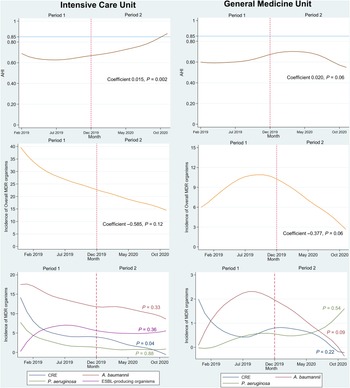
Using time series analysis, we detected a significant improvement in the antibiotic heterogeneity index in the ICU (coefficient, 0.015; P = .002) in period 2 compared to period 1, and the antibiotic heterogeneity index in the general medicine unit improved (coefficient, 0.020; P = .06). In the ICU, a decreasing trend in the incidence of the overall MDR-GNB occurred in period 2 (coefficient, −0.585; P = .11). Notably, we detected a significant reduction in CRE incidence (coefficient, −0.279; P = .04) as well as a reductions in the incidences of other MDR-GNB (Fig. 1). Compared to period 1, in the ICU, the overall DDD (P = .69), length of stay (P = .97), and 30-day mortality (P = .59) did not improve significantly in period 2 (Table 1). In the general medicine unit, the MDR-GNB incidence decreased (coefficient, −0.377; P = .06). However, the overall DDD (P = .36), length of stay (P = .47) and 30-day mortality (P = .32) did not significantly decrease (Table 1).
Antibiotic heterogeneity index, incidence of overall multidrug-resistant organisms (MDROs), and incidence of specific MDROs in both units.

Discussion
Our study yielded some notable findings. First, PAMS was implemented successfully in the ICU, which had a high prevalence of MDROs, and it led to a significant reduction in CRE incidence. Second, due to the low prevalence of MDROs in the general medicine unit, PAMS did not lead to significant reductions in overall MDR-GNB incidence. The key to improvement in the antibiotic heterogeneity index may be a high baseline prevalence of MDROs and a variety of antibiotics options, whereas improvement of MDR-GNB incidence may require a longer PAMS period.
In our study, in the ICU, consumption of carbapenems and β-lactam β-lactamase inhibitors (BLBIs) decreased. These findings may explain the overall decreases in MDR-GNB and a significant reduction in the CRE incidence in the ICU. We observed decreases in BLBI consumption in both units, which correlated with the reduction of MDR-A. baumannii in both units. Reference Ng, Teng and Lye7 Compared with previous studies, Reference Takesue, Nakajima and Ichiki3,Reference Takesue, Ohge and Sakashita4 our findings suggest that antibiotic heterogeneity index implementation may be successful in a medical ICU where the prevalence of MDROs is high and that such a strategy may not be practical in a general medicine unit with a low MDRO prevalence.
Our study has several limitations. First, this study was performed in a university hospital, where the choices of antibiotics were limited by patient insurance. Thus, our findings may not be applicable to hospitals that have a wider antibiotics choices. Second, the sample size and duration of follow-up in the ICU may not have been sufficient to reveal a significant reduction in antibiotics consumption and specific MDR-GNB incidences. Third, we were unable to evaluate the trend for ESBL-producing microorganisms in the general medicine unit because most cases were community-onset ESBLs. Fourth, time series analysis has limitations because it lacks a comparative arm. Finally, during period 2, the number of patients in the general medicine unit decreased by 11% due to the COVID-19 pandemic.
In conclusion, PAMS can be implemented successfully in a medical ICU with a high MDRO prevalence and may lead to a reduction in the incidence of MDR-GNB and CRE. Successful implementation of PAMS may require a wide variety of antibiotics choices, baseline prevalence of MDROs, and a long follow-up durations. Further studies to evaluate the role of PAMS in specific populations (eg, the neutropenic population and the pediatric ICU) are needed.
Supplementary material
To view supplementary material for this article, please visit https://doi.org/10.1017/ice.2021.231
Acknowledgments
We thank the primary physicians who practiced in the intensive care unit and general medical units during the study period at Thammasat University Hospital.
Financial support
No financial support was provided relevant to this article.
Conflicts of interest
All authors report no conflicts of interest relevant to this article.