Climate change is currently an existential threat to human beings. Civil society and international organizations have taken initiatives in this space. The Office of the United Nations High Commissioner for Human Rights (OHCHR) has linked human rights to climate change since 2009.Footnote 1 Investor and consumer-led fossil fuel divestment movements,Footnote 2 and international youth protests and strikes for climate have gained momentum in the real world as well as through social media.Footnote 3 More and more jurisdictions have pledged their goals to achieve carbon neutralisation as early as the 2040s.
Any proposal to reach the 1.5°C target in the 2018 IPCC reportFootnote 4 will require a sharp slowdown of the CO2 emissions. An effective response to climate change will critically depend on the cost, performance, and availability of technologies that can lower greenhouse gas emissions and mitigate and adapt to climate change. The decarbonisation goals may not be achieved without a “technology revolution” because it requires a fundamental change in a short period.Footnote 5 Not only are existing efficient technologies for energy conversion and utilisation in all sectors needed, but also breakthroughs in technologies for renewable energies (including but not limited to wind, solar, and renewable hydrogen) as well as technologies for cost-effective carbon capture, use, and storage. As addressing climate crisis cannot be achieved by a single new technology; a portfolio of these technologies needs to be deployed. This article generally refers to these technologies as clean technologies.Footnote 6
International negotiations to promote clean technologies diffusion (including transfer and dissemination) have been slow and controversial,Footnote 7 although the United Nations Framework Convention on Climate Change (UNFCCC) promoted mechanisms to facilitate technology transfer and access to clean technologies as early as 1992.Footnote 8 At the heart of this controversy is the role of intellectual property (IP) in clean technology diffusion. However, the importance of IP cannot be easily discerned if the term “intellectual property” could not even be put on the negotiation agenda.Footnote 9
This article explores possible pathways to restrict IP for clean technologies by examining existing mechanisms in international environmental law and international IP law at multilateral, bilateral, and national levels. The evidence from practices on each pathway so far indicates that developing countries need to maximize The Agreement on Trade-Related Aspects of Intellectual Property Rights (TRIPS)Footnote 10 flexibilities at the national level instead of expecting a “Doha-like declaration”.
This article makes three contributions to the literature. First, it systematically discusses three theoretical pathways to forester international clean technology diffusion by reviewing fragmented rules in environmental law and intellectual property law at different levels. From this, it proposes an operable pathway. Clean technology diffusion sits at the intersection of international IP law, which is essentially TRIPS and international environmental law (in particular those rules concerning climate change). For instance, Zaman argues that patent protection rules within TRIPS are one of the biggest impediments to the transfer of climate change-related technologies to poor and least developed countries.Footnote 11 Recent literature also maps interactions of provisions in international IP law and international environmental law and their chronological developmentFootnote 12 and explores the roles of various international fora on the outcome of negotiations.Footnote 13 However, the existing literature has not yet systematically examined available options for clean technology diffusion at different levels and across different disciplines of laws, nor has it explained why some options may be viable while others are not. Three theoretical pathways are identified: imposing external restrictions on IP, striking an internal balance within IP, and keeping the status quo (inaction). Imposing external restrictions would require multilateral environmental agreements specifically restricting the exclusivity of IP over clean technologies. Striking an internal balance would mean maximizing flexibilities within the IP system to balance incentives for innovations with the need for spillover benefits (diffusion). Keeping the status quo refers to the situation of inaction – none of the above is done. If this happens, clean technologies may enjoy more extensive protection over time as the upward ratchet of global IP never stops.Footnote 14 It is argued that instead of making efforts at what is likely to be prolonged treaty negotiations to impose external restrictions on IP, states should focus on a practical striking of an internal balance by maximizing and consolidating flexibilities available at TRIPS in national laws. States can do this unilaterally or collaboratively. Patent offices, as sites of national regulatory sovereignty, could be recaptured by the state. While this active defence will benefit the establishment of an international custom and the prevention of further expansion of TRIPS-plus standards, it may risk litigation at different fora, and some states need to be willing to take the burden of litigation.
Secondly, the national law-based solution proposed by this article responds to a popular proposal in the literature, a “Doha-like Declaration” as a solution to promoting access to clean technologies. Scrutinization of IP has been called for in many areas to promote better access to medicines,Footnote 15 access to knowledge,Footnote 16 and access to seeds.Footnote 17 The symbolic success in public health, in particular, the Doha Declaration on TRIPS Agreement and Public Health (Doha Declaration)Footnote 18 represents a significant rebalancing achievement by developing countries and civil society.Footnote 19 Therefore, some of these public health lessons are often referred to when envisaging mechanisms to foster clean technology transfer. However, a decade after the proposal was first made, it is argued that this approach is not operable due to the paralyzed multilateral trade mechanism, asymmetrical negotiation power of developing countries, prolonged negotiation process, and categorization problem in treaty negotiations.Footnote 20
Thirdly, the COVID-19 global pandemic reminds us of the importance of the fast dissemination of new technology as a response to the existential non-traditional threats to humankind. As a response to the pandemic, nation states are inclined to increase self-sufficiency and improve local supply chains for access to vital technology.Footnote 21 Global value chains have been a vital network for cross-border technology transfer,Footnote 22 and this trend of localising supply chains may cut the existing networks based on the global value chains. The current call for an IP waver for COVID-19 vaccines may bring about valuable discussions for clean technology diffusion that are otherwise impossible.Footnote 23 The demands for equitable access to COVID-19 related technologies, including but not limited to vaccine technologies, not only challenge the patent system in terms of adequacy of the current licensing mechanisms, but also raise the ethical issue of balancing profitability from patents and health equity.Footnote 24 Although the impacts are still unfolding, this article draws upon implications from this latest development for clean technology diffusion.
Section I will deal with IP in clean technology diffusion while the rest of this article will proceed as follows: Section II will analyse three theoretical pathways for clean technology diffusion. Section III will discuss the practical considerations for each pathway based on the existing evidence in international negotiations and law making. Section IV will evaluate the options, propose an operable pathway, and discuss implications from the COVID-19 pandemic. Section V concludes.
I. Intellectual Property Obstacle in Clean Technology Diffusion: Elephant in the Room
Acknowledging the importance of clean technologies decarbonization, many environmental and technology policy instruments have been used at the national level, from the overarching climate policy sequencingFootnote 25 to increasing the ratio of renewable energy in energy supplyFootnote 26 or reducing clean technology cost.Footnote 27 However, mechanisms to enhance technology diffusion have rarely been mentioned in the literature on clean technology policies in the last decades, after TRIPS established the requirement that every WTO member has to establish an IP system that meets its “minimum” standards. With protecting IP as a prerequisite, the focus has been reiterated as promoting technology transfer while respecting IP rather than restricting IP to promote technology diffusion.
Technology diffusion is the process by which innovations (including new products, new processes, or new management methods) spread within and across economies.Footnote 28 Technology diffusion creates positive externalities (benefits that have not been paid for – the positive side of “free-riding”). IP law, in particular the patent system, enables inventors to internalize such externalities through a limited period of monopoly, allowing for the private capture of social value. As pointed out by Nathan Rosenberg, it is an inescapable aspect of a patent system that “to the extent that it offers protection to a patent holder, it does so by slowing down the diffusion of inventions”.Footnote 29 This has always required a delicate balance between monopoly and diffusion of knowledge and between protecting private profitability and social warfare, within and beyond the patent system.
While TRIPS and post-TRIPS free trade agreements have directed the pendulum towards more extensive IP protection,Footnote 30 a longer historical perspective suggests that latecomers of industrialization across the world had long benefited from policies supporting technology diffusion. The Netherlands and Switzerland both abolished the patent system to enhance cross-border diffusion of knowledge to promote domestic industrialisation in the second half of the nineteenth century.Footnote 31 The US had provided systematic policy support to appropriate forbidden European know-how, including incentives to attract skilled workers to immigrate to North America, bringing with them the professional training they had acquired in Europe's factories.Footnote 32 The patent system was once part of the diffusion mechanism as domestic patent grants were also used to attract foreign skilled labour.Footnote 33
These countries began to lean towards a pro-IP position after they gained industrial power and became knowledge producers. In the late nineteenth century, justifications of IP based on utilitarianism and property theories underpinning the current IP laws became widespread. IP was incorporated into the network of bilateral treaties formalising intra-European commercial relations and was extended to colonial territories.Footnote 34 This mutual recognition of IP was further formalized in the Paris ConventionFootnote 35 and Berne ConventionsFootnote 36 in the 1880s. France, Germany, Spain, and the UK approved the Berne Convention in 1887, and following Article 19 of the Berne Convention, they included their territories, colonies, and protectorates in their accession to the Convention.Footnote 37 The influence of the former colonial powers on IP continued even after the developing countries became sovereign states. Despite the early international harmonisation of the Berne and Paris Conventions, IP rights remained territorial, and both conventions followed the quantitative, incentive-based approach.Footnote 38
Even economic theories on the patent system and technology diffusion in the 1970s and the 1980s took a very cautious perspective. For instance, Stoneman points out “it is the application of innovation (diffusion) rather than the generation of innovations (invention or R&D) that leads to the realization of benefits from technological advance”.Footnote 39 Profound transformations took place during the late 1970s and early 1980s, along with significant technological changes and the deployment of global value chains, where IP was reconceptualized as core competitiveness and a global trade issue.Footnote 40 IP was incorporated in the Uruguay Round negotiations, which produced TRIPS.Footnote 41 TRIPS emphasises commodification and transforms IP protection into a right proper rather than an innovation incentive. Nonetheless, Article 7 of TRIPS stipulates that:
the protection and enforcement of intellectual property rights should contribute to the promotion of technological innovation and the transfer and dissemination of technology, to the mutual advantage of producers and users of technological knowledge and in a manner conducive to social and economic welfare, and to a balance of rights and obligations.
However, there has been an increasing imbalance due to more extensive IP protection through TRIPs-plus provisions bilateral trade agreements in many issues,Footnote 42 and climate change is one of them. Technology breakthroughs in zero and negative emission technologies are essential to address the challenge of climate change. If clean technologies are stringently protected by IP (in particular through patents and trade secrets), both the supply and demand for clean technologies will be restrained. Although IP has been justified on various grounds,Footnote 43 international clean technology diffusion should be the clear priority given the importance of clean technologies in addressing the global challenge of climate change. This in turn implies the imperativeness of rethinking how to address the cost of the patent system – restrictions on others to have access to patented inventions so that the social value of clean technologies can be recaptured. This article discusses how such a restriction can be achieved at the international level.
II. Three Theoretical Pathways to Promote Clean Technology Diffusion
The IP system lies at the core of technology regulation. The use of patented clean technologies restricts access because of higher monopolistic prices.Footnote 44 Firms use their patents themselves. But they further maximize the returns to their IP investment through complex business strategies; for instance, licensing without production, strategic licensing to maintain dominance in a supply chain, or cross-licensing among competitors. These rational choices by firms have hindered optimal technology diffusion to address climate change.Footnote 45 Recent international initiativesFootnote 46 and negotiations have manifested demands for change.
The gap between technology supply and demand is often located in different countries. Therefore technology diffusion and transfer may not be well addressed solely by the national law of one state. Global coordination is necessary to promote the large-scale and fast deployment of clean technologies. Nonetheless, the disparity in levels of technology development has, to some extent, shaped the positions of different states towards clean technology diffusion. Clean technology diffusion is often framed as a zero-sum game across the North-South divide. IP has been centralized and prioritized in negotiations to guarantee returns on IP investment. Protected as a proprietary right, patents prohibit a third party from access to clean technologies without the consent of rights holders. Patent holders can charge a monopoly price, but if they do so demand will be less than it would be at a lower price in licensing practices.Footnote 47
Developed countries have been reluctant to transfer clean technologies to countries in need by arguing that there is insufficient IP protection to prevent unremunerated technology diffusion in the recipient country. This reluctance is facilitated by the international fragmentation of environmental law and IP law. However, if the environment continues to deteriorate without sufficient and speedy clean technology diffusion, everyone will be a loser. This points to the likelihood of demand for restrictions over IP.
There are two approaches to implement such restrictions to promote clean technology diffusion – those pursued outside of the international IP system and those pursued within the international IP system. The debate about technology diffusion also reflects the contest of values and which one shall be prioritized.Footnote 48 Prioritizing ecological objectives over private profits for IP rights holders, international environmental law could be a useful external restriction over IP and promote clean technologies diffusion. Negotiations within the IP system consist of exceptions and limitations within the IP law. These internal balances, however, often prioritize the value of innovation stimulation and the interest of rights holders. This differentiation refers to previous research on the interaction between IP law and human rights law, which takes a similar approach.Footnote 49 In addition to referring to this differentiation of external and internal restrictions, this paper also discusses a third possibility of taking no action, with the focus on possible consequences of no action.
A. Imposing External Restrictions
IP is ubiquitous and increasingly interacting with laws governing human rights, public health, preserving biodiversity, access to knowledge, and other issues.Footnote 50 The nexuses between these other areas of law and IP law have provided opportunities to address the substantive law overlaps, interfaces, tensions, and even conflicts. For the present purpose, external restrictions are efforts to incorporate clear provisions on restricting IP in multilateral environmental law.
Research on legal fragmentation and global legal pluralism has provided theoretical foundations on how one area of international law can define and delineate its relations with another.Footnote 51 Such clarification is made either by treaty provisions or judicial decisions. The treaty negotiation pathway is exemplified by the relationship between the Convention on Biological Diversity (CBD)Footnote 52 and TRIPS. Article 16.5 of the CBD provides that:
the Contracting Parties, recognizing that patents and other IP rights may influence the implementation of this Convention, shall cooperate in this regard subject to national legislation and international law to ensure that such rights are supportive of and do not run counter to its objectives.
This provision deals with the overlaps between the CBD and IP law (mainly TRIPS) and recognizes that the CBD objectives are to be given equal weight. However, this may not be an effective restriction because the vague expression “not run counter” in the CBD is subject to different interpretations and so is unlikely to safeguard the implementation of relevant rules. Although this non-contravention principle was further reaffirmed in a proposal for a new Article 29bis of TRIPS on Disclosure of Origin of Genetic Resources and/or Associated Traditional Knowledge,Footnote 53 text-based negotiations on this issue have never happened at the TRIPS Council. Consequently, Article 16.5 of the CBD only has symbolic meaning as it has not been, and probably will never be, concretely implemented. This treaty warns that an external restriction can only work effectively if it is guaranteed by a clearly articulated implementation mechanism.
In terms of clarification through judicial reviews, the European Court of Human Rights (ECHR) and the Court of Justice of the European Union (CJEU) have both examined the relationship between overlapping norms of human rights and IP.Footnote 54 In both cases, the courts used human rights law as the principal parameter for assessing the relationship – specifically the conflict between (1) national IP protection and enforcement measures and (2) freedom of expression and information or the right to privacy. The two courts took different approaches: the CJEU reconstructed international IP rules so that they fit with the court's approach to European Union (EU) human rights law while the ECHR allowed external rules to justify limitations on the right to property. Despite different approaches by the two courts, the use of judicial review itself has provided a possibility of procedurally rearranging the priorities between IP and other disciplines of law. This becomes increasingly relevant when the environment is framed as a human rights issue.Footnote 55 For instance, the United Nations Human Rights Council has stated in one of its resolutions that:Footnote 56
Noting that climate change-related impacts have a range of implications, both direct and indirect, for the effective enjoyment of human rights including, inter alia, the right to life, the right to adequate food, the right to the highest attainable standard of health, the right to adequate housing, the right to self-determination and human rights obligations related to access to safe drinking water and sanitation, and recalling that in no case may a people be deprived of its own means of subsistence.
With such developments in human rights law, there will be a possibility in the future that judicial review can also be used to resolve conflicts between IP and climate change on a case-by-case basis.
Considering both IP and climate change are subject to multilevel governance, external restrictions can be imposed at different levels. At the multilateral level, restrictions on IP could be incorporated into multilateral environmental agreements. Despite being fragmented, multilateral environmental arrangements aim to incorporate provisions promoting clean technology diffusion where the IP protection of such technology is an indispensable issue. At the bilateral and national levels, imposing external restrictions means incorporating restrictions on IP in various bilateral and plurilateral agreements, specifically into energy, climate change, or environment related treaty chapters. At the national level, external restrictions on IP can be imposed by domestic environmental protection laws. However, such rules may risk being accused of a TRIPS violation if there is no simultaneous breakthrough in multilateral negotiations.
B. Striking Internal Balance: TRIPS Flexibilities
The second approach is to strike an internal balance within the IP system. An internal balance has long been the cornerstone of the social contract theory of patents.Footnote 57 Economically, the social contract theory of patents requires that an effective and efficient patent system should balance the incentives for innovation and achieve sufficient spillover benefits to offset monopoly costs.Footnote 58 Flexibilities, either as limitations or exceptions to patentable subject matter or patent rights, have been an integral part of TRIPS.Footnote 59 Therefore, striking an internal balance for clean technology diffusion means exploration and maximization of available flexibilities within the IP system.
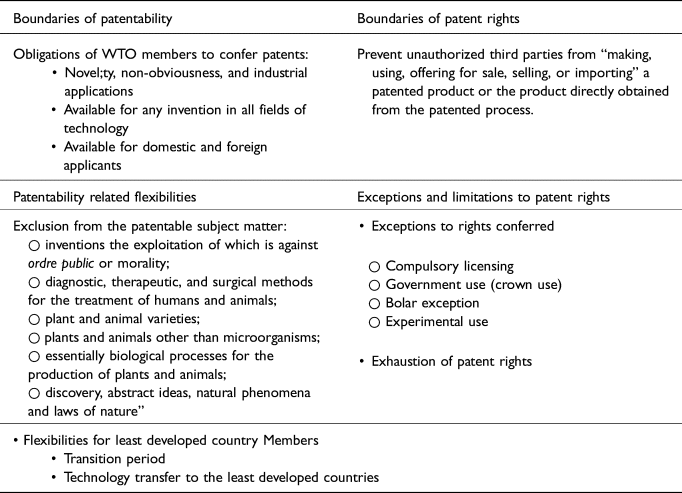
Article 27(1) of TRIPS requires WTO Members to make patents available for any inventions in all fields of technology and to patent rights enjoyable without discrimination as to the place of invention, the field of technology, and whether products are imported or locally produced. This non-differentiation in patent protection across technological fields is considered a demonstration of the principle of technology neutrality in patent law.Footnote 60 This provision sets the boundary of obligations for WTO members as well as rights for patent holders. Nonetheless, such obligations and rights are not absolute because flexibilities allow variations in implementation, which may mean less restrictive obligations for states in setting a patent standard or a lower level of protection for a granted patent.Footnote 61
Various flexibilities are available in TRIPS. Table 1 categorizes these flexibilities according to their relation to patentability and patent rights. Patentability related flexibilities allow WTO Members to provide variations in their national patent law when implementing WTO obligations through exclusion from the patentable subject matter. Flexibilities for patent rights are designed for right holders in the form of limitations or exceptions to their rights. Some of these flexibilities are only available to pharmaceutical patents such as the Bolar exception and experimental use. TRIPS also design flexibilities for the least developed county Members in the WTO, including a transition period to implement TRIPS and receiving technology transfer from developing country Members.
TRIPS flexibilities WTO Members may enact in national law

1. Patentability related flexibilities
Articles 27.2 and 27.3 of TRIPS list subject matter that a WTO Member may exclude from patentability in their national patent laws. Some WTO members, such as Brazil and India, have a broader scope of exclusion while others have narrower exclusions.Footnote 62 There are two subject matter grounds for exclusion in TRIPS. The first is specific technologies –diagnostic, therapeutic, and surgical methods for the treatment of humans or animals and plants and animals other than microorganisms (but plant varieties must be protected under the sui generis system). These exclusions were widespread in pre-TRIPS patent law (as were chemical compositions). While software is not specifically mentioned, TRIPS provides that software shall have copyright protection and, at the time TRIPS was being negotiated, this was the principal means by which software was protected in the EU and the USA. The implementation of this exclusion varies at the regional and national level. For instance, Article 52(2) of the European Patent Convention lists as non-patentable subject matter: “discoveries, scientific theories and mathematical methods; aesthetic creations; schemes, rules, and methods for performing mental acts, playing games or doing business, and programs for computers; presentation of information”. The US does not proscribe specific exclusion in its statutory law, but abstract ideas, natural phenomena, and laws of nature may be excluded on the basis of case law.
Another ground for exclusion is ordre public, which is included in the patent laws of many countries and regions.Footnote 63 This exclusion was introduced to patent laws because of its long tradition within the English Statute of Monopolies exclusions.Footnote 64 In WTO jurisprudence this provision also mirrors Article XX(a) of General Agreement on Tariffs and Trade (GATT)Footnote 65 and Article XIV(a) of General Agreement on Trade in Services (GATS).Footnote 66
While on the face of it ordre public indicates a broad scope in TRIPS – “to protect human, animal or plant life or health or to avoid serious prejudice to the environment, provided that such exclusion is not made merely because the exploitation is prohibited by their law”Footnote 67 – it has thus far only been applied to exclude life forms from patentability in biotechnology. For instance, Article 6(1) of the EU Biotechnology Directive provides that certain inventions presumptively fall within the remit of the exclusion from patentability on the grounds of ordre public. Additionally, religious communities (in particular Catholic churches) have been involved in the debates on the patentability of human genes and related technologies such as the use of human embryos, and human cloning.Footnote 68
What constitutes a contravention against public order and morality depends on the time, place, and culture of a certain country. There has been a call for a broad interpretation of Article 27.2 that ordre public should exclude clean technologies from patentability to “avoid serious prejudice to the environment”.Footnote 69 Action on climate change and other forms of environmental degradation become increasingly imperative, particularly in environmentally vulnerable countries. Therefore it is time to rethink about excluding clean technologies from patentability to avoid serious prejudice to the environment, even if it might not be a solid ground for ordre public when TRIPS was signed. WTO members should have the freedom to interpret excluding clean technologies from patentability as a circumstance of ordre public to solve their current social and environmental problem. However, such experiments become uncertain, with influential IP scholars like Keith Maskus arguing that it may require a significant change in Article 27 of TRIPS to allow interested countries to exclude environmentally sound technologies from patent eligibility.Footnote 70 Consequently, as current Article 27.2 does not explicitly mention excluding clean technologies from patentability as an ordre public issue, any attempt to implement it in national law may risk the United States Trade Representative (USTR) acting, or a WTO dispute. Negotiators from developing countries did pursue this exclusion for clean technologies for Copenhagen Accord, but the attempt failed in the end (Section III.A.1).
2. Exceptions and limitations to patent rights
Once a patent is granted, Article 28.1 of TRIPS specifies the rights of patent owners to prevent unauthorized third parties from “making, using, offering for sale, selling, or importing” a patented product or the product directly obtained from the patented process. Articles 30 and 31 of TRIPS provide exceptions and limitations to patent rights.Footnote 71 The exercise of exceptions is constrained by three conditions in Article 30 of TRIPS:Footnote 72
(i) that the exceptions to the exclusive rights must be “limited”
(ii) that the exceptions do not unreasonably conflict with a normal exploitation of the patent; and
(iii) that the exceptions do not unreasonably prejudice the legitimate interests of the patent owner, taking account of the legitimate interests of third parties.
State practice to promote access to technologies based on the exceptions under Article 30 may give rise to disputes under the WTO. In Canada – Patent Protection of Pharmaceutical Product, the European Communities (EC) challenged the extensive exceptions in Canadian patent law that were designed to ensure generic pharmaceutical products could enter the market the day after the patent expired. Canada's counterargument was that the three conditions stated in Article 30 of TRIPS should be given a liberal interpretation. While the panel found that the “limitations stated in Articles 7 and 8.1 must be borne in mind, as well as other provisions of TRIPS which indicate its objective and purposes”,Footnote 73 the WTO panel report has been criticized as its interpretation of rules was almost solely in light of expectations of the private right holders.Footnote 74 If “normal” exploitation of patents is given weight by reference to existing practice when interpreting Article 30, it will be difficult to introduce a new exception. While Article 30 can surely be relied on to justify an exception in the case of a global climate emergency, the Canadian pharmaceutical case indicates the associated legal uncertainty – a state considering such application is also required to be prepared for taking on the burden of litigation.
(a) Compulsory licensing
In addition to the Article 30 exceptions, Article 31 of TRIPS provides explicit exceptions as “use without authorization of the right holder”, which primarily includes compulsory licensing and government use (Crown use). Compulsory licensing is a mechanism whereby a licensee can obtain a licence for the patent without the consent of the patent owner when public interests are threatened. The purpose of the compulsory licensing system is to enhance the supply, which would otherwise be hindered by the patent right holders’ refusal to trade or through the imposition of an unreasonably high royalty rate. TRIPS allows for compulsory licensing in conditions of “emergency”, but only from domestic sources of supply. So far, TRIPS signatories have only recognized public health emergencies as meriting compulsory licensing. Even within the public health sector, it is often narrowly issued for communicable diseases instead of non-communicable chronic health problems such as cancer or heart disease.Footnote 75 Negotiations continued in the post-TRIPS era and eventually generated a WTO Ministerial Declaration on TRIPS and Public Health,Footnote 76 which further led to an amendment to TRIPS.Footnote 77
As the practical ability of states to issue compulsory licences for pharmaceuticals in emergencies has been heavily circumscribed, there has been a debate about whether compulsory licensing could be used for climate change related technologies.Footnote 78 Correa argues that “compulsory licensing or government use can be implemented to ensure access to other technologies outside the pharmaceutical field, for instance, technologies necessary to address climate change adaptation or mitigation”.Footnote 79 Zaman specifies that climate change mitigation and adaptation technologies would create strong demand for compulsory licensing, which is comparable to cases of access to essential generic drugs. Nonetheless, he acknowledges that compulsory licensing for clean technologies would be a critical issue under TRIPS because Article 31(b) does not define what constitutes “emergency” or “extreme urgency”.Footnote 80 The major opposition to a broad definition is based on a fear of a harmful backlash from the patent owners and their respective states, the differences between pharmaceuticals and clean technologies, and the effectiveness of issuing a compulsory licence as compared with removing tariffs and non-tariff barriers.Footnote 81
The real barriers for defining climate change as an “emergency” to suffice the compulsory licensing condition are the absence of obligation in multilateral environmental law and international legal fragmentation. The existential threat of climate emergency has been reiterated by environmental organizations such as the United Nations Environment Program (UNEP) and Intergovernmental Panel on Climate Change (IPCC).Footnote 82 For instance, the UNEP's periodic emissions gap report in 2019 states the urgency and magnitude of the challenges and urges that economies must shift to a decarbonization pathway now: “[c]ountries collectively failed to stop the growth in global GHG emissions, meaning that deeper and faster cuts are now required. … The technologies for rapid and cost-effective emission reductions have improved significantly.”Footnote 83 However, there seems to be a couple of gaps for such technologies to be effectively diffused through a compulsory licensing mechanism. First is to translate “climate emergency” from a mere advocate into a legally binding term in multilateral environmental law.Footnote 84 The second is to require Article 31(b) of TRIPS to interpret “emergency” or “extreme urgency” by reference to such multilateral environmental law, which seems unlikely in the existing “trade-related” TRIPS jurisprudence.Footnote 85
(b) Government use
Government use is another mechanism to use a patent without authorization. It enables governments and other parties authorized by a governmentFootnote 86 to exploit patented inventions for public non-commercial purposes or emergencies without the consent of or consulting with patent rights holders. Governments are still required to notify and ultimately remunerate the relevant rights holders but at a fair rate. Although compulsory licensing and government use both constrain exclusivity, they overlap conceptually. The two mechanisms may have different legal bases, different administrative or judicial implementation procedures, and different economic dynamics.Footnote 87 Government use of patents originated from Crown use in English patent law and is used in many Commonwealth countries such as Australia. Although rarely used in practice, the threat of use imposes pressure on the patent owner and can facilitate improved prices or licensing agreements.Footnote 88 Nonetheless, there are a lot of uncertainties regarding the circumstances where Crown use can be invoked, who may invoke it, the level of remuneration, and related transparency and accountability issues.Footnote 89
Compulsory licensing and government use are exceptions to patent privileges/rights in the sense that some otherwise unlawful practices are implied as non-violations. For these exceptions to be effective in practice, delineation of the boundaries of what is permitted is essential. Otherwise, there is too much uncertainty leading to a lack of action. Repeated practices of issuing compulsory licences for clean technologies are essential to establish a “custom” or general practice,Footnote 90 a practice that interprets such licences as WTO compliant.Footnote 91 The paradox is that such a practice to generate a new custom is deterred because the mere possibility of violation suffices to launch a dispute at the WTO. Despite the substantial academic debate on the legitimacy of (1) a government's issuing of a compulsory licence for certain clean technologies where the use is for a national emergency or other extremely urgent circumstancesFootnote 92 or (2) government authorization for use of a patent for public non-commercial purposes, there has never been any application for compulsory licensing or Crown use in clean technology patents.
The lack of clarity and the possibility of being sued has a deterrence effect. One way to navigate this uncertainty is to seek clarification. To make the first step work for clean technologies transfer, proponents call for a “Doha-like” declaration on TRIPS and climate change which would justify the application of non-voluntary licensing through compulsory licensing or government use (Section III.B.2).
(c) Patent exhaustion
IP rights are territorial rights. During TRIPS negotiations, countries did not agree on the exhaustion of IP; that is, the IP owners’ loss of the right to control the resale of the protected good. The exhaustion rules in TRIPS strike a balance between the access to and free movement of innovative goods, and the profits of IP rights holders.Footnote 93 Essentially, it is not a question of whether IP will exhaust but to what extent selling of an IP-protected product will lead to the loss of rights – international, national, or regional. This scope has different impacts on trade. International exhaustion (the selling of IP-protected goods in one country leads to exhaustion of rights in other parts of the world) allows the parallel import of goods. In contrast, national exhaustion (the selling of IP-protected goods in one country only means that the rights holder loses his/her rights within that nation) entitles the right holders to oppose parallel imports. A regional exhaustion system allows parallel imports within the region while prohibiting parallel imports between a member of the region and other states.
Article 6 of TRIPS allows WTO Members to choose how to address IP exhaustion, as long as the provisions comply with national treatment and most-favoured-nation principles. The Doha Declaration reaffirms the interpretation that WTO Members are free to establish their own exhaustion regimes.Footnote 94 As parallel imports have the positive impact of increasing the availability of goods through greater competition, international exhaustion maximizes the benefits to users of new patented technology.Footnote 95 In terms of clean technologies, while international exhaustion does not enhance transfer practices directly, it provides an alternative opportunity by improving potential competition so that countries without production capacity may have more affordable products to address climate change and other environmental challenges.
(d) Flexibilities for least developed countries
Article 66 of TRIPS provides two flexibilities to “least developed countries” (LDCs),Footnote 96 and these can be applied to clean technologies without differentiating by field of technology. The first is the extension of the transition period in which the LDCs are exempted from implementing TRIPS. The latest extension decision was made in Bali in 2013, with TRIPS extending the transition period to 1 July 2021.Footnote 97 If countries take advantage of this transition period, patents need not be a barrier to technology transfer to these LDCs. However, the absorptive capacities of the local communities as well as financial sources become significant issues. As many LDCs had patent protection in their previous history of colonization,Footnote 98 they could not take advantage of the transition period in reality.
Secondly, Article 66.2 of TRIPS requires developed countries to provide incentives to enterprises and institutions in their territories to promote and encourage technology transfer to the LDCs.Footnote 99 In 2001, the Doha Ministerial Conference required the TRIPS Council to “put in place a mechanism for ensuring the monitoring and full implementation of the Article 66.2 obligations of technology transfer”.Footnote 100 This was reiterated by the Decision on Implementation of Article 66.2 (IP/C/28) in early 2003, with details on developed country reports. The reporting mechanisms have their limitations; for instance, there are no legal consequences for non-compliance.Footnote 101 In addition, reporting to TRIPS Council is not very detailed – developed country members always note that the reports are only illustrative of the kind of incentives they provide. Among various sectors of the implementation from 2003 to 2006, environment and water, and energy are among the important fields where incentive programs are reported.Footnote 102
C. Inaction
What would happen if no efforts, either external restrictions or internal balance, are made to promote clean technology diffusion? While there is little legal interest to discuss concerning “inaction” per se, it is important to understand the consequences of inaction.
After TRIPS, trade negotiations shifted to bilateral fora in the form of Preferential Trade Agreements (PTAs), often referred to as Free Trade Agreements (FTAs). Most of these agreements include TRIPs-plus provisions.Footnote 103 As Drahos points out, the strategy of forum shifting means that “some negotiations are never really over”.Footnote 104 These PTAs have enhanced IP protection in the form of extending patentable subject matter and the duration of protection, lowering the threshold for patentability and foreclosing flexibilities. Through this chain effect, IP protection standards in many countries have quietly increased in the last two decades, either as general rules or sector-specific rules such as patent term extensions for pharmaceutical patents. Doing nothing means this chain effect continues, pulled by the giant anchor of the most-favoured-nation (MFN) principle, dragging states into the deep depths of obligation. With increased IP protection, technology diffusion will take place either later or in a more limited fashion. For instance, with the introduction of the patent term compensation in the Trans-Pacific Partnership (TPP)Footnote 105 and other preferential trade agreements, pharmaceutical products obtain longer patent duration than would otherwise be the case. This postpones the diffusion of new inventions. Given the progressively higher IP standards resulting from continuous PTA negotiations, any extensions generally applicable to patents will hinder clean technology diffusion and inaction means accepting these rules without questioning their ramifications for the environment, and essentially climate change. The analysis of this pathway in Section III.C will focus on the ramifications of inaction.
III. Three Pathways in Practice
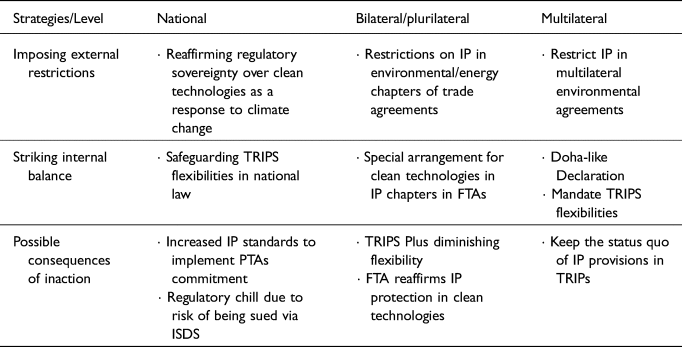
The three theoretical pathways, at a high level of abstraction, identify possible directions to promote clean technology diffusion. Various efforts have been made to undertake each of the pathways in the last decade. This section will assess the exiting experiences and explore why some of the pathways may not be viable. Table 2
Strategies for promoting clean technologies transfer at various levels

A. Imposing External Restrictions
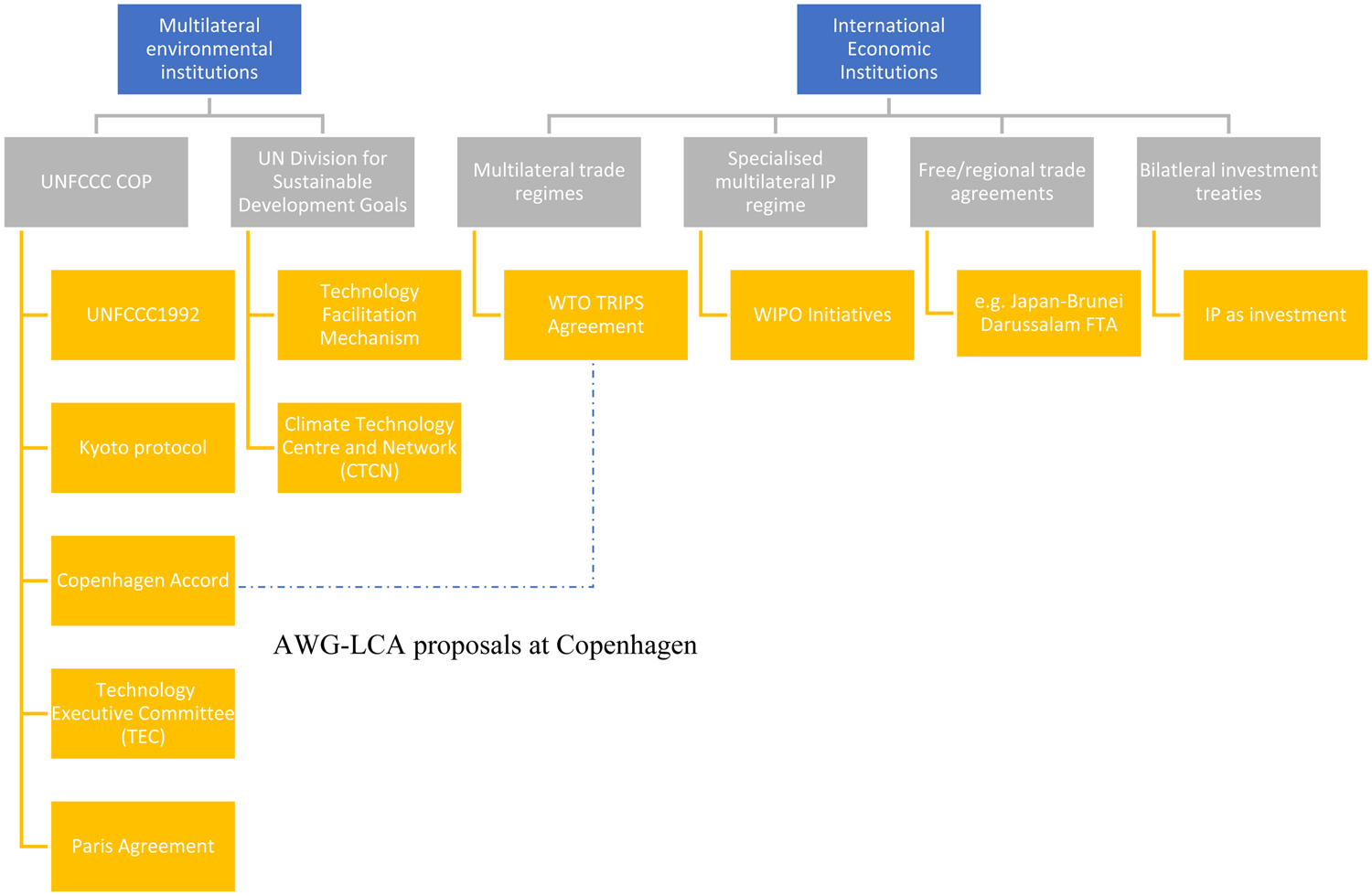
As discussed in Section II.A, external restrictions mean provisions that impose restrictions on IP in multilateral environmental law. In practice, there have been continuous efforts to impose such restrictions. To locate these attempts, we need to first identify the elementary institutions that are involved in the global governance of clean technologies transferFootnote 106 – primarily the multilateral environmental institutions and the international economic institutions in which international IP institutions are determined. The following figure shows the structure of these institutions: Figure 1
Fragmented International Institutions on Environmental and IP

Within the multilateral environmental institutions, the most important provision relating to external restriction to IP is Article 4.5 of the 1992 UNFCCC:
The developed country Parties and other developed Parties included in Annex II shall take all practicable steps to promote, facilitate and finance, as appropriate, the transfer of, or access to, environmentally sound technologies and know-how to other Parties, particularly developing country Parties, to enable them to implement the provisions of the Convention. In this process, the developed country Parties shall support the development and enhancement of endogenous capacities and technologies of developing country Parties.
Although this provision mandates developed countries to promote clean technology diffusion, there is a gap between this provision and the external restriction on IP – this provision does not explicitly mention IP to achieve the mandate. Following the 1992 UNFCCC,Footnote 107 the Kyoto Protocol again addresses technology transfer in Article 10, calling for “cooperating in the promotion of effective modalities for the development, application and diffusion of, and take all practicable steps to promote, facilitate and finance, as appropriate, the transfer of, or access to, environmentally sound technologies … in particular to developing countries”. With the qualifiers like “take all practicable steps” and “as appropriate”, the obligations for promoting technology transfer are diluted. These permissive provisions do not have teeth when they conflict with TRIPS. The Bali Action Plan (2007)Footnote 108 reaffirmed the centrality of clean technologies, calling for “enhanced action on technology development and transfer”. The Cancun AgreementsFootnote 109 have created a Technology Mechanism to facilitate technology transfer. Yet again, “delegates [at Cancun] decided to take one of the most contentious issues, intellectual property rights, off the table”.Footnote 110
Consequently, with no explicit mention of IP in the UNFCCC, it is difficult to introduce IP as an agenda in subsequent multilateral environmental negotiations, and IP rights holders have taken advantage of the permissive language in environmental treaties. Although the United Nations Development of Economic and Social Affairs (DESA) 2009 World Economic and Social Survey recommends that “the parties to the UNFCCC need to agree on the role of IP in the transfer of technology”,Footnote 111 progress on this issue is nonexistent. In the last decade, there have been efforts to impose external restrictions on IP in multilateral environmental agreements, but all have failed. This section uses developing countries’ efforts to incorporate restrictions on IP in the Copenhagen Accord in 2009 as an example to help understand the landscape of the negotiations.
1. Efforts to restrict IP in the Copenhagen negotiations
The Copenhagen AccordFootnote 112 is a typical example of the efforts of developing countries to incorporate external restrictions to IP in multilateral environmental agreements. UNFCCC COP-15, held at Copenhagen 7–18 December 2009, was the largest gathering in United Nations (UN) history, attracting 125 heads of state and government as well as nearly 40,000 participants.Footnote 113 The well-documented negotiation process provides an opportunity to see just how difficult the negotiating realities are when it comes to putting IP on an environmental agenda.
International NGOs were actively involved in submitting proposals at the Copenhagen Accord. The Third World Network (TWN) tabled a submission that elaborated various options for IP restrictions in clean technologies transfer. Identifying IP as a barrier to clean technologies transfer, these proposals to relax IP rights include specific measures at different stages of technology development. They could be implemented by various stakeholders (states, patent offices, and patent holders) at different levels.Footnote 114 Concerning patented technologies, the proposal was that contracting members would agree to exclude environment-friendly technologies from patenting. This exclusion could be mandatory or discretionary, and the scope of exclusion could be worldwide or just in developing countries. It was also proposed that a collective global technology pool would be established to share information about these technologies. Referring to the success of the Doha Declaration, it was proposed that a similar declaration on TRIPS and access to climate-related technology be negotiated. At the national level, the commitment includes implementing exclusions to patenting as well as regulations on compulsory licensing and monitoring terms of voluntary licensing.
The Ad Hoc Working Group on Long-term Cooperative Action (AWG-LCA), established under the Bali Road Map at the United Nations Framework Convention, was responsible for preparing the text for the Copenhagen Accord. IP was proposed to be incorporated in the chapter “Enhanced action on technology development and transfer”. In the early versions of the negotiation text, different options regarding IP mechanisms were proposed. Developing countries, including the Group of 77 (G77) and China, attempted to include a clear statement that IP rights constitute a barrier to technology transfer and development and called for the Executive Body to specifically “address issues related to IP rights as they arise” as one of its functions. Several proposals about restricting IP were submitted to the informal drafting group on technology by Bolivia, Bangladesh, and India. Nonetheless, these efforts were successfully opposed by developed countries by simply refusing to mention IP in any outcome concerning technology transfer.Footnote 115
In the preparation for Copenhagen, substantive restrictions on IP were proposed as part of the negotiation text. In the Bonn preparation meeting (June 2009), Annex IV Enhanced Action on Financing, Technology, and Capacity-building incorporated three options on IP, which imposed stringent restrictions. For instance, one proposal was that “all necessary steps shall be immediately taken in all relevant fora to mandatorily exclude from patenting climate-friendly technologies held by Annex II countries which can be used to adapt to or mitigate climate change.”Footnote 116 As discussed in Section II.B.2, it is difficult within IP law to entirely exclude certain technologies from patenting. Therefore, while this provision offers justification under multilateral environmental law to exclude clean technologies from patenting in all developing countries, it also mandates all necessary steps to be taken in all fora, which means the WTO, as the major IP treaty, which needs to be revised accordingly.
With the Copenhagen meeting approaching, negotiation documents were released in the form of non-papers. In the Barcelona preparation meeting, Non-paper No. 36 enumerated five options regarding IP measures.Footnote 117 Some of the options had absorbed positions in the TWN submission, such as abolishing IP for environmentally friendly technologies for developing countries (option 3) and establishing compulsory licensing for these technologies (option 4). Non-paper No. 36 was superseded by Non-paper No. 47. This non-paper was the final text for the Barcelona preparatory meeting in November 2009, in which positions on the role of IP in clean technologies transfer diverged again. The agenda went back to two options: one option does not mention IP at all, while the other introduced an overarching non-contravention statementFootnote 118 and proposed some moderate restrictions to remove specific barriers for clean technologies transfer arising from IP protection.Footnote 119 These restrictions on IP were not as stringent as those proposed in Non-paper No. 36. When negotiations proceeded at the Copenhagen Conference based on Non-paper No. 47, drafts were updated almost daily. Eventually, the Copenhagen Accord adopted the first option, without mentioning IP at all in the final text.Footnote 120 The Copenhagen outcome indicates that there is no lack of proposals or solutions to tackle IP-related issues in clean technologies transfer. Instead, there is a lack of political will, in particular from developed countries, to agree to these solutions.
2. Plurilateral and bilateral level implementation
IP is frequently included in bilateral and plurilateral trade agreements to confirm or reinforce TRIPS standards, as a process of global IP “up-ratchet”Footnote 121 these rules are usually provided in IP chapters and apply to all technological fields. However, there is a recent trend that sector-specific provisions on IP are incorporated in an FTA's environmental protection or energy chapter. For instance, in the Japan-Brunei FTA,Footnote 122 IP was specifically mentioned for environmental protection related to technology transfer in the chapter on energy. Article 93.2 provides that each party shall “encourage favourable conditions for the transfer and diffusion of technologies that contribute to the protection of environment, consistent with the adequate and effective protection of IP rights”. This provision imposes no external IP restrictions. Instead, it reaffirms adequate and effective IP protection for clean technologies. Such provisions may lock in countries signing such FTAs, preventing them from accepting any international agreements derogating from intellectual property in clean technologies.
More recently, the Agreement on Climate Change, Trade and Sustainability (ACCTS) initiated by Costa Rica, Fiji, Iceland, New Zealand, and Norway in 2019 could indicate a new trend in trade and environment agreements.Footnote 123 Since the purpose of the negotiation is to address interrelated elements of climate change, trade, and sustainable development agendas, the negotiators could address clean technology diffusion more systematically and effectively. As these negotiators may not oppose further restrictions on IP, it is promising that some sort of concrete text on flexible arrangements for clean technologies may appear at the bilateral level. Admittedly, while trade volumes among these economies are small, the provisions on restricting IP in promoting clean technology diffusion, either in the IP chapter or in the environmental/energy chapter, would have declarative value and might start a cascade of similar practices in future FTAs. Given the negotiations started only in 2019, no negotiating drafts are yet available and the outcome is yet to be seen.
3. National level restriction: why is it not viable?
TRIPS establishes minimum standards for IP protection, and any derogation from those standards can be considered as a violation and could be subject to a WTO dispute. Patent laws in Europe emerged during the industrial revolution. Historically, states once had the sovereignty to tailor their patent law for domestic policy objectives. During the major patent controversy in the late nineteenth century, the Netherlands repealed its patent legislation from 1896 to 1912, and so did Switzerland from 1850 to 1907.Footnote 124 After TRIPS, every WTO Member is obliged to provide internationally uniform standards for IP protection, regardless of the differences in their economic development, industrial structures, and social needs.Footnote 125 However, there can still be a counterargument for states to restrict IP in their national law in order to adapt and mitigate climate change, which can be justified by the TRIPS principles.Footnote 126 In addition, the principle that “IP should not be interpreted or implemented in a way that limits the purpose of addressing adaptation and mitigation climate change”Footnote 127 is a principle that could be used to resolve the conflict between laws, just like Article 16.5 of the CBD. This means that, although such provisions and principles can be incorporated into national laws, they could still be challenged at the WTO. Even if such a dispute settlement were to happen it would still be a better scenario than not having the principle at all. It may put the underpinning conflict between IP and clean technology diffusion under the spotlight, whereby demanders of high IP protection who once intentionally ignored the issue, or negotiators who used veto power at Copenhagen, might not simply ignore them again. In reality, however, no country has promulgated such legislation. Given the repetitive failure of incorporating various restrictions on IP into multilateral environmental law one would question the operability of a treaty pathway.
In addition to the threat of a WTO dispute settlement and unilateral measures from powerful countries, the collective action problemFootnote 128 can be one of the interpretations concerning the silence when it comes to restricting IP in national laws. Derogating from IP protection at the national level is always associated with costs, including the potential outflow of existing foreign direct investment to other countries with similar investment conditions, but without IP derogation.
A monopoly in the form of patents on core clean technologies are considered to be an effective way to retain competitive advantage in the renewable energy industry.Footnote 129 Without adequate IP protection in clean technology related sectors, owners of these technologies may simply avoid entering that market, which would make any national law futile. Therefore, if countries want to implement external restrictions at the national level, they need to form a coalition of a large number of countries to introduce such rules simultaneously and concertedly. Despite the presence of the G77, it is difficult to build such a coalition because of the diversified interests of countries and the shortage of trust. Without such a coalition, the first country introducing these rules would probably face a WTO dispute for a TRIPS violation and the country may not have adequate resources and strategies to win the WTO case. The country would bear the consequences of losing the case alone while sharing the benefit of winning the case with other WTO members. No rational country would be willing to be the first. With no prevailing national practice, it is difficult for countries to justify external restrictions on IP in customary international law.
The collective action dilemma can be overcome if a single country shows leadership. An example is the Australian tobacco plain packaging case. When confronting conflicting mandates of complying with TRIPS and the WHO Framework Convention on Tobacco Control (WHO FCTC),Footnote 130 the Australian Tobacco Plain Packaging Act 2011 was enacted to conform to the WHO FCTC by limiting trademark use on tobacco products or their retail packaging. The legislation was challenged by Philip Morris and the case was heard by the High Court of Australia and, later, an investor-state dispute settlement (ISDS) tribunal. A series of disputes were also brought before the WTO dispute settlement body.Footnote 131 The Australian government won all these disputes as well as the ISDS case. Many other countries followed suit once there was a reassurance of non-violation. Similar laws were implemented in other countries, including France, Ireland, New Zealand, Norway, the UK, Canada, Georgia, Hungary, Mauritius, Mauritius, Singapore, and Thailand.Footnote 132 Another example of the success of small states in WTO compliance bargaining is the US gambling services caseFootnote 133 where Antigua and Barbuda successfully challenged the US ban on the cross-border internet gambling and betting services despite their lack of resources.Footnote 134
The tobacco plain packaging case and the gambling service cases have broader implications for clean technology diffusion and WTO compliance. On the one hand, the tobacco plain packaging case shows that even developed countries can suffer from too restrictive IP standards. Australia had the technical expertise and willingness to absorb the cost of the action. Nonetheless, the gambling services case shows although power and resources are key to international bargaining leverage, small states such as Antigua could still gain bargaining leverage when employing thoughtful strategies and following the WTO's procedures. On the other hand, despite the encouraging developments, implementing national level restrictions is not a reliable pathway to promote clean technology diffusion because it is contingent on the uncertainty of WTO dispute settlement outcomes.
The difficulty in imposing external restrictions on IP to promote clean technology diffusion can also be explained by fragmentation in global governance.Footnote 135 Fragmentation signifies the diversity, multiplicity, and distribution of regulatory powers among different institutions. Within fragmented institutions, the IP system prevails due to the prescriptivenessFootnote 136 of its rules and the well-established implementation mechanisms.
B. Strike an Internal Balance – More Than a Doha-Like Declaration
Although TRIPS makes available various flexibilities (Section II.B), few WTO members have implemented these flexibilities in their national law. This is partly because of the constructive ambiguity in flexibility provisions and their non-mandatory nature.Footnote 137 This section examines not only the limited practices of flexibility implementation, it also explores how to tackle institutional problems of bifurcation and lack of clarity to facilitate future implementation of TRIPS flexibilities.
1. The need for clarification
As TRIPS flexibilities either delineate or carve out the exclusivity of IP rights, a clear boundary of flexibilities is needed before they can be implemented. However, none of the flexibilities in TRIPS has a clear boundary. Instead, there are considerable constructive ambiguities in TRIPS flexibility provisions.Footnote 138 Ambiguity refers to the use of ambiguous language for sensitive issues to conceal or postpone conflict by allowing alternative understandings. In international trade agreements ambiguities are intentionally used to allow trade partners the capacity and flexibility to cope with certain legitimate concerns without limiting advances in trade liberalization.Footnote 139 For instance, there can be multiple interpretations on the grounds for issuing a compulsory licence, specifically what constitutes “national emergency”, “extreme urgency”, and “public non-commercial use”,Footnote 140 and whether prior negotiation with the patent owner for a voluntary licence is required except in the case of national emergency or other extreme urgencies. Different definitions and formality requirements may have a significant impact on whether a compulsory licence can ultimately be issued.
Without clarification of what is specifically permitted as a TRIPS flexibility, their implementation risks the accusation of a TRIPS violation because the focus of these post-TRIPS efforts at implementing TRIPS flexibilities at the multilateral level is on reaffirming activities as non-violation of TRIPS. The Paragraph 6 mechanism in the Doha Declaration exemplifies such reaffirmation efforts; it looks as though it aims to clarify conditions to issue compulsory licences for supply to a foreign market.
Article 31(f) of TRIPS requires that production under the compulsory licensing has to predominantly supply a domestic market. This requirement has been amended by Paragraph 6 of the Doha Declaration. After the amendment, the requirement is relaxed so that a country without pharmaceutical manufacturing capability can make use of compulsory licensing so that firms outside of its jurisdiction can supply it.
2. A Doha-like declaration on TRIPS and climate change?
Facing similar, if not more, ambiguities in implementing flexibilities in the area of clean technology diffusion, a Doha-like Declaration on TRIPS and climate changeFootnote 141 has been proposed to clarify the boundaries in implementing TRIPS flexibilities to achieve access to clean technologies.Footnote 142 Following the example of the Doha Declaration, in particular its Paragraph 6 mechanism, there has been a concrete proposal for a Declaration on TRIPS and Environmentally Sound Technologies.Footnote 143
Before subscribing to this proposal, we need to examine how the Paragraph 6 mechanism has been used. The requirements elaborating Paragraph 6 are so onerous that the procedure has only been used once – Rwanda's request for compulsory licensing to import TriAvir, a generic HIV/AIDS drug manufactured in Canada by Apotex, has been the sole case using the Paragraph 6 mechanism.Footnote 144 Three other attempts eventually failed.Footnote 145 This indicates that Paragraph 6 mechanism is hard to use despite the considerable efforts made in the negotiations to establish such a mechanism. As pointed out by Peter Drahos, one lesson from the Doha Declaration over access to medicines for developing counting in engaging with future negotiations is: “where a coalition of weak bargainers obtains a negotiating gain that requires high levels of rule complexity to implement, it reduces its chances of successfully realizing that gain.”Footnote 146 To be effective, a Doha-like mechanism needs to be constructed so as to more appropriately meet the needs of users, not rights holders.
More than a decade has passed since a Doha-like proposal for clean technologies was first proposed. The world has changed dramatically since then. Multilateral negotiations within the WTO remain in deadlock and the WTO Appellate Body has been paralyzed. This indicates that the pathway for a Doha-like declaration would bog down in prolonged multilateral negotiations which will not suffice to achieve a speedy response to climate change. Additionally, in our case of restricting IP to promote clean technology diffusion, developing countries are in the same bargaining position as they were for medicines. If a Doha-like declaration is pursued the critical lesson from Doha is to have a concrete implementation mechanism that will achieve the diffusion goals. Nonetheless, it is warned that such a declaration will also suffer from the categorization problem in treaty negotiations.Footnote 147
3. Mandating TRIPS flexibilities
Another way to enhance the enforceability of TRIPS flexibilities is by changing them from permissions into mandates. TRIPS only allows the levels of protection to be exceeded, but not derogated. Such bifurcation has long-lasting impacts in the post-TRIPS era – WTO Members are only encouraged to expand IP protection beyond “minimum standards”. As a response, some scholars recommend setting maximum standards for TRIPS.Footnote 148 One aspect of setting ceilings is mandating TRIPS flexibilities. This can be justified by the fact that the lack of mandates undermines the legitimacy of the implementing flexibilities.Footnote 149 The lack of mandated flexibilities also leads to deviation from the principle on the balance of rights contained in Article 7 of TRIPS. A recent example for mandating TRIPS flexibility is the Marrakesh Treaty, which requires the contracting parties to implement copyright limitations and exceptions for persons who are blind, visually impaired, or otherwise print disabled.Footnote 150 As the only multilateral IP treaty that sets a ceiling for global IP protection, the Marrakesh Treaty's approach of mandating limitations and exceptions is a useful potential pathway for promoting clean technology diffusion.
While mandating TRIPS flexibilities at the multilateral level can be difficult, developing countries could endeavour to mandate TRIPS flexibilities in bilateral treaties. Unlike GATT, TRIPS does not include any exceptions to its MFN.Footnote 151 Consequently, when developing countries agree to more extensive IP protection in FTAs, they have to amend their domestic IP legislation to implement these FTA obligations. Even in common law countries IP is provided for in statutes, so amending domestic legislation is the only way to guarantee that the advantage or benefit, as a result of the change in IP law, is available to other WTO Members. This strategy of exerting pressure through a combination of FTA TRIPS-plus standards and non-exception to MFN has long been used by developed countries to exert pressure on the national law of their FTA partners (developing countries), which further consolidates TRIPs-plus standards.Footnote 152
As South-South FTAs and trade and sustainable development agreements are emerging, mandating flexibilities into FTA IP chapters would be an alternative use of the strategy to clarify and defend flexibilities at the bilateral level. However, in this scenario, flexibilities are benefits not to the IP owners, but to the general public. If implemented, this would lead to the creation or amendment of domestic legislation that specifies these TRIPS flexibilities, and the non-exception to MFN in TRIPS would guarantee national level flexibilities to all WTO members. This would help to develop a jurisprudence of customary international law that would further defend possible allegations of TRIPS violation.
4. National level implementation: reaffirming sovereign interpretation for TRIPS
At the national level, striking internal balances may also face the challenge of collective action. It resembles the problem of resorting to collective action as an instrument to impose external restrictions. However, as flexibilities do not face the problem of competing mandates in international law, the fundamental issue and the first step is about TRIPS interpretation. In a situation of constructive ambiguity, this is not only about how to interpret the ambiguous terms of TRIPS flexibility, but also a clear statement of who has the power to interpret. The Patent Protection Declaration, initiated by the Max Planck Institute for Innovation and Competition, has made efforts to clarify certain terms in the TRIPS concerning patents. The Patent Protection Declaration approaches flexibilities from the perspective of the regulatory sovereignty of states – states retain any regulatory power as long as it is not derogated from by international treaties. Rather than clarifying how a specific provision in TRIPS can be interpreted, this approach affirms who can interpret TRIPS – it proposes that when encountering ambiguity, states retain the power to interpret TRIPS flexibilities in their national law.Footnote 153 Therefore, interpreting TRIPS flexibilities is within the remit of national law and does not require consent from others.
Incorporating TRIPS flexibilities into national law requires a state to have access to expertise with sufficient understanding of TRIPS, in particular the underlying debates and possible interpretations of relevant provisions, to design a more acceptable implementation mechanism in terms of TRIPS compliance. It also requires sufficient legal, financial, and media support to respond to questions about WTO compliance. However, as compared to the challenges of a multilateral consensus for a Doha-like declaration or mandating TRIPS flexibilities, the national level implementation of TRIPS flexibilities in clean technologies is something that a WTO member can do now.
C. Is Keeping The Status Quo Possible?
As the development of global IP protection standards follows a path of ratcheting up, one can argue that there is no prospect of “keeping the status quo”. TRIPS-plus provisions in bilateral FTAs have continuously reinforced overall IP protection. These types of more extensive IP protection will apply to clean technologies if they are patent protected. Without an exception to the MFN, the benefit or privilege of enhanced protection for IP in an FTA needs to be immediately and unconditionally available to other WTO members. The only way to fulfil such treaty obligations is to amend domestic IP laws to incorporate higher protection standards. This generates further practices to support TRIPS-plus standards.
Despite this structural impediment, the reinforcement of IP protection is not equally distributed across different IP types. Within the patent system, recent negotiations for TRIPS-plus standards, including patent term compensation and patent linkage, have been applied solely to the pharmaceutical industry. For other technologies (including clean technologies), this means that as long as patent rights holders do not lobby their government to expand the scope of such patent standards, it is possible to keep a status quo of patent protection for these technologies. So far, there has been no sector-specific IP expansion in multilateral and bilateral agreements for clean technologies. While the possibility of keeping the status quo is reassuring, it only means that things will not be detrimental to clean technology diffusion, but it will not help improve clean technology diffusion.
IV. Discussion
A. An Operable Pathway for IP in Clean Technology Diffusion
Imposing external restrictions and striking internal balances are both active limitations on IP to promote clean technology diffusion. The only difference is whether such restrictions take place within the IP system. International negotiations take place at different fora partly because overlapping and non-hierarchal international regimes provide opportunities for cross-institutional strategiesFootnote 154 as the issue of clean technology diffusion lies exactly at the intersection of international regimes for IP and the environment.
While developing countries took advantage of the proliferation of actors and mechanisms in global governance and attempted to use forum shifting to direct IP negotiations to a multilateral environmental agreement, as they did in Copenhagen, these efforts failed. At the bilateral level, the Japan-Brunei FTA indicates an opposite trend of reaffirming IP in the environmental protection chapter. Such a statement of absolute IP protection may lock in countries signing these FTAs as the requirement of “adequate and effective IP protection” is likely to prevent them from incorporating external restrictions in the future.
One big lesson from the failure to incorporate IP limitations into the Copenhagen Accord is the position of powerful developed countries – they do not allow any derogation to IP to be written into any international treaties. The CBD provision that IP should not contravene other social values may not be repeated in other issue areas, including clean technology diffusion. Negotiating Doha-like declarations within the TRIPS framework is also not currently possible when the WTO system is paralyzed. Even without the current WTO crisis, text-based multilateral negotiations may still have difficulty being prioritized as an agenda for WTO negotiations. When it indeed becomes an agenda, negotiations may be drawn out. Given the fast evolving TRIPS-plus IP provisions in bilateral and plurilateral trade agreements, emphasizing a Doha-like declaration may also divert attention from safeguarding regulatory sovereignty in these ongoing trade negotiations. It is likely that such treaty pathways, either importing external restrictions or striking internal balances, may not work in the future.
Consequently, national level action seems to be the only operable pathway to promote clean technology diffusion. Admittedly, this is not an unobstructed path. External restrictions on IP to promote clean technology diffusion using environmental protection law may be susceptible to TRIPS violation charges. Due to the collective action problem, no country would be willing to bear the cost of losing a WTO case alone while sharing the benefits of winning with others. There is also a lack of trust for countries to take actions simultaneously and concertedly. Therefore, the starting point is to maximize TRIPS flexibilities in national IP laws. Contemporaneously, capacity building will be needed through networks of technocrats and civil society between this first mover and other countries to seek opportunities for collective action.
To make this happen, WTO Members need to uphold their sovereign regulatory power in TRIPS interpretation. Patent offices, as an important node for patent regulation,Footnote 155 should also recalibrate their roles in promoting clean technology diffusion. In the last decade many patent offices have implemented measures on fast-tracking green patent applications.Footnote 156 However, these expedited patent examination measures mainly help to produce more monopoly surrounding clean technologies, which makes diffusion harder not easier. However, as TRIPS has no provision on how a patent office can be run, patent offices can actively incorporate the flexibilities discussed in this paper into their daily practice. With the existing green patent classification, patent offices can also contribute to solving to categorization problem.Footnote 157
B. Implications of COVID-19 to International Clean Technologies Dissemination
This article is being written while the world is still suffering from the COVID-19 global pandemic. This evolving non-traditional threat and its aftermath may have fundamental impacts on decision-making by relevant stakeholders concerning international clean technology diffusion in the years to come. As the impacts are still unfolding, this article will only discuss two issues closely related to international clean technologies dissemination: (1) the implication of access to medicines to access to clean technologies and (2) the desire for self-sufficiency and localizing supply chains.
1. Access to “clean technologies”, but what are they?
Access to medicines has long been a point of reference and inspiration for similar debates or mechanisms for clean technologies. During the COVID-19 pandemic, there have been large-scale debates and practices about TRIPS flexibilities in terms of access to new vaccines and other medicines to treat COVID-19. Is it possible to refer to similar practices in access to clean technologies? One major challenge is the definition of clean technologies. While COVID-19 related medicines can be properly defined, clean technologies may never be clearly defined.
This article did not define clean technologies at the beginning. Instead of asking what clean technologies are, the discussion focused on rule making and rule reforming; in particular, who should own and use such technologies. However, what constitutes clean technologies, environmentally friendly technology, or environmentally sound technologyFootnote 158 are of central importance in implementing regulations. What constitutes clean technologies would become a controversial issue should any negotiations take place.
The scope of clean technologies sets the boundary of subject matter where IP protection needs to be limited. Defining clean technologies is essentially a regulatory categorization which refers to a process where the terms and conditions under which a product is made and distributed are specified under the law.Footnote 159 At the national level, regulatory categorization is a multiplayer contest essentially between a state and firms. Firms likely seek to influence the categorization process by signalling affiliation with favourable product categories or creating new categories.Footnote 160 At the international level, categorization per se would be a central issue in negotiations. The categorization of green goods is not new in international trade negotiations. Relevant negotiations took place at the WTO, but did not reach a definition of green goods even after ten years of negotiation. As pointed out by Cosbey, the political exercise of negotiating a list of green goods serves particular interests, to accept another's list out of reciprocity may serve the environment poorly. This would ultimately tarnish any green credibility they might gain from signing an agreement.Footnote 161
Although categorizing clean technologies may be technically more difficult than categorizing green goods, the WTO green goods negotiation may shed light on how difficult such negotiations can be. Most green goods already have numeric or alphanumeric code based product classifications (for example, the Harmonised Commodity Description and Coding System). Clean technology categorization not only includes the classification of end products. In addition, process patentsFootnote 162 may also influence the categorization by including inventions in technological processes for green purposes. This may blur its own boundary as one technological process can be used for dual or multiple purposes – both clean and non-clean. For instance, distributed ledger technology (blockchains) can be used for establishing smart energy grid systemsFootnote 163 to record electricity generated from renewable energy resources for purposes including calculating carbon emissions, just as they can be used for non-environmental purposes. This illustrates how most of the current and potential clean technologies can be categorized as both clean and non-clean, depending on the purpose served. Should negotiations on the list of clean technology to be transferred under preferable IP protection terms take place, donors may argue for excluding all dual purpose technologies from the list on the ground that these technologies can be further used for non-clean purposes for which donors may not have control at all. They may further propose that clean technologies be narrowly defined. If that happens, the negotiation on the scope of clean technologies may take a long time, and a narrowly defined clean technologies list may undermine concessions gained by limitations on IP rights. This mirrors the Paragraph 6 specification under the Doha Declaration.Footnote 164 This is another reason to pursue domestic rulemaking in TRIPS flexibilities instead of undertaking a treaty pathway.
Whether a specific technology is classified as clean technology also depends on the selection criteria and associated assumptions. For instance, mitigation solutions by technologies such as bioenergy production with carbon capture and storage (“BECCS”) can be controversial given the relative opacity of the underlying assumptions concerning both the technical and political, real-world feasibility of a massive BECCS roll-out.Footnote 165 An irresponsible assessment criterion may lead to the diffusion of speculative technologies with unknown risks. A restriction on IP in this case can be a distraction from the climate transition rather than a solution.
2. Post-COVID implication: self-sufficiency and IP waiver
Since the COVID-19 global pandemic, various countries have responded by emphasizing self-sufficiency. This is due to supply shortages for many strategic resources required to respond to COVID-19. Some shortages have been caused by border closures, temporary lockdowns of manufacturing sites, and export controls in other countries.Footnote 166 Although these export controls are sector specific, temporary, and only one of the reasons causing the shortage, they show the vulnerability of global value chains. As part of post-COVID response plans, many governments have started to urge domestic companies to rethink their international outsourcing practices, calling for “national” value chains.Footnote 167 The ramifications of the disruption of global supply chains extend beyond the medical sector. For many developed countries, this disruption is not the start but the catalyst of the existing trend of back flowing manufacturing production. The global value chains have long been major channels for technology and knowledge diffusion. The trend of localizing supply chains may restrict foreign investment and leave few opportunities for developing economies to obtain global value chain associate diffusion of knowledge.
To ensure fast, equitable, and affordable access to COVID-19 vaccines, in October 2020, India and South Africa presented a proposal at the WTO for a waiver of IP rights for vaccines, medicines, and other COVID-19 related technologies, such as diagnostic kits, medical masks, ventilators, and other personal protective equipment.Footnote 168 Specifically, they proposed that the TRIPS Council should recommend, as early as possible, to the General Council of the WTO a waiver from the implementation, application, and enforcement of major parts of TRIPS concerning prevention, containment, or treatment of COVID-19.Footnote 169 The IP waiver was initially only supported by developing countries,Footnote 170 but US USTR Ambassador Katherine Tai issued a statement announcing the US government support for the IP waiver in May 2021.Footnote 171 The EU, however, submitted a counter proposal to clarify flexibility included in the TRIPS, in particular through compulsory licensing.Footnote 172 Following the framework of this article, this debate of IP waiver versus the flexibility debate at the WTO is another case of contestation between imposing external restrictions and striking internal balance.
While scrutiny of the ongoing negotiations concerning IP waivers in respect of COVID-19 related technologies is beyond the scope of this article, there are profound implications for clean technology diffusion. This pandemic indeed stimulates a systematic course correction. The support for the IP waiver is considered a “complete reversal of policy” of the US after decades of strong IP protection position worldwide.Footnote 173 The discussions and debates on the IP waiver concerning COVID-19 technologies are no longer confined within the epistemic community of IP law who dismiss it as bad policy and bad precedent.Footnote 174 Human rights scholars have highlighted the consequences of global inequity in access to COVID-19 vaccines.Footnote 175 Public health professionals have followed this issue closelyFootnote 176 and argued that the inequity of vaccine access reveals a fundamentally flawed view of global health, and our global economy more broadly.Footnote 177 With a campaign for people's vaccines,Footnote 178 the involvement of multiple stakeholders in the open discussion of IP waiver has put the legitimacy of IP under the scrutiny of the pronounced objective of saving lives, equitable access, and broadly defined social welfare. Considering transitional justice in climate change has also attracted broad discussion beyond the IP community, any breakthrough in the IP waiver concerning COVID-19 technologies could set a precedent for similar arrangement in the diffusion of clean technologies.
V. Conclusion
This article has examined three pathways for promoting international clean technology diffusion, namely: imposing external restrictions on IP in environmental law; striking internal balancing in using TRIPS flexibilities; and keeping the status quo. These pathways are discussed in theory and practice, as well as at multilateral, bilateral, and national levels. Empirical evidence in this article suggests that treaty pathways, either at the multilateral or bilateral level, may not work. This is due to the power asymmetry in negotiations demonstrated in the Copenhagen case, the current WTO crisis, the inherent constructive ambiguity within TRIPS, and probably a prolonged negotiation process. Following this argument, the popular proposal of a “Doha-like” declaration on TRIPS and climate change may not be desirable. Therefore, emphasis should be put on the national level interpretation and implementation of TRIPS flexibilities.
While it is true that a national approach to a transnational problem is far from optimal, it remains the best approach for the time being. This national approach of implementing TRIPS flexibilities will at least be in “harmony” with existing international norms. Patent offices can play an active and important way in implementing these flexibilities. At the centre of any treaty negotiation in relation to clean technology diffusion is defining boundaries for “clean technologies”. This issue is discussed from the perspective of regulatory categorization. This is not just a matter of providing a generally accepted abstract definition of clean technology. These issues of dual use technologies and setting assessment criteria for categorisation of clean technologies, compounded with power asymmetry, may either prolong the treaty negotiation or undermine its outcome. The conclusion of focusing on national level interpretation and implementation of TRIPS flexibilities to support clean technology diffusion recognises a range of broader issues that affect the significance and scope for solutions to IP impediments to contribute constructively to climate emergency. In the context of green new deals in the EU and other parts of the world, the focus has been on green industrial policies – policies that can both promote economic advantage and contribute to climate mitigation and adaptation. Enabling development and breakthroughs in clean technologies has been at the forefront of green new deals in many countries. How the tension between IP protection and clean technology diffusion will unfold in these green new deals at both national and international remains to be seen.
There are some implications of the COVID-19 global pandemic for the future of international clean technology diffusion. Similar to the virus, global warming and extreme weather do not respect borders, and a self-sufficient solution will not help address climate change as a global challenge. Countries should be aware of the impact of the self-sufficiency trend and actively seek alternative solutions, such as making constructive efforts on risk management to build the resilience of the global value chains in the post-COVID era. On the other hand, the current debates at the WTO concerning IP waivers for COVID-19 related technologies will set a precedent for a similar arrangement to facilitate clean technology diffusion. In essence, this requires revaluating the legitimacy of IP in the broader picture of transitional justice because clean technologies are critical to address climate change and enable humankind to survive in generations to come. It also urges a rethinking of the North-South winner-loser framing of clean technology diffusion. The consensus in technology diffusion will be easier to reach if developed countries recognize the “all losers” outcome in the case of ecological collapse.
Acknowledgements
The author would like to thank Dr Emma Aisbett, Professor Peter Drahos and Dr Hazel Moir for comments on an earlier version of this article.
Funding Statement
This paper is supported by the ANU Grand Challenge Zero-Carbon Energy for the Asia-Pacific.
Competing interests
The author declares none.
 Dr Wenting Cheng is Grand Challenge research fellow at the Australian National University (ANU) Grand Challenge Program Zero-Carbon Energy for the Asia-Pacific, based at the ANU College of Law. She obtained her PhD on Regulation and Governance from the ANU School of Regulation and Governance (RegNet) in 2018 and MPhil on Intellectual Property Law from Peking University Law School in 2009. Dr Cheng has five-year work experience at the Intellectual Property Development and Research Center of the Chinese National Intellectual Property Administration. Her current research focuses on the role of non-climate laws in the process of climate and energy transition.