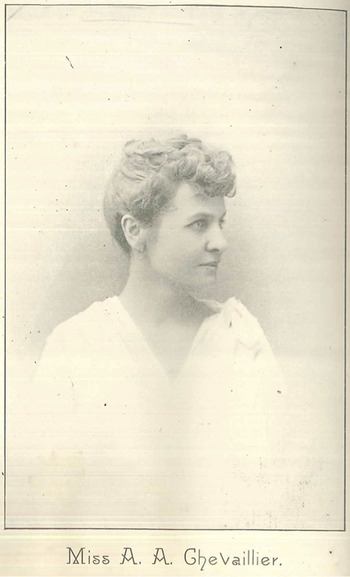
In November 1891, two weeks before the scandal broke in the pages of the San Francisco Chronicle, Kanaye Nagasawa sent a telegraph of distress to a friend urging him to come to Fountaingrove as soon as possible. “If you can arrange your business, please come tomorrow afternoon train,” wrote Nagasawa. “That Oakland woman is attempting to cause trouble.”Footnote 2 The woman in question, Alzire Adrienne Chevaillier (see fig. 1), was circulating letters about her four-month stay at Fountaingrove, a spiritualist utopian colony located near Santa Rosa, California. The “trouble” Nagasawa and the other Fountaingrove colonists feared soon materialized as Chevaillier's letter-writing campaign escalated into an all-out assault on the colony and especially its leader, prophet and poet Thomas Lake Harris.
“Woman suffragist, sociologist, spiritual scientist, philanthropist, nationalist, magazine writer, and reformer” Alzire Chevaillier, Chicago New Church Independent, July 1892. Courtesy Swedenborg Memorial Library, Urbana University.

In public lectures and in the pages of the Chronicle and other publications, Chevaillier accused Harris of the financial exploitation and sexual degradation of Nagasawa and the colony's thirty other members. She insisted that Harris, “the most unprincipled black magician who walks the earth today,” used unholy powers of hypnosis to turn his followers into a “spiritual harem,” their own claims of celibacy notwithstanding. The result, she said, was a “new sexology” with practices “worse than those of Mormonism.” Prepared to “devote the next few years of my life at least to breaking up that horrible place,” Chevaillier soon met with California Governor Henry Markham and vowed to go next to U.S. Congress, the postmaster general, and the president.Footnote 3
Although virtually forgotten today, the Fountaingrove scandal captured headlines not just in San Francisco but in Chicago, New York, London, and points in between due to its volatile mix of sex, religion, and racial exoticism.Footnote 4 From the start of Chevaillier's campaign in December 1891 until its resolution the following summer, dozens of periodicals across the United States and Great Britain reprinted and debated Chevaillier's claims as well as counterclaims made by Harris and his supporters.Footnote 5 For years after the initial scandal, the media continued to track the careers of Harris, Chevaillier, and Fountaingrove itself.Footnote 6 Like the better-known Henry Ward Beecher-Elizabeth Tilton scandal, the controversy surrounding Fountaingrove provides abundant opportunities to explore changing attitudes and anxieties in the Gilded Age.Footnote 7
This essay foregrounds what the scandal reveals about the interrelationship of religion, race, and sexuality in California, where the press coverage was most intense. The last decade has seen a surge of studies focusing on intersections of religion and race in U.S. history, categories that scholars have increasingly understood as being inseparable and volatile, at times blending and at other times clashing in various historical and geographical contexts.Footnote 8 This scholarship has shown how, in the nineteenth century, non-Protestant groups were frequently racialized as less than fully white, as well as the converse: racialized groups were frequently viewed as incapable of genuine Protestant Christianity. This seems to have been especially true for groups with non-normative sexual practices, from celibacy to polygamy. Tales such as The Awful Disclosures of Maria Monk portrayed “unnaturally” celibate Catholic priests as lecherous hypocrites preying on nuns and parishioners, fueling the racialization of Irish and Italian Catholics.Footnote 9 Historians have shown how scientists, politicians, political cartoonists, and travel writers depicted Mormons as Orientalized facilitators of interracial mixing due to their religious and sexual practices.Footnote 10 Co-constitutive discourses, religion, race, and sexuality overlapped and combined with sometimes devastating impact on the day-to-day lives of Americans outside the white Protestant establishment.
The Gilded Age in particular saw a wave of interlinked religious, racial, and sexual repression campaigns as white Protestant men and women attempted to police the boundaries of their increasingly unruly nation.Footnote 11 Whether due to its greater religious and ethnic diversity, its legacy of frontier violence, or the relative newness of its institutions, the American West was home to particularly brutal suppressions of groups judged immoral and uncivilized. From purges of “perverse” Chinese “heathens” in Western cities to the violent suppression of the Lakota Ghost Dance, from federal legislation targeting Mormons to the marginalization of Mexican American “folk” Catholicism, the West was “won” through a process of religious, racial, and sexual cleansing.Footnote 12
The Fountaingrove scandal is an overlooked part of that consolidation of the moral, racial, and sexual boundaries of the American West. As a mixed-race new religious movement accused of sexual immorality, Fountaingrove transgressed prevailing norms in multiple ways. As were the Mormons, the colony was Orientalized in the public imagination, confirming how new religions and non-normative sexual practices were coded as racially other. Yet media representations of Fountaingrove reflected more than straightforward “yellow peril” or Islamophobia. The two Japanese members of Fountaingrove, Kanaye Nagasawa and Ōsui Arai, inhabited several unstable categories at once, viewed as neither “heathen” nor Christian, neither adults nor children, neither white nor Chinese.Footnote 13 Depicted by Alzire Chevaillier as both “princes” and “slaves,” Nagasawa and Arai were troublingly contradictory figures that made the story all the more newsworthy. Because the scandal occurred just as large-scale immigration from Japan was beginning, it sheds light on the uncertain religio-racial status of early Japanese immigrants to the United States.
As we will see, Chevaillier's campaign to destroy Fountaingrove reveals her own values and biases, as well as the expectations of the public she was attempting to outrage, and little about Fountaingrove itself. A woman suffragist with a background in New England moral reform, Chevaillier sought to “rescue” Harris's followers. In this, she shared much with the scores of white middle-class Protestant women who attempted to establish, in the words of historian Peggy Pascoe, “female moral authority” in the late-nineteenth-century American West. Chevaillier's depictions of Harris as a corrupt patriarch were in line with how home missionary women demonized Mormon leaders, Chinese “slavers,” and male “seducers.”Footnote 14 Indeed, Chevaillier directed special attention to saving the young white women of Fountaingrove while generally ignoring the colony's white men. However, Chevaillier differed from home missionary women in that she also extended her efforts to the Japanese men in the colony, whom she judged appropriate subjects of rescue due to their perceived feminine and childlike qualities. Her willingness to infantilize and feminize Nagasawa and Arai shows another aspect of the liminal state inhabited by early Japanese immigrants as well as the racist dimensions of female moral reformers' attacks on male dominance.
Furthermore, compared to Protestant women working in Western rescue homes or missions, Chevaillier's sphere of influence was much more public and inhabited by men. This allows us to gauge broader perceptions of religious, racial, and sexual outsiders such as the Fountaingrove colonists and to observe the limits of how Chevaillier, as a white woman, could discuss their sexual transgressions. The wide range of public response to Chevaillier's campaign, from moral disgust to amusement to apathy, gives evidence of the cultural fissures breaking open in fin de siècle America.
Finally, this story confirms the deeply transnational nature of religious and racial formation during the Gilded Age. Simultaneously a local, regional, and transnational phenomenon, the Fountaingrove scandal shows the interpenetration of those arenas. Fountaingrove's members hailed from the United States, Japan, England, and Scotland, and the scandal spread from San Francisco to Europe and back. Thoroughly linked by technology and media to far-flung locales, 1890s California represented a particularly complex but hardly singular meeting place of people, ideas, and culture from the Euro-American and Pacific worlds.
ALZIRE CHEVAILLIER, THOMAS LAKE HARRIS, AND THE SATSUMA SAMURAI
Born in 1850 and raised in Boston, the center of Transcendentalism and New England moral reform, Alzire Chevaillier was a lifelong spiritual seeker and social activist who devoted her life to expanding the rights of women, children, workers, prisoners, and the insane. As a young woman, she lectured for woman suffrage, served as secretary for the National Association for the Protection of the Insane, and helped found the New York Society for Parks and Playgrounds for Children.Footnote 15 Her letters show her to be spiritual minded, introspective, and serious, a self-described “fighter for Principle” confused as to how anyone could “be happy while his brother has not equal opportunity and privilege as the child of God.”Footnote 16 Yearning to become a healer and seeking help for her own “nervous troubles,” she took classes from Christian Science founder Mary Baker Eddy in 1885 but soon rejected the church due to its secrecy, authoritarianism, and failure to improve her health.Footnote 17 She instead joined a loose network of ex-Christian Scientists who, to Eddy's dismay, healed people using their own, more individualized brands of “spiritual science.”Footnote 18 After reading several of Thomas Lake Harris's books, she wrote to him in the spring of 1891 to ask if he might find a secluded spot on Fountaingrove's 1,700 acres where she and her mother, Sarah Conant Chevaillier, could rest, meditate, and “gain a more perfect love and a deeper spiritual power.” He agreed.Footnote 19
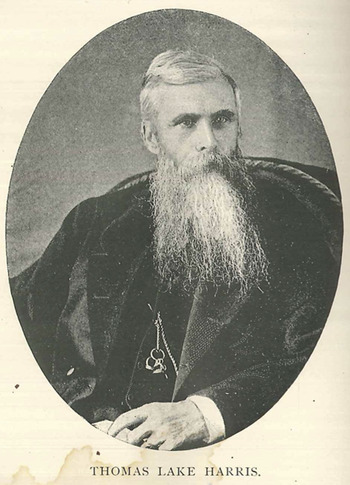
Though an obscure figure today, Harris (see fig. 2) was well known throughout the Atlantic world during his lifetime among those interested in what historian Catherine Albanese has termed “metaphysical religion.”Footnote 20 Walt Whitman, for example, read Harris's epic poetry and incorporated his ideas of “divine respiration” into “Song of Myself,” Arthur Conan Doyle spent years studying Harris's writings, and William James declared Harris “our best known American mystic” in The Varieties of Religious Experience. Footnote 21 Born in England in 1823, Harris grew up in Utica, New York, a central hub of the Second Great Awakening.Footnote 22 After experiencing a “new birth” at a local revival meeting at age fifteen, he studied to become a Universalist minister, soon earning his own pulpit in New York City. Following a progression that would become common among New York's booming class of religious experimenters, Harris moved from Universalism to Mesmerism to spiritualism, joining the early circle that surrounded the famed “Poughkeepsie Seer,” Andrew Jackson Davis.Footnote 23
Spiritualist poet, prophet, and utopianist Thomas Lake Harris, Chicago New Church Independent, July 1892. Courtesy Swedenborg Memorial Library, Urbana University.

Through meditation and communication with spirits, Harris realized that he had a special destiny to fulfill: he was the “pivotal man” who could enter unseen spiritual realms at will and whose destiny it was to “shed/ Celestial light on Earth.” In dozens of books and poems, he promoted a new theology that amalgamated elements of Mesmerism, spiritualism, utopian communitarianism, Adventism, and Swedenborgianism. He taught that “divine respiration”—a process of deep breathing, prayer, and meditation—would allow individuals to commune with God, ward off evil, heal physical maladies, and prolong life. In addition to spirits, Harris communicated with “fays,” or fairies, the “architects of heaven” visible only to children and spiritually advanced mediums. “Born from heavenly love,” golden, silver, azure, diamond, emerald, and opal fays lived on earth, frolicking mostly unseen and waiting for the coming day when humans would rise sufficiently in spiritual understanding to be able to commune with them.Footnote 24
Sex played a key role in Harris's cosmology. Building on Swedish theologian Emmanuel Swedenborg's theory of “conjugial love,” Harris established his doctrine of “counterparts,” the notion that “every human soul” had a perfect and opposite match-soul that would be, in this life or the next, “conjoined/In sacramental marriage of the heart.” Belief in the existence of soul mates, “match spirits,” or “affinities” was widespread among spiritualists, but Harris took it a step further by teaching that people's counterparts were usually not other humans but spirits. Harris's counterpart was Lily Queen, a powerful heavenly being with whom he entered a spiritual marriage with intense erotic undertones. “In communion sweet we learned to share/ Unspoken thought and ecstasies divine,” he recorded.Footnote 25 In this world, however, Harris claimed perfect celibacy after 1855; “when a man is no longer entangled with women, he begins to long for a Social Kingdom of God,” he explained.Footnote 26 This did not stop him from marrying a New Orleans spiritualist named Emily Waters, with whom he said he lived in celibacy for three decades until her death in 1885.Footnote 27 Harris's system of counterparts would be a crucial component of Chevaillier's attacks.
While in England in 1861, Harris formed the Brotherhood of the New Life, a church, society, “family,” and utopian movement open to anyone prepared to live in “relations radically different from those of others.”Footnote 28 The Brotherhood established an agrarian colony in Brocton, New York, at its height attracting about one hundred members. In 1875, Harris and his most trusted acolytes relocated to Fountaingrove in Santa Rosa, California. Those who joined the Brotherhood of the New Life were expected to leave behind anything that distracted them from spiritual concerns: sex, private property, class privilege, notions of racial or gender superiority, even children and spouses. Members of the Brotherhood rejected all coercive bonds and worldly concerns; all theoretically labored equally regardless of race, class, and gender and practiced celibacy. Harris boasted in 1877 that there had been only five births to members of the Brotherhood in seventeen years, evidence he claimed that proved most colonists were heeding his warnings about carnal distractions.Footnote 29 Harris expected that his ideas would slowly spread around the globe—and by 1891 he could claim scattered pockets of followers throughout the United States, England, and Scotland—triggering the Second Coming of Christ, the end of the world, and the dawning of a glorious new age.
In the spring of 1867, Harris delivered a private sermon to Naonobu Sameshima and Kiyonari Yoshida, two Japanese students visiting New York. According to their later retelling, the students were “strangely moved; one of them shed tears from the effect produced upon him.” Harris sat between them, “grasping the hand of each of them,” causing one student to feel his “right arm tremble, and for many weeks it was affected by a nervous trembling which he could not explain.”Footnote 30 The students were part of a group of nineteen Japanese samurai from Satsuma sent by their government to England in 1865 to learn about Western military strategy, agricultural practices, politics, and technology. Due to the shogunate's official ban on outmigration, the men—who ranged in age from thirteen to twenty-eight—had traveled in secret under assumed names. After meeting Harris, Sameshima and Yoshida returned to London and urged their fellow students to quit their studies and sail for the United States to join Harris's colony in upstate New York. Later that year, six of the nineteen students joined the Brotherhood of the New Life, becoming some of the earliest Japanese migrants in the United States. Ultimately, about twenty Japanese men would spend time in the Brotherhood.Footnote 31
As was typical of Japanese immigrants who entered the United States via New York City, Harris's Japanese followers were wealthier and better educated than most Japanese immigrants on the West Coast.Footnote 32 Their prior exposure to zazen, the Zen Buddhist practice of meditation, seems to have prepared them for the rigors of Harris's divine respiration, at which they were “especially demonstrative”; according to one observer, God's breath “came sensibly pushing through their frames and they at once accepted from their own sensations what was taught.”Footnote 33 Similarly, the men's elite samurai training may have attracted them to the asceticism, self-denial, obedience, and celibacy expected by Harris. For his part, Harris praised Asians as being more “subtle,” “virtuous,” “gentle,” “cleanly,” “abstemious,” and “capable of the loftier religious impulses” than other peoples.Footnote 34 He regarded Buddhism as a “magnificent system, fearfully powerful and fascinating to the intellect,” but one that was “crumbling at its centre.”Footnote 35 In its place, he envisioned a blossoming of the Brotherhood of the New Life; once planted in Japan, he prophesied, “it will go like lightning.”Footnote 36
By 1891, only two Japanese colonists remained, but they were among Harris's most devoted and trusted followers. Born in Kagoshima in 1852, Kanaye Nagasawa oversaw Fountaingrove's profitable vineyards; he had been only thirteen when he left Japan for London. Ōsui Arai, a samurai from the Sendai Domain who had joined the Brotherhood in 1871, ran the printing press that published Harris's spiritual missives to the world. A diary Nagasawa kept in 1871 shows him to have been an earnest—if sometimes bewildered—acolyte of Harris who conducted menial labor for long hours while striving to replace “self-hood” with “self-abnegation.” Struggling with his spiritual growth, he was excited to receive the “fairy name” of Phoenix, given “when the respiration is opened from internals,” after which he “began to feel nearer to them all before.”Footnote 37
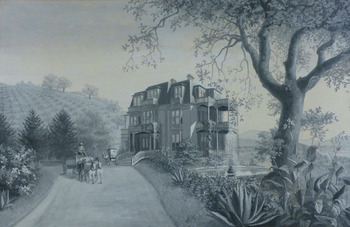
Prior to 1891, Fountaingrove (see fig. 3) enjoyed a generally positive reputation among Californians. In 1879, the Sonoma Democrat had dismissed Harris's religious teachings as “absurd” but praised Fountaingrove for its excellent vineyards, “elegant buildings,” and “the most extensive library in California.”Footnote 38 The author of a history of Sonoma County, published in 1889, seemed to know nothing of Harris's religion, celebrating instead how he had converted “barren hills into lands teeming with wealth and abounding in beautiful homes.”Footnote 39 Harris contributed poems to local periodicals and threw lavish dinner parties for Santa Rosa's elite, who enjoyed strolling “about the large rambling parlors, examining the splendid library, or in admiration of the magnificent art collection.”Footnote 40 Harris even joined Santa Rosa's local Masonic order and Episcopal Church.Footnote 41 To most people in California, Harris probably appeared nothing more than a genteel land baron whose popular Fountaingrove wines were helping Sonoma County gain an international reputation.Footnote 42
Building at Fountaingrove, painted by colonist Alice Parting, Pacific Rural Press, May 18, 1889.

However, some rumors did spread. A singular and divisive figure, Harris had made enemies in American and British spiritualist and Swedenborgian circles, who circulated letters alleging sexual improprieties. Some of these letters reached the San Francisco Chronicle, which sent a reporter to Fountaingrove in 1885. Posing as a wealthy admirer of Harris's writings, the journalist gained access for a day but saw nothing out of the ordinary. Nonetheless, he padded out his story with third-hand accounts of the “licentiousness” that had “reigned among the brethren” in the Brocton community, namely, “a Japanese system of bathing” and “other practices of an Edenic nature” that culminated in partner-swapping as “all restraint between the earthly and spiritual counterparts” was abandoned. The article, which began by comparing Harris to Oriental occult practitioners of the “black art,” ended by predicting that the “zealots” of Fountaingrove “would feel as much at home under the laws of Mohammedanism as anywhere.”Footnote 43 Numerous elements of the article would reappear in Chevaillier's campaign, including the presentation of Harris as a brilliantly hypnotic orator out to ensnare rich “dupes,” the charges of “Edenic baths” and counterpartal sex, and the equation of Fountaingrove colonists with racially marked foreigners.
Alzire Chevaillier and her mother arrived in Santa Rosa in June 1891. If she had not already heard the rumors about Harris, she soon learned of them. Shortly after being situated in a small house on a remote corner of Fountaingrove, Harris gave her the 1885 Chronicle article as well as Margaret Oliphant's newly published Memoir of the Life of Laurence Oliphant, which was attracting media attention throughout the Atlantic world. In the book, the author gave an outraged description of how her cousin Laurence Oliphant—the famous and wealthy British politician, adventurer, and writer, deceased since 1888—had joined Harris's Brocton colony in 1867 only to be cheated out of his fortune by Harris, “the wretched fanatic, the vulgar mystic.”Footnote 44 Due to Laurence Oliphant's still high profile, the book was triggering a wave of publicity throughout Great Britain, its colonies, and the United States debating Harris's biography and “strong magnetic personality.”Footnote 45
Publicly unperturbed by these accounts, Chevaillier praised Harris's spiritual genius throughout the summer of 1891 in interviews and editorials for her journal, The Problem of Life and International Magazine of Truth. “I regard Mr. Harris as being a grand man, and a powerful and profound thinker,” she told a journalist as she left Santa Rosa for Oakland in September. “His theory is very beautiful, and I never saw a happier and more harmonious set of people than those whom I met at Fountaingrove.”Footnote 46
However, Chevaillier and her mother later said that they had witnessed some upsetting scenes at Fountaingrove. One morning, Harris, while in a trance, “threw back his arms, kicked up his legs and began some queer convulsive motions” while shouting “profanity and vulgarisms,” shocking Chevaillier. She noticed how Jane Lee Waring, Harris's amanuensis and the “Mother” of Fountaingrove, smoked his pipes after he finished with them. Chevaillier once saw Harris “sitting with his feet in Miss Waring's lap.” She saw how Harris did little visible work while the other colonists toiled in the upkeep of the colony and vineyards. Most troublingly, Harris told Chevaillier about his doctrine of counterparts and informed her that her own counterpart, Sir Knight Peace, would soon visit her. “Father, how will I know when my counterpart is about to make himself known to me?,” she asked. Harris hesitated a moment before blurting, “Oh, you will feel him in your toes.” Chevaillier later reported, “This sent a shiver over me. I felt a revulsion and was for a moment sickened of the whole concern.”Footnote 47
These were not enough to start Chevaillier on her crusade. However, shortly after leaving Fountaingrove, she was visited by A. W. Manning, a Swedenborgian minister from San Francisco. Offended at Harris's appropriation of Swedenborgian doctrines, Manning had long been gathering letters and affidavits from ex-members of the Brotherhood of the New Life, some of which detailed “horrible licentious practices.” Manning turned these over to Chevaillier. By November, colonists at Fountaingrove received word that Chevaillier was preparing to “start the storm publicly.”Footnote 48
THE SCANDAL BEGINS
Though she herself saw “nothing impure” at Fountaingrove, Chevaillier told the San Francisco Chronicle that Manning's materials and her own investigations had now convinced her that Harris was “the greatest imposter of the age.” Using his immense hypnotic powers, Harris bilked wealthy followers, she said, while forcing them to toil long hours while they “wear old and coarse clothing and are given the plainest kind of food.” Furthermore, Harris's doctrine of counterparts served as a means to force apart husbands and wives. “After a man has been separated from his wife and has been taken into the inner circle he is given a heavenly counterpart,” she wrote, “which after a time is permitted by the prophet to descend and take material form in whatever woman [Harris] may see fit.” From there followed all sorts of “unspeakable” practices: women and men bathing together, unrestrained swapping of sexual partners, including “old men with young women and young men with old women,” and even “a boy of seventeen being ordered by Mr. Harris to co-habit six times a day with a married woman.” To hide such behavior, women who became pregnant were subjected to “kneading and pounding” so as to “produce abortion.” “Is it not most horrible immorality to teach such disorderly doctrines?,” Chevaillier asked.Footnote 49
What truth was there to Chevaillier's charges? The materials provided by Manning seem to have burned in the 1906 San Francisco fire, leaving their contents a mystery aside from Chevaillier's references to them.Footnote 50 However, colonists wrote hundreds of letters and other accounts that allow a partial reconstruction of daily life at Brocton and Fountaingrove. It is certain, for example, that Harris did ask husbands and wives to renounce their marriages. Furthermore, probably inspired by Japanese bathing practices, male and female colonists at Harris's colonies did at times bathe together. Discussing co-ed bathing, one Fountaingrove colonist wrote to a friend, “Our father [Harris] says that before we can be in any true condition we must all be so innocent that we can stand naked before each other without a thought of shame, and wash and dress each other.”Footnote 51 Harris insisted that all sexual urges be directed heavenward, toward communion with counterparts, rather than acted on physically, and no extant firsthand records indicate that this was not generally followed.
Numerous letters from colonists at Brocton and Fountaingrove do express their frustration at being separated from spouses and living in celibacy, however, and some sex—though forbidden by Harris—clearly did occur. In an 1891 letter, Jane Lee Waring recalled that many years ago “the sex question threatened to destroy the society…. Cases of nymphomania, with other phases of sexual insanity arose, and for a time it looked as if every effort to cast out devils, and restore the obsessed would fail.” Harris, however, “carried on the crusade against infernal scortation, to the victory.”Footnote 52 It was part of Kanaye Nagasawa's duties to thwart sexual liaisons; late in life, he recalled being “called out many times in the midnight hour from warm bed, to go out into the freezing air” in order to “rouse the brothers and sisters, to fight and break up the environment then existing [in] these houses, caused by the coalescing of the spheres, especially amongst the opposite sexes.”Footnote 53 Unlike “complex marriage” at Oneida or polygamy among Mormons, for which copious documentation exists, there is no surviving firsthand evidence that anything other than sometimes frustrating celibacy was systematically practiced in the Brotherhood of the New Life.Footnote 54
The question of whether or not Harris financially exploited his followers is more thorny. As was common in communitarian movements both secular and spiritual, members of the Brotherhood pooled finances, which were controlled by Harris. Some wealthy followers, such as Waring and Laurence Oliphant, did turn over to Harris large sums of money.Footnote 55 While his followers spent long days engaged in physical labor, Harris devoted his time to writing, communing with fays and spirits, and doing battle with demons in unseen realms. However, most members of the Brotherhood did not seem to have regarded this arrangement as inequitable, giving their money and labor willingly in exchange for an immersive utopian spiritual experience. In the case of his Japanese followers, Harris paid for their passage to the United States, provided free room and board, taught them English, and instructed them in “domestic science, social science, floriculture, horticulture, viniculture, poultry, and stock-raising.”Footnote 56
During the scandal of 1891–1892, Thomas Lake Harris and his defenders offered numerous explanations for why Chevaillier turned into “Judas Iscariot.”Footnote 57 They said she was a “traveling whore” who had failed to seduce Harris and was now out for revenge; she was acting as an agent of Margaret Oliphant and other enemies; she was possessed by “the lowest and subtlest evil in the inversive world spirit”; she was motivated by a “thirst for notoriety”; and that she was a “victim of a mediumistic and erotic insanity.”Footnote 58 While a desire to raise her profile as a lecturer and healer was probably a stimulus, Chevaillier's strongest motivation seems to have been a sincere, maternalistic concern for the well-being of Harris's followers. Her attacks on Fountaingrove were an extension of the reform efforts in which she had long been involved in Boston and New York. Her desire to protect the most vulnerable members of society—prisoners, women, children, the insane—now led her to decry Fountaingrove.
In line with her moral reform background, Chevaillier emphasized the dangers Fountaingrove presented to young women. “I am satisfied that ninety-nine out of every hundred girls who might be drawn under the spell of this wonderful and unscrupulous hypnotizer and mesmerist could by no means on earth escape from his power, and they would be dragged down to ruin,” she wrote.Footnote 59 She expressed “shock” that the “highly cultured” young “ladies” of Fountaingrove were “occupying servile positions.”Footnote 60 Middle- and upper-class white women, women like her, should not be living this way. Chevaillier's portrayal of Harris as an old-fashioned patriarch with unholy control over his “family” conjured up images of corrupt slave masters, depraved Catholic priests, evil Mormon polygamists, and other emblems of male supremacy. Two weeks after her initial exposé, she reported, “Already I think I have saved a number of girls from going there to be introduced to his licentious system of counterparts.”Footnote 61
In contrast, Chevaillier mentioned the white men of Fountaingrove other than Harris only in passing; the only saving they seemed to need was in terms of their finances. The sexual double standard of the Gilded Age, which condemned sexual aggressiveness in women while accepting or even valorizing it in men, made the “purity” of white men much less sacred.Footnote 62 Chevaillier likely suspected that it would be difficult to raise much public sympathy for Fountaingrove's adult white men, and furthermore it would have appeared overweening for her, as a woman, to try.
As a woman entering the public sphere to discuss sexual matters, Chevaillier was herself vulnerable to the very charges of impurity she leveled against Harris. Unlike Ida C. Craddock, Lillian Harmon, and other radical reformers of the era who championed sexual desire as an essential component of spiritual liberation, Chevaillier held fast to more traditional ideals of feminine propriety, virtue, and chastity.Footnote 63 “Spirituality and sensuality must be divorced,” she declared.Footnote 64 This attitude meant she had to walk a delicate line, presenting herself as a bold yet reluctant crusader, an expert in Fountaingrove's “disorderly doctrines” yet unsoiled by them. In a move that would be familiar to readers of women's anti-polygamy and anti-prostitution exposés, Chevaillier emphasized that she acted “at a great cost of inclination” and only out of “painful, altruistic, Christian duty.” She said she spoke only “in such a manner as propriety will permit” and “dared” not release all her evidence against Harris lest it corrupt “the general reading public.” She repeatedly emphasized that she herself “saw no impurities” at Fountaingrove, thereby retaining her modesty.Footnote 65 This attitude was consistent with the era's mainstream social purity and feminist movements. At this moment, California's woman suffrage activists were employing a similar strategy, going on to place a statewide referendum on the ballot in 1896 by evoking white women's need to enter the public sphere only to better protect the domestic.Footnote 66
FOUNTAINGROVE AND GILDED AGE PERCEPTIONS OF THE JAPANESE
Surprisingly, when it came to the Japanese men of Fountaingrove, Chevaillier judged them in need of protection as much or more as the colony's young white women. “Poor Ari [sic]! He is the most abject slave of the whole colony,” Chevaillier declared. Though “a well-educated young man,” Arai was forced to work long hours running Fountaingrove's printing press, making “hundreds of trivial changes in the proofs” due to Harris's vacillating whims. “It makes the young zealot perspire, but he does not complain,” she wrote. Harris “pays the poor dupe nothing.” Arai was “kept there by his blind, simple faith. Oh, it is pitiful.” When she asked him how he reconciled himself to his “hard lot,” Chevaillier reported that “he smiled sadly and gazed over the hills. ‘I am only a guest on this planet,’ said he.”Footnote 67
If Arai was a dupe and slave in Chevaillier's formulation, Nagasawa had been transformed by Harris into a petty zealot. “Prince Kanaye Nagavassa [sic] is a lordly young Japanese who fervently believes that the sun rises and sets in Harris,” wrote Chevaillier's mother Sarah in an article for the Chronicle supporting her daughter's campaign. “He drives the carriage for Harris and lords it over the one servant who is given over to his tender care.”Footnote 68
In making these portraits, the Chevailliers drew on broader racialized notions of the Japanese, notions that were very much in flux during the early 1890s, especially in California. In 1853, when Commodore Perry and his armada of gunboats officially opened Japan's doors to the West, most Americans had known little about Japan. However, the next fifty years saw an explosion of accounts penned by diplomats, scholars, artists, and missionaries interpreting Japan. Early visitors tended to portray the Japanese as exotic and inferior, “diminutive” and heathen, backwards and stunted in terms of both religion and race. However, Japan's rapid industrialization, modernization, commercial expansion, and rise to become an imperial power following the Meiji Restoration of 1868 had given many thinkers in the United States pause. How could a “Mongolian” and “heathen” nation be, by most available benchmarks, so “civilized”? American Japanologists, faced with this seeming challenge to racial and religious hierarchies, went to great rhetorical lengths to preserve those hierarchies. Observers insisted the Japanese were the exception in Asia that proved the rule; they claimed the Japanese were racially heterogeneous and therefore the “most un-Mongolian people in Asia”; and they maintained that Japan's “progress” was due to the influence of Christianity, spread by Protestant missionaries.Footnote 69
By the early 1890s, the industrialization and militarization of Meiji Japan, accomplished through heavy taxation and conscription, was beginning to trigger what would become a massive wave of out-migration. The 1890 federal census was the first to include “Japanese” as a separate racial category, recording only 2,039 Japanese men and women living in the United States. By 1924, however, at least 200,000 Japanese migrants would move to Hawai'i and another 180,000 would come to the U.S. mainland, mostly to California.Footnote 70 The long-standing presence of Chinese immigrants on the West Coast meant that, upon arrival, the Issei were viewed at times as part of a generalized “Asiatic” threat and at times as specifically Japanese. The passage of the Chinese Exclusion Act of 1882 had created a new demand for agricultural labor, which the Japanese began to satisfy. According to the San Francisco Call, San Fernando Valley orchardists initially preferred the Japanese to white or Chinese laborers because “they work harder and take less pay.”Footnote 71 Generally more literate than Chinese immigrants due to compulsory education in Meiji Japan, the Issei in California agriculture soon established a reputation for militant labor activism, winning higher wages and significantly less appreciation from white growers.Footnote 72
Japanese immigrants' success in agriculture prompted outcry from white laborers, especially Irish Catholics, who expanded and recycled the arguments they had used against Chinese “coolies” to solidify their own whiteness, patriotism, and Christianity. Denis Kearney, whose Workingmen's Party of California had helped rewrite the state Constitution in 1879 to ban employment of the Chinese, pivoted by 1892 to the new “menace,” now crying “the Japs must go!” Following the example of the still ongoing anti-Chinese movement, the West's anti-Japanese movement interwove economic, ethnological, and moral arguments, portraying the Japanese as racially debased and sexually depraved. Said Kearney in reference to Japan's mixed-gender bathing practices: “There is no such thing as virtue in Japan. The men and women of that country are as free to mingle together as are the beasts of the field.” Such arguments would ultimately lead to the formation of the Asiatic Exclusion League in 1906 and the passage of California's Alien Land Laws of 1913 and 1920, which prohibited “aliens ineligible for citizenship” from owning or leasing agricultural land.Footnote 73
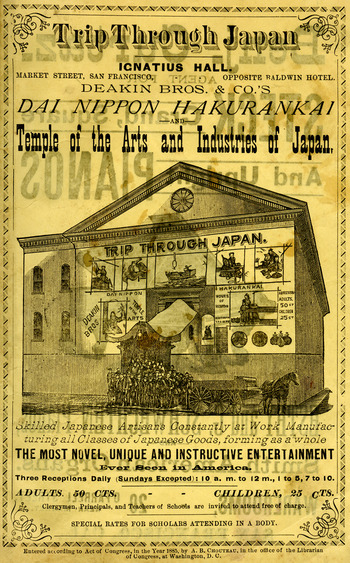
However, others welcomed the arrival of the Japanese not as workers but representatives of an “orderly,” “artistic,” and “mysterious” society. There was in fact something of a Japan craze in California during the 1880s and 1890s. Women's clubs hosted lectures on Japanese crafts; galleries displayed exhibitions of Japanese art; Japanese restaurants and tea gardens appeared in San Francisco, Sacramento, and Los Angeles.Footnote 74 The leading purveyors of the Japan craze were San Francisco's Deakin brothers—Walter, Frederic, Edwin, and Harry—whose company imported not only goods, arts, and crafts from Japan but the artists themselves, most prominently Toshio Aoki. The Deakin brothers also offered a “trip through Japan” in the form of an exhibition in San Francisco's St. Ignatius Hall in 1885 (see fig. 4). Three times a day, for two and a half months, San Franciscans could witness a “living panorama of the industrial and art life of the Japanese,” filled with “Skilled Japanese Artisans Constantly at Work Manufacturing all Classes of Japanese Goods,” including painters, potters, coppersmiths, weavers, tailors, and even barbers. Like nearby Chinatown, only more idealized and controlled, the Deakin brothers' “Japanese village” cashed in on white Californians' growing Orientalist fascination with Japanese culture.Footnote 75
Cover of program for Deakin Brothers’ “Trip Through Japan” in St. Ignatius Hall, San Francisco, 1885. Courtesy California Historical Society.

This was far from limited to California, of course. Japanese food, commodities, architecture, and design became popular across England, France, and the United States during these years, and Japanese art was prominently on display at international expositions in London, Paris, Philadelphia, and Chicago.Footnote 76 What is notable about California is that the Japan craze existed side by side with the nation's most virulent anti-Japanese movement. Due to San Francisco's size, location on the Pacific Rim, and history of both anti-Asian hostility and Orientalist tourism, the Japanese were likely discussed more often, and in more polarized extremes, there than in any city in North America during the 1890s.
Furthermore, the presence of hundreds of actual Japanese immigrants in San Francisco complicated non-Japanese Americans' efforts to represent them. The U.S. Census Bureau counted 590 people of Japanese heritage living in San Francisco in 1890; by 1900 the number had grown to 1,781.Footnote 77 Attracted by the alleged liberty and religiosity of the United States, many Japanese immigrants quickly grew disillusioned. “My idea of the Christian America was lofty, religious, Puritanic,” remembered Kanzō Uchimura, who had converted to Christianity in Sapporo and emigrated to the United States in 1884. He soon thought otherwise after encountering white Americans' overriding avarice and “the prejudice, the aversion, the repugnance, which they entertain against the children of Sinim.”Footnote 78
In Japanese- and English-language newspapers and in the courts, Issei in California criticized both Japanese and U.S. policy, fought against segregation and exclusion, and struggled for the right to naturalize.Footnote 79 As representatives of a “civilized” nation, Issei leaders especially resented being lumped with the largely working-class Chinese. For example, in 1892 San Francisco resident Setsu Nagasawa characterized the city's Chinatown as “a world of beasts in which, behind its outward façade, exists every imaginable depravity, crime, and vice known to the human world—assault, homicide, gambling, illicit business, prostitution, robbery, and drunken disorder.” The Japanese, they insisted, were more “progressive” and ready to “adapt themselves to American customs” than the Chinese.Footnote 80
In terms of religion, most people in the United States viewed the Buddhism practiced by the majority of Japanese immigrants as simple “heathenism” or “paganism,” epithets demarking both religion and race. However, by the early 1890s increasing numbers of white Americans were becoming at least somewhat intrigued by Buddhism, especially on the West Coast. The nation's first English-language Buddhist newspaper, The Buddhist Ray, appeared in 1887 in Santa Cruz, and Theosophists sponsored lectures on Buddhism in San Francisco and Los Angeles during the 1890s. Popular accounts of Japanese Buddhism lingered over the material aspects of the religion—details of temple architecture and the “little wooden gods” and other “curious things” found inside—with queasy enthrallment.Footnote 81
This noted, those Japanese immigrants who joined Protestant churches received a disproportionate amount of media coverage in San Francisco. Targeted by the Methodists, Congregationalists, and Presbyterians, the same denominations that had led evangelism efforts among the Chinese of California, Japanese Protestants were reassuring figures, seeming to realign Japanese “civilization” with Christianity. At the 1894 dedication of San Francisco's Japanese Methodist Church, the first of its kind in the nation for any Christian denomination, Bishop Daniel Goodsell praised the Japanese as “orderly, industrious, cheerful, law-abiding. A people that turn their eyes so hungrily toward Christian knowledge must have a great future.”Footnote 82
In 1890s California, then, Japanese immigrants were distressing figures who seemed to upset existing categories. Were they superior to the Chinese or ultimately part of the same Asian “menace”? Were the Issei's high rates of literacy and labor success, together with Japan's aggressive modernization, comforting or disconcerting trends? Were they intractable Buddhists, potential Christians, or something else?
For these reasons, the presence of Ōsui Arai and Kanaye Nagasawa at Fountaingrove made the scandal all the more sensational. Chevaillier drew on different aspects of prevailing racial ideology in her portraits of the two men. She portrayed Arai as hard working, tractable, and easily exploitable—a more sympathetic version of the depictions of Japanese agricultural workers offered by Denis Kearney and other unionists. Whereas she mostly ignored Fountaingrove's white men, she viewed Arai as an appropriate subject of her help and pity. His Japanese ethnicity and supposedly passivity allowed her to position herself as his would-be savior, gaining a measure of masculinist power in the process.Footnote 83 Her invocation of his “slavery” aligned her cause with other Gilded Age reform movements that drew on the Thirteenth Amendment and the moral legacy of abolitionism, including Chinese exclusion (stopping “coolieism”), anti-polygamy (freeing “Mormon slaves”), and anti-prostitution (ending “white slavery”).
Nagasawa's business acumen and greater power at Fountaingrove made him harder to conform to the stereotypes of Japanese agricultural workers that Chevaillier invoked with Arai. Instead, “lordly” Nagasawa represented to Chevaillier more of a “house slave” figure—ludicrous and twisted, a miniature version of Harris. Similarly haughty Asian villains would become stock characters in twentieth-century popular culture, from Fu Manchu to Ming the Merciless.Footnote 84 As white abolitionists had done to certain “distinguished” African slaves, she wrongly dubbed Nagasawa a “prince” to make his subjection all the more tragic.Footnote 85
Chevaillier was so concerned about the Japanese members of Fountaingrove that she paid a visit to the Japanese Consul in San Francisco to ask for help. “Both Ari and Nagasawa feel convinced that should they leave, Harris has the power to strike them dead,” she told the Consul. Arai “is as simple as a child and Harris can do anything with him that he pleases … There is no jinriki-hiki in all Yokohama who has one half the burden put upon him that is thrust on Ari's shoulders.” By infantilizing the two men, especially Arai, she drew on older notions of the Japanese as “childlike” and “miniature” while casting herself as their protector. Whether offended, skeptical, or merely too busy, Consul Sutemi Chinda “took the testimony of Miss Chevaillier with little show of interest.”Footnote 86 Chevaillier may have been surprised to learn that a predecessor of his, Saburō Takagi, had helped the Brotherhood of the New Life purchase the initial lands for Fountaingrove in the 1870s.Footnote 87
It is worth emphasizing that Chevaillier spent little time with Fountaingrove's two Japanese men and knew almost nothing about them. She misspelled their names; the biographical information she provided was mostly wrong. She did not even know how many Japanese men were in the colony, at times saying two and at other times saying three.Footnote 88 Though she called them “young,” both men were in their mid-to-late-thirties, only a few years younger than her.Footnote 89 They may have been the first Japanese men Chevaillier ever laid eyes on, and she saw them as not fully men.
Other than the telegram of distress to a friend mentioned earlier, unfortunately no writings from Nagasawa or Arai from this period are extant. However, diaries, letters, and other writings from earlier and later years show the men to be thoughtful and dedicated students of Harris's religion. In the mid-1890s, for example, Arai wrote several prayer books that demonstrate his deep engagement with Harris's theology. “Father [Harris] breathes among us and through him we have the open breath; he thinks and feels into and with us, and we have a higher thought and a purer feeling,” he wrote.Footnote 90 In the 1920s, Nagasawa was still studying Harris's works and, according to an interviewer from Stanford University, “spoke with the greatest reverence of Mr. Harris's life and his mystical religious and communistic doctrines.”Footnote 91 Sources indicate that the two men found a degree of acceptance and equality in Harris's movement that was highly unusual in Gilded Age America. A shrewd businessman, Nagasawa would ultimately assume full control of Fountaingrove and enjoy a degree of economic prosperity virtually unheard of among Issei.Footnote 92 But to suit Chevaillier's purposes they were dupes, slaves, and children.
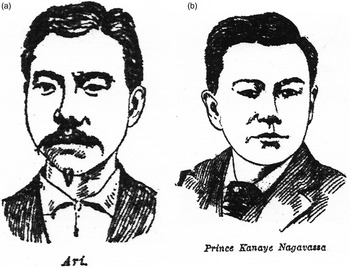
Chevaillier's racialization of Nagasawa and Arai was not entirely in sync with the expectations of her California audience, however. Of the thirty members of Fountaingrove, the San Francisco Chronicle published portraits (line illustrations) of only four: Thomas Lake Harris, Jane Lee Waring, and the two Japanese men. Clearly, the Chronicle believed the presence of the Japanese made the story especially newsworthy. Considering the accusations of unbridled promiscuity, emphasizing their physical presence by depicting their appearances added an element of potential miscegenation to the mix, invoking fears of racial impurity and Asian contamination. Historian Robert G. Lee has shown how the Chinese “represented a third-sex—an alternative or imagined sexuality that was potentially subversive and disruptive to the emergent heterosexual orthodoxy.” California's Gilded Age popular literature often depicted Chinese men as taking advantage of their supposedly feminized or asexual nature to gain the trust of white women so as to seduce them.Footnote 93 By the first decade of the twentieth century, Japanese “houseboys” would be distrusted for the same reason.Footnote 94 To the California white public, Chevaillier's portrayal of Arai as emasculated may have made him more rather than less of a threat to white female purity, contrary to what she seemed to intend.
Furthermore, the Chronicle's portraits of Arai and Nagasawa (see figs. 5a and 5b) show them to be not children but adult men who look back at the viewer with bold, even imperious gazes. This was consistent with another component of Gilded Age America's ornate Orientalist popular culture: cartoons. By the early 1890s, San Francisco readers would have been exposed to dozens of anti-Chinese cartoons in the Wasp and other publications, some of which stirred racial animosity by depicting a Chinese man proudly embracing his white bride (sometimes with “unnatural” mixed-race children in tow).Footnote 95 The Chronicle's pictorial representations of the two Japanese men, to the exclusion of virtually all other Fountaingrove members, carried echoes of such earlier images. The California legislature had banned marriage between whites and “Mongolians” in 1880; though initially directed at Chinese men, the “Mongolian” designation proved useful to block marriages between Japanese men and white women as well. In a case that would draw widespread media attention in 1909, Gunjiro Aoki and Helen Emery would have to travel from San Francisco to Washington State to wed.Footnote 96 During this period, controversies were erupting at Protestant mission schools when Asian male students became sexually involved with white female missionaries.Footnote 97 Fountaingrove's combination of Japanese men and white women was potentially explosive.
Portrait of Fountaingrove's Ōsui Arai, San Francisco Chronicle, December 27, 1891. Portrait of Fountaingrove's Kanaye Nagasawa, San Francisco Chronicle, December 27, 1891.

THE SCANDAL EVOLVES
After her initial flurry of reports for the Chronicle in December 1891, in which she repeatedly mentioned the presence of the Japanese men, Chevaillier dropped them from her discussion of Fountaingrove, including during her public lectures of 1892. It is impossible to know why, but her decision raises tantalizing questions. As she spent more time in California, did she decide her audience would not accept Japanese men as sympathetic victims? When she shifted from written to oral attacks on Fountaingrove, did she judge it too dangerous to position herself as a savior of men (though Japanese)? Did trying to save Nagasawa and Arai muddy her argument against the male dominance represented by Harris? Or had accentuating the mixed-race nature of Fountaingrove already served its purpose in terms of casting the colony as exotic and un-American?
One aspect that she continued to emphasize, and that received considerable attention from the media, was her exposé of the “Edenic” or “Japanese bathing” that went on at Fountaingrove. Within Japanese Buddhist practice, bathing was an important ritual of purification that was both communal and intensely personal. In the Brotherhood of the New Life, bathing served a similarly spiritual and communal function, helping individuals become “demagnetized from the hellish poisons which have inflowed from spiritual disorders,” enabling a “progressive elevation to a new Edenic state.”Footnote 98 Colonists bathed each other to encourage a breaking down of modesty as well as sexual desire, and as an expression of their utopian communal values. In a 1881 letter, one male Fountaingrove colonist described bathing Harris, granting him “a great relief recently, and in the baths [Harris] finds a help and an unburdening such as he never had hoped for; I have given him more than twenty vapour and warm sitzes, rubbings, etc.”Footnote 99
To Chevaillier and the outside world, however, such practices were clearly not spiritual. Mixed bathing in Japan had both shocked and titillated Americans as early as Commodore Perry's visit in 1853. In his diary of the expedition, one naval officer noted with disgust that a few American officers were paying visits to a “bath house where old and young, male and female are mingled promiscuously in a state of unblushing nudity to the gaze of strangers.”Footnote 100 Artist Wilhelm Heine's depiction of a sentō that appeared in early editions of Perry's narrative stirred up enough controversy that it was removed from subsequent printings.Footnote 101 While some Americans saw Japanese bathing as a sign of pre-sexual innocence (hence the term “Edenic”), most onlookers judged it vulgar, indecent, and animalistic.Footnote 102 Suspecting immorality, San Francisco health officials frequently investigated Japanese bathhouses in the 1890s, despite the fact that they usually featured a bamboo wall segregating the sexes, a reflection of both American gender roles and a shift away from mixed bathing occurring in Meiji Japan.Footnote 103 Talk of Japanese-style bathing at Fountaingrove therefore conjured up powerful racial and religious associations that cast the colony as doubly deviant.
Media accounts portrayed the colony as Oriental in other ways as well. Chevaillier declared that “Fountain Grove was no fit place for any one who had not first been a follower of Mohammed or other sensualist of equal power.”Footnote 104 Newspapers referred to counterparts as “Celestial Marriages,” a term borrowed from Mormon practice that invoked both the heavens and a well-known epithet for the Chinese.Footnote 105 Papers reported that Harris had a room at Fountaingrove “fitted up as a Turkish Bath” and that the colony was “more immoral and more licentiously conducted than a Turkish harem or the Oneida community.”Footnote 106 Jane Lee Waring dressed “in the most Sybaritic fashion imaginable,” reminiscent, Chevaillier said, of Frederic Leighton's famous 1880 Orientalist painting The Light of the Harem.Footnote 107 Japanese and Chinese Buddhists, Muslims, Turks, and ancient Sybarites, along with homegrown Mormons and Oneidans, all converged in the specter of Fountaingrove, marking the colony as foreign, racially debased, iniquitous, and profane.
Considering the space in their papers they gave over to Chevaillier's charges, editors from San Francisco to New York clearly believed the story was of interest to their readers. When editors weighed in on the matter directly, however, they expressed a mix of sentiments. In San Francisco, editors soberly urged authorities to conduct a formal investigation.Footnote 108 Elsewhere, some editors predictably used the scandal as an opportunity to denounce new religions. “Nine-tenths of such communities, wherever found, are either blasphemous or lewd,” thundered the Patriot of Harrisburg, Pennsylvania.Footnote 109 Picking up on Chevaillier's themes, the New York Times compared Harris to both Brigham Young and the “Wandering Jew.”Footnote 110
However, the tone of the Times editorial was overall more one of amusement than outrage, an attitude shared by many observers. Media outlets had mocked Harris's mystical writings since the 1850s, calling them “unmeaning rhodomontade,” “rinctum-puppy-diddle-boodle,” and “gabble,” and Chevaillier's new revelations seemed, to many, more of the same laughable but harmless weirdness.Footnote 111 While stating that he would have “no tears to shed” if Fountaingrove broke up, the editor of Twentieth Century felt that “if people want to make swine and hounds of themselves, and to practice the rites of Bacchus and Venus Impudica daily, hourly, as a religion, there is no reason why this magazine should go very far out of the way in the vain effort to hold them back.”Footnote 112 In a similarly broad-minded editorial that prompted an angry rejoinder from Chevaillier, Harper's editor William Dean Howells refused to condemn Harris's theology: “This faith, exultantly proclaimed, can be no less than pathetic to many; to those who are able to make it their own, it must be precious; and we will confess that we have no heart to deride it.”Footnote 113 After meeting with Chevaillier in January 1892, California governor Henry Markham assured her he would “take hold of the matter” but never ordered an investigation. California's Protestant press ignored the matter entirely.Footnote 114
Surely Fountaingrove's small size, together with the outlandishness of some of the accusations, helps explain this lack of widespread moral panic. But it also gives evidence of a broader cultural shift occurring in the 1890s: the emergence of recognizably “modern” conceptions of sexuality—that is, newly public, explicitly hetero-normative, emphasizing pleasure rather than solely the production of offspring.Footnote 115 The Fountaingrove scandal shows how Americans may have been harder to genuinely shock, but they still sought titillation through what historian Sarah Barringer Gordon has called the “exquisite tension spawned by emotional arousal and its containment within the boundaries of Christian morality.”Footnote 116 Sensations such as the Fountaingrove story provided a form of cultural tourism, a quasi-pornographic experience that, like a visit to Chinatown or the Deakin brothers' “Japanese village,” allowed white readers to safely explore the strange and fascinating margins of religion, race, and sex. Though unique in its particulars, the Fountaingrove scandal was part of a subset of stories growing increasingly prevalent in urban newspapers centered on “bizarre” sexual and religious practices, including those of “free love cults,” occultism, “Voodoo,” Theosophy, Shinto, “Mohammedanism,” and many others.Footnote 117
The explicitness of Chevaillier's campaign also shows how notions of sexuality and white femininity were changing. A comparison with Ann Eliza Young's mid-1870s campaign against her ex-husband Brigham Young shows both similarities and telling differences. Like Chevaillier, Ann Eliza Young embarked on a public speaking tour in which she lectured before mixed crowds of men and women, and like Chevaillier, she called on both citizens and the government to help young women escape from “the dark bondage of fanaticism.” Young, however, spoke of Mormonism's “atmosphere of social impurity” in comparatively vague terms.Footnote 118 In contrast, Chevaillier's discussion of mixed bathing, secret abortions, counterpartal marriages, and forced intergenerational couplings was prolonged and relatively frank. It is striking how much non-normative sex she felt she could describe, both in print and in front of mixed crowds, while still retaining her own virtue. In this, Chevaillier was a harbinger of an era in which middle-class white women would publicly discuss, define, and enforce sexuality in new and powerful ways.Footnote 119
Ultimately, in its impact on Fountaingrove, Chevaillier's campaign has to be judged a success. In March 1892, less than two weeks after Chevaillier lectured on “T. L. Harris and his Spiritual Harem” in Santa Rosa, Harris capitulated to conventional standards of morality by legally marrying Jane Lee Waring. Though headlines mockingly trumpeted “No More a Celibate,” Harris insisted he remained truly married to Lily Queen and wedded Waring only as “a matter of form and a concession to the prejudice of California society.” Intended to “stop the tongue of scandal,” the marriage failed to stop an arsonist who set fire to the Fountaingrove winery three months later, spoiling 400,000 gallons of wine. “Wild talk, and threats of violence” directed at Harris circulated.Footnote 120 By September, papers reported that Harris had left California for New York. He would never return.Footnote 121
Chevaillier declared victory but seemed chastened by her experiences. In a letter reflecting on the scandal several years later, she vowed to “never again attack any wrong but wait until lifted up spiritually to a height when I could draw others by Love and Truth into Holiness and Health.”Footnote 122 Now living in Los Angeles, she became known as the “Angel of the Jails” for her tireless work on behalf of prisoners. Still a religious seeker, she became involved in the local New Thought movement and rechristened herself “Faith.”Footnote 123
Bereft of its prophet after 1892, a few followers remained at Fountaingrove—now headed up by Nagasawa—until Harris's death in 1906, after which Nagasawa gradually converted it into a secular and even more profitable winery. Now known locally as the “Baron” of Fountaingrove, Nagasawa became one of California's most successful Japanese entrepreneurs until Prohibition crippled the wine industry. California's Alien Land Laws forbade him from leaving his estate to his chosen heir, a grandnephew, and after Nagasawa's death in 1934, Fountaingrove was purchased by a white engineer.Footnote 124 Ōsui Arai split with the Brotherhood of the New Life in 1899 and returned to Japan, becoming an independent Christian missionary. In Tokyo, he gathered a small group of disciples. “I have a hope not in the evil world,” Arai wrote in 1902. “In a very few young people who feel God within, in them I have the hope.”Footnote 125
The two men's involvement in the Fountaingrove scandal of 1891–1892 had helped racialize and Orientalize the colony in the public imagination, making Chevaillier's campaign even more compelling. Yet their presence in the colony produced a complex mix of connotations. Simultaneously exoticized and infantilized, imagined as dangerous yet enslaved, contaminates of society contaminated by Harris's doctrines, Nagasawa's and Arai's portraits could be printed in the Chronicle, but their racial, religious, and sexual identities resisted being fixed. Although the two men did not comment publicly on the scandal, their lives after 1892—Nagasawa a successful entrepreneur still reading Harris's works decades later, Arai a missionary and teacher in Japan—rebuked the notion that they needed to be “saved” by Chevaillier or anyone else.