Introduction
Making a living from music is difficult, largely because of the structural challenges involved in pursuing a professional career in a changing, highly digitalised world (Pecourt and Rius, Reference Pecourt Gracia and Rius-Ulldemolins2018) and in a labour market characterised by intermittency (Menger, Reference Menger, Ginsburgh and Throsby2006) and the need for musicians to diversify their activities (Perrenoud, Reference Perrenoud2007, Reference Perrenoud, Bureau, Perrenoud and Shapiro2009). Building a sustainable career that can provide a regular income sufficient to make playing music your main professional occupation is a goal that may seem straightforward, but is in fact complex to achieve. This reality compels many musicians to explore different opportunities in multiple fields beyond mere performance in order to ensure a livelihood.
The music sector in Catalonia today is marked by the precariousness and vulnerability affecting the vast majority of musicians working in the region (Casals-Balaguer, Reference Casals-Balaguer2018; CONCA, 2021). The new digital paradigm has transformed the forms of distribution and access to music, disrupting the very foundations of the market. In the world of jazz and other popular genres in the city of Barcelona, the proliferation of new technologies has expanded the opportunities for musical creation and dissemination, diversifying both the production and consumption of musical products in recent decades. Job instability and the marked intermittency of work opportunities force musicians to seek additional income in alternative jobs in order to maintain an economic base that will allow them to continue developing their musical careers (Casals-Balaguer, Reference Casals-Balaguer2020). The need to engage in multiple remunerative activities has become a distinctive feature of the lives of creative workers (Menger, Reference Menger1999), reflecting the changing nature of artistic work in contemporary society. However, the effectiveness of this strategy may vary depending on the specific circumstances of each context and the individual qualities of each artist.
This article focuses on artists working in jazz and other popular genres (funk, R&B, and so on) in the Barcelona music scene (Bennet and Peterson, Reference Bennet and Peterson2004). Its main objective is to analyse how contemporary musicians in the city navigate their careers by balancing their artistic aspirations with their economic realities. More specifically, the research explores the challenges these musicians face, the professional commitments they choose to take on, the organisation of their working relationships, and the strategies they adopt with the aim of developing their artistic careers. While existing studies have examined the idea of professionalisation in artistic fields, this research proposes a typology of musician profiles – musician-teacher, musician-composer, and musician-performer – that captures the fluid and evolving nature of music careers specifically in Barcelona’s labour market. This typology is grounded in two main research questions: (1) What are the dominant professional profiles amongst musicians in Barcelona’s jazz and other popular music scenes, and how do these musicians transition between and engage with artistic and other professional activities? (2) How do they organise their working relationships, and what strategies do they adopt to balance their different artistic and professional roles?
This study highlights how Barcelona’s music scene fosters career adaptability, shaped by its high concentration of conservatories, international networks, and a dynamic but informal gig economy. These factors give rise to unique professional challenges and opportunities, influencing how musicians combine multiple roles over time. To build on existing literature on the subject, which has already identified and studied different approaches to the topic of professionalisation in artistic worlds, with some proposing specific professional categories (e.g., Perrenoud and Bataille, Reference Perrenoud and Bataille2017), the purpose of the present study is to explore the musical universe of Barcelona, given its history as a city that is closely associated with jazz and other popular musical genres throughout the 20th century, and offer a typology of the musician that fits the reality under study and can be extrapolated to other music markets in which career fluidity and versatility are essential for professional sustainability.
This researchFootnote 1 is based on a qualitative approach using semi-structured and in-depth interviews and participant observation to analyse the career paths of those musicians who have managed to position themselves in the sector. In the context of this research, positioning refers to the achievement of a place of relative stability within this field through a combination of artistic and other professional activities. In other words, these are musicians who have achieved a certain degree of permanence and recognition in their field, allowing them to continue working professionally over an extended period. This positioning is the result of a series of efforts, decisions, strategies, experiences, and achievements over the course of their careers, as the specific professional activities of each artist will influence the different trajectories their careers will take.
Literature review
The study of artistic professions
To study the characteristics of artistic professions, it is essential to understand the ‘professionalisation process’ and the role played by professionalism in the structure of an occupation. According to classic theories of professionalisation (Wilensky, Reference Wilensky1964), professionalisation occurs when an occupation evolves into a recognised profession requiring exclusive dedication, specialised knowledge, and institutional recognition. However, the placement of artistic practices within this framework poses some analytical challenges (Freidson, Reference Freidson1986). Unlike traditional professions, musicians and other artists often lack formal professional organisations and legal protection, making their work more precarious and fluid. Freidson (Reference Freidson1986) argues that a profession cannot be defined solely by income, as artistic (and scientific) activities often involve deep motivation, specialised training, and valuable skills even without financial compensation. This tension between artistic labour and formal professionalisation is crucial in understanding how musicians in Barcelona navigate their careers.
In the process of professionalisation, artists develop ‘professional projects’ (Larson, Reference Larson1977) with the aim of establishing a market where their expertise is recognised, thereby forming a group of professionals responsible for producing works of art for consumers. These projects involve a combination of professional activities that encompass both the management of creative activity and more technical aspects that are not at the core of the creative process. This combination allows the establishment of a structure that can sustain the ongoing development of the music scene.
Further, this study positions jazz and other popular genre musicians within the broader framework of Becker’s (Reference Becker1982) concept of the ‘art world’, where artistic production emerges from a network of collaborative and cooperative interactions (Farrell, Reference Farrell2003; Becker, Reference Becker1982). The creation and production of a work of art depends not only on the members’ mastery of and specialisation in their artistic discipline, but also on the logistics of each stage of the creative process, which often involves different agents that are related to the creative practice in various ways. These networks function as organisational structures that facilitate both the conceptualisation and the execution of artistic work, underscoring the interdependence between creative labour and the logistical mechanisms necessary for its realisation (Becker, Reference Becker1982; Crane, Reference Crane1992).
Multiactivity and precariousness
Another key concept in this discussion is the multiactivity of musicians. Research has demonstrated that artists often face career instability, leading them to engage in various activities simultaneously to ensure a regular income while pursuing their artistic projects (Menger, Reference Menger1997; Perrenoud, Reference Perrenoud, Bureau, Perrenoud and Shapiro2009). Concepts such as démultiplication (Menger, Reference Menger1997), pluriactivity (Perrenoud, Reference Perrenoud, Bureau, Perrenoud and Shapiro2009; Throsby and Zednik, Reference Throsby and Zednik2011), and polyactivity (Rannou and Roharik, Reference Rannou and Roharik2006) describe how artists balance different forms of work activities – some directly related to their artistic practice, others in adjacent or unrelated fields. Studies in various contexts, such as Guadarrama’s (Reference Guadarrama Olivera2014) research on concert musicians in Mexico and Perrenoud and Bataille’s (Reference Perrenoud and Bataille2017) typology of musicians in Switzerland, emphasise that musicians’ careers are rarely linear, requiring continuous adaptation and versatile skills to master different registers in order to adapt to every context. This ability to juggle multiple roles is essential to sustaining their artistic practice in a challenging and often precarious music industry.
This research project builds on these insights by exploring how these dynamics play out in the specific case of Barcelona’s music scene in the period 2015-2020, during which international mobility, a dense conservatory network, and a gig-based economy shaped musicians’ professional strategies. For this reason, it presents a new variant of the typology of musicians.
Self-management and collaborative circles
In addition to the numerous work activities that musicians carry out to achieve a degree of economic stability, we also trace how another issue appears in parallel to artistic musical practice: the increasing demand for self-management and entrepreneurial skills (Vachet, Reference Vachet2024) in order to access opportunities to play live and develop a career as a musician. While many musicians reject the label of ‘entrepreneur’ (Vachet, Reference Vachet2024), studies have indicated that ‘administrative work’ (Umney and Kretsos, Reference Umney and Kretsos2014), networking, and marketing are integral to sustaining an artistic career. Jazz musicians in London, for example, rely on ‘associative activity’ and trust networks (Umney and Kretsos, Reference Umney and Kretsos2014), while freelance musicians in Canada navigate professional boundaries through local collaborations (Chafe and Kaida, Reference Chafe and Kaida2020). In Barcelona, these dynamics are shaped by jam sessions, conservatories, and higher education institutions, which serve as key sites for both artistic development and career-building (Casals-Balaguer, Reference Casals-Balaguer2017).
In the context of jazz, jam sessions (Monson, Reference Monson1996), as well as centres for higher education in the arts and music schools, have become ‘magnet places’ (Farrell, Reference Farrell2003) for the development of these collaborative circles, not only due to musical and creative affinities but also because of the personal quality of the relationships (Casals-Balaguer, Reference Casals-Balaguer2017).
Based on this theoretical foundation, professional (Freidson, Reference Freidson1986) musical practices belong to the art worlds (Becker, Reference Becker1982) and are characterised by uncertainty and intermittency (Menger, Reference Menger1997; Perrenoud, Reference Perrenoud, Bureau, Perrenoud and Shapiro2009; Guadarrama, Reference Guadarrama Olivera2014), requiring multiple precarious income sources as well as administrative and self-management practices (Umney and Kretsos, Reference Umney and Kretsos2014), similar to an entrepreneur (Vachet, Reference Vachet2024). This need for self-promotion takes time away from creative work. This study, therefore, extends the discussion on professionalisation and multiactivity by analysing how musicians in Barcelona integrate artistic work, economic survival strategies, and self-management. By developing a typology that reflects not only career roles but also the fluid and evolving nature of these identities, this research provides a framework that can be applied to other music markets where adaptability is essential for professional sustainability.
Methods
The methodology of this research is qualitative. The social context studied comprises musicians working in jazz and other popular genres of the Barcelona music scene. The author of this article possesses prior knowledge of this context due to her background as an active musician for the last fifteen years. Her background as a performer and a music teacher has offered her a wide network of contacts within the group under investigation, which facilitated her rapid identification of and entry into the study scene. The author reflected deeply on what it means to have prior knowledge of the subject matter and context. The sociologists and musicians Robert R. Faulkner and Howard S. Becker published an article in 2008 that deals specifically with this issue. In it, they reflect on where the boundaries are when a researcher is also an active participant in the art world he or she studies. Faulkner and Becker (Reference Faulkner and Becker2008) comment that, in these cases, it is necessary to establish methods of control and rigour for every step of the research to mitigate preconceptions.
Due to the lack of an official list of active musicians in Spain in general and in Barcelona in particular, the sample was obtained by means of an indicative census created expressly for this research. This resulted in the collection of more than 600 profiles of professional musicians on the Barcelona scene. This search was carried out through various, mostly digital, channels and platforms. Information was compiled on musicians who have participated in the many jazz festivals and/or other events (more than fifteen all over the territory) featuring popular genres that are held in Catalonia throughout the period 2015-2020, musicians who perform at the main venues that showcase music in the city, musicians who have released albums in recent years, supporting instrumental and vocal groups at festivals, and so on. Each time the name of a new musician was located, a search for specific information about them was carried out to expand on their basic biography and confirm whether they are indeed an active musician in Barcelona’s music scene.
In addition to the basic characteristics of each musician (sex, place of birth, academic training, main instrument, and genre of musical specialisation), we considered the trajectory of everyone’s artistic and professional career as a musician. In the initial sample selection, we sought musicians who belonged to different paths of training and stylistic branches within the genres of jazz and other popular genres, both men and women, both Catalan and foreign, and who had different academic and career development backgrounds. We then applied the ‘snowballing’ technique to expand the network of contacts to achieve a greater degree of diversity and representativeness in the sample.
The main data collection techniques were semi-structured, in-depth interviews and participant observation (Taylor and Bogdan, Reference Taylor and Bogdan1987). From 2015 to 2020, more than fifty semi-structured and in-depth interviews and about forty informal interviews were conducted with professional musicians active in Barcelona, as well as with other agents in the cultural sector and qualified informants and academic experts in this field of study. The interview guidelines used were divided into three main study blocks:
-
- Academic and professional data: reviewing their training and the entry into the professional world of music.
-
- Professionalisation: to explore the interviewee’s perception of the musician’s profession, their description of the activities that they carry out on a daily basis in their artistic-professional practice, and their assessment and expectations of their development. At the same time, questions were asked about creation in the musical field and the practice of teaching as an activity in parallel to performing or composing.
-
- The musician community and the music scene in Barcelona: to contextualise the professional, artistic, and musical contexts in which musicians are used to working. One aim was to reflect on the characteristics that define musicians on the Barcelona scene and how these influence work opportunities.
Subsequently, all the interviews were transcribed and translated into English, and the concepts linked to the main analytical dimensions of the research were categorised. Quotations and references were selected to provide material for the analytical corpus.
Throughout the fieldwork, participant observation was applied to complement the amount and type of information gathered. During the various instances of participant observation, the author strove to maintain an objective and analytical gaze to make complete and detailed field notes, which included descriptive data of the encounter (date, time, place of observation), a diagram of the scene, the formal and informal interactions between participants, and specification of the role adopted by the researcher.
The researcher documented instances of participant observation both in musical encounters (concerts, rehearsals, jam sessions, composition and recording sessions) as well as in meetings with institutions in the artistic, cultural, and educational sectors, including government agencies and professional associations.Footnote 2 Additionally, the author had the opportunity to participate as a musician in different musical groups, enabling them to experience the internal dynamics of the group members firsthand.
The jazz and pop music scenes in Barcelona
The research focused on jazz musicians and musicians of other popular genres who currently live in Barcelona and form part of the city’s artistic-musical scene. Jazz and genres such as funk, R&B, and so on belong to the category of popular music and have developed, expanded, and consolidated worldwide throughout the 20th century and the first decades of the 21st century. The musicians who have dedicated themselves to these genres have followed parallel paths to those of musicians specialising in other genres, such as classical, contemporary, or early music. One of the most notable differences for jazz and other popular musicians in Spain was their lack of legitimacy relative to academia and institutions for much of the 20th century. It was not until the beginning of the 21st century that, at least within the Spanish university system, jazz and ‘modern music’ studies (as other popular music genres were called in the academic context) were incorporated into the educational offer of some conservatories and music schools. Alongside the creation of the Escola Superior de Música de Catalunya (ESMUC) in 2001 in Barcelona, which was followed by the establishment of other higher music education institutions in Spain, such as Musikene – Centro Superior de Música del País Vasco (Donostia–San Sebastian) in 2002, and the Conservatorio Superior de Música de Navarra (Pamplona) in 2002, several older conservatories reformed their educational offerings by incorporating a wider variety of musical genres, such as jazz and pop. Examples include the Conservatorio Superior de Música da Coruña (A Coruña) in 2003 and the Conservatorio Superior de Música ‘Joaquín Rodrigo’ (Valencia) in 2008, among others. From this point on, musicians could officially and publicly opt for higher studies and thereby legitimise the training they had received with an official qualification – an option that introduced changes in the professionalisation paths of this group of musicians. A detailed study of these musicians can contribute to further studies of artistic professions in the context of contemporary art worlds. We decided to maintain the denomination that is still used today for university studies of these genres in Spain,Footnote 3 and we adapted the nomenclature ‘modern music’ to ‘other popular genres’ because ‘modern music’ is also used to name a broader spectrum of musical traditions from the 20th century.
The specific circumstances of the professional practices of musicians working in jazz and other popular music genres on the Barcelona scene (Papo, Reference Papo1985) are characterised by structural difficulties in the music sector hindering the professionalisation of those practices. The imbalance that exists between supply and demand in relation to music job opportunities, the changes to the market logic of the recording industry over the last twenty-five years, and the consolidation of the digital paradigm have all accentuated the problems encountered by professionals in their pursuit of a musical career.
There are three post-secondary music schools in Barcelona (Escola Superior de Música de Catalunya, Taller de Músics Escola Superior d’Estudis Musicals, and the Conservatori del Liceu) that teach jazz and pop music, among other genres, and a fourth (Escola Superior de Música Jam Session) that teaches rock, urban music, and new trends. Together, they have an average of 1,400 undergraduate students enrolled annually,Footnote 4 of whom more than 120 are specialising in jazz and popular genres. All of these students, in their first stages of professionalisation, along with the rest of the musicians working on the city’s music scene, actively seek opportunities to perform live, but there are very few venues scheduling live concerts on a regular basis. This situation can make it difficult for musicians to play many live concerts, especially at venues that are properly equipped for such activities and that have the resources to pay musicians adequately. The COVID pandemic, especially during the period from 2020 to 2022, further affected this precarious ecosystem in various ways. The period of lockdowns in the first months of the pandemic, with severe restrictions on any kind of non-essential activity, followed by the capacity and scheduling limitations in subsequent months, had an extremely negative impact on the development of the artistic market.
At the same time, changes to the forms of distribution and access to musical content, and to the consumption of culture in the context of the digital paradigm and social media, have altered the logic of the artistic market (Hesmondhalgh, Reference Hesmondhalgh2007). Over the last two decades, the increased possibilities for the creation and dissemination of music through new technologies and the internet have diversified the modes of production and consumption of musical products (Hull, Hutchison, and Strasser, Reference Hull, Hutchison and Strasser2011). This has not only had a negative impact on the recording industry, which has seen a significant drop in physical recording sales, but it has also facilitated the emergence of platforms that violate the intellectual property rights of the authors of musical (and literary, cinematic, etc.) works. This situation exacerbates the difficulties musicians face when trying to reach agreements of minimal benefit to them with record labels and music distribution platforms, while also undermining their working conditions and the possibilities of regulating their artistic practices – difficulties that are conditioned by the social and cultural context of the musicians themselves, as well as the possibilities of access to information and training in digitisation tools. As mentioned by Bataille and Perrenoud (Reference Bataille and Perrenoud2021), ‘beyond the often prophetic predictions about the so-called “digital revolution” in music and elsewhere, the usual social relations, stratifications, and discriminations remain generally the same’.
Moreover, the possibilities offered by the current digital paradigm have completely changed the forms of promotion and publicity of the artist and the musical product, as well as the channels of communication and feedback with the public. Digital social networks have allowed a much more direct contact between musicians and their audiences or potential audiences, and this has not only revolutionised the dialogue between producer and consumer but also promulgated new forms of creation and reception of the musical product.
What’s more, these digital tools (both for music production and for generating audiovisual content) have both expanded the channels for generating musical content (e.g., being able to record in a home studio, compose and create production demos with multiple instruments before rehearsing or recording with real musicians, etc.) and enabled new possibilities for creating audiovisual content that allows musicians to try to connect with potential audiences that will consume their music or attend their concerts (Baym, Reference Baym2018). In the case of the jazz scene and other popular genres, the self-management of such social networks, as well as the use of such digital tools, requires learning skills to develop the social networks and self-management time that not all musicians want or can afford (Casals-Balaguer, Reference Casals-Balaguer2020).
Results
The circumstances of instability in artistic employment (Mangset et al., Reference Mangset, Heian, Kleppe and Løyland2016) make it necessary for musicians to take on other professional activities in order to obtain a regular enough income to enable them to continue their musical career and their professional development. This engagement in multiple activities, i.e., polyactivity or pluriactivity (Throsby and Zednik, Reference Throsby and Zednik2011), has become one of the most characteristic features of professionals in the artistic sector.
This less-than-promising professional scenario reflects a worrying situation in the field of artistic work, marked by considerable instability. The need for musicians to take on various professional activities in order to ensure a minimum income indicates a structural lack of security and support for their artistic careers. The phenomena of polyactivity – with professional activities that do not come from the same employment sector – and pluriactivity – with related activities within the same employment sector (Perrenoud, Reference Perrenoud, Bureau, Perrenoud and Shapiro2009) – reflect the generalised precariousness of artistic work. The need to diversify their work activities in order to survive reveals a lack of stability and recognition in the field, where artists must struggle to ensure their professional growth in an uncertain working environment (Umney and Kretsos, Reference Umney and Kretsos2014). This situation also raises serious questions about the long-term viability of an artistic career and the true value placed on creativity and talent in a music market that prioritises economic flexibility over professional stability. In this uncertain environment, the work that musicians carry out may or may not be related to the practice of music itself.
In this context, three categories of musician are proposed to provide a conceptual framework for this research, based on observations made in Barcelona (Spain): the ‘musician-teacher’, the ‘musician-composer’, and the ‘musician-performer’. These categories represent different facets of artistic work and reflect how the need for job diversification manifests itself in the field of music. Each category relates to a way in which musicians attempt to adapt to precarious employment conditions, highlighting both the strategies they employ to balance their multiple roles and the lack of opportunities to pursue a stable career path in an intermittent market. Each one is thus representative of a part of the musician community, although they are not mutually exclusive, but rather reflect the most marked tendencies at each extreme.
The musician-teacher
Music teaching is one of the main activities that musicians carry out in order to supplement their income from performing or composing music. Barcelona has four music schools, three of which offer degrees in jazz and what is known as ‘modern music’, among other specialities, and a fourth that focuses on urban music and rock. In addition, the Barcelona City Council regulates six municipal music schools that offer both elementary and professional music education. There are also currently more than 50 private music schools in the city, although only some of them offer training in jazz and pop music. Teaching music is therefore a common activity carried out by musicians, at least during the months of the school year (from September to June), and the practice usually requires the highest number of work hours and energy in the day-to-day life of the ‘musician-teacher’ as a professional. This teaching activity is normally combined with the other activities discussed further below, in addition to musical practice itself, mainly developing in parallel with a career in performance or composition.
According to this research, the reasons for taking on music teaching vary depending on the situation and professional aspirations of each musician. There are three main reasons, which may occur separately or together, for taking up teaching: (1) teaching out of economic necessity; (2) teaching as a vocation; and (3) teaching as a means of continuing education.
The economic factor is one of the most common reasons for musicians to take up teaching. This option provides them with a relatively stable income, with some control over how many hours a week they want or can devote to it. Musicians typically teach in the late afternoons, as most music schools are open after school hours. This allows them to devote their mornings to giving private lessons to young students or adults, for example, or to other activities more directly related to music practice, such as rehearsals or performances, activities that they also often carry out in the evenings.
The difficulties that many musicians face when seeking job opportunities in performance or composition once they have completed their post-secondary degrees constitute a contradiction, as their training does not provide them with the pedagogical skills or knowledge necessary to teach music, because its focus is mainly on performance or composition. As one interviewee, a director of a music education institution, reflected,
Here we have some anomalous, mismatching situations. You study at a higher education school and you get a degree in performance. However, this qualification, which is for jazz saxophone or modern electric guitar, is a speciality that allows you to become a teacher in municipal music schools. But of course, there is a contradiction, because to enter a music school, be it municipal or private or whatever, a degree in pedagogy should be required, not a degree in music. [other agents/6]
Some of the musicians interviewed lack formal training in music pedagogy and rely on their own experience as performers to develop their teaching methods. Others received some pedagogical training during their higher education. Some, recognising the challenges posed by teaching, pursued further pedagogical training later. A musician’s teachers also influence their perception of teaching, which can shape not only their knowledge but also their artistic identities.
Teaching also allows musicians to continue their own training, especially if the students they are teaching require more technically advanced learning. This encourages musician-teachers to keep their musical knowledge up-to-date and their musical skills at a high level. For example, the direct contact that the teachers in the Bachelor of Music programme have with students who are on their way to becoming professionals helps them to keep abreast of the latest musical trends and the most innovative approaches to performing. As one of the musicians interviewed commented:
I started teaching out of economic necessity, but I really like teaching because it helps me to study; it makes me refresh a lot of content. Giving classes to advanced students makes you recharge your batteries. They are part of your own education. [musician/J7]
As noted above, teaching activity constrains musicians to a fixed time schedule during the working week. Some interviewees suggest that the hours they dedicate to teaching drain their energy and this conditions their involvement in other projects, rehearsals or concerts during the week. One of the musicians interviewed explained that the hours of teaching sometimes depleted her energies, leaving nothing left for performance or creation:
Eighteen [hours a week]. And also at these levels [of Bachelor of Music], it melts me. […] At the end of … I mean, you feel really empty. And you get home and what you don’t want to do is sing and you say ‘shit, I’m too tired, I can’t do it.’ [musician/J22]
The incursion into teaching also runs very much in parallel with the stage of development of each musician’s artistic career. In their first stage of self-discovery and growth as professional musicians, for example, teaching may be relegated to the background as an activity to be turned to in the future, when they are less focused on seizing opportunities for live performance, recording, etc.
On the other hand, many of the jazz musicians interviewed suggest that if they could earn a steady income from performing music alone, they would give up teaching or at least reduce the number of students they teach to a minimum, or they would keep only those students who showed a lot of interest and had a very high technical level. This would allow musician-teachers to use their teaching time as an opportunity to challenge themselves as well. On this point, one of the musicians interviewed observed:
I don’t know any jazz musician who prefers teaching to playing. I do know other musicians in other disciplines and I know other guys who consider themselves teachers more than musicians, but in the world of jazz, I don’t know anyone. The world of pop music, for example, yes. In the world of pop music there are guys who have ended up dedicating themselves more to teaching, and who have seen it more clearly. But not in jazz. That doesn’t mean that they don’t exist. [musician/J25]
Despite this perspective, some musicians argue that if they did end up dedicating themselves to music teaching, this would help to simplify and stabilise their work schedules, as some describe their current routine as ‘chaotic’, with trips, tours, and concerts in different places almost every day. Those who accept it ultimately recognise the positive and personally rewarding side of working for an educational institution.
Moreover, although teaching in a music school may have repercussions for the amount of time musicians can spend on musical performance or composition, it can sometimes be of long-term benefit to them due to the difficulty associated with finding regular performance work over a prolonged period of time. One of the musicians interviewed commented in this regard:
Yes, I like it [giving lessons]. When I was 28, I thought ‘wow, let’s see if one day I can make a living just from singing’, but time has also taught me that my voice isn’t good enough for me to sing every day, nor do I want to, nor do I like everything that surrounds the world of the artist who goes on stage. [Neither] 100% one thing, [nor] 100% the other; I like the combination of the two. [musician/J9]
Despite the diversity of musicians’ profiles among the group of interviewees, a large majority (85%) have been involved in music teaching at least to some extent at some point in their careers. The nature of that teaching is influenced by the stage of development of their artistic career, the stage of life they are in, their economic needs, and the volume of work they have as performers or composers, among other factors.
The musician-composer
Of the main activities that constitute musical practices, performance and composition are two of the most essential. These activities may be carried out simultaneously or separately, and there are musicians who build their careers giving equal importance to both activities, while others choose to focus on one more than the other, or to dedicate themselves to only one of the two. In the world of jazz, the compositional task differs from what is meant by composition in other musical genres, especially those more associated with classical or contemporary music. In jazz, this can mean anything from writing a score from which the band of performing musicians will perform and improvise live, to a much more detailed score for the different sections that make up a big band, for example.
In Catalonia at the time of writing (2025), there is still no university or conservatory degree specialising in composition in jazz or any other popular music genre, so musicians who pursue higher studies in music within the specialisation of jazz or other popular music genres are mainly trained in performance although they may begin exploring the world of composition afterwards, or even in parallel to their studies. When they reach their final year of the Bachelor of Music programme, many students decide to dedicate their final degree project to composing a repertoire for a project of their own, opening up the possibility of creating their first album. As one of the musicians interviewed recalled:
It was especially since the fourth year at the ESMUC, which was when my composing side became more and more visible, that I started to feel more and more like a composer, too. Even so, I consider myself an instrumentalist rather than a composer. [musician/J26]
However, composition does not always develop into a pursuit of the professional musician. Indeed, although at some point in their career they may work on a compositional project (for example, for their final degree or master’s project at the end of their studies), musicians sometimes find that this experience serves precisely to reaffirm the predominance of their role as performers. As one of the jazz musicians interviewed reflected:
There are jazz musicians who are more natural composers. In my case, I like it, but it’s very difficult for me to get it out of me. I mean, for example, the last compositional streak I had was when I wanted to do my master’s degree final project, which at the same time I knew would be my first album, so I spent a lot of time writing music, especially from some sketches I already had of music I had written. [musician/J25]
Conversely, other musicians find that composition comes to occupy an important place in their professional activity:
Yes, the creative part, for me it was a surprise because I came from studying everything and I was singing in many projects and I felt I was a singer by trade. To go and sing everywhere, do the repertoires well and nail them and do them my way and that’s it. Then, when I was finishing the Bachelor of Music programme, when I had to do the final project, (…) I started to write a song and it was a revelation (…). I started to write songs and I made my first album and I’ve done concerts and for me it’s been incredible. [musician/J8]
Musicians may also begin to explore composition at some point as a result of the development of their careers as performers. Another activity closely associated with composing is musical arrangement or production, where the musician rewrites and combines new elements of an existing composition by another artist to offer a new version. Over the course of their artistic careers, musicians will make decisions that will inevitably shape their professional development, as is the case with one of the musicians interviewed, who has been building up a repertoire of compositions little by little:
I made my group with whoever I wanted, and I’ve made ten albums. Ten is quite a lot. Because when I started there weren’t that many. I mean, I was one of the first ones who said: ‘all my repertoire’ and I chose the cool musicians I found and it was a bit of an act of bravery. [musician/J14]
When musicians decide to combine the different activities of performing, composing, and even teaching, they may spend periods of the year dedicated more to one activity and other periods to another. For example, as another of the musicians interviewed comments: ‘Summer is always my time to compose, especially songs, or to write lyrics, too. And to be calmer, trying things out’ [music/MM18]. Some musicians may also combine different activities that feed off each other, not only by taking on the composition and performance of a project of their own, but also by bringing composition into their teaching.
Improvisation is an element of paramount importance, both artistically and communicatively, especially in the language of jazz. Improvisation basically involves creating a live piece of music or a solo on a specific, usually pre-established rhythmic-harmonic base. Mastery of the art of improvisation is a skill that musicians seek to develop, as they themselves reflect, without the need to write down or compose any of the results afterwards. One of the musicians interviewed observed:
Perhaps my concern is not so much to find something new or innovative, [but] being very competent with improvisation […]. I see myself as more of an improviser, but… it’s curious because the concept of improviser means different things to different types of musicians. In my case, I see myself more as a performer of music in the moment, like an improviser in jazz rather than a composer. [musician/J25]
Some of the musicians interviewed go as far as affirming that ‘to perform is to create live’ [music/J14], as they understand that by integrating the elements of improvisation with an interest in covering jazz standards, for example, musicians can create a new work live on stage and at the same time generate their own discourse using the artistic resources that stylistically represent jazz. These kinds of resources are also present in the musical contexts of other popular music genres, such as funk, R’n’B, blues, or soul, where it is also very common to improvise live in certain parts of the songs.
The musician-performer
In the world of performance, musicians may play in groups that cover songs written by others (whether jazz standards, classics of the genre, or contemporary compositions) or that perform original songs, usually composed by one or several members of the band. In this way, musicians may occupy different roles as performers depending on the degree of their involvement in the composition and production of the works performed. Even though there are also trajectories in which the performing musicians fit one of these profiles and in which they deepen and develop their artistic path. As a result of the empirical data collected, three main types of musician-performers can be distinguished in the Barcelona music scene:
-
(1) musicians who are leaders of their own band, who usually compose the repertoire to be performed;
-
(2) musicians (either instrumentalists or vocalists) who are members of a band led by another artist;
-
(3) studio or session musicians, usually working on studio recording sessions or occasionally accompanying a live artist.
When musicians are in a cover band where their involvement is strictly performative, they themselves tend to describe their activity as ‘mercenary work’ [musician/MM15]. Perrenoud and Bataille (Reference Perrenoud and Bataille2017) place such musicians in the ‘artisan’ performing musician category, referring to those who perform in such groups mainly for economic reasons, without a particularly strong artistic or emotional commitment to the project. This is the formula that musicians seeking a regular income and live performing experience often find the most profitable. Following what Perrenoud and Bataille (Reference Perrenoud and Bataille2017) described in relation to this category, this study seeks to offer a local perspective that transcends the music scene in the city of Barcelona. Specifically, it is based on analysis of the reality of musicians, the vast majority of whom trained in Barcelona’s institutions of higher musical education. Once within the professional music circuit, these musicians find paths and dynamics of development that place creativity and interpretation as skills with differentiated values.
Stylistic versatility, or the ability to perform music of various genres, is a key strategy for musicians to develop their careers. Based on his ethnographic studies of ‘ordinary’ musicians in Toulouse, Perrenoud (Reference Perrenoud, Bureau, Perrenoud and Shapiro2009) highlights the connection between this skill and professionalism in the music sector, observing that good musicians need to be able to play anything. This versatility not only increases job opportunities but also reflects a deeper knowledge of music theory and practice, enhancing the musician’s professional reputation and ability to adapt to different musical contexts.
In this study, one interviewee reflected that
There are many people who are much more focused on being the perfect versatile performer who you put in any kind of situation and they nail it, and then there are people who are just focused on finding their own style, and even if they are not competent in other areas, they don’t care because they are focused on … Maybe in this case there would be a greater creative and innovative drive, and on the other hand, in the case of the versatile ones, all this artistic part from a romantic point of view would be left aside and they would be more empowered to be capable in any kind of situation. [musician/J25]
The findings of this study suggest that this stylistic versatility generally involves: (1) other genres of popular music; (2) different sub-genres of jazz; (3) working in parallel in other areas, such as classical music; and (4) working with different musical genres on children’s entertainment projects.
In relation to other popular music genres, many musicians move through different musical styles and genres over the course of their careers, from rock’n’roll, reggae, or blues to more commercial genres such as pop or disco. These musicians find themselves having to ‘learn to play whatever is necessary, very much on the fly’ [musician/MM23], which, they argue, offers the benefit of more opportunities to play live.
The transition from classical jazz to sister genres, such as contemporary jazz, blues, reggae, or African American music, is also related to the stage of development of each musician’s career. What some of the musicians interviewed highlight as most important is the fact of being able to tackle these different styles or sub-genres with the maximum possible mastery and excellence. As one person commented:
Jazz musicians, sometimes, among ourselves, we see those who [only] play dixie, those who play bebop, those who play fusion, those who play free jazz and it’s like it’s difficult for you to do it […]. If you really are an open musician and a musician who studies, who has studied the jazz tradition, which for me is very important, you can do all the things you want and always really, not do a pastiche. [musician/J6]
Stylistic versatility is also evident in musicians who have studied classical music at a higher level and subsequently begin working as performers of popular music genres and styles, such as pop, folk, etc. Sometimes the choice to specialise in jazz or pop music means abandoning classical music altogether, as this involves too exclusive a dedication and too high a technical demand, or sometimes musicians try to combine both, at least for a time, in the interests of obtaining more job opportunities.
Another of the ways that musicians will be able to secure performances on a more stable basis is by performing in entertainment or performing arts projects for children. For example, children’s musical shows are usually scheduled in the morning throughout the school year, which allows musicians to fill their morning schedules with performances over a significant portion of the year.
This stylistically versatile attitude will open up new opportunities and facilitate new professional connections. This attitude also requires flexibility and adaptability in relation to such job opportunities, and acceptance of the limited duration of the different artistic projects in which they will be involved. As one of the musicians interviewed suggested, ‘in the world of music, often someone who is very powerful in the field of work will be someone who is very flexible’ [musician/MM4].
Some of the musicians interviewed recognise that in the music industry today there are more possibilities to work on different projects involving popular music genres other than jazz. On this question, one of the musicians responded:
Yes, in fact, musicians, for example, who dedicate themselves almost exclusively to jazz, whatever that is, but the part more traditionally known as jazz, usually have more problems, because of course, modern or popular music is something that is supposed to be very open […] it’s supposed to be, eh, it depends on each person, but it can be [anything] from a big party to a pachanga Footnote 5 to a soul concert in the L’Auditori […]. So I have colleagues who work a lot, but they barely manage to pay [their rent] because they are very precarious jobs. [musician/MM15]
The three musician profiles and their inherent challenges
In the comparison between the professional profiles of musician-teacher, musician-composer, and musician-performer, different forms of commitment and specialisation emerge that affect both their professional development and their economic stability. This analysis highlights the complexity inherent in each of these professional profiles, revealing how the demands on the time, energy, and versatility of musicians affect their professional and personal development. It also highlights the fluidity, professional tensions, and strategic adaptability found in the Barcelona music scene.
Musician-teachers dedicate a significant part of their working day to pedagogical tasks. This activity, which becomes the main source of income for many musicians, offers considerable financial stability and a more predictable income structure. However, this stability comes at the cost of a significant burden in terms of time and energy, which can limit the musician’s ability to devote time to performance and composition. Teaching, often seen as a parallel activity to artistic practice, can be perceived ambivalently within the musician community. While some consider that professional musicians are qualified to engage in teaching, others argue that teaching requires specific training in music pedagogy in order to guarantee quality. This division reflects a tension between the educational vocation and the purely artistic perspective of the musician.
The musician-teacher profile, with its many nuances, is one of the most common facets of the musician’s professional activity, and one of the most controversial. The conflict between economic necessity and a passion for teaching raises questions about the musician’s professional identity and ability to balance multiple roles. While some may consider teaching a secondary activity once their careers as performers have stabilised, the tension between teacher and performer is significant. In this sense, some members of the musician community would argue that the proportion of their professional activity that musicians devote to teaching may affect their right to be considered a ‘professional musician’, while others may consider that teaching in the field of music is as equally legitimate an artistic activity as performance or composition. However, being a great performer or composer is no guarantee of ability as a teacher, which is why there are musicians in the community who consider that anyone dedicating a large part of their professional activity to teaching should receive specific training, either by completing a post-graduate degree in music pedagogy or a university degree in teaching and/or a subsequent master’s degree in music education.
In contrast, the musician-composer focuses on music creation, whether commissioned or self-initiated. While musicians with this profile can enjoy creative freedom and the possibility of leading their own projects, they also face the challenge of balancing composition with other professional demands such as performance and production. The role of arranger or producer demands significant flexibility and stylistic versatility, and the constant pressure to innovate can lead to a conflict between maintaining artistic authenticity and meeting commercial expectations. The integration of improvisation, especially in jazz, adds an additional layer of complexity, as live creation becomes a form of composition, broadening the horizons of the musician’s creativity. In the jazz genre, it is common for the profile of ‘musician-composer’ and ‘musician-performer’ to be combined, in the form of musicians who lead projects of their own creation. There are also musician-composers who do a significant amount of work as arrangers or producers, either of their own works or (more commonly) of works by other musicians.
Finally, the musician-performer operates in an environment characterised by adaptability to different musical genres and styles. Stylistic versatility is crucial for musicians seeking more career opportunities, but it can also lead to the perception of less personal and more profit-oriented work. Performing musicians who take on roles as bandleaders, accompanying band members, or session musicians may feel they have a fragmented artistic identity, especially when involved in projects with minimal artistic commitment. Participation in a wide range of performances, from commercial events to children’s shows, is characteristic of a job market that demands constant reinvention. While flexibility can offer economic stability and valuable experience, it may also mean sacrificing creativity and personal satisfaction, underlining the tension between profitable work and genuine artistic engagement. Fragmentation of artistic identity and a lack of opportunities for creativity are risks associated with the need for musicians to constantly reinvent themselves in a competitive labour market.
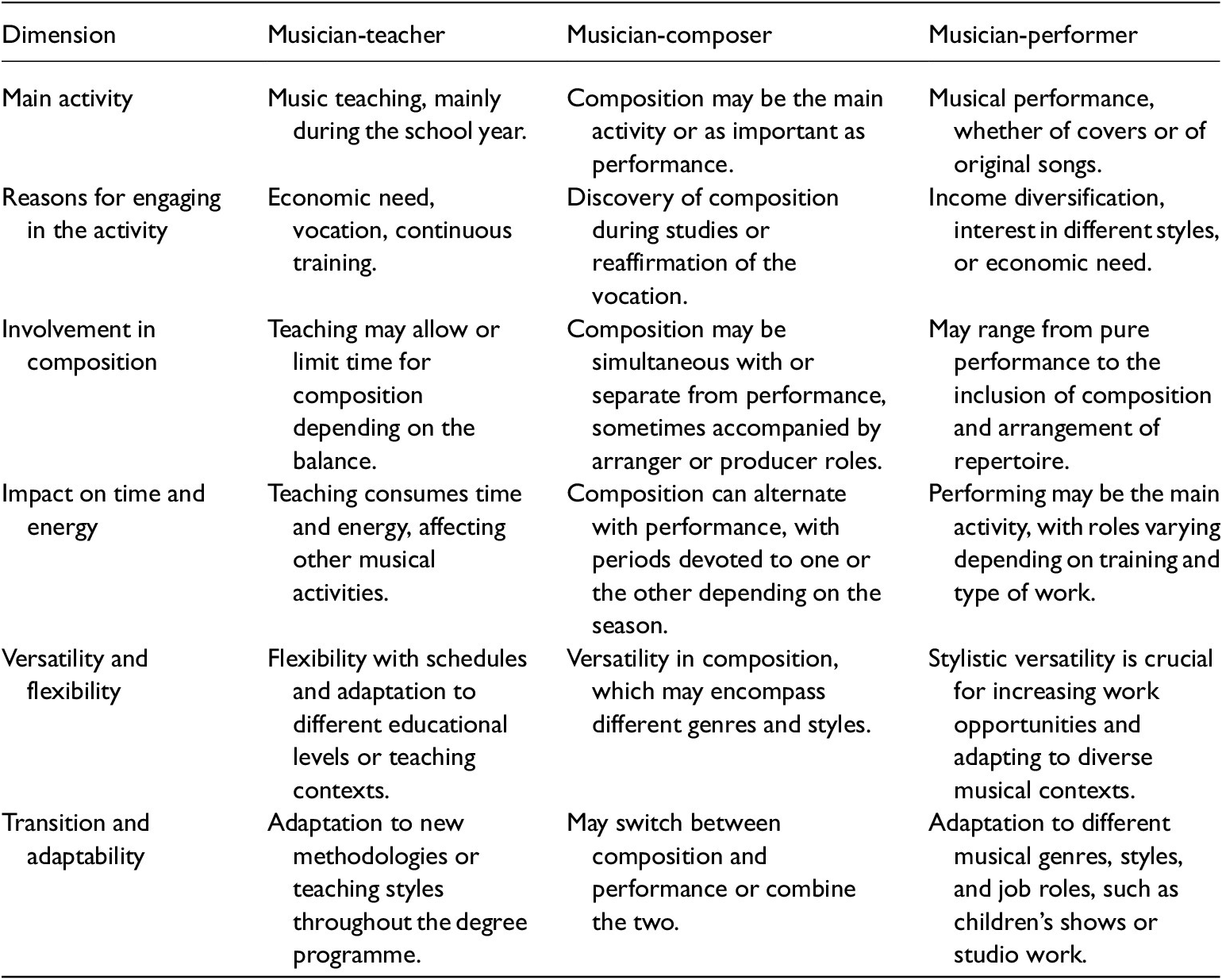
Each profile offers its own challenges and opportunities. As we can see in Table 1, the musician-teacher can attain economic stability but with restrictions on artistic practice; the musician-composer must balance creativity with market demands; and the musician-performer has to navigate between versatility and artistic authenticity. These differences underline the diversity of career paths in music and the complex interplay between economic stability, creative flexibility, and artistic commitment.
One of the central questions that emerges from this study is the relationship between specialisation and the economic conditions of the music sector. Building on the concepts of labour precariousness and démultiplication studied by Menger (Reference Menger1999), the Barcelona scene presents the same duality between artistic vocation and the pragmatic strategies of survival as identified by Coulangeon in France (Reference Coulangeon2004). Further, and despite the apparent rigidity of the table format, the typology of musicians presented here must be understood as a continuum of labour diversification.
Summary of the three profiles and their main characteristics

Source: Prepared by the author (2024).
Indeed, this study indicates how fundamental versatility is in the careers of jazz musicians. The literature on professional identity in music (Bennett, Reference Bennett2008; Coulson, Reference Coulson2010) has highlighted that musicians rarely identify with a single function but rather build their careers by combining multiple activities. It is common for musicians to start their music studies at a very early age and to continue their training until they enter adulthood. If, during the course of this training, the musician starts to give concerts or make recordings and receives financial remuneration for this, or gives private lessons to students, the musician will be identified as having entered the professional world at an early age (Menger, Reference Menger1999). In the case of teaching, this is an activity that a large majority of the musicians interviewed for this research have carried out at one time or another in their careers, many of them at the beginning. Some of them worked as private tutors or in music schools that did not require a qualification to teach, meaning these individuals had little knowledge of music education and pedagogy beyond what they received as pupils themselves. The lack of knowledge in formal music education or pedagogy may or may not awaken in them the desire to persevere as teachers. In others, this situation will convince them that they prefer to dedicate themselves fully to performance, despite all the economic difficulties that this may initially entail.
Another key aspect that emerges from the present analysis is the tension between the time spent on the main activity of each typology and the impact this has on other dimensions of musical practice. As Csikszentmihalyi (Reference Csikszentmihalyi1996) points out in his theory of creativity, composition and performance require extended periods of concentration and experimentation, which can conflict with other work demands. The ability to manage these resources effectively is key to professional sustainability in a highly competitive field.
While the table provides a useful classification of the main roles of jazz musicians, critical analysis proves that these profiles are not static but dynamic and constantly interacting, depending on the evolution of profiles and careers throughout the life of each musician as well as personal stages and financial needs that may arise (youth, formal training stages, parenthood, caring for dependants, emigration, etc.). While each career profile offers particular advantages, it also brings risks and challenges that affect the musician’s career. The need to balance financial stability with artistic authenticity and the pressure to adapt to a competitive and changing environment are recurring themes that influence the career trajectory and well-being of musicians in these roles. The course and stages of musicians’ lives will influence the evolution of their artistic careers and how they make decisions about the career strategies they choose along the way.
Conclusion
The multiactivity characteristic of artistic practice in music, like in occupations involving ‘making art’ to varying degrees, has allowed us to identify three predominant professional profiles: the ‘musician-teacher’, the ‘musician-composer’, and the ‘musician-performer’. These three activities are not mutually exclusive. As this study has shown, the current context demands constant adaptation to each situation, resulting in multiple variants of each profile depending on the resources, interests, and opportunities available to each musician. Thus, while there are musicians whose professional activities bring them closer to the ‘musician-teacher’ profile, others to the ‘musician-composer’ profile, and still others to the ‘musician-performer’ profile, there is always contact and overlap between them.
The multifaceted activities of music careers are characterised by a complex balance between economic stability and the quest for artistic authenticity. Musician-teachers, while gaining significant financial stability and a more predictable income structure, face the challenge of balancing their time and energy between teaching and their artistic practice, with potential limitations on their ability to engage fully in performance and composition, creating a constant tension between financial necessity and the desire to engage in authentic artistic work. The perception of teaching as a secondary activity may evolve over time, reflecting how musicians adjust their priorities as they consolidate their careers as performers.
This said, musician-composers and musician-performers operate in different environments that pose their own challenges. Composers enjoy remarkable creative freedom but must balance their time between artistic creation and the commercial demands of performance and production, which can lead to tensions between innovation and survival in a competitive marketplace. Meanwhile, musician-performers must constantly adapt to diverse genres, which can lead to a fragmentation of their artistic identity in the interests of profitability and job versatility. Both profiles may be marked by the dilemma between artistic authenticity and market demands, underlining the need to strike a balance between professional flexibility and commitment to creativity.
The increased predisposition of musicians working in jazz and other popular music genres to embrace versatility, particularly in stylistic terms, reflects a trend towards greater flexibility in their artistic careers. Such flexibility is necessary not only to adapt and experiment with different styles but also to be able to sustain a professional career.
The study brings to light the professional dilemmas that musicians face, particularly the tension between financial security and artistic engagement. While teaching provides economic stability, it can also limit time for performance and composition. Similarly, the composer profile involves balancing creative freedom with market constraints, while performers navigate a precarious gig economy that demands constant reinvention. These insights offer a nuanced perspective on how musicians strategically balance passion, versatility, and economic survival.
Barcelona’s music industry is characterised by a strong informal labour market, intermittent gig opportunities, and a high degree of artistic cross-collaboration, which shape musicians’ career trajectories in distinctive ways. The typology developed in this study – musician-teacher, musician-composer, and musician-performer – serves as a practical tool not only for academic research but also for policymakers, educators, and industry professionals. Future research can apply this framework to comparative studies across different music markets, examining how institutional and economic factors influence career adaptability in various regions.