Introduction
During the collection and study of specimens of the lichenicolous heterobasidiomycete Tremella macrobasidiata J. C. Zamora et al. in the Iberian Peninsula (Zamora et al. Reference Zamora, Pérez-Ortega and Rico2011), the first author found several specimens of an interesting inconspicuous parasite growing in the apothecia and surrounding thallus of the epiphytic lichen Lecanora carpinea (L.) Vain. The species characteristically develops acanthobasidia ornamented with warts, spines or pointed processes ornamentation, and also acanthohyphidia. A detailed analysis and subsequent search for an adequate name showed that, morphologically, the material fits relatively well within the genus Heteroacanthella Oberw.
Heteroacanthella is a genus of resupinate, originally plant saprotrophic, Basidiomycota with the hymenium composed of 1–2-sterigmate acanthoid basidia, acanthohyphidia, self-replicating basidiospores, and dolipores with continuous parenthesomes (Oberwinkler et al. Reference Oberwinkler, Langer, Burdsall and Tschen1990). Due to the inconspicuous appearance of the species, collected only accidentally, the almost entire lack of molecular data, and the characteristic basidia, secondary spores, and dolipores, Heteroacanthella has been considered an intermediate (“borderline”) genus between holobasidiomycetes and heterobasidiomycetes (Oberwinkler Reference Oberwinkler, Isaac, Frankland, Watling and Whalley1993; Weiss et al. Reference Weiss, Bauer, Begerow, Agerer, Piepenbring and Blanz2004). As a result, it has been placed by different authors in different orders, such as the Platygloeales R. T. Moore (Burdsall Jr. Reference Burdsall1986), Tulasnellales Rea (Oberwinkler et al. Reference Oberwinkler, Langer, Burdsall and Tschen1990; Oberwinkler Reference Oberwinkler, Isaac, Frankland, Watling and Whalley1993), Ceratobasidiales Jülich (Hawksworth et al. Reference Hawksworth, Kirk, Sutton and Pegler1995), Exidiales R. T. Moore (Roberts Reference Roberts1998a , Reference Roberts b ), Cantharellales Gäum. (Moncalvo et al. Reference Moncalvo, Nilsson, Koster, Dunham, Bernauer, Matheny, Porter, Margaritescu, Weiss and Garnica2006), and Auriculariales J. Schröt. (Wells & Bandoni Reference Wells, Bandoni, MacLaughlin, MacLaughlin and Lemke2001; Weiss et al. Reference Weiss, Bauer, Begerow, Agerer, Piepenbring and Blanz2004; Kirk et al. Reference Kirk, Cannon, Minter and Stalpers2008). Only two Heteroacanthella species are currently known, both saprotrophic; Heteroacanthella variabilis Oberw. & Langer, the type of the genus, and H. acanthophysa (Burds.) Oberw. (Oberwinkler et al. Reference Oberwinkler, Langer, Burdsall and Tschen1990). The former is known only from Taiwan (type collection) and Cameroon, whereas the latter has been recorded several times in North America and Europe, either in its teleomorphic (Burdsall Jr. Reference Burdsall1986; Roberts Reference Roberts1998b ; Duhem & Trichiès Reference Duhem and Trichiès2005) or anamorphic state (Roberts Reference Roberts1999).
Here, we describe a third species from the Jaén (Andalucía) and Madrid provinces in Spain, parasitizing the apothecia and surrounding thallus of the epiphytic, crustose lichen Lecanora carpinea, and thus being the first lichenicolous Heteroacanthella.
Materials and Methods
The morphological study was carried out using six fresh collections deposited in MAF. Herbarium specimens from K were also studied for comparison. Microscopic structures were initially observed with a Jeulin light microscope, hand-cut sections mounted in water and stained with Congo-red in 10% ammonia or with phloxin B in 5% KOH. Melzer's reagent was used for testing spore amyloidity. Measurements were all made in ammonia solution. Drawings were prepared from direct observation. Methodology related to current mycological and phytoclimatic terminology, measurements and range of dimensions, spore shape terminology, microphotographs, and GPS data follow Zamora et al. (Reference Zamora, Pérez-Ortega and Rico2011).
Specimens used for comparison. Celatogloea simplicibasidium (Lindsey & Gilb.) P. Roberts: Great Britain: England: V. C. 28, Norfolk: Swanton Novers, near Fakenham, Great Wood, in sterile basidiome of Corticium roseum on dead attached Salix twigs, 29 x 2003, A. M. Ainsworth [K(M) 122005].
Heteroacanthella acanthophysa (Burds.) Oberw.: Great Britain: England: V. C. 3, South Devon: Torquay, Watcombe Woods, on dead or moribund, attached Ulmus twigs, 25 xi 1995, P. J. Roberts [K(M)57513; anamorph (dried culture)—holotype of Acanthellorhiza globulifera P. Roberts]; ibid.: Slapton Wood, on dead or moribund, attached Ulmus branches, old coppice valley woodland, 1992, P. J. Roberts 535 [K(M) 26160].
Taxonomy
Heteroacanthella ellipsospora J. C. Zamora, Pérez-Ortega & V. J. Rico sp. nov.
MycoBank No.: MB805148
Lichenicolous Heteroacanthella that grows in the apothecia and thallus of Lecanora carpinea. Characteristically, its hymenium finally replaces the host hymenium and thallus cortex, developing acanthoid 1-sterigmate basidia, acanthohyphidia and broadly ellipsoid to ellipsoid, self-replicating basidiospores (9·0–)10·0–14·0(–14·5)×(6·0–)6·5–9·5(–10·0) µm, length/breadth ratio= (1·16–)1·31–1·64(–1·73).
Type: Spain, Comunidad de Madrid, Madrid, Collado-Villalba, near Urbanización La Chopera, in Lecanora carpinea (also parasitized by Taeniolella delicata) on Prunus sp. branches, 40°39′12″N, 04°00′01″W, 890 m alt., 29 December 2010, J. C. Zamora, Á. González & F. Prieto (MAF-Lich. 18273—holotype).
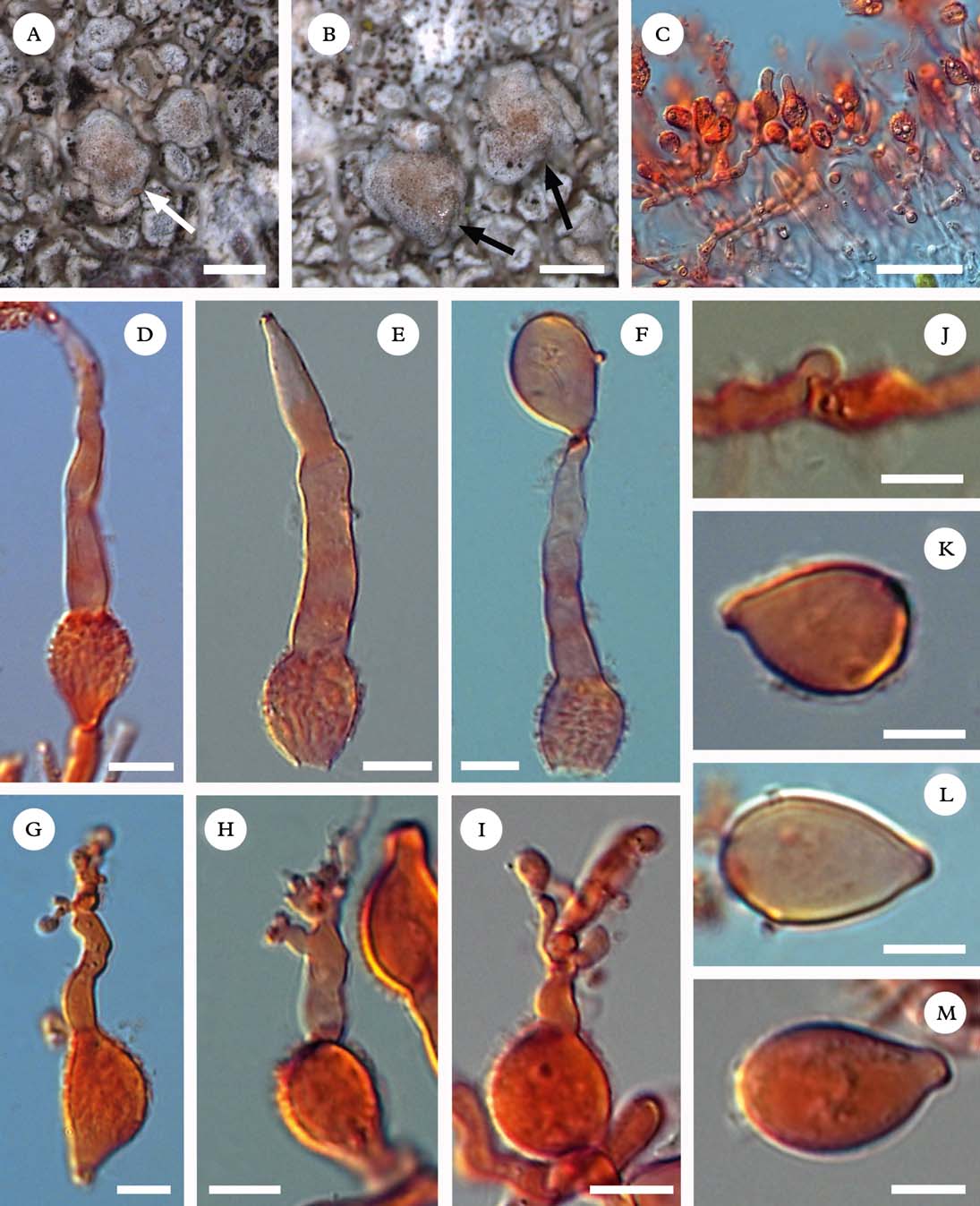
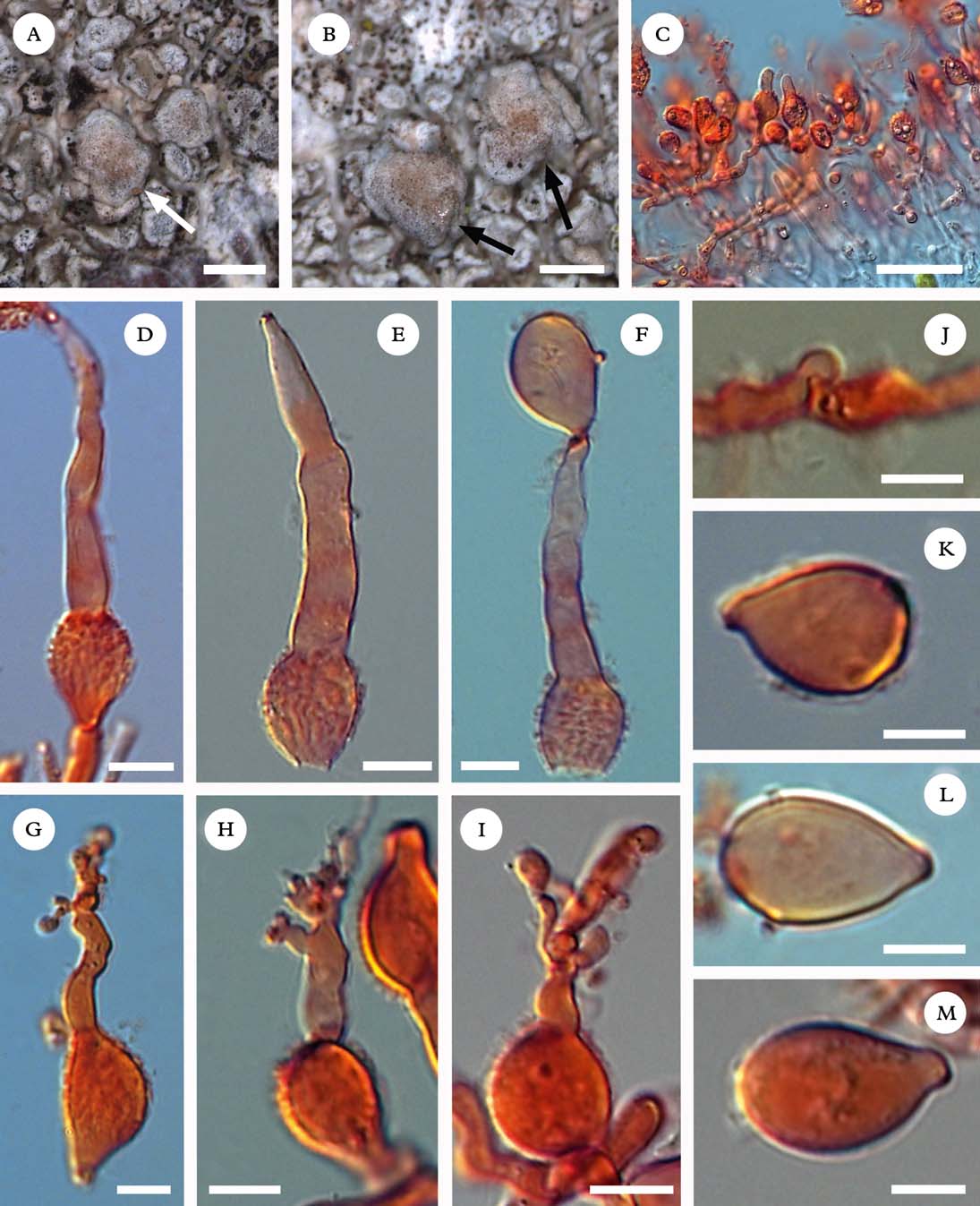
Heteroacanthella ellipsospora (holotype, MAF-Lich. 18273). A & B, habit, arrows point to apothecia with gall-like areas; C, hymenium; D–F, basidia; G–I, acanthohyphidia-like cells; J, clamp in a primary septum; K–M, basidiospores. All images except A and B of material stained with phloxin B in 5% KOH (DIC). Scales: A & B=0·5 mm; C=50 µm; D–I=10 µm; J–M=5 µm. In colour online.
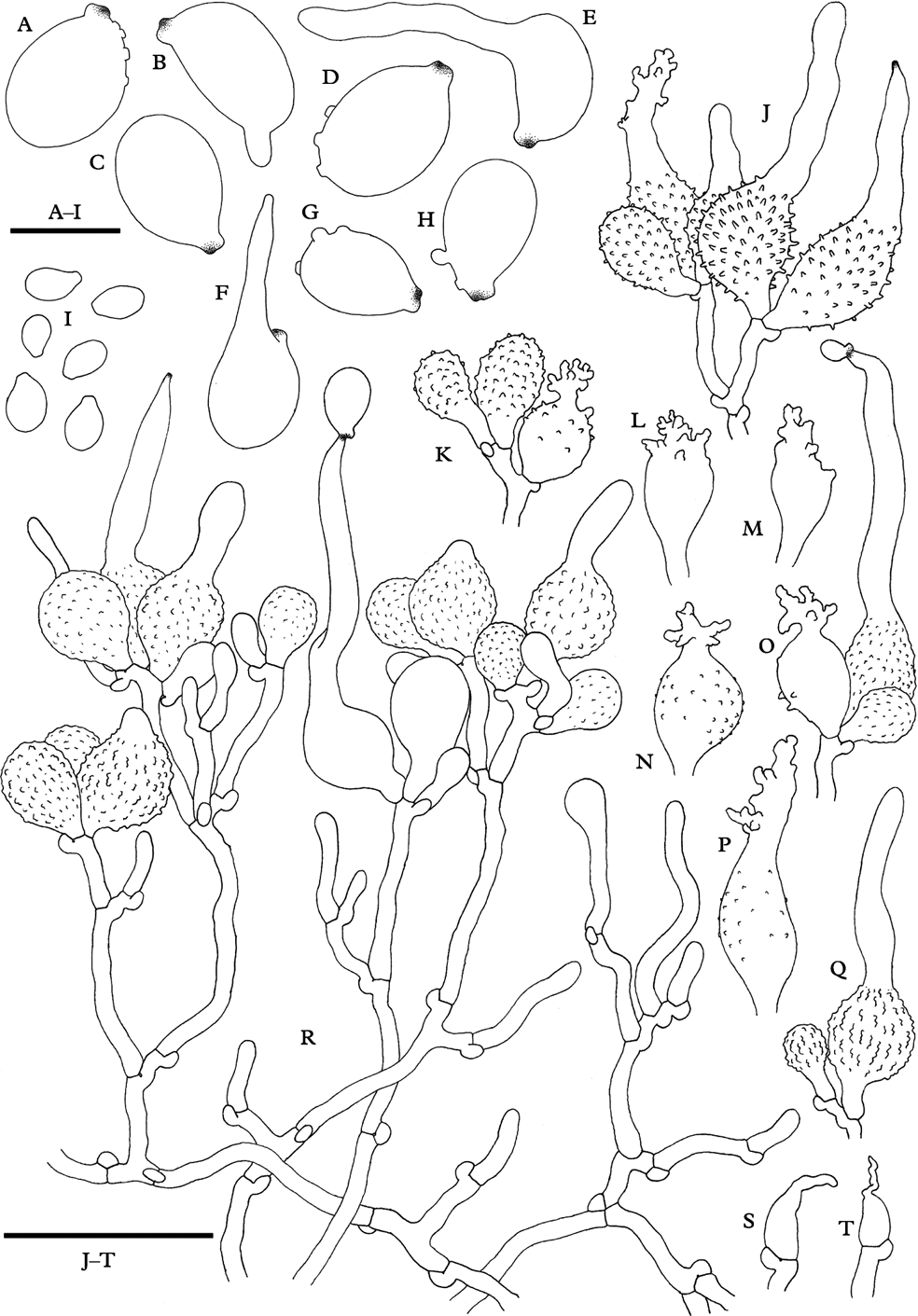
Heteroacanthella ellipsospora. A–H, basidiospores; I, blastic conidia; J, K, O, Q & R, basidia; J–P, acanthohyphidia-like cells; S & T, haustoria-like cells. A–B, D–I & R, (MAF-Lich. 18275); C & J–P, (MAF-Lich. 18274); Q, S & T, (MAF-Lich. 18277). Scales: A–I=10 µm; J–T=25 µm.
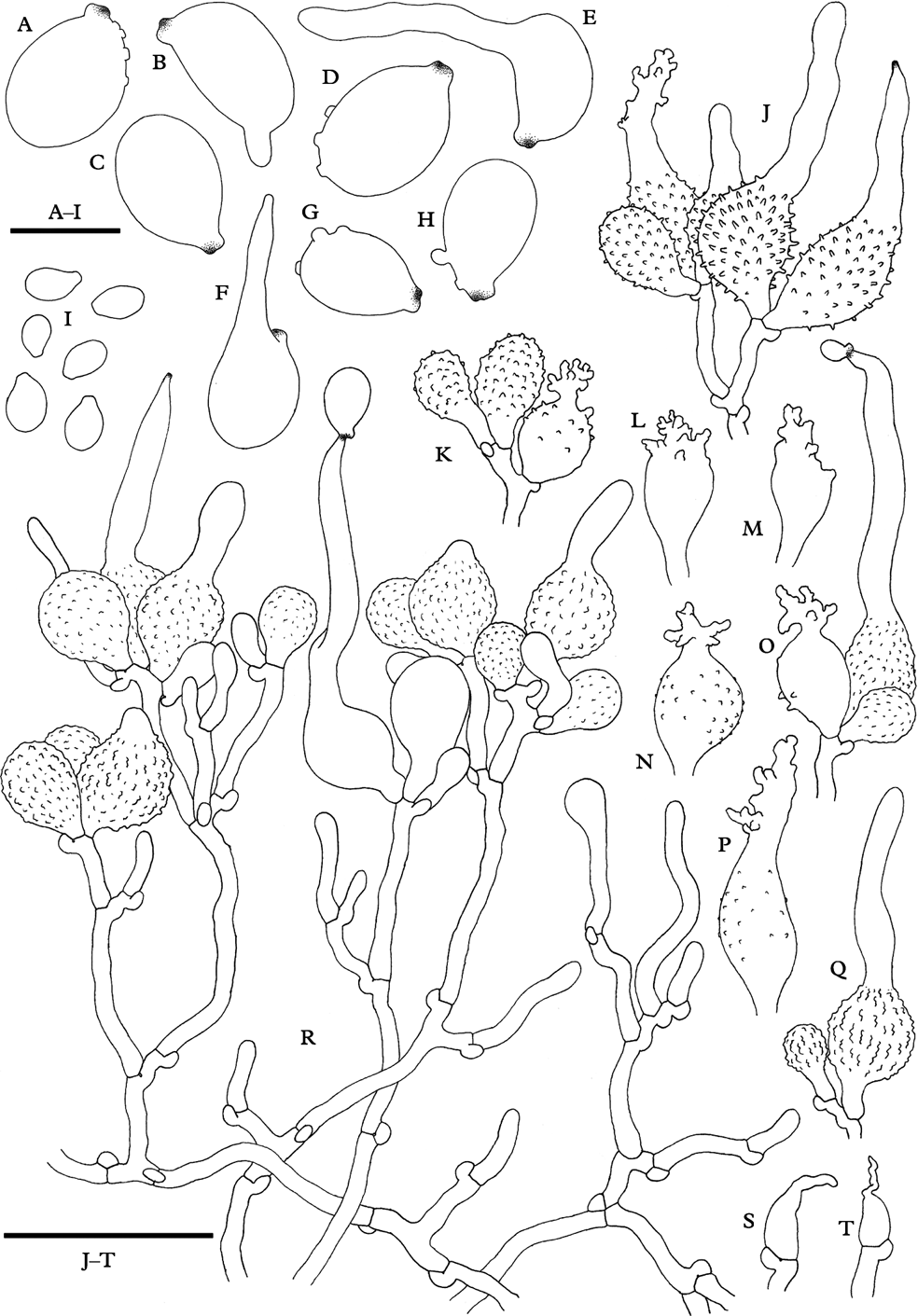
Lichenicolous fungus that grows in the apothecia and surrounding thallus of Lecanora carpinea, very inconspicuous and macroscopically not visible, to sometimes forming pale coloured gall-like areas, as small swellings, 0·1–0·8 mm diam. on the host. Hyphal system monomitic, hyphae smooth, hyaline, thin to slightly thick-walled, 1·5–4·5 µm wide, frequently septate, with clamp connections at all primary septa (seen at most of them), anastomoses rare. Haustoria unclear, a few haustoria-like cells observed but no contact with host hyphae seen; mother cells 5·0–10·5×3·0–4·0 µm, with a mostly unbranched apical filament 2–5×0·5–1·5 µm. Hymenium slightly compact, hyaline, in some cases well developed, replacing the host hyphae (hymenium or cortex) and comprising basidia, probasidia and hyphidia-like cells arising from long, mostly perpendicular to surface, subicular hyphae, otherwise not well developed and with probasidia and basidia intermixed with host hyphae; acanthoid hyphidia-like cells, 8–23×5–12 µm, with spine-like protuberances in the upper part, 1–7 µm long. Probasidia thin-walled, sphaeropedunculate to obpyriform. Basidia 1-celled, without septa, thin- to thick-walled, mostly stalked, subglobose, sphaeropedunculate, obpyriform to broadly clavate, (9–)10–15(–16)×7·5–12·0 µm (n=60; stalk not included); acanthoid, surface frequently rugose to warty, but varying from smooth to echinate or tuberculate (ornamentation up to 3 µm high, strongly congophilous), sometimes with conspicuous ridges due to coalescence of individual warts; stalk 1–7(–11) µm long; epibasidia subcylindrical, sometimes not well delimited from the hypobasidial part, (8–)17–64(–77)×(2·0–)3·0–5·5(–6·0) µm, smooth or with few spiny processes, normally with one sterigma, very rarely with two or more sterigmata, that are 1–3 µm long and refractive. Basidiospores broadly ellipsoid to ellipsoid, (9·0–)10·0–14·0(–14·5)×(6–)6·5–9·5(–10) µm, Q=(1·16–)1·31–1·64(–1·73) (n=50), smooth, hyaline, inamyloid, mostly without drops, hilar appendix present and normally refractive, thick, 1·0–1·5 µm long. Basidiospore germination shown by formation of hyphae, blastic conidia of 3·5–5·5×2·5–4·0 µm, and probably ballistoconidia (a limited number of germinated basidiospores, with imperfect sterigmata-like structures, were observed).
Anamorph unknown, apart from conidia of the germinating basidiospores.
Host. Heteroacanthella ellipsospora seems to be confined to Lecanora carpinea, as it was not found parasitizing other lichen species. We follow the L. carpinea species concept of Lumbsch et al. (Reference Lumbsch, Plümper, Guderley and Feige1997), including specimens with a pruinose, C+ yellow to orange apothecial disc, true, gelatinous amphithecial cortex with small crystals, granular epihymenium with small crystals and K+ yellow and P+ pale yellow thallus. Regarding the pathogenicity of Heteroacanthella ellipsospora, infected apothecia and the surrounding thallus surface of Lecanora carpinea became irregularly swollen and pale coloured. In the apothecia, the host hymenium is partially or totally replaced by the parasite hymenium and consequently ascospore production stops (Fig. 1C), which shows that it is clearly a parasite. In the host thallus, the cortex is partially replaced by the parasite hymenium. Lichenoconium lecanorae (Jaap) D. Hawksw., Taeniolella delicata M. S. Christ. & D. Hawksw. and other unidentified lichenicolous fungi are common accompanying species.
Etymology. The specific epithet ‘ellipsospora’ refers to the shape of basidiospores compared with the other species in the genus.
Distribution and ecology. As Heteroacanthella ellipsospora is currently known from Spain and seems to be host-specific in Lecanora carpinea, its distribution mainly depends on that of the host. Lecanora carpinea is a frequent epiphytic, pioneer and early colonizer of young twigs in boreal and temperate regions of the Northern Hemisphere and New Zealand (Nimis Reference Nimis1993; Lumbsch et al. Reference Lumbsch, Plümper, Guderley and Feige1997; Smith et al. Reference Smith, Aptroot, Coppins, Fletcher, Gilbert, James and Wolseley2009). In Spain, H. ellipsospora is a rare species; it has been collected at altitudes ranging from 590–1050 m in the Jaén and Madrid provinces, in dry to subhumid evergreen or deciduous forests of the mesomediterranean to supramediterranean belts of the Mediterranean Region (Rivas-Martínez Reference Rivas-Martínez1987); it prefers the young branches of trees and spiny deciduous shrubs of the forest fringe, or those cultivated on the edge of roads or boundaries and influenced by man.
Additional specimens examined (all in Lecanora carpinea apothecia and surrounding thallus). Spain: Andalucía, Jaén: Montizón, Venta de los Santos, near Embalse del Dañador, on Crataegus sp. branches, 38°24′19″N, 03°02′30″W, 700 m, 9 viii 2010, J. C. Zamora, B. Zamora & J. Señoret (MAF-Lich. 18277, also parasitized by Taeniolella delicata); ibid., 6 xii 2010, B. Zamora & J. C. Zamora (MAF-Lich. 18278, also parasitized by T. delicata). Comunidad de Madrid, Madrid: San Lorenzo de El Escorial, Silla de Felipe II, in Lecanora carpinea on Crataegus monogyna branches, 40°34′05″N, 04°09′05″W, 1050 m, 3 vi 2010, B. Zamora & J. C. Zamora (MAF-Lich. 18274); Villaviciosa de Odón, near the boundary between Boadilla del Monte and Brunete, on Gleditsia triacanthos bark, 40°24′54″N, 03°56′47″W, 590 m, 11 iv 2010, B. Zamora & J. C. Zamora (MAF-Lich. 18275, also parasitized by T. delicata); ibid., 23 iv 2010, B. Zamora & J.C. Zamora (MAF-Lich. 18276, also parasitized by Lichenoconium lecanorae and T. delicata).
Discussion
Heteroacanthella ellipsospora is distinguished by its unusual acanthoid, normally 1-sterigmate basidia, shape and size of basidiospores, and parasitic habit with haustoria-like cells. Micromorphological features, particularly acanthoid basidia and acanthohyphidia-like cells, fit rather well with those of the genus Heteroacanthella. Two species were previously included in Heteroacanthella, H. variabilis and H. acanthophysa. Both are saprotrophic species that have no haustoria-like cells, and form a thin layer, carrying the hymenium, on the surface of the substratum (Oberwinkler et al. Reference Oberwinkler, Langer, Burdsall and Tschen1990). Heteroacanthella variabilis differs from H. ellipsospora mainly by lacking clamp connections, having narrower acanthoid hyphidia, mostly globose basidiospores, and acanthoid basidia without wrinkled ornamentation that can produce one or two epibasidia. Heteroacanthella acanthophysa diverges from H. ellipsospora by its globose, mostly subglobose to broadly ellipsoid larger basidiospores, narrower acanthoid hyphidia (measurements from the protologue of Platygloea acanthophysa Burds. seem to include probasidia; see Burdsall Jr. Reference Burdsall1986), and basidia with less crowded and not rugose ornamentation, with up to 6 µm high spines. Concerning the here-called acanthoid hyphidia or acanthohyphidia, we have observed numerous transitions between basidia and cells which might be named acanthohyphidia. In our species, these acanthohyphidia may derive from certain basidia with an abnormal development; this hypothesis could explain the large variation in their abundance and dimensions. Studying the comparison material, description and drawings in Burdsall Jr. (Reference Burdsall1986), and drawings in Oberwinkler et al. (Reference Oberwinkler, Langer, Burdsall and Tschen1990), something similar may happen at least in Heteroacanthella acanthophysa. Acanthohyphidia present in the new species may also resemble conidiogenous cells producing asteroconidia of other lichenicolous heterobasidiomycetes (Diederich Reference Diederich1996). However, no asteroconidia or any other type of conidia production has been detected being produced by H. ellipsospora acanthohyphidia. In addition, conidiogenous cells producing asteroconidia are usually thick-walled, with a narrow lumen, and typically lack clamp connections, even in species having clamped hyphae (cf. Zamora et al. Reference Zamora, Pérez-Ortega and Rico2011), while acanthohyphidia are thin-walled to somewhat thick-walled, have a wide lumen, and in the new species bear basal clamp connections.
On the other hand, only Tremella monospora Diederich has been described as a lichenicolous heterobasidiomycetous fungus with 1-spored basidia. However, this species is very different from Heteroacanthella ellipsospora because of the absence of acanthoid hyphidia-like cells, always smooth basidia, the presence of smaller tremelloid haustoria, and subglobose, smaller basidiospores with a non-refractive apiculus; the host is also different (Diederich Reference Diederich1996).
Nevertheless, the taxonomic placement of the new species is far from clear. The monotypic genus Celatogloea P. Roberts, including C. simplicibasidium (Linsey & Gilb.) P. Roberts, shares some characteristics with H. ellipsospora: monosporic stalked basidia, basidiospores that are able to produce ballistoconidia or budding to produce yeast cells, clamped hyphae, as well as a parasitic behaviour, growing intrahymenially in Corticium roseum Pers. basidiomata (Roberts Reference Roberts2005). However, this genus has neither acanthohyphidia nor acanthoid basidia. Ultrastructure of septal pores and phylogenetic relationships with other Basidiomycota remain unknown, so that the genus is not yet placed in any order or class. Rather, many of the known characteristics of Celatogloea agree with the genus Tremella Pers., particularly with T. monospora, which is certainly not the most appropriate placement for the new species described here.
Regarding the refractivity of the hilar appendix, no data have been found from Heteroacanthella or Celatogloea species. However, Wells & Bandoni (Reference Wells, Bandoni, MacLaughlin, MacLaughlin and Lemke2001) show refractive hilar appendices and sterigmata in their drawings of Oliveonia atrata (Bres.) P. H. B. Talbot, and as far as we know, the genus Oliveonia Donk. is the most closely related to Heteroacanthella in molecular approaches (Roberts Reference Roberts1998a ). According to morphology, the new species cannot be placed in Oliveonia (cf. Roberts Reference Roberts1998a ), in which all species lack acanthoid basidia and acanthohyphidia, all species but two have smooth cystidia, and the basidia are mostly 2–4-spored. Only Oliveonia termitophila (Oberw. & Ryvarden) P. Roberts (syn. Monosporonella termitophila Oberw. & Ryvarden) has 1-spored basidia, but the remaining characters are different. Wells & Bandoni (Reference Wells, Bandoni, MacLaughlin, MacLaughlin and Lemke2001) include Oliveonia in Ceratobasidiales, but Heteroacanthella and Monosporonella Oberw. & Ryvarden in Auriculariales with uncertain affinities.
In the comparative analyses, we studied two specimens of Heteroacanthella acanthophysa (teleomorph and anamorph) and one of Celatogloea simplicibasidium, finding more or less refractive hilar appendices in Heteroacanthella basidiospores, and no refractive ones in Celatogloea, which supports our taxonomic treatment of the new species.
There are other genera of heterobasidiomycetous fungi with 1-spored basidia, Septobasidium Pat. (Couch Reference Couch1938; e.g. Septobasidium grandisporum Couch ex L. D. Gómez & Henk, and S. purpureum Couch) and Dacrymyces Nees [Wells Reference Wells1994; e.g. Dacrymyces unisporus (L. S. Olive) Wells], but the remaining morphological characters are quite different.
In any case, much work is still needed before the taxonomic relationships of most of the species mentioned are considered established. With all these data, but with some hesitation and awaiting more records and molecular analyses, we include this new species within Heteroacanthella.
We are grateful to Begoña Aguirre-Hudson (Kew) for sending material for comparison from K. VJR acknowledges support from the Spanish Ministry of Economy and Competitiveness, project CGL2011–25003. SPO is supported by the grant CMT2012-3822-C02-02 from the Spanish Ministry of Economy and Competitiveness.