Introduction
As in most parts of the world, urbanization is an ongoing process in Western Europe (Fuchs et al., Reference Fuchs, Herold, Verburg, Clevers and Eberle2015). Together with the need for densification in existing urban and suburban areas, urbanization leads to an increasing alienation of great segments of the society from agriculture. While agricultural activities can be found within and around cities in developing countries, this smooth transition between urban and rural characteristics is less present in developed cities of the western world (Viljoen and Wiskerke, Reference Viljoen and Wiskerke2012). However, urban residents and city administrators alike are part of a recent drive to reintegrate agricultural, especially horticultural areas and activities into urban areas and city life (Hirsch et al., Reference Hirsch, Meyer, Klement, Hamer and Terlau2016). This variety of agricultural and horticultural activities and initiatives can be bundled under the terms urban agriculture, urban farming and urban gardening. Unfortunately, these terms are often used interchangeably (e.g., Lovell, Reference Lovell2010; Barthel and Isendahl, Reference Barthel and Isendahl2013) and include the following activities: commercial farms within city boundaries, community supported agriculture, which involves collaborations between farmers and consumers, community gardens where anyone can participate in the field work and in the harvest of crops, and self-harvest gardens, which are sometimes defined as a sub-category of community gardens (e.g., Drake and Lawson, Reference Drake and Lawson2015) where plots of a vegetable field are leased by participants and then managed and harvested by those specific participants only.
Thus far, most studies focused on specific projects or regions and analyzed the state of the projects (e.g., Van Averbeke, Reference Van Averbeke2007; Lawal and Aliu, Reference Lawal and Aliu2012; Bendt et al., Reference Bendt, Barthel and Colding2013; Howard Schutzbank and Riseman, Reference Howard Schutzbank and Riseman2013; Hirsch et al., Reference Hirsch, Meyer, Klement, Hamer and Terlau2016), the theoretical potential, virtue and needs connected with the implementation (e.g., Adiprasetyo et al., Reference Adiprasetyo, Sukisno, Setyowati, Ginting and Handajaningsih2015; Surls et al., Reference Surls, Feenstra, Golden, Galt, Hardesty, Napawan and Wilen2015; Prasetiyo et al., Reference Prasetiyo, Budimansyah and Roslidah2016), the economic viability of specific projects (e.g., Vogl et al., Reference Vogl, Axmann and Vogl-Lukasser2004; Adenegan et al., Reference Adenegan, Balogun and Yusuf2016), or the networks and organizations of community gardens (Ghose and Pettygrove, Reference Ghose and Pettygrove2014; Drake and Lawson, Reference Drake and Lawson2015). However, Opitz et al. (Reference Opitz, Specht, Piorr, Siebert and Zasada2017) showed that self-harvest gardens contribute to the participants’ knowledge about food, like seasonality, and also help to gain insight in agricultural production methods and farmers’ perspectives. Therefore, self-harvest gardens could contribute in overcoming challenges of the current agri-food system. Furthermore, reasons for participation in self-harvest gardens were studied by Vogl et al. (Reference Vogl, Axmann and Vogl-Lukasser2004) and Hirsch et al. (Reference Hirsch, Meyer, Klement, Hamer and Terlau2016) at a regional basis. The questions about the characteristics of people who join self-harvest gardens, the key drivers for their participation, and the motivations of providers of self-harvest gardens have not been studied in a broader spatial context in Europe. This information is critical for existing and potential planners, entrepreneurs and supporters of local food systems.
This study included two components: a questionnaire where participants could indicate their background, motivation and experiences, and expert interviews to determine their motivation and experiences. The research focused on self-harvest gardens, which we define as a system in which a farmer or other provider plants a variety of vegetable crops in a field and each participant leases one plot that includes the variety of vegetables grown. The plot can be managed and harvested for one growing season and is then returned to the provider, who prepares the field for the next season (for details see Vogl et al., Reference Vogl, Axmann and Vogl-Lukasser2004). This study attempted to cover self-harvest gardens from all over Germany and aimed to answer the following questions: (a) What characterizes the participants of self-harvest gardens? (b) What characterizes the providers of self-harvest gardens? (c) What are the main factors for successful self-harvest gardens? (d) What are the main hurdles and difficulties self-harvest gardens face? The results present a self-assessment of the participants, the providers and their perspective on the benefits and challenges of self-harvest gardens. The paper has both theoretical and practical relevance as it provides an overview of how the stakeholders of self-harvest gardens in Germany assess their motivation and challenges. This can be a basis for further research and a reference for actors to distinguish their target group more accurately.
Materials and methods
Scope
Self-harvest gardens leased for one growing period, usually May to October, have become quite popular in German urban areas. The provider chooses and plants the vegetable crops and provides technical advice, water and gardening tools to the participant. Most of the self-harvest gardens are provided by individual farmers or entrepreneurs. However, they are often organized under umbrellas of commercial or non-commercial groups, which share knowledge and materials for the providers. The participants carry out the watering, weeding and harvesting tasks on their plots. The concept and design of these self-harvest gardens was described in detail by Vogl et al. (Reference Vogl, Axmann and Vogl-Lukasser2004). The vegetables are not sold but consumed within the family or with friends. Although there are other forms of urban agriculture, like small farms within urban areas or solidary agriculture, where participants buy so-called harvest shares and get a frequent amount of the harvest in return (Bauer, Reference Bauer2014), this study focused only on the self-harvest gardens.
Surveys
Survey using a questionnaire with participants
An online survey was conducted in 2015. With the attempt to cover as much self-harvest gardens as possible, all providers, who were found after an online search and by personal information from different experts, were contacted. In total, 95 providers of self-harvest gardens were contacted and asked to forward the questionnaire to their participants. The questionnaire consisted of ten pages and included questions about the participant's gardening experience, food consumption patterns, food buying behavior, reasons for engaging in self-harvest gardening, satisfaction with the experience, profession, sex, age, family status and time spent in the garden. The statements made by participants about lifestyle choices and buying behaviors were self-assessments. When participants described their behaviors relative to others (e.g., having a ‘sustainable lifestyle’ or ‘above average’ spending on food), the appraisal was also self-assessment. Most of the question response options were designed using a four-category Likert-type response format where the participants could choose between ‘totally correct’, ‘mainly correct’, ‘rather not correct’ and ‘not correct’. Some items used an open response format (e.g., age, profession) or nominal yes/no responses. Date, time, browser version and IP address were logged in order to avoid double entry.
A total of 196 participants from 66 cities and nine states in Germany filled out the questionnaire. The majority of answers were received from the states of Nordrhein-Westfalen, Hessen and Bayern. Since Germany has 16 states in total, not every state was covered, partly due to confidentiality concerns on the part of some providers. Hence, not all self-harvest gardens and all regions could be covered; therefore, the results of the survey represent the majority of the self-harvest gardens in Germany, but not all.
Only questionnaires in which the respondent answered items on all ten pages were included in the analysis. A total of 173 questionnaires were analyzed. Furthermore, it was possible to abstain from answering individual questions. Therefore, not all respondents, even if they completed all sections of the questionnaire, provided a total of 173 responses. The number of responses to each question was determined by percentage of respondents that answered the question. Therefore, sample size (n) varied by question. The statistical analysis was done using SPSS 23 (IBM, Armonk, New York, USA). Data were analyzed using descriptive statistics, while the Likert-type responses were treated as an ordinal scale (Goeb et al., Reference Goeb, McCollin and Ramalhoto2007; Norman, Reference Norman2010). The relative frequency of answers was displayed by calculating the median and the arithmetic mean.
Expert interview with providers
Interviews were conducted with 95 providers who had operated a self-harvest garden for more than one season. Thirty-eight providers agreed to an interview, of which 22 were organized in four networks, namely: tegut, meine ernte, Ackerhelden and Münchner Krautgärten, while 16 were self-operating providers. The interviewed providers came from nine states (similar to the participant's survey) and all interviews were conducted by phone. Four interviews could not be included in the analysis due to the need to maintain confidentiality. Hence, 34 interviews were analyzed. The mean length for an interview was 30 min with a minimum of 15 and a maximum of 50 min. All questions were established before the interviews. The providers were asked questions in each of the following sections: (1) characterization of the participants, (2) key success factors of self-harvest gardens, (3) problems during the operation, (4) economic status and (5) characterization of the providers. Each section included three to eight questions.
The structure of the research interview was designed according to Gläser and Laudel (Reference Gläser and Laudel2010).
The qualitative data set was analyzed according to Mayring (Reference Mayring, Mey and Mruck2010). Therefore, a category system was inductively developed by continuously adapting the categories during the analysis on the basis of text segments in the responses. This inductive method is connected with aggregation; however, the aggregating was cautiously done to avoid losing relevant information. Similar text segments observed in several interviews were aggregated to joint segments, which is generally referred as subsumption (Schreier, Reference Schreier and Flick2014). After all segments were categorized, quantitative data analysis was conducted using SPSS 23 (IBM) by calculating arithmetic means.
Results
Survey using a questionnaire with participants
General background of the participants
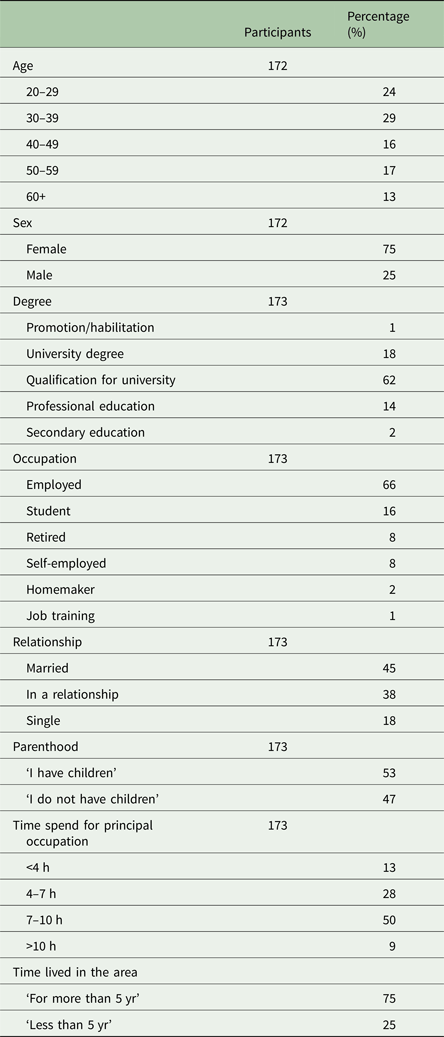
In terms of age, family status and time spent at work and for other activities, no trends were obvious. However, 75% of the participants in this study were female (n = 172), which is well beyond the relatively balanced sex ratio in Germany (Statistisches Bundesamt, 2014). The question for the highest academic qualification achieved was answered by 173 participants. Most of the participants had a university degree (62%), and an additional 18% had a general qualification for university entrance. These are much higher percentages than those reported for the population of Germany as a whole. Approximately 16% are reported to have an academic level (Statistisches Bundesamt, 2014). Most participants were employed (66%). Of the remainder, 16% studied, 8% were retired, 8% were self-employed persons, 2% were homemakers and 1% were in job training (Table 1).
General background of the participants

Connection to gardening
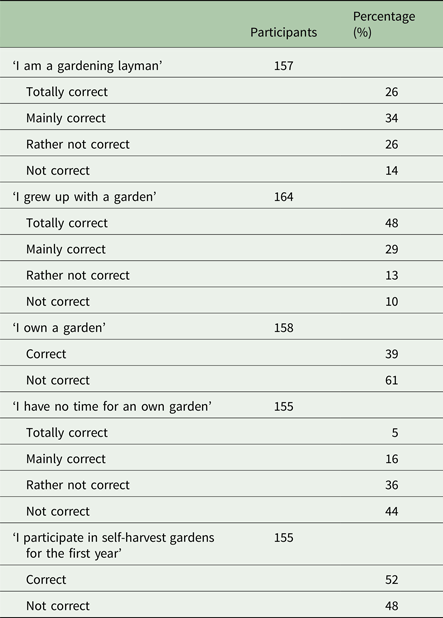
Half of the participants (52%) were in the first year of self-harvest gardening. When asked whether they thought the statement ‘I am a gardening layman’ correctly described their experience as a gardener, 26% totally agreed and 34% said this was ‘mainly correct’. This shows that 60% of the participants seeing themselves as rather inexperienced gardeners (Table 2). Rather surprising in light of the responses about experience with gardening, 48% of the participants totally agreed with the statement ‘I grew up with a garden’, while 29% mainly agreed with this statement. Sixty-one percent of the participants stated that they do not have their own garden. Eighty percent of the participants did not agree completely with the statement that they would not have the time for their own garden.
Participants’ connection to gardening

Buying habits and diets of the participants
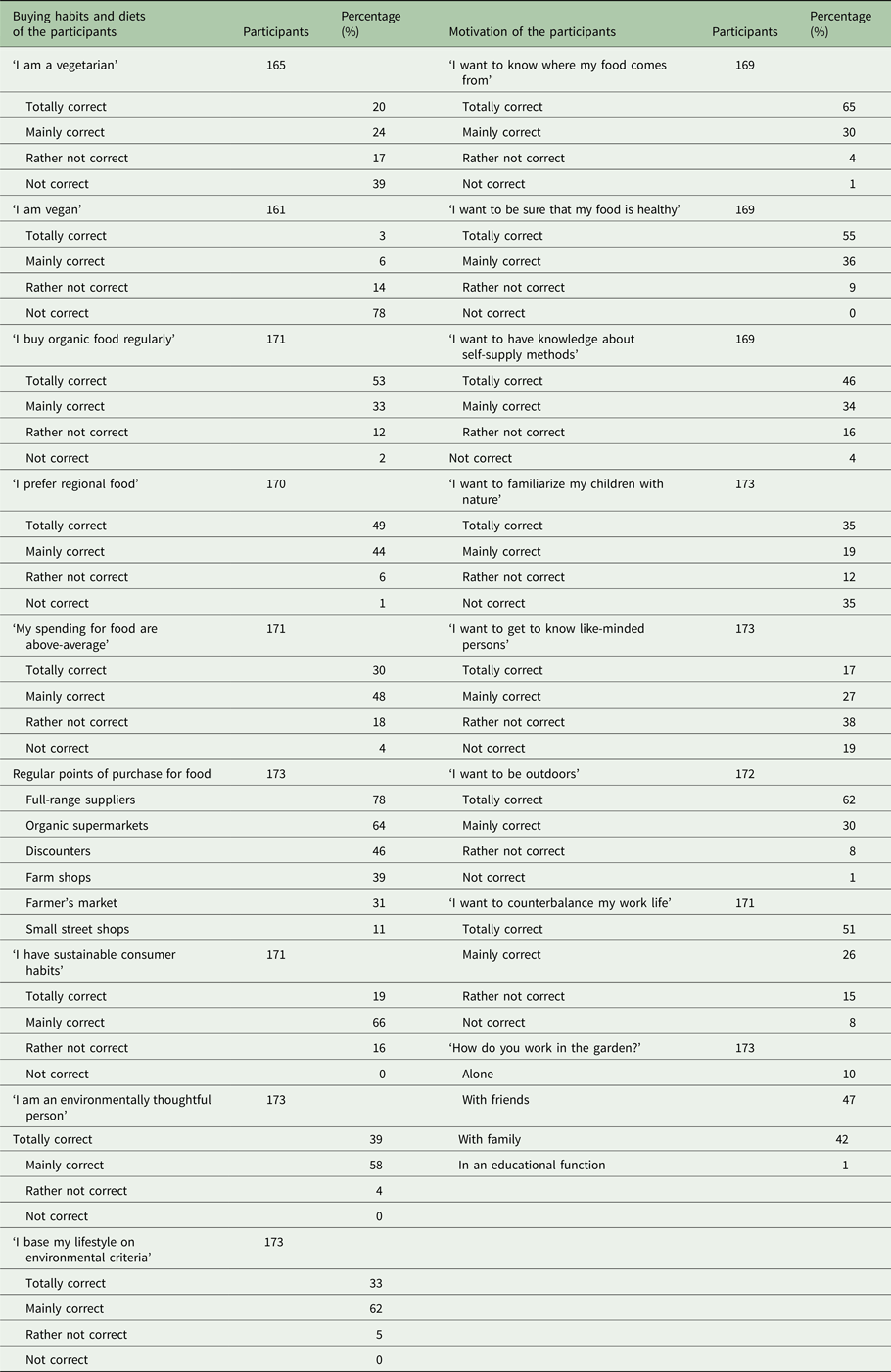
Remarkably, 78% of the participants agreed to the statement that their expenses for food were relatively high (n = 171). Most people chose full-range suppliers as their preferred point of purchase, followed by organic supermarkets and discounters (Table 3). In contrast, discounters have a total share of 42% of retail food sales in Germany (Statista, 2017).
Buying habits, diets and motivation of participants

Generally, a high share of participants agreed to the statement that they have sustainable consumption habits, are environmentally thoughtful individuals and base their lifestyle on environmental considerations. A very high percentage (44%) are vegetarians. In Germany, about 4% of total food sales are organic, but 53% of the participants of self-harvest gardens totally agreed with the statement ‘I buy organic food regularly’, while 33% mainly agreed (n = 171). An even higher agreement was observed for the statement ‘I prefer regional food’ where 93% of the participants totally or mainly agreed (n = 170).
Motivation of the participants
Interestingly, the statement ‘I want to get to know like-minded persons’ was denied by 57% of the participants. However, cross-tabulation revealed that disproportionally more over 60 yr of age concurred with the statement that they want to get to know like-minded persons (P = 0.016). Other statements, regarding the knowledge about the origin and the ‘good quality’ of food were seen as important by the majority of the participants of self-harvest gardens. No participant totally denied the statement ‘I want to be sure that my food is healthy’. Responses to this statement further analyzed through cross-tabulation with the sex of the participant. Disproportionally more female participants agreed to the statement regarding healthy food (P = 0.008). A lower acceptance as to the importance of knowledge of origin and ‘good quality’ of food was given to the statement ‘I want to counterbalance my work life’ (78%).
Satisfaction of the participants
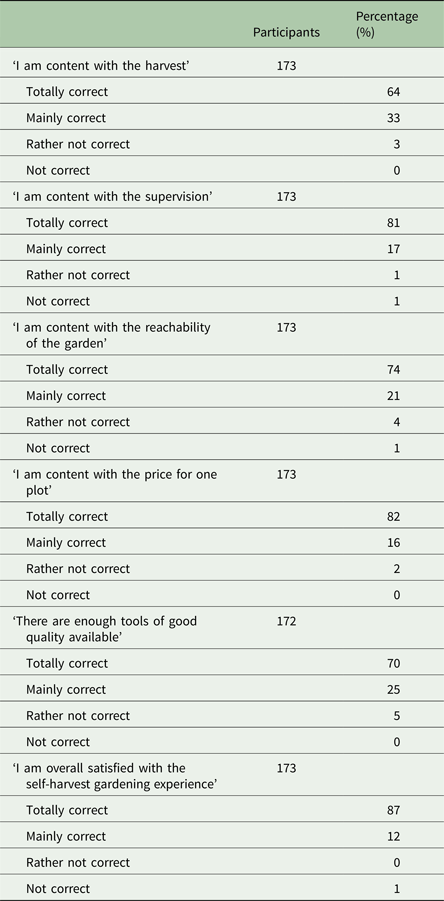
Overall, satisfaction was high regarding the quality of the harvested vegetables, the supervision of the providers of the self-harvest gardens, the accessibility of the self-harvest gardens and the price for one season. Compared with the response about the cost of the service, a slightly higher proportion of participants, 5% compared with 2%, responded that they were not fully satisfied with the quantity and quality of tools available. The last question dealt with the overall satisfaction of the self-harvest garden experience. Most of the participants (87%) were totally content, while 12% were mainly content and 1% was not content (Table 4).
Satisfaction of the participants

Expert interview with providers
Characterization of the providers
The providers that were interviewed had a mean of 124 active participants, where the smallest project had six participants and the largest had 997 participants (Fig. 1).
Number of participants of the 34 questioned providers; the black line symbolizes the mean of 124 participants and the intermittent line the median of 56 participants.

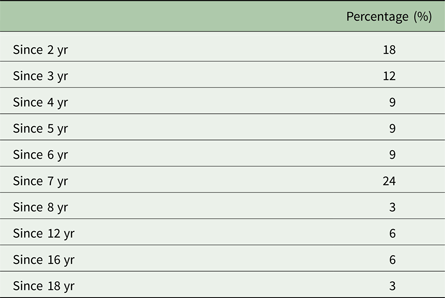
The area of the plots provided ranged between 20 and 120 m2, depending on the provider. The mean area was 54 m2, while the most common area was 40 m2. The providers charged between €1.3 and €10.2 per square meter and season, with a mean of €3.3 per square meter. Mostly, the providers planted the plots with 20–25 vegetable varieties (45%), where the minimum was six varieties and the maximum 50 varieties. Regarding their experience in providing self-harvest gardens, the largest group (24% of respondents) had actively provided plots for 7 yr, followed by 18% who have been active for 2 yr. One provider had 18 yr of experience (Table 5).
Experience of the interviewee as self-harvest garden providers

In addition to the preparation and planting of the plots, 79% of the providers supplied their participants with current information by email. Fifty-two percent offered a consultation hour, while 39% provided gardening devices and water, and 36% organized workshops. Other additional services for participants included technical advice by phone, bulletin boards, organization of plot maintenance during holidays of the participants and online blogs with gardening advice. Most of the providers were full-time farmers (58%). A fifth of the providers were part-time farmers or had only rented the area, 21 and 21%, respectively. Twenty-two of the 38 providers were organized in networks of self-harvest providers, of which some were commercial and some were non-commercial. Most of these farmers had a certified organic farm (82%). Fifteen percent had a conventional farm, but the self-harvest garden area was organically managed. Three percent of the self-harvest gardens followed conventional agricultural practices.
Characterization of the participants
Most of the providers responded that families with children were their most prevalent participants (56%), followed by providers, who stated that senior citizens were their most prevalent participants (41%). Many providers (44%) also pointed out that that they had more female than male participants. Two-thirds of the providers stated that their participants had no or very little gardening experience when they started. Twenty-nine percent estimated that their participants were very inhomogeneous in their gardening experience when they started. The providers valued their participants as highly environmentally thoughtful (88%), interested in a healthy diet (53%), and high affinity for organic (50%) and regional products (44%). Other criteria were mentioned far less frequently. Many of the providers assumed that the plots were mostly used by more than one person (35%). They also stated that during week days one person was gardening, while on weekends the gardening was shared by two or more people (27%).
Key success factors for self-harvest gardens
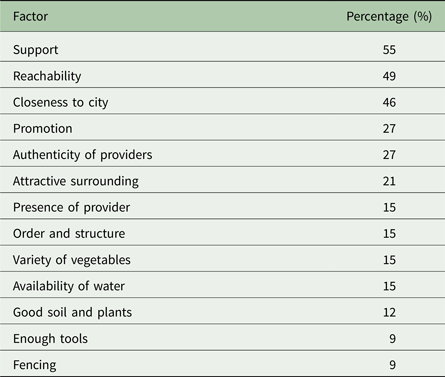
The providers identified the success factors for self-harvest gardens. Good support was mentioned by 55% of the providers, followed by a good accessibility (49%), proximity to a city (46%), adequate promotion about the gardens (27%) and authenticity of the provider (27%). Other factors like competition with other self-harvest gardens or prizes were only named by 6% of the providers (Table 6).
Most relevant success factors for self-harvest gardens from the providers’ point of view (percentages show how often one factor was named by the providers)

In response to questions about the main motives for participants to take part in self-harvest gardens, the providers named regional and healthy food (74%) and a compensating factor in their normal life (68%). One major motive also mentioned was the joy of learning to garden (50%). They also stated that participants probably want to show children how food is grown (50%) and that they want to know where their food comes from (27%). The providers were asked to speculate about aspects of their service that would generate participant satisfaction. Good support was most commonly mentioned (55%), followed by diversity and quality of the harvest (33%), enthusiasm for the project itself (24%) and good organization and infrastructure (24%). With regard to negative aspects of the experience and criticisms made by the participants, most providers named crop failure due to weather or diseases (21%), followed by ‘neighboring plots were full of weeds’ (23%), criticism about the choice of vegetables and cultivars (23%), ‘too little water available’ (19%), ‘theft of harvest’ (12%) and ‘vegetables left unharvested in neighboring plots’ (8%).
The providers were asked about their planned changes for the next seasons. Mostly, a change in the choice of vegetables and cultivars was named (31%) and an increase in plot numbers (21%). No more than 7% of the providers provided any other answer. With regard to their means for attracting new participants, most providers named their homepage (66%), followed by flyers (56%), advertisement in newspapers and journals (44%), posters and banners (41%), word-of-mouth advertising (28%), Facebook (22%) and events (19%). With regard to customer retention measures, most providers stated that they organize festivities (85%), followed by workshops (33%), collective cooking and meals (24%) and good customer service (18%).
Problems during the operation
Most providers stated the main problems faced were theft of harvest (53%), vandalism (21%) and conflicts with neighbors in the project area (15%). Measures to counteract these problems showed that 22% of the providers, who had problems with theft of harvest, wanted to build a fence, 11% wanted to personalize the plots and 11% wanted to establish signs with rules in the area. Providers who had problems with vandalism wanted to set up rules for the area (14%) and 14% wanted to buy cheaper gardening tools. Providers who had problems with weeds on plots wanted to contact the participants (100%).
Economic status
The perception of providers regarding the economic costs and benefits of running self-harvest gardens were also investigated. Nearly one-third of providers (30%) said that they earned a profit only if they did not consider their labor costs and 27% said that earning a profit depends on the number of participants. Twelve percent said that they had not made a profit to date and 6% said that they only managed to cover their costs. However, 15% said that they had no interest in earning a profit from the gardens. Commenting on their evaluations of synergistic effects between the gardens and other activities, 44% of the providers saw positive synergistic effects with their farm shops, 15% saw a synergistic effect with sales of seeds and plants, 12% saw a synergistic effect with their farm café and 32% saw no synergistic effects.
Twenty-six providers gave a statement regarding governmental subsidies. Two-thirds stated that at least one subsidy (e.g., organic farming or water protection) was discontinued for the area of the self-harvest garden, and one-third stated that they had not lost any subsidies.
Discussion
This study addressed four main questions. The first was what characterizes and motivates the participants of self-harvest gardens? Seventy-five percent of the participants in this survey were female, indicating that active gardeners in self-harvest gardens are mainly women. This conclusion was confirmed by the information from providers, 44% of whom explicitly stated that they have more female participants. Hirsch et al. (Reference Hirsch, Meyer, Klement, Hamer and Terlau2016), who did analyze urban agriculture in a German region in detail, also found that 60% of the participants were female. Self-harvest is apparently not mainly driven by productivity or economic factors, but rather by social, sustainability and health intentions, concepts that are believed to be more important to women than men (Franz-Balsen, Reference Franz-Balsen2014). The findings of Harrison and Klotz (Reference Harrison and Klotz2010), which showed that women are highly represented in sustainability leadership positions, support this assumption. However, this study did not examine whether social or sustainability aspects were decisive factors for the high female interest in self-harvest gardens. A high proportion of the participants characterized themselves as vegetarians, with a high affinity for organic food, and an even higher affinity for regional food. These self-assessments were reinforced by the providers’ survey. It could be shown that the participants considered their expenses for food as relatively high. The expenses for food, the high educational level and plot prices not being an issue suggest that a high proportion of participants are from the upper middle class.
The motivation of the participants was mainly driven by their desire to consume local and healthy food. This aspect was also discovered by a recent study of Hirsch et al. (Reference Hirsch, Meyer, Klement, Hamer and Terlau2016) in a western region of Germany, although the main factor was identified as ‘having fun with gardening’ in a previous study done by Rosol (Reference Rosol2006) in Berlin. Interestingly, in this study, older people were more motivated by the chance of getting to know like-minded people, although this was not a motivation for most of the gardeners. While Bell et al. (Reference Bell, Fox-Kämper, Keshavarz, Benson, Caputo, Noori and Voigt2016) identified economic factors as a motivation to participate in urban allotment gardens, especially in Southern Europe, this was clearly not a motivation in this study. On the contrary, almost all of the participants were content with the cost of the lease and stated that they spend relatively much money on food. The motivations of the participants seem to be both intrinsic and extrinsic. Extrinsic reasons like knowledge about food, its origin and healthy food were scored highly in the survey, as well as the statement ‘I want to be outdoors’, which shows that the activity in and of itself was a motivation to participate. This finding is in line with the results from regional surveys where Hirsch et al. (Reference Hirsch, Meyer, Klement, Hamer and Terlau2016) showed that the joy in gardening as well as the production of healthy food were very important for the participants of urban farming activities, including self-harvest gardens.
The second main question dealt with the characterization of the providers of self-harvest gardens. Most of the providers were full-time farmers or part-time-farmers. These individual providers were mainly organized in a network which gave the farmers initial support and a ‘brand’. However, the financial and contractual arrangements within these networks were not examined in this study. When taking into account that 16 of the 38 providers were not organized in a network and the others came from four networks, the level of aggregation of providers in associations seems to be relatively low in Germany. A study of Drake and Lawson (Reference Drake and Lawson2015) in North America revealed that among community gardeners and organizations involved in assisting the management of community gardens, the majority (77%) of the participants in the study were associated in organizations with more than 31 gardens or locations, respectively. An amplification of networking between different self-harvest gardens in Germany is a possible opportunity to share experiences and tackle joint challenges. Further research on networks of community gardens can be found by Ghose and Pettygrove (Reference Ghose and Pettygrove2014).
In order to till and prepare the area every year, agricultural machinery is needed which, together with the need for expertise in growing vegetables, can explain the farming background of the providers. Participants’ preference for organic food explains the large number of organic farms which offer self-harvest gardens. Often, the providers identified synergistic effects with their farm shops, cafés or plant sales. This explains in part why many of the providers still engage in self-harvest gardens even when they received no clear economic benefit from the project itself. This may represent a departure from the older findings of Vogl et al. (Reference Vogl, Axmann and Vogl-Lukasser2004), where these economical offsets were only marginal. Since 85% of the providers have <10 yr of experience with self-harvest gardens, it can be deduced that self-harvest gardens have expanded considerably in recent years.
The third primary question dealt with the most important factors for a successful self-harvest garden. Almost all participants in the survey were satisfied with how the gardens were managed. From the providers’ point of view, good support, good accessibility for possible participants and marketing were the three dominant success factors. Providers and participants pointed out that regionality and healthy food are key incentives to participate in self-harvest gardens. Therefore, responding to these factors of importance to participants through organic management, providing ample information for participants and emphasizing these attributes in promotional efforts are likely promising ways of acquiring participants. Most of the providers also organized festivities to strengthen the community within their gardens.
The last primary question dealt with the most challenging and difficult aspects of self-harvest gardens. Although a third of the providers identified poor harvests as a criticism by participants, this was obviously not seen as a big problem by the participants themselves. Most self-harvest gardens were provided with more than 20 vegetables from the start. This variety and quantity over multiple harvest periods reduces the risk that the majority of the vegetables will fail due to pests or weather conditions. It can be assumed that although the participants complain when one vegetable fails, at the end of the year they are satisfied with the overall harvest which leads to the observed discrepancy. The other problems, such as weeds in neighboring plots, water availability and choice of vegetables, are more controllable by the providers through management, planning and agreements with the participants. The main problems for the providers were theft of harvest and vandalism. A countermeasure, which is already in place or in future plans, is fencing. Providers also discussed the potential for additional security measures in the long run. Although 15% of the providers had conflicts with neighbors in the area, legal or policy problems, which were reported as major restraints in other countries, could not be identified in this study (Mikulec et al., Reference Mikulec, Diduck, Froese, Unger and MacKenzie2013).
Conclusions
In response to the four main questions in this study, the findings can be summarized as follows:
(a) The most dominant characteristics of the self-harvest gardeners were: a high level of education, an emphasis on a sustainable lifestyle, female, unexperienced with gardening practices and a high nutritional awareness (an emphasis on healthy, organic and regional foods).
(b) The most dominant characteristics of the providers of self-harvest gardens were a farming background, no need to generate their financial income solely from the self-harvest garden, synergistic effects with other activities and an affinity for organic farming.
(c) Most important success factors seemed to be a location that is easy to reach for participants, fencing, good support for participants by the provider, promoting the gardens and emphasizing healthy food.
(d) The most important difficulties for the providers were bad harvests, theft of harvests and vandalism.
In conclusion, self-harvest gardening in Germany seems to fit the social norms and lifestyles of many dwellers of urban areas in Germany. It is not predominantly used to produce cheap food or counterbalance work life, but mainly to get in touch with regional, sustainable and healthy food production. Farmers with an affinity for organic production methods and contact with consumers are most likely to take advantage of providing an area for self-harvest gardening. However, to be successful, it seems that the engagement of a provider has to go beyond the agricultural measure to include, e.g., constant promotion, professional support for the gardeners and the arrangement of social events.
A great part of the self-harvest gardens are driven by single farms, not linked in a greater network. Further research is needed to analyze and discuss if there is a trend to professionalization and commercialization in the organizational level of self-harvest gardens.
This study presents and analyses results of a survey of different stakeholders of self-harvest gardens in Germany, most parts are based on a self-assessment, hence it is unclear to which extent the results can be seen as actual behavior. Another limitation is that this study had no control group, which limits the degree to which the traits and characteristics of the self-harvest participants or providers can be compared to other groups of consumers or farmers in Germany.
Acknowledgements
The authors would like to thank Susanna Schulz for the development of the online survey. Finally, the authors thank the reviewers and the editor who helped to improve the paper considerably.