Introduction
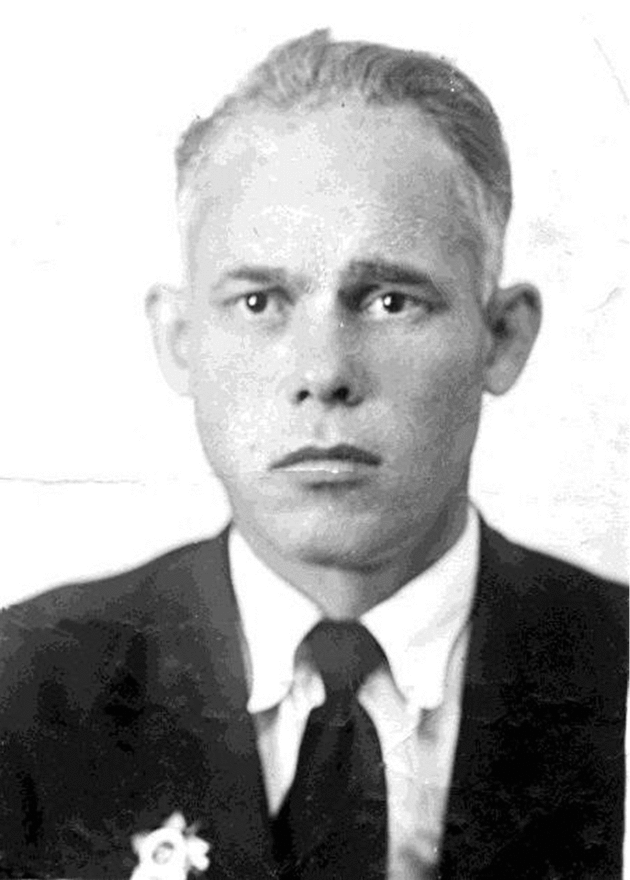
Pavel Sergeyevich Rozhkov (1910–1987) was a Mordvin from the small autonomous republic of Mordovia, which lies east of Moscow and south of Nizhnyi-Novgorod, and whose people were mostly anti-Soviet during the civil war. But he and perhaps his family must have supported the Bolsheviks, because he received training as a railway mechanic at a technical college in the 1920s and was then selected for further training on ships in Leningrad. After a brief spell in the merchant navy he joined the Soviet Navy in the late 1930s and served first in submarines and then in naval land forces in the Baltic during World War II (Fig. 1).
Captain Rozhkov in 1947. Courtesy of his grandson, Yurii Solocha.
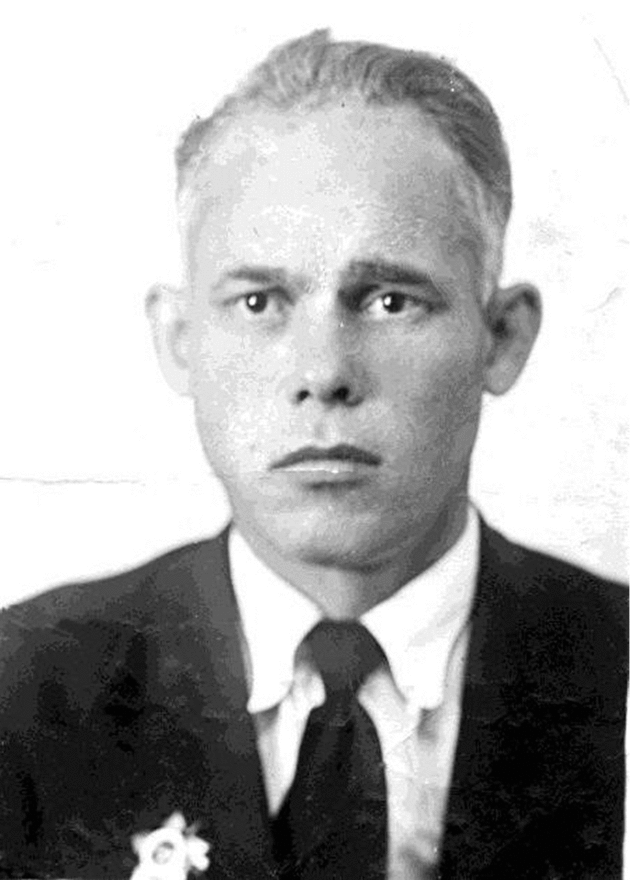
Rozhkov only went to the Antarctic once, as captain of the whale catcher Slava 3 on the first Soviet whaling cruise to that region in 1946–1947. He brought to it an eye unprejudiced by any previous experience of whaling or fisheries. For most of his subsequent career he captained merchant ships in the Soviet Arctic and far east, but before doing so he served briefly as deputy captain of the port of Klaipeda (Memel) in the Lithuanian SSR, which explains the genesis of the article that he wrote on his experiences in the south and which is printed here for the first time in English translation (Rozhkov Reference Rozhkov1948b). An abridged version had appeared slightly earlier in the Latvian SSR (Rozhkov Reference Rozhkov1948a).
While its longueurs sometimes aptly reflect those that were regularly endured by whalers, Rozhkov's prose leaves much to be desired by a modern reader. His naive but sincere Soviet communism is understandable in someone with his history who was found eligible for overseas service in the early years of the cold war. And for British readers, in particular, it may be interesting and even salutary to read his views.
As for his slapdash, demotic approach to statistics and other technical subjects, who are we to talk in the age of unedited ‘blogs’? But his unreliable geographical and biological passages are sometimes hard to tolerate. There is some evidence that he relied on the first edition of the Great Soviet Encyclopedia (1926–1947), which contained occasional minor errors of fact, such as the identification of Mount Adam as the highest point in the Falkland Islands. Some of his interpolations of general knowledge into the narrative of the voyage have been omitted here, thereby leaving a text which is rather more political than is the original. All such abridgements are flagged inside italic braces, {thus}. Linking passages, occasioned by the article's publication in daily instalments, over a period of eleven days, have also been dropped. Rozhkov's old-fashioned vocabulary has been respected.
As for the moral of the story, the re-education of Martinsen, readers will judge that for themselves.
As Rozhkov's translator in these pages, the author suggests we should tolerate his antique infelicities as the price, and indeed as the credentials that enabled this now valuable historical source to get into print in the first place. The point is that no other Soviet or post-Soviet author has ever described the first cruise of the Slava whaling flotilla in such graphic and historically significant detail. It has not been generally known before this, for example, that the flotilla called at the Canaries, Ascension, Tristan and Malta. And while Rozhkov was blithely revealing these matters for the inhabitants of an obscure provincial port, official Soviet accounts, concocted in Moscow and Leningrad, repeatedly concealed the flotilla's origins as booty seized from a defeated Germany and reluctantly handed over by the British in September 1946 (Bulkeley Reference Bulkeley2010). Rozhkov has also left us a lively if inevitably subjective picture, at the level of anti-fouling paint and harpoon ropes, of how such matters were actually conducted.
The only Martinsen with the flotilla was Marius Martinsen, a Norwegian harpoon gunner from Tjøme on the island of Hvasser (Dag Børresen, personal communication, 25 January 2010). But apparently not even Rozhkov could admit (or be allowed to admit) that his harpoon gunner had been a foreigner. Instead, he presents his ‘Martinsen’ in the guise of a boat steerer acting as (supernumerary) first mate. Alongside 379 Soviet citizens there were in all 54 Norwegians with the flotilla, 31 of them on the eight catchers (Børresen Reference Børresen2004). That suggests that there would have been three or four on Slava 3, or in other words that ‘Martinsen’ is a generic portrait.
Rozhkov's account can be checked in several places, such as the sailing date from Liverpool, the location of the flotilla in February 1947, and the fact that, with permission from the International Whaling Conference they continued operations into April 1947. There are no grounds for doubting the veracity of his basic narrative.
The former German whaling flotilla in question had been apportioned to the Soviet Union as wartime booty, under the terms of the Potsdam Agreement, in December 1945. As regards British treatment of the Russians at Liverpool in 1946, the British did remove a substantial amount of equipment from the flotilla before handing it over. Much of that equipment had been acquired and installed for the British Ministry of War Transport in Germany in 1945, and an unknown proportion of it may even have been identical with that removed from the flotilla when it was converted for the German Navy in 1939. So the Russians may have been entitled to claim that the flotilla should have been handed on to them fully equipped. Doubtless the British had paid a minimal sum in occupation marks to German shipyard workers, but they had also appropriated the flotilla for their own use in 1945–1946. Added to which the Russians were probably never given the option to reimburse those 1945 labour costs in gold and take over the flotilla intact and, crucially, earlier in 1946.
The idea of placing legal obstacles in the way of any consequent Russian ‘re-refit’ in Britain was in fact mooted in Whitehall, but never came to anything. But whether or not any official steps were taken to obstruct the Russians in their desperate efforts at Liverpool to prepare the flotilla for the 1946–1947 Antarctic season, the prospect of their failure was greeted with just as much complaisance in Whitehall as in Fleet Street (Bulkeley Reference Bulkeley2010).
That said, Rozhkov did allow himself some journalistic licence in respect of events at Liverpool. The Empire Venture (ex-Wikinger) and her seven Empire Viking whale catchers were handed over on 26 September 1946, and the first contingent of Russians may have arrived two weeks before that (Max Buhl, personal communication, 28 November 2009). A second contingent, including Rozhkov by his own account, travelled on the General Brusilov from Leningrad (via Szczecin), reaching Liverpool on 29 November (Lloyds List (London) 30 November 1946: 9). Rozhkov's reference to ‘ships’, plural, appears to confirm the author's previously formed hypothesis that the mysteriously acquired eighth catcher also joined the flotilla from Leningrad (Bulkeley Reference Bulkeley2010). But what matters here is that Rozhkov was not himself at Liverpool for the first two months. The affair of the anti-fouling paint stayed with him, in short, because he was there for that one.
Rozhkov's bold superlatives conceal the fact that, for understandable reasons, Slava had by far the poorest results of all whaling factories in the Antarctic in 1946–1947. She took less than half of her capacity. Rozhkov's figures for the catch mirror those published in 1947 by the Norwegian Whaling Gazette so closely that they may well have been taken from that source. The Gazette, however, had qualified its figures for Slava's oil production as approximate (Anon. 1947). (The following year the Gazette complained about the late submission of catch figures by the Russians and their failure to report their oil production.) Apparently Rozhkov ignored the qualifications attached to the Gazette's 1947 figures and converted their total of 35,000 barrels by rule of thumb at 10 poods per barrel. Had he used a more accurate ratio his result would have been slightly higher, 356,000 rather than 350,000 poods, and close to the official Soviet figure of 355,000 poods or 5,814 metric tons (Voronin Reference Voronin1948). In this connection it should be noted that 1 pood = 16.38 kg; 1 metric ton = 6 barrels.
Unlike Rozhkov, Martinsen returned in 1947–1948 and the team of gunners which he led on Slava 3 killed the third highest number of whales in the flotilla that season (Max Buhl, personal communication, 28 November 2009). With the same number of catchers but a longer and earlier season, the flotilla killed more than twice as many whales in 1947–1948 and the amount of whale oil produced went up by about two thirds. However that total was still below the amount (62,640 barrels) taken by the flotilla with one less catcher for the British in 1945–1946.
In the author's opinion, Rozhkov's main drawback as a primary source was not of his making. It was simply that he sailed on one of the catchers, rather than on Slava herself.
‘The first Soviet whalers in the Antarctic’
Pavel Sergeyevich Rozhkov
Translated from Sovyetskaya Klaipeda, June–July 1948, by Rip Bulkeley
See you soon, Motherland!
So, the day of departure had arrived at last. We had completed final preparations. A damp, cold November hung over Leningrad as she gave us an affectionate send-off. You could feel the approach of a harsh winter in the air. No one usually prepared that sort of expedition at that time of year. The Arctic Ocean was covered in thick ice by then, and it was no longer possible for even the strongest ice-breakers to sail through it. But we were heading, not for the Arctic, but for the rocky, ice-bound shores of Antarctica, the continent of the South Pole.
They had overwhelmed us with sincere, parental concern. The slightest wish of any expedition member had been fulfilled immediately. It is hard to put into words what we all felt at the last hoot of the ships as they left the shores of our native, our Soviet Leningrad. We set sail with immense gratitude for all that care and attention. ‘See you soon, Motherland!’
We were bound for England, from which the whole flotilla, headed by the whaling factory Slava, was obliged to set sail for the Antarctic.
From the first day we arrived in England we encountered open opposition from business quarters, which sought to delay the departure of the expedition by every possible means, such as postponing ship repairs or holding up necessary supplies. The press carried slanderous reports about Soviet seamen, about the expedition being doomed to failure due to the ‘poor condition of the ships’, ‘the lack of whaling specialists’, etc.
They tried every way to intimidate us. But throughout the sensational slanders we Soviet sailors quietly carried on trying to complete the repairs on the ships and, through our own resolute endeavours, to meet the challenge of the blatant sabotage by English businesses.
The crews led a normal Soviet life. A spirit of fruitful socialist emulation ran through the flotilla, its guiding principle being to set sail for the Antarctic by mid-December at the latest, and thus honourably fulfil the task required of us by the Motherland. Our doughty sailors performed wonders. Most of the on-board machinery was restored to working order.
The English sabotage obliged us to wait for the steamer [General] Brusilov, which brought out basic supplies for the flotilla [at the end of November]. Then things got a move on. Repairs to the most important equipment on the catchers and the factory machinery were completed ahead of time. We just needed to paint all the ships below the waterline. Even then the English shipowners tried, as they say, to put a spoke in our wheel. They refused to sell us [anti-fouling] paint. It was holding up the departure of the expedition, and December was already drawing to a close. Much to the disappointment of the capitalists, however, workers in Newcastle took it on themselves to help us out. They got hold of some paint (something hard to do in England, which was suffering severe shortages) and presented it to us.
‘Those who are obstructing you do not represent the people. Our hearts are with you,’ said their delegates as they handed us that immensely valuable gift.
We [Slava 3] set sail on 27 December. Any remaining jobs would be completed on the voyage. The December sea greeted the flotilla with storms. Slava successfully crossed the Bay of Biscay, drawing her line of catchers ever further from their native shores. Meanwhile the catcher crews were hard at work on many things. Everything had to be ready for hunting whales! We called at Gibraltar, where we were due to meet a Soviet tanker which would provide us with fuel and bring greetings from the Motherland.
Gibraltar
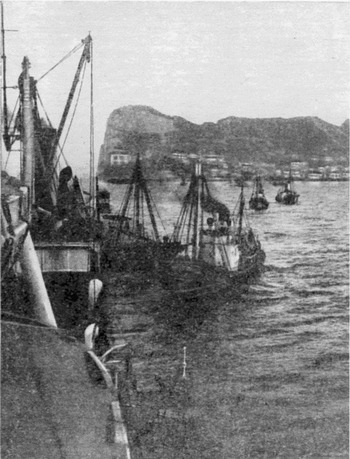
On the eve of 1947 Soviet whalers were piloted under the walls of Gibraltar, the English naval fortress (Fig. 2). The moment our ships entered the Bay they were surrounded by a crowd of boats belonging to the local inhabitants – Portuguese, Spaniards and Moroccans. Everyone wanted a look at the Soviet whaling flotilla. Some larger, apparently naval sloops could be glimpsed amongst the boats. On board were what seemed to be English naval officers. They looked us over with suspicious envy. Their sloops sailed close in to the whalers, then slowly circled the flotilla, calmly, brazenly scattering the local boats. {linking passage}
Slava (foreground) with catchers in the Bay of Gibraltar, circa 1 October 1949. Source: (Arsen'ev and Zemskii Reference Arsen'ev and Zemskii1954).

As we entered the Bay, an English pilot came aboard Slava 3 to take her in to the roads of Gibraltar. He was a tall fellow, so tall that he looked a bit of a freak. The face that looked out from under his enormous cap showed dry, almost burning eyes that had long lost all their curiosity. An owlish nose jutted out between his high cheekbones.
The English pilot took charge of everything. He was polite, cordial, and deft. His long hands in their white gloves grasped the ship's railings with a delicate grace, but as he climbed the ship's ladder he showed the bearing of an old sailor. An experienced pilot and seaman, he put a hand to the peak of his cap as if by habit and, with the ghost of a condescending smile, showed the captain the channel into the roads. The captain looked at the pilot and said in English, just before the other started pointing things out:
‘We go ahead now, then we put the wheel over to starboard, no more than 14 degrees, and let go anchor a cable from that buoy. Is that correct, sir?’
All the arrogance was wiped off the pilot's face. He broke into a warm smile.
‘Oho! so the Russian captain knows the harbours of the world, including Gibraltar!’ He gave a delighted, respectfully artistic bow, while still preserving his dignity.
The crowd of boats pressed ever more closely around our ships. We went ahead slowly, and started signalling to them. They bustled off in different directions, taking care not to collide with one another. Then they would stop, draw away in a different direction, and stop again with a yell. We went dead slow, signalling the whole time. The coolly polite face of the pilot, with his courteous smile, altered suddenly. After hesitating for a moment, he addressed the captain:
‘Why take so much trouble, sir? Go straight through them. They're only Spaniards, Portuguese and Moroccans, you know.’
So that was what had been hidden by his coldly polite expression. Each of us wondered whether those peoples knew what value their ‘friends’, the English, placed on them.
The weather was warm, the sea calm as we left Gibraltar. We had received a final human greeting there from our country, which loves and cares about all of us, about all Soviet sailors without exception.
Repairs to the ships were now almost complete. From now on, as we sailed, we needed to learn by heart, from books, the rules and methods of whaling, the habits of whales, etc. When off watch our free time was completely devoted to this task.
Martinsen the sceptic
He would spend hours on the bridge, gazing at the orderly wake of the Soviet flotilla. A passionately devoted whaler and a seasoned mariner, the Norwegian spent a lot of time on that bridge thinking about something. His lips moved as if he was trying to prove something, or was having an argument with someone. We took care not to disturb him at such times, as if we understood that Martinsen generally had little confidence in any of us. Our guest and companion had no faith, either, in our disinterested hospitality. But his greatest scepticism was reserved for the idea that all the catchers belonged to a single national economy.
When we pictured the whale hunt, in our forecastle discussions, as calling for the collective exertions of the whole flotilla, Martinsen would smile. He didn't want to hurt our feelings, but he couldn't keep the condescending tone out of his pronouncement:
‘Forgive me, but you are really quite naive. In our business the main thing is to rely primarily on oneself. Do you really suppose another whaler, a competitor, is going to help you out? Obviously not.’
We responded by explaining that there was no competition between us.
‘So there's no competition, just ‘emulation’? There's no difference whatsoever between them! Well, I've been whaling for twelve years,’ said Martinsen, ‘and you can trust in my experience. The boss I worked for used to go whaling in the Antarctic every year. Other Norwegian and English whalers went down there too. We hardly ever talked to them about the hunt, about our common pursuit of the whale. Polite agreements would be made that if one expedition found a great many pods they would let one or two of the others know about it. But we nearly always deceived one another. Those were our orders, and we submitted to the laws of competition, deception in short.’
He drew slowly and deeply on his massive pipe and smiled. ‘Look here, don't get the idea I think badly of any of you, but you know, even you will end up deceiving one another.’
We could see what that smile meant, and we responded warmly that in our country the merchant marine was a national, state institution, that we were working for each other, that there was a world of difference between competition and emulation, and so on. But he stood his ground.
He was getting on a bit, and it was hard for him to take in ideas he was completely unfamiliar with. All the same our words struck deep. From then on he took a close interest in the whole way of life, work and relationships among Soviet whalers. But we didn't discuss the matter again. To a crew made up mostly of young men, who had no personal experience of the ‘ways’ of a capitalist country and had always lived by the light of Stalin's Constitution, the Norwegian's scepticism was incomprehensible.
‘When he gets to know us better, he'll see for himself,’ the sailors decided, and they left Martinsen to his doubts. As for Martinsen, he went on watching and thinking.
The passage went by in work and study. On 4 January the Canary Islands rose over the horizon.
The land of canaries
Great was the amazement of the inhabitants of the Canary Islands when a Soviet Antarctic whaling flotilla showed up. They suddenly hove alongside the whalers and pinched them or even punched them for some reason or other, all the while quarreling amongst themselves about something.
‘Are these really Soviet ships?’ they asked the seamen, and without listening to the answer they resumed their furious argument. One of them was heatedly explaining something by waving a page from a newspaper and pointing a finger at our ships.
The reason for the arguments became clear. The boatman with the newspaper gave the definitive explanation. He shouted across:
‘Some American and English ships called here recently. We got some newspapers from them. Several reported that the Soviets were sending whalers to the Antarctic but their expedition was doomed to fail. That's why we want to know whether you are really Soviet citizens, or else substitute, hired whalers?’
The flotilla director, the world-famous polar captain Voronin, smiled. ‘See for yourselves,’ he shouted back with a loud-hailer. Then he added, ‘Obviously those English and American papers were nowhere near the truth.’
The Canarians studied the Soviet ships from morning until evening, regardless of the way the police kept trying to disperse them. As for us, we used the short visit for some further preparations, and we also got to know the way of life and the natural history of the Canary Islands, a territory of Francoist Spain. The archipelago comprises seven main and six small islands. They are crammed with tropical verdure. Canaries were carried to the islands on storm-clouds. It is not certain whether they took their name from the islands or the other way around, but it is certain that the birds are native to the islands. The archipelago was annexed by the Spanish in 1478. From that date also canaries, such beautiful birds, began to be distributed around the world. The main administrative centre, Santa Cruz, has grown from a small negro village of uncertain date.
The Canary Islands are well known. In the seventeenth century the meridian which passes the western extremity of the island of Ferro [El Hierro] was regarded as primary. Greenwich only replaced it much later. The climate is dry, warm and healthy.
{The dragon trees of the islands}
Here at the Canary Islands we also watched the hunt for giant sea turtles. Despite the wonderful natural setting, the standard of living of the islanders is very low. The Fascist usurper Franco takes everything from them and in return he gives them his police and his prisons. It was quite offensive and irritating to see what life is like for these colonial islands. We parted from their natural beauty and their unhappy lives with anger in our hearts. How much more acceptable and joyful it was, rather, to recall our own beloved Motherland.
Greetings to you, our Soviet nation!
We headed ever further south.
Further south
As our flotilla sailed ever further south towards the Equator, so it drew nearer to its goals. The air became strangely close. The vast, unbounded expanse of the ocean seemed like a gigantic pond, so dead was the silence that reigned over it. Only a gentle swell (comparatively speaking) disturbed it.
The flagship Slava headed the flotilla, with the world-famous Soviet mariner, polar veteran Voronin, on board. Eight catchers followed in the flagship's wake at various distances. Their functions were evident in several ways. Take Slava, the mother-ship. She is a huge whaling factory with a displacement of 28,000 tons and two funnels standing side by side towards her stern. All the equipment on her decks is arranged for dissecting the bodies of whales with maximum efficiency. Slava is a multi-storey ship, as they say, with three separate decks. You can also tell her size from her draught, which is 36 feet. Two main engines give her a maximum speed of 12 knots. High speed is extremely important for successful navigation in the Antarctic. {linking passage}
Next, Slava has a look-out post in the bow, and with the aid of binoculars a wide area of sea can be surveyed from the captain's bridge. Something unusual reveals her function at the first glance – a mast. But the real clue is its cut-down proportions. Slava carries the basic stores of the flotilla, plus a large floating factory for the processing of whale carcasses. The factory comprises several workshops. One for rendering whale oil, one for producing canned food, one for grinding flour from whale bones, and so on. Despite the fact that all the factory processes are mechanised, 250 workers are employed. That shows the size of the factory.
The mother-ship is equipped with the latest electrical navigation equipment, including a radio-location set which can detect any islands, icebergs or ships which might lie ahead, in bad weather and by day or night, up to a range of 40 to 50 miles.
The whale-catchers are also very well equipped. They have powerful engines which give them a speed of up to 15 knots, and the latest navigational equipment, radio direction finders. They are excellent sea boats, able to withstand the most violent storms. In those conditions all hatches are hermetically sealed and the boat is kept head to wind. Even if storm waves sweep across the waist, life on board continues normally.
Each catcher is equipped with a harpoon gun, which is an extremely complex device. Outwardly it resembles an artillery gun, with a projectile, the harpoon, made up of a metal shank and a barbed tip. The harpoon draws a rope after it. When it reaches the whale and strikes into it, a bomb screwed on to the tip explodes and wounds the animal in the heart. There are also flukes on the side of the harpoon that are opened by springs after the explosion. By this arrangement the harpoon embeds itself rather like an anchor. The flukes make it impossible for the whale to dislodge the harpoon.
The catcher also has complex equipment for towing a whale.
{The doldrums; flying fish}
The tropical heat played havoc with the timetable of our working day. None of the sailors could stand being below decks. Everyone took shelter under canvas awnings on the upper decks, which have been transformed into something like the covered markets of western countries, where people hide from the scorching rays of the sun under huge umbrella-like shelters. Stripped to their underpants, the seamen would rush out of the hold as fast as possible, drink lots of water, and dash under the shower. Then as soon as their watch was over they would dash back under the awning and into the shower again.
Schools of Atlantic predators stayed with us the whole time – sharks. Any attempt at bathing could go horribly wrong. Everyone knew this, including those daredevils who had sworn they were definitely going to take a dip at the Equator – while they were still back home on the banks of the Neva. There were also dolphins, like the ones in the Black Sea, which came right up to the ships before darting off again.
At 15.30 on 11 January the flagship hoisted signals to inform all hands that the flotilla had crossed the invisible line of the Equator. All the ships gave a long blast on their sirens.
So much for the Equator. We pressed on to the south.
Ascension Island
Three days sail in the southern hemisphere and we were approaching Ascension Island, which was discovered 447 years ago by Portuguese navigators. It remained arid and deserted until English colonialists went there 118 years ago. They landed a group of negro slaves who founded the first settlement, George Town. By now it has grown from a hamlet into a significant port, through which underwater cables pass from the coasts of Africa to South America. Thanks to its location it has abundant tropical vegetation and they raise sheep and cattle. Most of the inhabitants are negroes, but many English criminals were also transported there.
Before the flotilla reached the island the flagship was welcomed by a ‘Governor’ on behalf of the imperial British lion. But as we found out later, the Governor had ended up there for some sort of misconduct himself. The omnipotent ruler of the island is weighed down with duties and responsibilities. He is estate manager, magistrate, schoolmaster, doctor, radio officer, pharmacist, etc.
A large farm, buried in verdure, could be seen from the roads. A tiled roof peeped through the foliage – the Governor's residence. Low, flat-roofed buildings, built of volcanic tufa, were spread out along the shore in both directions. These stone burrows, evidently, were the dwellings of the lower orders.
The inhabitants are terribly poor. They dress in tatters. The lucky ones may have some worn-out dungarees, cast-offs from the English navy, for their one piece of outdoor clothing. Most have only multi-coloured rags. The main sources of income for the inhabitants of Ascension Island, or ‘Aksenchell’ as the English call it, are fish, vegetables and the products of animal husbandry. Hunting sea-turtles, which can weigh up to 300 kg, plays a special part in their fishery. We particularly enjoyed the metre-long local cucumbers.
The English colonialists have done all they can to preserve the accursed traditions of slavery on the island. It is forbidden to breathe a word there about any aspect of civilization. The inhabitants learn about world events only from fragmentary and thoroughly distorted sources. They hardly know anything about the war, which almost every country in the world took part in.
Now for the first time they heard what Russians had to say. Those of our sailors who could speak English told them there was a country in the world where there were no ‘Governors’, where everyone has equal rights, and where the birth of a child was a joy for the family, not a sorrow as it is for them. When they heard this they took it for a fable. After all they had never heard of the USSR and had no idea there was a country like that anywhere. They only thing they all knew and recited, from the youngest to the oldest, was that ‘All the sea and all the lands are English. The whole world is English.’
Dearth is the grim companion of the population of this romantically named island. The inhabitants brought the best they had to our ships, offering to exchange their wares, such as fish, cucumbers or turtles, for scraps of old canvas, rope ends, pieces of paper, etc. The unfortunates have no protection against sickness and epidemics. Even the Governor acknowledged that ‘More people die here than are born.’
In short, the life of these subjects of the English empire is an appalling tragedy.
‘Things get worse and worse there every year. The island is dying,’ said Martinsen, who had been there often, as we sailed onwards. By now he was keeping himself somewhat to himself. But we felt that Martinsen was starting to understand rather more about life, which previously had interested him only insofar as it contained whales and the sea.
{The crew spend a few hours shark fishing}
Final preparations
{The flotilla crosses the latitude of St Helena}
By now we were heading south over the ocean, away from the Equator and towards the ‘top’ of the Antarctic. The weather got cooler. A northeasterly, force 3, drove the waves before it. The catcher crews completed all repair and maintenance work and waited impatiently for whaling to begin. Our last port of call was the archipelago of Tristan da Cunha, which we reached on 22 January. Portuguese navigators discovered the archipelago back in 1506. Its small administrative centre, Edinburgh, has a population of 198, and it lies almost exactly halfway along the sea route from the Cape of Good Hope to South America. Most of the islands are uninhabited. We found people on Tristan living in the same conditions as they do on Ascension – the same type of British Governor, the same poverty and lack of human rights. The islands are famous for their huge lobsters; they can be up to four metres long, including the antennae.
While there we made our final preparations for whaling. The equipment on the catchers was readied for the hunt and the look-outs were reinforced.
By now we were far, far away from our good, familiar northern sky, and from its best-known astronomical signpost, the Great Bear. Henceforward our navigational observations would be oriented around the constellation of the Southern Cross, the bright stars of which were clearly visible at night.
We had reached the margin of the whaling grounds. The first icebergs were encountered.
The first whale
On 27 January Slava's radio-locator detected the first iceberg, far off on the horizon. Icebergs are gigantic bits of ice which break away from the steep shores of Antarctica. They gradually spread out away from the South Pole and into warmer water, thus influencing local currents. They act like heralds, greeting new arrivals to the Antarctic, a grim region which precedes the South Pole itself, Antarctica that is, a continent 14 million square kilometres in extent. The continent is eternally shrouded in a gigantic ice-sheet between two and three kilometres in depth. With the passage of time its edge breaks off into the oceans, forming floating icebergs. The Pacific, Atlantic and Indian Oceans all border Antarctica. The summer there is awful. The region is open to winds from all sides, which fill the enormous body of water with seething oceanic storms. What is more the temperature never rises above 0° C.
Indeed the temperature was falling noticeably. By this time people were coming on deck in their winter outfits, not their underpants. A chill wind blew up from the south. December, January and February are the warmest summer months in Antarctica, but to us they felt like a bitter autumn in the Gulf of Finland.
By now the crew were living below decks, and some had even started wearing their quilted jackets. On 28 January a quantity of floating ice appeared on the horizon – icebergs. A flock of blue-feathered Antarctic gulls appeared, and plump penguins were perched on the edges of the bergs. On the distant horizon one could just make out, rarely and only with binoculars, the large, columnar spouts of water which are the infallible sign of pods of whales.
That day, at latitude 58°S and longitude 11°W, the catcher Slava 5 found and successfully killed our first whale, a 130 ton finback. To mark the occasion there were celebratory broadcasts, meetings, and a special issue of the flotilla's newspaper. Congratulatory telegrams were received, in which people back home committed themselves to new socialist targets for the duration of the whaling season.
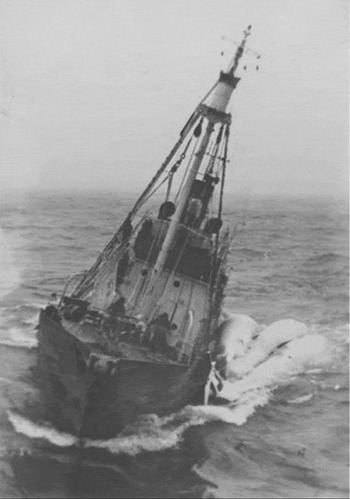
Icy winds, stormy weather, icebergs, a forest of whale spouts on that side or this – it all started to become familiar and unremarkable. The crews soon learned to handle the Antarctic. After taking on supplies of fuel and food, and receiving directions from Slava, the catchers would set off for the hunt (Fig. 3), spreading out from 100 to 200 nautical miles apart. Their base, Slava, would lie to and drift, maintaining constant radio contact.
Unidentified Slava catcher. Courtesy of Yurii Solocha.

It was a South Pole summer in the Antarctic.
At dawn on 29 January an impressive number of spouts was sighted at a great distance from the catchers. Their height gave an indication of the size of the whales. Some were as high as 12 to 15 metres.
At 8 a.m. the catcher Slava 3 set off after a pod. She reached them and started to pursue with her engines at full power. (Her Stakhanovite engineers, Lyapin and Guzeyev, kept steam right up to the mark throughout the chase.) The captain immediately decided to signal the mother-ship Slava, to let them know the hunt was on.
Then something extraordinary happened, something ridiculous too. As soon as Martinsen realised what the captain was doing, he ran up to him and started trying to persuade him ‘not to act so foolishly.’
‘We'll kill many whales, make plenty of profit, and the whalers will get lots of kroner. I know from experience. Don't do this. It will be better for us,’ he insisted.
There were chuckles around the deck. Laughing heartily one of the look-outs, Lustov, ran across to the Norwegian.
‘Oh you and your competition, all those kroner, all those profits. Look, we're not a private company. We've told you before but you still don't understand.’
And everyone started explaining again to the Norwegian why all Soviet whalers shared a common interest in killing as many whales as possible.
The catcher's top speed was 14.5 knots. We kept it up for a full 90 minutes in pursuit of that pod. We only gave up when the whale we picked out had reached a speed of 19 miles an hour. But then the whale began to falter too, and our ship drew close to the enormous animal as it alternately sounded and then surfaced again to take a breath. The animal laid on a display of spouting, huge pillars of water.
There were three enormous whales in front of our catcher. Sensing danger, they started diving frequently and changing their line of flight. We swerved about after them. The look-out, stationed at the masthead throughout, called out directions. The chase lasted a long time. In the end we managed to get within 120 metres of the pod. But even then all three whales stayed together as a group. That is their only defence against their enemy, the killer whale.
The whales were clearly exhausted. They were spouting often and had slowed down noticeably. In the end, by dint of our 15 knots of speed and by turning sharply to the left we managed to get within 45 metres of one of them. The crew were all at their posts and primed for action. A senior, experienced harpoon gunner stood by his weapon, ready to fire his deadly harpoon into the whale the moment it showed on the surface.
Firing a harpoon gun takes great skill. The complexity of the task is due to the fact that the whale only surfaces for four or five seconds to take a breath before it returns to safety by sounding deeply once again.
As soon as the whale showed its gigantic back the gunner fired. In an instant the huge harpoon, with its long hempline attached, struck deep into the animal's right flank . . .
With a dull rumble and some convulsive jerks on the rope the huge animal disappeared into the depths, pulling the rope by which it was held behind it. It struggled with all its strength to break free, but by now that was impossible. After the bomb had exploded, the mighty steel barbs of the harpoon were held fast inside it, causing fearful pain. The whale hauled so strongly on the rope that it was towing the catcher behind it, but even so it could not free itself.
In that situation whalers pay out their rope to 500 or 600 metres, and the boat, propelled by the towing power of the whale and its own screws, slowly follows the mortally wounded animal.
Suddenly the masthead look-out shouted that the whale had swerved to the left. A few minutes later there came some huge bloody spouts on our left-hand side. The bloody breaths of the wounded animal were up to 10 metres high.
‘This one won't get away!’ shouted the gunner.
‘No way,’ voices echoed from the deck.
Seeing the exhaustion of the wounded animal, the sailors began to haul in the hempline. The whale blew more and more bloody spouts, but kept slowly pulling on the strong hempline. There were more jerks and convulsive pulls on the line, and the whale managed to ‘get away’, so to speak, for the last time, to a distance of about 100 or 150 metres.
As it realises its peril, the animal bursts into a final sprint. It sounds, and before it surfaces again it tries to break the hempline with blows of its tail, or by swerving under the boat, but it is impossible for it to break the ‘reins’ which hold it back. The exhaustion of the mortally wounded creature is plain to see when bloody spouts come thick and fast, standing up from the ocean like red geysers.
Tired out and weak, the animal had no strength left. By now it was only 20 metres from the catcher. Because the first shot had not been completely successful, the gunner fired a second, final time. The huge finback lay spread out on the surface of the ocean, then it settled down into the water, motionless, with its belly turned up.
The whale was dead.
They haul it alongside, cut two holes near its tail and fasten it to our slings. They cut off part of the tail and throw it overboard, a gift to the sea.
Now the marine creature has been fastened alongside the catcher. The sailors blow a large hole in it with a grenade and then use a compressor to pump air into it. The body of the whale comes right out of the water, like a[n empty] barrel. They lash it with steel hawsers and tow it to the factory ship, Slava, which winches it on board. At that point they start processing the carcass. They render several tons of edible fat, manufacture high-quality canned food, and extract an edible flour from the bones. The valuable whiskers [baleen] are also removed.
{The natural history of whales; the whaling industry; ambergris}
In spite of starting late our whaling in the Antarctic continued successfully. At first Slava took at most four whales a day. Later the tempo of both the whaling and the processing picked up. Down there in the remote Antarctic the method of socialist labour – emulation – began to tell. From two to four whales a day, the number processed went as high as twelve, and the factory was getting up to 200 tons of fat per day.
The flotilla extended its whaling grounds. For the first time in Soviet history Slava led her catchers into Antarctic waters, that is, within 450 miles of the continent of the South Pole.
The area of the Antarctic Ocean which the catchers covered in February was about the same size as the Black Sea. It was more or less open to the winds on all sides and dangerous for navigation. Fierce gales, born in the high latitudes of the northern hemisphere, frequently drove mighty waves along the 20°W meridian from the shores of Greenland to the Antarctic. Huge storm-waves would reach the latitude occupied by gigantic icebergs, thus creating a serious obstacle for the catchers. [Rozhkov was describing the sea area south of the South Sandwich Islands and north of the eastern shore of the Weddell Sea and the adjoining Princess Martha Coast.]
The whalers laboured manfully under those new and complex meteorological conditions, but when storms made whaling impossible the catchers would lie to and take temporary shelter in the lee of icebergs. Those ice giants can reach a height of 200 metres above sea level. The winds and storm waves which arrive in the Antarctic from the tropics erode their cliffs into fantastic shapes. Fragments of berg would glitter in the southern sun like glass palaces on which hundreds or thousands of Antarctic birds had settled.
What made their work so hard for the flotilla crews was the depth of the water where they were hunting. Throughout the season there was never an opportunity for one of the ships to lie at anchor. But the helmsmen had the hardest time of all. Our magnetic compasses deviated under the exceptionally strong influence of the South [Magnetic] Pole. The only thing that worked was the gyro-compass on board Slava, with which the catchers had to keep in touch by radio.
By the end of February the flotilla was taking several tens of whales [a day]. Individual catchers had managed to kill from 30 to 45 each so far. By starting earlier, the flotilla would undoubtedly achieve a huge success in a future whaling season.
But even at the time we were doing well.
‘Your emulative competition gets much better results than our competition,’ remarked Martinsen. He was amazed when we paid one or other of the workers, sailors or whalers the great compliment of calling him a Stakhanovite. He could barely grasp the explanation that the toilers of our country are surrounded with esteem and respect, and that labour is a matter of honour, prowess and heroism with us.
‘With us people work because they need the money, and that's all there is to it. It seems to be different with you,’ he commented.
The Antarctic waters furnished us with an almost inexhaustible supply of whales. Their spouts continually adorned the horizon with a forest of geysers.
As March ended and April began we felt the breath of an approaching Antarctic winter. The temperature of the ambient atmosphere fell daily. The quantity of icebergs and pancake ice in sight went up, and the ships were increasingly at risk from sudden icing. The seamen donned their fur-lined clothing. On some days the surface of the sea was covered with a dense floor of ice floes, freezing together into a solid mass. Snow and sleet pelted the decks. The ferocious Antarctic winter was upon us. The number of whale spouts on the horizon began to drop. The main body of whales had departed for their homeland, the warm waters of Australia. It was time to leave, to call off the hunt!
The Soviet whalers had creditably fulfilled the target set by their Motherland. The ships of the Slava flotilla had scored the following splendid achievements. After killing 386 whales they had lowered 350,000 poods [5,698 metric tons] of high quality whale oil, about 16,000 poods [260 metric tons] of edible flour, and a quantity of baleen into their holds. [The Russian text was corrupted at this point, perhaps during typesetting, and the omitted words, underlined here, were restored from Rozhkov (Reference Rozhkov1948a).]
The quantity and value of products extracted can be judged from the following figures. To move them by railway would take more than 400 wagons. The flotilla had actually harvested an amount of edible fat equivalent to what could be rendered by slaughtering a line of large, well-nourished cattle for over 340,000 years!
In short, the sailors of the Slava flotilla had spared the workers on Soviet collective farms from having to slaughter their cattle, thus enabling them to go on increasing the national herd of the USSR.
Soviet whalers had successfully completed an amazing expedition to the Antarctic waters once sailed by the famous Russian explorer Bellingshausen. And so we set off home to our Motherland to bring her news of our achievements.
Until our next encounter, Antarctic!
The flotilla left the Antarctic with a rich catch and set course for the [South] Orkney Islands. We had almost reached them before the whole squadron emerged from the ice fields. We spent [the rest of] March and the first days of April pursuing and catching some isolated whales that were lingering there.
By 26 April we had reached Staten Island [Isla de los Estados], which is separated from Tierra del Fuego by an enormous strait. The uninhabited island, covered with a meagre tundra, proved to be a haven for birds. Their squalling could be heard from miles away as we approached. After a brief stop, during which we refuelled from the mother-ship, we headed for the eastern entrance to the Strait of Magellan, which we reached on 28 April. From the Strait the flotilla headed due east, on course for the Falkland Islands.
While still en route to the Strait of Magellan we had established two-way communications with the Soviet tanker Kremlin, which was heading to meet the returning flotilla. Arrangements had been made for Kremlin to rendezvous with us near the Falklands and to resupply us with fuel and food, as well as mail from home.
The Falkland (or Malvinas) Islands are situated near the southern tip of South America. They carry the marks of a harsh environment. A typical tundra has established itself, of the sort familiar to Soviet citizens anywhere around Murmansk or the Laptev Sea. But they do not yet cultivate frost-resistant cereals there. The coasts are cut by fjords. The highest summit, Mount Adam, reaches 700 metres above sea level. The only significant economic activities are cattle herding and the fur trade. There is an abundance of hardy tussock grass, a fodder which provides the staple diet of the local horned cattle.
The Falklands are one of the strongholds of British imperialism. They guard the sea routes around South America. The strategic significance of the islands is obvious. There is currently a legal dispute about their sovereignty between England and much weaker sealers from South America.
On the eve of the 1947 May Day holiday we had an unforgettable rendezvous there with the tanker Kremlin. A meeting to celebrate the holiday took place on Slava. All our radio sets were tuned to Moscow, whence the Motherland sent us her greetings and best wishes. For the first time ever the remote Falkland Islands heard from our loudspeakers the national music of the great Soviet Union, music which celebrates our good fortune, our joy and our freely given labours.
The whalers were handed letters from their families, newspapers and magazines from up to December 1946. We were very happy to get even such a ‘recent’ post as that. We completed supplies and, in the shelter of the islands, took a break from the constant tossing of the waves. Then we made ready to return to the Motherland along the eastern seaboard of South America. Taking leave of the crew of the Soviet tanker Kremlin, the flagship gave the order to raise anchor.
Before the expedition began, while the flotilla was still at Liverpool and we were taking urgent steps to equip the catchers with hempline, the special rope to which the harpoon is attached, the English had palmed off hundreds of metres of sub-standard rope on our flotilla.
That sly transaction by English businessmen, whom we paid honestly, had pernicious consequences. During the season in the Antarctic the rotten hempline snapped on us more than fifty times, with the result that some fifty badly wounded whales escaped.
During the voyage we had rather forgotten the matter, but now we were back in the roads of Gibraltar [21–24 June] everyone started talking about the duplicity of the English again. The Norwegian had warned us: ‘Those Yankees [sic] have no honour; you don't know them . . .’
No, we didn't feel like socializing with the English after that. As we passed under the walls of Gibraltar their flag evoked nothing but our contempt.
Moving on into the Mediterranean, the flotilla set course for Constantinople on 24 June 1947. As we travelled towards the Turkish port it came time to take leave of our new friend Martinsen. After whaling with us for several months you could honestly say that Martinsen had been re-born. He had sailed from England to the South Pole in almost total ignorance of the Soviet way of life. Even the simplest things, which every Soviet child understands, had seemed like fairy-tales to him.
We remembered how, when our whalers said to him, ‘Give us the benefit of your experience, Martinsen; teach us a thing or two.’ he would reply ‘No; there's no benefit for me in passing things on to you. That way hordes of people would soon be in the know.’
He really said that. But then the Norwegian came to our shipboard meetings and saw how we discussed the results of every successful hunt in the forecastle, how the wall newspaper was full of the subject. By now he knew what a Stakhanovite was, and the pride with which Soviet people spoke that word. By the end of the season the Norwegian also clearly understood the difference between Norwegian-style competition and Soviet ‘competition’, in other words socialist emulation.
When we reached Malta the Norwegian got his gear together and prepared to leave us and take passage home to Norway. The Oslo man looked in to our quarters for the last time and had a word with each of the crew. He promised faithfully to visit the Soviet Union some time. As he left, he thanked the whalers for their collective efforts.
‘When I get to Norway I'll be sure to tell them about your fine style of ‘emulative competition’. We haven't got anything like that, and perhaps it would be a good idea. Yes, there's quite a lot we don't have . . .’
He waved to us for a long time as the flotilla drew away from the shores of Malta.
Greetings, Motherland!
With long foaming wakes stretched out astern, the ships of the flotilla approach Odessa. The tranquillity of the Black Sea and the fine weather prompt us to relax, to dream.
Motherland! Odessa! City of sailors, city of sun and fruit. Now we can see thousands of Odessites on your shoreline. Behold, the wives, the children and the parents of the glorious whalers who are closing the shore of their Motherland with unprecedented riches from the remote Antarctic [on 6 July 1947].
From far out in the approaches we could see tens of white stripes stretching upwards to vanish in the sky. It was an effect of all the long blasts on their sirens with which Soviet ships, moored in the roads, were saluting the arrival of the first Soviet antarctic [whaling] flotilla.
Behind us lay a voyage of 54 thousand kilometres across seas and oceans.
‘Hail mighty Stalin, who educates our fearless Soviet sailors!’ came a roar from the welcoming crowd. And a rolling hurrah echoed out across the bay, amidst the hooting of tens of ships’ sirens.
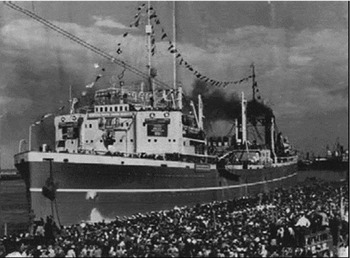
There were strong handshakes and warm kisses, followed by flowers, flowers, and more flowers (Fig. 4).
Odessa, the quayside welcome for the flotilla, c 1950. Courtesy of Yurii Solocha.

The welcome brimmed over into a demonstration of the love and dedication of the sailors for their Motherland and for the leader of its peoples, Comrade Stalin. The Slava flotilla was back home from a remarkably successful cruise, through which they had connected the inexhaustible riches of the waters of the Antarctic to the planned socialist economy of our beloved Motherland!
Acknowledgements
The credit for bringing Rozhkov's long forgotten article to light belongs entirely to his grandson, Yurii Solocha, who posted it on the Infoflotforum.ru website in December 2006. The author is also indebted to Mr Solocha for generously providing copies of the original publication, together with a biography and photographs of Pavel Rozhkov, and to Dag Børresen and Max Buhl for additional information. Any flaws in the translation or other defects of presentation are, of course, the responsibility of the author.