INTRODUCTION
In the recent literature, the genus Ocinebrina Jousseaume, 1880, is well represented by 17 species distributed throughout the Mediterranean and north-eastern Atlantic (Houart, Reference Houart2001; Bonomolo & Buzzurro, Reference Bonomolo and Buzzurro2006; Cecalupo et al., Reference Cecalupo, Buzzurro and Mariani2008): O. aciculata (Lamarck, 1822); O. buzzurroi Cecalupo & Mariani, 2008; O. carmelae Cecalupo, Buzzurro & Mariani, Reference Cecalupo, Buzzurro and Mariani2008; O. corallinoides Pallary, 1912; O. edwardsii (Payraudeau, 1826); O. erronea (Settepassi, 1977); O. helleri (Brusina, 1865); O. hispidula (Pallary, 1904), O. hybrida (Aradas & Benoît, 1876), O. ingloria (Crosse, 1865); O. inordinata (Houart & Abreu, 1994); O. leukos Houart, 2000; O. miscowichae Pallary, 1920; O. nicolai Monterosato, Reference Monterosato T. di Maria Marchese di.1884; O. paddeui Bonomolo & Buzzurro, Reference Bonomolo and Buzzurro2006; O. piantonii Cecalupo, Buzzurro & Mariani, Reference Cecalupo, Buzzurro and Mariani2008; and O. purpuroidea Pallary, 1920. Many of these species are known only for the Mediterranean Sea, while only 4 species were found only in the north-eastern Atlantic: O. inordinata has only been reported from the south-eastern coast of Madeira Island; O. leukos is endemic to Lanzarote Island in the Canary Islands; O. miscowichae and O. purpuroidea are recorded exclusively from Mauritania, West Sahara and Morocco. The most common and widespread species throughout the Mediterranean and north-eastern Atlantic are O. aciculata and O. edwardsii. Up until now these are the only two known species recorded for mainland Portugal (Nobre, Reference Nobre1938–1940; Macedo et al., Reference Macedo, Macedo and Borges1999; Houart, Reference Houart2001). As part of a characterization study of the marine submerged areas in the central Algarve region in south Portugal, sampling took place on rocky and submerged rocky bottoms between Vale do Lobo and Albufeira, at water depths ranging from 0 to 30 m (Gonçalves et al., Reference Gonçalves, Monteiro, Coelho, Afonso, Ribeiro, Almeida, Veiga, Machado, Berecibar, Oliveira and Bentes2004, Reference Gonçalves, Monteiro, Coelho, Afonso, Almeida, Veiga, Machado, Machado, Oliveira, Ribeiro, Abecasis, Primo, Tavares, Fernández-Carvalho, Abreu, Fonseca, Erzini and Bentes2007). From the samples taken, Ocinebrina nicola is herein reported for the first time from Algarve, south coast of Portugal. This record is also a new contribution for the biodiversity of the Portuguese and north-eastern Atlantic malacological fauna. We hereby present a short note with a brief description and the comparison with other congeneric species found in Portugal. Local information on geographical distribution and habitat is also given.
MATERIALS AND METHODS
The study of marine molluscs was part of a large scale project (RENSUB–CCMar) targeted to describe and map coastal biotopes (habitats and species) of the central Algarve coast in south Portugal, in the subtidal zone from 0 to 30 m depth between Anção and Galé, namely macroalgae, marine plants, benthic macroinvertebrates and fish communities. Within this geographical range, organisms were photographed, collected, identified and quantified in situ. Sampling was random, stratified by depth (0–10, 10–20 and 20–30 m) and 97 different stations were analysed seasonally between May 2003 and April 2006. Two indirect methods, beam trawl and Van Veen dredge were used in sand, shell and gravel bottoms. Visual censuses with direct sampling by SCUBA diving were applied in sand, shell and gravel bottoms as well as in rock and submerged rock bottoms. Samples taken were analysed and compared in the laboratory, and preserved in 98% alcohol solution. Ocinebrina nicolai is one of the 151 different gastropods species recorded during this study.
RESULTS
MATERIAL EXAMINED
Between August 2003 and March 2004, 16 live specimens and a few dead specimens were collected and studied. All specimens were sampled by the first author by SCUBA diving during projects ‘RENSUB I & II’ (Gonçalves et al., Reference Gonçalves, Monteiro, Coelho, Afonso, Ribeiro, Almeida, Veiga, Machado, Berecibar, Oliveira and Bentes2004, Reference Gonçalves, Monteiro, Coelho, Afonso, Almeida, Veiga, Machado, Machado, Oliveira, Ribeiro, Abecasis, Primo, Tavares, Fernández-Carvalho, Abreu, Fonseca, Erzini and Bentes2007) in several study sites: Pedra-do-alto, 6 specimens (37°03′30.3N 8°12′25.9W), 18–19 m deep; Malhada-do-gado, 3 specimens, (37°01′17.2N 8°02′48.6W), 14–15 m deep; Barrocas-de-fora, 2 specimens, (37°01′34.3N 8°04′6.0W), 17 m deep; Balancial-de-terra, 2 specimens, (37°03′16.9N 8°09′44.7W), 16 m deep.
Other material examined
Additional specimens were later sampled in the same study areas reconfirming the existence of established populations. Recent samples were obtained from a different location: 5 live specimens, Sagres, south-west Algarve, 18–24 m deep. Samples studied were also compared with specimens from a different geographical location, found outside the study area: Malaga (Alboran Sea, south of Spain).
DIAGNOSIS
Shell broadly ovate, fusiform, tuberculated and up to 14–16 mm in length. Spire high with 1.5 rounded protoconch whorls. Teleoconch composed of 5 convex whorls. Axial sculpture of last teleoconch whorl, consisting of 6 or 7 low ribs. Spiral sculpture composed of low primary cords well spaced by secondary cords. Aperture small, ovate, whitish with light pale pinkish-orange tan. Columellar lip smooth, glossy and adherent. Outer lip crenulate, with 5 strong well marked denticles within. Siphonal channel short, straight and sealed. Shell pale orange or light tan with whitish spiral threads. Animal cream with yellow tentacle tips.
DISTRIBUTION AND HABITAT
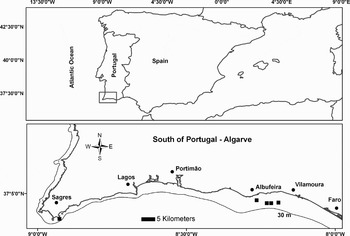
Specimens were collected in the south and south-west regions of the Algarve, south coast of Portugal, between Vale do Lobo and Albufeira and in Sagres respectively (Figure 1). Specimens from south Algarve were taken attached in crevices and fissures under incrusted rocks, mainly on rocky platforms or submerged/uncovered rocky bottoms during SCUBA diving surveys. Specimens from the south-west Algarve region were also sampled by SCUBA diving surveys in crevices on rock walls with incrusting algae (e.g. Mesophyllum lichenoides), false corals (e.g. Myriapora truncata) and brown algae cover (e.g. Halopteris filicina). So far this species has only been reported from a few localities in the Mediterranean: Gibraltar (United Kingdom); Ceuta and Malaga (Spain); Corsica (France); off Pianosa Island, Toscana, Sardinia and Lipari (Italy); and Oran (Algeria) (Houart, Reference Houart2001).
Location of the sampling sites (■) where Ocinebrina nicolai was found, between 14 and 24 m deep, Algarve, south Portuguese coast.

REMARKS
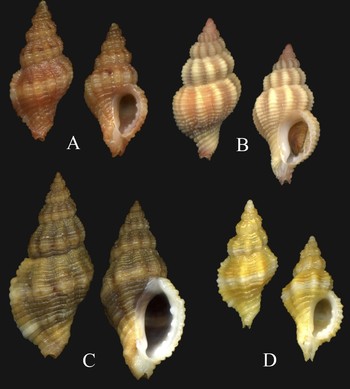
Ocinebrina nicolai (Figure 2A) can easily be separated from O. aciculata (Figure 2B) by animal soft parts as well as shell morphology. In the latter the animal is uniform vivid red-orange flecked with numerous yellow-white spots in contrast to a cream colour foot and yellow tentacle tips present in the animal of O. nicolai. Most obvious morphological differences between these two sympatric species are the shape of the protoconch, shorter and rounded in O. aciculata. The teleoconch spiral sculpture is also different, O. aciculata having similar cords, not alternated primary and secondary cords as in O. nicolai. On the other hand, O. nicolai resembles some forms of O. edwardsii (Figure 2C), one of the most common and variable European species, to which it is morphologically more closely related. In the studied area, O. edwardsii has a slender appearance, larger maximum size length (20–22 mm) and a light or dark brown coloured shell. In contrast to this, O. nicolai attains a maximum length size of 14–16 mm, having rounded teleoconch whorls and an orange or light tan shell with whitish spiral threads. Based on the axial sculpture of the last teleoconch whorl O. nicolai has 6 or 7 low ribs, occasionally with erratically placed varix while O. edwardsii, although highly variable, usually consists of 7 or 8 low rounded nodose ribs. The spiral sculpture in O. nicolai consists of low primary cords spaced by secondary cords. Primary and secondary cords are broader, wider and thicker in O. edwardsii and the distance between them is clearly much smaller than in O. nicolai. There is a fourth species of Ocinebrina (Figure 2D) found in Portuguese waters, that does not match satisfactorily the description of any other known species reported for the north-eastern Atlantic and that clearly differs from O. nicolai. It is currently studied by Bonomolo et al. and new information about this taxon will soon be published.
(A) Ocinebrina nicolai Monterosato, Reference Monterosato T. di Maria Marchese di.1884, 11.64 mm, Balancial-de-terra south coast of Portugal, 17 m deep; (B) Ocinebrina aciculata (Lamarck, 1822), 16.86 mm, off Burgau, south coast of Portugal, 45–60 m deep; (C) Ocinebrina edwardsii (Payraudeau, 1826), 20.70 mm; Ilha de Faro, south coast of Portugal, 2–3 m deep; (D) Ocinebrina sp., 14.13 mm, off Ponta da Piedade, 50–60 m deep.

DISCUSSION
It seems that O. nicolai is well established in Algarve, south coast of Portugal hence specimens have been regularly sampled in several rocky locations at bathymetric depths ranging from 14 to 24 m. Throughout its distribution range in south Portugal it occurs sympatrically and in a similar habitat to the congeneric species O. edwardsii and O. aciculata from which it clearly differs. Ocinebrina nicolai has no conservation status in the Mediterranean and north-eastern Atlantic but the environments where it was sampled in south Portugal are part of a national ecological marine reserve. Up until now, the only known records for the species are from a few scattered localities within the Mediterranean (Monterosato, Reference Monterosato T. di Maria Marchese di.1884; Houart, Reference Houart2001). We hereby widen its distribution range in the north-eastern Atlantic by reporting this species for the first time from the Algarve and setting its most western occurrence in European waters. Future studies and new samples may prove that this species may well have a larger distribution throughout its geographical range.
ACKNOWLEDGEMENTS
The authors gratefully acknowledge the following persons: Franco Gubbioli (Marbella, Malaga, Spain) and Roland Houart (Landen, Ezemaal, Belgium) for their valuable suggestions related to the subfamily Ocenebrinae; C. Coelho, C. Almeida and D. Abecasis from The Coastal Fisheries Research Group (Projects ‘RENSUB I & II’, CCMar, Universidade do Algarve, Faro, Algarve, Portugal) for cooperation and technical support; CCDR-Algarve (Proalgarve) and ARH-Algarve for the financial assistance. We would also like to thank the referees for their constructive reviews and useful comments and suggestions.