INTRODUCTION
Over a decade of scholarship on language and social relations has invited us to rethink concepts such as language, identity, community, context, and contact (Wortham Reference Wortham2006; Agha Reference Agha2007; Blommaert & Rampton Reference Blommaert, Rampton, Arnaut, Blommaert, Rampton and Spotti2015). This work invites us to see contact with strangers or with those who do not share similar semiotic repertoires or histories of socialization as the default human condition. Some of this scholarship has increasingly focused upon commentaries about contact, especially those that police, create, and reproduce norms around a host of different social practices, while coining new terms for referring to this phenomenon. These include diversity talk (Faudree & Schulthies Reference Faudree and Schulthies2015), knowledging (Goebel Reference Goebel2015), and linguascapes (Dovchin Reference Dovchin2018). This article seeks to extend this conceptual work through reference to work on reflexivity, especially work that enables us to see how commentaries about contact value certain semiotic configurations (Agha Reference Agha2007). One of the main critiques that I offer here, is that the above-mentioned terms do not differentiate participation frameworks. For example, diversity talk presupposes small participation frameworks and a focus on oral forms of discourse, even though many who use the term diversity talk focus on large participation frameworks that are institutionally inter-connected and authorized. In building on this work I offer the term contact discourse.
Contact discourse refers to the multitude of participation frameworks that are the focus of contemporary sociolinguistic work, while not presupposing orality. Contact refers to any form of human contact, while highlighting the point that all social life is characterised by contact with those who are not exact copies of ourselves with exactly the same communicative repertoires. Here the term contact presupposes some discursive work to establish social sameness and/or difference (Bucholtz & Hall Reference Bucholtz and Hall2004). This discursive evaluation polices language practices. Discourse refers to face-to-face talk as found in canonical works on contact discourse (Gumperz Reference Gumperz1982; Rampton Reference Rampton1995), as well as that which focuses on other forms of communication. The term discourse thus refers to semiotic analysis in linguistic anthropology (Agha Reference Agha2007), work in critical disourse analysis (Wodak, Kwon, & Clarke Reference Wodak, Kwon and Clarke2011), and work on multimodal discourse analysis (Norris Reference Norris2004; Dovchin Reference Dovchin2018).
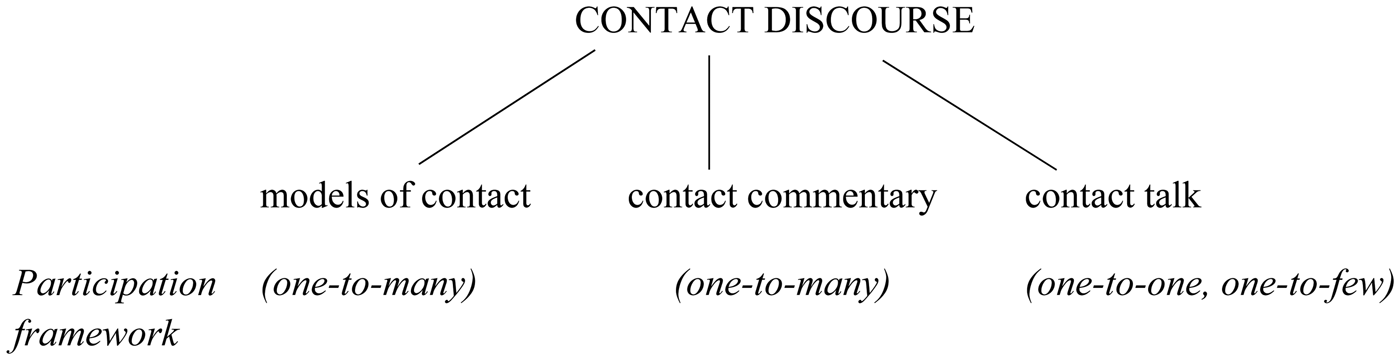
Having lumped together a whole host of discursive practices under the rubric of contact discourse, I then propose three terms to cover some of the main types of contact discourse, while also keeping in mind the connections between them. All of these terms continue to refer to discursive practices that police, create, and reproduce normativities around social practices. The first is models of contact. This term focuses on how multimodal representations of contact in one-to-many participation frameworks, such as television and radio broadcasts and classrooms, project normativities around contact as well as sociolinguistic boundaries. In this participation framework, the multimodal representation represents the ‘one’, while the viewers, listeners, and readers represent the ‘many’. Such models engender a second type of contact discourse that I refer to as contact commentary. Contact commentary refers to written evaluative commentaries we find in one-to-many participation frameworks, such as newspapers, online newspapers, and blogs. In contrast to projecting normativities around contact and sociolinguistic boundaries, contact commentaries evaluate and police them.
The third one is contact talk. This refers to the multiple semiotic resources used to make meaning in face-to-face talk in contact situations and their connection with resources from other chronotopes. This term covers much the same ground as the above-mentioned concepts (i.e. diversity talk, knowledging, and linguascapes), as well as semiosis (Agha Reference Agha2005), truncated competence (Blommaert Reference Blommaert2010), polylanguaging (Jørgensen, Karrebæk, Madsen, & Møller Reference Jørgensen, Karrebæk, Madsen; and Møller2011), translanguaging (Wei Reference Wei2018), metrolingualism (Pennycook & Otsuji Reference Pennycook and Otsuji2015), and transglossia (Sultana Reference Sultana2015). A common theme to this work is their focus on how multiple semiotic resources are recontextualized to make meaning in situated interactions. What I focus on here, however, is the need to also examine how reflexive talk polices sociolinguistic boundaries in small participation frameworks. In what follows, I expand on each of these working definitions drawing mainly on examples from Indonesia.
CONTACT
While much of the earlier sociolinguistic scholarship on contact worked from a perspective that viewed contact as contact between named languages and/or speakers of different ethnolinguistic groups (Le Page & Tabouret-Keller Reference Le Page and Tabouret-Keller1985; Myers-Scotton Reference Myers-Scotton1993), forty or so years of research on talk-in-interaction suggests that most situations can be classified as contact situations (Tannen Reference Tannen1984; Bucholtz & Hall Reference Bucholtz and Hall2004; Blommaert & Rampton Reference Blommaert, Rampton, Arnaut, Blommaert, Rampton and Spotti2015). This is so for two reasons. First, people are rarely, if ever, exact replicas of each other in terms of their trajectories of socialization (Wortham Reference Wortham2005), and the semiotic resources that they have appropriated along the way. Accordingly, in any interaction the meaning of resources used emerges through their re-use or recontextualization in interaction (Bauman & Briggs Reference Bauman and Briggs1990; Agha Reference Agha2007; Lempert Reference Lempert2014). Second, contemporary infrastructures for mobility and connection have increased the probability of contact with those who share very few semiotic resources (Blommaert & Rampton Reference Blommaert, Rampton, Arnaut, Blommaert, Rampton and Spotti2015). In line with Blommaert & Rampton (Reference Blommaert, Rampton, Arnaut, Blommaert, Rampton and Spotti2015), we can thus start with the assumption that contact is the default human condition.
If contact is the default human condition, then one way of understanding social relations in these encounters is to examine comments about such encounters for discourses about sameness and difference. These discourses help to organize social life, while being organized, mediated, and understood in situ through reference to other processes and semiotic resources from other chronotopes. Put slightly differently, these discourses about diversity are commentaries that reflexively frame the value of social practice as it unfolds or after it unfolds. Examples of both can be found in abundance if we examine studies of talk in small participation frameworks, especially work on conversational narrative and gossip that pay attention to talk about unexpected events and how they are used to (re)produce and project normative social practice (Ochs & Capps Reference Ochs and Capps2001; Georgakopoulou Reference Georgakopoulou2007; Besnier Reference Besnier2009).
Within larger institutionally authorized participation frameworks, such as school classrooms (Karrebæk Reference Karrebæk, Arnaut, Karrebæk, Spotti and Blommaert2016), asylum interviews (Jacquemet Reference Jacquemet2015), and courtrooms (Eades Reference Eades2008), the normativization of social practices are also achieved through commentaries about contact. Often such commentaries are connected to other participation frameworks that use some parts of these commentaries to help formulate policy, train officials, design curriculum, and so on. In short, these chains of authorized reflexive commentaries about diversity police and value social practices as part of ongoing processes of enregisterment (Agha Reference Agha2007). As mentioned, these discourses of diversity have recently been referred to as diversity talk (Faudree & Schulthies Reference Faudree and Schulthies2015), knowledging (Goebel Reference Goebel2015), and linguascapes (Dovchin Reference Dovchin2018). We examine each of these concepts below as we look at how the talk that occurs in contact settings has been reconceptualized over the last twenty-five years.
TALK-IN-CONTACT SITUATIONS
Work on language ideologies and mixed language practices has invited us to reconceptualize this thing called language (Alvarez-Cáccamo Reference Alvarez-Cáccamo and Auer1998; Agha Reference Agha2007; Blommaert & Rampton Reference Blommaert, Rampton, Arnaut, Blommaert, Rampton and Spotti2015). Work on language practices in contact settings has questioned the brought-along notions of language as pure, bounded, nameable, and unproblematically linked to territorially bound groups of native speakers. Some of the most robust critiques have been from those who take conversation analytical (CA) approaches to talk-in-interaction (Auer Reference Auer, Milroy and Muysken1995; Gafaranga & Torras Reference Gafaranga and Torras2002), and/or those who have combined CA-inspired analysis with ethnography and social theory (Alvarez-Cáccamo Reference Alvarez-Cáccamo and Auer1998; Meeuwis & Blommaert Reference Meeuwis, Blommaert and Auer1998; Rampton Reference Rampton and Auer1998). Concerns about the nature of language and/or unwittingly equating codes with bounded languages and thus codeswitching as the use of two bounded codes generated a flurry of conceptual work. Typically, these new concepts referred to the practice of alternation between different sets of semiotic resources, while often also proposing a rethink of notions of language and communicative competence.
These concepts included semiosis and competence to comprehend (Agha Reference Agha2005, Reference Agha2007), superdiverse repertoire (Blommaert & Backus Reference Blommaert and Backus2011), and orders of indexicality (Blommaert Reference Blommaert2010), as well as some mentioned earlier—truncated competence (Blommaert Reference Blommaert2010), polylanguaging (Jørgensen et al. Reference Jørgensen, Karrebæk, Madsen; and Møller2011), metrolingualism (Pennycook & Otsuji Reference Pennycook and Otsuji2015), translanguaging (Wei Reference Wei2018), knowledging (Goebel Reference Goebel2015), transglossia (Sultana Reference Sultana2015), and linguascapes (Dovchin Reference Dovchin2018). A common theme in much of this work is that meaning is emergent and constructed through the imitation of semiotic resources from other chronotopes. In line with a long history of work in linguistic anthropology and linguistic ethnography (Duranti Reference Duranti and Duranti2009), many of the proponents of these concepts also argue that to understand this thing called language, we need to combine close analysis of the discursive work found within particular participant constellations with participant-observation of participants’ social life, both on-line and off-line. In short, we need to understand their trajectories of exposure to different semiotic resources.
Another theme that emerged in some of this work (Agha Reference Agha2007; Blommaert Reference Blommaert2010; Goebel Reference Goebel2015; Dovchin Reference Dovchin2018), or as a response to it (Faudree & Schulthies Reference Faudree and Schulthies2015; Lee Reference Lee2017), was the importance of understanding evaluative processes. For example, Agha (Reference Agha2007) invites us to see how different participation and authorization frameworks contribute to valuation processes (i.e. enregisterment) and to the production and circulation of semiotic constellations that are recognizable by wider segments of a population (i.e. semiotic registers). Blommaert (Reference Blommaert2010) invites us to understand why some semiotic registers have more social value than others (referred to earlier as orders of indexicality). While some more programatic work invites us to move beyond evaluation, especially in the context of teaching English (Lee Reference Lee2017), other work delves into the relationship between infrastructures and evaluative processes (Goebel Reference Goebel2015; Dovchin Reference Dovchin2018).
For example, Dovchin (Reference Dovchin2018) argues that in order to understand mass-mediated discursive evaluations of youth language practices, we need to incorporate ethnographically sensitive work with understandings of how discursive evaluation relates to other domains and infrastructures referred to as scapes. Goebel's (Reference Goebel2015) work focuses on how processes of enregisterment in one-to-many participation frameworks engendered evaluative practices in smaller participation frameworks.
A special issue on diversity talk focuses to a greater or lesser extent on how discourses about diversity help to create, police/manage, and reproduce ideas about what are normal and socially valued interactional practices (Faudree & Schulthies Reference Faudree and Schulthies2015), although the papers in this collection focus on quite different participation frameworks and frameworks of authorization. For example, in Moore's (Reference Moore2015) paper, diversity talk refers to institutional discourses about diversity. Such discourses manage diversity via institutionally authorized commentaries that (re)create boundaries around named languages and the communities that are imagined to speak them. These commentaries are found in institutional policies and in documents that cite discussions about these policies.
Brink-Danan (Reference Brink-Danan2015) examines diversity talk in the form of religious institution policies and working papers. At the same time, diversity talk is used to describe commentaries from informal interactions—such as the commentary made by a religious leader involved in interfaith dialogues projects ‘London isn't a British city anymore’ (Brink-Danan Reference Brink-Danan2015:47)—as well as longer narratives about experience that were provided at an interfaith communication workshop (Brink-Danan Reference Brink-Danan2015:48). In Faudree's (Reference Faudree2015) paper, diversity talk mainly refers to commentaries about sameness, difference, and belonging among small participant constellations in online forums. The term is also used to refer to conversations about diversity in a market (Faudree Reference Faudree2015: 40–41). In Schulthies (Reference Schulthies2015) paper, diversity talk is used to refer to both face-to-face talk and how media professionals’ practices contribute to creating, valuing, and policing models of diversity on televised talent contests.
In sum, much of the scholarship that focuses explicitly on talk-in-contact situations has moved from a focus on language practices (e.g. polylanguaging, translanguaging, and metrolingualism) to a focus on the evaluation of talk in contact situations (e.g. linguascapes, knowledging, transglossia, and diversity talk). While the increasing focus on evaluation offers exciting new directions, these terms cover quite different participation and authorization frameworks, and the term diversity talk presupposes orality even though one-to-many participation frameworks are covered by this term. Here I propose an alternate cover term, contact discourse, that covers evaluative practices in contact settings in general, while also proposing the three concepts mentioned in the introduction—models of contact, contact commentary, and contact talk—that take into account different participation frameworks (see Figure 1). In what follows, I provide some data to further outline the semiotic scope of these different types of contact discourse.
Contact discourse.

MODELS OF CONTACT
Models of contact are multimodal representations of contact that are circulated in one-to-many participant frameworks (e.g. television, radio, novels, comics, and online). Models of contact project normativities around contact as well as sociolinguistic boundaries. In the case of novels (as in excerpt (1) below), multimodality is achieved via meta-pragmatic commentaries about multimodality, rather than the representation of the multiple visual and aural signs we find on television, the radio, and online. In addition to occurring in one-to-many participation frameworks, many models of contact have quite different frameworks of authorization to contact commentaries and contact talk.
Models of contact found on television, the radio, novels, or in classrooms are often authorized by chains of agents acting for the nation-state or other powerful interests (e.g. media organizations, multinational companies, multinational organizations such as the United Nations, the International Monetary Fund, and so on). This is often done remote to the actual model of contact and is achieved via direct or indirect means such as teacher intervention, policies, or incentives. This contrasts with contact commentaries and contact talk, which are typically authorized locally, although they can also be connected to other frameworks of authorization. While any representation of contact would suffice to exemplify what I mean by models of contact, below I focus on the modelling of ethnic personas and ethnolinguistic boundaries in novels and on television in Indonesia. In doing so, I also point out how imitation links these sign configurations with other chronotopes.
Excerpt (1) is drawn from the colonial short story Si Doel Anak Betawi ‘Doel a Betawi’ (Aman 1932/1971). The novel is written by a mobile Indonesian, Aman, who, after migrating to Jakarta from one of Indonesia's large islands, Sumatra, takes up a job with the Dutch colonial publisher Balai Pustaka. During his stay in Jakarta, Aman begins writing about his own experiences and observations of contact in colonial Jakarta. He was especially fascinated by the different lifestyle and social practices of his new neighbors, and noted that the source of his story were observations of one of his neighbor's children and their language practices. Indeed, contact is a central feature of this story. Aman (1932/1971:5) specifically notes in his foreword to the short story that the dialogue involving the hero of the story, Doel, was in what he termed ‘Betawi language’, and that he did this as a way of acquainting readers from outside of Batavia (now Jakarta) with the language of the Betawi community. In doing so, he also anchors characters to territory through reference to birth or reference to their status as original inhabitants of a neighborhood, and all are represented as speaking in Betawi.
In this case, Aman (1932/1971) was imitating ideas about the association between linguistic forms, social types, and territory that had been authorized through colonial administration processes within schools and the bureaucracy since European contact with Indonesians (Errington Reference Errington2001; Moriyama Reference Moriyama2005). His introduction, and the story as a whole, also distinguished a local named language (Betawi) from a colonially authorized one, Malay. Excerpt (1), for example, is part of Doel's account of his first day at school.Footnote 1
(1) Modelling contact in colonial short stories (Aman 1932/1971:104)
Abdi gaduh adi tilu, entjik ‘I have three siblings, miss’ (to the teacher)
In this account, Doel tells his parents that the other kids at school are from other ethnic groups (Aman 1932/1971:102–105). The hero of the story, Doel, also talks of these kids using Indonesian with a Sundanese accent, while also reporting the Sundanese talk (in bold) of a Sundanese female student when speaking with her Javanese teacher in the class. This discursive work thus meta-pragmatically frames the interaction as one of contact, while also providing an example of the talk found in such contact settings. In this short story, meta-pragmatic commentary not only projects contact zones and ethnolinguistic boundaries, but it also laminates the personas that inhabit these contact zones with particular demeanors, predispositions, and religious convictions. In this case, those modelled as Betawi are represented as pious Muslims, not predisposed to formal state education, and unable to control their emotions, especially anger.
As with other short stories that model contact, Aman's novel has been imitated in a number of social domains, including feature length films, soap operas, and commentaries about these representations, as in excerpt (2). Excerpt (2) is from a television soap opera, Si Doel Anak Sekolahan ‘Doel an educated lad’, that first aired in 1992 in Indonesia. It ran for seven seasons in total and regularly represented contact between those of different faiths, ethnicities, social class, gender, generation, and education. Excerpt (2) is an extract from the third season, which aired in 1998. This extract is of talk between two of the central characters, Karyo, a migrant from Central Java, and Mandra, a local Betawi and the uncle of Doel. In contrast to Doel, who is represented as successfully finishing tertiary education, Mandra is represented as having little education and being illiterate. Mandra is also represented as being unable to control his emotions.
In the lead up to this scene, both have had a bad day; Mandra's marriage proposal was rejected, and Karyo could not get a loan to pursue a business venture because his identity card still showed that he did not live in Jakarta. Up to this point, Karyo does all of the talking. Mandra just nods his head, while looking down at the ground. This bit of talk occurs after Mandra gives his identity card to Karyo, which as Karyo points out, has expired. I have drawn upon annotation conventions found in interactional sociolinguistics to represent this talk.Footnote 2
(2) Televised models of contact (Source: Karno Reference Karno1998)


There are a number of points of interest here. First, we have a representation of an inter-ethnic encounter where we see Mandra being represented as understanding bits of Javanese (in bold) in lines 4, 7, and 11. In the extended dialogue, not reproduced here, Karyo is also represented as understanding bits of Betawi (in bold small caps) of the type found in lines 17–19 and 23. This sits in contrast to national ideology that Bahasa Indonesia ‘Indonesian’—the constitutionally defined official language of the nation-state—would be used in such contact situations. Thus, part of the model of contact being projected here is a counter-model to the national narrative of what should happen in such contact zones. Second, this representation also projects ethnolinguistic boundaries, in this case, between those who are Betawi and those who are not (lines 16–20).
Third, the representation of this contact situation includes multiple modes, such as a movement from initially slow speech by Karyo to fast speech by both (indicated by a > surrounding an utterance), the raising of the volume of speakers’ talk relative to their earlier talk (indicated by a + surrounding an utterance), the use of touch, as well as facial expressions, and so on. When considered together with the discursive actions described above, this points to the modelling of two ethnic personas who are unable to control their emotions. The representation of Mandra as ethnically Betawi is congruent with chronotopes inhabited by hot-tempered Betawi figures modelled in Aman's (1932/1971) short story.
In the above two excerpts, connections to other chronotopes that model contact are achieved via the imitation of multiple signs, including language practices, descriptions of territory, meta-pragmatic framing of someone as Betawi, and so on. In line with Agha (Reference Agha2007), such chains of imitation increase the recognizability of particular personas or figures of personhood. In doing so, such representations also produce some of the language ideological bases that engender contact commentary.
CONTACT COMMENTARY
Contact commentaries refers to primarily written commentaries found in one-to-many participation frameworks, although such commentaries can also include the use of memes and icons in social media and SMS texts as described by Blommaert & Varis (Reference Blommaert and Varis2015), Velghe (Reference Velghe2015), and others. Like the comments we find in conversational narratives and gossip (Ochs & Capps Reference Ochs and Capps2001; Georgakopoulou Reference Georgakopoulou2007; Besnier Reference Besnier2009), these commentaries are typically about contact with some unexpected social practice, person, or event. Like all contact discourse, the basis of these expectations are language ideologies (Woolard Reference Woolard, Schieffelin, Woolard and Kroskrity1998; Kroskrity Reference Kroskrity and Kroskrity2000), or ways of thinking about language and social relations that have solidified as part of a person's trajectory of socialization (Wortham Reference Wortham2005). Below I provide two examples of what I mean by contact commentary (excerpts (3) and (4)). Excerpt (3) relates to excerpt (2) because it is a commentary about a model of contact found on television, while excerpt (4) relates more generally to notions of ethnolinguistic personhood.
Excerpt (3) is a commentary about character representations in the televised soap, Si Doel Anak Sekolahan ‘Doel an educated lad’ (see excerpt (2)), but it is unclear which season or episode the comment relates to. This excerpt is part of a commentary published in 2003 in the online version of the Indonesian newspaper, Kompas (CAN/NIC/ARN/XAR 2003). In commenting on this soap, the author not only comments on contact via marriage, but he also distinguishes between different ethnic groups. This helps imitate ideologies that link language to place and community.
(3) Commenting on representations of contact

In this excerpt, Ardan evaluates the ethnic-ness of representations in the television comedy. This is discursively achieved through a number of comparisons about sameness and difference (indicated by a double underline followed by superscripts 4, 7, 11, and 13), and evaluations (3, 14), while also (re)linking these to features associated with ethnic identity including accent (9), territory (1, 6, 8), and the social relationships of siblingship and spousal-ship (2, 12). In terms of frameworks of authorization, Ardan's commentary presupposes some form of belonging to Betawi-ness, while its animation in a well-regarded weekly online magazine, Kompas, can be seen as authorizing this commentary and claim to Betawi-ness.
This commentary is about contact between two characters, Mandra and Aminah Cendrakasih. It values the correct links being made between territory, linguistic form, and ethnic group. At the same time, this commentary provides insights into which settings are considered contact settings and which are not. By commenting on the imitation of emblems of personhood found in another chronotope, this commentary polices contact, ethnolinguistic boundaries, and ideas about what semiotic configurations constitute such boundaries. In doing so, this commentary also reproduces links between language practices, identity, and territory that have a long ideological history in Indonesia (e.g. as pointed out in relation to excerpts (1) and (2)). These types of chains of reflexive commentaries that link language practices to identity and territory are quite common in Indonesia, and are also recontextualized in the service of larger political discourses, as in in excerpt (4).
Excerpt (4) is part of an ongoing discussion about separatism in Indonesia (for a fuller treatment of this issue, see Goebel Reference Goebel, Kroon and Swanenberg2019)—in this case, the formation of a new province, Cirebon, in the West Java province of Indonesia's most populous island, Java. The excerpt is taken from a blog published on March 30, 2008 (Elgibrany 2008).
(4) Contact commentary and territorial formation

The import of the commentary in excerpt (4) is how it compares and thus values cultural difference (lines 1–2) by linking it with territorial difference. For example, the new proposed province would not be able to include two of the five districts, in this case the districts of Kuningan and Majaelengka (lines 7–9). Note too, that this valuing of territory as a cultural emblem is linked to another descriptor, Sundanese (line 10), which, according to the commentator, is part of the cultural difference that makes reterritorialization something that not all would accept (lines 6–8).
While separatism in West Java has its own discursive history, so too do labels linking cultural essence to territory (as noted in relation to excerpts (1)–(3)). Here, the label Sundanese is part of an older semiotic configuration that is also tightly associated with language. In this case, it emanates from colonial times (Goebel Reference Goebel2015). This indexical association with Sundanese language practices represents a base for discursive comparison and indeed enables such comparisons. At the same time, this discursive work also reproduces and projects cultural and linguistic boundaries—Sundanese and non-Sundanese.
The above two examples focus primarily on the policing of ethnolinguistic boundaries, but the idea of contact commentaries refers to policing of any type of boundary via similar types of evaluative discursive work. Like models of contact, contact commentaries are circulated via one-to-many participation frameworks. This contrasts with contact talk where the modality can be talk or sign language and where the participation frameworks are often one-to-one or one-to-few.
CONTACT TALK
When nuanced understandings of talk in social life are required, we know that delineating ‘everyday talk’ from ‘conversational narrative’ or ‘interviews’ from ‘conversational narrative’ and ‘everyday talk’ is not straightforward (Briggs Reference Briggs1986; Georgakopoulou Reference Georgakopoulou2007; De Fina & Perrino Reference De Fina and Perrino2011). While I thus resist delineating different forms of talk, my definition of contact talk does draw upon insights from work on narrative and gossip (Ochs & Capps Reference Ochs and Capps2001; Georgakopoulou Reference Georgakopoulou2007; Besnier Reference Besnier2009). In particular, I define contact talk as talk about human contact that consists of accounts of what is expected during contact. These accounts function to value or devalue the practices and participants in the account, while policing social practice.
Such accounts receive uptake by other participants in the form of agreement about what is unexpected, while also containing other accounts, such as accounts of what is normal, sanctions, the benefit of contact, and so on. This evaluative work also enables evaluators to discursively construct themselves as insiders and those who engage in unexpected practices as outsiders. Understanding contact talk requires us to link these accounts to other ethnographically recoverable information. This can include (i) the impact of these accounts on the social life of those providing them, as well as on those who become the objects of such accounts, and (ii) the connections between these accounts, other contact talk, and models of contact. In what follows, I move from a ‘simple’ case (excerpt (5)), to more complex ones (excerpts (6)–(7)). The former is classified as simple only because of my incomplete interpretive work on the connections between this chronotope and others (Goebel Reference Goebel2020).
Excerpt (5) is an example drawn from a fieldwork interview that I conducted in the late stages of a larger project on language and social relations in the Indonesian civil service (Goebel Reference Goebel2007, Reference Goebel2014). This project included five months of sustained participant-observation and recording of interaction both in an office within the same government building, as well as in settings outside of the office involving those with whom I was working. In this interview with two career civil servants, Pak Gatot and Pak Wisnu, I was interested in finding out whether and to what extent my observations of interviewees’ interactional practice matched their ideologies about contact amongst colleagues in the office.
As a semi-structured interview, many of my questions were in response to our ongoing talk, and my earlier observations of and participation in office life. At the time, I was not concerned with matters of contact commentaries. Even so, a look at my interview corpus shows many instances of such commentaries; excerpt (5) is just one example. In the lead up to this piece of talk, Pak Gatot has just explained that symmetrical exchange of ngoko Javanese is possible and often happens between him and his boss, Pak Ismail, because they have known each other for nearly twenty years.
(5) We don't speak Indonesian to friends

In the above excerpt, Pak Gatot points out that using Indonesian in contact with colleagues would be interpreted by others as unexpected (lines 1–4), and indexing a social relationship lacking closeness (lines 4–6). This comment also receives uptake by Pak Wisnu in line 7. In this excerpt Pak Gatot frames social value as policed by Pak Wisnu and others’ commentaries (lines 2–4 and 9–12). In this case, what is not valued in interaction amongst colleagues is the use of Indonesian because of its association with social distance. In talking about norms for communication in conditions of contact, these participants also project norms for future encounters (i.e. use ngoko Javanese if you want to perform closeness and Indonesian if you do not). These norms align with ones that they both have encountered as part of their trajectories of socialization.
In particular, in the thirty or so years prior to my fieldwork, nation-building infrastructures had constructed Javanese as the language of co-ethnic communication, and Indonesian as the national language and language for communication among strangers and ethnic others (Errington Reference Errington1998; Goebel Reference Goebel2010). As part of this process, as well as in everyday situations of contact, one variety of Javanese, ngoko Javanese, had become indexically associated with everyday interactions amongst family, kin, friends, and colleagues, while the practice of using Indonesian became ideologically associated with strangerhood, authority, political power, knowledge, and socioeconomic mobility. Along with the type of ethnographically recoverable information that I discuss in relation to excerpt (6) below, knowledge of these nation-state regimented associations also comes into play in other settings.
Excerpt (6) represents talk from a women's meeting in an urban ward of Semarang, Indonesia where I lived and conducted fieldwork between April 1996 and July 1998 (Goebel Reference Goebel2010). A ward consists of roughly eighteen to twenty-four families who typically live on the same street. In addition to being inhabited by people with a wide range of educational, economic, and religious backgrounds, most members of this ward were mobile Indonesians who moved every two to five years on average. This ward was located in an ethnic homeland of Javanese speakers, but inhabitants came from both central and peripheral Javanese speaking areas, as well as a number of Indonesia's four hundred or so ethnolinguistic areas. I have put an asterisk after the names of neighbors who self-identified as non-Javanese to distinguish them from those who self-reported or were reported by others as Javanese.
This excerpt is drawn from a two-hour-long recording of a ward meeting recorded in July 1996. At this meeting, there were thirteen attendees. They represented thirteen out of the twenty-three households in this ward. These meetings functioned as a forum to disseminate government development policies, gather and disseminate co-operative finance, gather and distribute funds for the upkeep of ward infrastructure and health initiatives, for socializing, and importantly for the analysis presented here, to create, police, and (re)produce norms for social practice in this ward. This talk occurs after discussion about who had and had not paid contributions towards the upcoming Independence Day celebrations in this ward. Bu Abdurraham* had only started living in the ward four months earlier, and the other three ward members had lived in the ward for several years. All habitually interacted in other ward contexts (Goebel Reference Goebel2010), including attending these monthly meetings. Bu Naryono, the most vocal in the meeting, was also the head of the women's group.
(6) Policing neighborly conduct (BuA* = Bu Abdurrahman*; BuNu = Bu Nurholis; BuS* = Bu Sumaryono*; BuNa = Bu Naryono)

The import of this excerpt is that from line 6 onwards we see that Bu Nurholis, Bu Naryono, and Bu Sumaryono* jointly construct what is seen as normative practice in this ward through an account of an unexpected event. In this case, it is nonattendance at monthly meetings and the nonpaying of contributions toward upcoming celebrations (lines 5–9). The social value of attendance is framed in terms of how attendance relates to having friends (lines 10–11). Put slightly differently, through the positioning of Bu Tobing* as non-normative or deviant, those doing the positioning are inferring that they themselves are persons who do not belong to this category. As such, we not only have the situated construction of a deviant social type, but we also have the emergence of the opposite social type, namely those who are considered nondeviant or belong in this ward context. If we examine all of the talk in this meeting, then we see the beginning of a neighborhood voice about an emergent ward normativity. This includes how one should interact with neighbors, including the facial expressions one should use upon contact, how regularly one should attend meetings, and as we see later in excerpt (7), the language one should use.
By focusing on how these different identities emerge in this interaction, we can see that participants are engaging in the social pursuit of sameness and difference (e.g. we think about this person in the same way, we are different to this deviant person by way of actually attending meetings and making financial contributions). The social pursuit of sameness and difference is also achieved through the minutiae of interactional performance. In this case, it is achieved via a chain of repetitions that occur after Bu Abdurrahman's* query about where one of several meeting absentees lives. These repetitions have a copy of others’ talk nggak pernah datang ‘never attends’ (lines 6–10), together with a response with some new information from lines 7–10.
These copies are not just copies of words, but also of the talk's tempo. For example, we see that in line 9 Bu Nurholis copies the tempo of Bu Naryono's talk in line 8. In this case, Bu Nurholis speeds up her talk (indicated by > surrounding pieces of talk), as done by Bu Naryono before copying the actual words nggak pernah datang. In addition to constructing common ground around a topic, the regular occurrence of imitation here and elsewhere also constructs common language practices and other common ground, such as opinions about normative behavior. In the following excerpt, we get a sense of how normativities around language choice are discursively constructed amongst this same participant constellation.
Excerpt (7) is from the same meeting as excerpt (6). My observations of Bu Sumaryono's and Bu Naryono's language practices both in this meeting and in other ward contexts showed a proclivity to use linguistic forms stereotypically associated with ngoko Javanese, and linguistic forms stereotypically associated with Indonesian in the same utterance. In other words, language alternation was habitual and normative within this participant constellation. Familiarity with their language practices, as well as close attention to their talk across speech events showed a number of patterns. The first was where alternation between ngoko Javanese and Indonesian occurred within one intonation unit. Bu Sumaryono* and others in this neighborhood saw this practice as a way of demonstrating both belonging to the ward and/or close social relations with Javanese ward members. We see a little of this type of alternation in lines 6–7 of excerpt (7).
(7) Representing contact talk (BuNa = Bu Naryono; BuS* = Bu Sumaryono*)

It was also common to find another type of alternation where a whole tonal unit was in either ngoko Javanese or Indonesian, as in lines 1–3. This same pattern was imitated by Bu Naryono and others present at this meeting over the course of this two-hour meeting. Typically, such alternation co-occurred with and signaled a change in activity type. Of import here, is the movement between ngoko Javanese and Indonesian when talking about Bu Tobing*. In particular, we see a move from providing background to an encounter with the nonpresent Bu Tobing* (lines 1–2), to quoting an apparent interaction with her (lines 2–3). This instance of alternation is made more significant through how Bu Sumaryono* responds to Bu Naryono's representation of Bu Tobing's Indonesian talk.
In this case, Bu Sumaryono* uses Javanese (line 4) with her Javanese interlocutor (Naryono). By using ngoko Javanese, Bu Sumaryono* demonstrates or inhabits a persona that is different to the constructed Indonesian speaking Bu Tobing*, while also aligning with a pattern of usage within this ward where non-Javanese learn and use fragments of ngoko Javanese to demonstrate belonging and close social relations with other ward members. With reference to language ideologies emanating from the state, we can also see connections between ideologies of the nation-state and the practice of using ngoko Javanese in inter-ethnic encounters in this ward. In this case, the national ideology about Indonesian as the language for interaction with ethnic strangers potentially adds further meaning to this represented talk. In this case, it also constructs Indonesian as inappropriate for interaction amongst those present in this meeting because they are neighbors (who use Javanese, attend meetings, and pay dues).
The outcome of chains of these types of contact talk was not only a situated feeling of social sameness or ‘us’, but for Bu Tobing* it also meant that someone at the meeting conveyed these neighborly concerns to her. As a result, Bu Tobing* attended the next monthly meeting. In summing up this example, we can say that the talk represents contact talk at several levels. It is talk between those who do not share different trajectories of socialization; it is talk about contact with another who is different; and importantly, this talk polices how one should conduct oneself in this neighborhood. In this case, it normativizes the use of Javanese as an index of belonging, while also normativizing the use of Indonesian as an index of outsider-ness.
Within this ward, outcomes of this type of contact talk could also be explored by following the men's monthly meetings. For example, in the men's monthly meetings in this ward members collaboratively constructed ward normativities, such as attending meetings, paying monthly dues, and being generous (Goebel Reference Goebel2009, Reference Goebel2010). In one case, one serial nonattender and nonpayer of dues was constructed as an Indonesian of Chinese ancestry in need of punishment. It was only because this particular person's wife was an active and contributing member of the ward that such punishment was not meted out, as was the case elsewhere in Indonesia.
CONCLUSION
Sociolinguists have been studying human contact for more than half a century and during this time understanding of what constitutes contact has changed from contact between different ethnic groups, religious groups, and nationalities, to also include contact between those of different genders, generation, education, socioeconomic background, or in sum contact between those with different trajectories of socialization. Taken together with the observation that increased human mobility and connectivity is now the default human condition, sociolinguists have increasingly argued that we need to start with the assumption that those involved in interaction typically share few semiotic resources. One implication of this change in our starting assumptions about human contact is that it enables us to focus our work on the question of how people in these contact settings go about organizing and managing social life.
I have started to offer an answer to this question with reference to a wide range of work on translingualism, discourse analysis, and the discursive policing of social life. The basic argument is that all social practice is discursively policed. We can thus answer the question of how social life is managed through examination of different discourses about contact. While I have lumped together these discursive practices via the descriptor, contact discourse, I offer a typology consisting of models of contact, contact commentary, and contact talk. These types of contact discourse are connected to each other. For example, models of contact can engender contact commentary (e.g. excerpts (2) and (3)), and they can also feed into contact talk (e.g. excerpt (7)).
In doing so, I provided a bridge between work on translingual practices and work on diversity talk that focuses on the discursive policing of language and social relations. The former pays little attention to the situated discursive policing of language practices. The latter seems to overlook the importance of participation frameworks, while also presupposing orality. Using discourse instead of talk avoids this issue. The use of contact covers much of what is referred to by theories of translingualism and associated notions of diversity, while underscoring the nonshared-ness of semiotic resources in most settings.
APPENDIX: TRANSCRIPTION CONVENTIONS
Orthographic conventions follow standard Indonesian orthography (Departemen Pendidikan dan Kebudayaan 1993).
- plain font
Indonesian
- bold small caps
Betawi
- bold
ngoko Javanese
- bold italics
forms that can be classified as ngoko Javanese or Indonesian
- underline
repetition of words or utterances between adjacency pairs
- underline
word or utterance was repeated in prior talk, although it may not always be in the immediately preceding turn
- word. word
perceivable silence
- (.4)
length of silence in tenths of a second
- =
no perceivable pause between speaker turns
- [
start of overlapping talk
- ’
final falling intonation
- ?
final rising intonation
- +utterance+
raising of volume
- #utterance#
lowering of volume
- >utterance>
utterance spoken faster than previous one
- wor::d
sound stretch
- (???)
word that could not be transcribed